Product-Market Fit
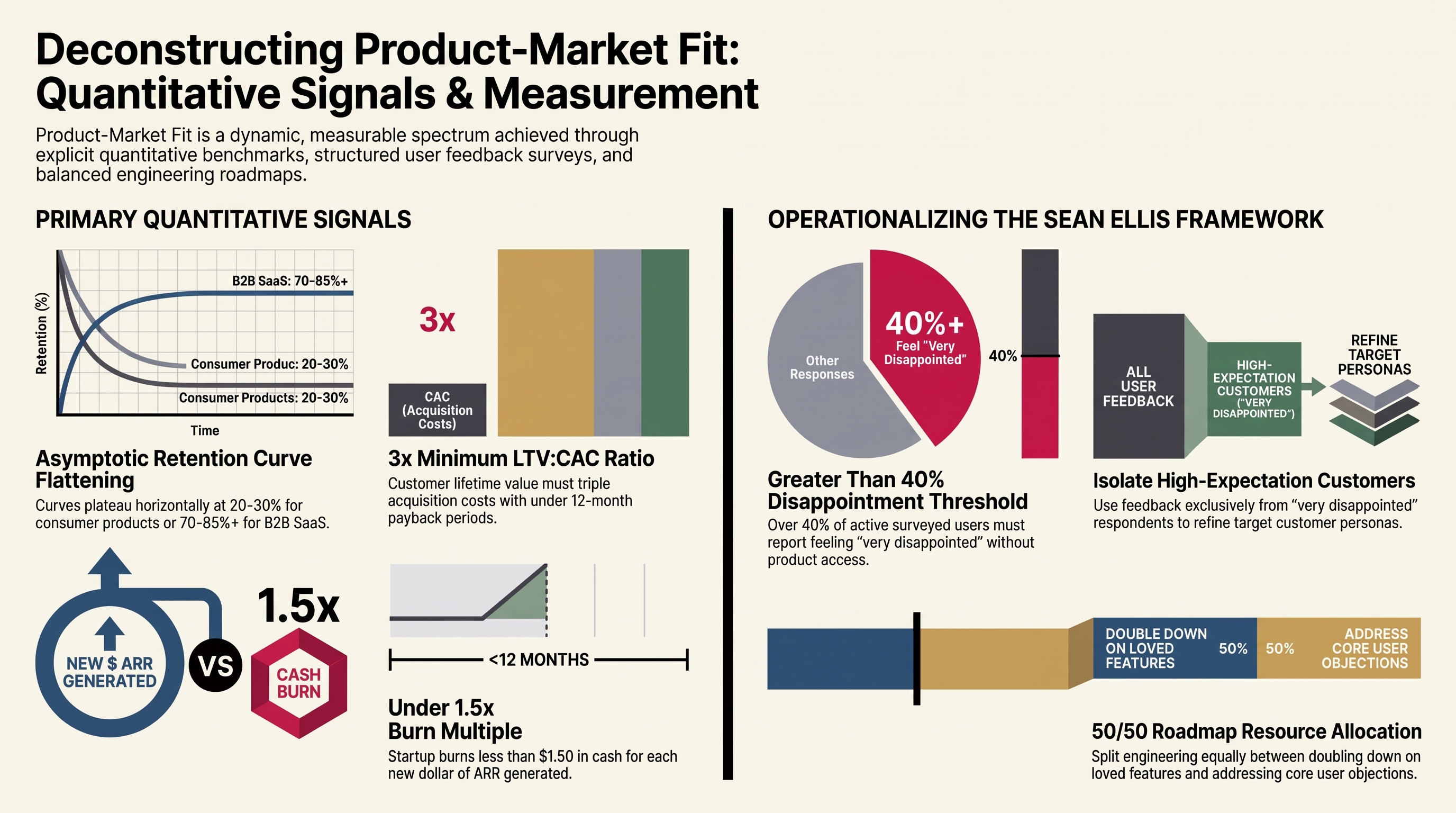
Product-Market Fit (PMF) is the degree to which a product satisfies strong market demand. It is the essential prerequisite for any company attempting to scale: attempting to scale before achieving PMF is the leading cause of premature scaling and startup failure.
🗂️ Interactive Notebook: Open Study Companion (Video Summary, Flashcards, Mind Map) ↗
Product-Market Fit (PMF) is often treated as a binary milestone—either you have it or you do not—but in practice, it operates as a dynamic, measurable spectrum of alignment between target customers, their underserved problems, the product's core value proposition, and scalable distribution channels. Analyzing PMF systematically requires examining the quantitative mechanics of cohort retention, operational frameworks for discovering and manufacturing fit, and multi-dimensional company-building models.
1. Deconstructing the Quantitative Signals of PMF
While Marc Andreessen's qualitative description ("customers buying as fast as you can make it") captures the feeling of extreme market pull, most founders and product leaders navigate a ambiguous middle ground where intuition can be misleading. Quantitative verification relies on three primary pillars:
Cohort Retention Curves (The Definitive Benchmark)
Evaluating Product-Market Fit requires measuring cohort retention rather than vanity acquisition metrics. Specifically, the definitive quantitative signature is asymptotic flattening. When tracking the percentage of active users (Y-axis) over time since onboarding (X-axis) across discrete cohorts:
- No PMF: The retention curve slopes steadily downward until it approaches 0%. Channel spend or top-of-funnel acquisition into a product lacking retention simply fills a leaky bucket.
- True PMF: After an initial drop-off of casual users, the curve flattens out parallel to the X-axis. The height of the asymptote depends on business model and vertical (e.g., 20%–30% for consumer social, 70%–85%+ for enterprise B2B SaaS), but the horizontal plateau proves an indispensable core user base has been established.
- Smile Graph (Negative Churn): In premier software products (such as Slack or Figma), the curve eventually bends upward as dormant users reactivate via network effects or account expansion (seat additions, tier upgrades) outpaces logo churn.
Unit Economics and Capital Efficiency
When authentic PMF is achieved, operational metrics transition from pushing an uphill value proposition to accommodating organic market pull:
- LTV:CAC Ratio: Customer Lifetime Value (LTV) should exceed Customer Acquisition Cost (CAC) by at least 3:1, accompanied by a CAC payback period under 12 months (and under 6 months for hyper-efficient software models).
- Net Dollar Retention (NDR): For subscription and B2B models, an NDR greater than 100% confirms that expansion revenue from existing accounts outpaces revenue lost to downgrades and cancellations.
- The Burn Multiple: Formulated by David Sacks, this evaluates cash burned relative to net new Annual Recurring Revenue:
A Burn Multiple under 1.5x indicates organic product pull and operational leverage, whereas figures exceeding 2.0x indicate that growth is being artificially manufactured through subsidized acquisition.
2. Operationalizing the Sean Ellis Test (The Superhuman Framework)
The quantitative benchmark established by Sean Ellis defines strong PMF when 40% or more of surveyed users state that they would be "very disappointed" if the product disappeared tomorrow. However, the operational power of the survey lies not merely in taking a static pass/fail temperature check, but in using it as a systematic engine to manufacture PMF, as codified by Rahul Vohra at Superhuman:
- Survey Active Users: Send a targeted four-question survey to users who have experienced the core product at least twice in the past two weeks:
- How would you feel if you could no longer use [Product]? (Very disappointed / Somewhat disappointed / Not disappointed)
- What type of people do you think would most benefit from [Product]?
- What is the main benefit you receive from [Product]?
- How can we improve [Product] for you?
- Isolate High-Expectation Customers (HXC): Disregard feedback from "not disappointed" respondents—attempting to appease indifferent users compromises product focus. Focus instead on the "very disappointed" cohort: their answers to Question 2 reveal the precise profile of the ideal customer, as delighted users naturally describe their own roles and workflows.
- Analyze Aligned "Somewhat Disappointed" Users: Filter the "somewhat disappointed" segment to examine only those whose perceived benefit (from Question 3) aligns with what the HXC group loves. Their responses to Question 4 uncover the exact missing integrations, onboarding barriers, or performance bottlenecks holding them back from full advocacy.
- Allocate the Engineering Roadmap: Allocate product development capacity symmetrically:
- 50% of roadmap capacity: Double down on what "very disappointed" users love, cementing the core differentiation.
- 50% of roadmap capacity: Systematically resolve the high-impact objections of the aligned "somewhat disappointed" cohort.
3. Dan Olsen’s Product-Market Fit Pyramid
Why do products fail to achieve PMF? Product strategist Dan Olsen structures PMF as a five-layer hierarchical model divided between The Market (external market realities that cannot be controlled, only chosen) and The Product (internal execution within the team's control):
| Layer | Category | Core Question to Validate | Common Failure Mode |
|---|---|---|---|
| 5. UX (User Experience) | Product | Can the user effortlessly navigate features to realize the core value? | Complex onboarding or confusing UI obscures a genuinely valuable feature set. |
| 4. Feature Set | Product | Does the functional scope deliver reliably on the promised outcome? | Bloating the MVP with peripheral features instead of perfecting the core workflow. |
| 3. Value Proposition | Bridge | How does the product outperform existing alternatives? | Delivering a marginal 10% incremental gain rather than a 10x improvement over the status quo. |
| 2. Underserved Needs | Market | Is the target pain point acute, frequent, and poorly resolved? | Formulating a "vitamin" (convenience) rather than an urgent "painkiller." |
| 1. Target Customer | Market | Who specifically experiences this problem and possesses purchasing authority? | Defining customer personas too broadly (e.g., "small businesses" vs. "independent dental practices"). |
When diagnosing product stagnation or planning pivots, teams must identify which layer of the pyramid is misaligned. Refining visual UI or onboarding (Layer 5) cannot salvage a business if the chosen customer segment has no urgent, underserved pain (Layers 1 and 2).
4. Beyond PMF: Brian Balfour’s Four Fits Framework
Securing Product-Market Fit does not by itself guarantee a resilient, venture-scale enterprise. Growth strategist Brian Balfour contends that scaling requires four interlocking structural fits that co-evolve:
- Market-Product Fit: Validating market demand and acute pain before designing the product to solve it.
- Product-Channel Fit: Engineering the product to fit specific distribution channels (e.g., viral loops, programmatic SEO, product-led expansion), rather than treating marketing as an external add-on.
- Channel-Model Fit: Aligning customer acquisition channels with the pricing model (Average Revenue Per User, ARPU). Products with an ARPU of $20/year require zero-touch viral or organic distribution, whereas enterprise software commanding $100,000/year justifies outbound direct sales teams.
- Model-Market Fit: Verifying that total addressable customers multiplied by realistic market capture and pricing yields a sustainable business:
5. Why Product-Market Fit Is Dynamic
A frequent strategic error is treating Product-Market Fit as a permanent milestone. In reality, PMF is subject to natural decay and erosion driven by three forces:
- Platform and Paradigm Shifts: Macro-technological transitions alter customer expectations and render legacy workflows obsolete (e.g., generative AI automating manual SaaS workflows).
- Competitive Saturation: Rapid imitation by competitors turns unique differentiators into baseline table stakes, compressing margins and customer retention.
- Audience Dilution: Moving across Geoffrey Moore's chasm from visionary early adopters to pragmatic mainstream buyers exposes new friction around compliance, reliability, and ecosystem integrations—a product with strong fit among early adopters can experience negative fit with the early majority.
🎴 Interactive Web Practice (Comprehension Check)
Question 1 (Core Concept): Why is attempting to scale a business before achieving Product-Market Fit (PMF) considered the leading cause of startup failure?
Answer: Attempting to scale prematurely commits capital and resources to acquiring users before the product has demonstrated sustained, repeatable value. Without strong retention and organic customer pull, aggressive expansion accelerates cash burn and magnifies operational inefficiencies rather than driving sustainable, decoupled growth.
Question 2 (Measurement & Metrics): How does the Sean Ellis test quantitatively evaluate Product-Market Fit, and why is retention favored over top-of-funnel acquisition?
Answer: The Sean Ellis test asks existing users how they would feel if they could no longer use the product; if 40% or more respond that they would be "very disappointed," the product has achieved strong PMF. Retention is prioritized over acquisition (such as downloads or signups) because vanity metrics can be artificially inflated through paid marketing, whereas durable cohort retention proves that the product solves an acute, ongoing need and delivers defensible value.
Question 3 (Strategic Transition): What constitutes the "Pre-PMF Trap," and how does a company's operational focus pivot once authentic Product-Market Fit is confirmed?
Answer: The "Pre-PMF Trap" involves mistaking transient spikes in interest, launch press, or isolated early sales for true market validation. Authentic PMF exhibits sustained cohort retention, shortened sales cycles, and organic customer pull. Once confirmed, the operational focus pivots from exploratory discovery, customer interviews, and lean iteration to execution, infrastructure investment, and process standardization to support efficient scaling.
Question 4 (Behavioral Signals): What operational and qualitative indicators distinguish genuine Product-Market Fit from manufactured or paid traction?
Answer: Authentic PMF is characterized by organic market pull rather than push acquisition: inbound word-of-mouth referrals, compressed sales cycles with minimal objection handling, high cohort retention, and usage metrics that outpace marketing expenditures. When PMF is present, operational constraints typically shift from demand generation to delivery capacity (such as server bandwidth or production volume).
Question 5 (Discovery & Interview Methodology): Why is asking customers "What would you do if this product didn't exist?" structurally superior to asking for feature requests or general satisfaction?
Answer: General satisfaction and feature requests often elicit polite, speculative, or non-committal feedback that inflates false optimism. In contrast, evaluating a user's alternative options tests whether the product addresses an acute, indispensable pain point; if users report that they would be genuinely stranded or forced into painful workarounds, the value proposition is defensible and mission-critical.
Question 6 (Iteration vs. Pivoting): What diagnostic threshold should prompt a team to execute a pivot rather than continuing incremental product iterations?
Answer: If systematic iterations on the MVP fail to produce an upward shift in cohort retention and users remain indifferent (scoring below 25% on the Sean Ellis test), the core problem-solution hypothesis is likely invalid. Rather than continuing incremental refinements to an unviable value proposition, the team must execute a pivot—redefining the target customer segment or fundamentally realigning the core solution to address a verified market need.
Related Notes
- Difference Between Growth and Scaling — The foundational conceptual and operational distinction between linear resource expansion and exponential scale.
- Difference Between UI and UX Design — How information architecture, user journeys, and iterative usability testing shape product adoption.
- DM - Strategy — Core principles of customer segmentation, competitive positioning, and value proposition design.
- PM - Agile Methodology — Iterative sprint planning, minimum viable products (MVPs), and discovery feedback loops.
- The Diffusion of Innovations Theory — Framework for navigating technology adoption lifecycles and crossing the chasm from early adopters to the pragmatic mainstream.
References
- Andreessen, Marc — The Only Thing That Matters / PMArchive
- Balfour, Brian — Why Product-Market Fit Isn't Enough / Reforge
- Ellis, Sean & Brown, Morgan — Hacking Growth: How Today's Fastest-Growing Companies Drive Breakout Success / Crown Business
- Maurya, Ash — Running Lean: Iterate from Plan A to a Plan That Works / O'Reilly Media
- Olsen, Dan — The Lean Product Playbook: How to Innovate with Minimum Viable Products and Rapid Customer Feedback / Wiley
- Ries, Eric — The Lean Startup: How Today's Entrepreneurs Use Continuous Innovation to Create Radically Successful Businesses / Crown Business
- Vohra, Rahul — How Superhuman Built an Engine to Find Product-Market Fit / First Round Review