Ernest Becker
Ernest Becker (September 27, 1924 – March 6, 1974) was an American cultural anthropologist and interdisciplinary social theorist whose work achieved a monumental synthesis of existential philosophy, psychoanalytic depth psychology, and sociological theory.[1] He is best known for his 1973 masterwork, The Denial of Death, which was awarded the Pulitzer Prize for General Nonfiction posthumously in 1974.[1:1] Becker posited that the primary motivating engine of human civilization, social organization, and psychological pathology is the unconscious effort to overcome the paralyzing dread of mortality through symbolic immortality projects (causa sui).[2]
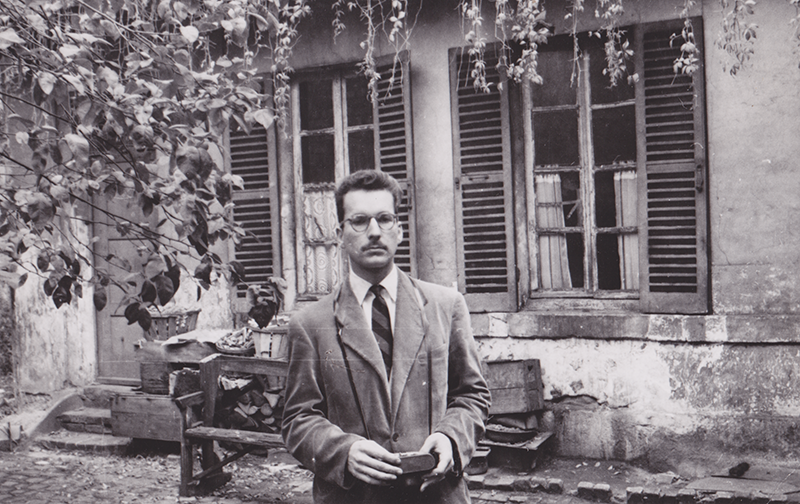
Core Thesis: Ernest Becker posited that human beings exist within an unbearable existential paradox: we possess a god-like symbolic consciousness capable of imagining infinity and desiring cosmic significance, yet we are irrevocably chained to a creaturely, decaying, animal body doomed to biological death. To prevent this terror of finitude from inducing madness or paralysis, individuals and cultures construct elaborate "vital lies" and symbolic hero-systems (causa sui)—including religion, art, nationhood, wealth, and romantic partnerships. When rival cultural immortality projects collide, the result is human evil, tribal violence, scapegoating, and catastrophic warfare.
Biographical Overview & Academic Trajectory
Becker's intellectual trajectory was characterized by intense institutional resistance, stemming from his refusal to submit to the narrow methodological specialization and quantitative positivism of post-World War II social sciences.[3]
Early Life, Military Trauma, and Camp Liberation
Born in Springfield, Massachusetts, to Jewish immigrant parents, Becker served in the United States Army infantry in the European Theater during World War II.[1:2] During his service, he participated in the liberation of a Nazi concentration camp (a subcamp of Buchenwald near Nordhausen).[3:1] Confronting the unmitigated horrors of industrialized genocide, piles of skeletal corpses, and the raw capacity of human beings to murder out of ideological fanaticism scarred Becker permanently. This wartime encounter became the existential catalyst for his life's inquiry: why do humans inflict cruelty, and how do collective symbolic beliefs compel ordinary people to engage in mass slaughter?[3:2]
Following the war, Becker worked at the U.S. Embassy in Paris for several years before returning to the United States to pursue graduate education at Syracuse University. He completed his Ph.D. in Cultural Anthropology in 1960, having already begun to synthesize anthropology with psychiatry and existential philosophy.[1:3]
Institutional Alienation and Academic Nomadism
Throughout the 1960s, Becker challenged the academic establishment by insisting that the social sciences should form a morally engaged "science of man" aimed at liberating humanity from alienation and self-destruction.[4] His passion made him extraordinarily popular among students, but his interdisciplinary contempt for disciplinary silos provoked administrative hostility:
| Academic Institution | Tenure | Disciplinary Setting | Pedagogical Focus & Institutional Friction |
|---|---|---|---|
| SUNY Upstate Medical Center | 1960–1963 | Department of Psychiatry | Taught psychiatric anthropology; partnered with anti-psychiatry pioneer Thomas Szasz. Resigned in principled protest when medical administrators violated Szasz's academic freedom and suppressed critical psychiatric debate.[3:3] |
| Syracuse University & UC Berkeley | 1963–1967 | Department of Anthropology | Addressed auditoriums of over 1,000 students at Berkeley, weaving together Shakespeare, Søren Kierkegaard, and Sigmund Freud. Denied tenure when senior faculty dismissed his lectures as "unscientific, overly emotional, and literary."[3:4] |
| San Francisco State College | 1967–1968 | Social Psychology | Revered by student activists during the peak of the Free Speech and Anti-War movements. Resigned in outrage when Governor Ronald Reagan dispatched armed National Guard forces to occupy the campus.[3:5] |
| Simon Fraser University | 1969–1974 | Department of Political Science, Sociology, and Anthropology | Welcomed to Vancouver, British Columbia, where he authored his mature crowning works (The Denial of Death, Escape from Evil). Diagnosed with advanced colon cancer in 1972, he worked tirelessly until his death in 1974 at age 49.[1:4] |
The Final Dialogue: Sam Keen and the Deathbed Interview
In late 1973, while bedridden at the Burnaby General Hospital in Vancouver, Becker conducted a renowned final interview with philosopher Sam Keen for Psychology Today (later titled The Heroics of Everyday Life).[3:6] Experiencing his own bodily dissolution firsthand while discussing The Denial of Death, Becker demonstrated absolute philosophical integrity. He argued that the true measure of courage is not stoic invulnerability, but the capacity to surrender one's defenses, acknowledge creatureliness, and embrace the trembling mystery of existence without retreating into violent collective dogmas.[3:7]
Intellectual Foundations: The Transdisciplinary Synthesis
Becker sought to fulfill the Enlightenment vision of a unified "science of man" by reconciling existentialism, psychoanalysis, and critical sociology.[4:1]
| Intellectual Ancestor | Core Concept Borrowed | Becker's Thanatological Synthesis |
|---|---|---|
| Søren Kierkegaard (Existential Dread & Angst) | The "vertigo of freedom" and objectless existential anxiety arising from awareness of finitude in an infinite cosmos.[2:1] | Identifies Kierkegaard as the preeminent psychologist of modernity; translates Kierkegaardian Angst into the developmental horror of physical death and bodily decay.[2:2] |
| Otto Rank (The Vital Lie & The Hero) | Neurosis as a failure of creative symbolization; the psychological indispensability of the vital lie (Lebenslüge) to endure reality.[2:3] | Centers Rank over Freud; frames mental health as the construction of life-affirming illusions and culture as a codified arena for symbolic heroism.[2:4] |
| Sigmund Freud (Repression & Defense Mechanisms) | The unconscious, defense mechanisms, and transference as filters against intolerable instinctual drives.[2:5] | Rejects Freud's pan-sexual libido and Oedipal reductionism; reinterprets repression not as sexual shame, but as a terror-management shield against bodily finitude.[2:6] |
| Norman O. Brown (Somatic Corporeality) | The ontological war between bodily instincts and disembodied culture (Life Against Death, 1959).[2:7] | Highlights how animal functions (excretion, decay, disease) shatter symbolic vanity, driving the ego into frantic thanatological denial.[2:8] |
| Arthur Schopenhauer (Metaphysics of Will) | The blind, insatiable will to live clashing against the inevitability of suffering and physical dissolution.[2:9] | Provides the philosophical basis for humanity's insatiable hunger for permanence in an ephemeral material universe.[2:10] |
                      [ SØREN KIERKEGAARD ]
                   Existential Angst & Freedom
                               │
                               ▼
[ OTTO RANK ] ────────► [ ERNEST BECKER ] ◄──────── [ SIGMUND FREUD ]
The "Vital Lie" &       The Denial of Death          Repression & Unconscious
Creative Heroism         & Escape from Evil           Defense Mechanisms
                               ▲
                               │
                      [ NORMAN O. BROWN ]
                   Corporeality & Animal Decay
1. Søren Kierkegaard and the Anatomy of Dread
Becker considered Danish philosopher Søren Kierkegaard the supreme diagnostician of the human psyche.[2:11] In The Concept of Anxiety (1844) and The Sickness Unto Death (1849), Kierkegaard analyzed Angst—not as a medical pathology, but as the inevitable ontological condition of an entity caught between the temporal and the eternal, the finite and the infinite.[2:12] Becker secularized Kierkegaard's framework: dread is the direct consequence of human self-consciousness waking up to its own inevitable annihilation.
2. Otto Rank: The Master Key to Becker's Thought
The Austrian psychoanalyst Otto Rank—once Freud's favored disciple who broke with the Vienna Psychoanalytic Society following the publication of The Trauma of Birth (1924)—provided the cornerstone for Becker's mature anthropology.[2:13] In masterpieces such as Art and Artist (1932) and Will Therapy (1936), Rank argued that neurosis is not a sexual malfunction, but an existential failure of the creative will.[2:14]
Rank introduced the vital concept of the "Vital Lie" (Lebenslüge), showing that unmediated truth is toxic to the human psyche; without protective illusions, consciousness collapses under the weight of cosmic insignificance.[2:15] Becker elevated Rank's insight to a universal civilizational law: all cultural institutions, monuments, and systems of belief are collective vital lies designed to make biological life livable.
3. Freud Reclaimed and De-Sexualized
While Becker acknowledged Sigmund Freud's genius in mapping the unconscious, repression, and defense mechanisms, he firmly rejected Freud's biological pan-sexualism.[2:16] Becker argued that the child's primary developmental crisis is not the repressed incestuous desire for the parent, but the terrifying realization of vulnerability, physical helplessness, and mortal contingency.[2:17] Repression does not exist to hide forbidden sexual drives from the Superego; it operates as an evolutionary anxiety buffer that keeps the conscious mind from being paralyzed by the ever-present specter of death.[2:18]
4. Norman O. Brown and the Anality Complex
From Norman O. Brown's Life Against Death (1959), Becker integrated the somatic dimension of thanatology. Brown demonstrated that civilization represents a sublimation of repressed bodily mortality.[2:19] Becker expanded Brown's analysis of the "anality complex": feces, urine, menstruation, sweat, and visceral decay serve as unceasing physiological evidence that humanity belongs to the animal kingdom, puncturing our cultural fantasies of divine transcendence.[2:20]
Core Theoretical Architecture
The Existential Paradox: "Gods with Anuses"
The foundational axiom of Becker's anthropology is the irreconcilable ontological schism at the core of human nature.[2:21]
"Man is literally split in two: he has an awareness of his own splendid uniqueness in that he sticks out of nature with a towering majesty, and yet he goes back into the ground a few feet in order to blindly and dumbly rot and disappear forever... Man is a creator with the mind of a god, and a body of a worm."[2:22]
Human beings are cursed with symbolic self-awareness. Through language, imagination, and conceptual thought, we contemplate eternity, project into the infinite future, and construct empires of meaning.[2:23] Yet this god-like mind is imprisoned inside a decaying animal vessel that must feed, excrete, age, bleed, and decompose.[2:24] Becker summarized this grotesque dualism with the uncompromising phrase "gods with anuses."
| Analytical Dimension | The Symbolic Self (The "God") | The Creaturely Body (The "Worm") |
|---|---|---|
| Ontological Realm | Meaning, ideation, language, culture, ethics, and art.[2:25] | Organic tissue, metabolic cells, blood, viscera, and entropy.[2:26] |
| Temporal Horizon | Eternal time, historical memory, and enduring legacy.[2:27] | Linear physical deterioration and unavoidable mortality.[2:28] |
| Psychological Motivation | Autonomy, heroic transcendence, and symbolic immortality (causa sui).[2:29] | Homeostasis, caloric intake, physical excretion, and reproduction.[2:30] |
| Primary Vulnerability | Meaninglessness, cognitive dissonance, and ideological invalidation.[2:31] | Sickness, senescence, physical agony, and biological decomposition.[2:32] |
The "Vital Lie" of Character and Neurosis
Because constant awareness of this paradox would induce incapacitating panic, the mind must deaden its perception of reality.[2:33] To survive, every human infant constructs what Becker termed the "vital lie" of character—an armor of habits, social roles, defenses, and reflexive responses that filter out cosmic dread.[2:34]
In Becker's view, normal character is itself a socially sanctioned form of neurosis:
- The "Normal" (Adapted) Neurotic: The average person manages existential terror by surrendering autonomy to the dominant cultural hero-system. They submerge themselves in routine, mortgage payments, status games, and civic duty, numbing themselves to the absurdity of existence.[2:35]
- The Clinical Neurotic (The Failed Artist): The neurotic is an individual whose character armor has broken down. Possessing excessive lucidity, they see through the arbitrary illusions of society but lack the creative capacity or courage to fashion a working personal hero-system.[2:36] Overwhelmed by raw reality, their will turns inward, generating debilitating somatic and psychiatric symptoms as a localized, artificial defense against cosmic dread.[2:37]
| Personality Structure | Interaction with the "Vital Lie" | Existential Status & Behavioral Manifestation |
|---|---|---|
| The Adapted Type | Blindly embraces cultural scripts; accepts collective illusions as literal truth.[2:38] | Functionally "sane" and socially productive, but living an inauthentic, unexamined existence.[2:39] |
| The Clinical Neurotic | Sees through societal illusions; unable to sustain the vital lie, yet paralyzed by terror.[2:40] | Isolates the self; constructs localized obsessive symptoms to shrink reality to a manageable panic.[2:41] |
| The Creative Artist | Acknowledges the abyss; actively crafts original symbolic structures and works.[2:42] | Channels mortal anxiety into lasting cultural objects; risks isolation and psychic collapse.[2:43] |
The Causa Sui Project and Cultural Hero-Systems
Humans do not merely want to avoid pain; we demand cosmic significance. Becker argued that the urge toward heroism is the primary driver of human psychology.[2:44] Every person seeks validation that their life represents an enduring, primary value in the cosmic order.
Borrowing the Spinozistic and psychoanalytic concept of causa sui ("cause of oneself"), Becker explained that humans attempt to become their own creators.[2:45] By achieving cultural distinction, we strive to cut our umbilical cord to animal biology and establish a symbolic self that will outlive the grave:
| Immortality Domain | Primary Mechanism | Societal and Behavioral Manifestations |
|---|---|---|
| Theological / Sacred | Transcending biological death via metaphysical salvation, karmic rebirth, or divine grace.[2:46] | Institutional religion, liturgical sacrifice, prayer, sacred pilgrimages, monastic discipline. |
| Biological / Patronymic | Perpetuating the self through genetic lineages, familial names, and ancestral inheritance.[2:47] | Dynastic succession, family crests, generational estates, tribal continuity. |
| Creative / Intellectual | Creating masterpieces, scientific theories, or philosophical systems that withstand time.[2:48] | Monumental art, literature, architecture, patent innovations, academic tenure. |
| Ideological / Political | Merging the fragile individual identity into the eternal body of an empire, state, or party.[5] | Nationalistic fanaticism, flag veneration, military martyrdom, monuments to the state. |
| Material / Commercial | Amassing capital, physical property, and commercial luxury as an armor against fragility.[5:1] | Corporate acquisitions, conspicuous consumption, brand prestige, philanthropic foundations. |
The Romantic Transference: When the Lover Becomes God
With the secularization of the modern West and the collapse of transcendent religious frameworks, Becker observed that the individual was stranded without a cosmic audience.[2:49] Consequently, modern humans attempt to solve the existential crisis through romantic love—a phenomenon Becker termed the "Romantic Transference."[2:50]
The Cosmic Burden of Love: Modern secular humans load the romantic partner with the impossible spiritual demand that used to be directed toward God. We demand that our lover redeem our existence, justify our sacrifices, forgive our inadequacies, and guarantee our symbolic immortality.[2:51] Because no mortal, defective human being can bear the cosmic weight of divinity, romantic transference inevitably collapses into disillusionment, resentment, domestic tyranny, and bitter divorce.[2:52]
The Anatomy of Human Evil: War, Scapegoating, and Money (Escape from Evil)
In his posthumous treatise, Escape from Evil (1975), Becker applied his thanatological model to the macro-sociological phenomena of war, genocide, systemic exploitation, and economic accumulation.[5:2]
Becker's central philosophical breakthrough is the realization that the greatest horrors of human history are not caused by animal bestiality or sadistic malice, but by the desperate human drive for righteousness, purity, and symbolic immortality.[5:3]
[ CONFLICTING IMMORTALITY PROJECTS ]
                 │
                 ▼
[ TERROR: Exposure of One's "Vital Lie" as Fictional ]
                 │
                 ▼
[ PROJECTION: Demonization & Dehumanization of the "Other" ]
                 │
                 ▼
[ RITUAL PURGING: War, Scapegoating, and Annihilation ]
(By destroying the enemy's body, our immortality is preserved)
- The Clash of Immortality Projects: Because cultural hero-systems are arbitrary symbolic illusions, the mere physical existence of another group practicing an alien religion or ideology threatens to reveal our own immortality project as a fictional contrivance.[5:4] To protect our psychological shield against non-being, we feel an overwhelming compulsion to delegitimize, convert, or physically exterminate the ideological outsider.[5:5]
- Scapegoating as Thanatological Transfer: Societies manage internal guilt, physical disease, and death-anxiety by selecting a designated "scapegoat" (ethnic minorities, political dissidents, heretics). By projecting our animal frailty and moral impurity onto the scapegoat and ritualistically destroying them, the collective feels renewed, purified, and cosmically triumphant.[5:6]
- War as a Sacramental Exorcism: Modern war is a ritualized mass sacrifice wherein nations slaughter millions not primarily for pragmatic resource gain, but to defeat death symbolically. In war, the soldier feels merged with an immortal state; by inflicting death upon the enemy, the warrior feels magically insulated from dying.[5:7]
- Money as the Sacramental Token of Immortality: Becker analyzed money not merely as an economic medium of exchange, but as a magical, sacred energy. Capital does not rot, bleed, or age; it confers absolute power, commands the labor of others, and survives the biological demise of its owner. In capitalist modernity, wealth accumulation functions as the supreme secular immortality shield.[5:8]
Major Works & Systematic Bibliography
Becker's oeuvre documents a continuous intellectual progression from psychiatric anthropology and educational reform to an all-encompassing philosophy of civilization, evil, and death.[4:2]
| Title | Year | Disciplinary Focus | Core Theoretical Argument & Historical Legacy |
|---|---|---|---|
| The Birth and Death of Meaning | 1962 (2nd ed. 1971) | Interdisciplinary Anthropology & Social Psychology | Establishes the linguistic and symbolic foundations of the ego, demonstrating how self-esteem functions as a socially learned anxiety shield.[4:3] |
| The Revolution in Psychiatry | 1964 | Critical Psychiatry & Social Epistemology | Conceptualizes psychiatric disorders (depression, schizophrenia) as social failures of action and meaning rather than biological brain defects.[6] |
| Beyond Alienation | 1967 | Educational Philosophy & Social Theory | Proposes a radical, interdisciplinary university curriculum designed to cultivate moral wisdom and counter bureaucratic technocracy.[6:1] |
| The Structure of Evil | 1968 | Intellectual History & Sociology of Knowledge | Traces the Enlightenment quest from Giambattista Vico and Jean-Jacques Rousseau to Marx and Kierkegaard for an integrated "science of man."[4:4] |
| Angel in Armor | 1969 | Cultural Psychoanalysis & Literary Criticism | Examines character armor, psychological fetishes, and the existential burdens placed on modern romantic love through literary analysis.[6:2] |
| The Lost Science of Man | 1971 | Critical Sociology & History of Anthropology | Diagnoses why 20th-century social sciences fractured into sterile quantitative specializations, abandoning their moral human mission.[6:3] |
| The Denial of Death | 1973 | Existential Anthropology & Depth Psychology | Becker's magnum opus; synthesizes Kierkegaard, Freud, and Rank to formulate the causa sui project, the vital lie, and the paradox of human duality.[2:53] |
| Escape from Evil | 1975 | Posthumous Political Sociology & Macro-Thanatology | Applies the thanatological thesis to money, property, ritual warfare, scapegoating, and state genocide as collective rituals to conquer mortality.[5:9] |
Legacy, Empirical Operationalization, and Contemporary Reach
While mainstream cultural anthropology in the 1970s was dominated by structuralism and empirical fieldwork that largely ignored Becker's sweeping existential claims, his work sparked a profound revolution across experimental social psychology, palliative care, and cultural sociology.[3:8]
Terror Management Theory (TMT)
In 1986, experimental social psychologists Sheldon Solomon, Jeff Greenberg, and Tom Pyszczynski formulated Terror Management Theory (TMT) to translate Becker's philosophical insights into testable laboratory hypotheses.[7] Over four decades, TMT has generated more than 1,000 empirical, peer-reviewed studies across dozens of countries, validating Becker's core assertions through rigorous quantitative paradigms:[7:1]
| TMT Core Hypothesis | Experimental Laboratory Paradigm | Behavioral and Cognitive Outcome |
|---|---|---|
| Mortality Salience (MS) Hypothesis | Priming participants with thoughts of their own death (e.g., writing essays about dying, subliminal death words, proximity to cemeteries).[7:2] | Triggers aggressive cultural worldview defense: elevated ingroup favoritism, severe moral judgment against transgressors, and hostility toward foreigners.[7:3] |
| Anxiety-Buffer Hypothesis | Experimentally bolstering an individual's self-esteem or validating their cultural worldview before presenting a threat.[7:4] | Eliminates the spike in death anxiety, physiological stress arousal, and defensive outgroup hostility following mortality reminders.[7:5] |
| Death-Thought Accessibility (DTA) | Threatening an individual's cultural belief system, religious dogmas, or self-worth.[7:6] | Subconscious death thoughts become immediately accessible in implicit memory tests (e.g., completing COFF_ _ as COFFIN rather than COFFEE).[7:7] |
Clinical and Cultural Impact: Becker's insights form the foundational bedrock of Existential Psychotherapy, particularly through the clinical writings of Irvin D. Yalom and Viktor Frankl. In cinematic arts, director Woody Allen repeatedly translates Beckerian existential dread into tragicomedy—most visibly in The Existential Paradox of Annie Hall's Opening Monologue, where intellectual posturing, artistic legacy, and hypochondriacal fixations operate as frantic comedic armor against somatic decay.[3:9] The Ernest Becker Foundation, based in Seattle, Washington, continues to facilitate international multidisciplinary scholarship on death anxiety, palliative medicine, and conflict resolution.[1:5]
Scholarly Criticisms & Contemporary Resolutions
Despite its explanatory brilliance, Becker's framework has encountered significant philosophical and empirical scrutiny:
| Critical Objection | Scholarly Source | Theoretical Substance of Critique | Contemporary Defense / Resolution |
|---|---|---|---|
| Pan-Thanatological Monocausality | Humanistic & Evolutionary Psychology | Accused of replacing Freud's pan-sexual reductionism with a pan-death reductionism, ignoring intrinsic exploratory, play, and altruistic motives.[3:10] | Becker acknowledged basic mammalian drives, but demonstrated that cognitive foresight of death supercharges and organizes all higher symbolic motivations.[2:54] |
| Western & Androcentric Bias | Feminist Philosophy & Post-Colonial Studies | The quest for solitary causa sui heroic triumph reflects Western, individualistic, patriarchal values, downplaying communal, relational, and indigenous worldviews.[3:11] | Cross-cultural TMT experiments prove that while the content of hero-systems varies (communal harmony vs. individual glory), the anxiety-buffering function remains universal.[7:8] |
| Empirical Falsifiability Concerns | Analytical Philosophy & Positivism | Positing that calm individuals are merely "repressing" mortal terror creates a potentially unfalsifiable psychoanalytic loop.[7:9] | Directly resolved by TMT researchers, who operationalized unconscious Death-Thought Accessibility (DTA) through double-blind, computer-masked cognitive testing.[7:10] |
🎴 Interactive Web Practice (Comprehension Check)
Question 1 (The Existential Paradox & Dualism): What does Ernest Becker mean by characterizing humanity as "gods with anuses," and how does this ontological paradox drive human culture?
Answer: Becker uses the phrase "gods with anuses" to capture the tragic dualism of human existence: humans possess an abstract, symbolic consciousness capable of imagining eternity, producing art, contemplating the cosmos, and desiring infinite significance (the "god"), while simultaneously being trapped inside an animal body subject to visceral excretion, disease, decay, and inevitable biological death (the "anus/worm").
Because the human mind cannot endure the terror of this paradox—that a being of cosmic self-awareness will rot and disappear forever—culture emerges not merely as a pragmatic system for physical survival, but as a codified "immortality system." Culture provides symbolic structures (religions, nations, art, wealth) that allow the mortal individual to construct a symbolic self (*causa sui*) that feels eternal, transcendent, and detached from animal corporeality.
Question 2 (The "Vital Lie" of Character & Otto Rank's Typology): How did Otto Rank's concept of the "vital lie" (*Lebenslüge*) influence Becker's understanding of mental health and neurosis?
Answer: Otto Rank demonstrated that unmediated truth is toxic to human psychology: to function without succumbing to persistent existential dread, every human being requires protective illusions, or "vital lies." Following Rank, Becker re-evaluated mental health not as the possession of pure objective truth, but as the ability to sustain convincing, life-affirming illusions.
In Rank and Becker's typology:
- The Adapted (Normal) Person: Successfully adopts the ready-made vital lies provided by society (careerism, consumerism, social roles) and lives an unreflective life validated by the crowd.
- The Neurotic (Failed Artist): Possesses too much lucidity to buy into conventional cultural illusions, but lacks the creative will to build a sustainable personal hero-system. Paralyzed by the raw terror of existence, their will turns inward, generating obsessive symptoms as a localized defense.
- The Creative Artist: Acknowledges the existential abyss and consciously channels mortal dread into original, transformative symbolic works without relying on unconscious societal conformity.
Question 3 (The Secular Crisis & The Romantic Transference): Why does modern secular society place an unprecedented and destructive existential burden on romantic relationships, according to Becker?
Answer: Becker argued that historical human beings looked to transcendent religious frameworks to provide cosmic validation and guarantee personal significance beyond the grave. With the rise of the Enlightenment and the death of traditional religious mythologies, modern secular individuals were left without a divine audience to redeem their lives.
In the absence of God, modern humans engage in the "Romantic Transference," transferring their hunger for cosmic justification onto a mortal partner. We demand that our romantic partner become our private savior, justifying our sacrifices, alleviating our existential isolation, and proving that our lives matter in the cosmos. Because no mortal, flawed human being can shoulder the burden of being another person's deity, this dynamic inevitably collapses into disillusionment, control, mutual resentment, and emotional ruin.
Question 4 (The Anatomy of Evil & Posthumous Sociology): In Escape from Evil, why does Becker assert that human violence and warfare are paradoxically driven by life-affirmation rather than innate cruelty?
Answer: Becker overturns the conventional psychological assumption that war, genocide, and tribal violence stem from innate animal bloodlust or sadistic savagery. Instead, Becker argues that human evil is rooted in humanity's desperate urge to conquer death and protect symbolic immortality projects.
Because cultural hero-systems are symbolic fictions ("vital lies"), the existence of a rival group with different gods, morals, or ideologies directly threatens to unmask our own system as an arbitrary illusion, triggering existential panic. To defend our psychological shield against non-being, we demonize the outsider. Furthermore, through scapegoating and war, human groups ritualistically transfer their own vulnerability, guilt, and mortality onto an enemy; by physically annihilating the designated other, the victorious group feels purified, righteous, and magically insulated from biological death.
Resonant Notes
The following notes in the vault share direct thematic, sociological, and literary connections with Ernest Becker:
🔴 Thanatology, Existential Dread & Psychoanalytic Theory
- Terror Management Theory (TMT) — The direct empirical operationalization of Becker's work by Sheldon Solomon, Jeff Greenberg, and Tom Pyszczynski, experimentally validating the Mortality Salience Hypothesis, the Anxiety-Buffer Hypothesis, and Death-Thought Accessibility across social psychology.
- Otto Rank — Becker's primary intellectual muse; Rank's revolutionary theories of the vital lie (Lebenslüge), character armor, the creative artist, and the departure from Freudian instinctual determinism form the core infrastructure of The Denial of Death.
- Søren Kierkegaard — Becker's foundational philosophical predecessor; Kierkegaard's exploration of Angst as the dizziness of freedom and the despair of failing to become a true self (The Sickness Unto Death) provides the existential scaffolding for Becker's thanatology.
- Sigmund Freud & Freud's The Uncanny (Das Unheimliche) — Becker radically deconstructs and reframes Freud's model of repression, shifting the primary repressed content from infantile sexual libido to the terrifying reality of bodily vulnerability and physical death.
- Martin Heidegger — Heidegger's existential phenomenology of Being-towards-death (Sein-zum-Tode) and the inauthentic flight of Dasein into the conformist chatter of the "They" (das Man) mirrors Becker’s diagnosis of how cultural roles shield the ego from authentic mortality awareness.
- Jean-Paul Sartre — Sartre's concept of bad faith (mauvaise foi) directly parallels Becker's analysis of the "vital lie," illustrating how individuals hide behind reified societal roles to avoid confronting the vertigo of radical freedom and mortal contingency.
- Albert Camus — Camus’s formulation of the Absurd—the irreconcilable clash between humanity's demand for cosmic purpose and the cold silence of the universe—serves as the existential landscape upon which Becker’s causa sui projects are constructed.
- Schopenhauerian Pessimism — Arthur Schopenhauer’s metaphysical analysis of the blind, insatiable Will and the inevitable suffering of bodily existence anticipates Becker's recognition of the creaturely body as an engine of decay and finitude.
- Jacques Lacan — Lacan's structural triad of the Real, the Imaginary, and the Symbolic illuminates Becker's existential paradox: the biological body is the unassimilable Real of decomposition, while culture is the Symbolic hero-system designed to veil it.
- Viktor Frankl — Survived the Holocaust and founded logotherapy, providing a therapeutic counterpart to Becker's wartime realizations; while Becker emphasized the defensive denial of death, Frankl emphasized the proactive discovery of meaning amid suffering.
- Fyodor Dostoevsky (1821-1881) — Dostoevsky's existential masterpieces (Notes from Underground, The Brothers Karamazov) dramatize humanity's frantic flight from existential freedom into the seductive safety of the Grand Inquisitor's miraculous, authoritative hero-systems.
- Friedrich Nietzsche — Nietzsche's diagnosis of the "Death of God" and the subsequent crisis of European nihilism directly forecasts Becker's warning that modern secular humans are left without cosmic immortality scaffolds.
- William James — James's exploration of the "sick soul" and the divided self in The Varieties of Religious Experience provides an early American psychological precursor to Becker's existential dualism.
🟡 Cognitive Architecture, Defense Mechanisms & Epistemology
- Transdisciplinary Analysis of Epistemological Illusion and Cognitive Defense — The central synthesizing note bridging Becker's thanatology, Kierkegaardian dread, predictive processing, and cognitive defenses against existential anomalies.
- Default Mode Network (DMN) — The neurobiological network responsible for autobiographical time-travel, narrative self-maintenance, and ego coherence, providing the neurological machinery that generates mortality awareness and sustains Becker's causa sui project.
- Identity Protective Cognition — The cognitive heuristic through which individuals dismiss destabilizing empirical evidence to safeguard group affiliation, operating as a micro-level mechanism of cultural worldview defense.
- Cognitive Dissonance & Confirmation Bias & Confirmation Bias Connections — The foundational psychological defense algorithms mobilized when an individual's worldview buffer is threatened by empirical contradictions or competing cultural immortality projects.
- The Interface Theory of Perception (ITP) — Donald Hoffman’s evolutionary Fitness Beats Truth theorem establishes that cognitive faculties evolved to hide objective reality behind an adaptive desktop interface, paralleling Rank and Becker's claim that survival requires vital lies rather than absolute truth.
- Bayesian Brain Hypothesis & Glitches in The Bayesian Brain — Models the brain as a prediction machine where cultural worldviews operate as high-level, hyper-rigid priors designed to minimize the catastrophic entropy of existential chaos.
- Theory of Mind - The Cognitive Architecture of Social Intelligence — The cognitive adaptation that allowed humans to model other minds, which inevitably unlocked the ability to project oneself into the future and foresee one's own physical demise.
- Apophenia & Pareidolia — The cognitive drive to detect intentional agency and meaningful patterns in indifferent noise, functioning under mortality salience to construct cosmic significance out of biological contingency.
- Louis Sass - Phenomenological Psychopathology and the Self — Sass's examination of hyperreflexivity and schizophrenia illustrates what occurs when the "vital lie" and tacit background assumptions of the everyday lifeworld collapse into unmediated existential dread.
- Carl Gustav Jung — Jung's archetypal psychology and analysis of myth-making substantiate Becker's claim that humans are inherently religious, symbolic creatures who wither without transcendent narratives.
🟢 Cultural Systems, Sociological Nomos & Symbolic Immortality
- The Social Construction of Reality - A Treatise in the Sociology of Knowledge — Peter Berger and Thomas Luckmann's analysis of the socially constructed nomos as a "sacred canopy" directly complements Becker's view of culture as an anxiety-buffering immortality system shielding society from anomic chaos.
- Alfred Schütz (1899–1959) — Schütz's phenomenological analysis of the everyday "natural attitude" clarifies how human beings suspend metaphysical doubt and mortality terror through social routines, recipes, and typifications.
- Durkheimian Sociology & Durkheimian Sociology and Reified Gestalt & Émile Durkheim - Sociology of Chaos — Durkheim's formulation of sacred totems, collective effervescence, and religious ritual explains how finite mortal organisms merge their fragile egos into an enduring collective social body.
- Woody Allen & The Existential Paradox of Annie Hall's Opening Monologue — The artistic embodiment of Becker’s thesis: Allen's films dramatize how intellectual hyper-rationalization, art, and neurotic hypochondria function as frantic comic buffers against cosmic decay.
- Don DeLillo Major Themes Analysis — DeLillo's postmodern literature (especially White Noise) functions as a narrative realization of Becker: characters use supermarket rituals, brand name incantations, and pharmaceuticals (Dylar) to drown out the omnipresent dread of death.
- Consumer Behavior and the Architecture of Influence — Demonstrates the corporate exploitation of thanatological anxiety, revealing how modern consumerism sells brand prestige, luxury goods, and cosmetic treatments as secular armor against biological decay.
- The Digital Infrastructure of Delusion-A Buddhist Economic and Psychological Analysis of Corporate Culture — Connects Beckerian death anxiety with corporate obsession with perpetual growth, profit maximization, and digital legacy.
- Defining a Simulacrum — Jean Baudrillard's hyperreality demonstrates how late-capitalist media spectacles replace the mortal, decaying flesh with impervious digital signs, completing the technological denial of death.
- The Metropolis and Mental Life & The Philosophy of Money (Philosophie des Geldes) — Georg Simmel's sociological analysis of the rationalizing power of urban life and money directly illuminates Becker's thesis that money operates as a sacred, rot-proof token of symbolic immortality.
- The Numinous & Rudolf Otto’s The Idea of the Holy — Rudolf Otto's concept of the mysterium tremendum et fascinans illustrates the raw religious terror and awe that cultural hero-systems domesticate into dogma.
- Joseph Campbell and the Hero's Journey — Explores the archetypal monomyth of the hero, providing a mythological foundation for Becker's concept of culture as a codified arena for heroic self-transcendence.
- Dystopian Counterpoints - Brave New World vs. Nineteen Eighty-Four — Analyzes how totalitarian regimes either drug citizens into hedonic distraction (Huxley's soma) or mobilize them through ritualized collective hatred (Orwell's Two Minutes Hate) to stabilize political hero-systems.
- Norman Mailer — Mailer's existential investigations of courage, violence, and totalitarianism echo Becker's critique of the sanitized, plastic defenses of modern technocratic society.
- Charles Darwin (1809–1882) — Darwinian evolutionary biology provides the naturalistic origin of the organismic self-preservation drive that, when wedded to human symbolic foresight, generates the Thanatological Paradox.
Backlinks
- Terror Management Theory (TMT) — The central contemporary empirical psychological paradigm directly founded upon and validating Becker's The Denial of Death.
- Otto Rank — The foundational psychoanalytic figure whose concepts of the vital lie, character armor, and the creative artist inspired Becker's mature thesis.
- Transdisciplinary Analysis of Epistemological Illusion and Cognitive Defense — Conceptual synthesis integrating Beckerian thanatology into a transdisciplinary framework of cognitive illusions and worldview maintenance.
- Woody Allen — Cinematic study of neurotic protagonists deploying psychoanalysis, romantic obsessions, and artistic vanity as Beckerian defense shields against death.
- The Existential Paradox of Annie Hall's Opening Monologue — Detailed breakdown of mortality terror, romantic transference, and humor as vital lies buffering somatic decay.
- Don DeLillo Major Themes Analysis — Postmodern literary anatomy of consumerism, technology, and media saturation as modern secular immortality systems in White Noise.
- The Social Construction of Reality - A Treatise in the Sociology of Knowledge — Sociological analysis of institutionalized symbolic worlds acting as protective canopies against existential dread.
- Default Mode Network (DMN) — The neuroanatomical substrate sustaining the narrative self and autobiographical time-travel that makes mortality awareness possible.
- Consumer Behavior and the Architecture of Influence — Applied commercial operationalization of Beckerian thanatology, exploring how marketing leverages subconscious mortality fear.
References
Ernest Becker Foundation / Biography of Ernest Becker / ernestbecker.org ↩︎ ↩︎ ↩︎ ↩︎ ↩︎ ↩︎
Ernest Becker / The Denial of Death / Simon & Schuster ↩︎ ↩︎ ↩︎ ↩︎ ↩︎ ↩︎ ↩︎ ↩︎ ↩︎ ↩︎ ↩︎ ↩︎ ↩︎ ↩︎ ↩︎ ↩︎ ↩︎ ↩︎ ↩︎ ↩︎ ↩︎ ↩︎ ↩︎ ↩︎ ↩︎ ↩︎ ↩︎ ↩︎ ↩︎ ↩︎ ↩︎ ↩︎ ↩︎ ↩︎ ↩︎ ↩︎ ↩︎ ↩︎ ↩︎ ↩︎ ↩︎ ↩︎ ↩︎ ↩︎ ↩︎ ↩︎ ↩︎ ↩︎ ↩︎ ↩︎ ↩︎ ↩︎ ↩︎ ↩︎ ↩︎
Daniel Liechty / The Ernest Becker Reader / University of Washington Press ↩︎ ↩︎ ↩︎ ↩︎ ↩︎ ↩︎ ↩︎ ↩︎ ↩︎ ↩︎ ↩︎ ↩︎
Ernest Becker / The Structure of Evil: An Essay on the Unification of the Science of Man / Free Press / Archive.org ↩︎ ↩︎ ↩︎ ↩︎ ↩︎
Ernest Becker / Escape from Evil / Simon & Schuster / Free Press ↩︎ ↩︎ ↩︎ ↩︎ ↩︎ ↩︎ ↩︎ ↩︎ ↩︎ ↩︎
Ronald A. Loveridge & Kenneth E. Newell / Ernest Becker: A Bibliography / ernestbecker.org ↩︎ ↩︎ ↩︎ ↩︎
Sheldon Solomon, Jeff Greenberg, & Tom Pyszczynski / The Worm at the Core: On the Role of Death in Life / Penguin Random House ↩︎ ↩︎ ↩︎ ↩︎ ↩︎ ↩︎ ↩︎ ↩︎ ↩︎ ↩︎ ↩︎