Hans Baluschek (1870-1935)
Hans Baluschek (May 9, 1870 – September 28, 1935) was a German painter, graphic artist, illustrator, and writer who served as one of the foremost representatives of German Critical Realism and a core member of the Berlin Secession.[1][2] Operating at the intersection of late-19th-century Naturalism and early-20th-century modernism, Baluschek dedicated his career to chronicling the social realities of Berlin's industrial proletariat, the rapid expansion of railway infrastructure, and the marginalized fringes of urban society.[3][4]
Core Research Takeaway: Hans Baluschek bridged the gap between the literary Naturalism of the 1890s and the socially engaged visual arts of the Weimar Republic.[2:1][5] Rejecting Kaiser Wilhelm II's sanitized academic art, Baluschek pioneered a gritty, narrative-driven aesthetic known as Critical Realism.[2:2][4:1] While celebrated during his lifetime for both his unsparing depictions of the Berlin working class and his whimsical fairy-tale illustrations (most notably Peterchens Mondfahrt), his left-wing political alignment led the Nazi regime to brand him a "Marxist artist" and classify his works as Entartete Kunst (Degenerate Art) in 1933.[2:3][6]
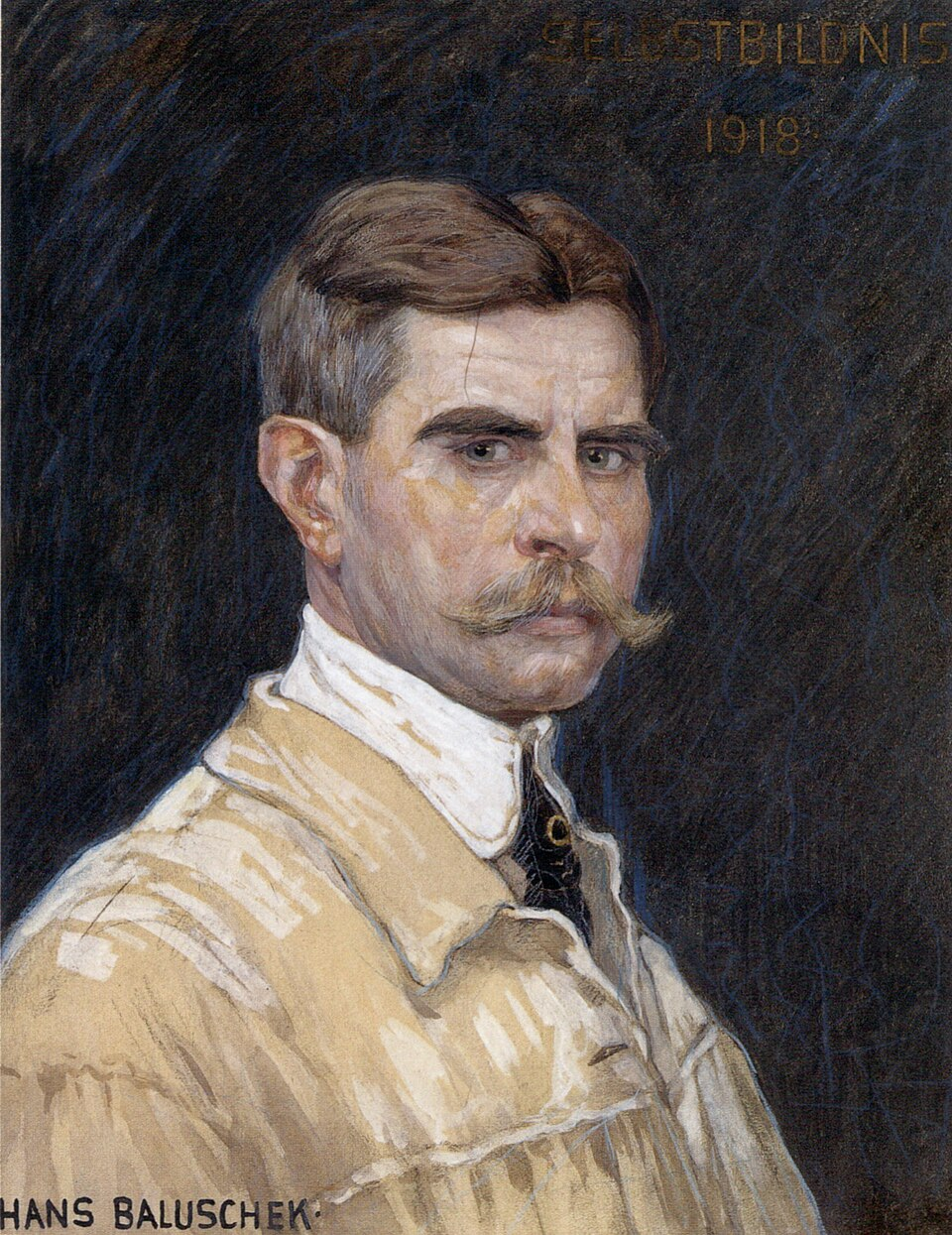
Biography & Historical Context
Early Life and Formative Years (1870–1894)
- Origins and Railway Influence: Born on May 9, 1870, in Breslau (now Wrocław, Poland), Baluschek was the son of Franz Baluschek, a railway engineer and surveyor.[2:4][5:1] Accompanying his father on inspections during the post-1871 Gründerzeit railway boom instilled in the young Baluschek a lifelong mechanical and aesthetic fascination with steam locomotives, signal boxes, and steel viaducts.[2:5][4:2]
- Move to Berlin and Stralsund: In 1876, the family moved to Berlin.[2:6] Following an outbreak of typhus in Berlin during the 1880s, Baluschek briefly relocated with his family to Stralsund on the Baltic coast, where he attended the gymnasium and formed early intellectual circles devoted to discussing socialist politics and the literary realism of Leo Tolstoy and Émile Zola.[2:7][5:2]
- Academic Training: After passing his Abitur in 1889, he returned to Berlin to enroll at the Königliche Akademie der bildenden Künste (Royal Academy of Arts, now the Berlin University of the Arts).[2:8] Studying until 1893 under conservative history painter Martin Körte, Baluschek grew increasingly disillusioned with academic traditionalism.[2:9][5:3]
- Literary Naturalism: Leaving the Academy in 1893 to work as an independent artist, he immersed himself in the radical literature of Gerhart Hauptmann, Henrik Ibsen, Arno Holz, and Johannes Schlaf.[2:10][5:4] These writers championed Naturalism—the unflinching examination of hereditary and environmental determinism among the lower classes—which Baluschek directly translated into visual art, anticipating the documentary ethos later championed by Charles Baudelaire and the detached urban observations of The flâneur.[3:1][4:3]
The Berlin Secession and Pre-War Prominence (1894–1914)
- Breakthrough Exhibitions: Between 1895 and 1897, Baluschek gained notoriety in Berlin's avant-garde circles through joint exhibitions with sculptor Martin Brandenburg, hosted by gallery owner Eduard Schulte.[2:11] His depictions of suburban tenements and amusement parks shocked conservative critics who favored idealist, imperial imagery.[2:12][4:4]
- The Gutter Art Controversy: Emperor Wilhelm II fiercely opposed modern social realism, famously dismissing non-academic depictions of poverty and industrial squalor as Rinnsteinkunst ("gutter art") during the 1901 inauguration of the Siegesallee.[2:13][4:5] Baluschek wore this imperial disdain as a badge of honor, cementing his alliance with anti-establishment creatives.[4:6]
- The Berlin Secession: In 1899, Baluschek joined the newly founded Berlin Secession, led by Max Liebermann, Walter Leistikow, and Käthe Kollwitz.[2:14][3:2] Serving on its board of directors, he became a fixture of Secessionist exhibitions, standing out from his Impressionist peers through his linear, graphic precision and overt social commentary.[1:1][3:3]
- Personal Life: After a brief marriage to theater actress Charlotte von Pazatka-Lipinsky (1902–1906), Baluschek married former art student Irene Drösse in 1913; the couple remained together until his death and raised two daughters during the First World War.[2:15]
World War I and the Weimar Republic (1914–1932)
- Wartime Trauma: Swept up in the initial patriotic fervor of 1914, Baluschek donated to war relief efforts and volunteered for military service in 1916, serving in the Landsturm in Romania and later on the Western Front.[2:16] The industrialized slaughter of the war deeply traumatized him, shifting his wartime canvases toward bleak, snowbound home-front scenes and the mutilation of soldiers.[2:17][5:5]
- Civic and Political Engagement: Following Germany's collapse in 1918, Baluschek threw himself into cultural reconstruction. In 1920, he officially joined the Social Democratic Party of Germany (SPD).[2:18][6:1] Throughout the Weimar era, he occupied major cultural-political posts:
- Served as an arts advisor to Berlin's reformist Mayor Gustav Böss.[2:19]
- Co-founded and chaired the Wirtschaftliche Verband bildender Künstler (Welfare Bureau for Berlin Artists) to combat poverty among creatives during hyperinflation.[2:20][5:6]
- Contributed illustrations to left-wing publications, including the SPD satirical magazine Der Wahre Jacob, Illustrierte Reichsbanner-Zeitung, and the journal Sichel und Hammer.[2:21][6:2]
- Served as Director of the Große Berliner Kunstausstellung (Greater Berlin Art Exhibition) from 1929 to 1931, championing progressive municipal housing initiatives that mirrored the architectural agenda of The Bauhaus School.[2:22][7]
Persecution and Final Years (1933–1935)
- Nazi Proscription: Following the Nazi seizure of power in January 1933, Baluschek became an immediate target of National Socialist cultural purges.[2:23] Fanatical Nazi art theorist Wolfgang Willrich—author of the polemic Säuberung des Kunsttempels—singled out Baluschek for denunciation.[2:24]
- Defamation as "Degenerate": The regime branded Baluschek a "marxistischer Künstler" (Marxist artist) and classified his body of work as Entartete Kunst (Degenerate Art), a fate shared by modernists like Paul Klee (1879–1940).[2:25][6:3] He was summarily dismissed from his leadership posts, stripped of his studio in the Schöneberg Ceciliengärten, and subjected to a strict Ausstellungsverbot (exhibition ban).[2:26][5:7]
- Death: Isolated and professionally ruined, Hans Baluschek died in Berlin on September 28, 1935, at the age of 65.[1:2][2:27] He was buried in the Wilmersdorfer Waldfriedhof in Stahnsdorf, south of Berlin.[2:28]
Artistic Style, Technique, and Themes
Technical Signature: Unlike the oil-heavy impasto of Berlin Impressionists like Max Liebermann or Lovis Corinth, Baluschek favored mixed media on paper or cardboard.[1:3][3:4] By combining watercolor, gouache, tempera, pastel, and greasy chalk with sharp ink or charcoal contours, he achieved a matte, atmospheric, and distinctly graphic aesthetic suited to both gallery walls and print reproduction, directly anticipating Walter Benjamin's insights in The Work of Art in the Age of Mechanical Reproduction.[3:5][5:8]
1. The Industrial Landscape and the Railway
For Baluschek, the steam locomotive was the ultimate metaphor for modernity—simultaneously a marvel of human engineering and a monstrous force that crushed individuality.[5:9][4:7]
- Architectural Framing: His compositions are dominated by iron bridges, signal gantries, soot-blackened brick walls, and switching yards that dwarf the human figures below, anticipating the enigmatic urban railway motifs of Giorgio de Chirico (1888-1978).[8][4:8]
- Atmospheric Soot and Steam: He utilized dark, muddy palettes punctuated by glowing red and green railway signals, billows of white steam, and the harsh glare of electric arc lamps cutting through Berlin winter fog, articulating an industrial variation of The Sublime.[8:1][5:10]
2. The Berlin Proletariat and the Mietskasernen
Baluschek documented the demographic explosion of Berlin as rural migrants flooded into the city's Mietskasernen (tenement barracks), capturing the spatial estrangement theorized in Anthony Vidler-The Architectural Uncanny.[8:2][4:9]
- The Urban Periphery: He focused heavily on the transitional zones where the expanding city chewed into the surrounding Brandenburg countryside—places of gravel pits, allotment gardens (Laubenkolonien), and waste dumps.[2:29][4:10]
- Leisure and Escape: Rather than depicting workers solely on the factory floor, Baluschek frequently painted their Sunday excursions to suburban beer gardens (where signs read "Hier können Familien Kaffee kochen"—Here families can brew coffee) or cheap fairgrounds like the Hasenheide, capturing the desperate, fleeting pursuit of joy amid exhausting labor.[2:30][6:4][4:11]
3. Social Alienation and Physiognomy
Baluschek possessed a sharp, almost clinical eye for human posture and facial expression, often bordering on the grotesque without crossing into cruel caricature.[5:11][9]
- The Marginalized: His portfolios include unsparing studies of alcoholics, sex workers, war amputees, striking laborers, and orphans (Porträts asozialer Frauen, 1923; Portrait einer Kokainistin, 1923).[2:31][9:1]
- Psychological Distance: Even in crowded scenes, Baluschek's figures rarely make eye contact with one another; they stare blankly ahead or hunch against the wind. This visual atomization represents the precise pictorial equivalent of Georg Simmel's diagnosis of the metropolitan blasé attitude and social reserve in The Metropolis and Mental Life, as well as the societal fragmentation analyzed in Durkheimian Sociology.[8:3][4:12]
4. The Dual Persona: Fairy Tales and Spiritualism
In stark contrast to his grim social realism, Baluschek maintained a parallel career illustrating children's literature, myths, and fantastical narratives.[2:32][9:2]
- Escapism as Counterweight: Scholars at the Bröhan-Museum note that Baluschek's fairy-tale works were not a contradiction of his realism, but a psychological refuge from the bleakness of industrial Berlin, informed by turn-of-the-century Symbolism, contemporary interest in spiritualism, and the Romantic impulse of Sehnsucht.[9:3]
Major Works & Critical Analysis
Hier können Familien Kaffee kochen (Here Families Can Make Coffee, 1895)
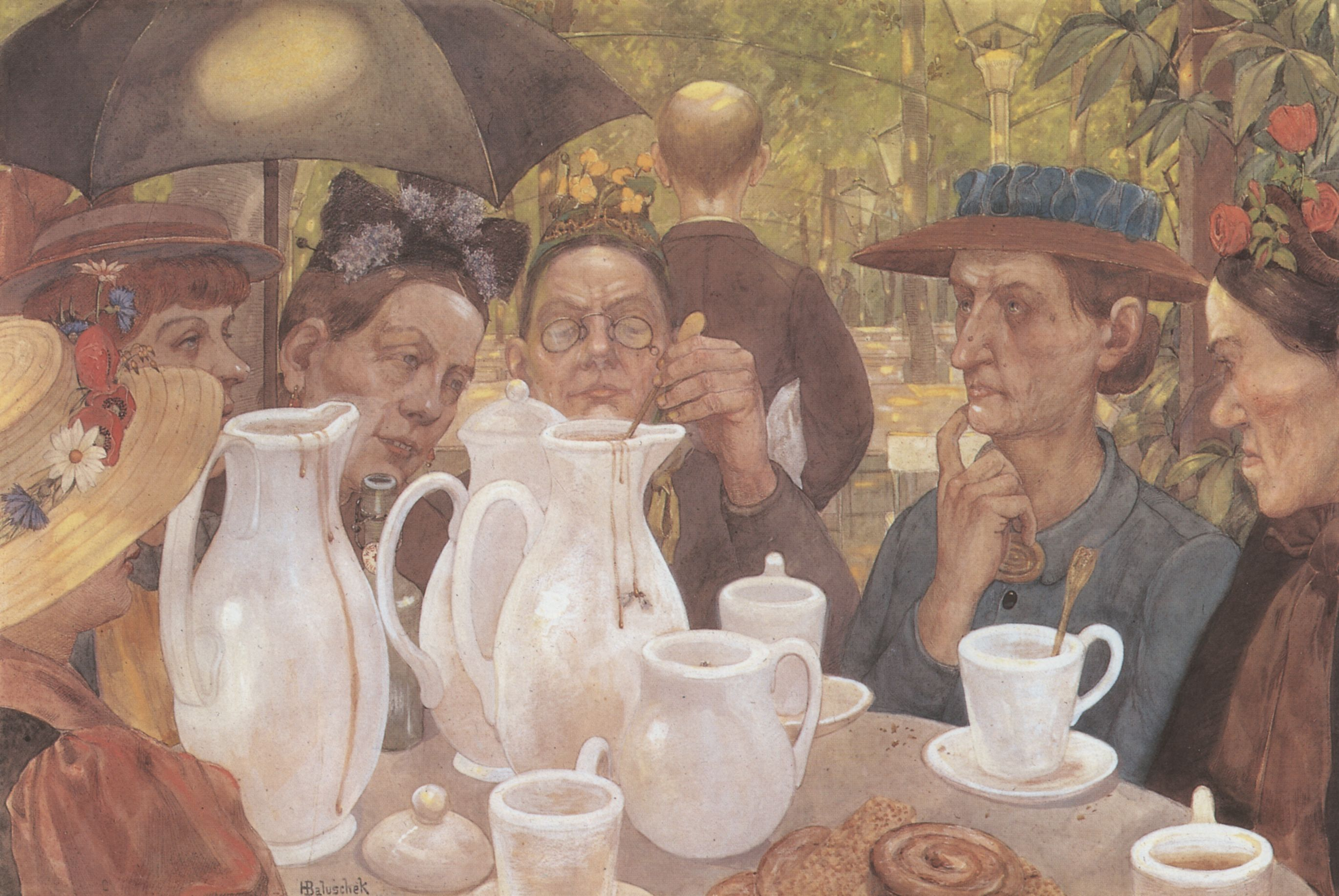
- Medium: Mixed media (pastel, gouache, and watercolour) on paper.[2:33]
- Analysis: One of Baluschek's earliest masterpieces, the work depicts a working-class family sitting at a sparse wooden table in a suburban garden restaurant on the outskirts of Berlin.[2:34][4:13] Unable to afford restaurant prices, proletarian families brought their own ground coffee and paid only a nominal fee for hot water.[4:14] The painting strips away all bourgeois pastoral romance: the women and children appear pale, exhausted, and joyless against a stark, treeless horizon, transforming a scene of leisure into an indictment of urban poverty.[2:35][4:15]
Großstadtbahnhof (Big City Train Station, 1904)
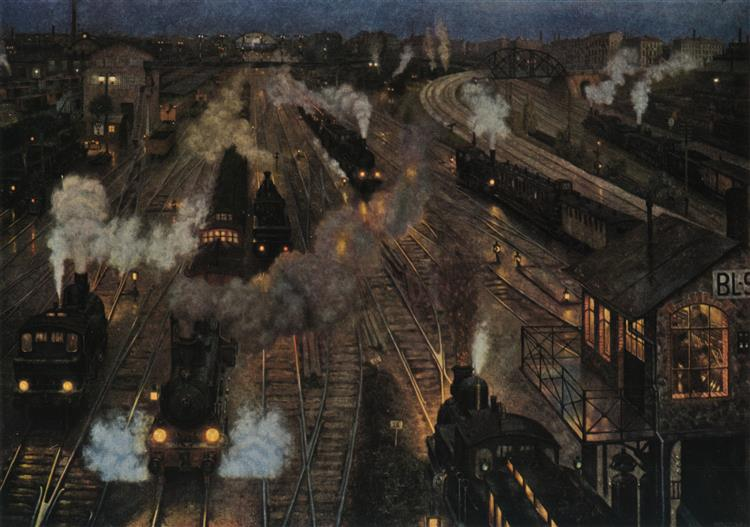
- Medium: Mixed media on paper/cardboard.[3:6]
- Analysis: Showcases the monumental iron-and-glass architecture of a Berlin terminal at night.[5:12] The composition contrasts the dynamic, glowing power of the departing steam engines with the tiny, ant-like silhouettes of commuters and railway workers navigating the treacherous tracks, evoking the relentless temporal synchronization described in The Metropolis and Mental Life.[5:13][4:16]
Peterchens Mondfahrt (Little Peter's Journey to the Moon, 1915)
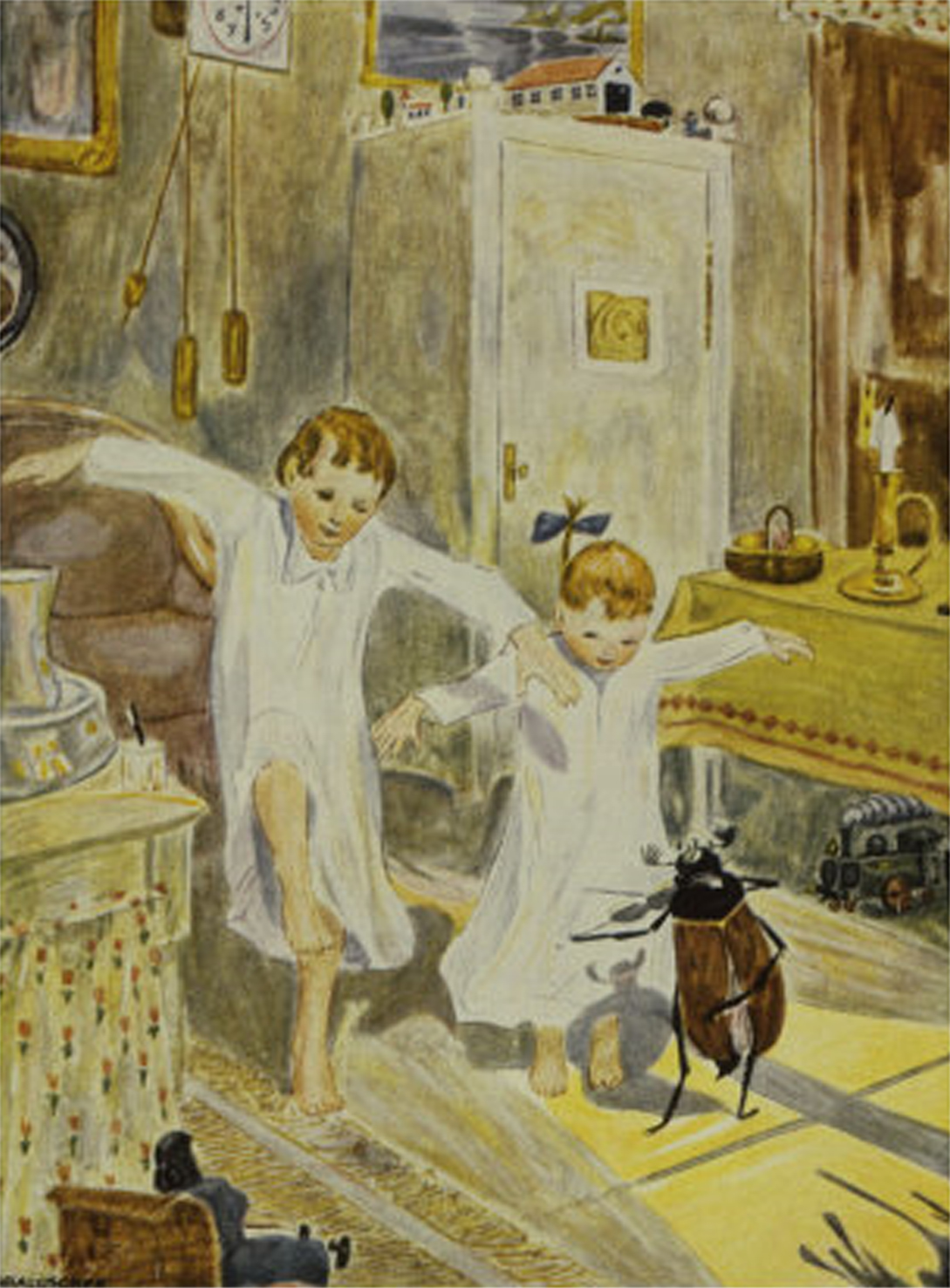
- Context: Written by Gerdt von Bassewitz originally as a 1912 stage play, the 1915 book edition featuring Baluschek's color plates became one of the most beloved classics of German children's literature.[2:36][9:4]
- Analysis: Depicting the adventures of two children and a five-legged May beetle (Herr Sumsemann) traveling to the moon to recover his missing sixth leg, Baluschek's illustrations blend Jugendstil decorative flair with warm, imaginative personifications of cosmic phenomena (such as the Night Fairy, the Sandman, and the Man in the Moon).[2:37][9:5]
Arbeiterstadt (City of Workers, 1920)
.jpg)
- Medium: Oil on canvas (123 × 92.1 cm).[8:4][10]
- Collection: Milwaukee Art Museum, USA.[8:5][10:1]
- Analysis: Painted in the wake of the German Revolution of 1918–1919 and the Kapp Putsch, Arbeiterstadt presents a claustrophobic, nocturnal panorama of Berlin's tenement canyons.[8:6][10:2] In the lower-left foreground, a dark, silhouetted figure wearing a coat and hat stands atop a freight car with his back to the viewer—a deliberate, dark inversion of Caspar David Friedrich's Romantic Rückenfigur and the classic ideal of The Sublime.[8:7][10:3] Instead of gazing over a sublime sea of mountain fog, the figure looks down into an oppressive labyrinth of brick chimneys, glowing tenement windows, and railway smoke.[8:8][10:4]
Literary Output
Beyond the canvas, Baluschek was an accomplished author of Naturalist prose, publishing collections of short stories and novellas that mirrored the themes of his visual art:[2:38][5:14]
- Spreeluft: Berliner Geschichten (1913): A collection of vignettes detailing the everyday struggles, dialects, and dark humor of Berlin's working-class districts ("Spree Air").[2:39]
- Enthüllte Seelen (1916): Psychological character studies exploring alienation, desire, and social pressure ("Unveiled Souls").[2:40]
- Großstadtgeschichten (1924): Weimar-era narratives examining the post-war urban condition, inflation, and moral survival in the metropolis ("Big City Stories").[2:41][5:15]
Reception, Historiography, and Legacy
| Era / Region | Historiographical Reception & Institutional Treatment |
|---|---|
| Wilhelmine Empire (1890–1918) | Polarizing figure; hailed by progressive critics (such as Hermann Esswein) as the visual chronicler of modern industrialism, while condemned by imperial conservatives as a practitioner of ugly Rinnsteinkunst.[2:42][4:17] |
| Weimar Republic (1919–1932) | Reached the zenith of his institutional influence as an SPD cultural functionary, exhibition director, and widely reproduced people's artist; somewhat overshadowed in avant-garde circles by the sharper cynicism of Neue Sachlichkeit (Otto Dix, George Grosz).[2:43][5:16][6:5] |
| Third Reich (1933–1945) | Professionally eradicated; labeled a "Marxist" and "Degenerate" artist; works confiscated from public collections and banned from public view.[2:44][10:6] |
| East Germany / GDR (1949–1990) | Extensively rehabilitated and celebrated by Marxist art historians (such as Günter Meißner) as a heroic pioneer of Socialist Realism and proletarian consciousness; major retrospectives hosted at the Märkisches Museum in East Berlin.[2:45][10:7] |
| West Germany / FRG (1949–1990) | Largely neglected in the Western modernist canon, which prioritized abstraction and Expressionism (as analyzed in The Dehumanization of Art); remembered among the general public almost exclusively as the illustrator of Peterchens Mondfahrt.[2:46][9:6] |
| Post-Reunification (1990–Present) | Subject to major critical re-evaluation; recognized as a vital link between 19th-century Realism and Weimar Neue Sachlichkeit.[5:17][9:7] Honored with the naming of Hans-Baluschek-Park in Berlin-Schöneberg (2004) and major retrospective exhibitions at the Bröhan-Museum (Geheime Codes. Hans Baluscheks Malerei neu lesen!, 2024).[2:47][9:8] |
Where to View His Works Today: The largest institutional holdings of Hans Baluschek's paintings, graphic portfolios, and archival materials are housed in the Bröhan-Museum (Berlin's state museum for Jugendstil, Secession, and Art Deco), the Märkisches Museum (Stiftung Stadtmuseum Berlin), the Berlinische Galerie, and the Milwaukee Art Museum.[2:48][8:10][7:1][9:9]
Resonant Notes
The following notes in the vault share direct thematic, sociological, and aesthetic connections with Hans Baluschek:
🔴 Industrial Urbanism, Metropolitan Psychology & Spatial Alienation
- The Metropolis and Mental Life — Georg Simmel's 1903 Berlin sociological thesis provides the direct theoretical anatomy for Baluschek's paintings; where Simmel analyzes sensory overstimulation (Steigerung des Nervenlebens), monetary calculability, and the protective shield of urban reserve, Baluschek renders their visual somatic reality in the soot-laden tenements, alienated crowds, and exhausted laborers of fin-de-siècle Berlin.
- Georg Simmel (1858-1918) & The Philosophy of Money (Philosophie des Geldes) — Simmel’s formal analysis of monetary leveling and objective culture outstripping subjective cultivation mirrors Baluschek’s pictorial indictment of industrial capitalism, where proletarian lives are subordinated to the quantitative rhythms of factories, switching yards, and tenement barracks.
- The flâneur & The Painter of Modern Life, a seminal 1863 essay by French poet and art critic Charles Baudelaire — Baudelaire’s mandate for the modern artist to distill the poetic from the transient, fleeting, and industrial ephemera of the modern city is radicalized by Baluschek; discarding the bourgeois dandy’s leisurely stroll, Baluschek acts as a committed proletarian observer documenting the harsh social fringes and industrial margins of Berlin.
- Anthony Vidler-The Architectural Uncanny — Vidler's diagnosis of spatial estrangement and modern architectural alienation finds vivid expression in Baluschek’s Mietskasernen (tenement canyons), where claustrophobic brick facades, gravel pits, and soot-blackened railway viaducts strip the domestic sphere of shelter and warmth.
- Durkheimian Sociology & David Émile Durkheim (1858–1917) — Durkheim's concept of anomie—the breakdown of social cohesion and organic solidarity caused by unregulated, hyper-rapid industrial division of labor—animates Baluschek's figures, who exist in mutual physical proximity within urban masses yet remain atomized, uncommunicative, and emotionally isolated.
🟡 Visual Culture, Modernist Aesthetics & Mechanical Reproduction
- The Work of Art in the Age of Mechanical Reproduction & Walter Benjamin (1892–1940) — Benjamin’s analysis of the loss of the bourgeois "aura" and the democratization of art through graphic reproduction illuminates Baluschek's technical choice: deliberately favoring mixed media, lithography, gouache, and illustration on paper over monumental oil impasto to ensure immediate circulation in socialist periodicals, mass-market books, and proletarian homes.
- The Sublime — Baluschek systematically inverts the classical Romantic sublime (Caspar David Friedrich's mountain fog and infinite skies); in masterworks like Arbeiterstadt, the lone Rückenfigur overlooks an oppressive, smoke-choked industrial abyss of tenement chimneys, freight yards, and glowing arc lamps—an industrial, anti-pastoral sublime.
- Paul Klee (1879–1940) — Baluschek’s Berlin Secession peer who, like Baluschek, was branded a "degenerate artist" (Entartete Kunst) and stripped of his academic post by the National Socialist regime in 1933; both artists bridged the gulf between whimsical graphic fantasy (fairy tales, puppets) and unsparing modernist critique of industrialized society.
- The Bauhaus School — Baluschek's late-Weimar curatorial leadership at the Große Berliner Kunstausstellung (1929–1931) championed progressive public housing and municipal reform, aligning directly with the Weimar Bauhaus mission to harness industrial design and urban architecture for working-class social uplift.
- Giorgio de Chirico (1888-1978) — While de Chirico rendered railway stations and locomotives as silent, dreamlike metaphysical monuments of existential melancholy, Baluschek depicts them with gritty, soot-stained Critical Realism as the menacing, mechanical engines of class exploitation and technological discipline.
- The Dehumanization of Art — José Ortega y Gasset’s critique of modernist avant-gardes abandoning human social reality for self-referential abstraction highlights Baluschek's conscious refusal: Baluschek maintained an unyielding figurative commitment to human suffering and working-class empathy, resisting purely formalist modernism in favor of socially engaged Critical Realism.
🟢 Class Struggle, Totalitarianism & Existential Dread
- George Orwell (1903-1950) — Baluschek’s visual chronicling of Berlin's working-class squalor, mine workers, and suburban poverty functions as the visual predecessor to Orwell's documentary realism in The Road to Wigan Pier; both creators used unsparing naturalistic detail and democratic socialist commitment to shatter bourgeois complacency.
- Franz Kafka (1883-1924) — Baluschek's depictions of crushed, anonymous individuals dwarfed by monumental industrial architectures and indifferent municipal machinery share a direct existential frequency with Kafka’s nightmarish bureaucratic labyrinths and alienated proletarians.
- Sehnsucht — The German psychological and cultural motif of deep, unquenchable longing appears across Baluschek's dual oeuvre: expressed negatively in the pale, exhausted families seeking fleeting respite in suburban beer gardens (Hier können Familien Kaffee kochen), and sublimated positively into the cosmic escapism of Peterchens Mondfahrt.
- Michel Foucault — Foucault’s analysis of disciplinary spaces and the surveillance of marginalized populations clarifies Baluschek’s portrayal of the urban periphery—allotment gardens, psychiatric facilities, holding barracks, and police-regulated streets where the deviant and the proletarian are physically partitioned.
- Entropy — The thermodynamic and social degradation of energy into soot, waste, and systemic exhaustion pervades Baluschek’s urban winterscapes, where mechanical steam quickly dissipates into toxic fog and human vitality is steadily consumed by industrial friction.
Backlinks
- The Metropolis and Mental Life — Baluschek's Arbeiterstadt (1920) serves as the definitive visual anchor for Simmel's analysis of metropolitan nervous overstimulation, social reserve, and the oppressive dominance of objective over subjective culture.
- Walter Benjamin (1892–1940) — Connects Baluschek's graphic chronicle of the 19th-century Berlin railway boom and working-class childhood to Benjamin's materialist historiography and memoirs of Berlin childhood around 1900.
- Paul Klee (1879–1940) — Represents a shared historical fate under the 1933 National Socialist cultural purges (Entartete Kunst), contrasting Klee's morphological, metaphysical abstraction with Baluschek's unsparing social realism.
- The flâneur — Functions as the class-conscious photographic foil to Baudelaire's detached bourgeois wanderer, shifting the urban gaze from Parisian arcades to Berlin's impoverished Mietskasernen.
- Anthony Vidler-The Architectural Uncanny — Provides the architectural theory for analyzing Baluschek's oppressive tenement canyons, switching yards, and industrial infrastructure as uncanny, dehumanizing spaces.
References
Artnet / Hans Baluschek Artist Biography and Works / artnet.com ↩︎ ↩︎ ↩︎ ↩︎
Wikipedia / Hans Baluschek / en.wikipedia.org ↩︎ ↩︎ ↩︎ ↩︎ ↩︎ ↩︎ ↩︎ ↩︎ ↩︎ ↩︎ ↩︎ ↩︎ ↩︎ ↩︎ ↩︎ ↩︎ ↩︎ ↩︎ ↩︎ ↩︎ ↩︎ ↩︎ ↩︎ ↩︎ ↩︎ ↩︎ ↩︎ ↩︎ ↩︎ ↩︎ ↩︎ ↩︎ ↩︎ ↩︎ ↩︎ ↩︎ ↩︎ ↩︎ ↩︎ ↩︎ ↩︎ ↩︎ ↩︎ ↩︎ ↩︎ ↩︎ ↩︎ ↩︎ ↩︎
WikiArt / Hans Baluschek: Artworks and Berlin Secession / wikiart.org ↩︎ ↩︎ ↩︎ ↩︎ ↩︎ ↩︎ ↩︎
Weimar Berlin / Hans Baluschek, the Painter of the Working Class / weimarberlin.com ↩︎ ↩︎ ↩︎ ↩︎ ↩︎ ↩︎ ↩︎ ↩︎ ↩︎ ↩︎ ↩︎ ↩︎ ↩︎ ↩︎ ↩︎ ↩︎ ↩︎ ↩︎
MeisterDrucke / Hans Baluschek Biography and Weimar Republic Career / meisterdrucke.uk ↩︎ ↩︎ ↩︎ ↩︎ ↩︎ ↩︎ ↩︎ ↩︎ ↩︎ ↩︎ ↩︎ ↩︎ ↩︎ ↩︎ ↩︎ ↩︎ ↩︎ ↩︎
Art Blart / Hans Baluschek and the Social Democratic Party / artblart.com ↩︎ ↩︎ ↩︎ ↩︎ ↩︎ ↩︎
MutualArt / Hans Baluschek Market Data and Exhibitions / mutualart.com ↩︎ ↩︎
Catherine Sawinski / From the Collection–Hans Baluschek's "Working-class City" / blog.mam.org ↩︎ ↩︎ ↩︎ ↩︎ ↩︎ ↩︎ ↩︎ ↩︎ ↩︎ ↩︎ ↩︎
Laura Storfner / Hans Baluschek at the Bröhan Museum: Berlin Between Spiritualism and Social Criticism / ceecee.cc ↩︎ ↩︎ ↩︎ ↩︎ ↩︎ ↩︎ ↩︎ ↩︎ ↩︎ ↩︎
Wikipedia / City of Workers (Arbeiterstadt) / en.wikipedia.org ↩︎ ↩︎ ↩︎ ↩︎ ↩︎ ↩︎ ↩︎ ↩︎