Aldous Huxley's Brave New World (1932)
Aldous Huxley's Brave New World (1932) is a landmark dystopian masterpiece set in London in AF 632 (632 "After Ford," corresponding to 2540 AD). Huxley depicts an insidious technocratic World State that achieves perpetual social stability and economic equilibrium not through physical terror or violent coercion, but through total biological engineering, behavioral conditioning, state-mandated promiscuity, hyper-consumerism, and the ubiquitous psychotropic drug soma. As the ultimate literary counterpoint to George Orwell's Nineteen Eighty-Four, Huxley's novel warns of a "soft totalitarianism" where citizens surrender critical autonomy and spiritual depth in exchange for engineered security, effortless pleasure, and constant sensory distraction.
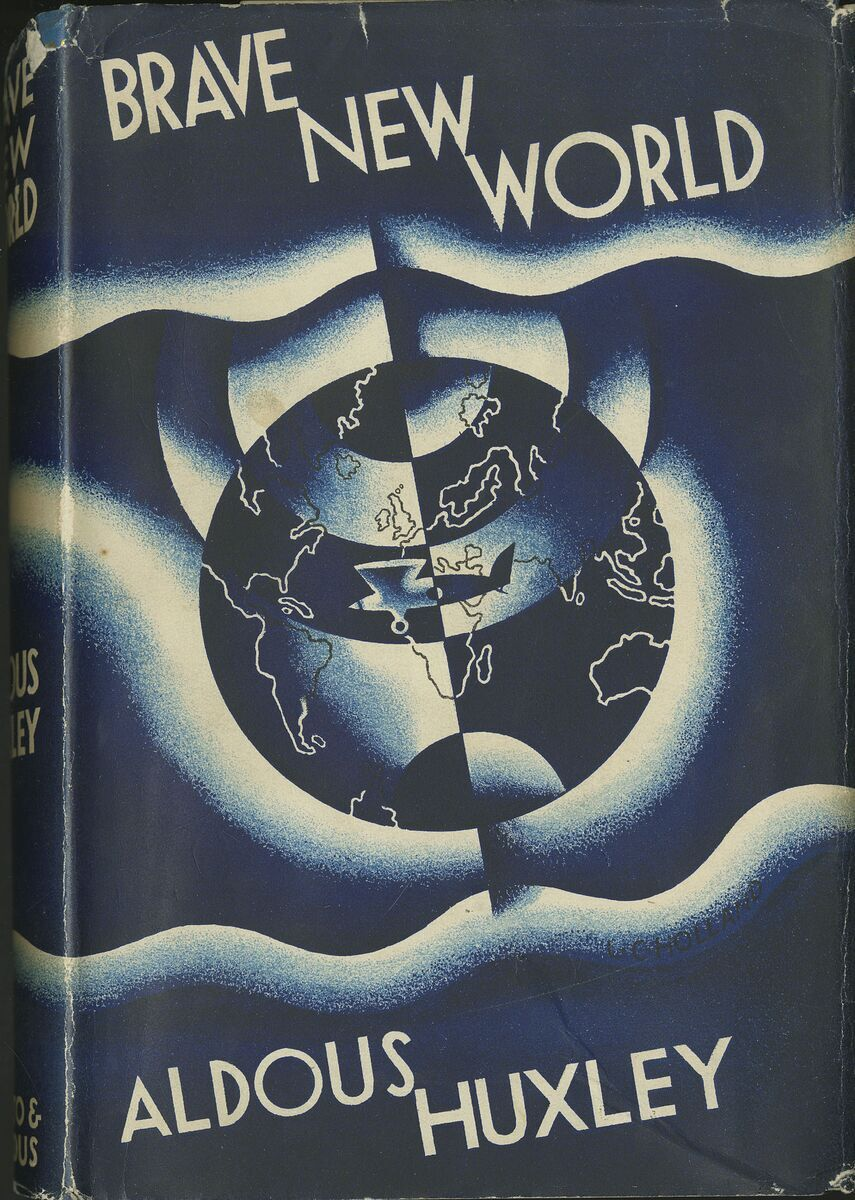
1. Historical and Contextual Genesis
Aldous Huxley wrote Brave New World in 1931 against the backdrop of interwar economic dislocation, the onset of the Great Depression, and the accelerating industrialization of the Western world. Rather than predicting a militarized autocracy, Huxley recognized that mass-production capitalism and technocratic management held the potential to transform human civilization into an ultra-rationalized factory system.
- Fordism and Industrial Standardization: Huxley satirizes American assembly-line industrialism by elevating industrialist Henry Ford to a supreme cultural deity ("Our Ford," occasionally punned with "Our Freud" when discussing psychological repression). The Christian cross is physically amputated into the capital "T," commemorating the Model T automobile. Time itself is measured from the launch of Ford's Model T in 1908.
- Parody of H.G. Wells's Techno-Utopianism: The novel was conceived as a direct satirical rebuttal to H.G. Wells's optimistic techno-utopian visions (notably Men Like Gods and A Modern Utopia). Huxley rejected the naive presumption that unchecked scientific mastery and material abundance would inevitably liberate humanity, arguing instead that technological progress divorced from ethical self-determination results in spiritual enslavement.
- Eugenics and Watsonian Behaviorism: Huxley drew heavily from early 20th-century debates on eugenics, as well as the behaviorist psychology of John B. Watson and Ivan Pavlov. Watson's belief that infant emotional responses could be conditioned mechanically provided Huxley with the blueprint for a state apparatus capable of manufacturing human desires and caste compliance at the reflex level.
2. World State Apparatus and Social Engineering
The World State is governed under the supreme triadic motto: "Community, Identity, Stability." To eliminate social friction, political volatility, and economic downturns, the state intervenes in human biology from fertilization to crematorium.
| Control Domain | Operational Mechanism | Pedagogical / Societal Objective | Systemic Outcome |
|---|---|---|---|
| Reproduction | Bokanovsky Process & Podsnap Technique | Mass production of genetically standardized sibling cohorts | Complete eradication of biological family units and genetic randomness |
| Prenatal Conditioning | Chemical and oxygen titration in incubator jars | Biological fixing of physiological and cognitive caste boundaries | Absolute somatic adaptation of individuals to their assigned division of labor |
| Postnatal Conditioning | Neo-Pavlovian conditioning (electric shock & loud sirens) | Instinctive psychological repulsion toward nature and high literature | Channeling worker recreation toward fee-paying industrial pastimes |
| Subconscious Conditioning | Hypnopaedia (sleep-teaching repetitions) | Subliminal crystallization of caste pride and consumerist ethics | Spontaneous, lifelong identification with state orthodoxy without conscious reasoning |
Biological Stratification: The Hatchery and Conditioning Centre
Natural viviparous reproduction ("having a mother") is criminalized and treated with visceral social disgust. Life begins in the Central London Hatchery and Conditioning Centre:
- Bokanovsky's Process: A proprietary method of artificial reproduction where a single fertilized human egg is subjected to arrests, chilling, and alcohol treatment, causing it to split into up to 96 identical embryos. This method is applied to Gammas, Deltas, and Epsilons to produce standardized batches of laborers.
- Pre-Natal Manipulation: Developing embryos are dosed with precise amounts of oxygen, temperature fluctuations, and chemical toxins. Epsilons receive minimal oxygen and toxic additives to stunt intellectual faculties and physical stature, tailored precisely to menial labor.
- Neo-Pavlovian Conditioning: Infants from lower castes are placed on carpets adorned with blooming roses and lavishly illustrated books. When the babies crawl forward with delight, alarm sirens shriek and copper plates emit mild electric shocks. After repeat conditioning, the children develop an unbreakable reflex aversion: a love of nature does not keep factories busy, whereas mechanical sports require expensive manufactured equipment.
- Hypnopaedia: During sleep, children listen to recorded voices repeating moral maxims dozens of thousands of times ("Ending is better than mending," "A gramme is better than a damn," "I'm awfully glad I'm a Beta"). Reason cannot undo what sleep-teaching has embedded, because hypnopaedic instruction bypasses intellect and anchors itself in instinctive prejudice.
The Biological Caste Matrix
| Caste | Decanting & Chemical Manipulation | Biological & Cognitive Profile | Uniform Color | Indoctrinated Mindset & Hypnopaedic Slogan | Societal Role & Labor Allocation |
|---|---|---|---|---|---|
| Alpha | Single decanting without Bokanovsky splitting; full oxygen and optimal nutrient baths | Superior intellect, tall stature, critical judgment, executive capacity | Grey | "Alphas work much harder than we do, because they're so frightfully clever." | Supreme administrators, directors, scientists, philosophers, World Controllers |
| Beta | Individual decanting; optimal embryonic environment without mutation | High technical intelligence, refined social competence, lack of leadership burden | Mulberry | "Betas don't have to work as hard as Alphas, but we are much better than Gammas." | Senior technicians, laboratory specialists, head nurses, skilled managers |
| Gamma | Bokanovsky splitting (20–40 twins); mild oxygen suppression | Moderate intellect, standardized dexterity, emotional pliability | Green | "Gammas are stupid. They all wear green, and Delta children wear khaki." | Clerks, mechanics, factory supervisors, domestic service dispatchers |
| Delta | Intensive Bokanovsky splitting; reduced oxygen, chemical retardation | Diminished intellect, low initiative, conditioned fear of books and flowers | Khaki | "I'm glad I'm not an Epsilon, who are too stupid to even read." | Semi-skilled manual labor, assembly-line operators, equipment handlers |
| Epsilon | Extreme Bokanovsky splitting (up to 96 twins); severe oxygen deprivation & alcohol poisoning | Severe cognitive impairment, stunted stature, illiteracy, absolute docility | Black | "Epsilons don't mind being Epsilons; they don't know any better." | Heavy menial labor, sewer maintenance, elevator operation, sewage disposal |
3. Mechanisms of Pacification: Hedonic Totalitarianism
Where authoritarian regimes rely on the police baton, secret arrests, and execution squads, the World State governs through the systematic gratification of sensory appetites. By pre-empting frustration, the state eliminates the psychological seeds of rebellion.
The Architecture of Pacification
| Stage / Tier | Control Dimension | Core Operational Mechanism | Systemic Outcome |
|---|---|---|---|
| Tier 1 | Reproductive Control | Bokanovsky Process & Decanting Bottles | Eradication of biological family units and random genetic variance |
| Tier 2 | Psychic Formatting | Neo-Pavlovian Conditioning & Hypnopaedia | Reflexive aversion to nature/literature and subliminal caste loyalty |
| Tier 3 | Hedonic Reinforcers | Mandatory Promiscuity & "The Feelies" | Sensory saturation, preemption of deep emotional bonds, and continuous consumption |
| Tier 4 | Chemical Safeties | Soma ("A gramme is better than a damn") | Instant pharmacological mitigation of anxiety, grief, and existential dread |
| Terminal State | Total Equilibrium | Triadic State Motto: "Community, Identity, Stability" | Frictionless social order and self-administering citizen compliance |
Pharmacological Pacification: Soma
Soma is the ultimate psychotropic stabilizer engineered by state chemists:
- "Christianity Without Tears": Soma provides complete emotional solace, transcendent calm, and euphoric escapism without causing hangovers, liver toxicity, or physiological degradation.
- Preemption of Existential Dread: Whenever an individual encounters grief, boredom, jealousy, or existential solitude, a small dose ("half-gramme for a half-holiday, a gramme for a weekend") swiftly restores placid emotional equilibrium. By chemically abolishing somatic despair (dukkha), the regime ensures that melancholy cannot evolve into philosophical questioning.
Mandatory Promiscuity & Abolition of the Nuclear Family
The state recognizes that deep interpersonal attachments, monogamous romantic love, and parental affection generate intense emotional friction, jealousy, and competing loyalties:
- "Everyone Belongs to Everyone Else": Citizens are conditioned from early childhood to engage in recreational sexual play and rotate romantic partners continually. Forming an exclusive emotional bond is treated as an antisocial perversion.
- Malthusian Drill: To prevent accidental pregnancy, fertile females undergo daily contraception drills and wear decorative cartridge belts known as "Malthusian belts."
- Eradication of Historical Ties: By abolishing the nuclear family, the World State destroys ancestral continuity, intergenerational transmission of counter-knowledge, and private emotional refuges.
Hyper-Consumerism and Industrialized Leisure
The economy of the World State requires uninterrupted industrial output and high levels of consumption:
- "Ending is Better than Mending": Mending old clothes or repairing broken tools is stigmatized as economic treason. Citizens are hypnopaedically trained to throw away worn goods and purchase factory replacements immediately.
- Complex Mechanical Sports: Pastimes that require zero manufactured equipment (such as walking in the countryside) are prohibited. All sanctioned recreations—such as Obstacle Golf, Centrifugal Bumble-puppy, and electromagnetic golf—demand costly machinery and travel infrastructure.
- The Feelies: Cinematic entertainment is upgraded into multi-sensory immersion: viewers grip metal knobs that transmit synchronized tactile sensations (feelies), accompanied by synthetic aromas and surround-sound music, filling the sensorium to capacity and preventing interior reflection.
4. Key Characters and Allegorical Archetypes
| Character | Social Identity | Allegorical / Sociological Function | Fate & Ultimate Trajectory |
|---|---|---|---|
| Bernard Marx | Alpha-Plus Psychologist | The Maladjusted Inauthentic Dissident: Alienated because of an accidental physical deficiency (short stature), he resents the system not out of noble ethics, but because it denies him social vanity and status. | Exiled to the Falkland Islands after failing to sustain his temporary celebrity status. |
| Helmholtz Watson | Alpha-Plus Emotional Engineer | The Restless Intellectual & Artist: Possesses surplus mental power; craves a muscular, authentic language that can express tragic emotion rather than trivial state rhymes. | Willingly chooses exile to a harsh, stormy climate (the Falklands) to cultivate serious artistic creation. |
| John "The Savage" | Outsider born on Malpais Reservation | The Tragic Humanist: Raised on Shakespeare and tribal rituals; embodies classic romantic passion, religious guilt, and the demand for existential suffering. | Driven to madness and public exploitation; commits suicide in a secluded Surrey lighthouse. |
| Mustapha Mond | Resident World Controller for Western Europe | The Grand Inquisitor / Technocratic Realist: An elite intellectual who abandoned pure scientific inquiry to govern society, fully aware of history, religion, and the costs of stability. | Rules the state with detached philosophical clarity; dispenses compassionate exile to non-conformists. |
| Lenina Crowne | Beta-Plus Hatchery Worker | The Archetype of Conditioned Orthodoxy: Beautiful, cheerful, and unreflectively obedient; uses hypnopaedic slogans and soma as automatic shields against authentic feeling. | Baffled and traumatized by John's demand for monogamy and chivalric suffering; remains an instrument of the state. |
| Linda | Former World State Beta worker / John's mother | The Deconditioned Relic: Stranded on the Savage Reservation; torn between hypnopaedic programming and somatic aging/decay. | Returns to London, enters a permanent soma-induced terminal holiday, and dies in hospital apathy. |
5. Philosophical Dialectic: Mustapha Mond vs. John the Savage
The intellectual climax of the novel occurs in Chapters 16 and 17, where Resident World Controller Mustapha Mond debates John the Savage and Helmholtz Watson. This confrontation parallels the "Grand Inquisitor" chapter in Fyodor Dostoevsky's The Brothers Karamazov.
The Dialectical Standoff (Chapters 16 & 17)
| Dialectical Axis | Mustapha Mond (Utilitarian Technocracy) | John the Savage (Tragic Humanism) |
|---|---|---|
| Primary Social Value | Social stability and universal synthetic happiness | The pursuit of God, poetry, tragedy, and heroic virtue |
| Approach to Suffering | Pain and distress chemically eradicated via soma and comfort | Suffering, grief, and adversity as indispensable catalysts of spiritual depth |
| Cultural Expression | High art replaced by superficial, multi-sensory "Feelies" | Shakespearean tragedy as the authentic mirror of existential human reality |
| Individual Liberty | Universal biological conditioning and somatic security | Freedom to choose, fall, sin, err, and somatically decay |
| Core Philosophical Maxim | "Actual happiness looks pretty squalid in comparison with the over-compensations for misery." | "I claim the right to be unhappy." |
The Incompatibility of Truth and Stability
Mond concedes openly that high art, pure scientific research, and religion are superior to the trivial diversions of the World State. However, he demonstrates that these pursuits are structurally incompatible with social equilibrium:
- Art Requires Tragedy: Shakespeare cannot be understood in a world without emotional devastation, sexual frustration, familial conflict, and catastrophic grief. In a society where every appetite is instantly sated, tragedy becomes unintelligible.
- Science Threatens Equilibrium: Pure scientific exploration searches for fundamental truth regardless of consequences, whereas the World State requires only technological applications that preserve socioeconomic stability.
- Religion as the Fruit of Senescence: Mond reads aloud from Maine de Biran and Cardinal Newman, noting that religious longing arises when physical vitality wanes and individuals confront somatic death. Because the World State preserves artificial youth and health until age sixty, God has been rendered obsolete: "Our Ford or Our Freud."
"The Right to Be Unhappy"
When Mond explains that the regime has deliberately purchased tranquility at the price of heroism, John asserts the core manifesto of existential humanism:
"Art, science—you seem to have paid a fairly high price for your happiness," said the Savage.
"Anything else?"
"Well, religion, of course," said the Controller. "There used to be something called God."
...
"I don't want comfort. I want God, I want poetry, I want real danger, I want freedom, I want goodness. I want sin."
"In fact," said Mustapha Mond, "you're claiming the right to be unhappy."
"All right, then," said the Savage defiantly, "I'm claiming the right to be unhappy."
"Not to mention the right to grow old and ugly and impotent; the right to have syphilis and cancer; the right to have too little to eat; the right to be lousy; the right to live in constant apprehension of what may happen to-morrow; the right to catch typhoid; the right to be tortured by unspeakable pains of every kind."
There was a long silence.
"I claim them all," said the Savage at last.
Mustapha Mond shrugged his shoulders. "You're welcome," he said.
This exchange demonstrates the tragic paradox of the novel: the human spirit cannot flourish in a sterile environment of engineered pleasure, yet genuine freedom entails exposure to somatic disease, spiritual dread, and moral failure.
6. Sociological, Epistemological, and Contemporary Relevance
| Dimension | Huxleyan Prognosis (Brave New World) | 21st-Century Structural Manifestation |
|---|---|---|
| Biotechnology | Bokanovsky Process, in vitro fertilization, genetic caste modification | CRISPR-Cas9 gene editing, designer embryos, reproductive outsourcing, commercial surrogacy |
| Pharmacology | Soma as universal mood-regulator without physical hangover | SSRIs, lifestyle benzodiazepines, micro-dosing culture, chemical mitigation of workplace stress |
| Attention & Media | "The Feelies," synthetic music, compulsory leisure spectacles | Infinite algorithmic feeds (TikTok/Instagram), VR immersive entertainment, variable dopamine hooks |
| Social Organization | "Everyone belongs to everyone else," casualized relations | Algorithmic dating markets, transactional social connections, dissolution of family coherence |
| Ideological Control | Hypnopaedic conditioning, drowning truth in entertainment | Informational "blur and glut," attention commodification, post-truth media fatigue |
Soft Totalitarianism vs. Hard Coercion
In Amusing Ourselves to Death (1985), media theorist Neil Postman highlighted why Huxley's dystopia is far more prescient for Western democratic consumer societies than Orwell's Oceania:
- Orwell feared those who would deprive us of information; Huxley feared those who would give us so much that we would be reduced to passivity and trivia.
- Orwell feared that books would be banned; Huxley feared there would be no reason to ban a book, because no one would want to read one.
- Orwell feared that truth would be concealed from us; Huxley feared the truth would be drowned in a sea of irrelevance.
As analyzed in Dystopian Counterpoints - Brave New World vs. Nineteen Eighty-Four, while 20th-century autocracies operated through Orwellian violence and fear, 21st-century late-stage capitalism maintains control through Huxleyan amusement, algorithmic sedation, and consumer satisfaction.
Deleuze's Control Societies & Foucault's Biopolitics
- Biopolitical Administration: As Michel Foucault identified in his lectures on biopolitics, modern power ceases to be merely sovereign (the right to kill) and becomes biopolitical (the administration, regulation, and optimization of living bodies). The World State is the absolute culmination of biopolitics: biology is entirely nationalized.
- Societies of Control: In Postscript on the Societies of Control, Gilles Deleuze diagnosed the shift from disciplinary enclosures (prisons, factories) to open networks of continuous modulation. In Brave New World, citizens require no prison walls; their desires are continuously modulated by entertainment and pharmacology, making servitude indistinguishable from consumer choice.
🎴 Interactive Web Practice (Comprehension Check)
Question 1 (Hedonic Totalitarianism vs. Coercive Force): How does the World State's reliance on positive reinforcement and hedonic pacification represent a more durable architecture of social control than the physical coercion depicted in Orwell's Nineteen Eighty-Four?
Answer: The World State's system of hedonic control is structurally more permanent and durable than Orwellian physical coercion because violence and terror inevitably generate psychological friction, hidden resentment, and the impulse toward rebellion. Physical torture and constant surveillance require enormous administrative overhead and an active secret police apparatus to keep citizens suppressed under fear.
In contrast, Huxley's World State conditions citizens from the embryonic stage to love their assigned station in life through chemical titration, Neo-Pavlovian reflexes, and sleep-teaching (hypnopaedia). By satisfying sensory desires instantaneously through compulsory promiscuity, organized recreation, and the anxiety-erasing narcotic soma, the regime eliminates the psychological gap where frustration and introspective dissent can develop. A populace that perceives itself as happy and continuously stimulated has no grievance to mobilize and will never conceive of rebellion, transforming servitude into an object of voluntary devotion.
Question 2 (The Incompatibility of Stability and High Art): In his dialogue with John the Savage, why does Mustapha Mond assert that high art (such as Shakespeare's tragedies) and pure scientific research cannot coexist with societal stability?
Answer: Mustapha Mond explains that high art, specifically tragedy, requires emotional agony, heroic sacrifice, unfulfilled passion, and intense existential instability to exist. Works like Othello or King Lear derive their meaning from jealousy, betrayal, grief, and spiritual conflict—elements that the World State has systematically engineered out of society. In an environment where every sexual urge is instantly gratified, every loss is buffered by soma, and citizens live in painless equilibrium, the emotional vocabulary of tragedy becomes completely unintelligible. The regime deliberately replaces high art with multi-sensory, superficial amusements (the "feelies") that evoke immediate sensory stimulation without demanding contemplation or moral distress.
Similarly, Mond points out that pure scientific inquiry is an unpredictable, destabilizing force because it seeks fundamental truth and conceptual revolutions that can disrupt established social arrangements. The World State permits only applied technological adjustments that optimize industrial output and reinforce the existing socioeconomic hierarchy, actively suppressing genuine scientific breakthroughs that might alter the balance of power.
Question 3 (The Existential Claim of the Savage): What is the philosophical significance of John the Savage's demand for the right to be unhappy, and how does this stance expose the limits of utilitarian technocracy?
Answer: John the Savage's declaration—claiming the right to be unhappy, along with the right to grow old, suffer disease, endure pain, experience sin, and face existential dread—is an uncompromising assertion of existential human dignity against utilitarian technocracy. Utilitarianism defines the good entirely as the maximization of pleasure and the eradication of pain. The World State takes this premise to its logical extreme, manufacturing a frictionless civilization where no one suffers, yet where no one possesses depth, moral courage, or spiritual transcendence.
John demonstrates that authentic human consciousness requires friction: spiritual awareness, ethical virtue, and profound love cannot exist without the possibility of suffering, heartbreak, and somatic vulnerability. By deliberately claiming the right to suffer, John exposes the World State's happiness as a shallow, infantalizing deception. To eliminate all suffering by chemically and biologically amputating the soul is not to elevate humanity, but to reduce human beings to domestic animals grazing in an engineered pasture.
Resonant Notes
The following notes in the vault share direct thematic, sociological, and literary connections with Aldous Huxley's Brave New World:
🔴 Totalitarianism, Biopolitics & Social Control
- Dystopian Counterpoints - Brave New World vs. Nineteen Eighty-Four — Comprehensive comparative study contrasting Huxley's hedonic, pharmacologically sedated World State with Orwell's punitive, surveillance-driven Oceania, evaluated through Neil Postman's media ecology and Buddhist psychology.
- George Orwell (1903-1950) — The biographical and textual foundation of Orwell's political thought; features the core dialectic between Orwellian hard terror and Huxleyan soft seduction.
- Don DeLillo Major Themes Analysis — DeLillo maps how the Huxleyan model of consumer abundance, media saturation, and informational "blur and glut" displaced Orwellian violence as the primary control mechanism of late 20th-century Western capitalism.
- Postscript on the Societies of Control — Gilles Deleuze's formulation of control societies transitioning from physical institutional enclosures to continuous, network-based digital modulation mirrors the World State's frictionless, self-administering pacification.
- Michel Foucault — Foucault's analysis of disciplinary regimes and biopolitics (the state management of biological life, population fertility, and health) illuminates the totalitarian institutional logic of the Hatchery and Conditioning Centre.
- Fyodor Dostoevsky (1821-1881) — The Grand Inquisitor parable in The Brothers Karamazov serves as the direct ideological template for Mustapha Mond, demonstrating that humanity willingly trades spiritual liberty for earthly bread, security, and sensual comfort.
- Franz Kafka (1883-1924) — While Kafka depicts the alienating, irrational nightmare of legal and bureaucratic labyrinths, Huxley portrays its rationalized inverse: a hyper-logical technocracy that neutralizes alienation by abolishing human interiority.
- Yuval Noah Harari — Harari's analysis of biotechnology, algorithmic conditioning, and the technocratic "hacking of human animals" updates Huxley's prophecies of genetic engineering and psychological programming for the 21st century.
🟡 Media Ecology, Consumerism & The Attention Economy
- Marshall McLuhan (1911-1980) & McLuhan's The Medium is the Message — McLuhan's insight that communication technologies radically restructure sensory ratios explains why the World State's multi-sensory "feelies" and synthetic music pacify consciousness far more effectively than rational discourse.
- Innis (1950) - Empire and Communications & Innis (1951) - The Bias of Communication — Harold Innis's concept of monopolies of knowledge clarifies how the World State monopolizes biological decanting, archival history, and scientific literature to engineer social equilibrium.
- The Attention Economy — Explores how contemporary digital platforms, continuous notifications, and variable-ratio dopamine loops fulfill Huxley's vision of social control through unending, addictive trivial distraction.
- Simmel and the Attention Economy — Abstraction, Alienation, and Cognitive Capture — Georg Simmel's analysis of monetary abstraction, urban overstimulation, and the blasé attitude anticipates the emotional detachment and casual hedonism that insulate World State citizens from existential depth.
- William H. Whyte's The Organization Man & William H. Whyte's Social Ethics — Whyte's mid-century corporate conformist, submissive to the "Social Ethic" of belongingness and institutional harmony, mirrors the hypnopaedically conditioned citizens who live solely for collective stability.
- Norman Mailer — Mailer's critique of technocratic standardization and corporate "plastic totalitarianism" parallels Huxley's disgust with Fordist mechanization and synthetic human assembly lines.
🟢 Consciousness, Mysticism & Existential Philosophy
- Aldous Huxley's The Doors of Perception (1954) — Huxley's landmark exploration of mescaline and the brain as a "reducing valve" that filters transcendent reality, offering the authentic mystical counterpart to the numbing, artificial sedation of soma.
- Aldous Huxley's The Perennial Philosophy — Huxley's synthesis of the transcendent unity of world religions, outlining the spiritual depth and contemplative wisdom that the materialist World State systematically outlaws.
- Aldous Huxley's Heaven and Hell (1956) — Huxley's complementary essay investigating visionary aesthetics and the chemical triggers of spiritual illumination, contrasting sacred ecstasy with industrial entertainment.
- Tibetan Wheel of Life — The Buddhist cosmology of cyclic existence (Saṃsāra); the Deva Realm (god realm of sensory delight, continuous comfort, and spiritual blindness) represents the exact metaphysical analog of Huxley's World State.
- The Digital Infrastructure of Delusion-A Buddhist Economic and Psychological Analysis of Corporate Culture — Connects Buddhist diagnoses of Taṇhā (craving) and Moha (delusion) to modern organizational life, demonstrating how institutional systems manufacture artificial needs.
- Constructs of the Mind-Unmasking Consciousness in East and West — Investigates how the conscious self is constructed, highlighting the contrast between authentic spiritual deconstruction of ego (Anattā) and the totalitarian liquidation of individuality.
- Schopenhauerian Pessimism — Arthur Schopenhauer's diagnosis of the endless pendulum of human misery swinging between desire and boredom explains the World State's desperate necessity to supply continuous soma and distraction to forestall metaphysical emptiness.
- Albert Camus — Camus's philosophy of the Absurd and the lucid refusal to seek illusory consolations directly aligns with John the Savage's defiant rejection of synthetic happiness in favor of facing somatic reality.
Backlinks
- Dystopian Counterpoints - Brave New World vs. Nineteen Eighty-Four — The primary comparative essay exploring the sociopolitical, epistemological, and Buddhist psychological tensions between Huxley and Orwell.
- George Orwell (1903-1950) — Orwell's biographical and thematic profile, highlighting the historical dialectic between Orwellian terror and Huxleyan hedonic pacification.
- Don DeLillo Major Themes Analysis — Postmodern literary analysis tracking how late-capitalist media ecologies, brand mantras, and consumer seduction manifest Huxleyan soft totalitarianism in contemporary society.
- Aldous Huxley's The Doors of Perception (1954) — Huxley's pharmacological and mystical inquiry into sacred consciousness, serving as the philosophical antidote to soma's state-enforced chemical lobotomy.
- Aldous Huxley's The Perennial Philosophy — Comprehensive study of world mysticism, articulating the metaphysical realities erased by the World State's secular technocracy.
- The Attention Economy — Documents the 21st-century realization of Huxley's entertainment society through algorithmic digital media, continuous amusement, and voluntary attention surrender.