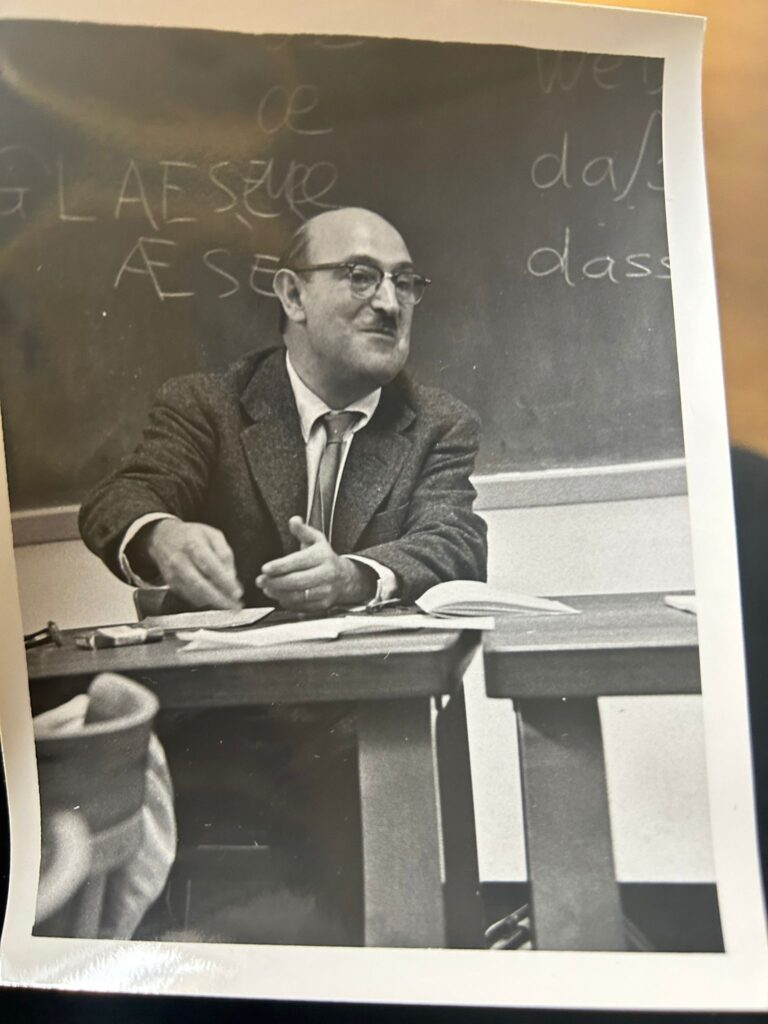
Renato Poggioli: Teoria dell'arte d'avanguardia
In his seminal 1962 work Teoria dell'arte d'avanguardia (The Theory of the Avant-Garde, translated into English in 1968), Italian literary scholar Renato Poggioli analyzed the avant-garde not merely as an aesthetic style, but as a distinct sociological and psychological phenomenon.[1] Emerging from the intersection of nineteenth-century Romanticism and bourgeois democratic-capitalist society, the avant-garde transformed the traditional "school" of art into a dynamic, ideological "movement" driven by a shared psychology of alienation and dialectical opposition.[2]
From the "School" to the "Movement"
Before outlining the specific psychological stages of the avant-garde, Poggioli establishes a foundational sociological distinction between the traditional artistic school and the modern movement.[1:1]
-
The Traditional School: Rooted in pre-modern and classicist frameworks, a school centers on a master, a workshop, and a canon of established techniques. Its primary goal is the preservation, transmission, and refinement of a static aesthetic ideal across generations (contrasting sharply with later modernist workshop syntheses such as The Bauhaus School).[1:2]
-
The Avant-Garde Movement: Born out of Romanticism, the movement rejects static perfection in favor of dynamic becoming. Rather than clustering around a master to learn a craft, members of a movement band together as partisan agitators pursuing a collective cultural, ideological, and psychological trajectory.[2:1]
For Poggioli, the avant-garde movement is only possible within a liberal, bourgeois-capitalist society.[2:2] While the artist relies on the free market and democratic tolerance for survival and expression, the commodification of art simultaneously induces deep psychological, social, and economic alienation.[2:3] The movement serves as a protective minority subculture that wages symbolic war against the very bourgeois majority that sustains it—a dynamic foundational to the emergence of modern counter-cultures.[2:4]
The Four Defining "Moments" of the Avant-Garde
Poggioli identified four defining "moments"—or psychological and ideological attitudes—that govern the internal logic and lifecycle of any avant-garde movement.[2:5] The first two (activism and antagonism) define the practical, outward logic of the group, while the latter two (nihilism and agonism) push the movement beyond its immediate historical bounds into an extreme, self-destructive dialectic.[2:6]
1. Activism (The Moment of Action)
Activism is the foundational, least ideological drive of a movement.[2:7] It represents the sheer joy of dynamism, adventure, and agitation for its own sake—taking action simply for the thrill of acting, moving, and making noise rather than merely to achieve a calculated political or aesthetic outcome.[2:8]
-
Psychological Drive: The thrill of speed, physical restlessness, and collective mobilization.
-
Cultural Manifestation: The proliferation of manifestos, public demonstrations, theatrical provocations, and little magazines. Italian Futurism represents the purest archetype of the activist moment, glorifying dynamism, machinery, and velocity before settling on any coherent formal system—channeling the rapid sensory tempo and nervous stimulation of urban modernity analyzed in The Metropolis and Mental Life.[2:9]
2. Antagonism (The Moment of Opposition)
Whereas activism acts for the sake of acting, antagonism acts against something or someone.[2:10] It is the permanent spirit of hostility and opposition directed at two primary targets: the Academy (the guardians of aesthetic tradition) and the Bourgeois Public (the philistine mass market consuming commercial Kitsch and conventional forms of reified "good taste").[2:11]
-
Social Solidarity: Antagonism binds the movement together internally through shared antipathy toward the outside world, fostering a sectarian, aristocratic-yet-bohemian group identity rooted in the detached estrangement of The flâneur and Charles Baudelaire's bohemian stance.[2:12]
-
Cultural Manifestation: Deliberate unpopularity, linguistic hermeticism, and the ethos of épater la bourgeoisie (shocking the middle class) through public insult, scandal, and aesthetic hostility—a structural alienation between the vanguard and the public famously diagnosed in José Ortega y Gasset's The Dehumanization of Art.[2:13]
3. Nihilism (The Moment of Destruction)
When the spirit of activism and antagonism is pushed past rational critique into its extreme logical conclusion, it becomes nihilism.[2:14] In this transcendent moment, the movement finds ecstasy in pure destruction, attaining a kind of non-action through the systematic demolition of all existing cultural, moral, and formal barriers.[2:15]
-
Aesthetic Tabula Rasa: The goal is no longer to reform art, but to annihilate the very concept of traditional art, syntax, and meaning to clear the ground for the unconditioned new.
-
Cultural Manifestation: Dadaist anti-art, Marcel Duchamp's readymades (the foundational objects of Peter Bürger's institutional critique and Walter Benjamin's thesis in The Work of Art in the Age of Mechanical Reproduction), sound poetry devoid of semantic value (prefiguring conceptual language practices examined in Uncreative Writing-Managing Language in the Digital Age), and the aggressive erasure of the boundary between sense and nonsense.
4. Agonism (The Moment of Self-Sacrifice)
Derived from the Greek agon (struggle or contest), agonism is the pathetic, masochistic, and tragic culmination of the avant-garde psyche.[2:16] In its febrile anxiety to push always further into the future, the movement ignores not only the ruin of others, but welcomes its own inevitable catastrophe and obsolescence.[2:17]
-
The Victim-Hero: The avant-garde artist accepts martyrdom and self-destruction as a necessary historical sacrifice to pave the way for future movements that will inevitably supersede them.[2:18]
-
Historical Trajectory: Agonism binds itself to Futurism (not the specific Italian movement, but the broader psychological obsession with the future), wherein a movement willingly immolates itself on the altar of historical succession.[2:19]
"Looking deeper, we ultimately see that, in the febrile anxiety to go always further, the movement and its constituent human entity can reach the point where it no longer heeds the ruins and losses of others and ignores even its own catastrophe and perdition. It even welcomes and accepts this self-ruin as an obscure and unknown sacrifice to the success of future movements."[2:20]
Comparative Matrix of the Four Moments
| Moment | Core Orientation | Primary Target / Object | Archetypal Expression |
|---|---|---|---|
| Activism | Action for the sake of action | Stagnation and passivity | Manifestos, street agitation, Italian Futurism |
| Antagonism | Action against an adversary | The Academy and the Bourgeoisie | Épater la bourgeoisie, elitist hermeticism |
| Nihilism | Transcendental destruction | Aesthetic form, syntax, and tradition | Dadaism, anti-art, readymades |
| Agonism | Tragic self-immolation | The movement's own survival | The poète maudit, self-obsolescence for the future |
The Paradox of Avant-Garde Succession
Poggioli's four moments culminate in what he terms the dialectic of movements.[2:21] Because the avant-garde is defined by perpetual forward motion (futurism) and self-sacrifice (agonism), it is structurally incapable of achieving permanent stability without betraying its own nature.[2:22]
For Poggioli, the frequent proclamations of the "death of the avant-garde" misunderstand its sociological function.[2:23] When an individual movement exhausts its agonistic energy and is either destroyed or absorbed into the museum and the bourgeois market, the overarching condition of avant-gardism does not die.[2:24] Rather, it undergoes a crisis of succession ("the king is dead, long live the king!"), wherein antitraditionalism itself becomes the paradoxical modern tradition—initiating the recurring cycle of institutional recuperation and commodification analyzed in Peter Bürger's theory of the avant-garde and Don DeLillo Major Themes Analysis.[2:25]
Resonant Notes
The following notes in the vault share direct thematic, sociological, and literary connections with Renato Poggioli's The Theory of the Avant-Garde:
🔴 Sociological & Institutional Theories of the Vanguard
- The Avant-Garde — Serves as the vault's overarching historical and conceptual anchor note; situates Poggioli's four psychological moments (activism, antagonism, nihilism, agonism) within the broader genealogy of the vanguard from Saint-Simonian socialist origins to mid-century aesthetic autonomy and postmodern collapse.
- Peter Bürger-Theorie der Avantgarde — Peter Bürger provides the decisive institutional and historical-materialist counter-model to Poggioli; whereas Poggioli examines the avant-garde as a recurring psychological and dialectical attitude within liberal capitalism, Bürger defines it strictly as a historically unique institutional assault aimed at abolishing the autonomy of art and reintegrating aesthetic practice into everyday Lebenspraxis.
- Counter-Culture — Examines the structural lifecycle of oppositional subcultures; Poggioli's portrayal of avant-garde antagonism as a sectarian, bohemian subculture waging symbolic warfare against the bourgeois public directly prefigures the sociological dynamics of modern counter-cultures and their perpetual grapple with commercial co-optation.
- The Dehumanization of Art — José Ortega y Gasset offers a parallel aesthetic diagnosis of Poggioli’s antagonistic moment; by methodically purging sentimental, human-centered realism, modernist vanguard art deliberately alienates the bourgeois majority, cultivating an unpopular, aristocratic minority culture.
- Kitsch — Clement Greenberg’s 1939 formulation identifies kitsch as the debased, commercialized mass culture generated by industrialization; in Poggioli's framework, antagonism against the bourgeois public and its appetite for kitsch serves as the essential social glue holding the vanguard movement together.
🟡 Urban Alienation, Modernity & Aesthetic Rupture
- The Metropolis and Mental Life & Georg Simmel (1858-1918) — Simmel’s sociological diagnosis of metropolitan nervous stimulation and the protective blasé attitude of the modern urbanite illuminates the psychic soil from which Poggioli’s activist and antagonistic moments spring, provoking the noisy shock tactics of Italian Futurism to shatter public indifference.
- The flâneur & The Painter of Modern Life, a seminal 1863 essay by French poet and art critic Charles Baudelaire — Baudelaire’s detached, peripatetic observer wandering 19th-century Parisian boulevards marks the historical inception of the modern bohemian artist, cultivating an aristocratic disdain for bourgeois utilitarianism that Poggioli identifies as the precursor to avant-garde antagonism.
- The Work of Art in the Age of Mechanical Reproduction & Walter Benjamin (1892–1940) — Benjamin’s analysis of the decay of the ritual "aura" through industrial mass reproduction provides the technological underpinning for Poggioli's nihilistic moment, where Dadaist anti-art and Duchampian readymades annihilate traditional notions of artistic sanctity and craft.
- The Bauhaus School — Walter Gropius and the Bauhaus circle represent the constructive institutional alternative to Poggioli’s nihilism and agonism; rather than indulging in tragic self-immolation or destructive anti-art, the school sought a functionalist reconciliation between vanguard aesthetics, industrial mass production, and everyday life.
- Good Taste and Naïve Realism — Explores the psychological mechanisms and social institutions that reify class conventions into canons of "good taste," defining the normative bourgeois consensus against which avant-garde antagonism directs its public scandals (épater la bourgeoisie).
🟢 Agonism, Succession & Postmodern Recuperation
- Don DeLillo Major Themes Analysis — DeLillo illustrates the late-capitalist exhaustion of Poggioli’s dialectic of movements; where Poggioli envisioned an endless cycle of agonistic succession, DeLillo shows how late-stage consumer capitalism effortlessly absorbs, packages, and commodifies transgressive aesthetic dissent into toothless lifestyle spectacles.
- Uncreative Writing-Managing Language in the Digital Age — Kenneth Goldsmith demonstrates how Poggioli’s moment of nihilism—first manifested in Dadaist phonetic poetry and semantic demolition—reappears in 21st-century digital poetics through computational text management, algorithmic constraints, and conceptual appropriation.
- Defining a Simulacrum — Jean Baudrillard’s theory of hyperreality explains the crisis of the neo-avant-garde; in a media ecology saturated by third-order simulacra, transgressive shock is preemptively simulated and commodified, depriving the vanguard of the authentic social friction necessary to sustain antagonism.
- Marshall McLuhan (1911-1980) & McLuhan's The Medium is the Message — McLuhan views the avant-garde artist as an indispensable cultural radar system capable of navigating unconscious technological transformations, directly echoing Poggioli’s concept of the activist vanguard scouting ahead of historical consciousness.
- Postscript on the Societies of Control — Gilles Deleuze’s transition from disciplinary institutions to decentralized control societies clarifies why traditional avant-garde movements have dissolved, as continuous electronic modulation eliminates the rigid institutional boundaries that previously provoked dialectical opposition.
Backlinks
- The Avant-Garde — Contextualizes Poggioli's sociological and psychological model alongside Peter Bürger's institutional theory and Clement Greenberg's formalist defense of high modernism.
- Peter Bürger-Theorie der Avantgarde — Provides the historical-materialist and institutional critique that directly challenges Poggioli's psychological theory of avant-garde succession.
- The Dehumanization of Art — Ortega y Gasset’s analysis of vanguard unpopularity as an intentional filter separating the intellectual minority from the bourgeois public.
- Counter-Culture — Explores how oppositional minority subcultures mobilize sectarian antagonism against bourgeois hegemony, mirroring Poggioli's avant-garde dynamic.
- Kitsch — Greenberg’s classic account of industrial mass culture as the dialectical antagonist of avant-garde aesthetic autonomy.
- The Metropolis and Mental Life — Simmel's analysis of sensory intensification in the capitalist city, establishing the psychological basis for vanguard activism.
- Don DeLillo Major Themes Analysis — Postmodern examination of how late-capitalist media systems neutralize, aestheticize, and commodify avant-garde subversion.