Jay L. Garfield on the Three Turnings
Contemporary philosopher Jay L. Garfield challenges centuries of sectarian polemics across Indo-Tibetan traditions by proposing a non-hierarchical interpretation of the Three Turnings of the Wheel of Dharma (dharmacakrapravartana). Rather than treating the turnings as a progressive ranking where later teachings supersede earlier ones as definitive (nītārtha) over provisional (neyārtha), Garfield demonstrates that all three constitute authentic Buddhavacana (speech of the Buddha). Each turning addresses a unique, indispensable dimension of reality: the First Turning establishes the foundational ontological and ethical framework; the Second Turning examines emptiness from the side of objects (deconstructing intrinsic natures); and the Third Turning analyzes emptiness from the side of the subject (deconstructing cognitive projection and dualistic apprehension).
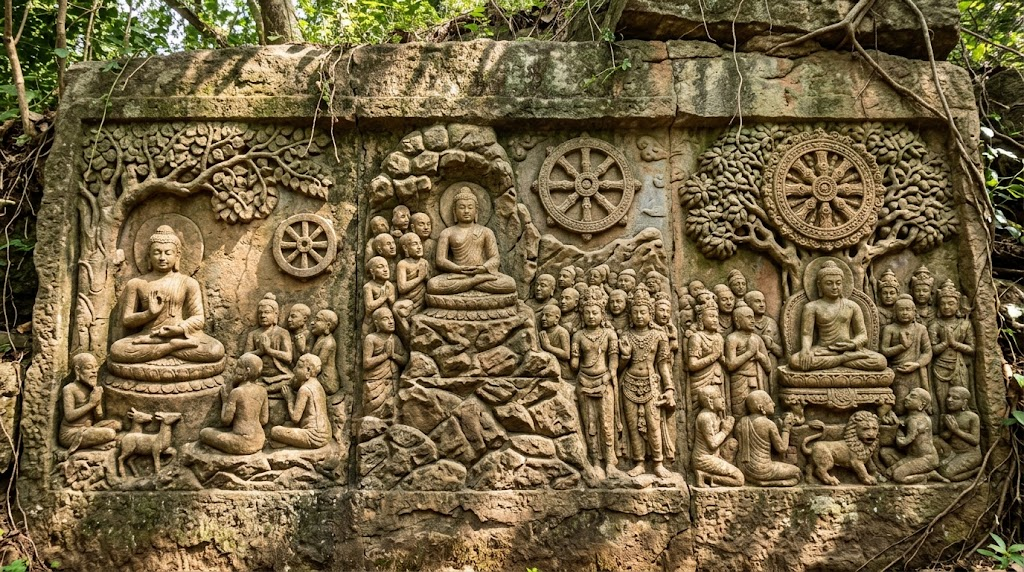
1. The Hermeneutical Problem of the Three Turnings
In the Saṃdhinirmocana Sūtra (The Sūtra Unraveling the Thought), the Buddha is depicted setting forth three successive dispensations of the Dharma, each tailored to distinct audiences, conceptual capacities, and historical junctures:[1]
- The First Turning (Sarnath / Deer Park): Centered on the Dhammacakkappavattana Sutta, introducing the Four Noble Truths, the Three Marks of Existence (anicca, dukkha, anattā), the Twelve Links of Dependent Origination (pratītyasamutpāda), and early Abhidharma analysis.
- The Second Turning (Vulture Peak / Rajgir): Centered on the Prajñāpāramitā (Perfection of Wisdom) literature, systematized by Nāgārjuna in the Madhyamaka school, establishing the radical emptiness (śūnyatā) of all phenomena and the total absence of inherent existence (svabhāva).
- The Third Turning (Vaishali / Mount Malaya): Centered on the Saṃdhinirmocana Sūtra and Tathāgatagarbha texts, systematized by Asaṅga and Vasubandhu in Yogācāra (Cittamātra / Vijñānavāda), introducing the Three Natures (trisvabhāva), the Storehouse Consciousness (ālayavijñāna), and the phenomenological nature of awareness.
The Sectarian Impulse: Neyārtha vs. Nītārtha
Historically, scholastic traditions constructed competitive doxographies (tenet systems or siddhānta) to crown their own school's preferred texts as definitive truth (nītārtha) while demoting rival teachings to provisional truth (neyārtha):
- The Gelug Madhyamaka Hegemony: Following Je Tsongkhapa, the Gelug tradition elevates the Second Turning (specifically Prāsaṅgika-Madhyamaka) as the supreme, definitive summit of Buddhist thought, categorizing Third Turning Yogācāra texts as provisional doctrines requiring interpretive re-reading.
- The Shentong and Yogācāra Reversal: Traditions emphasizing Buddha-nature and Yogācāra (such as the Jonang school) assert that the Third Turning represents the ultimate, luminous culmination of the path, dismissing the Second Turning as a purely deconstructive, incomplete negative dialectic.
- The Mahāyāna Deprecation of the First Turning: Early Mahāyāna polemics frequently disparaged First Turning teachings as "Hīnayāna" (lesser vehicle), treating the core foundational discourses as basic stepping stones designed solely for listeners incapable of grasping profound emptiness.
Garfield argues that this competitive hermeneutic obscures the organic unity of Buddhist philosophy.[2] [3] Deprecating any turning damages the coherence of the Dharma: discarding the First Turning abandons the path's ethical and existential rationale; discarding the Second Turning risks reifying mind into an absolute soul; discarding the Third Turning leaves practitioners without psychological tools to transform subjective cognitive distortion.
| Hermeneutic Dimension | Traditional Sectarian Ranking | Garfield's Non-Hierarchical Model |
|---|---|---|
| Organizing Logic | Vertical hierarchy (inferior to superior; provisional to definitive). | Horizontal complementarity (mutually interdependent perspectives). |
| Interpretive Axis | Doctrinal supremacy (nītārtha vs. neyārtha polemics). | Functional specialization (framework, object-analysis, subject-analysis). |
| Status of First Turning | Basic, provisional, historically superseded vehicle. | Indispensable existential foundation and practical bedrock for all practice. |
| Status of Second Turning | Either definitive summit (Madhyamaka) or barren nihilism (Shentong). | Rigorous deconstruction of external reality and objective essence (svabhāva). |
| Status of Third Turning | Either provisional mind-only heresy (Gelug) or supreme revelation (Jonang). | Phenomenological analysis of subjective cognitive construction and affective repair. |
| Pedagogical Outcome | Sectarian factionalism and scholastic gatekeeping. | Integrated, holistic contemplative ecology combining metaphysics and psychology. |
2. The Complementary Framework: Three Interlocking Perspectives
Rather than an ascending evolutionary ladder, Garfield reframes the three turnings as a three-dimensional philosophical system. Each turning investigates existence through a distinct, necessary lens.
| Dimension | First Turning (Foundational) | Second Turning (Madhyamaka) | Third Turning (Yogācāra) |
|---|---|---|---|
| Primary Discourse | Dhammacakkappavattana Sutta | Prajñāpāramitā Hṛdaya (Heart Sūtra) | Saṃdhinirmocana Sūtra |
| Core Philosophical Focus | General characterization of reality & suffering | Emptiness from the side of the object | Emptiness from the side of the subject |
| Ontological Target | Reification of the personal self (ātman) | Reification of intrinsic nature (svabhāva) in all entities | Reification of dualistic cognitive structures (grāhya-grāhaka) |
| Analytical Mechanism | Mereological decomposition & causal sequences | Reductio ad absurdum (prasaṅga) & tetralemma (catuṣkoṭi) | The Three Natures (trisvabhāva) & intentionality |
| Soteriological Work | Diagnosing craving & providing the path | Dissolving the conceptual grounds of egoism | Reprogramming mental habits & emotional reflexes |
The First Turning: The General Framework of Reality
Garfield insists that the Dhammacakkappavattana Sutta remains the single most important text in the history of Buddhist philosophy.[3:1] Rather than setting forth dogmatic religious creeds, the First Turning articulates a pragmatic phenomenological diagnosis of the human condition:
- Suffering as a Mental Reflex: Garfield analyzes duḥkha (unsatisfactoriness) not merely as physical discomfort, but as an involuntary cognitive reflex of superimposition (samāropa). Human consciousness instinctively projects permanence, stability, and substantiality onto impermanent, fluid processes. When reality fails to match these reified illusions, existential anxiety inevitably erupts.
- The Eightfold Path as Spheres of Concern: The Noble Eightfold Path is not a rigid list of moralistic commandments. In Garfield's reading, it represents eight interrelated domains of human agency—epistemic understanding, ethical intention, communicative expression, physical action, livelihood, attention, mindfulness, and cognitive stability. Liberative transformation requires aligning all eight domains with the reality of conditionality.
- Mereological Analysis (The Chariot Simile): Drawing on the foundational dialogue in the Milindapañha (where the monk Nāgasena deconstructs King Milinda's chariot), the First Turning introduces mereological reductionism. Just as a chariot is nothing more than an aggregation of wheels, axles, shafts, and reins held together by convention, the person is a dynamic aggregation of the five psycho-physical components (aggregates or skandhas). No self exists inside or behind the parts.
The Second Turning: Emptiness from the Side of Objects
While the First Turning demonstrates that composite entities and persons lack intrinsic selfhood, early scholastic Abhidharma thinkers attempted to rescue ontology by claiming that the ultimate building blocks of reality—the momentary dharmas—possess intrinsic existence (svabhāva). The Second Turning, initiated by the Prajñāpāramitā scriptures and systematized by Nāgārjuna, systematically dismantles this residual realism:[4] [5]
- The Heart Sūtra's Formula: Garfield unpacks the celebrated fourfold formula from the Heart Sūtra:
- "Form is emptiness": Physical phenomena lack independent, self-sufficient substance; their very being is entirely contingent upon parts, causes, and mental designations.
- "Emptiness is form": Emptiness is not a transcendent void, a vacuum, or a metaphysical substratum hidden behind phenomena; emptiness exists solely as the mode of being of concrete, dependently arisen forms.
- "Form is not other than emptiness; emptiness is not other than form": Reality and emptiness are coextensive. To encounter dependently originated appearance is to encounter emptiness directly.
- The Speaker of the Sūtra (Avalokiteśvara): Garfield highlights a crucial literary detail in the Heart Sūtra: the discourse on ultimate emptiness is delivered not by the Buddha, but by Avalokiteśvara, the Bodhisattva of Compassion, addressing Śāriputra, the master of Abhidharma scholasticism. This staging demonstrates that radical emptiness is inseparable from compassion. By showing that all phenomena lack intrinsic boundaries, the Second Turning dissolves the metaphysical partition between self and other, eradicating the rational foundation for self-centered hoarding.
- Dependent Origination as Emptiness: As developed in Nāgārjuna's Mūlamadhyamakakārikā, dependent origination is identity-neutral: because phenomena depend on conditions, they cannot be inherently real (svabhāva); because they lack inherent reality, they can freely arise, mutate, and perish in response to conditions. Emptiness does not annihilate the world; it enables causation, action, and liberation.
The Third Turning: Emptiness from the Side of the Subject
The Second Turning demonstrates that objects lack inherent reality, but it leaves an urgent psychological question unanswered: Why does the human mind stubbornly experience the world as populated by real, solid, self-existing entities? The Third Turning, articulated in the Saṃdhinirmocana Sūtra and Yogācāra philosophy, pivots internal: it examines the subjective cognitive architecture that projects these illusions.[6] [1:1]
Garfield clarifies that Yogācāra is frequently misunderstood as a naive metaphysical idealism or solipsism—the doctrine that physical reality does not exist and only cosmic mind exists. Instead, Garfield translates and interprets "Mind-Only" (Cittamātra / Vijñaptimātra) phenomenologically:[3:2] [6:1]
"Mind-Only is not an ontological claim that matter does not exist; it is an epistemological and soteriological realization that the mind is the only site where reality is constructed, and therefore the mind is the only thing you can directly work on."[3:3]
To map this cognitive architecture, the Third Turning articulates the Doctrine of the Three Natures (trisvabhāva).
3. The Three Natures (Trisvabhāva) in Practice
Garfield illustrates the Three Natures using everyday perceptual scenarios, such as perceiving a coffee cup on a table or experiencing sudden anger during an interpersonal conflict:
| Nature | Sanskrit Term | Philosophical Definition | Garfield's Everyday Perceptual Example (The Coffee Cup) | Applied Psychological Example (Working with Anger) |
|---|---|---|---|---|
| The Imagined Nature | Parikalpita-svabhāva | The reified dualism of independent subject and external object; cognitive distortion. | Superimposing a permanently existing, solid ceramic container "out there" distinct from an observer "in here." | Believing the other person is intrinsically offensive and possessing an offended, solid ego under assault. |
| The Other-Dependent Nature | Paratantra-svabhāva | The actual causally conditioned, interdependent flow of experience and neural-sensory events. | The causal sensory event: photons hitting retinas, tactile pressure, memory retrieval, and linguistic naming. | The contingent arising of physiological arousal, adrenaline, past conditioning, and verbal interaction. |
| The Consummated Nature | Pariniṣpanna-svabhāva | The realization that the other-dependent flow is completely empty of the imagined subject-object duality. | Recognizing that the sensory visual event occurs without a solid external essence or an isolated internal ego. | Recognizing that anger is an empty, transient affective storm without an intrinsic offender or victim. |
The Pragmatic Payoff: Working with Emotion
In Garfield's synthesis, the practical difference between the Second and Third Turnings becomes obvious when working with destructive emotions like anger:
- The Second Turning Intervention: When anger strikes, Madhyamaka dialectics analyze the object of anger. Is the person who insulted you identical to their physical body? Their vocal cords? Their intentions? Their reputation? Through rational deconstruction, one discovers that the "offender" lacks inherent reality, evaporating the external target.
- The Third Turning Intervention: Yogācāra phenomenological mindfulness analyzes the subjective side of the experience. It tracks how the mind actively manufactures the sensation of threat through internal narrative, storehouse karmic seeds (bīja), and defensive ego-grasping. By recognizing that the offense is a projection generated by the mind's own interpretive machinery, the practitioner refrains from feeding the flame, allowing the emotional state to self-liberate in open awareness.
4. Synthesis: The Non-Hierarchical Interdependence of the Three Turnings
By discarding sectarian competition, Garfield shows that the Three Turnings form an organic, mutually supportive system:[2:1] [3:4]
- Without the First Turning: Buddhist philosophy loses its moral grounding, its diagnosis of the existential predicament, and its ethical path. Without the Four Noble Truths and the Eightfold Path, Buddhist practice degrades into detached intellectual gamesmanship.
- Without the Second Turning: The Third Turning easily deteriorates into substantialist idealism or mystical eternalism. Without Madhyamaka deconstruction, practitioners inevitably reify consciousness (vijñāna), the storehouse consciousness (ālayavijñāna), or Buddha-nature (tathāgatagarbha) into a permanent, transcendent metaphysical Self.
- Without the Third Turning: The Second Turning's insight into emptiness remains a sterile, purely negative intellectual dialectic. Without Yogācāra's subtle phenomenological roadmap of cognitive mechanisms, perception, and affective transformation, practitioners struggle to translate the realization of emptiness into daily emotional freedom.
🎴 Interactive Web Practice (Comprehension Check)
Question 1 (Hermeneutics & Sectarian Critique): Why does Jay L. Garfield reject the traditional Indo-Tibetan practice of classifying the Three Turnings into definitive (nītārtha) and provisional (neyārtha) hierarchies, and what theological danger arises from deprecating any single turning?
Answer: Garfield rejects the traditional hierarchical classification because it reduces the Buddha's integrated teachings to competitive sectarian polemics. When schools like the Gelug elevate the Second Turning as the sole definitive truth and demote the Third Turning to provisional status, or when Shentong traditions reverse this ranking to dismiss Madhyamaka as incomplete negation, they obscure the complementary functionality of the Dharma.
Furthermore, deprecating any single turning introduces grave philosophical and practical errors:
- Deprecating the First Turning: Severs the tradition from its ethical bedrock (the Noble Eightfold Path) and its foundational diagnosis of human suffering (the Four Noble Truths).
- Deprecating the Second Turning: Risks turning Buddhist philosophy into eternalist idealism, where consciousness or Buddha-nature is reified into an absolute metaphysical substance.
- Deprecating the Third Turning: Leaves practitioners with an abstract, purely negative deconstructive logic (Madhyamaka) stripped of the phenomenological and psychological tools necessary to understand and dismantle subjective cognitive distortions in daily experience.
Question 2 (The Heart Sūtra & The Speaker of Wisdom): In Garfield's analysis of the Second Turning, what is the philosophical and soteriological significance of having Avalokiteśvara—the Bodhisattva of Compassion—deliver the Heart Sūtra rather than the historical Buddha or an Abhidharma scholar like Śāriputra?
Answer: In Garfield's reading of the Second Turning, the structural setting of the Heart Sūtra contains profound pedagogical meaning:
- Uniting Emptiness and Compassion: Avalokiteśvara is the archetypal embodiment of universal compassion. Having the Bodhisattva of Compassion expound radical emptiness (śūnyatā) establishes that emptiness is not an alienating nihilistic void, but the direct ontological ground of selfless compassion. Because all phenomena and persons are empty of intrinsic, isolated self-nature (svabhāva), the rigid dualistic boundary between "self" and "other" is revealed to be a conceptual fiction. Without inherent separation, egoistic grasping and indifference toward the suffering of others become irrational.
- Critique of Scholastic Dogmatism: Avalokiteśvara addresses Śāriputra, the foremost disciple representing the analytical rigor of early Abhidharma scholasticism. This confrontation signifies that mere intellectual categorization of dharmas into fundamental real elements is insufficient for liberation; conceptual schemas must themselves be recognized as empty of inherent existence to prevent scholastic analysis from becoming another form of cognitive attachment.
Question 3 (The Three Natures & Cognitive Transformation): How does Garfield use the cup example to explain the Three Natures (trisvabhāva) of the Third Turning, and why does this reframe Yogācāra from a metaphysical idealism into an actionable cognitive phenomenology?
Answer: Garfield uses the everyday experience of observing a cup on a desk to demonstrate the three dimensions of cognitive experience:
- The Imagined Nature (Parikalpita): The mind's automatic, unreflective reification of the scene into two inherently existing, independent entities: an isolated, autonomous subject "in here" looking out at a self-sufficient, solid physical object "out there." This subject-object duality is an illusory conceptual projection.
- The Other-Dependent Nature (Paratantra): The actual, causally conditioned stream of experience. This consists of sensory-neural events: photons striking the retina, neural firing, tactile sensations, memory recall, and linguistic naming occurring in dynamic interdependence without any static essence.
- The Consummated Nature (Pariniṣpanna): The direct apprehension that the other-dependent stream of experience is, and always has been, completely free of the imagined dualistic split between an isolated perceiver and an independent object.
This reframing demonstrates that Yogācāra is not metaphysical idealism (the absurd claim that physical objects vanish into thin air and only mind exists). Rather, it is a rigorous cognitive phenomenology: because our experience of reality is mediated entirely by subjective cognitive processes, the mind is the only place where suffering is manufactured, and therefore the only place where liberation can be achieved.
Resonant Notes
The following notes in the vault share direct thematic, philosophical, and contemplative connections with Jay L. Garfield's hermeneutics of the Three Turnings:
🔴 Madhyamaka, Dependent Origination & Emptiness
- Nāgārjuna — Garfield's landmark translation and philosophical commentary on the Mūlamadhyamakakārikā serves as the primary bridge connecting classical Indian Madhyamaka dialectics with modern analytic epistemology, providing the exact architectural foundation for Garfield's analysis of the Second Turning.
- Boltzmannian Coarse-Graining and Nagarjunian Emptiness — Explores how Nāgārjuna's Two Truths doctrine aligns with modern statistical physics; just as thermodynamic properties emerge through cognitive coarse-graining, conventional reality emerges through dependent designation without ultimate intrinsic essence.
- Two Kinds of Nothingness-Astrophysics and Buddhist Philosophy — Contrasts physical vacuums in cosmic inflation with Buddhist śūnyatā, illustrating Garfield's core thesis that emptiness is not ontological nothingness but relational, dependent arising.
- Stephen Batchelor — Batchelor's secular, task-oriented reworking of the Four Noble Truths resonates directly with Garfield's First Turning emphasis on the Dhammacakkappavattana Sutta as an active therapeutic diagnosis rather than metaphysical dogma.
🟡 Cognitive Phenomenology, Perception & Mind
- Constructs of the Mind-Unmasking Consciousness in East and West — Analyzes the cognitive mechanisms through which consciousness constructs internal models of reality, providing a direct Western and Eastern parallel to the Yogācāra Third Turning's Three Natures.
- Internal Time-Consciousness and Buddhist Psychology — Investigates how the flow of awareness generates the illusion of an enduring self, connecting Husserlian phenomenological temporality with the storehouse consciousness (ālayavijñāna) and reflexive awareness (svasaṃvedana).
- The Interface Theory of Perception (ITP) — Donald Hoffman's evolutionary theorem that perception serves as a species-specific desktop interface rather than a veridical mirror of objective reality mirrors Garfield's Yogācāra analysis of the imagined nature (parikalpita).
- Epistemology of Preference-Avijjā, Māna, and the Emptiness of Aesthetic Taste in Buddhist Philosophy — Examines how basic ignorance (avijjā) and conceit (māna) project inherent value onto external objects, aligning with Garfield's analysis of the cognitive reflex of superimposition.
- The Core Instruction - Turning the Gaze Inward — Details the contemplative methodology of investigating the subjective locus of perception, translating the Third Turning's analysis of consciousness into direct experiential praxis.
🟢 Ethics, Systems & Process Metaphysics
- Tibetan Wheel of Life — Visually maps the First Turning's Twelve Links of Dependent Origination, illustrating how subjective craving (tṛṣṇā) and ignorance (avidyā) drive cyclic mental rebirth in the absence of Second and Third Turning insights.
- The Noble Eightfold Path & Sīla - Buddhist Ethics — Articulates the indispensable ethical foundation that Garfield insists must never be discarded or demoted as merely provisional when studying advanced Mahāyāna philosophy.
- Time as Change & Carlo Rovelli — Relational quantum mechanics and thermal time theory echo Garfield's Second Turning analysis of dependent origination: things do not possess intrinsic properties in isolation; they exist strictly through relations.
- Martin Heidegger — Heidegger's deconstruction of the Cartesian subject into Dasein (being-in-the-world) mirrors Garfield's argument in Losing Ourselves that we are relational, narrative persons rather than permanent metaphysical selves.[7]
- Schopenhauerian Pessimism — Schopenhauer's diagnosis of the insatiable Will as the root of existential suffering parallels Garfield's First Turning analysis of craving, while Schopenhauer's ascetical and aesthetic deliverance echoes Buddhist liberation from reified grasping.
Backlinks
- Nāgārjuna — Garfield's non-hierarchical interpretation provides a comprehensive balance to Nāgārjuna's Second Turning deconstruction, contextualizing Madhyamaka alongside Yogācāra subjective phenomenology.
- Tibetan Wheel of Life — The Wheel of Life serves as the graphic cosmological encoding of the First Turning's Twelve Links, while Garfield's reading demonstrates how the Second and Third Turnings deconstruct the hub of the wheel.
- The Noble Eightfold Path — Garfield's interpretation of the Eightfold Path as eight interconnected domains of concern redeems First Turning praxis from being deprecated by advanced philosophical schools.
- Constructs of the Mind-Unmasking Consciousness in East and West — Garfield's analysis of the Three Natures provides the technical Buddhist vocabulary for the subjective reality-generation models explored throughout this note.
References
John Powers / Hermeneutics and Tradition in the Saṃdhinirmocana-sūtra / State University of New York Press (1993) ↩︎ ↩︎
Jay L. Garfield / Empty Words: Buddhist Philosophy and Cross-Cultural Interpretation / Oxford University Press (2002) ↩︎ ↩︎
Jay L. Garfield / Engaging Buddhism: Why It Matters to Philosophy / Oxford University Press (2015) ↩︎ ↩︎ ↩︎ ↩︎ ↩︎
Jay L. Garfield / The Fundamental Wisdom of the Middle Way: Nāgārjuna's Mūlamadhyamakakārikā / Oxford University Press (1995) ↩︎
Jan Westerhoff / Nāgārjuna's Madhyamaka: A Philosophical Introduction / Oxford University Press (2009) ↩︎
Dan Lusthaus / Buddhist Phenomenology: A Philosophical Investigation of Yogācāra Buddhism and the Ch'eng Wei-shih Lun / RoutledgeCurzon (2002) ↩︎ ↩︎
Jay L. Garfield / Losing Ourselves: Learning to Live without a Self / Princeton University Press (2022) ↩︎