Émile Durkheim - Sociology of Chaos
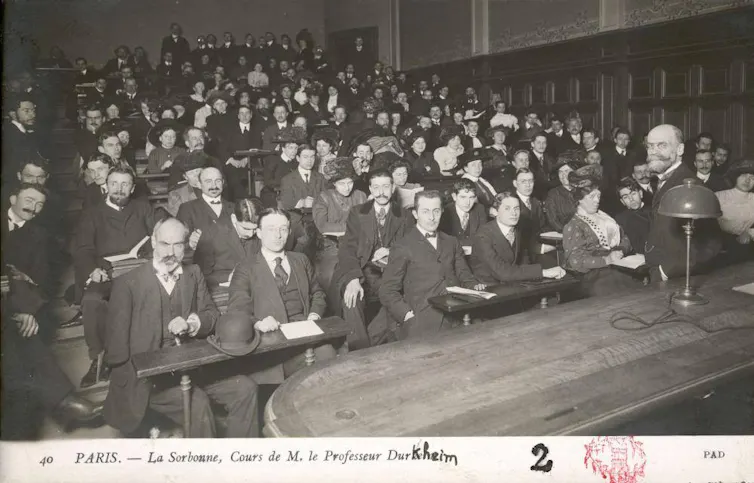
Pioneering sociologist foresaw our current chaos 100 years ago
The Conversation — Émile Durkheim's concepts of anomie, social facts, and the sacred offer a powerful diagnosis of modern social and political turbulence.

Summary
"Pioneering sociologist foresaw our current chaos 100 years ago" — Galen Watts, The Conversation (Nov 12, 2018)
The article argues that Émile Durkheim's sociological concepts — developed over a century ago — remain urgently relevant for understanding today's social and political turbulence, from rising authoritarianism to the erosion of shared norms.
Social facts
Durkheim introduced the idea that society is composed not just of individuals but of social facts — structures, norms, and institutions that shape individual action and thought from the outside. His study of Suicide demonstrated that suicide rates reflect social cohesion, not just individual psychology: Protestant countries had higher rates than Catholic ones because Protestantism encouraged individualism while Catholicism fostered collectivism.
The problem of anomie
Durkheim foresaw that the shift from premodern to modern society would bring both emancipation and a radical erosion of social ties. He called this condition anomie — a state of "normlessness" — and considered it the core pathology of modern life. His career was devoted to reconciling individual freedom with the need for community.
The sacred and social solidarity
In his later work, Durkheim came to see religion as a social fact — a system of beliefs and practices that unites people into a moral community. The key concept is the sacred: unquestionable, binding, and set apart. Wherever you find the sacred, you find religion in Durkheim's sense — whether in sports fandom, environmentalism, art, or political movements.
The sacred is necessary for social bonding, but it can also be dangerous — it appears in hate groups and nationalism as well as progressive movements. Durkheim's great dilemma: how to construct a shared conception of the sacred that binds us together for the common good without falling prey to the violence and exclusion inherent to the sacred itself.
Key takeaway
Durkheim's question — how to build social solidarity in liberal democracies without sacrificing individual freedom — remains as urgent today as it was a century ago.
🎴 Interactive Web Practice (Comprehension Check)
Question 1 (Social Facts & Methodology): What are "social facts" in Durkheim's sociology, and how did his landmark study of suicide demonstrate their influence over individual behavior?
Answer: Social facts are external structures, norms, and institutions that exert coercive influence over individual thought and action. Rather than treating suicide as a purely subjective psychological act, Durkheim demonstrated through comparative empirical analysis that suicide rates correlate directly with levels of social cohesion and integration—evidenced by higher rates in individualistic Protestant societies compared to collectivist Catholic communities.
Question 2 (Modern Pathology & Anomie): How does Durkheim define "anomie," and why did he consider it the core pathology of modern life?
Answer: Durkheim defined anomie as a condition of "normlessness" arising from the rapid transition from premodern to modern society. While this transition brought individual emancipation, it also dissolved traditional communal bonds and moral guardrails. Without shared norms and moral regulation to anchor desires and expectations, individuals experience profound alienation and disorientation, leaving societies vulnerable to instability and chaos.
Question 3 (The Sacred & Collective Solidarity): In what ways does Durkheim's concept of the "sacred" extend beyond traditional religion, and what central dilemma does it create for modern liberal democracies?
Answer: Durkheim identified religion as any system of beliefs and practices centered on the "sacred"—elements that are set apart, binding, and unquestionable. This dynamic operates across secular domains such as political ideologies, sports fandom, or environmentalism. While the sacred is essential for forging moral solidarity and community cohesion, it also risks fueling tribalism, nationalism, and violent exclusion. The enduring dilemma for liberal democracies is cultivating a shared conception of the sacred that unites citizens for the common good without triggering this destructive sectarianism.
Vault connections
- Durkheimian Sociology — The main vault note on Durkheim's theoretical tradition, covering social facts, collective consciousness, anomie, and the sacred-profane distinction.
- David Émile Durkheim (1858–1917) — Biographical note on Durkheim's life, major works, and intellectual legacy.
- Structural Functionalism — Durkheim is the foundational theorist of structural functionalism, providing the core concepts that later theorists systematized.
- The Social Construction of Reality - A Treatise in the Sociology of Knowledge — Berger and Luckmann's social constructionism builds on Durkheim's insight that social reality is sui generis — a distinct level of reality irreducible to individual consciousness.
- The Organic Analogy — Durkheim's organic solidarity refines the organic analogy by showing how modern societies cohere through functional interdependence.