Walter Benjamin's The Arcades Project
Walter Benjamin's The Arcades Project (Das Passagen-Werk), composed in Paris between 1927 and his death in 1940, is a sprawling, unfinished materialist investigation into the cultural, economic, and architectural origins of capitalist modernity.[1] Organized as an intricate literary montage of thousands of archival citations and philosophical fragments grouped into thematic files called "convolutes," the work treats the iron-and-glass shopping arcades of nineteenth-century Paris as the primal blueprint of consumer capitalism, urban alienation, and modern historical consciousness.[2]
Historical Genesis and Compositional Trajectory
The Arcades Project originated in 1927 as a modest collaboration between Walter Benjamin and the journalist Franz Hessel to write a short essay on the passages couverts—the covered pedestrian passageways of Paris that were rapidly falling into obsolescence.[2:1] Deeply influenced by Louis Aragon's Surrealist novel Paris Peasant (Le Paysan de Paris, 1926) within The Avant-Garde, which celebrated the decaying Passage de l'Opéra as a dreamscape of modern mythology, Benjamin soon realized the subject demanded a vastly expanded philosophical framework.[2:2]
Working tirelessly beneath the painted summer sky of the ceiling mural in the Bibliothèque Nationale in Paris, Benjamin transformed the essay into what he called "the theater of all my struggles and all my ideas".[1:1] Across thirteen years of research, the project evolved through two distinct phases:
- The Early Metaphysical-Surrealist Phase (1927–1930): Focused on collective dream states, Surrealist intoxication, and the enchanted phenomenology of decaying urban commodities.[2:3]
- The Mature Historical-Materialist Phase (1934–1940): Following his exile from Nazi Germany in 1933 and increasing affiliation with the Institute for Social Research (the Frankfurt School) alongside figures like Theodor W. Adorno, Benjamin anchored his observations in Marxist critique, producing two programmatic summaries known as the Exposés of 1935 and 1939 ("Paris, the Capital of the Nineteenth Century").[3]
When German forces marched toward Paris in June 1940, Benjamin entrusted his massive manuscript to Georges Bataille, then an archivist at the Bibliothèque Nationale, who hid the papers inside the library until the end of World War II. Benjamin fled south and died by suicide at the Franco-Spanish border in Portbou in September 1940, leaving the work forever unfinished.[1:2]
Methodological Architecture: The Convolutes and Literary Montage
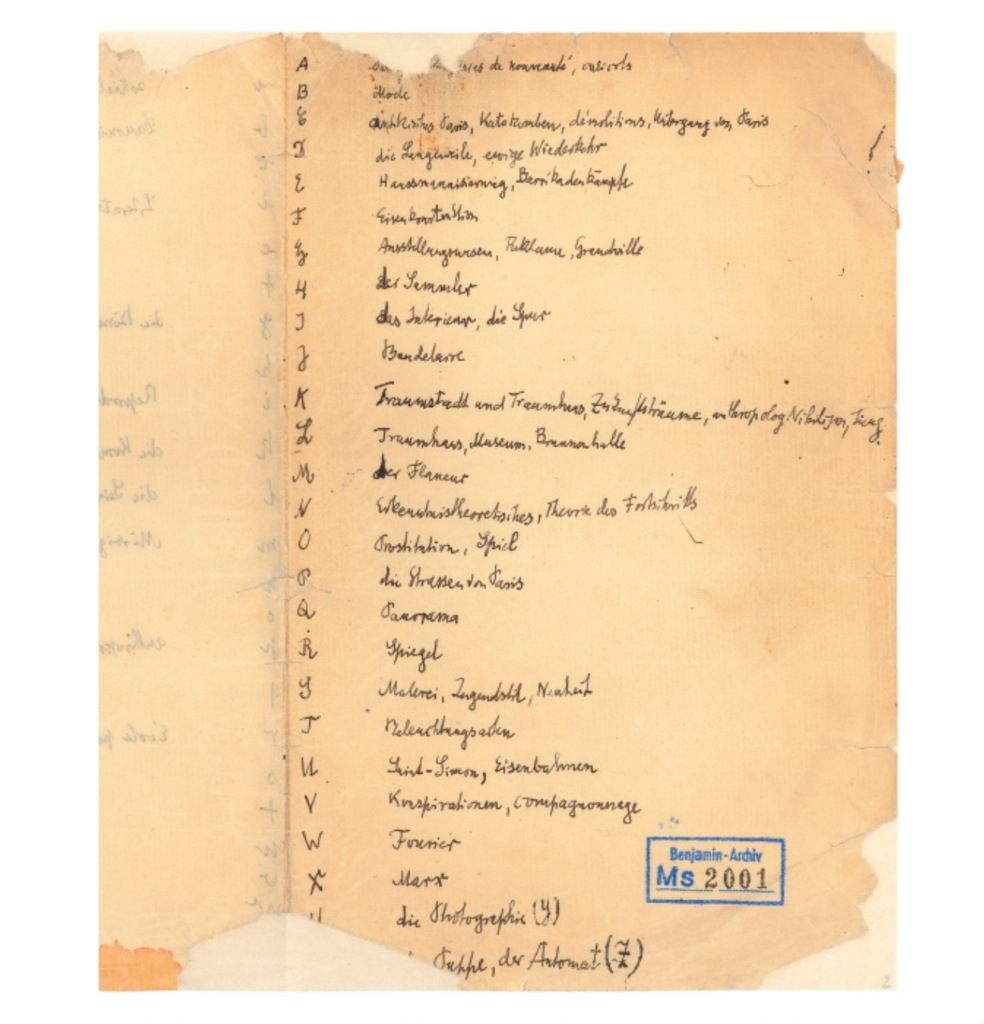
Rather than composing a linear narrative, Benjamin constructed The Arcades Project as a vast experimental apparatus organized into 36 alphabetized folders, translated from the German Konvolute (meaning "bundles" or "sheafs" of manuscripts) as Convolutes (labeled A through Z, and a through w).[2:4]
| Structural Stage | Architectural Component | Methodological & Epistemological Function |
|---|---|---|
| I. Archival Substratum | 19th-Century Archival Fragments & Commentary | Archival citations, newspaper clippings, police dossiers, architectural pamphlets, and aphoristic reflections. |
| II. Categorical Taxonomy | Thematic Convolutes (Folders A–Z, a–w) | Thematic clustering around key archetypes and motifs (arcades, fashion, flânerie, iron construction, Baudelaire). |
| III. Compositional Praxis | Literary Montage Technique | Spatial juxtaposition without authorial moralizing; historical collisions replacing linear causality. |
| IV. Epistemological Telos | The Dialectical Image (Dialektik im Stillstand) | Sudden constellation between past and present, sparking historical awakening from the capitalist dream-sleep. |
The Art of Citation without Quotation Marks
In Convolute N ("On the Theory of Knowledge, Theory of Progress"), which serves as the epistemological engine of the entire work, Benjamin explicitly rejects traditional bourgeois historicism in favor of literary montage—a radical methodology that prefigures modern developments in Uncreative Writing-Managing Language in the Digital Age and Unoriginal Genius-Poetry by Other Means in the New Century.[4] He writes that the method of his project is to "carry over the principle of montage into history" and to assemble large-scale constructions out of the smallest, most precisely cut architectural components.[4:1]
- Juxtaposition over Linear Causality: By placing forgotten nineteenth-century newspaper clippings, police reports, architectural treatises, and poetry alongside his own sharp aphorisms, Benjamin sought to let the historical fragments speak through their collision rather than through authoritarian commentary.[2:5]
- Refusal of Empathy: In direct continuity with Walter Benjamin’s Theses on the Philosophy of History, the materialist historian refuses to empathize with the victors of history; instead, he salvages the discarded detritus and cultural "refuse" of the past to reveal the hidden violence and utopian longings buried within everyday objects.[2:6]
Major Thematic Convolutes
| Convolute | Title / Theme | Core Analytical Focus |
|---|---|---|
| Convolute A | Arcades, Magasins de Nouveautés, Sales Clerks | The emergence of iron-and-glass commercial corridors and early luxury retail.[2:7] |
| Convolute B | Fashion | The eternal return of the new; fashion as a compact between the living body and the inorganic commodity fetish and Kitsch.[1:3] |
| Convolute E | Haussmannization, Barricade Fighting | Baron Haussmann's "strategic beautification" of Paris designed to prevent proletarian insurrections, analyzed as spatial estrangement in Anthony Vidler-The Architectural Uncanny.[3:1] |
| Convolute F | Iron Construction | The tension between engineering functionality (iron and glass) and classical architectural ornamentation, anticipating The Bauhaus School.[2:8] |
| Convolute H | The Collector | The redemptive act of detaching objects from their utilitarian market value into a private historical system.[5] |
| Convolute J | Baudelaire | Charles Baudelaire as the lyric poet of high capitalism, allegory, and urban shock.[6] |
| Convolute K | Dream City and Dream House, Dreams of the Future | The nineteenth century as a collective dream state requiring historical awakening, engaging Freud's The Uncanny (Das Unheimliche).[5:1] |
| Convolute M | The Flâneur | The flâneur: the alienated urban stroller, the physiognomy of the crowd, and the transformation of the intellectual into a commodity.[6:1] |
| Convolute N | On the Theory of Knowledge, Theory of Progress | Epistemological foundations: the dialectical image, montage, and the critique of linear progress elaborated in Walter Benjamin’s Theses on the Philosophy of History.[4:2] |
Core Philosophical Concepts
1. The Dialectical Image and "Dialectics at a Standstill"
The central category of The Arcades Project is the dialectical image (dialektisches Bild).[2:9] Against both positivist historicism (which views the past as a fixed sequence of facts) and vulgar Marxism (which assumes an automatic, linear march of technological progress), Benjamin argues that true historical comprehension occurs in a sudden, lightning-like flash.[4:3]
"It is not that what is past casts its light on what is present, or what is present its light on what is past; rather, image is that wherein what has been comes together in a flash with the now to form a constellation. In other words: image is dialectics at a standstill." — Walter Benjamin, Convolute N2a, 3.[4:4]
In this moment of arrest, the temporal continuum is blasted open. The "What-has-been" collides with the "Now of Recognizability" (Jetzt der Erkennbarkeit), exposing the mythic illusion of capitalist progress as an ongoing catastrophe—an insight immortalized through the allegory of the Angel of History inspired by Paul Klee's Angelus Novus in Walter Benjamin’s Theses on the Philosophy of History.[5:2]
2. Phantasmagoria and the Commodity Fetish
Expanding upon Karl Marx's analysis of commodity fetishism in Capital, Benjamin introduces the concept of phantasmagoria—originally a late eighteenth-century magic-lantern theater that projected ghostly illusions onto smoke by hiding the mechanical projector from the audience.[3:2]
- Ideological Enchantment: In nineteenth-century Paris, the arcades, World Exhibitions (Expositions Universelles), panoramas, and department stores functioned as vast phantasmagorias.[2:10] They surrounded commodities with a theological halo of luxury and novelty, obscuring the exploited human labor that produced them and mesmerizing the urban masses into passive consumerism—a dynamic that prefigures Jean Baudrillard's hyperreality in Defining a Simulacrum and Don DeLillo's critique of corporate consumer spectacles.[2:11]
- The Bourgeois Interior: As public space became thoroughly commercialized, the private bourgeois apartment evolved into a velvet-lined fortress—a protective casing filled with plush cushions, taxidermy, and knick-knacks where the property owner sought refuge from the ruthless anonymity of the market, inducing the domestic estrangement detailed in Anthony Vidler-The Architectural Uncanny.[6:2]
3. Collective Dreaming and Historical Awakening
In Convolute K, Benjamin adapts Sigmund Freud's psychoanalytic dream-work to the collective consciousness of social classes.[5:3] He posits that the material culture of the nineteenth century—its iron train stations, winter gardens, and glass-roofed passages—was the physical crystallization of a sleeping collective dreaming of a classless utopia, yet trapped within the nightmare of capital.[5:4]
For Benjamin, the task of the historian is analogous to the interpreter of dreams: not merely to admire the dream-world of the past, but to trigger a sudden awakening (Erwachen) in the present generation so they can seize their historical moment politically.[5:5]
Urban Spatiality and Social Typologies
Benjamin populates the architectural stage of Paris with a gallery of threshold figures (Schwellenkundige) who embody the contradictions of modernity.[2:12]
The Architecture of the Arcades
Constructed largely during the textile boom of the 1820s and 1830s, the Parisian arcades were glass-roofed, marble-paneled corridors cutting through entire blocks of buildings.[2:13]
- Ambiguity of Space: The arcade is neither fully inside nor fully outside; it transforms the exterior street into a domestic interior while turning the interior shop into a public thoroughfare, embodying the dialectic of transparency explored in From Walls of Wood to Walls of Glass - Northrop Frye’s Geography of Isolation.[6:3]
- Technological Threshold: Utilizing industrial iron as a structural skeleton for the first time, architects nonetheless disguised the revolutionary building material as classical Greek columns and Pompeii-style frescoes—demonstrating how new productive forces are initially trapped inside archaic mythic forms, an aesthetic tension later resolved by The Bauhaus School.[2:14]
The Flâneur, the Collector, and the Gambler
- The Flâneur: Immortalized by Charles Baudelaire and rooted in Edgar Allan Poe's "The Man of the Crowd," The flâneur is the gentleman stroller who treats the bustling metropolis as his personal drawing room.[6:4] Around 1839, it was even considered fashionable for flâneurs to walk live tortoises on leashes through the arcades to protest the frantic speed of industrial Taylorism and street traffic.[5:6] Yet the flâneur's detachment is an illusion: as Georg Simmel (1858-1918) demonstrated in The Metropolis and Mental Life, the urbanite must adopt a "blasé attitude" to survive sensory shock. As the arcades gave way to giant department stores, the stroller's idle gaze was co-opted into window-shopping, and as a freelance writer or journalist, he too entered the marketplace to sell his observations as a commodity.[6:5]
- The Collector: Standing in opposition to the consumer, the collector (explored in Convolute H) rescues objects from the degradation of the market by stripping them of both their practical use-value and their monetary exchange-value, integrating them into a curated historical cosmos.[5:7]
- The Gambler and the Ragpicker: While the gambler mirrors the factory worker through the repetitive, empty reflex of placing bets against the clock of fate, the ragpicker (chiffonnier) serves as a double for the materialist poet-historian—scavenging the city's discarded scraps at dawn to construct an alternative history of civilization, a figure whose dark modern foil re-emerges in Travis Bickle.[2:15]
Haussmannization and the Destruction of Old Paris
During the Second Empire under Napoleon III, Prefect of the Seine Baron Georges-Eugène Haussmann demolished large swaths of medieval, working-class Paris—including many early arcades—to construct wide, straight boulevards lined with uniform neoclassical facades. Benjamin analyzes what Haussmann termed "strategic beautification": the boulevards were engineered specifically to prevent the erection of revolutionary street barricades and to provide clear lines of artillery fire and rapid troop deployment from railway terminals directly into the heart of working-class neighborhoods.[3:3] As detailed by Anthony Vidler-The Architectural Uncanny, this spatial surgery induced widespread metropolitan agoraphobia and displaced thousands of proletarian citizens. Despite these state interventions, the Paris Commune of 1871 resurrected the barricade one final, heroic time before its brutal suppression.[3:4]
Reception and Editorial Legacy
Following the end of World War II, Bataille handed the hidden manuscripts to Theodor W. Adorno, who brought them to Frankfurt.[3:5] Because Benjamin wrote in microscopic script across dozens of notebooks and loose sheets using complex alphanumeric filing codes, the work remained largely inaccessible for decades.[1:4]
It was first published in full in German in 1982 as Volume V of Benjamin's Gesammelte Schriften by Suhrkamp Verlag under the meticulous editorship of Rolf Tiedemann, and subsequently translated into English in 1999 by Howard Eiland and Kevin McLaughlin for Harvard University Press.[3:6] Since its publication, The Arcades Project has stood as a foundational cornerstone of media theory, urban geography, architectural history, and critical theory—directly anticipating Marshall McLuhan's insights in McLuhan's The Medium is the Message, contemporary discussions of hypertext, database aesthetics in Unoriginal Genius-Poetry by Other Means in the New Century, and critiques of spectacle capitalism and digital modulation in Postscript on the Societies of Control.[1:5]
Resonant Notes
The following notes in the vault share direct thematic, sociological, and literary connections with Walter Benjamin's The Arcades Project:
🔴 Critical Theory, Commodity Fetishism & Historiography
- Walter Benjamin (1892–1940) — The overarching biographical and philosophical portrait of Benjamin, framing The Arcades Project as the thirteen-year crucible synthesizing his Jewish messianism, Western Marxism, and Parisian cultural criticism.
- Walter Benjamin’s Theses on the Philosophy of History — The culminating 1940 theoretical companion to The Arcades Project, crystallizing Convolute N's critique of homogeneous, empty time into the revolutionary concept of Jetztzeit and the allegory of the Angel of History.
- The Work of Art in the Age of Mechanical Reproduction — Benjamin’s landmark 1935 essay written in the orbit of The Arcades Project, analyzing how industrial reproduction liquidates the traditional "aura" and transforms sensory perception from contemplative absorption into distracted mass reception.
- Karl Marx - Economic and Philosophic Manuscripts of 1844 — Marx's early formulation of alienated labor (Entfremdung) and commodity fetishism, which Benjamin translates into the spatial and architectural reality of the 19th-century Parisian arcades.
- Continental Philosophy — Locates Benjamin's dialectical materialism within the broader Continental genealogy, linking his micrological critique of modernity to Frankfurt School Critical Theory and French structuralism.
- Paul Klee (1879–1940) — Modernist artist whose watercolor Angelus Novus provided Benjamin with the physical embodiment of the Angel of History, gazing backward upon the catastrophic wreckage of capitalist progress.
- Michel Foucault — Foucault's archaeological and genealogical methods directly inherit Benjamin’s commitment to excavating subjugated knowledges and institutional histories "against the grain."
- Postscript on the Societies of Control — Gilles Deleuze's diagnosis of how disciplinary enclosures mutate into continuous corporate modulation, extending Benjamin's analysis of the arcade and department store into digital surveillance capitalism.
🟡 Urban Modernity, Flânerie & Spatial Architecture
- The flâneur — The central sociological archetype of The Arcades Project, tracing the tragic transformation of Baudelaire's sovereign street philosopher into an alienated commodity domesticated by the modern department store.
- The Painter of Modern Life, a seminal 1863 essay by French poet and art critic Charles Baudelaire — Charles Baudelaire's foundational treatise defining modernity as the ephemeral and fugitive, serving as the central poetic and allegorical source material across Benjamin's convolutes.
- Anthony Vidler-The Architectural Uncanny — Vidler draws extensively on Benjamin's arcades and Haussmann's urban surgery to theorize metropolitan estrangement, agoraphobia, and the uncanny spaces (unheimlich) of capitalist modernity.
- Georg Simmel (1858-1918) & The Metropolis and Mental Life — Simmel's sociological diagnosis of metropolitan sensory overstimulation and the protective "blasé attitude" provides the psychological foundation for Benjamin's flâneur confronting the urban crowd.
- The Philosophy of Money (Philosophie des Geldes) & Georg Simmel's concept of The Stranger — Simmel's examination of monetary abstraction and the stranger's dialectic of proximity and remoteness directly mirror the flâneur's ambivalent status in the marketplace.
- Edgar Allan Poe (1809-1849) — Author of "The Man of the Crowd," analyzed by Baudelaire and Benjamin as the first literary depiction of the solitary individual experiencing the vertigo and moral opacity of the metropolitan throng.
- From Walls of Wood to Walls of Glass - Northrop Frye’s Geography of Isolation — Frye's spatial critique of architectural enclosure and glass transparency explores the isolation of modern urban dwellers, echoing Benjamin's analysis of the iron-and-glass arcade.
- Virginia Woolf — Woolf adapts the peripatetic flâneur into the modernist flâneuse in essays like "Street Haunting" and Clarissa Dalloway's London walks, capturing the fleeting sensory kaleidoscope of the modern street.
- Travis Bickle — Scorsese and Schrader's alienated cab driver represents a toxic, mechanized distortion of the flâneur and ragpicker, drifting through nocturnal urban decay in search of cathartic violence.
🟢 Citational Poetics, Media Ecology & Avant-Garde Methodologies
- The Avant-Garde & Peter Bürger-Theorie der Avantgarde — Traces the historical avant-garde's effort to reintegrate art into life practice, clarifying Benjamin's Surrealist roots in Louis Aragon's Paris Peasant and his radical montage technique.
- Uncreative Writing-Managing Language in the Digital Age & Unoriginal Genius-Poetry by Other Means in the New Century — Goldsmith and Perloff identify The Arcades Project as the paramount 20th-century prototype for conceptual writing, citational poetics, database aesthetics, and hypertextual assembly.
- Marshall McLuhan (1911-1980) & McLuhan's The Medium is the Message — Media ecological theory analyzing how technological environments and communication infrastructures reshape human sensory ratios, building directly upon Benjamin's analysis of the optical unconscious and industrial architecture.
- Defining a Simulacrum — Jean Baudrillard's hyperreality—where models and copies precede the real—marks the contemporary evolution of Benjamin's 19th-century commodity phantasmagoria.
- Don DeLillo Major Themes Analysis — DeLillo’s postmodern fiction updates Benjamin’s critique of the crowd, commodity spectacles, and historical trauma within late consumer capitalism and media saturation.
- The Bauhaus School — Weimar design movement that embraced industrial materials like iron and glass, overcoming the historicist masking that Benjamin diagnosed in 19th-century arcade architecture.
- Freud's The Uncanny (Das Unheimliche) & Sigmund Freud — Freudian psychoanalysis provides Benjamin with the categories of dream-work, repression, and the uncanny, used to decode the collective unconscious of 19th-century bourgeois society.
- Kitsch — Clement Greenberg’s critique of synthetic, pre-digested cultural commodities directly connects to Benjamin's analysis of fashion and mass luxury in Convolute B as the eternal return of the new.
Backlinks
- Walter Benjamin (1892–1940) — The central biographical and philosophical profile detailing Benjamin's Parisian exile, his dialectical method, and The Arcades Project as his unfinished magnum opus.
- The flâneur — Dedicated sociological study of the metropolitan stroller, examining Benjamin's critique of the flâneur's commodification and domestication by the department store.
- The Painter of Modern Life, a seminal 1863 essay by French poet and art critic Charles Baudelaire — Foundational aesthetic text establishing the flâneur and modern beauty, which Benjamin analyzed as the lyrical mirror of high capitalism.
- Walter Benjamin’s Theses on the Philosophy of History — Formulates the philosophical methodology of Jetztzeit, dialectical arrest (Stillstellung), and the critique of progress developed in Convolute N.
- The Work of Art in the Age of Mechanical Reproduction — Companion essay examining the liquidation of the ritual aura, tactile distraction, and sensory shock produced by industrial media.
- Anthony Vidler-The Architectural Uncanny — Explores how the covered glass arcades and Haussmann's boulevards turned 19th-century Paris into an alienating labyrinth of spatial anxiety.
- Unoriginal Genius-Poetry by Other Means in the New Century — Examines Benjamin's convolutes as the primary precursor to 21st-century citational poetics and conceptual compilation.
- Uncreative Writing-Managing Language in the Digital Age — Treats The Arcades Project as the historical forebear of digital database management, uncreative transcription, and literary montage.
- Don DeLillo Major Themes Analysis — Postmodern examination extending Benjamin's concepts of commodity phantasmagoria, crowds, and historical disaster into late-capitalist media culture.
References
Harvard University Press / The Arcades Project by Walter Benjamin / hup.harvard.edu ↩︎ ↩︎ ↩︎ ↩︎ ↩︎ ↩︎
Walter Benjamin (Translators' Foreword by Howard Eiland and Kevin McLaughlin) / The Arcades Project / voidnetwork.gr ↩︎ ↩︎ ↩︎ ↩︎ ↩︎ ↩︎ ↩︎ ↩︎ ↩︎ ↩︎ ↩︎ ↩︎ ↩︎ ↩︎ ↩︎ ↩︎
Walter Benjamin (Edited by Rolf Tiedemann) / The Arcades Project: Overview and Bibliographic Data / scribd.com ↩︎ ↩︎ ↩︎ ↩︎ ↩︎ ↩︎ ↩︎
Walter Benjamin / Arcades Project Convolute N: On the Theory of Knowledge, Theory of Progress / platypus1917.org ↩︎ ↩︎ ↩︎ ↩︎ ↩︎
Goodreads Literary Archives / The Arcades Project: Convolute Citations and Commentary / goodreads.com ↩︎ ↩︎ ↩︎ ↩︎ ↩︎ ↩︎ ↩︎ ↩︎
University of Pennsylvania Department of English / The Vertical Flâneur: Joyce and Benjamin / english.upenn.edu ↩︎ ↩︎ ↩︎ ↩︎ ↩︎ ↩︎