McLuhan's The Medium is the Message
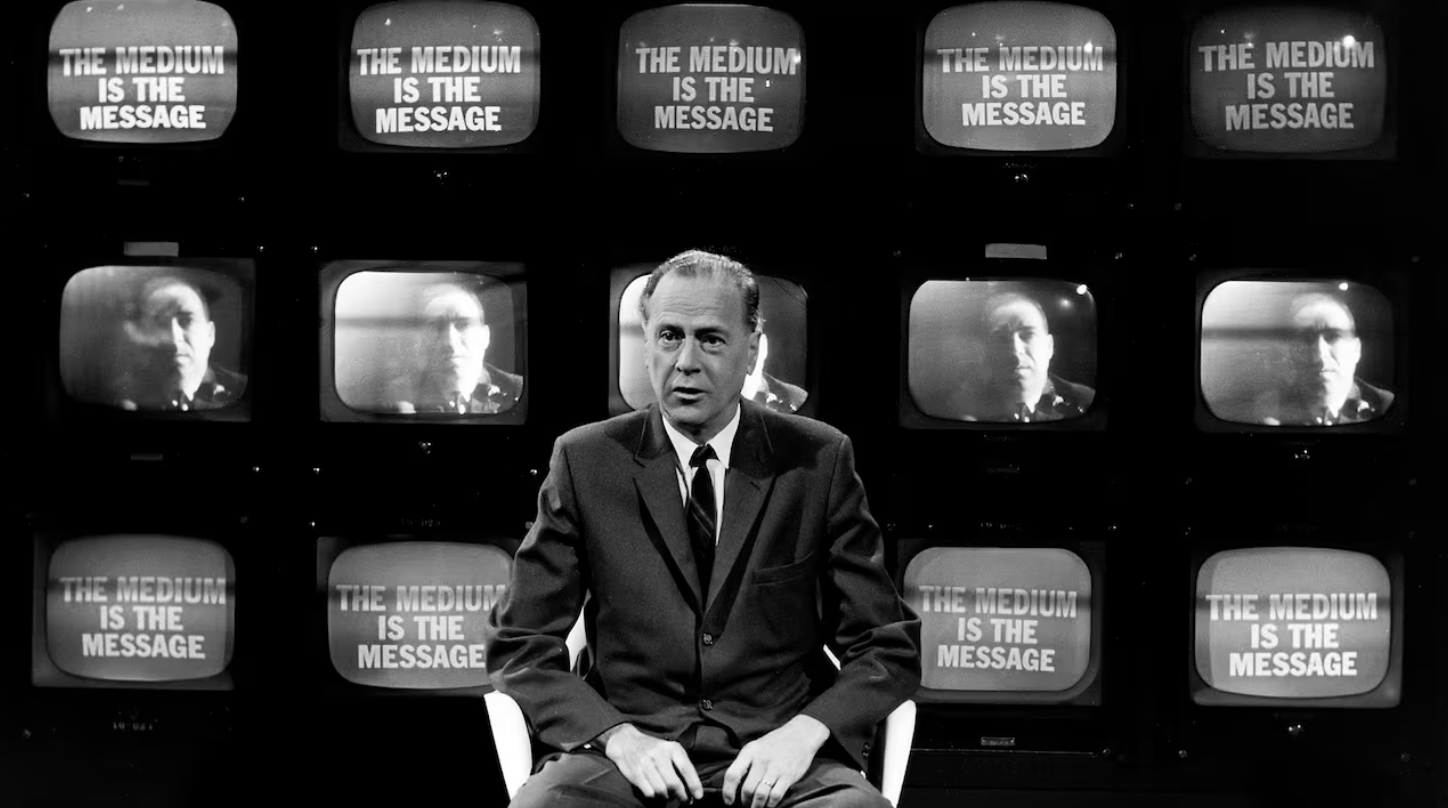
Marshall McLuhan’s foundational thesis—"the medium is the message"—posits that the structural architecture, scale, and pace of a communication medium restructure human cognition and social organization far more profoundly than whatever explicit content it transmits. In the modern ecosystem, digital interfaces, algorithmic feeds, and workplace messaging tools operate not as passive transmission conduits, but as an immersive environmental surround engineering continuous partial attention, sensory re-tribalization, and cognitive capture.
1. The Core Idea: Why the Container Matters More Than the Content
Marshall McLuhan's central insight is that the structural characteristics of a communication medium are far more consequential than the explicit content it carries. A medium introduces "a change of scale, pace, or pattern into human association," acting as an environmental force that restructures consciousness and social organization.[1] The content is merely "a juicy piece of meat carried by the burglar to distract the watchdog of the mind"—society becomes consumed with arguing about what is on the screen while the platform itself is quietly rewiring neural and cultural architecture.[2]
2. How It Has Shaped Work and Digital Labor
The medium of digital work tools has fundamentally restructured the nature of labor itself:
-
The Inbox as Environment: Email and enterprise messaging apps (such as Slack and Microsoft Teams) are not neutral conduits for organizational directives. Their structural characteristics—asynchronous, interrupt-driven, and infinite—have reshaped the pace and pattern of work. Constant connectivity introduces what the Neuroproductivity note terms "continuous partial attention"—always connected, never fully present. The medium's implicit message is that work is never finished, temporal and spatial boundaries are dissolved, and perpetual responsiveness is the supreme virtue.
-
The Platform as Workplace: Digital workspace tools do not merely transmit work tasks; they reorganize the scale and velocity of human association. McLuhan's Tetrad applies directly: they enhance instant communication across distributed teams, obsolesce deep focus and private contemplation, retrieve the acoustic dynamics of the village forum, and reverse into chronic burnout and information overload when pushed to extremes.
-
Attention as Commodity: As analyzed in Neuroproductivity, human attention has become the primary object of economic capture. Workplace and software interfaces deploy notification badges, variable feedback loops, and micro-interruptions that fragment the attention-intention reflexive loop. The structural design of the interface carries the definitive message: human cognitive capacity is a raw resource to be harvested.
3. How It Has Shaped Social Media
Social media represents perhaps the purest contemporary realization of McLuhan's thesis. The ephemeral content populating a feed is the distraction; the real message resides in the structural architecture of the platform:
-
The Algorithmic Feed — Its message is that attention must be continuously harvested, that emotional arousal (outrage, fear, moral indignation) is the optimal currency of engagement, and that subjective reality must be hyper-personalized to maximize dwell time. This is not incidental content; it is the medium's structural bias.
-
The Infinite Scroll — Its message is that closure is obsolete. By removing physical and visual pagination, the interface enforces a persistent state of continuous partial attention. This architectural design leverages intermittent variable rewards—the exact operant conditioning mechanism that renders slot machines addictive.
-
The Metric of Engagement (Likes, Shares, Views) — Its message is that social validation is quantifiable, social standing is algorithmically mediated, and interpersonal discourse is a performance optimized for quantifiable reach.
-
The Push Notification Ecosystem — Its message is that the exterior demands of the network override the interior state of the subject, asserting that presence elsewhere takes precedence over presence here.
Applied to digital network architecture, McLuhan's Tetrad of Media Effects reveals how modern platforms operate:[3]
- Enhancement: Instant global connectivity, hyper-rapid information dissemination, and democratized publishing.
- Obsolescence: Contemplative silence, linear focus, epistemic gatekeeping, and spatial boundaries.
- Retrieval: Tribal gossip dynamics, acoustic reputation monitoring, and collective emotional contagion.
- Reversal: Pushed to its technological maximum, hyper-connectivity flips into extreme affective polarization, surveillance capitalism, and severe cognitive fragmentation.
4. Cross-Disciplinary Synthesis & Conceptual Intersections
McLuhan's media ecology provides a foundational structural framework that intersects with several philosophical, sociological, and cognitive disciplines:
A. Media Architecture and Epistemic Capture
Digital interfaces systematically exploit cognitive vulnerabilities. When the medium delivers endless stimuli, it pre-empts deliberate reflective processing. The platform's architecture acts as an infrastructure of distraction, systematically eroding the capacity for sustained concentration and deep inquiry.
B. Network Topology and Social Order
Information networks are optimized for network propagation, tribal alignment, and systemic cohesion rather than objective veridical truth. McLuhan's axiom that the medium is the message explains this mechanism: algorithmic curation, affective homophily, and echo-chamber dynamics structurally privilege group belonging and engagement over empirical accuracy. The platform's architecture is the message: cohesion over truth, emotional resonance over nuance.
C. Neuroproductivity and Cognitive Sovereignty
As framed in Neuroproductivity, sustained attention is the prerequisite for rigorous cognition and higher-order creativity. McLuhan clarifies why this capacity is systematically compromised in the digital age: digital devices are technological extensions of the central nervous system that simultaneously amputate deep, linear focus. The structural message of the digital environment is the fragmentation of intention and the surrender of cognitive sovereignty.
D. The Contemplative Framework as Counter-Medium
Contemplative traditions—such as The Noble Eightfold Path, particularly Right Mindfulness (Sammā Sati) and Right Concentration (Sammā Samādhi)—function as an intentional counter-medium. Where the digital environment dictates algorithmic capture and compulsive reaction, contemplative training cultivates deliberate attention and intentional stillness, restoring internal agency against an environment engineered to extract it.
E. The Tetrad Applied to the Digital Attention Economy
| Dimension | Systematic Impact of the Digital Medium |
|---|---|
| Enhancement | Global interconnectivity, instantaneous distributed collaboration, friction-free publishing |
| Obsolescence | Solitude, contemplative boredom, sustained linear literacy, localized communal boundaries |
| Retrieval | Pre-typographic acoustic space, tribal gossip dynamics, oral-style affective contagion |
| Reversal | Pervasive cognitive fatigue, information pollution, systemic surveillance, hyper-polarization |
5. The Deeper Synthesis
McLuhan's media ecology converges with multiple contemporary intellectual paradigms:
- Perceptual and Evolutionary Science: Paralleling The Interface Theory of Perception (ITP), which demonstrates that biological perception evolved for fitness rather than an objective mirror of reality, media systems construct synthetic environments tailored for behavioral capture rather than transparent representation.
- Neuroscience & Attention: Modern neurological research into hemispheric balance and executive function mirrors McLuhan's warning regarding sensory amputation and the "Narcissus narcosis"—the numbing of cognitive faculties caused by technological extensions.
- Network Sociology: The shift from centralized broadcast media to algorithmic networks instantiates McLuhan's prediction of a retribalized "global village," marked by intense friction and ideological warfare.
Technologies are never neutral vessels. From the printing press to social media and generative artificial intelligence, every emerging medium radically restructures the human sensorium and social order. Recognizing that the medium is the message remains an indispensable prerequisite for maintaining cognitive sovereignty, epistemic discernment, and democratic autonomy within the digital surround.
🎴 Interactive Web Practice (Comprehension Check)
Question 1 (Core Thesis & Content vs. Medium): What does Marshall McLuhan mean by the assertion "the medium is the message," and why does he characterize explicit content as "a juicy piece of meat carried by the burglar"?
Answer: McLuhan argues that the fundamental significance of any communication technology lies not in the explicit content or information it carries, but in the structural change of scale, pace, or pattern it introduces into human affairs and cognition. The content functions merely as "a juicy piece of meat carried by the burglar to distract the watchdog of the mind"—it occupies our conscious attention while the architectural form and operational environment of the medium silently and profoundly reconfigure human perception, neural habits, and social structures.
Question 2 (Media Ecology & Digital Labor): How does the deployment of digital workplace communication platforms (such as Slack or email) exemplify media ecology, and how does it induce "continuous partial attention"?
Answer: Under a media ecology framework, workplace communication platforms are not inert conduits for transmitting business data, but an immersive environment that fundamentally dictates behavioral patterns. Because these tools are asynchronous, interrupt-driven, and infinite, they dismantle the temporal and spatial boundaries between labor and rest, elevating instant responsiveness into the primary organizational virtue. This structural dynamic produces "continuous partial attention"—a chronic state of divided focus where workers remain continuously tethered to incoming communication streams, which fractures deep cognitive immersion and prevents sustained, solitary contemplation.
Question 3 (The Tetrad of Media Effects on Social Platforms): How does McLuhan's Tetrad of Media Effects (Enhancement, Obsolescence, Retrieval, Reversal) explain the systemic trajectory of algorithmic social media platforms?
Answer: When applied to algorithmic social media networks, McLuhan's Tetrad illustrates the fourfold structural shifts produced by the medium: 1. Enhancement: It amplifies instantaneous global reach, friction-free peer-to-peer publishing, and rapid viral distribution. 2. Obsolescence: It renders obsolete linear reading patience, contemplative boredom, institutional gatekeeping, and spatial boundaries. 3. Retrieval: It retrieves pre-literate, oral tribal dynamics—centering communication on acoustic-style gossip, emotional contagion, and collective social monitoring. 4. Reversal: When pushed to its extreme, hyper-connectivity flips into its opposite: cognitive overload, deep affective polarization, algorithmic surveillance, and widespread psychological burnout.
Resonant Notes
The following notes in the vault share direct thematic, sociological, and literary connections with McLuhan's media ecology and thesis:
🔴 Media Ecology, Communication & Technological Determinism
- Marshall McLuhan (1911-1980) — The biographical and intellectual profile detailing McLuhan's career, the Toronto School of Communication, acoustic space, hot vs. cool media, and the Tetrad.
- Innis (1950) - Empire and Communications & Innis (1951) - The Bias of Communication — Harold Innis's foundational analysis of time-biased and space-biased media provides the historical and economic root of media ecology, demonstrating how monopolies of knowledge structure political power.
- Martin Heidegger — Heidegger's critique of technology in The Question Concerning Technology defines modern technology not as a neutral tool, but as Gestell (enframing)—a systemic mode of revealing that orders the world into standing reserve, directly paralleling McLuhan's claim that media actively structure human consciousness and existence.
- Timothy John Berners-Lee & How the Internet Works — Berners-Lee's World Wide Web protocol and the underlying TCP/IP packet-switching infrastructure provide the technical substrate that actualized McLuhan's prophetic vision of the interconnected "global village."
🟡 Attention Economy, Perception & Cognitive Sovereignty
- Neuroproductivity — Directly operationalizes McLuhan's structural analysis within modern productivity frameworks, diagnosing how digital notifications and infinite feeds induce continuous partial attention, degrade intention, and extract human focus.
- Simmel and the Attention Economy — Abstraction, Alienation, and Cognitive Capture — Georg Simmel's analysis of sensory overstimulation in the modern metropolis and the protective development of the blasé attitude anticipates McLuhan's concept of the "Narcissus narcosis"—the psychological numbness induced by sensory overextension.
- The Interface Theory of Perception (ITP) — Donald Hoffman's "Fitness Beats Truth" theorem demonstrates that perception evolved as a functional user interface rather than a veridical representation of reality, echoing McLuhan's principle that technological interfaces shape and constrain human experiential reality.
- The Noble Eightfold Path — Offers a disciplined, intentional counter-medium; the cultivated practices of Sammā Sati (Right Mindfulness) and Sammā Samādhi (Right Concentration) serve to reclaim cognitive sovereignty against algorithmic attention extraction and sensory fragmentation.
🟢 Control Societies, Simulation & Cultural Critique
- Postscript on the Societies of Control — Gilles Deleuze's formulation of continuous modulation, "dividuals," and systemic tracking traces the sociopolitical evolution of McLuhan's electronic environment into algorithmic governance and digital control societies.
- Defining a Simulacrum — Jean Baudrillard's hyperreality represents the ultimate philosophical extrapolation of McLuhan's thesis: when the medium completely supplants the message, signs detach from physical referents to generate self-perpetuating simulations.
- Don DeLillo Major Themes Analysis — DeLillo's fiction dramatizes the lived psychological consequences of McLuhan's media surround, examining characters overwhelmed by informational "blur and glut," catastrophic media spectacles, and televised hyperreality.
- Entropy — Explores informational entropy (Shannon) and thermodynamic entropy, demonstrating how high-throughput digital communication channels inevitably decay into cognitive noise, fatigue, and systemic disorder.
References
Marshall McLuhan, Understanding Media: The Extensions of Man (New York: McGraw-Hill, 1964), pp. 7–9. ↩︎
Marshall McLuhan, Understanding Media: The Extensions of Man (New York: McGraw-Hill, 1964), p. 18. ↩︎
Marshall McLuhan and Eric McLuhan, Laws of Media: The New Science (Toronto: University of Toronto Press, 1988). ↩︎