Marshall McLuhan (1911-1980)
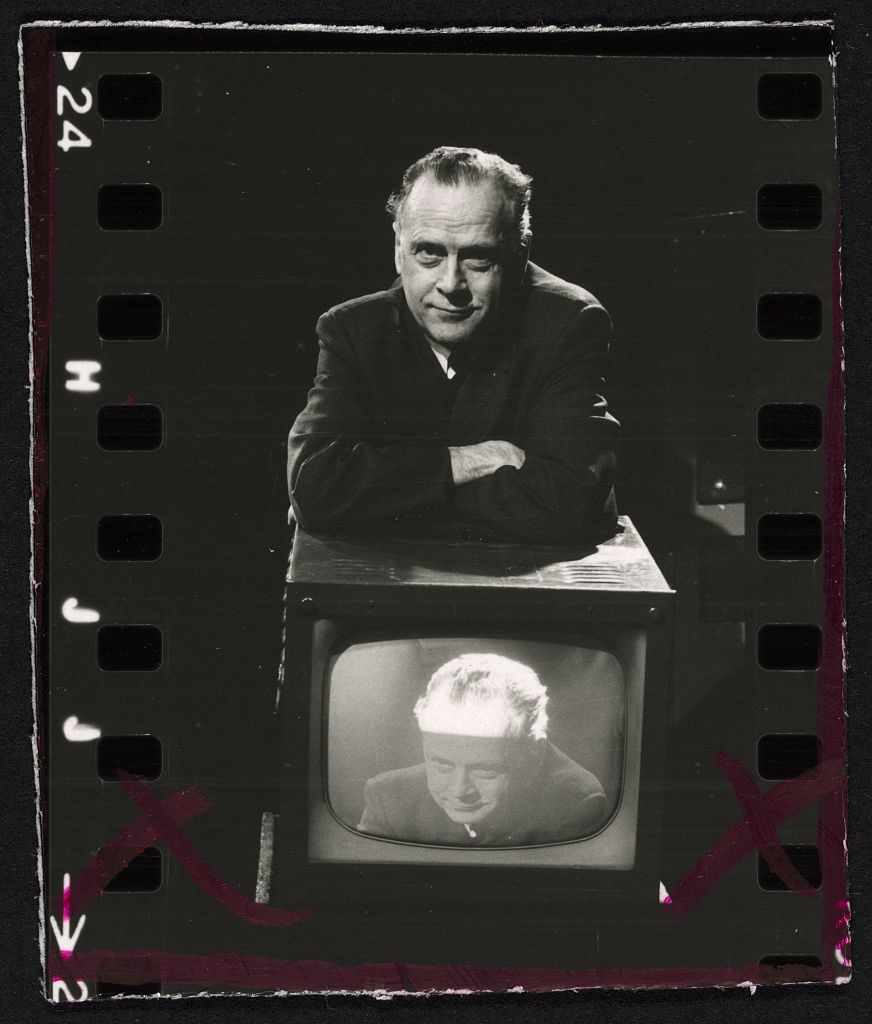
Herbert Marshall McLuhan (1911-1980) was a Canadian philosopher, university professor, and public intellectual. His work is considered the cornerstone of modern media theory. He is globally renowned for coining the expressions "the medium is the message" and the "global village," successfully predicting the World Wide Web almost thirty years before its invention.
Biographical Overview
Marshall McLuhan was born in Edmonton, Alberta, and later moved to Winnipeg, Manitoba. He earned his BA and MA in English from the University of Manitoba, followed by a PhD from Cambridge University. His doctoral research focused on the history of the trivium (grammar, logic, and rhetoric), which profoundly influenced his later structural analysis of communication.[1] McLuhan spent the majority of his academic career at the University of Toronto, where he directed the Centre for Culture and Technology. Alongside Northrop Frye and Harold Innis, he was a central figure in the Toronto School of Communication.
Key Concepts and Theories
McLuhan's research fundamentally shifted the focus of communication studies from the content of media to the form of the media itself.
The Medium is the Message
This is McLuhan's most famous axiom, introduced in his 1964 book, Understanding Media: The Extensions of Man.[2] It posits that the true significance of a medium is not the content it carries, but the way the medium alters the scale, pace, or pattern of human affairs. (See McLuhan's The Medium is the Message for a dedicated analysis of this concept and its application to the digital attention economy.)
"For the 'message' of any medium or technology is the change of scale or pace or pattern that it introduces into human affairs." — Marshall McLuhan
- Content as a Distraction: McLuhan argued that people are often too distracted by the content of a medium (e.g., the plot of a television show) to notice how the medium itself (television as a technology) is restructuring their minds and societies.
- The "Light Bulb" Example: McLuhan used the electric light bulb to illustrate this concept. A light bulb has no "content" in the way a newspaper has articles, yet it is a powerful medium that alters human environments by creating spaces for activity during the nighttime.[2:1]
The Global Village
Introduced in The Gutenberg Galaxy (1962), the concept of the "global village" describes how electronic media collapse space and time, connecting humanity on a global scale.[3]
- Retribalization: McLuhan argued that the printing press created a culture of individualism and fragmentation (a "visual" culture). In contrast, electronic media (like radio and television) return humanity to an oral/aural culture, creating a deeply interconnected global tribe.[3:1]
- Internet Prophecy: Modern scholars frequently cite the "global village" as a direct, highly accurate prediction of the Internet and social media.[4]
When asked about the implications of the global village, McLuhan warned it wouldn't necessarily be a peaceful utopia. He suggested that maximum proximity could lead to maximum friction, predicting the hyper-polarized environments we see on modern social media.
Hot and Cool Media
McLuhan categorized media based on the degree of participation they demand from the user (see McLuhan's The Medium is the Message for an applied analysis of this framework alongside its systemic effects):
- Hot Media: High-definition, data-rich media that engage a single sense completely and require very little active participation or "filling in" by the audience.
- Examples: Print, photographs, radio, movies.
- Cool Media: Low-definition media that provide less data, demanding that the user actively participate to fill in the gaps and extract meaning.
- Examples: Television (as it existed in the 1960s), the telephone, seminars, cartoons.[2:2]
The Tetrad of Media Effects
Developed later in his life and published posthumously in Laws of Media (1988), the Tetrad is a pedagogical tool used to examine the impact of any given technology on society. It poses four questions about any medium:[5]
- Enhancement: What does the medium amplify or intensify? (e.g., Radio amplifies news and music across distances).
- Obsolescence: What does the medium drive out of prominence? (e.g., Radio reduces the prominence of print).
- Retrieval: What does the medium recover that was previously lost? (e.g., Radio retrieves the tribal spoken word).
- Reversal: What does the medium flip into when pushed to its extreme limits? (e.g., Acoustic radio flips into audio-visual television).
Major Publications
To fully understand McLuhan, one must engage with his core triad of texts:
- The Mechanical Bride: Folklore of Industrial Man (1951): An early critique of advertising and popular culture, treating newspapers, comics, and ads as subjects worthy of serious academic analysis.
- The Gutenberg Galaxy: The Making of Typographic Man (1962): Explores the psychological and cognitive effects of the printing press and the transition from oral to visual culture.
- Understanding Media: The Extensions of Man (1964): His magnum opus, containing his most famous concepts ("the medium is the message", hot/cool media).
- The Medium is the Massage: An Inventory of Effects (1967): A highly experimental, visually driven book co-created with graphic designer Quentin Fiore. The typo in the title ("Massage" instead of "Message") was a printer's error that McLuhan loved and kept, arguing that media literally "massage" our sensorium.[6]
McLuhan's relevance exploded in the 1990s with the rise of the Internet. Wired Magazine named him its "patron saint" upon its founding in 1993. As we transition into an era dominated by Artificial Intelligence, McLuhan's framework remains vital: we must ask not just what AI outputs (the content), but how the existence of AI changes human cognition and social organization (the medium). For a synthesis of McLuhan with Martin Heidegger's critique of technology (Gestell and Bestand), see Martin Heidegger and McLuhan's The Medium is the Message.
🎴 Interactive Web Practice (Comprehension Check)
Question 1 (Core Axiom & Media Architecture): What does Marshall McLuhan mean by the axiom "the medium is the message," and why does he use the electric light bulb to demonstrate that media alter human affairs independently of content?
Answer: McLuhan argues that the primary social and psychological consequence of any communication technology lies not in the explicit content or information it conveys, but in the structural change of scale, pace, or pattern it introduces into human association. Explicit content functions merely as "a juicy piece of meat carried by the burglar to distract the watchdog of the mind"—diverting conscious attention while the architectural form of the medium quietly reorganizes neural habits and cultural frameworks. He cites the electric light bulb as an example of a "pure medium": it carries no textual or pictorial content, yet completely restructures human environments and social activity by transforming night into productive space.
Question 2 (The Global Village & Retribalization): How does electronic media dismantle typographic individualism, and why did McLuhan warn that the "global village" would produce intense friction rather than harmonious unity?
Answer: Typographic culture (inaugurated by the printing press) cultivated a visual, linear, and fragmented sensory bias that promoted private individualism, nationalism, and detachment. In contrast, electronic media (radio, television, digital networks) re-immerse humanity into an acoustic, simultaneous, and multi-sensory environment characteristic of oral tribal societies ("retribalization"). However, McLuhan cautioned that the "global village" is not a peaceful utopia; because electronic media collapse physical space and temporal distance, diverse cultures and factions are forced into immediate, total proximity without the insulation of geographic boundaries, inevitably provoking identity panic, ideological friction, and hyper-polarization.
Question 3 (Hot vs. Cool Media & The Tetrad of Media Effects): How does McLuhan differentiate "hot" and "cool" media, and how does the Tetrad of Media Effects function as a diagnostic tool for analyzing technological innovation?
Answer: McLuhan distinguishes media based on sensory definition and audience participation:
- Hot Media: High-definition media that saturate a single sense with complete data, requiring minimal audience participation or cognitive "filling in" (e.g., print, radio, cinema, photographs).
- Cool Media: Low-definition media that provide sparse sensory information, requiring active cognitive participation and interpretive closure from the audience (e.g., telephone, speech, 1960s television, seminars).
- Enhancement: What human capacity or process does the medium amplify or extend?
- Obsolescence: What previous medium, tool, or cultural practice does it eclipse or push aside?
- Retrieval: What older, discarded cultural ground or psycho-social dynamic does it recover?
- Reversal: When pushed to its extreme technological limit, what does the medium flip into (its opposite effect)?
Resonant Notes
The following notes in the vault share direct thematic, sociological, and literary connections with Marshall McLuhan's media theory and scholarship:
🔴 Toronto School, Media Ecology & Technological Determinism
- Innis (1950) - Empire and Communications & Innis (1951) - The Bias of Communication — Harold Innis's economic history of communication media—specifically his division between time-biased and space-biased media and monopolies of knowledge—laid the historical and analytical groundwork for McLuhan's media ecology.
- Northrop Frye & Northrop Frye's - Anatomy of Criticism — Fellow central figure of the Toronto School of Communication; while McLuhan examined how sensory technologies and electronic media reshape human perception and culture, Frye mapped archetypal mythologies, genres, and narrative structures in literature.
- Martin Heidegger — Heidegger's critique of technology in The Question Concerning Technology conceptualizes modern technology not as an inert instrument, but as Gestell (enframing)—a systemic mode of revealing that orders reality into standing reserve (Bestand), directly paralleling McLuhan's axiom that the medium is an active environment shaping cognition.
- McLuhan's The Medium is the Message — Dedicated conceptual note examining how communication media restructure cognition, attention, and institutional dynamics independent of their manifest content, analyzing the digital attention economy, workplace platforms, and continuous partial attention.
🟡 Digital Networks, The Global Village & Information Architecture
- Timothy John Berners-Lee & How the Internet Works — Berners-Lee's invention of the World Wide Web and the underlying packet-switching protocols materially instantiated McLuhan's prophetic vision of the decentralized, interconnected "global village."
- The Internet of Things (IoT) — Realizes McLuhan's concept of media as technological "extensions of man" in physical space, embedding computational feedback loops and sensor networks into everyday material environments.
- Postscript on the Societies of Control — Gilles Deleuze's diagnosis of control societies tracing how continuous digital modulation, dividuals, and electronic networks replace disciplinary institutions, evolving McLuhan's acoustic electronic surround into systemic algorithmic governance.
- Entropy — Explores Shannon's mathematical theory of communication and thermodynamic entropy, demonstrating how high-throughput electronic channels degrade into informational noise, sensory overextension, and cognitive fatigue.
🟢 Perception, Mechanical Reproduction & Cultural Simulation
- Walter Benjamin (1892–1940) & The Work of Art in the Age of Mechanical Reproduction — Benjamin's examination of how mass reproduction technology liquidates the singular "aura" of art and shifts sensory perception from solitary contemplation to distracted mass consumption directly anticipates McLuhan's focus on the cultural impact of media forms.
- Defining a Simulacrum — Jean Baudrillard's hyperreality extends McLuhan's media ecology to its radical conclusion: when the medium completely eclipses the message, signs detach from physical referents to generate self-referential simulations that supersede the real.
- Don DeLillo Major Themes Analysis — DeLillo's postmodern fiction captures the lived psychological reality of McLuhan's media surround, dramatizing characters inundated by informational "blur and glut," televised disaster spectacles, and corporate simulation.
- Simmel and the Attention Economy — Abstraction, Alienation, and Cognitive Capture — Georg Simmel's analysis of urban sensory overstimulation and the compensatory development of the blasé attitude prefigures McLuhan's concept of the "Narcissus narcosis"—the psychological numbness and sensory auto-amputation induced by rapid technological extension.
References
W. Terrence Gordon / Marshall McLuhan: Escape into Understanding / Internet Archive ↩︎
Marshall McLuhan / Understanding Media: The Extensions of Man / MIT Press ↩︎ ↩︎ ↩︎
Marshall McLuhan / The Gutenberg Galaxy: The Making of Typographic Man / University of Toronto Press ↩︎ ↩︎
Paul Levinson / Digital McLuhan: A Guide to the Information Millennium / Routledge ↩︎
Marshall McLuhan and Eric McLuhan / Laws of Media: The New Science / University of Toronto Press ↩︎
Marshall McLuhan and Quentin Fiore / The Medium is the Massage: An Inventory of Effects / Gingko Press ↩︎