Jack Kerouac (1922-1969)
Jack Kerouac (1922–1969) was the literary architect and spiritual compass of the Beat Generation, transforming post-WWII American literature through Spontaneous Prose, the philosophical synthesis of Franco-American Roman Catholicism and Zen Buddhism, the sacralization of the open road as nomadic pilgrimage, and the creation of the "Beatific" outcast. Conceived not as isolated novels but as an interconnected Proustian autobiographical epic entitled The Duluoz Legend, Kerouac's work revolted against the technocratic conformity and consumer stasis of Cold War America, pursuing an ecstatic, jazz-inflected quest for cosmic transcendence, redemptive suffering, and the elusive epiphany known simply as "IT."
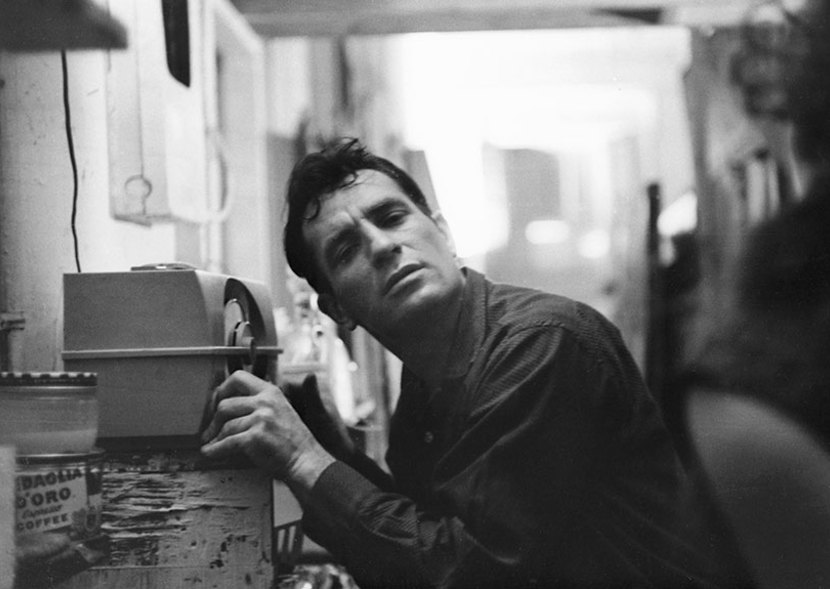
1. Biographical Genesis & Cultural Backdrop
Jean-Louis Lebris de Kérouac was born on March 12, 1922, in the industrial textile mill town of Lowell, Massachusetts, to French-Canadian immigrants from Quebec, Léo-Alcide Kérouac and Gabrielle-Ange Lévesque.[1] Kerouac’s first language was Joual (a Quebec French dialect), and he did not attain fluent English literacy until his early adolescence. This dual linguistic inheritance imbued his writing with an acute acoustic sensitivity, a foreignness within standard English syntax, and an instinctive musicality that later found its voice in American jazz.[1:1][2]
The Ghost of Gérard and the Roman Catholic Substrate
Two formative biographical events fundamentally shaped Kerouac's existential posture:
- The Death of Gérard (1926): When Jack was four years old, his older brother Gérard died of rheumatic fever at age nine.[1:2] Gérard was revered by his devout mother and local priests as a saintly child of miraculous piety and quiet suffering. Gérard's premature demise cast an indelible shadow of grief, guilt, and mortality across Kerouac's life, chronicled decades later in Visions of Gerard (1963). Kerouac was left with an unbearable survivor’s sorrow and a lifelong conviction that pure holiness was inextricably bound to earthly pain, frailty, and childhood innocence.[1:3][3]
- Franco-American Catholic Piety: Raised in the strict sacramental world of Saint-Louis-de-France parish, Kerouac remained deeply conditioned by Catholic liturgy, the iconography of the Sacred Heart, the cult of the Virgin Mary, the certainty of original sin, and the yearning for divine redemption.[1:4] Even at his most bohemian and intoxicated extremes, Kerouac insisted: "I am not a beatnik, I am a Catholic."
Columbia, the Founding Circle, and Cold War Disenchantment
Recruited as a star running back to Columbia University in 1940, Kerouac suffered a fractured tibia during his freshman season, leading to a bitter falling-out with coach Lou Little and his eventual departure from collegiate athletics.[1:5][4] Stranded in New York City during the apex of World War II, Kerouac coalesced with a cohort of intellectual mavericks who would form the vanguard of the Beat Generation: Allen Ginsberg, William S. Burroughs, Lucien Carr, and the underworld hustler Herbert Huncke.[1:6][5]
Together, they formulated a "New Vision"—a radical aesthetic commitment modeled on Arthur Rimbaud, William Blake, and Oswald Spengler that demanded the systematic expansion of perception, the exploration of subconscious depths, and the rejection of bourgeois moral orthodoxies.[5:1][3:1]
Following service in the Merchant Marine and an arrest as an accessory in the David Kammerer homicide case (for helping Lucien Carr dispose of evidence), Kerouac witnessed post-war America settle into the rigid, institutionalized orthodoxy of the 1950s:
- Suburban Standardization: Mass-produced suburbs (Levittown), corporate bureaucratization, and the rise of the conformist "Organization Man."
- Cold War Paranoia: McCarthyism, anti-communist purges, existential nuclear dread, and the psychic militarization of everyday life.
- Consumer Complacency: The equation of democratic freedom with appliance acquisition, automobile prestige, and material comfort.
Kerouac perceived this suburban tranquility as a living death—a spiritual petrification that muffled the cries of the human soul. Against this sanitized landscape, he set forth on the transcontinental highways to uncover the authentic, neglected margins of the continent.[1:7][6]
2. The Dual Ethos of "Beat": Weariness and Beatitude
The phrase "Beat Generation" has historically suffered from widespread trivialization, reduced by mass media to juvenile hedonism, urban delinquency, or bohemian posturing.[5:2] Kerouac himself rigorously formulated the term through a precise dialectical tension:
                      ┌───────────────────────────────────────┐
                      │            THE BEAT ETHOS             │
                      └──────────────────┬────────────────────┘
                                         │
                 ┌───────────────────────┴───────────────────────┐
                 ▼                                               ▼
   [ Beaten Down / Exhaustion ]              [ Beatific / Holy Illumination ]
   - Street slang (Herbert Huncke)           - Roman Catholic beatitude
   - Physical poverty, dispossession         - The Sermon on the Mount
   - Shedding of societal pretension         - Unveiling of the divine spark
   - Bodily suffering and ruin               - The "Dumbsaint" and holy fool
                 │                                               │
                 └───────────────────────┬───────────────────────┘
                                         ▼
                         [ The Sacralized Outcast ]
              Redemption found at the bottom of civilization
1. Physical and Social Exhaustion ("Beaten Down")
Kerouac borrowed the vernacular term "beat" from Herbert Huncke, a Times Square petty thief and morphine addict who used it to describe being drained, penniless, exhausted by the street, and cast out by respectable society.[1:8][5:3] For Kerouac, this state of total depletion carried profound ontological value: when a human being is stripped of social status, financial security, and bourgeois vanity, the false ego dissolves, exposing raw, unadorned existential truth.[5:4]
2. Spiritual Illumination ("Beatific")
Kerouac performed a radical theological transvaluation of Huncke's street slang, linking "beat" directly to the Beatitudes of Christ’s Sermon on the Mount ("Blessed are the poor in spirit, for theirs is the kingdom of heaven").[5:5] To be "beat" was not to be defeated, but to exist in a state of holy receptivity, radiant humility, and spiritual grace.[1:9]
The Archetype of the "Dumbsaint"
By sanctifying social exhaustion, Kerouac populated his narratives with figures he termed "dumbsaints"—drifters, freight-train hobos, Mexican agricultural workers, African American jazz musicians, and down-and-out wanderers.[1:10][3:2] Where mainstream mid-century America saw social pathology or economic failure, Kerouac beheld the luminous face of Christ. These outcasts possessed an instinctive existential authenticity and a freedom from careerist ambition that elevated them into unconscious mystics of the American landscape.[3:3]
3. Spontaneous Prose and Bop Prosody
Kerouac regarded standard academic prose, rhetorical revision, and conventional grammar as artificial filters that sanitized the visceral immediacy of lived experience.[4:1][2:1] To close the gap between consciousness and the written page, he developed the methodology of Spontaneous Prose, codified in his two operational manifestos: Essentials of Spontaneous Prose (1953) and 30 Beliefs and Techniques for Modern Prose (1958).[4:2]
"No periods separating sentence-structures already arbitrarily riddled by false colons and timid usually needless commas—but the vigorous space dash separating rhetorical breathing (as jazz musician drawing breath between outblown phrases)... Blow as deep as you want—write as deeply, fish as far down as you want, satisfy yourself first, then reader cannot fail to receive telepathic shock."[4:3]
The Mechanics of Spontaneous Composition
Kerouac's compositional protocol was rigorous, disciplined, and rooted in specific procedural stages:[4:4][2:2]
  [ Visual/Mnemonic Fixation ] ──> Focus on the "Jewel Center of Interest"
               │
               ▼
   [ Somatic / Breath Unit ]  ──> Exhalation dictates sentence length (Bop phrasing)
               │
               ▼
  [ Uncensored Flow: Stream ] ──> "First Thought, Best Thought" (No revisions)
               │
               ▼
  [ Typographic Notation ]   ──> Long dashes (--) replace syntactic punctuation
               │
               ▼
   [ Telepathic Resonance ]   ──> Reader receives raw, unmediated consciousness
- The "Jewel Center of Interest" (Sketching): Influenced by his friend Ed White's recommendation to sketch street scenes with words as a visual artist sketches with pencil, Kerouac instructed the writer to fix the mind on an internal image, memory, or sensory node, and write outward from that center in continuous, radiating ripples of description without pausing to analyze.[4:5]
- Bop Prosody and Breath Mechanics: Modeling his sentence cadence on modern jazz horn players—most notably the tenor saxophones of Charlie Parker, Lester Young, and Dexter Gordon—Kerouac treated prose as an acoustic, bodily exhalation.[4:6][2:3] A sentence ended when the writer ran out of physical breath. Conventional punctuation marks were replaced by the vigorous dash (
--), preserving the syncopated, polyrhythmic swing of jazz improvisation.[2:4] - "First Thought, Best Thought": Rejecting the traditional academic canon of meticulous drafting and redrafting, Kerouac held that intellectual editing is merely the fearful ego censoring the divine subconscious.[4:7] The initial, uninhibited utterance captures the pure phenomenological reality of memory; revision introduces calculated dishonesty and rhetorical artifice.[4:8][3:4]
- The Scroll Manuscript of On the Road (1951): To eliminate the friction of having to reload standard typing paper into his machine, Kerouac taped twelve-foot strips of tracing paper together into a continuous 120-foot teletype roll.[6:1] In April 1951, writing fueled by black coffee and manic devotion, he typed the entirety of On the Road in twenty days—a unbroken paragraph simulating the relentless, unyielding velocity of the American asphalt highway.[6:2]
4. Spiritual Dialectic: Roman Catholic Mysticism and Zen Buddhism
Kerouac’s intellectual architecture was defined by an ongoing, often agonizing tension between the Western theology of his childhood and the Eastern metaphysics of his middle years.[1:11][3:5]
| Dimension | Roman Catholic Faith | Zen Buddhism & Mahāyāna | The Kerouacian Synthesis |
|---|---|---|---|
| Primary Ontological Lens | Creation, Divine Grace (Gratia), Original Sin | Emptiness (Śūnyatā), Interdependence, Non-Self | Life as a holy, tragic dream (Samsara as sacred theater) |
| Problem of Suffering | Redemptive suffering through the Passion of Christ | Cause of suffering in craving (Taṇhā); Impermanence (Anicca) | Pity for all sentient beings; tender, universal sorrow |
| Soteriological Ideal | The Saint, the Martyr, the Penitent | The Bodhisattva, the Arhat, the Zen hermit | The "Dharma Vagabond" wandering between monastery and rails |
| Ultimate Destination | The Kingdom of Heaven, Communion of Saints | Nirvana, Extinction of Illusion, Liberation from Wheel | The Great Void of Light (The Tathāgata / Sacred Heart) |
The Discovery of the Dharma (1953–1956)
In late 1953, while staying in San Luis Obispo and reading in libraries, Kerouac discovered Dwight Goddard’s seminal anthology A Buddhist Bible.[1:12] The discovery ignited an intensive theological autodidacticism. Kerouac mastered the Diamond Sūtra, the Śūraṅgama Sūtra, the Lankāvatāra Sūtra, and the life of the historical Buddha. He filled thousands of notebook pages with personal translations and aphorisms (later published as Some of the Dharma) and drafted his own biography of Siddhartha Gautama (Wake Up).[1:13]
For Kerouac, Buddhism supplied a metaphysical explanation for the relentless suffering and loss that had haunted him since Gérard's death:
- Śūnyatā (Voidness): All conditioned forms are empty of inherent existence; the material world is a fleeting phantasmagoria (māyā).
- Universal Compassion (Karuṇā): Because all living creatures are trapped on the turning Tibetan Wheel of Life (samsara), they deserve boundless gentleness and pity.
In his 1955 poetry collection Mexico City Blues, Kerouac merged Buddhist epistemology with jazz improvisation across 242 choruses, dedicating stanzas to the Avalokiteśvara Bodhisattva, the illusion of death, and the universal Void of pure, empty light.[3:6]
The Dharma Bums and the Mountain Hermit
In 1955, Kerouac met poet and student of Zen Gary Snyder (dramatized as Japhy Ryder in The Dharma Bums, 1958). Snyder introduced Kerouac to the Chinese hermit tradition of Han Shan (Cold Mountain) and the physical discipline of wilderness mountaineering.[1:14]
Inspired by Ryder, Kerouac formulated the vision of a "Rucksack Revolution"—thousands of young Americans abandoning corporate desk jobs to wander the continent with sleeping bags, meditating in alpine meadows, praying for all sentient beings, and creating spontaneous art.[1:15]
In the summer of 1956, Kerouac spent sixty-three days in total isolation as a fire lookout atop Desolation Peak in the Cascade Mountains of Washington State. Expecting profound Buddhist satori (enlightenment), Kerouac instead encountered crippling loneliness, claustrophobic weather, and the persistent specter of his own neurotic anxieties—an ordeal that marked the high-water mark and subsequent unraveling of his Buddhist optimism, as recorded in Desolation Angels (1965).[1:16]
The Dark Night and Breakdown: Big Sur (1962)
By the early 1960s, ravaged by chronic alcoholism and suffocated by unwanted celebrity, Kerouac's serene Buddhist synthesis shattered. Retreating to Lawrence Ferlinghetti's cabin in Bixby Canyon, California, Kerouac suffered a catastrophic mental breakdown accompanied by delirium tremens.[1:17]
In the climactic passages of Big Sur (1962), the Buddhist emptiness that once brought solace metastasized into cold, nihilistic terror. In the throes of madness and auditory hallucinations, Kerouac abandoned Eastern detachment and threw himself at the foot of the Christian cross:
"Suddenly as I stare at that rugged unnamable thing in the dark it turns into a huge cross looking down on me... I make the sign of the cross and say 'Jesus, help me'... and a sweet, radiant feeling of gold and white lights fills the cabin."[1:18]
For Kerouac, Eastern philosophy provided an intellectual sanctuary against mortal sorrow, but Roman Catholic devotional mysticism remained the visceral, indelible marrow of his soul.[1:19][3:7]
5. The Open Road as Sacred Pilgrimage & The Epiphany of "IT"
For Kerouac, the American highway system was not a mechanism for geographical transit, but a sacred altar of initiation.[6:3] Movement across the vast physical terrain of North America functioned as an embodied antidote to bourgeois stasis, psychological decay, and domestic entrapment.[6:4]
[ Suburban Domesticity ] <─────────── Friction / Polarity ───────────> [ The Open Road ]
 - Enclosure, Mortgage, Fear                                            - Motion, Risk, Ecstasy
 - Chronological Time (Chronos)                                         - Kairos / Eternal Present
 - Preservation of Self (Ego)                                           - Dissolution into "IT"
The Search for "IT"
Throughout On the Road, Visions of Cody, and their transcontinental journeys between New York, Denver, San Francisco, and Mexico, Kerouac and his companions pursued moments of supreme illumination, referred to colloquially as "IT." [6:5]
"IT" represents the sudden suspension of profane chronological time (chronos) in favor of sacred qualitative time (kairos):
- In a smoky jazz club watching a saxophonist hit a sustained, soaring riff, the musician "has IT"—he has bypassed technical calculation to become a pure, transparent vessel for the cosmic life force.[2:5][6:6]
- In a speeding car tearing across the Nebraska plains at midnight, the boundaries separating the self, the vehicle, the highway, and the stars dissolve.
- "IT" is the ecstatic realization of total presence: the past and future vanish, the conscious ego is annihilated, and the individual experiences unmediated communion with the universe and God.[6:7]
Dean Moriarty as the American Dionysian Hero
The engine driving this transcontinental pursuit was Neal Cassady, immortalized as Dean Moriarty in On the Road and as the eponymous hero of Visions of Cody.[6:8] Cassady—a juvenile car thief, street philosopher, and manic talker—functioned for Kerouac as the supreme archetype of the holy barbarian:
- The Holy Fool / Puer Aeternus: Dean embodies uninhibited kinetic velocity, uncorrupted by societal guilt or institutional respectability.[6:9]
- The Western Hero Transfigured: Dean is the mythic cowboy of the frontier stripped of his horse and six-shooter, reincarnated in a battered 1949 Hudson blazing across the interstate.[6:10]
- The American Dionysus: Dean’s appetite for sex, speed, music, and conversation shatters the Apollonian order of suburban post-war America, driving the narrative toward ecstatic self-transcendence.[6:11]
6. The "Duluoz Legend": Proustian Memory and Mortal Elegy
Kerouac consistently emphasized that his major works were not standalone fictions, but chapters of a single, monumental autobiographical masterwork titled The Duluoz Legend.[1:20][3:8]
Modeled explicitly on Marcel Proust’s À la recherche du temps perdu (In Search of Lost Time), Kerouac sought to document his entire lived existence—from childhood memories in industrial Massachusetts through his merchant marine voyages, jazz odysseys, and spiritual hermitages—using uniform, recurring character archetypes veiled by thin pseudonyms (Jack Kerouac as Leo Percepied / Jack Duluoz; Neal Cassady as Dean Moriarty / Cody Pomeray; Allen Ginsberg as Carlo Marx / Irwin Garden; William S. Burroughs as Bull Lee / Hubbard).[1:21]
                         THE DULUOZ LEGEND CHRONOLOGY
┌──────────────────────────────────────────────────────────────────────────┐
│  CHILDHOOD & YOUTH:                                                      │
│  - Visions of Gerard (1963) ── Holy childhood, brother's death (1926)    │
│  - Doctor Sax (1959)        ── Mythic boyhood, shadow-monsters (1930s)   │
│  - Maggie Cassidy (1959)    ── Teenage romance in Lowell, athletic prime │
├──────────────────────────────────────────────────────────────────────────┤
│  BOHEMIAN AWAKENING & THE HIGHWAYS:                                      │
│  - The Town and the City (1950) ── Traditional family dissolution        │
│  - On the Road (1957)       ── Transcontinental journeys with Cassady    │
│  - Visions of Cody (1972)   ── Experimental, microscopic bop portrait    │
│  - The Subterraneans (1958) ── San Francisco jazz romance & neurosis     │
├──────────────────────────────────────────────────────────────────────────┤
│  SOLITUDE, DHARMA & DISSOLUTION:                                         │
│  - The Dharma Bums (1958)   ── Cascades mountaineering & Zen Buddhism    │
│  - Desolation Angels (1965) ── Desolation Peak isolation & wanderlust    │
│  - Big Sur (1962)           ── Alcoholic breakdown, delirium, madness    │
│  - Satori in Paris (1966)   ── Quest for ancestral roots in Brittany     │
│  - Vanity of Duluoz (1968)  ── Weary final retrospective (1935–1946)     │
└──────────────────────────────────────────────────────────────────────────┘
The Writer as Recording Angel Against Annihilation
Kerouac's urgent autobiographical drive was propelled by a profound, agonizing terror of oblivion.[1:22] Having witnessed the sudden deaths of his beloved brother Gérard, his father Léo, and close friends like Lucien Carr's victim David Kammerer, Kerouac viewed human memory as an embattled redoubt against the abyss.
He defined the high obligation of the novelist as that of a "Recording Angel": to witness and faithfully transcribe the exact textures, visual lights, smells, and spoken dialects of mortal life in all its "bleak inhuman loneliness." [4:9][3:9] Every catalog of passing telephone poles, roadside diners, neon tavern signs, and late-night jazz solos was a sacred effort to salvage fleeting existence from the cold river of time.[3:10]
7. Cultural Distortion, Decline, and Transatlantic Legacy
When On the Road was published by Viking Press in September 1957, review critic Gilbert Millstein famously proclaimed in the New York Times that its publication was "an historic occasion" marking the definitive emergence of a new generation, comparing its significance to Ernest Hemingway’s The Sun Also Rises.[6:12] Overnight, the thirty-five-year-old Kerouac was propelled into international fame.
The "Beatnik" Travesty and Cultural Estrangement
This sudden celebrity proved catastrophic for Kerouac’s fragile psyche. In 1958, San Francisco columnist Herb Caen coined the derogatory term "beatnik" (appending the Russian suffix -nik from the Soviet satellite Sputnik), instantly crystallizing a sensationalized media caricature:[5:6]
- The Media Stereotype: Goatees, berets, dark sunglasses, bongo drums, finger-snapping, apathy, and nihilistic slang.
- Kerouac’s Despair: Kerouac was horrified by the commercialization and trivialization of his spiritual crusade. While youth across the globe mimicked the caricature, Kerouac retreated into heavy drinking, feeling that his deeply religious message of beatitude and Christian-Buddhist compassion had been completely misunderstood.[5:7]
Furthermore, as the counterculture radicalized in the mid-1960s with anti-Vietnam War protests, psychedelic acid-rock, and the New Left, Kerouac fundamentally broke with the younger generation. Grounded in his working-class Catholic patriotism, Kerouac publicly supported the American military effort in Vietnam, defended the American flag, denounced hippies and student demonstrators, and alienated many former friends, including Ginsberg.[1:23] He spent his final years living in isolation with his mother Gabrielle and his third wife, Stella Sampas, in Northport, New York, and St. Petersburg, Florida.[1:24]
On October 20, 1969, while sitting in his Florida home sipping whiskey and writing notes on his father’s printing press, Kerouac suffered a massive internal abdominal hemorrhage caused by cirrhosis of the liver. He died the following morning at St. Anthony's Hospital at the age of forty-seven.[1:25]
Enduring Aesthetic Impact
Despite his tragic personal decline, Kerouac’s literary innovations revolutionized Western literature:
- Democratization of Literary Subject Matter: By opening literature to the rhythms of the highway, jazz musicians, manual laborers, and urban outcasts, Kerouac dismantled academic elitism.
- Invention of New Journalism: His raw, first-person subjective reporting, speed-prose, and blurring of autobiography with narrative fiction directly inspired the New Journalism of Hunter S. Thompson (Gonzo journalism), Tom Wolfe, and Michael Herr.
- Musical and Cultural Echoes: Figures from Bob Dylan (who credited On the Road with changing his life) to the musical landscape of American folk, rock, and jazz drew directly from Kerouac's acoustic cadences, breathless wanderlust, and mythologization of the American continental landscape.
Summary of Core Concepts
| Concept | Philosophical / Aesthetic Formulation | Key Works |
|---|---|---|
| Beatitude | The state of divine grace, holiness, and spiritual luminosity found at the bottom of society among the exhausted and marginalized. | On the Road, Visions of Gerard |
| Spontaneous Prose | Breath-driven, uncensored writing modeled on jazz improvisation; substituting dashes for formal punctuation to preserve pure memory. | Essentials of Spontaneous Prose, The Subterraneans |
| Bop Prosody | Structuring language on the physical exhalation of breath, syncopated rhythms, and acoustic phrasing derived from Bebop saxophonists. | Mexico City Blues, Visions of Cody |
| Dharma Vagabondage | Synthesis of Catholic devotion and Zen Buddhist mindfulness; voluntary simplicity, rucksack nomadism, and wilderness meditation. | The Dharma Bums, Desolation Angels |
| The Epiphany of "IT" | The ecstatic suspension of chronological time (chronos); total presence where the ego dissolves into unified cosmic awareness. | On the Road, Visions of Cody |
| The Duluoz Legend | A massive, interconnected multi-volume autobiographical epic modeled on Proust, functioning as a recording angel against mortality. | Doctor Sax, Big Sur, Vanity of Duluoz |
🎴 Interactive Web Practice (Comprehension Check)
Question 1 (The Dual Etymology of "Beat"): How does Jack Kerouac's concept of the "Beat Generation" dialectically unite Herbert Huncke's street vernacular with Roman Catholic theology, and why did Kerouac reject the media caricature of the "beatnik"?
Answer: Kerouac defined "Beat" through a dual etymology that linked physical exhaustion with spiritual transcendence. From street hustler Herbert Huncke, he adopted the slang "beat" (beaten down), signifying poverty, physical depletion, social marginalization, and the shedding of bourgeois illusions. However, Kerouac performed a radical theological transvaluation by connecting this exhaustion to Catholic "beatitude"—the holy grace, radiance, and purity articulated in Christ's Beatitudes on the Sermon on the Mount. In Kerouac's vision, the outcast, the hobo, and the down-and-out wanderer were "dumbsaints" who touched divine truth precisely because they were stripped of societal ego. Consequently, Kerouac violently rejected the 1958 media-invented caricature of the "beatnik" (berets, sunglasses, bongo drums, and apathy) because it trivialized a deeply religious, redemptive quest into a commercialized, nihilistic lifestyle trend.
Question 2 (Spontaneous Prose & Bop Prosody): What are the primary procedural mechanics of Kerouac's "Spontaneous Prose," and how does his use of "Bop prosody" dismantle traditional syntactic revision?
Answer: Codified in Essentials of Spontaneous Prose, Kerouac's technique operates on four interrelated mechanics: (1) Sketching from the "jewel center of interest", where the author visually fixes upon a single memory or image and writes outward without stopping; (2) "First thought, best thought", which forbids retrospective revision and editing on the grounds that conscious correction is merely the fearful ego censoring the pure, telepathic truth of the subconscious mind; (3) Bop prosody, which discards standard grammatical punctuation (commas, periods, semicolons) in favor of the physical exhalation of breath, using the long dash (--) to structure phrases identically to a jazz horn player blowing between breaths; and (4) Continuous momentum, epitomized by the 120-foot taped tracing paper scroll used for On the Road, which eliminated physical interruptions and allowed prose to mirror the uninterrupted velocity of human consciousness and the highway.
Question 3 (The Catholic-Buddhist Dialectic): How did Kerouac synthesize Roman Catholicism and Zen Buddhism during his middle period, and why did this philosophical equilibrium collapse into crisis in Big Sur?
Answer: In the mid-1950s, Kerouac synthesized his childhood Franco-American Roman Catholicism (with its bedrock concepts of original sin, divine grace, redemptive suffering, and devotion to the Sacred Heart) with Mahayana and Zen Buddhist metaphysics (the reality of śūnyatā/emptiness, the cycle of samsara, and universal compassion/karuṇā for all suffering beings). This synthesis culminated in The Dharma Bums and the ideal of the "Dharma Vagabond"—an ascetic, rucksack-carrying wanderer combining Christian caritas with Buddhist meditation. However, this delicate equilibrium collapsed in 1960 during his isolated retreat at Bixby Canyon, dramatized in Big Sur. Ravaged by alcoholism and delirium tremens, the Buddhist concept of emptiness transformed from serene liberation into terrifying metaphysical nihilism. Unable to find solace in Eastern detachment, Kerouac suffered a psychological breakdown and instinctively reverted to the devotional symbols of his Roman Catholic upbringing, crying out to Christ and making the sign of the cross to dispel his internal demons.
Resonant Notes
The following notes in the vault share direct thematic, sociological, and literary connections with Jack Kerouac:
🔴 American Counterculture, Existentialism & The Social Margin
- Norman Mailer — Mailer's existential archetype of the "Hipster" in The White Negro shares the Beat generation's rejection of suburban conformity and embrace of danger, jazz, and the marginalized outsider, though Mailer's vision tends toward violent sociopathy while Kerouac's remains mystic, ecstatic, and tender.
- Albert Camus — Camus's philosophy of the absurd and the rebel parallels Kerouac's wanderers who confront cosmic silence not with cynical despair, but through passionate, immediate rebellion and nomadic vitality.
- Jean-Paul Sartre — Kerouac's characters enact an American variant of existential freedom and radical choice, though Kerouac rejected Sartre's atheistic, politically engaged Parisian intellectualism in favor of an intuitive, spiritual pursuit of holy grace.
- The flâneur — Baudelaire's urban observer wandering the Parisian boulevards is transposed by Kerouac into the American hitchhiker and rail-rider navigating the transcontinental highway and metropolitan neon underworld.
- Travis Bickle — Schrader and Scorsese's isolated urban drifter represents the pathological, violent dark shadow of the alienated American wanderer, contrasting with Kerouac's loving, beatific search for communion.
- Don DeLillo Major Themes Analysis — DeLillo's postmodern landscape of media saturation, consumer dread, and technological isolation represents the tragic aftermath of the post-war American consumer culture against which Kerouac waged his early spiritual rebellion.
🟡 Transcendentalism, Eastern Metaphysics & Perennial Philosophy
- Beyond Representation-Shared Epistemology of Thoreau and Kerouac — Directly examines how Thoreau's concept of "Wildness" as epistemological openness links to Kerouac's spontaneous prose method, treating writing not as analytical representation but as embodied presence and direct contact with reality.
- Metaphysics of Henry David Thoreau — Thoreau's practice of "sauntering," voluntary poverty, and spiritual self-reliance at Walden Pond established the historical and philosophical blueprint for Kerouac's "Dharma Vagabond" roaming the wilderness.
- American Transcendentalism & Ralph Waldo Emerson — Kerouac's sacralization of the open road and individual intuition directly descends from Emerson's "original relation to the universe" and "Self-Reliance," infused with 20th-century jazz rhythm and blue-collar Catholic grit.
- Perennial Philosophy & Aldous Huxley's The Perennial Philosophy — Kerouac's lifelong attempt to synthesize Roman Catholic devotion with Zen Buddhism exemplifies the Perennialist conviction that a universal metaphysical core of divine reality underlies all spiritual traditions.
- Tibetan Wheel of Life — Kerouac's understanding of worldly existence as samsara—a cyclic trap of craving, illusion, and suffering held by Yama (impermanence)—underpins his ascetic retreats and nomadic flights from suburban materialism.
- The Dhammapada & Sīla - Buddhist Ethics — In his study notes (Some of the Dharma) and The Dharma Bums, Kerouac meditated intensely on Buddhist ethical precepts, mental discipline, and the cessation of craving as the path to liberation.
- Stephen Batchelor — Batchelor's contemporary conception of "Buddhism Without Beliefs" and the secular, existential encounter with dharma mirrors Kerouac's pragmatic, lived adaptation of Buddhist mindfulness amidst post-war Western modernity.
- Nāgārjuna — Nāgārjuna's Madhyamaka philosophy of śūnyatā (emptiness) and the mutual identity of dependent origination and voidness heavily informs Kerouac's Mexico City Blues, where all phenomena are celebrated as transient, empty, and luminous mind-forms.
🟢 Consciousness, Stream of Consciousness & Aesthetic Theory
- William James & William James and the Landscape of Eastern Thought — James's psychological concept of the "stream of consciousness" and his openness to non-ordinary mystical states in The Varieties of Religious Experience provide the foundational psychological substrate for Kerouac's "First Thought, Best Thought" and spontaneous sketching.
- Virginia Woolf — Woolf's modernist stream of consciousness captured the unfiltered rhythm of inner time and perception; Kerouac stripped away Woolf's delicate structural scaffolding to create an urgent, bop-inflected masculine version of the same temporal project.
- Edgar Allan Poe (1809-1849) — Poe's calculated "Unity of Effect" and mathematical predetermination of plot stand in direct dialectical opposition to Kerouac's spontaneous, unrevised composition; yet both shared an obsession with altered states of consciousness, nocturnal insomnia, and hypnotic acoustic cadence.
- Aldous Huxley's The Doors of Perception (1954) & Aldous Huxley's Heaven and Hell (1956) — Huxley's exploration of mescaline to dismantle the brain's cognitive "reducing valve" and reveal "Mind at Large" mirrors Kerouac's pursuit of "IT"—a state of ecstatic cosmic illumination where the ego dissolves into universal presence.
- Friedrich Nietzsche (1844-1900) — Kerouac's search for ecstatic transcendence through bodily motion, bop music, and nomadic risk is an American incarnation of the Nietzschean Dionysian drive, shattering the principium individuationis in pursuit of primordial cosmic unity.
- Carl Gustav Jung — Kerouac's recurring archetypal figures—Dean Moriarty as the Dionysian Puer Aeternus and divine trickster, the "dumbsaint" as holy fool—reflect the eruption of unconscious mythic motifs into modern American life.
- Gestalt Psychology-The Mechanics of the Whole — Kerouac's technique of "sketching" from a single "jewel center of interest" aligns with Gestalt principles of perceptual grouping and holistic field dynamics, perceiving scenes as immediate living totalities before intellectual fragmentation.
- Henry James (1843—1916) — Henry James's refined "central consciousness" technique offers an intellectual precursor to Kerouac's autobiographical Duluoz Legend; both authors treat consciousness not as a static recording instrument, but as an active, selective, and deeply emotional flow.
References
Ann Charters / Kerouac: A Biography / St. Martin's Press ↩︎ ↩︎ ↩︎ ↩︎ ↩︎ ↩︎ ↩︎ ↩︎ ↩︎ ↩︎ ↩︎ ↩︎ ↩︎ ↩︎ ↩︎ ↩︎ ↩︎ ↩︎ ↩︎ ↩︎ ↩︎ ↩︎ ↩︎ ↩︎ ↩︎ ↩︎
Justin Thomas Trudeau / Jack Kerouac's Spontaneous Prose: A Performance Genealogy / LSU Scholarly Repository ↩︎ ↩︎ ↩︎ ↩︎ ↩︎ ↩︎
Michael Hayward / Unspeakable Visions: The Beat Generation and The Bohemian Dialectic / Simon Fraser University ↩︎ ↩︎ ↩︎ ↩︎ ↩︎ ↩︎ ↩︎ ↩︎ ↩︎ ↩︎ ↩︎
Jack Kerouac / Essentials of Spontaneous Prose / University of Pennsylvania Department of English ↩︎ ↩︎ ↩︎ ↩︎ ↩︎ ↩︎ ↩︎ ↩︎ ↩︎ ↩︎
John Tytell / Naked Angels: Kerouac, Ginsberg, Burroughs / Ivan R. Dee Publishing ↩︎ ↩︎ ↩︎ ↩︎ ↩︎ ↩︎ ↩︎ ↩︎
Douglas Brinkley / The Rolling Stone Book of the Beats: The Beat Generation and American Culture / Hyperion Books ↩︎ ↩︎ ↩︎ ↩︎ ↩︎ ↩︎ ↩︎ ↩︎ ↩︎ ↩︎ ↩︎ ↩︎ ↩︎