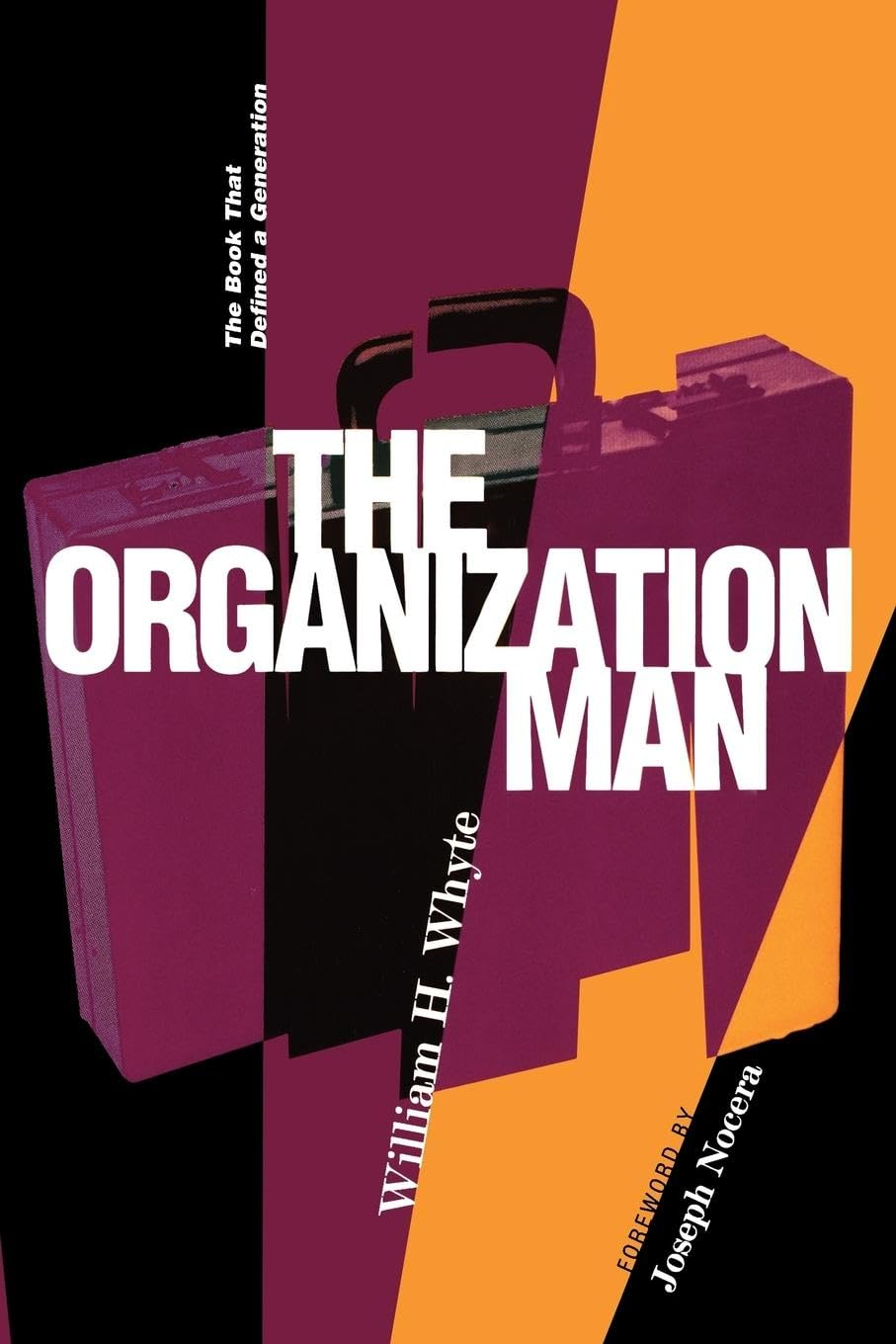
William H. Whyte's The Organization Man
Published in 1956, William H. Whyte's The Organization Man is a foundational sociological text that analyzes the shift in American culture from the individualistic "Protestant Ethic" to a collectivist "Social Ethic." It critiques how postwar corporate life, suburbanization, and education systems demanded conformity, groupthink, and extreme loyalty at the expense of individual creativity and self-reliance.
The Shift from Individualism to Conformity
William H. Whyte, an editor at Fortune magazine, spent years studying corporate America and observing a fundamental transformation in the mid-20th-century American character.[1] Historically, the United States was built on the Protestant Ethic—the belief that hard work, thrift, and individual competitive struggle were the primary engines of success and salvation.[2]
However, the postwar economic boom and the rise of massive corporate bureaucracies gave birth to what Whyte termed the Social Ethic (explored in depth in William H. Whyte's Social Ethics).[3] This new ethos argued that the group, rather than the individual, was the ultimate source of creativity and productivity.[4] According to Whyte, the modern white-collar worker was expected to spiritually and physically subordinate themselves to the benevolent organization, essentially taking "vows of organization life."[5]
Key Concepts and Sociological Observations
The Three Pillars of the "Social Ethic"
Whyte argued that the Social Ethic was built upon three core tenets:
-
The belief in the group as the source of creativity: The assumption that consensus, committee work, and team synergy produce better results than a solitary thinker (see Pros and Cons of Brainstorming for how this assumption falters in practice).[6]
-
The belief in "belongingness" as the ultimate human need: The idea that individuals find their psychological security and primary purpose by fitting smoothly into a larger group, drawing directly from Elton Mayo's Human Relations school (see From Cogs to Collaboration - The Evolution of Management Thought).[7]
-
The belief in the application of science to achieve belongingness: The use of management theory, organizational psychology, and behavioral testing ("scientism") to engineer harmonious "cultural fit."[8]
The Cult of Personality Testing
One of the most famous critiques in the book surrounds the corporate reliance on personality tests to screen employees. Whyte argued these tests did not measure true competence, leadership, or brilliance; rather, they measured conformity and a lack of eccentricity. To highlight the absurdity of this practice, Whyte included advice on how to cheat on personality tests, encouraging ambitious workers to provide the most bland, well-adjusted, and middle-of-the-road answers possible to beat the system.
Suburbia: The Organization Family
The book extends its analysis beyond the boardroom and into the home. Whyte conducted extensive fieldwork in the newly built, planned suburb of Park Forest, Illinois.[9] He viewed these communities as the domestic wing of the corporation:
-
Transience and Rootlessness: Organization men were highly mobile, frequently relocating their families whenever the company demanded.[10] Suburbs became environments where forming fast, superficial bonds and "fitting in" quickly were paramount to survival.
-
Hyper-Socialization: Suburban life was intensely communal. Whyte noted that non-participation in neighborhood gatherings or failure to conform to consumption habits (such as buying the same consumer goods as neighbors, an early manifestation of the bandwagon effect) was viewed as almost antisocial.[11]
Education and the Decline of the Humanities
Whyte noted that universities were increasingly acting as vocational training grounds for the corporation. The focus shifted away from fundamental academic inquiry and the humanities, leaning heavily toward business administration and "social adjustment."[12] The primary goal of higher education, he warned, was no longer to produce independent, critical thinkers, but rather highly employable, frictionless team players.
Modern Relevance
While the 1950s era of "lifetime employment" at a single company has largely ended, Whyte's observations on corporate psychology remain strikingly prescient today.
Though the "new economy" of the 1990s and the rise of Silicon Valley startups temporarily celebrated the "rebel entrepreneur," the fundamental pressures of the Social Ethic persist in modern knowledge work.[13] Today's corporate emphasis on "company culture", team synergy, open-plan offices, and behavioral screening during hiring are direct descendants of Whyte's Organization Man.[14] Furthermore, the pressure to integrate work and life—where the modern professional is expected to be deeply, emotionally tied to the corporate mission (see Strategic Alignment)—echoes Whyte's original warning: the organization does not just want the worker's labor; it wants their soul. The entrepreneurial alternative—starting with your own means and building ventures through personal agency rather than corporate belonging—is formalized in Saras Sarasvathy's effectuation theory (see Effectuation).
🎴 Interactive Web Practice (Comprehension Check)
Question 1 (Protestant Ethic vs. Social Ethic): How does William H. Whyte distinguish between the traditional "Protestant Ethic" and the mid-20th-century "Social Ethic," and what fundamental shift did this represent in American corporate culture?
Answer: The Protestant Ethic was rooted in rugged individualism, personal agency, thrift, and competitive struggle as the primary engines of success and moral validation. In contrast, Whyte's "Social Ethic" asserts that the group—not the individual—is the ultimate source of creativity, that "belongingness" is humanity's primary psychological need, and that scientific management techniques should engineer organizational harmony. This transition marked a structural shift in postwar corporate life: employees ceased acting as self-reliant autonomous agents and were instead expected to spiritually and psychologically subordinate their individuality to the collective life of the organization.
Question 2 (The Cult of Personality Testing): Why was Whyte so fiercely critical of corporate personality testing, and what did he argue these assessments actually measured?
Answer: Whyte contended that corporate personality tests did not measure genuine intellectual competence, executive initiative, or visionary leadership. Instead, cloaked in the pseudo-objective authority of social science ("scientism"), they functioned as conformity filters designed to screen out idiosyncrasy, eccentricity, and independent dissent. Because these instruments rewarded bland, predictable consensus-builders, Whyte famously provided strategic advice on how to game the questionnaires by selecting the most conventional, middle-of-the-road answers to bypass institutional gatekeepers.
Question 3 (Suburbia & Higher Education as Organizational Extensions): In what ways did the pressures of the Social Ethic extend beyond corporate headquarters into suburban communities and university campuses?
Answer: Whyte demonstrated that postwar planned suburbs (such as Park Forest, Illinois) acted as the domestic wing of the corporation: transient corporate families formed rapid, superficial bonds, with hyper-socialization and consumer conformity becoming social obligations. Simultaneously, higher education shifted away from the humanities and critical intellectual inquiry toward applied business administration and "social adjustment." In both environments, institutions were re-engineered to condition individuals into frictionless, compliant team players calibrated for seamless corporate absorption.
Resonant Notes
The following notes in the vault share direct thematic, sociological, and literary connections with William H. Whyte's The Organization Man:
🔴 Corporate Bureaucracy, Conformity & Management Theory
- William H. Whyte's Social Ethics — A focused companion treatment analyzing the Social Ethic's three primary pillars (Scientism, Belongingness, Togetherness) and tracing their legacy into modern tech culture, "culture fit" screening, and urban planning.
- From Cogs to Collaboration - The Evolution of Management Thought — Documents the historical shift from Taylorist scientific management to Elton Mayo's Human Relations school, which Whyte identified as the intellectual foundation providing corporate legitimacy to "belongingness" and group conformity.
- Max Weber (1864-1920) — Formulates the classical Protestant Ethic that Whyte identifies as the historical baseline superseded by corporate collectivism; Weber's analysis of rationalized bureaucracy as an "iron cage" (stahlhartes Gehäuse) details the structural apparatus that traps the Organization Man.
- Effectuation — Saras Sarasvathy's framework for entrepreneurial action serves as the operational antithesis to the Organization Man, championing individual agency, resource leveraging, and autonomy over institutional loyalty and corporate dependence.
- Pros and Cons of Brainstorming — Interrogates groupthink and the fallacy of committee-driven creativity, validating Whyte's observation that while groups excel at information exchange and consensus maintenance, authentic innovation originates in individual thought.
- Strategic Alignment & Company Values — Modern management frameworks illustrating how contemporary organizations operationalize the Social Ethic, engineering employee consensus and cultural cohesion under the rubric of shared corporate mission.
- The Peter Principle — Complements Whyte's critique of the bureaucratic corporate ladder, diagnosing how hierarchical organizations systematically promote conformist employees to their level of incompetence.
🟡 Sociological Frameworks, Social Facts & Institutional Control
- Capitalism and Schizophrenia — Deleuze and Guattari analyze the broader macroeconomic transition from disciplinary institutional codes to the flexible capitalist axiomatic; Whyte's mid-century corporate conformist represents the final phase of disciplinary enclosure before corporate power mutated into fluid, continuous modulation.
- Durkheimian Sociology and Reified Gestalt — Demonstrates how corporate institutions function as reified, sui generis social realities; Durkheimian collective effervescence explains the psychological mechanism through which organizational rituals sanctify group consensus and coerce individual compliance.
- Durkheimian Sociology & David Émile Durkheim (1858–1917) — Provides the foundational sociological theory of social facts, mechanical vs. organic solidarity, and collective consciousness, explaining how the corporate Social Ethic exerts external coercive power over individual autonomy.
- The Social Construction of Reality - A Treatise in the Sociology of Knowledge — Berger and Luckmann’s analysis of institutionalization, habituation, and externalization articulates how the arbitrary social structures of corporate hierarchies and suburban tracts become experienced as objective, inevitable realities.
- Structural Functionalism — Explores Talcott Parsons's mid-century paradigm of social integration and institutional equilibrium, which provided academic justification for the "social adjustment" and compliance that Whyte trenchantly critiques.
- Postscript on the Societies of Control — Gilles Deleuze’s diagnosis of the transition from disciplinary enclosures (the corporate cubicle and suburban subdivision) to continuous, modulating control societies where corporate evaluation and behavioral modulation become inescapable.
- Michel Foucault — Illuminates how institutional disciplinary techniques, normative examinations, and surveillance cultivate docile, self-regulating corporate subjects, echoing Whyte's critique of psychological personality tests as conformity filters.
🟢 Literary, Cultural & Existential Parallels of Containment
- From Walls of Wood to Walls of Glass - Northrop Frye’s Geography of Isolation — Whyte's corporate conformist parallels Frye's "garrison mentality"; where early settlers erected psychological and physical walls against a hostile wilderness, the Organization Man constructs defensive institutional barriers against social eccentricity and dissent.
- Ayn Rand's The Fountainhead - An Explanation — Howard Roark's uncompromising commitment to individual integrity against architectural committees and the conformist "second-hander" Peter Keating serves as the primary literary counterpart to Whyte's critique of collective mediocrity.
- Norman Mailer — Mailer’s blistering polemic against postwar technocracy, bureaucratic timidity, and "plastic totalitarianism" directly mirrors Whyte's alarm over the corporate eradication of human vitality and individual courage.
- Don DeLillo Major Themes Analysis — Examines the postwar trajectory of Whyte's Organization Man into late-twentieth-century consumer culture, where corporate conformity evolves into a "soft totalitarianism" mediated by brand mantras, simulated reality, and suburban dread.
- George Orwell (1903-1950) — Contrasts Orwell's vision of hard, state-enforced ideological coercion with Whyte's analysis of soft, voluntary corporate subordination, demonstrating how democratic capitalism manufactured conformity without physical terror.
- The Great Realignment - Deconstructing the Post-Pandemic Labor Market Correction — Analyzes the structural unraveling of the mid-century corporate compact, documenting how remote work, burnout, and shifting employee priorities challenge the legacy of lifelong organizational allegiance.
- Snob Effect vs. Veblen Goods vs. Bandwagon Effect — Unpacks the bandwagon effect as the consumer-behavior engine of suburban conformity, illuminating Whyte's field observations in Park Forest where communal purchasing functioned as a mandatory social ritual.
Backlinks
- Capitalism and Schizophrenia — Whyte's portrait of postwar corporate conformity captures the disciplinary socius on the verge of mutating into the late-capitalist society of control and flexible axiomatic management analyzed by Deleuze and Guattari.
- From Cogs to Collaboration - The Evolution of Management Thought — Traces the historical progression from Taylorist command-and-control to Elton Mayo's Human Relations school, which Whyte identified as providing the pseudo-scientific justification for "belongingness" and the corporate Social Ethic.
- The Peter Principle — Diagnoses the structural pathology of the bureaucratic hierarchy, showing how organizations that prize conformity, loyalty, and frictionless adjustability over competence systematically promote employees to their level of incompetence.
- Pros and Cons of Brainstorming — Examines the empirical failures of group ideation and committee-driven consensus, validating Whyte's critique of the mid-century belief that the group is inherently superior to the solitary thinker as an engine of creativity.
- IBM - Understanding Organizational Structure — Details how organizational hierarchies, scalar chains, and bureaucratic designs shape employee behavior, reflecting Whyte's analysis of the mid-century managerial pyramid that subordinated individual autonomy to institutional stability.
- IBM - Managerial Styles and Global Leadership & IBM - Personal Development and Leadership — Contrasts conformist bureaucratic socialization and groupthink with authentic individual leadership development, exploring how modern leadership models seek to overcome the passive compliance engineered by the Organization Man.
- PM - Managing Resources — Analyzes resource management, team dynamics, and bureaucratic friction within project lifecycles, incorporating Whyte's historical perspective on corporate conformity and human relations.
- Strategic Alignment & Company Values — Modern management frameworks illustrating how contemporary corporations continue to operationalize the Social Ethic, engineering employee consensus and demanding psychological commitment to the organizational mission.
- The Great Realignment - Deconstructing the Post-Pandemic Labor Market Correction — Analyzes the structural collapse of the mid-century corporate compact of lifetime loyalty, documenting how modern phenomena like "quiet quitting" and burnout avoidance actively reject the Organization Man's subordination to institutional demands.
- From Toxic Blitzscaling to Corporate Governance - Investigating Uber's Systemic Reforms — Demonstrates the real-world consequences when corporate culture and aggressive incentive structures decouple performance from ethical accountability, echoing Whyte's warning that organizations inevitably behave according to their institutional dogmas.
- Case Study-Managing Workplace Relationships and Love Contracts — Examines corporate encroachment into the private and emotional lives of employees, reflecting Whyte's observation that the organization seeks total psychological containment over the individual.
- Effectuation — Saras Sarasvathy's entrepreneurial framework serves as the pragmatic counter-model to corporate dependency, offering an operational path of individual agency, resourcefulness, and self-directed creation outside hierarchical belonging.
- Snob Effect vs. Veblen Goods vs. Bandwagon Effect — Maps the bandwagon effect as the social-proof mechanism that drove postwar suburban consumer conformity in planned communities like Park Forest, Illinois, where purchasing decisions functioned as mandatory badges of belonging.
- Difference Between Leadership and Management — Highlights the tension between administrative maintenance and creative transformation, demonstrating how the Organization Man represents the apex of bureaucratic management stripped of visionary leadership.
References
William H. Whyte / The Organization Man / Yale Law School Open Scholarship ↩︎
William H. Whyte / The Organization Man / Yale Law School Open Scholarship ↩︎
Nikki Springer / William Whyte's The Organization Man / Blackwell's ↩︎
Paul Millerd / The Organization Man by William Whyte: Where Corporate Loyalty & the Career Ladder Began / pmillerd.com ↩︎
Paul Millerd / The Organization Man by William Whyte: Where Corporate Loyalty & the Career Ladder Began / pmillerd.com ↩︎
Nikki Springer / William Whyte's The Organization Man / Blackwell's ↩︎
Paul Millerd / The Organization Man by William Whyte: Where Corporate Loyalty & the Career Ladder Began / pmillerd.com ↩︎
Paul Millerd / The Organization Man by William Whyte: Where Corporate Loyalty & the Career Ladder Began / pmillerd.com ↩︎
Google Books / The Organization Man (Publisher Synopsis) / Google Books ↩︎
Paul Millerd / The Organization Man by William Whyte: Where Corporate Loyalty & the Career Ladder Began / pmillerd.com ↩︎
Paul Millerd / The Organization Man by William Whyte: Where Corporate Loyalty & the Career Ladder Began / pmillerd.com ↩︎
Paul Millerd / The Organization Man by William Whyte: Where Corporate Loyalty & the Career Ladder Began / pmillerd.com ↩︎
National Book Foundation / The Organization Man / National Book Foundation ↩︎
Google Books / The Organization Man (Publisher Synopsis) / Google Books ↩︎