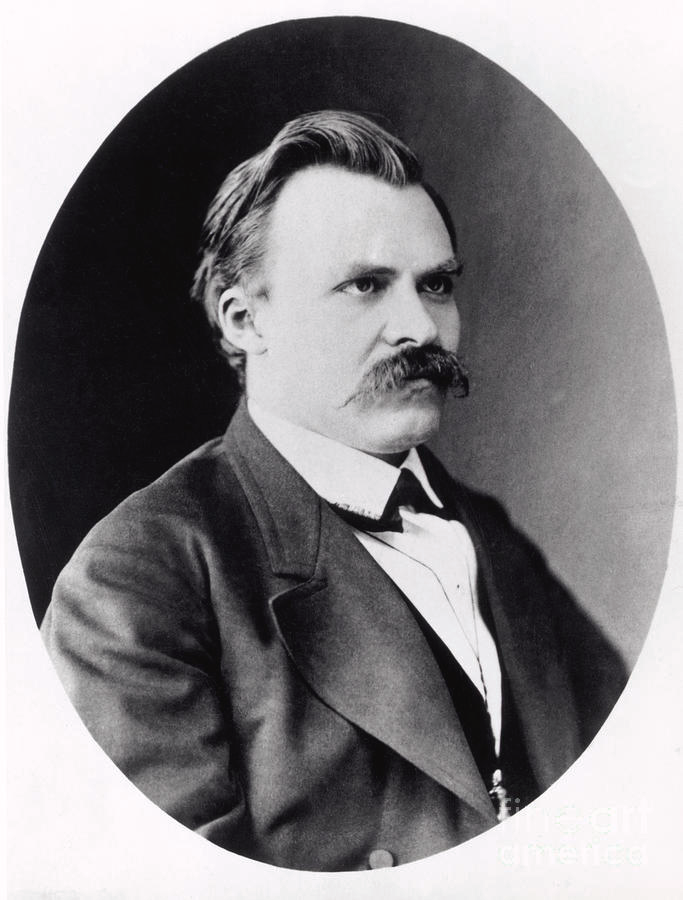
Friedrich Nietzsche (1844-1900)
Friedrich Nietzsche (1844–1900) was a German philosopher, cultural critic, poet, and classical philologist whose radical critique of Western metaphysics, Judeo-Christian morality, and Enlightenment rationalism fundamentally altered modern intellectual history. Rejecting traditional systematic philosophy in favor of aphoristic brilliance, psychological dissection, and genealogical unmasking, Nietzsche diagnosed the profound cultural crisis of European nihilism unleashed by the "Death of God." He formulated transformative concepts—the Will to Power, the Übermensch, Eternal Recurrence, Master-Slave Morality, and the Apollonian-Dionysian duality—that sought to overcome decadence through the unconditional affirmation of life (Amor Fati) and a radical transvaluation of all values (Umwertung aller Werte). His ideas prefigured modern psychoanalysis, existentialism, phenomenology, and postmodern hermeneutics.
1. The Death of God and the Crisis of Nihilism
Nietzsche's declaration that "God is dead" (Gott ist tot) is not an expression of triumphant atheism; rather, it is a catastrophic cultural diagnosis. Articulated famously in The Gay Science (§125) through the parable of the Madman and later developed in Thus Spoke Zarathustra, Nietzsche recognized that the Enlightenment, scientific empiricism, and secular rationalism had dismantled the transcendent theological architecture of Western civilization.
                    [ TRADITIONAL WESTERN METAPHYSICS ]
                 • Transcendent absolute (God / Platonic Forms)
                 • Objective moral foundation & cosmic telos
                                     │
                                     ▼  Enlightenment / Scientific Rationalism
                 [ THE DEATH OF GOD: METAPHYSICAL RUPTURE ]
                 • Loss of transcendent horizon & objective meaning
                 • The abyss of existential vertigo
                                     │
                 ┌───────────────────┴───────────────────┐
                 ▼                                       ▼
       [ PASSIVE NIHILISM ]                     [ ACTIVE NIHILISM ]
       • Cynicism, exhaustion, retreat          • Radical destruction of hollow idols
       • "The Last Man" (*Der letzte Mensch*)   • Clearance for creative self-overcoming
       • Complacent, risk-free comfort          • Transvaluation of all values
The Parable of the Madman
In The Gay Science, a madman enters a marketplace with a lantern in broad daylight, crying out that he seeks God. When mocked by secular townspeople who no longer believe in God, the madman shatters his lantern and delivers an apocalyptic warning:
"God is dead. God remains dead. And we have killed him. How shall we comfort ourselves, the murderers of all murderers? What was holiest and mightiest of all that the world has yet owned has bled to death under our knives: who will wipe this blood off us? What water is there for us to clean ourselves?" — The Gay Science (§125)[1]
Nietzsche understood that secular society took God's disappearance far too lightly. If the metaphysical foundation of morality is eliminated, then traditional ethical concepts (such as universal human equality, compassion, and divine justice) lose their ontological grounding.
Passive Nihilism vs. Active Nihilism
Nietzsche identified two distinct responses to the evaporation of transcendent meaning:
- Passive Nihilism (The "Last Man" / Der letzte Mensch): The condition of cultural exhaustion and spiritual decay. The "Last Man" desires only comfort, safety, entertainment, and shallow happiness. He takes no risks, creates no lasting values, and avoids all greatness, blinking blankly at existence without aspiration or passion.
- Active Nihilism: A dynamic, destructive force that attacks remaining metaphysical illusions and hollow dogmas. For Nietzsche, active nihilism serves as an indispensable clearing ground—a transitional stage required to eradicate dead values so that new, life-affirming values can be forged.
2. The Will to Power (Der Wille zur Macht)
Against Arthur Schopenhauer’s metaphysical "Will to Live" (Wille zum Leben) and Charles Darwin’s biological struggle for survival, Nietzsche proposed the Will to Power (Der Wille zur Macht) as the fundamental driving engine of existence.
┌─────────────────────────────────┐      ┌──────────────────────────────────┐
│    SCHOPENHAUER / DARWIN        │      │       NIETZSCHEAN ONTOLOGY       │
├─────────────────────────────────┤      ├──────────────────────────────────┤
│ • Conservation of life          │      │ • Dynamic self-overcoming        │
│ • Mere self-preservation        │ vs.  │ • Expansion, mastery & growth    │
│ • Reactive avoidance of pain    │      │ • Expenditure of abundant energy │
│ • Pessimistic denial of Will    │      │ • Affirmation of tragic vitality │
└─────────────────────────────────┘      └──────────────────────────────────┘
Beyond Mere Survival
Nietzsche rejected the biological reduction of life to mere survival:
"Physiologists should think twice before postulating the drive for self-preservation as the cardinal drive of an organic being. A living thing seeks above all to discharge its strength—life itself is will to power; self-preservation is only one of the indirect and most frequent results." — Beyond Good and Evil (§13)[2]
For Nietzsche, life is never content with mere equilibrium; living organisms crave growth, conquest, overcoming of obstacles, and the assertion of creative form over chaotic matter.
Sublimation (Sublimierung)
Crucially, the Will to Power is not a crude mandate for tyranny or physical violence. Nietzsche’s most profound psychological insight is that the highest manifestation of the Will to Power occurs through sublimation (Sublimierung):
- Raw aggressive and instinctual drives are redirected inward, transformed into creative discipline, artistic creation, rigorous intellectual inquiry, and spiritual self-mastery.
- The truly powerful individual does not dominate others through brute force; rather, they master their own internal chaos, harmonizing conflicting passions into a unified artistic whole.
3. Master-Slave Morality, Genealogy, and Ressentiment
In On the Genealogy of Morality (1887), Nietzsche pioneered a historical-critical method—the genealogy—to expose how contemporary moral values were not timeless, divinely ordained truths, but contingent psychological creations born out of historical struggle and class conflict.[3]
                             [ THE GENEALOGY OF MORALS ]
                                          │
                  ┌───────────────────────┴───────────────────────┐
                  ▼                                               ▼
       [ MASTER MORALITY ]                             [ SLAVE MORALITY ]
       • Origin: Noble ruling castes                   • Origin: Subjugated, priestly caste
       • Primary axis: Good vs. Bad                    • Primary axis: Evil vs. Good
         (*Gut* vs. *Schlecht*)                          (*Böse* vs. *Gut*)
       • Value-creating, spontaneous, proud            • Reactive, vengeful, compensatory
       • Celebrates strength, beauty, vitality         • Glorifies meekness, pity, equality
       • Psychological root: Self-affirmation          • Psychological root: *Ressentiment*
The Aristocratic Noble Morality (Herrenmoral)
In ancient noble cultures (e.g., Archaic Greece, Rome), the ruling aristocratic castes created values out of their own overflowing vitality and social power:
- Good (Gut): Denoted nobility, strength, courage, wealth, physical excellence, and pride.
- Bad (Schlecht): Denoted commonness, plebeian weakness, cowardice, and insignificance—not moral wrongdoing, but mere aesthetic and biological wretchedness.
The Slave Revolt in Morality and Ressentiment
Subjugated classes and the priestly caste, unable to take physical revenge against noble masters, orchestrated a psychological "slave revolt in morality":
- The Engine of Ressentiment: A deep, festering sense of grievance, frustration, and impotence. The weak redirect their resentment into spiritual vengeance.
- The Transvaluation of Values: Slave morality begins with a reactive negation: it points at the powerful noble and declares him Evil (Böse). Only retroactively, as an antithesis to this "evil" oppressor, does the slave define himself as Good (Gut)—the meek, the humble, the patient, and the suffering.
- The Ascetic Ideal: Sufferers are taught that their suffering is spiritually meritorious, transforming involuntary weakness into a voluntary moral virtue.
| Feature | Master Morality (Herrenmoral) | Slave Morality (Sklavenmoral) |
|---|---|---|
| Originating Class | Aristocratic, warrior nobility | Enslaved, subjugated, priestly castes |
| Foundational Dynamic | Active, self-affirming creation ("I am good, therefore...") | Reactive negation of the master ("You are evil, therefore I am good") |
| Primary Antithesis | Good vs. Bad (Gut vs. Schlecht) | Evil vs. Good (Böse vs. Gut) |
| Core Virtues | Courage, physical health, pride, generosity, distinction | Pity (Mitleid), humility, meekness, altruism, equality |
| Attitude Toward Suffering | Tragic condition of life; an obstacle to be overcome | Sign of divine election; moral martyrdom |
| Psychological Engine | Overflowing vitality and self-reverence | Poisonous ressentiment and suppressed revenge |
4. The Übermensch (Overman) and the Transvaluation of All Values
To prevent humanity from degenerating into the sterile mediocrity of the Last Man after the death of God, Nietzsche introduced the ideal of the Übermensch (Overman) in Thus Spoke Zarathustra (1883–1885).
         [ THE ANIMAL ] ──► [ MAN (THE ROPE OVER THE ABYSS) ] ──► [ THE ÜBERMENSCH ]
                                         │
                    ┌────────────────────┴────────────────────┐
                    ▼                                         ▼
         [ THE THREE METAMORPHOSES ]               [ CREATIVE ATTRIBUTES ]
         1. The Camel ("Thou Shalt")               • Loyalty to the earth
         2. The Lion ("I Will")                    • Beyond Good and Evil
         3. The Child ("A Sacred Yes")             • Self-legislating artist
The Three Metamorphoses of the Spirit (Drei Verwandlungen)
In the opening discourse of Thus Spoke Zarathustra, Nietzsche outlines the psychological and spiritual stages necessary to attain self-overcoming:
- The Camel: The beast of burden that kneels to bear heavy weights. It represents the spirit that submits to tradition, duty, cultural inheritance, and established moral law ("Thou shalt").
- The Lion: The camel journeys into the lonely desert and transforms into a fierce predator. The lion seeks freedom, confronting the great dragon whose name is "Thou Shalt." The lion replies with "I Will" (Ich will), winning the freedom to destroy sacred prohibitions and overthrow established idols.
- The Child: Yet the lion cannot create new values; it can only clear the ground through destruction. The spirit must finally become a child: The Child and the Sacred Yes
"The child is innocence and forgetting, a new beginning, a game, a self-rolling wheel, a first movement, a sacred 'Yes'. For the game of creation, my brothers, a sacred 'Yes' is needed: the spirit now wills his own will, and he who had been lost to the world now conquers his own world." — Thus Spoke Zarathustra[4]
Loyalty to the Earth (Bleibt der Erde treu!)
Nietzsche’s Übermensch completely rejects all metaphysical escapes, heavenly promises, and Platonist "otherworlds" (Hinterwelten). Zarathustra implores humanity: "Remain true to the earth, my brothers, and do not believe those who speak to you of otherworldly hopes!" The Übermensch embraces the physical body, sensory life, and immanent existence without seeking consolation in an imaginary afterlife.
5. Eternal Recurrence (Die ewige Wiederkehr) and Amor Fati
Nietzsche considered the doctrine of the Eternal Recurrence of the Same (Die ewige Wiederkehr des Gleichen) to be his most fundamental thought—the "highest formula of affirmation that is at all attainable."
                    ┌──────────────────────────────────────────┐
                    │    THE GREATEST WEIGHT / TEST OF SOUL    │
                    │   "Every pain, joy, thought, and sigh    │
                    │      repeated in identical sequence      │
                    │         through infinite cycles"         │
                    └────────────────────┬─────────────────────┘
                                         │
                 ┌───────────────────────┴───────────────────────┐
                 ▼                                               ▼
      [ THE REACTION OF DESPAIR ]                     [ THE REACTION OF AFFIRMATION ]
      • Gnashing of teeth                             • "You are a god, and never have
      • Crushed by cosmic meaninglessness               I heard anything more divine!"
      • Escapism & regret                             • Radical *Amor Fati* (Love of Fate)
The Demon's Challenge
First presented in The Gay Science (§341) under the title "The Greatest Weight" (Das schwerste Gewicht), the thought experiment asks:
"What if some day or night a demon were to sneak after you into your loneliest loneliness and say to you: 'This life as you now live it and have lived it, you will have to live once more and innumerable times more; and there will be nothing new in it, but every pain and every joy and every thought and sigh and everything unutterably small or great in your life will have to return to you, all in the same succession and sequence...' Would you not throw yourself down and gnash your teeth and curse the demon who spoke thus?" — The Gay Science (§341)[1:1]
Amor Fati: The Unconditional Love of Fate
Eternal Recurrence functions not primarily as a cosmological astrophysics theory, but as an existential litmus test. To pass this test, one must achieve Amor Fati (love of fate):
- One must not merely endure or tolerate suffering, but love reality exactly as it is, recognizing that pain, horror, and tragedy are inextricably intertwined with joy, beauty, and triumph.
- The Übermensch possesses the existential courage to answer the demon: "Was that life? Well then! Once more!"
6. The Apollonian and Dionysian Dialectic
In his first book, The Birth of Tragedy out of the Spirit of Music (1872), written under the twin influences of Arthur Schopenhauer and Richard Wagner, Nietzsche identified two opposing aesthetic forces that drove ancient Greek culture.[5]
               [ THE APOLLONIAN ]                         [ THE DIONYSIAN ]
         • Principle of individuation               • Dissolution of ego-boundaries
         • Light, clarity, form, reason             • Primal unity (*das Ur-Eine*), frenzy
         • Dream state (*Traum*)                    • Intoxication (*Rausch*)
         • Sculpture, plastic arts, epic            • Music, dithyramb, tragic dance
                        │                                          │
                        └────────────────────┬─────────────────────┘
                                             ▼
                               [ ATTIC TRAGEDY ]
                      (Aeschylus, Sophocles, Tragic Chorus)
               Dionysian abyss given beautiful Apollonian form
The Twin Artistic Drives
- The Apollonian (Das Apollinische): Named after Apollo, god of the sun, light, and prophecy. It represents form, measure, clarity, rationality, symmetry, and the principle of individuation (principium individuationis). It manifests in sculpture, painting, and epic poetry (Homer), acting as a protective dream-veil shielding consciousness from the terrifying chaos of existence.
- The Dionysian (Das Dionysische): Named after Dionysus, god of wine, frenzy, harvest, and ecstasy. It represents the destruction of individual boundaries, intoxicating abandonment, primordial unity (das Ur-Eine), and direct contact with the churning, ecstatic, and terrifying essence of life. It manifests in music, rhythmic dance, and sacred chorus.
The Triumph and Death of Attic Tragedy
Nietzsche argued that Greek culture achieved its highest artistic zenith in Attic tragedy (Aeschylus and Sophocles), where Dionysian ecstatic horror was captured, redeemed, and made bearable through Apollonian dramatic dialogue and formal beauty.
However, tragedy was murdered by Euripides and Socrates, who introduced "Socratic rationalism"—the optimistic illusion that dialectical reason and scientific calculation could explain, master, and cure the tragic suffering of existence.
7. Perspectivism and the Deconstruction of Truth
Long before twentieth-century postmodernism and post-structuralism, Nietzsche launched a radical critique of Cartesian epistemology, Kantian metaphysics, and objective scientific positivism.
"Against positivism, which halts at phenomena—'There are only facts'—I would say: No, facts are precisely what there is not, only interpretations. We cannot establish any fact 'in itself': perhaps it is folly to want to do such a thing." — Notebooks (Nachlass), Fall 1885–Autumn 1887[6]
Perspectivism (Perspektivismus)
Nietzsche maintained that all human cognition is inherently perspectival:
- There is no detached, objective "God’s-eye view" or neutral archimedean point from which reality can be witnessed without bias.
- Every claim to truth is conditioned by the physiological interests, historical context, psychological drives, and Will to Power of the knower.
- The more perspectives and eyes one can bring to bear on a phenomenon, the richer and more nuanced our understanding becomes.
Truth as a "Mobile Army of Metaphors"
In his early essay On Truth and Lie in an Extra-Moral Sense (1873), Nietzsche exposed the linguistic foundations of human knowledge:
- Truth is not an accurate reflection of the external world, but a "mobile army of metaphors, metonyms, and anthropomorphisms"—illusions whose figurative origin has been forgotten through habitual repetition.
- Language categorizes heterogeneous, unique sensory phenomena into rigid abstract concepts, blinding human beings to the chaotic, fluid richness of concrete reality.
8. Chronological Synthesis of Nietzsche's Major Works
| Work | Year | Period / Stylistic Mode | Core Philosophical Preoccupations | Historical & Conceptual Significance |
|---|---|---|---|---|
| The Birth of Tragedy | 1872 | Philological & Wagnerian aestheticism | Apollonian and Dionysian duality; critique of Socratic rationalism; rebirth of tragedy in modern music. | Breaks with conventional classical philology; establishes aesthetic justification of existence. |
| Human, All Too Human | 1878 | Free-spirit enlightenment; aphoristic turn | Psychological skepticism; demystification of metaphysics, religion, and romantic art. | Marks break with Wagner and Schopenhauer; initiates analytical, scientific detachment. |
| The Dawn (Daybreak) | 1881 | Psychological naturalist critique | Critique of moral prejudices; origin of customs; physiology of drives and feelings. | Prefigures genealogical unmasking; exploration of subconscious impulses. |
| The Gay Science | 1882 | Joyful wisdom (la gaya scienza) | The Madman and Death of God (§125); Eternal Recurrence (§341); Amor Fati; intellectual vitality. | Introduces core mature concepts; bridges early skepticism and Zarathustra. |
| Thus Spoke Zarathustra | 1883–1885 | Poetic, prophetic scripture | The Übermensch; Three Metamorphoses; Will to Power; Eternal Recurrence; critique of the Last Man. | Nietzsche's literary-philosophical magnum opus; alternative gospel of the earth. |
| Beyond Good and Evil | 1886 | Systematic philosophical polemic | Critique of previous philosophers; perspectivism; Will to Power; Master and Slave morality. | Clarifies Zarathustra's poetic insights into rigorous, trenchant analytical critique. |
| On the Genealogy of Morality | 1887 | Historical-psychological treatise | Historical emergence of ressentiment; guilt and bad conscience; ascetic ideals and their meaning. | Nietzsche's most coherent academic treatise; founding document of modern genealogy. |
| Twilight of the Idols | 1889 | Dense, explosive summary ("philosophizing with a hammer") | Critique of Socrates, Plato, Kant, and Christian morality; "The Four Great Errors." | Brilliant philosophical handbook written in Turin just before his final collapse. |
| The Antichrist | 1888/1895 | Fierce polemical attack | Christianity as decadent corruption; Paul's betrayal of Jesus's practice; triumph of slave morality. | Radical indictment of institutional religion; distinction between Christ and Christendom. |
| Ecce Homo | 1888/1908 | Autobiographical retrospective | "Why I Am So Wise," "Why I Write Such Good Books," "Why I Am a Destiny." | Astonishing self-assessment; tragic culmination of his intellectual autobiography. |
9. Comparative Framework: 19th-Century Existential & Systematic Thinkers
===================================================================================
             FOUR FOUNDATIONAL VISIONS OF HUMAN DESTINY AND METAPHYSICS
===================================================================================

 [ HEGELIAN SYSTEM ]  ──► Geist (Absolute Spirit) realizing itself through dialectical
                          historical synthesis; ultimate rational reconciliation.
            │
            ▼
 [ SCHOPENHAUER ]     ──► The blind, irrational Will causing universal torment;
                          salvation via aesthetic contemplation & ascetic denial.
            │
            ▼
 [ KIERKEGAARD ]      ──► Subjectivity is truth; anxiety (*angst*) of absolute freedom;
                          the radical, paradoxical leap of faith into the absurd.
            │
            ▼
 [ NIETZSCHE ]        ──► The Will to Power; active overcoming of nihilism; rejection
                          of otherworlds; unconditional *Amor Fati* & the Übermensch.
===================================================================================
| Dimension | G.W.F. Hegel (1770–1831) | Arthur Schopenhauer (1788–1860) | Søren Kierkegaard (1813–1855) | Friedrich Nietzsche (1844–1900) |
|---|---|---|---|---|
| Fundamental Reality | Rational Idea (Geist) unfolding in history. | Blind, irrational, purposeless Will (Wille). | The single, concrete Individual (Den Enkelte) before God. | Dynamic, pluralistic Will to Power (Wille zur Macht). |
| Epistemology | Objective dialectical logic; Absolute Knowing. | Transcendental idealism (World as Representation). | Subjectivity is truth; inwardness, paradox. | Perspectivism; interpretations without transcendent facts. |
| View of Suffering | Necessary dialectical negation overcome in synthesis. | Innate condition of existence; ceaseless frustration and boredom. | Spiritual crisis; anxiety (angst) provoking existential choice. | Forge of greatness; necessary condition for self-overcoming and creativity. |
| Ultimate Resolution | Systematic integration into the rational State and Geist. | Ascetic denial of the Will; Buddhist-like extinction of desire. | Leap of Faith into the paradoxical Christian absurd. | Amor Fati; creative transvaluation; affirmation of the Übermensch. |
| Attitude to Christianity | Philosophical truth expressed in mythological form. | Respect for Christian asceticism; rejection of theist creator. | Passionate defense of authentic faith against state "Christendom." | Radical condemnation of Christian morality as poisonous slave ressentiment. |
🎴 Interactive Web Practice (Comprehension Check)
Question 1 (The Death of God & Nihilism): What did Nietzsche mean by declaring that "God is dead," and why did he consider the advent of "The Last Man" to be a far greater cultural peril than initial active despair?
Answer: Nietzsche's declaration "God is dead" was not a celebratory atheist victory, but an acute cultural diagnosis. He recognized that the Enlightenment, empirical science, and historical criticism had irreversibly shattered the metaphysical foundation of Western civilization. Without a transcendent deity or Platonic absolute, all traditional values, moral systems, and teleological frameworks lost their cosmic grounding, plunging humanity into existential disorientation.
Nietzsche feared that society would fail to grasp the gravity of this collapse and default to the condition of "The Last Man" (Der letzte Mensch)—the ultimate embodiment of passive nihilism. The Last Man seeks only petty physical comforts, risk-free entertainment, and mindless conformity. He is incapable of great passion, creative sacrifice, or self-overcoming, blinking complacently while reducing human existence to shallow bourgeois satisfaction. For Nietzsche, this tranquil, unthinking mediocrity represents the permanent death of humanity's creative potential, making it far more dangerous than active nihilistic despair, which at least retains the destructive energy required to clear away decayed idols.
Question 2 (Master vs. Slave Morality & Ressentiment): How does Nietzsche's genealogical method explain the emergence of Judeo-Christian ethics, and what psychological role does ressentiment play in this moral transvaluation?
Answer: In On the Genealogy of Morality, Nietzsche argued that contemporary morality is not universal or divinely ordained, but the historical product of a psychological revolt executed by subjugated classes against aristocratic rulers. In noble master morality, the primary distinction was between Good (Gut)—connoting physical vitality, nobility, strength, courage, and pride—and Bad (Schlecht)—connoting the common, wretched, and impotent.
Subjugated and enslaved populations, unable to take physical revenge against their masters, experienced profound ressentiment—a festering, repressed psychological venom. Through the leadership of the priestly caste, this impotence underwent a creative transvaluation. Slave morality began with a reactive negation: it pointed at the noble master and branded his virtues (power, wealth, strength, pride) as Evil (Böse). Only retroactively did the slave define his own traits (poverty, meekness, obedience, pity) as Good (Gut). Through this psychological inversion, suffering was recast as spiritual virtue, and involuntary weakness was glorified as voluntary moral excellence, subverting noble vitality in favor of universal leveling.
Question 3 (Eternal Recurrence, Amor Fati & The Apollonian-Dionysian Dialectic): How does the thought experiment of the Eternal Recurrence function as an existential litmus test, and how does Amor Fati resolve the tension between Apollonian form and Dionysian tragedy?
Answer: The Eternal Recurrence of the Same asks whether an individual, confronted by a demon stating that every joy, pain, sorrow, and trivial detail of their life will be repeated in identical sequence across infinite cycles, would collapse in curse and despair or revere the demon as divine. The thought experiment does not require physical belief in cosmic cyclicity; rather, it functions as the supreme psychological and existential litmus test: have you lived in a manner such that you would wholeheartedly desire the infinite repetition of every single moment?
This test is passed only through Amor Fati (the love of fate)—an attitude that does not merely tolerate misfortune, but embraces every agonizing and tragic aspect of existence as necessary and valuable. This directly resolves the tension first analyzed in The Birth of Tragedy: while the Apollonian impulse seeks refuge in idealized aesthetic illusions and orderly forms, and the Dionysian impulse exposes the terrifying, chaotic abyss of primordial existence, Amor Fati allows the individual to confront the raw Dionysian reality without fleeing into otherworldly escapism, utilizing Apollonian creative discipline to transfigure tragic suffering into sublime artistic greatness.
Resonant Notes
The following notes in the vault share direct thematic, sociological, and literary connections with Friedrich Nietzsche:
🔴 Existentialism, Nihilism & The Metaphysics of Will
- Schopenhauerian Pessimism — Schopenhauer was Nietzsche's primary philosophical mentor and greatest adversary. Nietzsche transformed Schopenhauer’s blind, suffering-producing "Will to Live" (Wille zum Leben) into the life-affirming, creative "Will to Power" (Wille zur Macht), substituting Schopenhauer's ascetic renunciation with the radical, life-affirming embrace of Amor Fati.
- Søren Kierkegaard — Kierkegaard and Nietzsche represent the twin 19th-century precursors to existentialism, both violently rebelling against Hegelian systemic rationalism and institutional Christianity. While Kierkegaard responded to existential dread with a subjective leap of faith into the Christian absurd, Nietzsche countered with the death of God, loyalty to the earth, and the Übermensch.
- Albert Camus — Camus's philosophy of the Absurd and heroic revolt in The Myth of Sisyphus is the direct heir to Nietzsche's Amor Fati. Sisyphus consciously affirming his eternal, boulder-rolling punishment is the literary embodiment of Nietzsche's eternal recurrence and tragic joy.
- Jean-Paul Sartre — Sartre’s existentialist axiom that "existence precedes essence" and his doctrine of radical personal responsibility directly systematize Nietzsche's collapse of transcendent values; without God, human beings are condemned to invent their own moral meaning.
- Continental Philosophy — Nietzsche stands as the pivotal bridge in the Continental tradition, linking German Idealism and Schopenhauerian metaphysics to twentieth-century phenomenology, French existentialism, and post-structuralism.
- Martin Heidegger — Heidegger dedicated monumental lecture series to Nietzsche, interpreting him as the thinker who completed and exhausted Western metaphysics through the absolute culmination of the Will to Power.
- Georg Wilhelm Friedrich Hegel (1770–1831) — Hegel's teleological historicism and dialectical system represent the supreme philosophical edifice of 19th-century rationalism that Nietzsche, following Kierkegaard and Schopenhauer, sought to dismantle through genealogical critique.
🟡 Aesthetics, Psychology & Consciousness
- Sigmund Freud & Freud's The Uncanny (Das Unheimliche) — Nietzsche's formulations of the unconscious, instinctual drives, repression, the pleasure principle, and sublimation directly anticipated Freud's psychoanalytic architecture; Freud openly acknowledged that Nietzsche had a more penetrating self-knowledge than any man who ever lived.
- Jokes and Their Relation to the Unconscious — Freud's analysis of jokes and wit as psychic economy and the release of repressed aggressive drives mirrors Nietzsche's celebration of philosophical laughter, irony, and the "gay science" (la gaya scienza) as tools to overthrow solemn religious idols.
- Carl Gustav Jung — Jung conducted a multi-year seminar analyzing Thus Spoke Zarathustra, viewing Nietzsche's concept of the Dionysian, the shadow, and the Übermensch as profound psychological excavations of the collective unconscious and the individuation process.
- Jacques Lacan — Lacan's linguistic formulation of the unconscious and the deconstruction of the autonomous Cartesian ego build upon Nietzsche's recognition that the "subject" and the "ego" are grammatical fictions imposed upon dynamic instinctual drives.
- The Dehumanization of Art — José Ortega y Gasset's diagnosis of modernism's rejection of 19th-century bourgeois sentimentality and romantic pathos parallels Nietzsche's critique of the ascetic ideal and his demand for an austere, noble art of distance.
- Iain McGilchrist — McGilchrist’s neurological distinction between the left hemisphere (linear, analytical, categorizing) and right hemisphere (holistic, embodied, contextual) provides a contemporary cognitive substrate for Nietzsche’s Apollonian and Dionysian dialectic.
- Defining a Simulacrum & Jacques Derrida — Nietzsche's claim that truth is a "mobile army of metaphors" and that there are "no facts, only interpretations" directly fathered Baudrillardian simulacra and Derridean deconstruction, proving that all claims to fixed origins and transcendent signifieds are linguistic illusions.
🟢 Modernity, Cultural Critique & Literature
- Johann Wolfgang von Goethe (1749-1832) & Goethe's Faust — Goethe represented Nietzsche’s ultimate historical exemplar of the whole, fully realized human being: a man who synthesized Apollonian artistic discipline with Dionysian vitality, creating himself through art and science without moralistic self-hatred. Faust's relentless striving mirrors the Will to Power.
- Fyodor Dostoevsky (1821-1881) — Nietzsche discovered Dostoevsky in 1887, calling him "the only psychologist from whom I had something to learn." Dostoevsky’s Underground Man embodies the corrosive psychology of ressentiment, while Raskolnikov in Crime and Punishment and Ivan Karamazov in The Brothers Karamazov wrestle with the terrifying moral vacuum of the death of God.
- Ralph Waldo Emerson & American Transcendentalism — Emerson was one of Nietzsche’s most enduring lifelong inspirations; Nietzsche filled his copies of Emerson's essays with ecstatic margin notes. Emersonian self-reliance, nonconformity, and spiritual nobility directly shaped the concept of the free spirit and the Übermensch.
- Giorgio de Chirico (1888-1978) — The Italian metaphysical painter drew his central aesthetic inspiration from Nietzsche’s writings and his fateful Turin period; De Chirico translated Nietzsche's sense of philosophical solitude, uncanny autumn light, and empty classical piazzas onto canvas.
- Michel Foucault — Foucault explicitly adopted Nietzsche’s genealogical method in Discipline and Punish and The History of Sexuality, demonstrating how modern institutional concepts of sanity, penal justice, and sexuality are produced through historical power dynamics rather than objective humanitarian progress.
- Yuval Noah Harari — Harari's concept of "intersubjective realities" (legal corporate entities, nations, paper money) as shared imaginative fictions that structure human societies is a direct sociological extension of Nietzsche’s insight that human truths are useful cultural illusions.
- Northrop Frye & Northrop Frye's - Anatomy of Criticism — Frye’s archetypal analysis of the tragic and ironic mythoi explores the identical mythological territory Nietzsche charted in The Birth of Tragedy, unmasking the tension between cyclical cosmic terror and heroic individuation.
- Woody Allen & The Existential Paradox of Annie Hall's Opening Monologue — Allen’s cinematic protagonists dramatize the comedic, neurotic despair of modern secular humanity struggling to find purpose after the death of God, constantly seeking neurotic escapes from the terrifying reality of mortality.
References
Friedrich Nietzsche / The Gay Science / Translated by Walter Kaufmann / Vintage Books, 1974 ↩︎ ↩︎
Friedrich Nietzsche / Beyond Good and Evil: Prelude to a Philosophy of the Future / Translated by Walter Kaufmann / Vintage Books, 1989 ↩︎
Friedrich Nietzsche / On the Genealogy of Morality / Translated by Maudemarie Clark and Alan J. Swensen / Hackett Publishing, 1998 ↩︎
Friedrich Nietzsche / Thus Spoke Zarathustra / Translated by R.J. Hollingdale / Penguin Classics, 2003 ↩︎
Friedrich Nietzsche / The Birth of Tragedy / Translated by Walter Kaufmann / Vintage Books, 1967 ↩︎
Friedrich Nietzsche / Writings from the Late Notebooks / Edited by Rüdiger Bittner / Cambridge University Press, 2003 ↩︎