Dystopian Counterpoints: Brave New World vs. Nineteen Eighty-Four
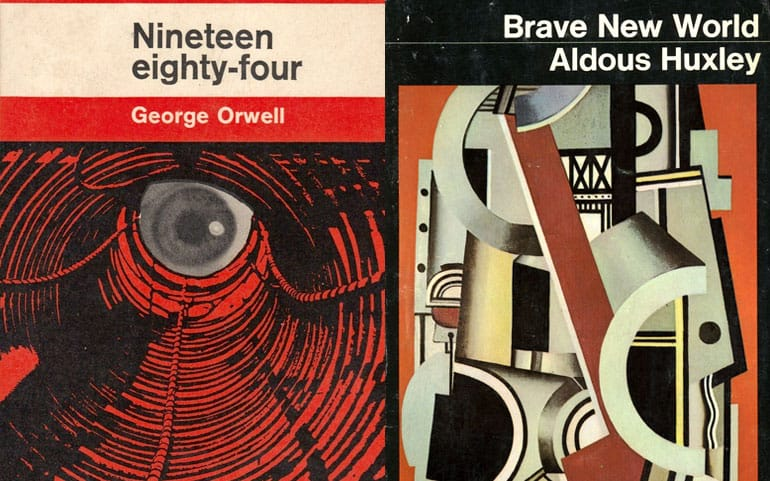
The primary intellectual debate governing twentieth-century political dystopias contrasts George Orwell's Nineteen Eighty-Four (1949) with Aldous Huxley's Brave New World (1932). While Orwell warned of a centralized, punitive totalitarianism enforced through fear, state-managed scarcity, physical surveillance, and linguistic mutilation, Huxley envisioned an insidious technocratic hegemony sustained by biological engineering, consumer hedonism, informational glut, and pharmacological pacification (soma). When evaluated through Buddhist psychology and epistemology, the two dystopias operationalize opposite roots of unwholesome consciousness (akusala-mūla): Oceania weaponizes hatred and aversion (dosa), while the World State exploits sensory craving (taṇhā) and greed (lobha), both culminating in total delusion (moha / avijjā). In the twenty-first century, late-capitalist digital media ecologies synthesize both paradigms into a hybrid control apparatus that marries Huxleyan algorithmic sedation with Orwellian biometric surveillance.
1. The Dual Architectures of Totalitarian Domination
The twentieth century produced two radically diverging prognostications concerning the mechanisms by which technological civilization would extinguish human freedom. Rather than merely offering political satires of their respective historical moments—interwar Fordist industrialism for Huxley and post-WWII Stalinist/Fascist totalitarianism for Orwell—both authors constructed rigorous ontological and behavioral models of societal subjugation.
| Dimension / Layer | Orwellian Coercive Apparatus (Nineteen Eighty-Four, 1949) | Huxleyan Hedonic Apparatus (Brave New World, 1932) |
|---|---|---|
| Operant Conditioning | Negative reinforcement / Aversive control | Positive reinforcement / Hedonic conditioning |
| Primary Medium | Weaponized pain, fear, scarcity, and material deprivation | Pharmacological sedation (soma) and sensory glut |
| Institutional Apparatus | Centralized terror: Thought Police, Ministry of Love, Room 101 | Biological caste determinism: Decanting, Bokanovsky Process, hypnopaedia |
| Epistemic Environment | Information scarcity: Newspeak, rigid censorship, archival erasure | Information noise: Distraction, irrelevance, triviality |
| Interiority & Subjectivity | Violent destruction of interiority through somatic torture | Preemption of interiority through instant gratification |
| Societal Mobilization | Totalitarian mobilization: Hate Week, organized rage, perpetual war | Consumer pacification: Compulsory consumption and organized leisure |
| 21st-Century Synthesis | Hard Infrastructure: Biometric tracking, predictive surveillance grids | Soft Interface: Algorithmic dopamine loops, digital sedation |
The Orwellian Model: Hard Totalitarianism and Weaponized Pain
In Oceania, power is naked, centralized, and sadistic. As interrogator O'Brien infamously tells Winston Smith in the subterranean chambers of the Ministry of Love, "Power is not a means; it is an end. One does not establish a dictatorship in order to safeguard a revolution; one makes the revolution in order to establish the dictatorship."
The architecture of Orwellian control relies upon:\n- Pain and Somatic Degradation: Physical discomfort, chronic shortages of razor blades and decent gin, decaying infrastructure, and the ever-present threat of torture in Room 101 keep the nervous system in an acute state of defensive stress.
- Total Surveillance: The two-way telescreen, hidden microphones, and the child spies of the Junior Spies institutionalize an external panoptic gaze (resonating with Michel Foucault's analysis of panopticism) that eliminates the spatial and psychological possibility of sanctuary.
- Linguistic Compression (Newspeak): By actively amputating vocabulary and collapsing semantic nuance into rigid binaries (ungood, doubleplusgood), the state attempts to make heterodox thought literally unformulateable, as analyzed in George Orwell (1903-1950).
- Historical Negationism: Continuous alteration of archival records ensures the Party maintains absolute infallibility: "Who controls the past controls the future: who controls the present controls the past."
The Huxleyan Model: Soft Totalitarianism and Engineered Desire
Aldous Huxley recognized that overt physical violence is structurally inefficient, economically disruptive, and historically unstable. Writing in the wake of the Industrial Revolution's assembly line breakthroughs, Huxley grasped that a truly permanent tyranny must condition the governed to love their servitude.
The architecture of Huxleyan control relies upon:
- Biological and Genetic Stratification: Natural biological birth is abolished in favor of industrial decanting and the Bokanovsky Process, manufacturing rigid, genetically determined cognitive castes (Alphas, Betas, Gammas, Deltas, Epsilons).
- Hypnopaedic Conditioning: Moral and consumerist dogmas are whispered into children's ears thousands of times during sleep, embedding reflex-level conformity before the development of conscious reasoning ("Ending is better than mending," "A gramme is better than a damn").
- Pharmacological Pacification (Soma): The synthetic narcotic soma provides "Christianity without tears"—instant, chemically induced euphoria without physiological hangovers, eliminating existential angst, grief, or metaphysical unrest at the molecular level.
- Compulsory Hedonism and Distraction: Solitude is treated as an antisocial pathology. Citizens are continuously immersed in hyper-sensory amusements—the "Feelies," synthetic music, centrifugal bumble-puppy, and compulsory promiscuity ("everyone belongs to everyone else")—ensuring that the reflective stillness required for contemplative consciousness is entirely foreclosed.
2. Neil Postman's Diagnosis: Amusing Ourselves to Death
In his 1985 media ecology treatise Amusing Ourselves to Death, cultural critic Neil Postman formalized the profound epistemological difference between Orwell and Huxley, arguing that the contemporary democratic West was succumbing not to the boot of Big Brother, but to the laughing gas of the World State:
"What Orwell feared were those who would ban books. What Huxley feared was that there would be no reason to ban a book, for there would be no one who wanted to read one. Orwell feared those who would deprive us of information. Huxley feared those who would give us so much that we would be reduced to passivity and egoism. Orwell feared that the truth would be concealed from us. Huxley feared the truth would be drowned in a sea of irrelevance."
Postman's insight connects directly with the Toronto School of media ecology, notably Marshall McLuhan (1911-1980) and The Medium is the Message, as well as Harold Innis's examination of knowledge monopolies in Innis (1950) - Empire and Communications and Innis (1951) - The Bias of Communication:
- Censorship vs. Informational Glut: While the Ministry of Truth burns inconvenient documents in the "memory hole," the World State renders censorship obsolete by drowning critical reflection in sensory triviality and entertainment noise. As explored in Don DeLillo Major Themes Analysis, late-capitalist culture achieves ideological pacification through informational "blur and glut" rather than state-enforced silence.
- Coercive Captivity vs. Addictive Seduction: Orwell's citizens are held captive in an ideological prison guarded by barbed wire and Thought Police; Huxley's citizens are trapped in an amusement park whose gates they have zero desire to open.
- The Erosion of Epistemology: In Orwell, truth is actively fabricated by the state; in Huxley, the very desire for truth is atrophied by continuous amusement, prefiguring the contemporary attention economy, where attention capture supersedes rational discourse.
3. Buddhist Epistemology: The Three Poisons as Mechanisms of Control
The profound metaphysical contrast between Orwell and Huxley becomes exceptionally luminous when examined through the lens of early Buddhist psychology (Abhidhamma) and canonical soteriology. In Buddhist philosophy, all existential suffering (dukkha) and cycles of karmic entrapment (as mapped in the Tibetan Wheel of Life) arise from the Three Unwholesome Roots (Akusala-mūla), also known as the Three Poisons:
- Aversion / Hatred (Dosa)
- Craving / Greed (Lobha / Taṇhā)
- Delusion / Ignorance (Moha / Avijjā)
| Buddhist Root (Akusala-mūla) | Psychological Manifestation | Dystopian Operationalization | Regime Manifestations |
|---|---|---|---|
| Dosa (Aversion / Hatred) | Fear, hatred, rage, repulsion from somatic pain | Orwellian Totalitarianism (Coercive / Aversive Control) | • Two Minutes Hate & Hate Week • Terror of Room 101 & physical torture • Perpetual external warfare |
| Lobha / Taṇhā (Greed / Craving) | Sensory appetite, greed, grasping for pleasant feeling (vedanā) | Huxleyan Technocracy (Hedonic Conditioning) | • Soma chemical euphoria • Hyper-sensory amusements ("the Feelies") • Compulsory consumerist compulsion |
| Moha / Avijjā (Delusion / Ignorance) | Ignorance of true nature, reification of the false self | Shared Systemic Engine (Total Epistemic Closure) | • Newspeak and doublethink (Orwell) • Hypnopaedic dogma & sleep conditioning (Huxley) • Systematic erasure of Anicca and Anattā |
Oceania as the Weaponization of Dosa (Aversion and Terror)
The emotional and psychological energy that powers Orwell's Oceania is derived almost exclusively from Dosa (aversion, hatred, hostility, and terror):
- The Cult of Organized Hatred: Through rituals like the daily Two Minutes Hate and the colossal spectacle of Hate Week, the Party deliberately stimulates latent psychological frustration, sexual repression, and economic misery, transforming these feelings into screaming, frothing rage directed outward against Emmanuel Goldstein and rival superstates.
- Aversion to Pain as the Lever of Submission: In Buddhist psychology, aversion creates intense mental constriction and reactive defensiveness. The Party uses the raw physiological terror of physical torture—symbolized by the cage of carnivorous rats in Room 101—to break the last bastion of human interiority. Winston Smith's betrayal of Julia ("Do it to Julia! Not me!") represents the ultimate triumph of dosa: the instinctive, panicked aversion to somatic pain annihilates the capacity for selfless love (mettā) and moral virtue (Sīla - Buddhist Ethics).\n- Ego Destruction via Humiliation: Rather than transcending the illusory ego in the Buddhist sense of Anattā (non-self), Oceania violently shatters the autonomous subject, replacing individual dignity with terror-stricken submission to the immortal totem of Big Brother.
The World State as the Weaponization of Taṇhā (Craving and Hedonism)
In diametric opposition, Huxley's World State bypasses aversion and anchors its dominion entirely within Lobha (greed) and Taṇhā (craving, insatiable thirst for pleasant sensations):
- The Samsaric Loop of Sensual Craving (Kāma-taṇhā): Buddhist psychology teaches that pursuing pleasant feeling (vedanā) through sensory objects never produces lasting peace; instead, it fuels endless grasping (upādāna) and birth into renewed suffering. The World State institutionalizes this exact cycle: citizens are conditioned to constantly satisfy desires before any introspective gap can occur. By satisfying appetites instantaneously, the regime eliminates the existential frustration that leads to philosophical inquiry.
- The Deva Realm Cosmological Analog: In the Buddhist cosmology depicted on the Tibetan Wheel of Life, the Deva Realm (the heaven of the gods) is characterized by unbroken aesthetic luxury, physical beauty, sensory delight, and the absence of apparent suffering. Crucially, early Buddhist texts identify the Deva Realm as the most spiritually dangerous realm of rebirth. Because the gods experience continuous pleasure, they are completely blinded by complacency; they never confront the truth of suffering (dukkha), generate no spiritual urgency (saṃvega), and cannot practice the The Noble Eightfold Path. Huxley’s World State is the technological realization of the Deva Realm: an artificial, secular heaven whose inhabitants are so blissfully intoxicated that liberation is rendered unthinkable.
- Soma as the Anti-Dharma: In Aldous Huxley's The Perennial Philosophy and Aldous Huxley's The Doors of Perception (1954), Huxley showed profound awareness of Eastern spiritual disciplines and the expansion of mystical consciousness. In Brave New World, however, he invented soma as the sinister photographic negative of genuine spiritual awakening:
- While Buddhist meditation (bhāvanā) cultivates clear-eyed mindfulness (sati), equanimity (upekkhā), and courageous confrontation with impermanence and grief, soma functions as an evasive chemical lobotomy.
- When characters feel the slightest prick of emotional discomfort, melancholy, or solitude, they take soma to suppress somatic reality: "One cubic centimetre cures ten gloomy sentiments." It is pharmacological denial of dukkha, cementing spiritual slumber rather than awakening.
The Common Ground: Moha (Delusion) and the Erasure of Anattā
Both dystopian regimes ultimately terminate in Moha (fundamental delusion or cognitive ignorance, known as avijjā in Buddhist epistemology):
- The Suppression of Anicca (Impermanence):
- Oceania denies impermanence by establishing the eternal, immutable Party, freezing history in a continuous present.
- The World State denies impermanence by biologically arresting somatic aging: individuals remain physically youthful and sexually vigorous until age sixty, whereupon they are swiftly, painlessly liquidated in hospital wards while youth cohorts are conditioned through candy distribution to view death as a sterile, non-event. The existential encounter with sickness, old age, and death—the foundational "Four Sights" that prompted Siddhartha Gautama to abandon his palace and seek enlightenment—is systematically engineered out of human experience.
- The Caricature of Selflessness vs. Anattā:
- True Buddhist Anattā deconstructs the reified ego to reveal boundless interdependence, compassion, and unconditioned awareness, as discussed in Constructs of the Mind-Unmasking Consciousness in East and West.
- Both dystopias offer grotesque caricatures of this dissolution:
- Orwell forces the surrender of the ego into the immortal collective of the Party ("Alone—free—the human being is always defeated... But if he can make complete, utter submission... he is the Party").
- Huxley enforces an artificial collectivization ("Everyone belongs to everyone else"), dissolving individual reflection into promiscuous social integration and herd consciousness.
4. The Savage as Spiritual Dissident: The Right to Suffer
The climax of Brave New World—the extended philosophical duel between World Controller Mustapha Mond and John the Savage—stands as one of literature's greatest confrontations between technocratic utilitarianism and existential/spiritual transcendence.
Mond articulates the ultimate consumerist compromise: civilization has eliminated instability, war, disease, poverty, and misery. In exchange, humanity had to sacrifice high art (Shakespeare), religious reverence, heroic nobility, and deep philosophical inquiry:
Mond: "Actual happiness always looks pretty squalid in comparison with the overcompensations for misery... And, of course, stability isn't nearly so spectacular as instability. And being contented has none of the glamour of a good fight against misfortune..."
The Savage: "I don't want comfort. I want God, I want poetry, I want real danger, I want freedom, I want goodness. I want sin."
Mond: "In fact, you're claiming the right to be unhappy."
The Savage: "Not to mention the right to grow old and ugly and impotent; the right to have syphilis and cancer; the right to have too little to eat; the right to be lousy; the right to live in constant apprehension of what may happen to-morrow; the right to catch typhoid; the right to be tortured by unspeakable pains of every kind."
Mond: "You're welcome."
This exchange resonates profoundly with the First Noble Truth of Buddhism: Dukkha-sacca (the Noble Truth of Suffering). In Buddhist philosophy, as articulated in The Dhammapada and analyzed by modern commentators like Stephen Batchelor, awakening cannot occur by running away from suffering into sensory intoxication. Genuine spiritual realization requires acknowledging and penetrating the reality of existential suffering. By legally abolishing suffering, the World State has abolished the very friction that awakens human consciousness, producing a civilization of smiling, genetically modified animals.
5. Comparative Structural Matrix: Orwell vs. Huxley
The following table provides a comprehensive contrastive synthesis across key sociological, political, epistemological, and metaphysical axes:
| Analytical Dimension | George Orwell (Nineteen Eighty-Four) | Aldous Huxley (Brave New World) |
|---|---|---|
| Primary Mechanism of Control | Coercive pain, state terror, physical deprivation, violence | Seductive pleasure, sensory gratification, chemical sedation (soma) |
| Dominant Buddhist Root | Dosa (Hatred, aversion, anger, existential terror) | Lobha / Taṇhā (Greed, sensory craving, attachment to pleasure) |
| Epistemological Engine | Moha / Avijjā enforced via Newspeak, doublethink, and memory holes | Moha / Avijjā enforced via hypnopaedia, sensory noise, and distraction |
| Information Policy | Information scarcity: rigid censorship, burning of historical archives | Information flood: trivialization, drowning serious truth in amusement |
| Surveillance Apparatus | Panoptic: Two-way telescreens, microphones, Thought Police | Normative / Social: Mutual surveillance disguised as mandatory promiscuity |
| Reproduction & Family | Traditional biological family subverted into state informant cells | Industrialized: Bokanovsky decanting, bottle conditioning, abolition of mothers |
| Economic Logic | Permanent scarcity, rationing, perpetual war consuming surplus production | Compulsory hyper-consumption ("Ending is better than mending"), luxury goods |
| Spiritual & Existential Stance | State replaces God with Big Brother; demands fanatic political worship | Technology replaces God with Ford; pacifies existential yearning with soma |
| Handling of Dissent | Arrest, psychological torture in Room 101, execution, and vaporization | Gentle territorial exile to remote islands (Iceland, Falklands) with fellow thinkers |
| Cosmological Analog | Naraka (Hell realms of rage, torture, and perpetual conflict) | Deva Realm (God realms of sensory bliss, heedless complacency, and spiritual sleep) |
6. The Twenty-First Century Convergence: Control Societies and Surveillance Capitalism
For decades, political theorists debated whether the modern world would culminate in Orwell's Oceania or Huxley's World State. The reality of the twenty-first century has delivered a chilling synthesis of both:
| Architectural Layer | Paradigm Source | Control Vectors & Operational Mechanisms | Systemic Synthesis (Deleuzean Control) |
|---|---|---|---|
| Soft Front-End Interface | Huxleyan Hedonism (Brave New World) | • Algorithmic feeds & variable dopamine loops • Pharmaceutical saturation & mood regulation • Gamified consumer reward programs • Endless streaming media ("the Feelies") | Voluntary Subjectivity Capture: Human attention surrendered voluntarily through distraction, convenience, and pleasure |
| Hard Back-End Infrastructure | Orwellian Surveillance (Nineteen Eighty-Four) | • Omnipresent CCTV & facial recognition networks • Mass telecommunications intercepts & spyware • Predictive policing & behavioral threat scoring • Financial de-banking & social credit mechanisms | Automated Involuntary Tracking: Behavioral data tracked and enforced automatically through continuous surveillance grids |
The Soft Front-End (Huxley)
Contemporary Western subjects inhabit an undeniably Huxleyan media ecology:
- As detailed in Simmel and the Attention Economy — Abstraction, Alienation, and Cognitive Capture and The Attention Economy, digital platforms harvest user focus through variable-ratio dopamine reinforcement schedules that mirror the conditioning tanks of the Hatchery.
- The culture industry floods consciousness with endless streaming feeds, gamified consumer applications, and algorithmic micro-entertainment, effectively drowning substantive political and philosophical inquiry in a sea of personalized triviality.
- The pharmacological boom in mood-stabilizing pharmaceuticals and recreational escapism echoes the universal deployment of soma as a behavioral buffer against civilizational burnout.
The Hard Back-End (Orwell)
Concurrently, the digital infrastructure sustaining this consumer playground incorporates an Orwellian surveillance grid of unprecedented technical precision:
- As Gilles Deleuze anticipated in Postscript on the Societies of Control, power has mutated from Foucault's disciplinary enclosures into continuous digital tracking, biometric monitoring, and corporate profiling.
- Corporate data-brokers and state intelligence agencies harvest geolocation logs, search queries, facial recognition feeds, and behavioral analytics.
- Modern authoritarian states (e.g., social credit architectures, digital dissidents erased from search algorithms) demonstrate that when Huxleyan amusement fails to preserve political obedience, the Orwellian apparatus of hard censorship, financial de-platforming, and physical coercion remains immediately accessible.
🎴 Interactive Web Practice (Comprehension Check)
Question 1 (Hedonic vs. Aversive Control): How do Orwell's Oceania and Huxley's World State differ in their fundamental behavioral mechanisms of social control, and why did Huxley argue that hedonic conditioning provides a more permanent form of totalitarianism than state violence?
Answer: George Orwell's Nineteen Eighty-Four operates through aversive control and negative reinforcement: the state maintains obedience through fear of physical torture (the Ministry of Love, Room 101), perpetual material deprivation, state-sanctioned surveillance, and the mobilization of violent hatred. Conversely, Aldous Huxley's Brave New World operates through hedonic control and positive reinforcement: the state maintains obedience by engineering citizens to love their servitude through biological decanting, subconscious hypnopaedia, compulsory consumerism, synthetic sensory entertainment (\"the Feelies\"), and pharmacological sedation (soma).
Huxley argued that hedonic conditioning is inherently more durable and permanent than Orwellian terror because terror breeds resentment, psychological friction, and eventual revolt. Violent coercion requires vast administrative overhead and constant enforcement, whereas a population whose biological drives and sensory desires are continuously satisfied will never conceive of rebellion. By replacing the whip with chemical and psychological pleasure, the regime eliminates the very impulse to resist.
Question 2 (Buddhist Epistemological Critique): Through the framework of early Buddhist psychology (Abhidhamma), how do Orwell's and Huxley's dystopian systems weaponize different roots of the Three Poisons (Akusala-mūla), and why does the World State function as a technological realization of the Deva Realm?
Answer: In Buddhist psychology, all suffering and cyclic bondage originate in the Three Unwholesome Roots: Aversion/Hatred (Dosa), Craving/Greed (Lobha / Taṇhā), and Delusion/Ignorance (Moha / Avijjā).
1. Orwell's Oceania weaponizes Dosa: The regime consolidates social cohesion by actively provoking rage, fear, and aggressive hatred through institutional rituals like the Two Minutes Hate, Hate Week, and the threat of severe physical pain in Room 101. The aversion to physical pain is the final weapon that breaks human interiority and solidarity.
2. Huxley's World State weaponizes Lobha and Taṇhā: The regime conditions subjects to cycle endlessly through the satisfaction of sensory appetites (kāma-taṇhā). Any arising of emotional distress or existential friction is instantly pacified with soma, preventing the contemplative pause necessary for self-inquiry.
The World State mirrors the Deva Realm (the god realm on the Tibetan Wheel of Life) because its citizens are immersed in perpetual comfort, synthetic youth, sensory indulgence, and the artificial erasure of sickness and death. In Buddhist cosmology, the Deva Realm is regarded as spiritually hazardous because continuous luxury induces heedless complacency: lacking the direct confrontation with suffering (dukkha), beings in the Deva Realm never cultivate spiritual urgency (saṃvega) or seek ultimate liberation.
Question 3 (Postman's Media Ecology & 21st-Century Hybridity): How does Neil Postman's contrast in Amusing Ourselves to Death illuminate the modern synthesis of Huxleyan entertainment and Orwellian surveillance in contemporary algorithmic societies?
Answer: Neil Postman demonstrated that while Orwell feared an authoritarian elite that would ban books, censor facts, and conceal historical truth, Huxley feared a culture where no one would want to read books because humanity would be drowned in an endless sea of triviality and amusement. In Postman's formulation, Orwell feared we would become a captive culture; Huxley feared we would become a trivial culture.
The twenty-first century synthesizes both models into a hybrid apparatus:
- The Huxleyan Front-End: Users voluntarily surrender attention and agency to algorithmic social media feeds, hyper-targeted digital distractions, and dopamine feedback loops that sedate critical thought and commodify human consciousness (the modern attention economy).
- The Orwellian Back-End: This voluntary immersion operates upon a comprehensive, invisible surveillance grid—including biometric tracking, digital behavior monitoring, data-broker tracking, and predictive policing. As diagnosed by Gilles Deleuze, continuous control is executed smoothly through modulation, where consumers are pacified by amusement while remaining subject to omnipresent digital capture.
Resonant Notes
The following notes in the vault share direct thematic, sociological, and philosophical connections with the comparison between Brave New World and Nineteen Eighty-Four:
🔴 Totalitarianism, Surveillance & Institutional Control
- George Orwell (1903-1950) — Establishes the biographical, political, and aesthetic foundation of Orwell's critique of totalitarianism, Newspeak, and the destruction of interiority in Nineteen Eighty-Four.
- Don DeLillo Major Themes Analysis — DeLillo serves as the primary postmodern bridge between Orwell and Huxley, showing how classic "hard totalitarianism" (state violence, censorship) evolved in late capitalism into a "soft totalitarianism" of brand mantras, media saturation, and informational "blur and glut."
- Postscript on the Societies of Control — Gilles Deleuze’s transition from Foucault's disciplinary institutions (prisons, factories) to continuous, network-based digital modulation explains how contemporary society executes Huxleyan behavioral sedation within an Orwellian tracking infrastructure.
- Michel Foucault — Foucault’s analysis of disciplinary power and panoptic surveillance clarifies the architectural logic of Oceania's telescreens, while his late work on biopolitics mirrors the World State's genetic engineering and bodily administration.
- Fyodor Dostoevsky (1821-1881) — Dostoevsky's "The Grand Inquisitor" in The Brothers Karamazov represents the supreme nineteenth-century precursor to both novels: the Inquisitor argues that humanity will gladly exchange the terrifying burden of moral freedom for the security of bread and institutional miracles.
- Franz Kafka (1883-1924) — Illustrates the psychological horror of incomprehensible, labyrinthine bureaucratic authority, acting as the existential counterpart to Winston Smith's helplessness before the Ministry of Love.
- Norman Mailer — Mailer's critique of postwar technocratic standardization and synthetic "plastic totalitarianism" aligns directly with Huxley's warnings against sterile technological conformity.
🟡 Media Ecology, Knowledge Monopolies & The Attention Economy
- Marshall McLuhan (1911-1980) & McLuhan's The Medium is the Message — McLuhan’s media ecological framework proves that the electronic media environment reshapes human sensoriums and cognitive ratios, explaining why Huxley's entertainment spectacle pacifies minds more effectively than printed decrees.
- Innis (1950) - Empire and Communications & Innis (1951) - The Bias of Communication — Harold Innis’s diagnosis of "monopolies of knowledge" illuminates both the Ministry of Truth's monopoly on historical memory and the World State's monopoly on genetic and hypnopaedic conditioning.
- The Attention Economy — Analyzes the digital mechanisms through which late-capitalist software platforms engineer behavioral loops and capture human consciousness, fulfilling Huxley's vision of distraction-as-control.
- Simmel and the Attention Economy — Abstraction, Alienation, and Cognitive Capture — Georg Simmel's analysis of monetary abstraction, sensory overstimulation, and the blasé urban attitude prefigures the emotional numbness and constant distraction that insulate Huxleyan citizens from genuine existential feeling.
- Yuval Noah Harari — Harari's analysis of "hacking human animals" through biometric sensors, algorithmic data-harvesting, and biochemical manipulation directly traces the historical trajectory from 20th-century political ideologies to 21st-century technocratic engineering.
🟢 Buddhist Epistemology, Consciousness & Existential Philosophy
- Aldous Huxley's The Perennial Philosophy — Huxley's own comparative masterpiece on world mysticism, demonstrating the profound metaphysical and Eastern spiritual convictions that informed his critique of secular technocracy and egoic delusion.
- Aldous Huxley's The Doors of Perception (1954) — Huxley's investigation of consciousness expansion and the brain as a "reducing valve," providing the authentic mystical foil to the synthetic, deadening narcotics of soma in Brave New World.
- Aldous Huxley's Heaven and Hell (1956) — Explores the visionary landscape of consciousness, contrasting transcendent religious illumination with the artificial chemical manipulation of psychic states.
- Tibetan Wheel of Life — Visually maps Dependent Origination (paṭiccasamuppāda) and the Six Realms of Rebirth; the Deva Realm provides the exact cosmological mirror for the World State's trap of heedless hedonic bliss.
- Sīla - Buddhist Ethics — Establishes the necessity of ethical restraint and non-harm (ahiṃsā) as the psychological ground for mental clarity, revealing how both Oceania and the World State systematically corrupt Right Speech, Right Action, and Right Livelihood.
- The Noble Eightfold Path — The complete therapeutic and contemplative framework whose systematic practice requires confronting existential suffering (dukkha), directly opposed to soma's pharmacological avoidance.
- The Dhammapada — Highlights canonical verses on guarding the mind against the twin traps of hatred (dosa) and sensual craving (taṇhā), warning that an undisciplined mind produces greater destruction than external enemies.
- The Digital Infrastructure of Delusion-A Buddhist Economic and Psychological Analysis of Corporate Culture — Connects Buddhist psychological diagnoses of Moha and Upādāna to modern institutional workplaces, showing how corporate environments manufacture synthetic belongingness akin to the World State.
- Epistemology of Preference-Avijjā, Māna, and the Emptiness of Aesthetic Taste in Buddhist Philosophy — Analyzes how cognitive delusion (avijjā) and conceit (māna) construct arbitrary attachments, explaining why hypnopaedic social conditioning successfully binds citizens to their assigned castes.
- Constructs of the Mind-Unmasking Consciousness in East and West — Investigates the cognitive mechanics of ego construction, contrasting authentic Buddhist realization of non-self (Anattā) with the totalitarian obliteration of individual identity.
- Schopenhauerian Pessimism — Arthur Schopenhauer’s metaphysical insight into the endless, agonizing cycle of desire (Wille zum Leben) explains why the World State's ceaseless gratification of appetite cannot provide genuine peace, but merely postpones existential horror.
- Stephen Batchelor — Offers a secular, this-worldly approach to the Dharma that emphasizes wrestling directly with the existential predicaments of modern life, echoing the Savage's demand for the right to confront suffering.
Backlinks
- George Orwell (1903-1950) — The primary vault biography and textual analysis of Orwell; features the source comparison between Orwellian hard coercion and Huxleyan soft seduction.
- Don DeLillo Major Themes Analysis — Connects the Orwell/Huxley counterpoint to postmodern American fiction and the emergence of corporate consumer totalitarianism.
- Aldous Huxley's The Perennial Philosophy — Provides the spiritual and metaphysical framework of Aldous Huxley, serving as the philosophical antithesis to the technocratic materialism depicted in Brave New World.
- The Digital Infrastructure of Delusion-A Buddhist Economic and Psychological Analysis of Corporate Culture — Extends the Buddhist analysis of institutional delusion, craving, and organizational conformity into contemporary workplace environments.
- The Attention Economy — Documents the technological realization of Huxley's entertainment society through algorithmic attention capture and dopamine-driven media ecosystems.