Goethe's Faust
Faust is Johann Wolfgang von Goethe's magnum opus, a monumental two-part verse tragedy composed across six decades (Part I published in 1808; Part II completed on the eve of Goethe's death in 1832). Radically transforming the sixteenth-century German folk legend and Christopher Marlowe's Renaissance cautionary tale of damnation, Goethe recasts the Faust myth into an epic philosophical inquiry into the modern human condition. Across its cosmic and historical arc, Faust dramatizes the tension between unceasing striving (Streben) and crippling inertia, the dialectical interpenetration of creation and destruction, the limits of scholastic knowledge, and the ultimate reconciliation of human error through divine grace and the Eternal Feminine.
The Genesis and Architecture of the Drama
Goethe worked on Faust intermittently for over sixty years, transforming it from a youthful Sturm und Drang insurrection against Enlightenment rationalism into an expansive, encyclopedic synthesis of Weimar Classicism, European myth, and nineteenth-century political economy.[1]
The evolution of the text reflects Goethe's own intellectual maturation:
- Urfaust (c. 1772–1775) — An early, prose-heavy draft centering rawly on the domestic and social tragedy of Gretchen (Margarete), steeped in the passionate emotionalism of the Sturm und Drang period.
- Faust, ein Fragment (1790) — Published after Goethe's transformative Italian Journey (1786–1788), introducing poetic verse forms and deepening the metaphysical framework.
- Faust: The Tragedy, Part One (1808) — The complete dramatic arc of the scholar's existential crisis, the pact with Mephistopheles, and the psychological descent and spiritual elevation of Gretchen.
- Faust: The Tragedy, Part Two (1832) — Posthumously published, this five-act allegorical epic moves beyond bourgeois tragedy into the macrocosm of world history, classical mythology, statecraft, global finance, and the industrial engineering of the natural landscape.[2]
The Three Prologues
Goethe frames the drama through three nested opening movements that establish its metafictional and cosmic scale:
- Dedication (Zueignung) — An elegiac, deeply personal lyric in ottava rima wherein the aging poet confronts the apparitions of his youth and the lost companions who heard the earliest iterations of the work.
- Prelude in the Theater (Vorspiel auf dem Theater) — A pragmatic, dialectical colloquy between the Theater Director (seeking box-office appeal), the Dramatic Poet (demanding timeless artistic purity), and the Merry Andrew or Comic Actor (advocating for visceral, immediate audience engagement).
- Prologue in Heaven (Prolog im Himmel) — Modeled directly on the biblical Book of Job, this prologue elevates Faust's struggle to a cosmic wager between the Lord and Mephistopheles. When Mephistopheles scoffs at humanity as grasshoppers leaping in the mud, the Lord points to Faust as His servant. The Lord articulates the foundational theological axiom of the entire drama:
"Es irrt der Mensch, solang er strebt."
("Man errs so long as he strives.")[1:1]
The Lord affirms that dynamic error is inherent to conscious life; moral and existential failure is not the antithesis of salvation, but the unavoidable friction of vital spiritual motion. Inertia alone is damnable.
The Metaphysical Shift: The Wager Versus the Pact
The pivotal philosophical divergence between Goethe's Faust and previous iterations of the legend (such as the 1587 Spies Faustbuch or Christopher Marlowe's The Tragical History of Doctor Faustus) lies in the operational contract between Faust and the demonic spirit.[3]
In the medieval and Renaissance traditions, the transaction is a fixed-term contract: the protagonist receives earthly power and necromantic mastery for a set period (typically twenty-four years), after which his soul belongs unconditionally to Hell. In Goethe's drama, however, the static legal pact is replaced by an existential wager (Wette) dictated by the epistemology of restless striving.
Faust, having exhausted scholastic medicine, jurisprudence, theology, and philosophy, recognizes that finite sensory pleasures can never sate the human spirit. He wagers his soul not on the expiration of a temporal term, but on the psychological impossibility of complacent contentment:
"Werd' ich zum Augenblicke sagen: / Verweile doch! du bist so schön! / Dann magst du mich in Fesseln schlagen, / Dann will ich gern zugrunde gehn!"
("If ever I say to the passing moment: / Tarry a while! Thou art so fair! / Then you may cast me into fetters, / Then gladly will I perish!")[1:2]
By framing the wager around the phrase "Verweile doch!" ("Tarry a while!"), Faust asserts that his consciousness is intrinsically dynamic. To rest in satisfaction, to desire the petrification of any temporal state, is already to have surrendered spiritual life. Mephistopheles cannot win simply by providing worldly pleasures; he must extinguish the spark of forward momentum (Streben) within Faust's soul.[3:1]
Part One: The Microcosm and the Gretchen Tragedy
Part One traces Faust's private, subjective world—the microcosm of intellectual despair, sensory rejuvenation, and erotic tragedy.
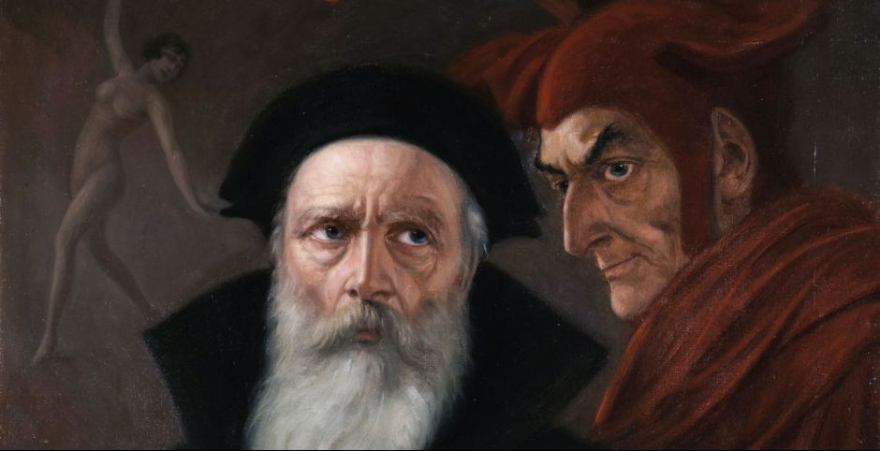
The Scholar's Despair and the Earth Spirit
The drama opens in a Gothic, claustrophobic vaulted study where Heinrich Faust laments the sterility of book-learning. In his pursuit of absolute knowledge, Faust turns to magic (Magie) and contemplates the sign of the Macrocosm, only to find it a detached intellectual spectacle. He then summons the awe-inspiring Earth Spirit (Erdgeist), the primordial vital force of nature:
"In Lebensfluten, im Tatensturm / Wall' ich auf und ab, / Webe hin und her! / Geburt und Grab, / Ein ewiges Meer..."
("In the tides of life, in the storm of action, / I ebb and flow, / Weaving here and there! / Cradle and grave, / An eternal sea...")[1:3]
When the Earth Spirit rejects Faust—declaring that Faust resembles only the spirit he can comprehend, not the Earth Spirit itself—Faust experiences complete existential humiliation. On the brink of suicide on Easter Eve, he is arrested not by theological belief, but by the nostalgic, aesthetic chime of Easter bells and angelic choral memories of childhood.
Mephistopheles and the Dialectic of Negation
Walking among the townsfolk outside the city gates on Easter Sunday, Faust is followed by a black poodle that slips into his study and subsequently metamorphoses into Mephistopheles, dressed as an itinerant scholar. When Faust asks his identity, Mephistopheles delivers Goethe's celebrated definition of demonic polarity:
"Ein Teil von jener Kraft, / Die stets das Böse will und stets das Gute schafft... Ich bin der Geist, der stets verneint!"
("Part of that power which eternally wills evil and eternally works good... I am the spirit that ever negates!")[1:4]
In accordance with Goethe's Metaphysics of Polarity, Mephistopheles is not a cosmic rival to God, but an indispensable dialectical agent within the divine order. By attempting to tear down, negate, and mock human aspiration, Mephistopheles perpetually prods humanity out of torpor and back into productive striving.
The Tragedy of Gretchen (Gretchentragödie)
Rejuvenated by a youth potion in the grotesque laboratory of the Witches' Kitchen (Hexenküche), Faust returns to the mortal world as an aristocratic nobleman. He encounters the young, pious bourgeois maiden Margarete (Gretchen). What begins as an orchestrated seduction rapidly evolves into authentic passion, culminating in disaster:
- Gretchen unwittingly administers a lethal overdose of sleeping draught to her mother to facilitate Faust's nocturnal visits.
- Gretchen's brother, Valentine, attacks Faust to avenge his family honor and is fatally run through by Faust with Mephistopheles' assistance.
- Pregnant, socially ostracized, and driven to despair, Gretchen drowns her newborn infant in a pond.
While Faust is whisked away by Mephistopheles to the orgiastic, supernatural spectacle of Walpurgis Night (Walpurgisnacht) atop the Brocken, a phantom vision of Gretchen with a severed red line around her neck jolts Faust back to her mortal plight.
In the climactic Dungeon Scene (Kerker), Faust infiltrates Gretchen's cell to break her out before her execution. Gretchen, teetering between madness and spiritual clarity, recognizes the demonic corruption radiating from Mephistopheles and refuses to flee. She submits herself entirely to the righteous judgment of God. As Mephistopheles declares, "Sie ist gerichtet!" ("She is judged!"), a divine voice resounds from above: "Ist gerettet!" ("She is saved!"). Gretchen's refusal to preserve her physical life through demonic complicity secures her spiritual redemption.
Part Two: The Macrocosm, Classical Antiquity, and Modernity
In Part Two, Goethe abandons the psychological interiority and bourgeois tragedy of Part One for an encyclopedic, allegorical exploration of civilization across five massive acts.[2:1] Faust moves through the macrocosmic spheres of political governance, economic abstraction, classical aesthetics, and planetary modernization.
       [ Cosmic Wager in Heaven ]
                  │
        PART I: The Microcosm
  ┌───────────────┴───────────────┐
[ Scholar's Despair ]    [ Gretchen Tragedy ]
  (Scholastic limits)     (Guilt & Redemption)
                  │
        PART II: The Macrocosm
  ┌───────────────┼───────────────┐
[ Imperial Court ] [ Helen of Troy ] [ Modern Engineering ]
 (Paper Money &   (Union of Classic  (Land Reclamation,
  State Hubris)    & Romantic Art)   Philemon & Baucis)
                  │
     [ Blindness, Dying Moment ]
                  │
     [ Celestial Grace & Ascent ]
      "Das Ewig-Weibliche zieht
             uns hinan"
Act I: The Imperial Court and the Invention of Paper Money
Faust and Mephistopheles enter the bankrupt court of the Holy Roman Emperor. To solve the state's financial collapse, Mephistopheles orchestrates the invention of paper currency, backing bank notes with the promise of buried gold and unmined riches still lying beneath imperial soil.
Through this episode, Goethe—who was a practicing privy councillor and administrator in the Duchy of Saxe-Weimar—presents a prescient critique of speculative capitalism and modern financialization. Wealth is abstracted from tangible labor and physical assets into credit and floating signs, generating temporary euphoria that anticipates systematic inflation and societal instability.[4]
Acts II & III: The Homunculus, The Classical Walpurgis Night, and Helen of Troy
Back in Faust's old study, his pedantic former assistant Wagner has succeeded in artificially creating life: the Homunculus, a spirit trapped inside a glass vial. Possessing boundless intellect but lacking physical embodiment, the Homunculus guides Faust and Mephistopheles into the Classical Walpurgis Night in Thessaly, Greece.
Faust's mission is to retrieve Helen of Troy, the supreme archetype of classical beauty. To do so, Faust must descend to the Realm of the Mothers (Reich der Mütter)—a terrifying, non-spatial void holding the primordial templates and metaphysical archetypes of all being.
In Act III, set before the palace of Menelaus in Sparta, Faust and Helen unite:
- Their marriage represents the aesthetic synthesis of Weimar Classicism—the reconciliation of northern, Romantic German inwardness (Gehalt) with southern, classical Greek harmony of form (Gestalt).
- Their union bears a child, Euphorion, an aerial spirit of incandescent poetic inspiration modeled directly on Lord Byron. Euphorion's reckless attempt to fly leads to his immediate fall and death, mirroring the tragic fragility of poetic idealism in a violent world. Following Euphorion's dissolution, Helen vanishes into the underworld, leaving only her garments to transform into clouds that carry Faust away.
Acts IV & V: Faust as the Titan of Modernity and Land Reclamation
In the final acts, Faust abandons both scholastic theory and aesthetic retreat in favor of titanic, real-world action. He demands of Mephistopheles not land or riches, but the power to master nature itself: he aims to push back the raging ocean and reclaim vast tracts of fertile land (Landgewinnung) for productive human habitation.[4:1]
Rewarded with coastal dominion after helping the Emperor crush a rival usurper, Faust becomes the archetypal modern industrialist, developer, and colonial builder:
- The Modernizing Drive: Faust coordinates fleets of merchant ships, canals, dikes, and drainage systems, remaking the earth into a hub of international commerce and production.
- The Tragedy of Philemon and Baucis: Faust's grand utopian project is marred by an obsessive irritation: an elderly, pious couple, Philemon and Baucis, refuse to vacate their traditional cottage and chapel atop a sand dune that obstructs Faust's panoramic view of his reclaimed empire. Faust orders Mephistopheles to relocate them by force; Mephistopheles and his henchmen instead burn the cottage down, incinerating the couple and a guest inside.
This episode functions as Goethe's indictment of the catastrophic underside of progress. As cultural critic Marshall Berman demonstrates, Faust represents the prototype of the modern developer whose visionary drive for modernization inherently demolishes organic human communities and historical memory in the name of economic development.[4:2]
The Climax: Blindness, the Fatal Moment, and Cosmic Redemption
As Faust broods over the murder of Philemon and Baucis, four grey women approach his palace: Want (Mangel), Guilt (Schuld), Distress (Not), and Care (Sorge). While the first three cannot breach the wealthy titan's gates, Care slips through the keyhole. When Faust adamantly refuses to acknowledge her psychological dominion, Care breathes on his eyes, leaving him physically blind.
The Illusory Final Moment
Stripped of eyesight, Faust's inner vision becomes even more manic. Hearing the metallic clatter of spades outside, he ecstatically believes thousands of laborers are digging canals to drain the final marshland, securing a thriving home for millions:
"Solch ein Gewimmel möcht' ich sehn, / Auf freiem Grund mit freiem Volke stehn! / Zum Augenblicke dürft' ich sagen: / Verweile doch, du bist so schön!"
("Such a bustling multitude I would see, / Upon a free soil with a free people stand! / To the moment I might then say: / Tarry a while, thou art so fair!")[1:5]
Unbeknownst to the blind Faust, the spades belong not to ditch-diggers, but to Mephistopheles' demonic Lemures, who are digging Faust's grave. Having projected his fulfillment into a conditional, anticipated future ("dürft' ich sagen"—"I might say"), Faust collapses into the grave and dies.
                    ┌─────────────────────────┐
                    │   Mephistopheles' Claim  │
                    │   Literalism: Words of   │
                    │      the wager spoken   │
                    └────────────┬────────────┘
                                 │
                 The Legalistic / Spiritual Rift
                                 │
                    ┌────────────┴────────────┐
                    │      Heavenly Decree    │
                    │ Striving (*Streben*) +  │
                    │ Divine Grace (*Gnade*)  │
                    └─────────────────────────┘
Mephistopheles gloats that the wager is won: the clock has stopped, the hour has run out, and the soul is forfeit. Yet Mephistopheles' victory is strictly literal and ultimately hollow. Faust did not succumb to sensory indolence; his utterance was a forward-looking vision of collective, ongoing human labor.
Angelic Intervention and the Ascent
As Mephistopheles prepares to seize Faust's soul, a choir of celestial angels descends, showering the demons with consecrated roses. The burning petals inflict excruciating spiritual agony on the demons while disorienting Mephistopheles with illicit, ironic erotic longing for the cherubs. While Mephistopheles is distracted, the angels lift Faust's immortal essence (Fausts Unsterbliches) and carry it upward through mountain gorges populated by holy hermits and penitent women.
The angels announce the ultimate theological decree governing the universe of the drama:
"Wer immer strebend sich bemüht, / Den können wir erlösen."
("Whoever strives with all his power, / Him we can redeem.")[1:6]
Striving alone is insufficient for salvation, but it creates the indispensable spiritual substrate upon which celestial grace can operate.
In the final scene, Gretchen—now elevated as Una Poenitentium (one of the penitents)—intercedes for Faust before the Virgin Mary (Mater Gloriosa). The drama concludes with the enigmatic, sublime proclamation of the Chorus Mysticus:
"Alles Vergängliche / Ist nur ein Gleichnis; / Das Unzulängliche, / Hier wird's Ereignis; / Das Unbeschreibliche, / Hier ist's getan; / Das Ewig-Weibliche / Zieht uns hinan."
("All that is transitory / Is only a symbol; / The inadequate, / Here becomes event; / The indescribable, / Here it is done; / The Eternal Feminine / Draws us upward.")[1:7]
The "Eternal Feminine" (Das Ewig-Weibliche) stands as the supreme metaphysical counterweight to Faustian masculine hubris and aggressive domination of nature. It embodies selfless love, creative generation, mercy, and the transcendent beauty that draws striving humanity out of egotistical enclosure toward spiritual wholeness.
Major Philosophical Themes
| Concept | German Term | Operational Definition & Thematic Role |
|---|---|---|
| Endless Striving | Streben | The irreducible motor of human consciousness. Error is pardoned so long as individual development never stagnates into inert complacency. |
| Polarity & Escalation | Polarität & Steigerung | Dynamic interplay of contradictory forces (Faust/Mephistopheles, Light/Dark, Spirit/Matter) resulting in higher spiritual metamorphosis rather than static deadlock. |
| Dialectical Negation | Geist der Verneinung | The destructive cynicism of Mephistopheles acting unconsciously as the catalyst for constructive divine creation. |
| Faustian Modernization | Tat & Gestaltung | The tragic paradox of industrial transformation: mastering nature and building civilization while inevitably trampling organic communal life. |
| The Eternal Feminine | Das Ewig-Weibliche | Transcendent grace, receptive beauty, and spiritual love functioning as the redemptive telos of human existence. |
🎴 Interactive Web Practice (Comprehension Check)
Question 1 (The Wager vs. The Pact): How does Goethe's conceptualization of the Faustian wager (Wette) fundamentally invert Christopher Marlowe's traditional Renaissance pact, and why is the phrase "Verweile doch! du bist so schön!" the fulcrum of Faust's vulnerability?
Answer: In Christopher Marlowe's Renaissance drama, Faustus enters into a traditional legalistic pact: he barters his soul for a fixed, twenty-four-year term of absolute necromantic power, after which his damnation is inevitable. In contrast, Goethe transforms this contract into a dynamic existential wager grounded in German Romantic epistemology. Faust wagers that Mephistopheles cannot ever satisfy the infinite longing of human consciousness with finite earthly pleasures. The phrase "Verweile doch! du bist so schön!" ("Tarry a while! Thou art so fair!") represents the moment human striving (Streben) halts in self-satisfied, passive stagnation. For Goethe, psychic and moral death is not defined by committing sins or errors while striving, but by the cessation of motion and spiritual complacency. Faust can only lose his soul if he surrenders to inertia.
Question 2 (Polarity and the Demonic): How does Mephistopheles' self-definition as \"part of that power which eternally wills evil and eternally works good\" reflect Goethe's metaphysics of polarity?
Answer: In Goethe's philosophical framework (elaborated in his scientific treatises and *Theory of Colours*), nature operates through Polarität (the dynamic tension between opposing forces) and Steigerung (upward intensification through struggle). Mephistopheles does not exist as an autonomous, Manichaean counter-deity opposed to God, but as an integral dialectical instrument within the cosmic order. By embodying the \"spirit that eternally negates\" (der Geist, der stets verneint), Mephistopheles seeks to plunge humanity into destruction, cynicism, and nihilism. However, this perpetual negation serves to counteract human inertia, forcing Faust to continuously struggle, create, and adapt. Mephistopheles wills destruction, but his friction generates the spiritual momentum that elevates humanity, making evil the involuntary midwife of higher divine purpose.
Question 3 (The Tragedy of Modernization): Why does Marshall Berman interpret Part Two of Faust as the definitive tragedy of modern development, and how do Philemon and Baucis embody the human cost of Faust's engineering titanism?
Answer: In Part Two, Faust evolves from an introspective scholar into a titanic modernizer who coordinates global shipping, canals, and large-scale land reclamation (Landgewinnung) from the sea. Marshall Berman identifies Faust as the quintessential \"developer\" whose vision of progress demands total dominion over nature and society. The elderly couple Philemon and Baucis represent the pre-modern, pastoral world grounded in traditional piety, domestic contentment, and organic rootedness. Because their modest cottage and chapel obstruct Faust's panoptic view of his reclaimed domain, their existence becomes intolerable to his totalizing developmental vision. Their violent eradication through Mephistopheles' arson illustrates the tragedy of modernization: progressive industrial development and utopian state-building routinely pulverize traditional communities, historical memory, and moral restraints under the juggernaut of economic transformation.
Resonant Notes
The following notes in the vault share direct thematic, philosophical, and literary connections with Goethe's Faust:
🔴 German Idealism, Polarity & Continental Philosophy
- Johann Wolfgang von Goethe (1749-1832) — The biographical and intellectual locus of Goethe's thought, bridging his early Sturm und Drang rebellion, his scientific works on morphology and optics, and his mature Weimar Classicism.
- Goethe's Metaphysics of Polarity — The theoretical blueprint for the dramatic tension of Faust; polarity (Polarität) and upward intensification (Steigerung) explain why Faust and Mephistopheles must operate as intertwined, indivisible counterparts driving spiritual evolution.
- Continental Philosophy — Goethe's verse tragedy stands as a primary literary catalyst for the German philosophical tradition, directly conditioning the idealist metaphysics of Schelling and Hegel, the existentialism of Kierkegaard, and the cultural diagnostics of Nietzsche.
- Georg Wilhelm Friedrich Hegel (1770–1831) — Faust's historicized progression from subjective isolation through classical antiquity to public statecraft mirrors the dialectical development of world spirit in the Phenomenology of Spirit.
- Friedrich Nietzsche — Nietzsche's diagnosis of the Faustian drive and the dynamic interplay between the Apollonian (form, harmony, classical Helen) and Dionysian (eruptive ecstasy, Walpurgis Night) deeply inherits Goethe's paradigm of creative self-overcoming and the will to life.
🟡 Romantic Longing, Aesthetics & The Sublime
- Sehnsucht — Faust's unquenchable, melancholic longing for infinite experience and transcendent meaning is the supreme literary embodiment of Sehnsucht, defining the tragic rift between finite human reality and infinite aspiration.
- The Sublime — The aesthetic framework governing Faust's encounters with nature, from the terrifying majesty of the Earth Spirit (Erdgeist) to the dizzying precipices of the Alpine landscapes that open Part Two.
- Immanuel Kant-The Transcendental Sublime — Kant's formulation of the mathematical and dynamical sublime—wherein the mind's rational faculties triumph over the overwhelming terror and scale of nature—mirrors Faust's confrontation with cosmic forces and his reclamation of the ocean.
- Edmund Burke-The Physiological Sublime — Burke's analysis of terror, vastness, and obscurity as the primary sources of sublime aesthetic transport provides the affective vocabulary for the Gothic gloom of Faust's vaulted study and the demonic horror of the Brocken.
- The Nightmare — Henry Fuseli's Gothic canvas, conceived within the same European Sturm und Drang climate, visualizes the demonic incubus and the violent intrusion of the irrational unconscious that parallels the spectral horrors of Faust's Walpurgisnacht.
🟢 Depth Psychology, Hubris & Existential Crisis
- Carl Gustav Jung — Jung regarded Faust as his lifelong companion text and the definitive alchemical drama of individuation, identifying Mephistopheles as the archetypal Shadow, Gretchen and Helen as layered manifestations of the Anima, and the cosmic ascent as the alchemical coniunctio oppositorum.
- Freud's The Uncanny (Das Unheimliche) & Sigmund Freud — The demonic pact represents the psychological projection of repressed drives; Mephistopheles externalizes Faust's id and disavowed destructive impulses, erupting through the uncanny transformation of ordinary objects and domestic spaces.
- Fyodor Dostoevsky (1821-1881) — Dostoevsky's treatment of intellectual pride, rational rebellion against God, and the confrontation with demonic alter-egos (notably Ivan Karamazov's hallucinated devil in The Brothers Karamazov) directly inherits Goethe's dialectic of scholastic hubris and spiritual torment.
- Schopenhauerian Pessimism — Schopenhauer praised Goethe yet argued that Faust's endless striving (Streben) illustrates the torment of the insatiable, blind metaphysical Will; whereas Goethe resolves this striving through divine grace and productive labor, Schopenhauer posits that striving can only culminate in suffering.
- Albert Camus — Faust's rebellion against the metaphysical silence of the universe anticipates Camus's absurd hero, challenging the limits of human cognition while refusing to accept the resignation of a quiet life.
References
Johann Wolfgang von Goethe / Faust: A Tragedy (Parts One and Two) / Translated by Walter Kaufmann / Anchor Books ↩︎ ↩︎ ↩︎ ↩︎ ↩︎ ↩︎ ↩︎ ↩︎
Nicholas Boyle / Goethe: The Poet and the Age (Volume II: Revolution and Renunciation, 1790–1803) / Oxford University Press ↩︎ ↩︎
Walter Kaufmann / Goethe's Faust: The Original German and a New Translation and Introduction / Anchor Books ↩︎ ↩︎
Marshall Berman / All That Is Solid Melts Into Air: The Experience of Modernity / Verso Books ↩︎ ↩︎ ↩︎