Paul Klee (1879–1940)
Paul Klee was a Swiss-born German master of early 20th-century modernism whose radical visual epistemology resisted dogmatic alignment with any single avant-garde movement. Traversing Expressionism, Cubism, and Surrealism while maintaining a singular poetic autonomy, Klee formulated a groundbreaking pedagogical science of form during his ten-year tenure at the Bauhaus (1921–1931). Synthesizing musical counterpoint, Goethean color polarity, rhythmic geometric grids, and graphic inventiveness, Klee fundamentally redefined the task of modern art: not to reproduce the visible world mimetically, but to render the invisible forces of nature, time, and consciousness visible.
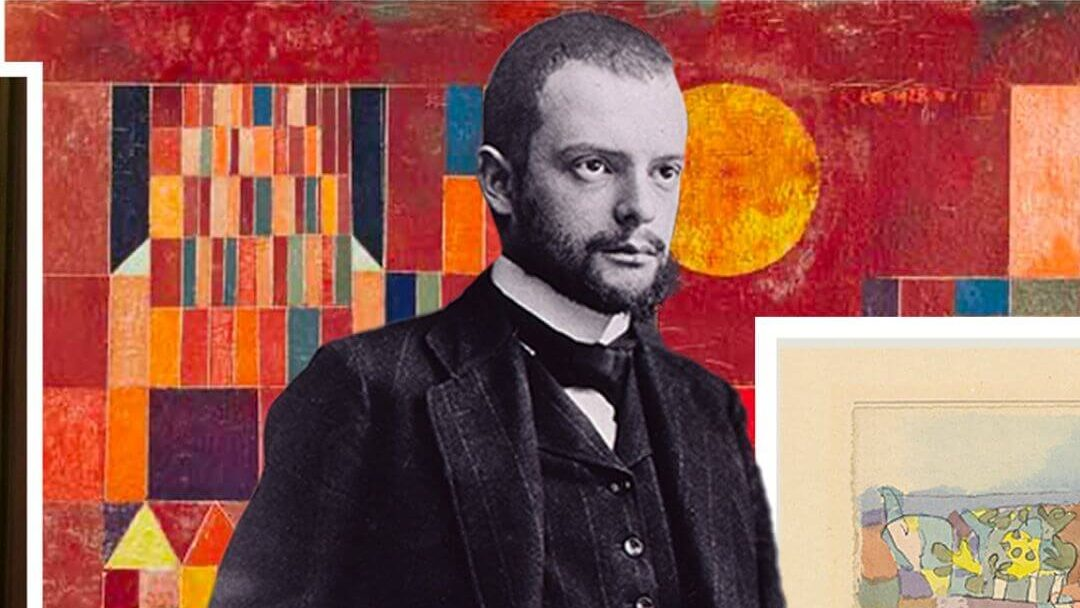
Biographical Trajectory and Formative Epiphanies
Paul Klee's artistic evolution was marked by a disciplined transition from conservative academic draughtsmanship to cosmic abstraction and profound chromatic freedom.
Musical Heritage and Graphic Beginnings
Born in Münchenbuchsee near Bern, Switzerland, to a German music teacher (Hans Wilhelm Klee) and a Swiss singer (Ida Marie Frick), Klee was raised in a deeply musical household. By age seven, he was an accomplished violinist, eventually performing with the Bern Municipal Orchestra. Throughout his life, music remained the governing structural paradigm for his visual thinking: he conceived pictorial space not as a static plane, but as a dynamic temporal field of polyphonic counterpoint, tempo, and harmonic intervals.[1]
In 1898, choosing painting over a career in classical performance, Klee relocated to Munich to study at the private studio of Heinrich Knirr and subsequently at the Academy of Fine Arts under the academic symbolist Franz von Stuck. For the first fifteen years of his career, Klee struggled intensely with color, working almost exclusively as a graphic artist, etcher, and illustrator. His early etching series, Inventionen (Inventions, 1903–1905), showcased a caustic, satirical wit, combining grotesque anatomical distortions with intricate, northern Gothic linear precision.[2]
Der Blaue Reiter and the Parisian Avant-Garde
In 1911, Klee joined the Munich avant-garde circle known as Der Blaue Reiter (The Blue Rider), co-founded by Wassily Kandinsky and Franz Marc. While sharing their spiritual aspiration toward an art free from materialist naturalism, Klee maintained a more ironic, detached perspective. Through this circle, Klee encountered the works of Paul Cézanne, Vincent van Gogh, and Henri Matisse.
A critical breakthrough occurred during his 1912 visit to Paris, where Klee met Robert Delaunay. Delaunay's theoretical writings on "pure painting" and his chromatic Cubism—termed Orphism by Guillaume Apollinaire (1880–1918)—demonstrated how simultaneous contrasts of pure spectral colors could generate luminous spatial vibrations and autonomous rhythmic motion without representational scaffolding.[3] Klee translated Delaunay's seminal essay De la lumière (On Light) into German for Herwarth Walden's avant-garde magazine Der Sturm.
The 1914 Journey to Tunisia: The Color Epiphany
In April 1914, just prior to the outbreak of World War I, Klee undertook a transformative two-week voyage to Tunisia with fellow painters August Macke and Louis Moilliet. In Tunis, St. Germain, Hammamet, and Kairouan, the incandescent Mediterranean light, whitewashed architectural cuboids, and brilliant desert hues dissolved Klee's lingering inhibitions regarding color.[4]
In his diary at Kairouan on April 16, 1914, Klee recorded the definitive epiphany of his artistic life:
"Color has taken possession of me; no longer do I have to pursue it. I know that it has hold of me for ever and ever. I am a painter."
— Paul Klee, The Diaries of Paul Klee (1898–1918)[4:1]
This voyage crystallized Klee's signature structural method: reducing the landscape into modular, translucent geometric planes and colored squares that hum with internal light, fusing Orphic chromatic theory with Islamic architectural geometry.
                    ┌───────────────────────────────┐
                    │    Musical Training (Bern)    │
                    │   Polyphony, Counterpoint,    │
                    │       Rhythm & Harmony        │
                    └───────────────┬───────────────┘
                                    │
                                    ▼
┌──────────────────────────┐        │        ┌──────────────────────────┐
│   Northern Graphic Line  │        │        │  Robert Delaunay/Orphism │
│  Grotesque Etchings and  │────────┼───────▶│ Simultaneous Contrasts,  │
│  Satirical *Inventionen* │        │        │ Pure Chromatic Radiation │
└──────────────────────────┘        │        └──────────────────────────┘
                                    │
                                    ▼
                    ┌───────────────────────────────┐
                    │ 1914 Tunisia Epiphany (Color) │
                    │   "Farbe und ich sind eins.   │
                    │         Ich bin Maler"        │
                    └───────────────┬───────────────┘
                                    │
                                    ▼
                    ┌───────────────────────────────┐
                    │   Bauhaus Theoretical Apex    │
                    │   *Bildnerisches Denken* and  │
                    │  Dynamic Genesis of Form      │
                    └───────────────────────────────┘
The Bauhaus Decade (1921–1931): A Science of Form
In 1920, Walter Gropius invited Klee to join the faculty of the newly established State Bauhaus in Weimar. Klee taught at the Bauhaus for a full decade (Weimar until 1925, and Dessau from 1925 to 1931), directing the bookbinding, stained-glass, metalwork, and free painting workshops, as well as delivering foundational lectures on pictorial mechanics.[5]
Theoretical Rigor: Pädagogisches Skizzenbuch and The Thinking Eye
At The Bauhaus School, Klee transformed from an intuitive modernist practitioner into one of the twentieth century's most formidable visual theoreticians. Alongside his close friend Wassily Kandinsky, Klee systematized the elementary relationships between point, line, plane, weight, gravity, and color.
His classroom lecture notes—later compiled into Pädagogisches Skizzenbuch (Pedagogical Sketchbook, 1925) and the monumental two-volume Bildnerisches Denken (The Thinking Eye)—function as a comprehensive morphological grammar of visual art.[6] Klee's philosophy rejected static geometric formalism; he insisted that art must mirror nature not in its finished, frozen forms (natura naturata), but in its underlying generative processes of growth and metamorphosis (natura naturans).
"Genesis as formal movement is the essential thing in a work of art. In the beginning the motif, the insertion of energy, movement. The work of art is above all a process of creation; it is never experienced as a mere product."
— Paul Klee, Notebooks, Vol. 1: The Thinking Eye[6:1]
The Dynamic Line: "Taking a Line for a Walk"
Central to Klee's Bauhaus curriculum was his legendary definition of linear energy. Klee categorized the line not as a passive boundary between shapes, but as a kinetic trajectory of active force:
- Active Line (Eine aktive Linie): A point setting itself into dynamic motion without preconceived geometric limitation. As Klee famously summarized to his students: "An active line on a walk, moving freely, without goal. A walk for a walk's sake."[6:2]
- Medial Line: A line that defines a contour while simultaneously participating in the planar creation of surface.
- Passive Line: A line generated indirectly through the juxtaposition or collision of two distinct color planes.
   [ Point: Static Potential ]
               │
               ▼ (Kinetic Energy Applied)
   [ Active Line: "Walking freely without goal" ]
               │
               ▼ (Linear Modulation & Weaving)
   [ Medial Line: Structural Plane Formation ]
               │
               ▼ (Tension of Opposing Hues)
   [ Passive Line: Interfacial Boundary between Color Masses ]
Core Pictorial Mechanics and Philosophical Principles
Klee's body of work—comprising over 9,000 cataloged drawings, watercolors, and paintings—is grounded in four interlocking theoretical paradigms.
1. Polyphonic Painting (Mehrstimmigkeit)
Drawing directly on Johann Sebastian Bach's fugues and Wolfgang Amadeus Mozart's operatic ensembles, Klee sought to overcome the traditional limitation of visual art: its apparent simultaneity versus music's temporal progression.[1:1]
Through overlapping translucent geometric washes and modular color grids, Klee orchestrated polyphonic painting. Different visual "voices"—linear rhythms, color intensities, tonal modulations, and textural densities—operate concurrently across the surface. The viewer's eye does not absorb the canvas instantaneously; rather, it performs a temporal reading, navigating interwoven rhythmic themes, syncopations, and counterpoints analogous to listening to a multi-part fugue.[7]
2. Chromatic Polarities and Goethe's Farbenlehre
Klee's color theory deeply inherited Johann Wolfgang von Goethe (1749-1832)'s chromatic phenomenology and the principles articulated in Goethe's Metaphysics of Polarity. Rather than adopting Isaac Newton's purely mathematical, optical prism, Klee organized color around living psychological, spatial, and dynamic polarities:[8]
- Light versus Darkness (White vs. Black): The fundamental tonal polarity of energy and inertia.
- Warmth versus Coolness (Red/Yellow vs. Blue): The active, centrifugal expansion of warm hues counterbalanced by the receptive, centripetal contraction of cool hues.
- Complementary Dialectics: The mutual tension and balance between color complements (Red-Green, Yellow-Violet, Blue-Orange) arranged across a dynamic color wheel and icosahedron.
In his "Magic Square" paintings of the late 1920s (such as Castle and Sun and Monument in Fertile Land), Klee arrayed tonal variations within rational grid networks. Color acts simultaneously as chromatic pitch, spatial depth, and emotional resonance.
| Chromatic Property | Bauhaus Structural Analogy | Phenomenological & Psychological Effect |
|---|---|---|
| Hue (Farbe) | Musical Pitch / Timbre | Qualitative character, atmospheric temperature, and mood resonance |
| Tone / Value (Helligkeit) | Dynamics / Volume | Gravitational weight, illumination, spatial recession or projection |
| Saturation (Sättigung) | Intensity / Harmonic Purity | Visual energy, tension between active vitality and passive neutrality |
3. The Oil-Transfer Technique (Ölpaustechnik)
In 1919, Klee invented a distinctive drawing technique known as the oil-transfer process (Ölpaustechnik), which allowed him to bridge graphic drawing with rich, atmospheric watercolor backgrounds.[9]
- The Transfer Matrix: Klee coated a sheet of tracing paper with wet black oil paint or printing ink.
- The Incision: He placed this inked sheet face down onto a receiving surface (Japan paper, gauze, cardboard, or primed canvas) and layered a preliminary pencil sketch on top.
- The Trace: Tracing the drawing with a sharp metal stylus or needle, the pressure transferred the oil paint onto the underlying sheet.
- The Uncanny Residue: The mechanical pressure of Klee's hand and fingers left random smudges, velvety blurs, and irregular ink halos across the composition.
This technique yielded a fragile, trembling line that combined the spontaneity of freehand drawing with the mechanical, alienated detachment of a printed plate, evoking an uncanny, dreamlike ambiguity.
4. "Making Visible": The Rejection of Mimesis
In his celebrated 1920 manifesto Schöpferische Konfession (Creative Credo), Klee formulated the foundational epistemological axiom of twentieth-century abstraction:
"Art does not reproduce the visible; rather, it makes visible."
("Kunst gibt nicht das Sichtbare wieder, sondern macht sichtbar.")[10]
For Klee, the visible world is merely an isolated sample of an infinite cosmic reality. The true task of the artist is not photographic transcription, but the penetration of mundane appearances to expose the hidden mathematical laws, vital rhythms, and spiritual structures of Being.
Persecution, Exile, and the Late Tragic Style (1933–1940)
The rise of German National Socialism shattered Klee's career. In 1931, seeking relief from administrative factionalism at the Bauhaus, Klee accepted a professorship at the Kunstakademie Düsseldorf. However, following Adolf Hitler's appointment as Chancellor in 1933, Klee was immediately targeted by Nazi cultural apparatchiks as a "cultural Bolshevik" and a producer of "degenerate" art.[5:1]
Dismissal and the Bern Exile
In April 1933, stormtroopers ransacked Klee's Dessau home, and he was summarily dismissed from the Düsseldorf Academy. Branded by state propaganda as a "Galician Jew" (a fabricated accusation), Klee went into self-imposed exile, returning to his native city of Bern in December 1933. Paradoxically, despite being born in Switzerland, Klee was legally classified as a German national; his repeated applications for Swiss citizenship were bogged down in bureaucratic surveillance and suspicions regarding his avant-garde politics, and naturalization was granted only posthumously.[2:1]
The 1937 Entartete Kunst Exhibition
In 1937, the Nazi regime confiscated 102 of Klee's works from public museums across Germany. Seventeen of his paintings and drawings were prominently displayed in the notorious Entartete Kunst (Degenerate Art) exhibition in Munich, hung alongside works by Wassily Kandinsky, Marc Chagall, and Max Ernst, surrounded by derogatory slogans mocking his child-like graphic forms and spiritual motifs.[5:2]
Scleroderma and the Late Idiom
In 1935, Klee developed the first symptoms of scleroderma, a rare, incurable systemic autoimmune disease that hardens the skin, limits joint mobility, and attacks internal organs. Faced with excruciating physical pain and mortality, Klee experienced an astonishing creative surge in his final three years: in 1939 alone, he completed 1,253 cataloged works.[2:2]
His late style departed radically from the delicate, translucent grid structures of the Bauhaus years:
- Thick, Black Graphic Ideograms: Delicate linear webs were replaced by heavy, charcoal-black glyphs and calligraphic runes executed with paste and tempera on rough unprimed newspaper or burlap.
- The Angel Cycle (Engel-Zyklus): Klee created over fifty drawings and paintings of hybrid, incomplete angels—figures suspended between celestial transcendence and clumsy mortal fragility (Angel, Still Female, Angel in the Making, Poor Angel).
- Confrontation with Death: Works such as Death and Fire (Tod und Feuer, 1940) reduced visual language to stark hieroglyphs of grief, farewell, and impending annihilation.
Landmark Artworks: Comparative Analysis
Klee's expansive oeuvre spans diverse mediums, scales, and conceptual frameworks. The table below outlines key masterworks representative of his shifting stylistic epochs:
| Artwork | Year | Medium & Support | Structural Mechanics & Conceptual Analysis |
|---|---|---|---|
| Angelus Novus | 1920 | Oil transfer and watercolor on paper | Hybrid avian-human messenger with outspread wings and wide eyes. Acquired by Walter Benjamin (1892–1940), it became the seminal emblem of the "Angel of History" in 20th-century critical theory.[11] |
| Twittering Machine (Die Zwitscher-Maschine) | 1922 | Oil transfer, watercolor, and ink on paper | Four spindly, open-beaked birds perched on a mechanical hand-crank against an eerie pink-and-blue wash. A tragicomic satire on industrial rationalization and the mechanization of living song.[12] |
| Senecio (Head of a Man) | 1922 | Oil on gauze mounted on cardboard | A monumental circular head fragmented into vibrant orange, red, and yellow quadrants. Subverts academic portraiture through the geometric abstraction of theatrical Harlequin masks and child art.[12:1] |
| Fish Magic (Fischzauber) | 1925 | Oil and watercolor on canvas on panel | Aquatic nocturnal dreamscape combining fish, flora, celestial clock faces, and geometric runes beneath a dark wash, with a muslin square pinned to the center symbolizing the canvas as cosmic curtain.[12:2] |
| Castle and Sun (Burg und Sonne) | 1928 | Oil on canvas | Architectural cityscape assembled entirely from saturated modular rectangles, triangles, and squares under a radiant crimson sun. Exemplifies Klee's polyphonic grid system at Dessau.[7:1] |
| Ad Parnassum | 1932 | Oil and casein on canvas | Widely regarded as Klee's magnum opus. A monumental stepped pyramid rendered through divisionist, mosaic-like dots of spectral color overlaid with bold linear contours, evoking Apollo's mythic mountain.[1:2] |
| Death and Fire (Tod und Feuer) | 1940 | Oil and paste on burlap | Stark white skull-like face whose features spell the word TOD (Death in German: T for forehead/nose, O for eye, D for mouth) navigating a glowing ember-lit underworld. A testament to his late tragic idiom.[2:3] |
In-Depth Analysis: Two Pivotal Canvases
1. Angelus Novus (1920) and the Angel of History
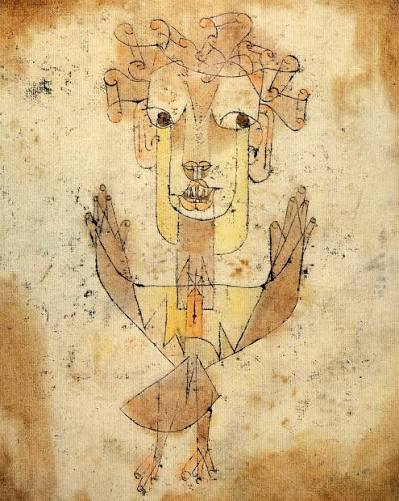
Rendered using Klee's oil-transfer technique, Angelus Novus depicts a winged figure with wild, transfixed eyes, an open mouth, and outstretched, claw-like hands. The figure appears paralyzed—simultaneously hovering, fleeing, and seeking to communicate an unutterable revelation.
The painting entered intellectual history in 1921 when cultural philosopher Walter Benjamin (1892–1940) purchased it in Munich. For two decades, it hung in Benjamin's apartments in Berlin and Paris as his supreme contemplative icon. In his final masterpiece, Walter Benjamin’s Theses on the Philosophy of History (1940), Benjamin transformed Klee's fragile monoprint into Thesis IX—the definitive critique of modern progress:
"There is a painting by Klee called Angelus Novus. It shows an angel who seems about to move away from something he stares at. His eyes are wide, his mouth is open, his wings are spread. This is how the angel of history must look. His face is turned toward the past. Where a chain of events appears before us, he sees one single catastrophe, which keeps piling wreckage upon wreckage and hurls it at his feet. The angel would like to stay, awaken the dead, and make whole what has been smashed. But a storm is blowing from Paradise and has got caught in his wings; it is so strong that the angel can no longer close them. This storm drives him irresistibly into the future, to which his back is turned, while the pile of debris before him grows toward the sky. What we call progress is this storm."
— Walter Benjamin, Illuminations[11:1]
Through Benjamin's reading, Klee's watercolor became an existential mirror of catastrophic modernity: the divine messenger stripped of agency, immobilized by the relentless technological wreckage of the twentieth century.
2. Twittering Machine (1922) and the Uncanny Automaton
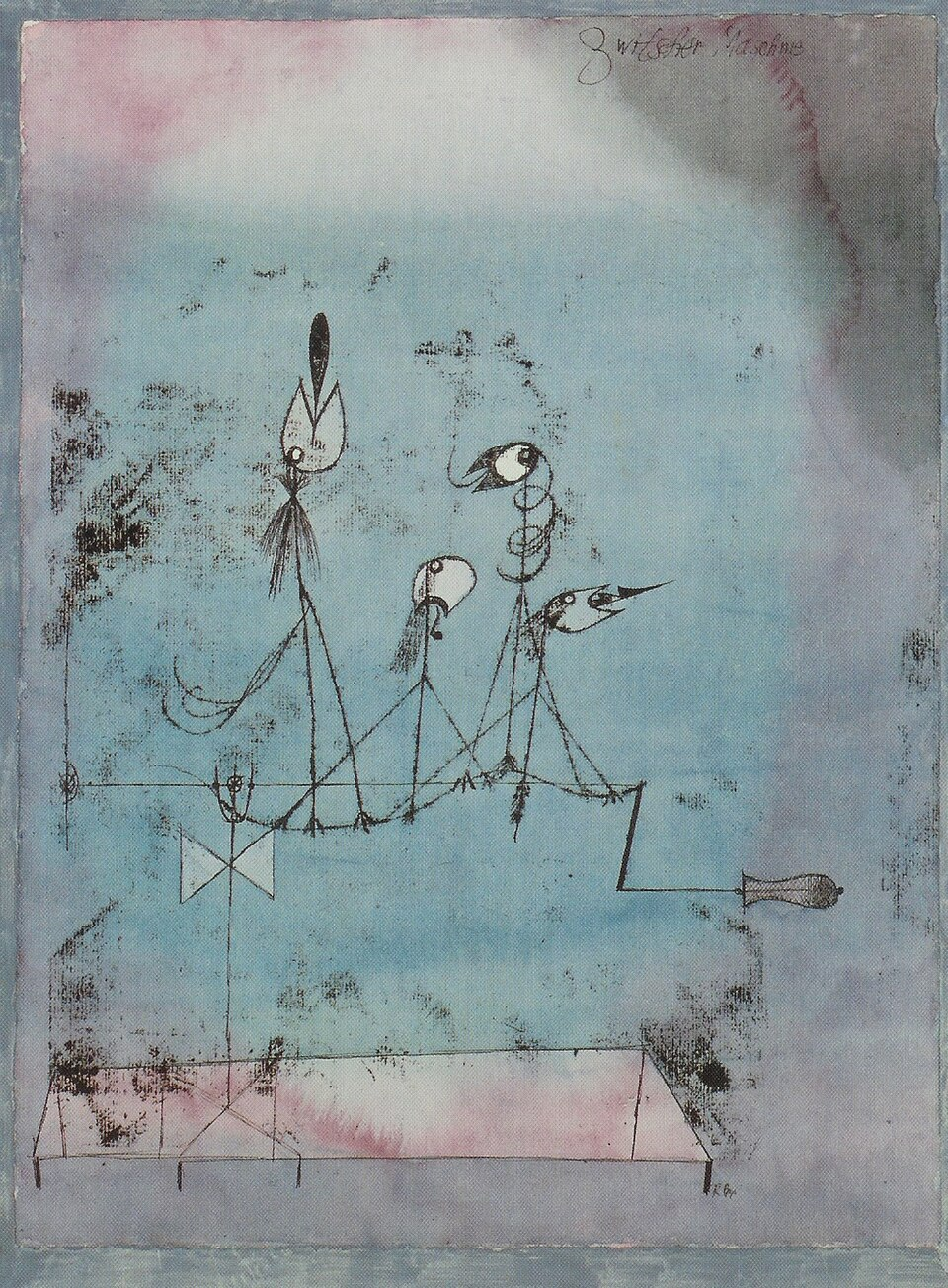
Painted during Klee's second year at Weimar, Twittering Machine (Die Zwitscher-Maschine) is an iconic emblem of the Bauhaus debate between nature, humanity, and machine culture.
Four grotesque, stick-figure birds are tethered by their legs to an iron crankshaft, their beaks agape as if emitting discordant chirps. An arrow points downward toward a rectangular trap or trough. The creatures are suspended within a delicate, misty atmospheric wash of soft rose, lavender, and aqueous blue, created using Klee's velvety oil-transfer line.
The work embodies a deep ambivalence toward industrialization:
- The Parody of Efficiency: In an era where Walter Gropius championed the integration of art and technology ("Art and Technology: A New Unity"), Klee crafted a machine whose only functional output is absurd, artificial bird-song.[12:3]
- The Mechanization of Vitality: The canvas explores the boundary between living organism and mechanical automaton. The birds do not sing out of organic vitality; their vocalizations are mechanically coerced by the turning of the crank.
- The Freudian Uncanny: Resonating with Freud's The Uncanny (Das Unheimliche) and Ernst Jentsch's analysis of automata, the painting generates cognitive unease by confronting the viewer with the eerie ambiguity between the animate and the inanimate—a living creature reduced to a prosthetic contraption.
🎴 Interactive Web Practice (Comprehension Check)
Question 1 (Pictorial Genesis & Epistemology): What did Paul Klee mean by his famous dictum, "Art does not reproduce the visible; rather, it makes visible," and how does his concept of "taking a line for a walk" exemplify this philosophy?
Answer: Klee rejected the classical nineteenth-century doctrine of mimesis, which held that the purpose of visual art was to copy or reproduce the external, observable world. For Klee, observable nature is merely a static, finished product (natura naturata). The true task of the modernist artist is to make visible the underlying energetic processes, dynamic forces, and formative laws of nature (natura naturans) that remain imperceptible to ordinary sight.
His concept of "taking a line for a walk" (eine Linie spazieren führen) directly operationalizes this philosophy. Rather than using a line as a static, passive boundary to circumscribe a pre-existing object, Klee treats the line as an active, self-generating trajectory of kinetic energy. The line originates from a point setting itself into dynamic motion, evolving freely across time and space. The artwork is therefore not a passive depiction of reality, but an autonomous event of genesis and vital transformation.
Question 2 (Critical Theory & Walter Benjamin): How does Walter Benjamin utilize Paul Klee's watercolor Angelus Novus in his ninth Thesis on the Philosophy of History to dismantle the Enlightenment concept of "progress"?
Answer: Benjamin transforms Klee's Angelus Novus into an allegorical personification of the "Angel of History." While bourgeois historicism and Social Democratic ideology conceptualize history as a continuous, linear chain of technological and moral advancement ("progress"), the Angel of History perceives the past as "one single catastrophe" that incessantly piles wreckage upon wreckage at his feet.
The Angel desires to halt, awaken the slaughtered dead, and mend the shattered fragments of human existence. However, a violent tempest blowing from Paradise has caught in his outspread wings with such fury that he cannot close them. This uncontrollable tempest propels the Angel helplessly backward into the future, while the mound of historical ruins grows skyward. Benjamin concludes that this catastrophic storm, which blinds humanity to systemic violence and perpetuates destruction, is precisely what modern civilization euphemistically calls "progress."
Question 3 (Musicality & Polyphonic Counterpoint): How did Klee's background as a classical violinist inform his theory of "polyphonic painting" at the Bauhaus, and how did he resolve the temporal difference between music and visual art?
Answer: As a trained classical violinist steeped in the music of Bach and Mozart, Klee recognized that traditional painting suffered from apparent spatial simultaneity, whereas music possessed temporal unfolding through rhythm, duration, and counterpoint. To bridge this divide, Klee formulated "polyphonic painting" (Mehrstimmigkeit) at the Bauhaus.
By superimposing translucent glazes of watercolor, modular tonal squares ("magic squares"), and varied graphic linear rhythms, Klee created multi-layered pictorial compositions where independent visual "voices" operate simultaneously without canceling one another out. A geometric grid might establish the underlying metric tempo, while intersecting diagonal lines provide syncopated rhythmic counterpoint, and graded color harmonies determine pitch and emotional key. The viewer's gaze cannot comprehend the canvas in a single static glance; instead, it is compelled to travel temporally across the surface, reading overlapping visual themes in an experience analogous to hearing a multi-part musical fugue.
Resonant Notes
The following notes in the vault share direct thematic, aesthetic, and philosophical connections with Paul Klee:
🔴 Modernist Avant-Garde, Bauhaus & Aesthetic Theory
- The Bauhaus School — Klee served as one of the most influential Masters of Form at the Bauhaus in Weimar and Dessau (1921–1931), developing the school's foundational visual grammar and mediating between Gropius's industrial functionalism and expressive spiritual autonomy.
- The Dehumanization of Art — José Ortega y Gasset's 1925 thesis on the avant-garde's rejection of sentimental 19th-century mimesis in favor of pure conceptual form provides the theoretical framework for Klee's non-representational, self-referential pictorial systems.
- Guillaume Apollinaire (1880–1918) — Apollinaire's codification of Orphic Cubism and Robert Delaunay's simultaneous color contrasts directly inspired Klee's breakthrough into luminous chromatic abstraction, while Apollinaire's calligraphic ideograms parallel Klee's integration of poetic runes into painting.
- Giorgio de Chirico (1888-1978) — Contemporary modernist whose metaphysical painting (Pittura Metafisica) shares Klee's interest in dreamlike architectures, enigmatic pictograms, and the uncanny reality lurking behind everyday appearances.
- René Magritte — Magritte's surrealist deconstruction of the gap between painted image, linguistic label, and material object extends Klee's semiotic investigation of visual symbols and titles as cognitive riddles.
🟡 Philosophy of History, The Uncanny & Modern Alienation
- Walter Benjamin (1892–1940) — Benjamin owned Klee's monoprint Angelus Novus for nearly twenty years, making the painting the central contemplative emblem of his philosophical writings on messianic redemption and cultural critique.
- Walter Benjamin’s Theses on the Philosophy of History — Thesis IX of Benjamin's final text provides the iconic philosophical interpretation of Klee's Angelus Novus as the Angel of History driven helplessly into the future by the storm of progress.
- The Work of Art in the Age of Mechanical Reproduction — Benjamin's analysis of the liquidation of artistic "aura" illuminates Klee's oil-transfer technique, which deliberately simulates mechanical reproduction and printmaking within unique, fragile hand-drawn artifacts.
- Franz Kafka (1883-1924) — Klee's contemporary in Prague whose minimalist parables, grotesque transformations (The Metamorphosis), and fragile linear dread share a direct psychic and aesthetic affinity with Klee's tragicomic graphic drawings.
- Freud's The Uncanny (Das Unheimliche) — Freud's concept of the uncanny—rooted in cognitive doubt regarding whether an entity is living or an automaton—provides the psychological framework for understanding Klee's mechanical hybrids, notably Twittering Machine.
- The Uncanny Valley (不気味の谷現象) — The unsettling aesthetic friction produced by Klee's half-human, half-mechanical puppets and suspended avian automata directly presages the psychological dynamics of the uncanny valley.
🟢 Perception, Metaphysics of Nature & Cognitive Form
- Goethe's Metaphysics of Polarity — Goethe's theory of polarity (Polarität) and upward intensification (Steigerung)—articulated in his Theory of Colours—served as the direct scientific and philosophical foundation for Klee's color wheel and Bauhaus harmonic exercises.
- Johann Wolfgang von Goethe (1749-1832) — Goethe's botanical morphology (Die Metamorphose der Pflanzen), which posited that all plant organs derive from a single dynamic primal leaf (Urpflanze), profoundly influenced Klee's belief that art must emulate nature's generative processes (natura naturans) rather than its static forms.
- Gestalt Psychology-The Mechanics of the Whole — Developed concurrently in Weimar Germany, Gestalt principles of visual grouping, figure-ground segregation, and perceptual closure directly informed Klee's pedagogical analyses of visual balance and compositional tension at the Bauhaus.
- Henri Bergson & Bergson’s Eliminative Model of Perception and Memory — Bergson's concept of durée (lived duration as opposed to mechanical clock-time) and the vital impulse (élan vital) closely mirror Klee's insistence that painting must capture temporal movement and continuous metamorphosis.
- Iain McGilchrist — McGilchrist's divided-brain thesis clarifies Klee's aesthetic resistance: Klee rejected the left hemisphere's rigid, instrumental, and reifying gaze in favor of the right hemisphere's relational, metaphoric, and organically living apprehension of reality.
- The Sublime — Klee's cosmic landscapes, celestial diagrams, and late encounters with mortality (Death and Fire) evoke a modernist, introspective sublime that locates the infinite within miniature, fragile pictorial spaces.
References
Will Grohmann / Paul Klee / Harry N. Abrams ↩︎ ↩︎ ↩︎
Susanna Partsch / Paul Klee: 1879–1940 / Taschen ↩︎ ↩︎ ↩︎ ↩︎
Robert Delaunay / The New Art of Color: The Writings of Robert and Sonia Delaunay / Viking Press ↩︎
Paul Klee / The Diaries of Paul Klee, 1898–1918 / Edited by Felix Klee / University of California Press ↩︎ ↩︎
Paul Klee / Notebooks, Volume 1: The Thinking Eye / Edited by Jürg Spiller / Lund Humphries ↩︎ ↩︎ ↩︎
Andrew Kagan / Paul Klee: Art & Music / Cornell University Press ↩︎ ↩︎
Johann Wolfgang von Goethe / Theory of Colours / Translated by Charles Lock Eastlake / MIT Press ↩︎
Museum of Modern Art / Paul Klee: Oil-Transfer Technique and Conservation / moma.org ↩︎
Paul Klee / Creative Credo (Schöpferische Konfession) / In The Inward Vision: Watercolors, Drawings, Writings / Harry N. Abrams ↩︎
Walter Benjamin / Illuminations: Essays and Reflections / Edited by Hannah Arendt / Schocken Books ↩︎ ↩︎
Zentrum Paul Klee, Bern / Collection Online & Works Database / zpk.org ↩︎ ↩︎ ↩︎ ↩︎