American Transcendentalism
American Transcendentalism was a profound philosophical, spiritual, and literary movement that crystallized in New England—principally Concord, Massachusetts—during the 1830s and 1840s. Operating as a passionate rebellion against rigid rationalism and institutionalized religion, Transcendentalism championed the inherent goodness of humanity, the divinity of nature, and the supreme authority of individual intuition over social conformity.
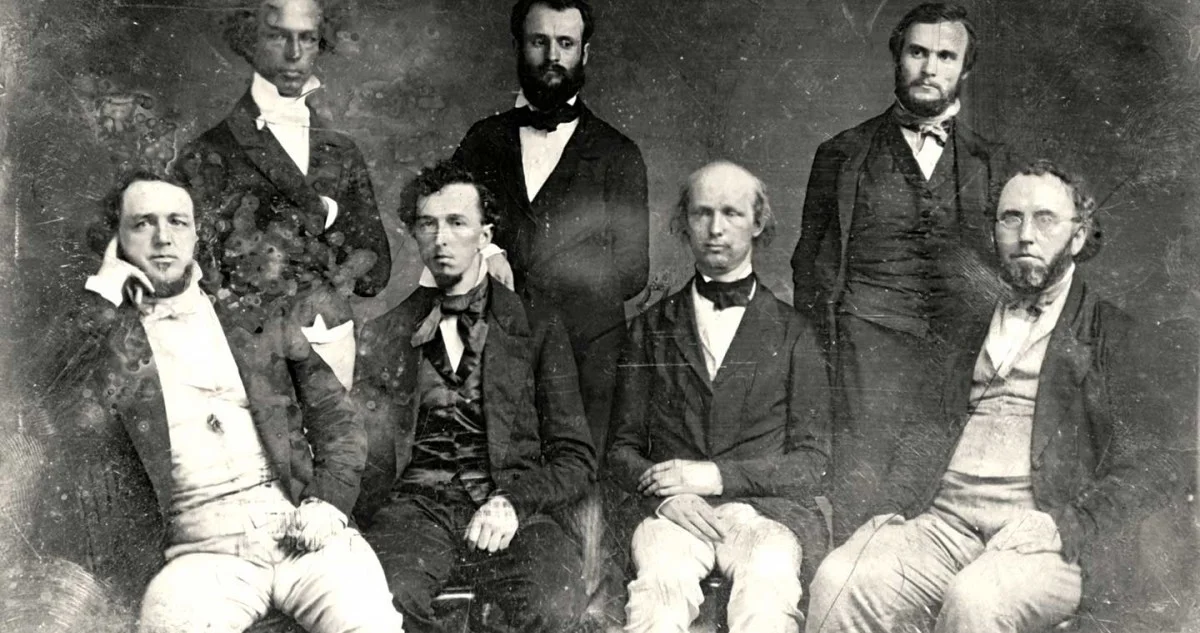
Origins and Historical Context
Transcendentalism emerged as a distinct intellectual current in the late 1820s and 1830s, primarily among a circle of New England thinkers who felt stifled by the dominant cultural forces of their era[1].
-
The Reaction Against Unitarianism: The movement's founders were largely Unitarian clergy and intellectuals centered around Harvard University. While Unitarianism was considered liberal for its time, Transcendentalists grew dissatisfied with its cold intellectualism, heavy emphasis on empirical reason, and reliance on historical evidence for spiritual truth[2].
-
The Romantic Backlash: Mirroring European Romanticism, the movement rejected the mechanistic view of the universe promoted by the Enlightenment. It traded the cold science of the Age of Reason for imagination, raw emotion, and direct spiritual experience of The Sublime[2:1].
-
Eclectic Philosophical Roots: Transcendentalism was an eclectic, cosmopolitan synthesis. It drew heavily from German Idealism (particularly Immanuel Kant, from whom the term "transcendental" was borrowed), British Romantic poetry (Coleridge and Wordsworth), and ancient Eastern spiritual texts, such as the Hindu Upanishads and Bhagavad Gita (crystallizing an early American expression of Perennial Philosophy)[3][4].
On September 12, 1836, Ralph Waldo Emerson, George Putnam, Frederic Henry Hedge, and a small circle of intellectuals formed the Transcendental Club in Cambridge, Massachusetts[5]. This loose alliance served as the crucible for the movement's radical new ideas.
Core Pillars of Transcendentalist Thought
To understand the Transcendentalist worldview, one must look at its three foundational pillars:
1. Individualism and Self-Reliance
Transcendentalists maintained an unwavering faith in the fundamental purity and potential of the individual. They argued that human beings are at their absolute best when they are completely self-reliant and independent. Conversely, they viewed organized society and its rigid institutions—such as political parties and organized religion—as inherently corrupting forces that demand unthinking conformity[4:1][5:1].
2. The Divinity of Nature
For the Transcendentalist, nature was not a resource to be commodified, nor was it merely a beautiful backdrop. It was a living, breathing manifestation of the divine, closely echoing ancient traditions of nature sacralization and Animism. Spending time in nature was viewed as the closest a person could come to experiencing God[2:2]. Within the natural world, the boundaries between the physical and spiritual evaporated, allowing individuals to access what Emerson termed the Oversoul (or Over-Soul)—a universal, omnipresent spiritual force that unites all humanity, nature, and the divine into a singular cosmic being[5:2][6] (resonating with the mystical cosmology of Emanuel Swedenborg).
3. Intuition Over Empiricism
Rejecting John Locke's empiricism (which asserted that all knowledge comes through the physical senses), Transcendentalists argued for the supremacy of Intuition (often referred to in their writings as "Reason" or "Insight")[3:1][6:1]. They believed that the human soul possesses an innate, transcendent ability to grasp absolute truths directly, bypassing the need for scientific proofs, logic, or institutional mediation[3:2][6:2] (a precursor to Henri Bergson's intuition and William James's studies of mystical consciousness).
Key Figures and Definitive Works
The movement was driven by a highly individualistic, often eccentric group of writers, philosophers, and social reformers.
Ralph Waldo Emerson (1803—1882)
The undisputed intellectual anchor of the movement, Emerson gave Transcendentalism its philosophical vocabulary[1:1]. A mesmerizing public lecturer and essayist, his works laid the foundation for an independent American cultural identity[3:3][2:3].
-
Nature (1836): Published anonymously, this landmark essay established the foundational ideas of the movement, urging Americans to abandon historical dogmas and build an "original relation to the universe."[2:4][7]
-
Self-Reliance (1841): A fierce defense of individualism, containing his famous warning against mindless conformity: "A foolish consistency is the hobgoblin of little minds..."[2:5]
Henry David Thoreau (1817—1862)
If Emerson was the movement's architect, Thoreau was its practical builder, determined to live out Transcendentalist principles in physical reality[3:4] (see Metaphysics of Henry David Thoreau and Beyond Representation-Shared Epistemology of Thoreau and Kerouac).
-
Walden; or, Life in the Woods (1854): A masterpiece of American literature documenting the two years, two months, and two days Thoreau spent living in a self-built cabin on Walden Pond[2:6]. The book explores themes of deliberate living, self-sufficiency, and spiritual expansion through deliberate simplification[2:7].
-
Civil Disobedience (1849): Written after Thoreau spent a night in jail for refusing to pay a poll tax in protest of slavery and the Mexican-American War[6:3] (a moral critique examined in The Ethics of Taxes). It argues that individual moral conscience surpasses state law, famously declaring: "Under a government which imprisons any unjustly, the true place for a just man is also a prison."[6:4]
Margaret Fuller (1810—1850)
One of the era's most formidable public intellectuals, Fuller brought a sharp socio-political edge to the movement[2:8]. She served as the first editor of the primary Transcendentalist literary magazine, The Dial[3:5].
- Woman in the Nineteenth Century (1845): Widely considered the first major American feminist work, Fuller applied Transcendentalist concepts of individual liberty and spiritual self-reliance to women, demanding total intellectual and political equality[3:6][2:9].
"We would have every arbitrary barrier thrown down. We would have every path laid open to Woman as freely as to Man."
Social Reform and Communal Utopias
Though fiercely individualistic, Transcendentalists were acutely aware of the humanitarian crises of their day. By the 1840s and 1850s, their focus naturally pivoted from individual enlightenment toward systemic social reform[3:7][2:10].
-
Communal Experiments: In an attempt to balance manual labor with intellectual and artistic vitality, members of the movement launched utopian communities. The most famous was Brook Farm (founded by George Ripley in 1841), which attracted many literary elites[3:8][8]. Another, more radical experiment was Amos Bronson Alcott's short-lived vegetarian commune, Fruitlands[3:9][5:3].
-
The Abolitionist Movement: As sectional tensions worsened over slavery, leading Transcendentalists threw themselves into the abolitionist cause. Emerson and Thoreau became fierce critics of the Fugitive Slave Law and outspoken defenders of radical abolitionists like John Brown[2:11].
-
Educational Innovation: Elizabeth Palmer Peabody championed revolutionary early childhood education, opening the first English-language kindergarten in the United States in 1860, utilizing Transcendentalist concepts of innate child purity and creativity[2:12].
Legacy and Modern Impact
While Transcendentalism as a cohesive, active movement waned by the outbreak of the American Civil War, its ripples altered the trajectory of global philosophy and culture[2:13][8:1].
-
Global Civil Rights: Thoreau’s philosophy of nonviolent resistance directly inspired Leo Tolstoy, Mahatma Gandhi's campaigns in India, and Martin Luther King Jr.'s leadership during the American Civil Rights Movement.
-
Modern Environmentalism: The movement's sacred view of nature laid the groundwork for the modern conservation movement. Figures like John Muir explicitly channeled Emersonian and Thoreauvian thought when advocating for the creation of America's National Parks.
-
American Literary Renaissance: The focus on native materials, internal psychologies, and individual identity directly shaped the masterworks of contemporaries like Walt Whitman, Herman Melville, and Emily Dickinson, as well as downstream cultural heirs like Jack Kerouac (1922-1969) and the Beat Generation.
-
Transatlantic and Continental Crosscurrents: Emerson's radical defense of the sovereign individual deeply influenced Friedrich Nietzsche, who celebrated Emerson's defiance of herd conformity. Meanwhile, the Transcendentalist sacralization of wilderness stands in striking contrast to the North American garrison tradition identified by Northrop Frye in English-language Canadian Literature (English CanLit) and the landscape painting of the Group of Seven (also known as the Algonquin School).
🎴 Interactive Web Practice (Comprehension Check)
Question 1 (Epistemological Foundations & The Rejection of Empiricism): How did American Transcendentalism synthesize German Idealism, British Romanticism, and Eastern sacred texts to construct its epistemological critique of Lockean empiricism and Harvard Unitarianism?
Answer: American Transcendentalism arose as a dual rebellion against the sensory empiricism of John Locke—which posited that the mind is a blank slate (tabula rasa) receiving truth solely through physical sensory impressions—and the rationalistic conservatism of Harvard Unitarianism, which demanded historical, scriptural proofs for spiritual truth.
To overcome this cold, mechanistic worldview, the Transcendentalists enacted an eclectic synthesis:
- German Idealism: Borrowing terminology from Immanuel Kant, they asserted that the human mind possesses higher transcendental faculties capable of apprehending noumenal realities that lie beyond sensory experience.
- British Romanticism: Drawing on Coleridge and Wordsworth, they substituted Enlightenment mechanical rationalism for creative imagination, deep emotional resonance, and unmediated communion with the natural sublime.
- Eastern Monism: Through the Hindu Upanishads and Bhagavad Gita, they absorbed a monistic cosmology wherein the individual soul (Atman) is fundamentally identical with the ultimate spiritual ground of the universe (Brahman), rejecting ecclesiastical mediators in favor of direct intuitive revelation.
Question 2 (The Emersonian Paradox: Self-Reliance vs. The Over-Soul): How does Ralph Waldo Emerson reconcile the radical, sovereign individualism of Self-Reliance with the boundary-dissolving, universal pantheism of the Over-Soul?
Answer: The apparent paradox between extreme individual autonomy and all-encompassing cosmic unity is reconciled through Emerson's mystical epistemology. In Emerson's metaphysics, individual intuition is not the subjective caprice of a private, isolated ego; rather, it is the voice of the divine speaking directly through the individual.
When Emerson writes in Self-Reliance to "Trust thyself: every heart vibrates to that iron string," the "self" that one relies upon is an inlet to the Over-Soul—the universal, omnipresent spiritual substrate that flows through all humanity and nature.
Conformity to social institutions, political parties, or religious creeds is disastrous precisely because it blocks this divine influx. As symbolized by the famous "transparent eyeball" metaphor in Nature ("I am nothing; I see all; the currents of the Universal Being circulate through me; I am part or parcel of God"), authentic self-reliance is paradoxically an act of absolute divine reliance: the dissolution of the petty social ego enables the universal spirit to act freely in the material world.
Question 3 (Thoreauvian Praxis: Deliberate Living and Conscientious Civil Resistance): How did Henry David Thoreau transform Emersonian idealism from an abstract philosophy into an embodied ecological praxis and political weapon in Walden and Civil Disobedience?
Answer: Where Ralph Waldo Emerson served as the movement's architectural philosopher and public orator, Henry David Thoreau acted as its experimental field practitioner, testing Transcendentalist theory in the laboratory of physical reality:
- Embodied Ecology and Deliberate Living (Walden): Thoreau moved to Walden Pond not as a romantic recluse, but to conduct an intentional epistemological experiment in simplifying material needs down to their bare essentials ("to drive life into a corner, and reduce it to its lowest terms"). By uniting intense empirical field observation (botany, phenology, lake depth) with spiritual contemplation, Thoreau bridged naturalism and Transcendental idealism, demonstrating that the mundane physical environment is alive with immanent divine meaning.
- Ethical Conscience Against the State (Civil Disobedience): Thoreau translated the doctrine of individual spiritual authority into radical political resistance. By refusing to pay his Massachusetts poll tax to protest chattel slavery and the imperialist Mexican-American War, Thoreau insisted that the individual conscience is superior to statutory state law. In doing so, he formulated the principle that when the state becomes an agent of systemic injustice, the moral citizen must function as a "counter-friction to stop the machine," laying the theoretical groundwork for modern global nonviolent civil rights movements.
Resonant Notes
The following notes in the vault share direct thematic, sociological, and literary connections with American Transcendentalism:
🔴 Individualism, Nonconformity & Moral Conscience
- Ralph Waldo Emerson — The intellectual anchor of Transcendentalism. His foundational essays Nature and Self-Reliance articulated the core doctrines of individual self-trust, resistance to institutional conformity, and the recovery of an unmediated relation to the universe.
- Metaphysics of Henry David Thoreau — Emerson's primary counterpart and disciple, who grounded Transcendental idealism in empirical ecological observation, radical simplicity at Walden Pond, and an ontology of divine immanence.
- Friedrich Nietzsche — Deeply stimulated by Emerson's essays, Nietzsche adopted and transformed the Transcendentalist critique of herd conformity and dogmatic religion into his philosophy of radical individual sovereignty, self-overcoming, and the Übermensch.
- Søren Kierkegaard — A European contemporary foil who paralleled Emerson and Thoreau's revolt against institutionalized state religion, championing solitary inwardness, subjective truth, and the absolute primacy of individual conscience over the collective.
- The Ethics of Taxes — Connects Thoreau's foundational act of conscientious tax resistance (refusing the Massachusetts poll tax in moral protest against slavery and war) to contemporary ethical dilemmas concerning civic obligation, taxation, and state coercion.
- Ayn Rand's The Fountainhead - An Explanation — Provides an instructive individualist foil: while both Transcendentalism and Randian Objectivism fiercely condemn social collectivism and conformity, Transcendentalism anchors individual autonomy in mystical communion with the Over-Soul, whereas Rand grounds it in rational egoism and technological mastery.
🟡 Pantheism, Metaphysics & The Mystical Ideal
- Immanuel Kant-The Transcendental Sublime — Provided the philosophical terminology adopted by New England intellectuals; Kant's epistemological distinction between sensory phenomena and the mind's intuitive transcendental faculties justified prioritizing inner Insight over Lockean empiricism.
- The Sublime & Edmund Burke-The Physiological Sublime — The aesthetic and philosophical framework through which Transcendentalists experienced wild nature—not as a passive pastoral backdrop, but as an awe-inspiring, boundary-dissolving encounter with divine immanence.
- Emanuel Swedenborg — The Swedish mystic whose doctrine of correspondences (natural objects serving as direct physical emblems of spiritual realities) profoundly shaped Emerson's transparent eyeball epiphany and Transcendentalist symbolic cosmology.
- Goethe's Metaphysics of Polarity & Johann Wolfgang von Goethe (1749-1832) — Parallels Transcendentalist organicism. Goethe's holistic conception of nature as a dynamic, living metamorphosis bridged European Romantic natural philosophy with Concord's spiritual ecology.
- Perennial Philosophy & Aldous Huxley's The Perennial Philosophy — Emerson's conception of the Over-Soul exemplifies the perennialist "Divine Ground." The Transcendentalist synthesis of the Hindu Upanishads, Neoplatonism, and Christian mysticism directly mirrors the perennial pursuit of universal spiritual truth.
- Henri Bergson & Bergson’s Eliminative Model of Perception and Memory — Bergson's critique of mechanical rationalism and his championing of intuitive insight and the vital impulse (élan vital) echoes the Transcendentalist elevation of Intuition over analytical dissection.
🟢 Literary Lineage, Counter-Traditions & Wilderness
- Beyond Representation-Shared Epistemology of Thoreau and Kerouac — Explores the philosophical lineage linking Thoreau's epistemology of "Wildness" and spectator consciousness to Jack Kerouac's spontaneous prose aesthetics.
- Jack Kerouac (1922-1969) — Kerouac's "Dharma Vagabond" stands as the twentieth-century Beat successor to Thoreau's saunterer, pursuing ecstatic communion with the American continent while rejecting bourgeois materialism and institutional conformity.
- William James & William James and the Landscape of Eastern Thought — Emerson's godson and philosophical heir, James transformed Transcendentalist mystical intuition into a rigorous psychological and philosophical taxonomy of religious experience and pluralistic consciousness.
- English-language Canadian Literature (English CanLit) — Functions as a primary cultural and geographical foil. While American Transcendentalists viewed the wilderness as a benevolent temple of spiritual regeneration, the Canadian literary tradition historically characterized nature as an indifferent, hostile force demanding collective survival.
- Group of Seven (also known as the Algonquin School) — Contrasts North American nature aesthetics: where Transcendentalism found universal harmony and divine peace in Concord's woodlands, the Group of Seven depicted the Canadian Shield as a rugged, untamable, and solitary northern wilderness.
- From Walls of Wood to Walls of Glass - Northrop Frye’s Geography of Isolation & Northrop Frye — Frye's concept of the "garrison mentality" provides the critical foundation explaining why Canadian cultural imagination resisted Emersonian transcendental optimism in favor of defensive communal cohesion against an overwhelming wilderness.
References
Internet Encyclopedia of Philosophy: American Transcendentalism ↩︎ ↩︎
Khan Academy: Transcendentalism and Reform ↩︎ ↩︎ ↩︎ ↩︎ ↩︎ ↩︎ ↩︎ ↩︎ ↩︎ ↩︎ ↩︎ ↩︎ ↩︎ ↩︎
Britannica: Transcendentalism - American Movement ↩︎ ↩︎ ↩︎ ↩︎ ↩︎ ↩︎ ↩︎ ↩︎ ↩︎ ↩︎
Center for the Study of World Religions (Harvard Divinity School): Transcendentalism Then—And Now ↩︎ ↩︎
Academy Publication: Contextual American Transcendentalism ↩︎ ↩︎ ↩︎ ↩︎ ↩︎
Study.com: American Transcendentalism - Origin, Beliefs & Characteristics ↩︎
EBSCO Research Starters: Transcendentalism (Literary period) ↩︎ ↩︎