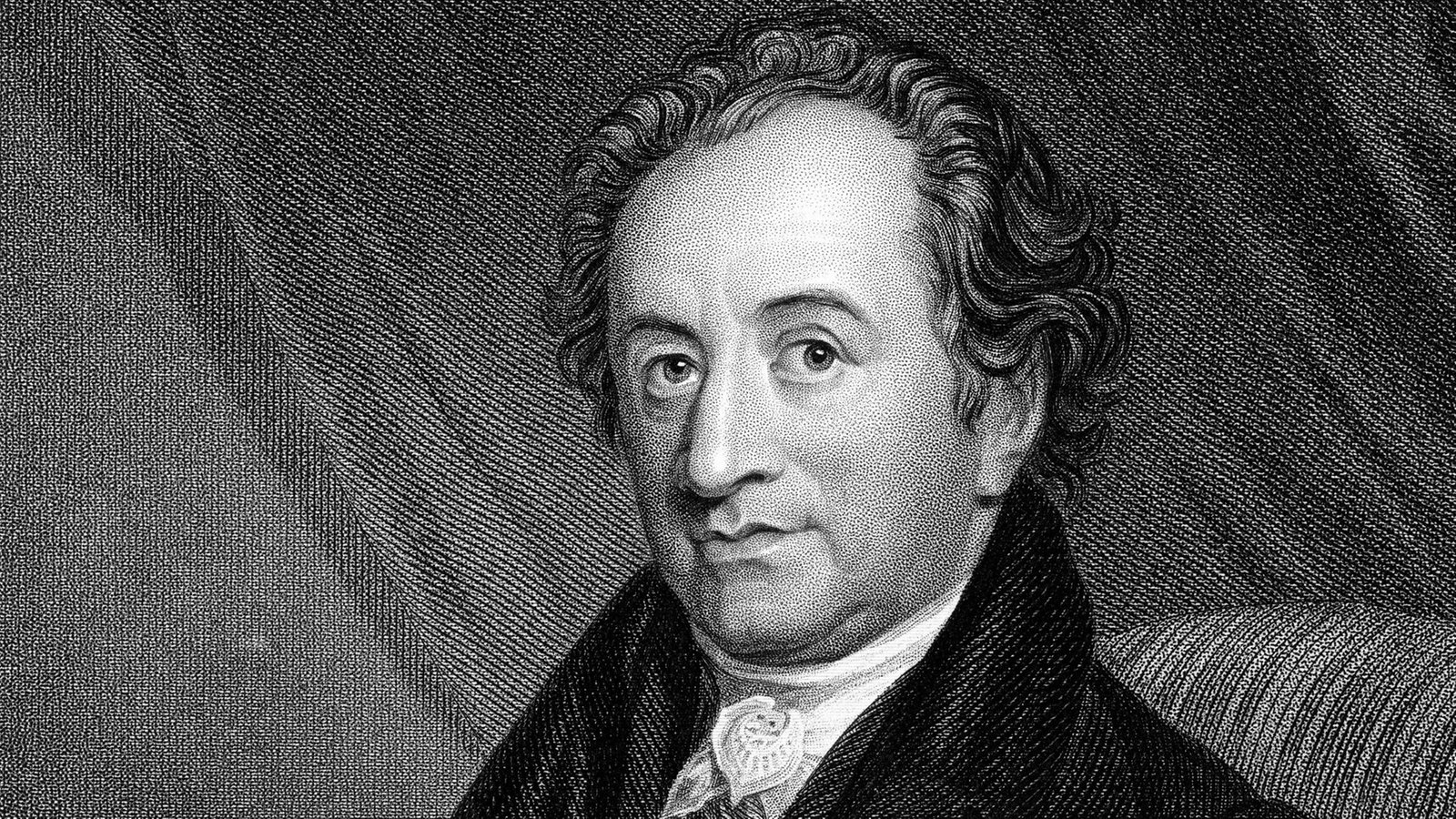
Johann Wolfgang von Goethe (1749-1832)
Johann Wolfgang von Goethe (1749–1832) was a German polymath, poet, dramatist, novelist, statesman, and natural philosopher whose intellectual and creative output decisively reshaped European literature, aesthetics, and natural science.[1][2] Emerging as the tempestuous vanguard of the Sturm und Drang movement with The Sorrows of Young Werther, Goethe subsequently transformed European aesthetic theory through Weimar Classicism alongside Friedrich Schiller, authored the monumental two-part philosophical verse tragedy Faust, and pioneered an organic, phenomenological approach to natural science based on morphology, polarity (Polarität), and intensification (Steigerung).[2:1][3] Rejecting both the arid mechanization of Enlightenment rationalism and the solipsistic extremes of Romanticism, Goethe articulated a holistic cosmos wherein art, human consciousness, and organic nature participate in continuous, living metamorphosis.[1:1][4]
1. Biographical Arc & Intellectual Trajectory
Goethe's life spanned eighty-two years of transformative European history—bridging the Enlightenment, the French Revolution, the Napoleonic Wars, and the dawn of industrial modernization.[1:2] His intellectual evolution represents a continuous dynamic dialectic between subjective passion and objective form, poetic intuition and rigorous empirical observation.[2:2]
[ Sturm und Drang Vanguard (1770s) ] ────► Emotional radicalism, Werther fever, revolt against rules
                     │
                     ▼
[ Weimar Court & Statecraft (1775–1786) ] ─► Civic governance, mineralogy, administrative discipline
                     │
                     ▼
[ The Italian Journey (1786–1788) ] ─────► Classical rebirth, Palladian order, morphological vision
                     │
                     ▼
[ Weimar Classicism (1794–1805) ] ──────► Partnership with Schiller, aesthetic humanism, formal rigor
                     │
                     ▼
[ Late Period & Weltliteratur (1805–1832) ] ► Faust II, West-östlicher Divan, holistic scientific legacy
Early Life, Legal Studies & The Strasbourg Epiphany (1749–1771)
Born on August 28, 1749, in Frankfurt am Main into a prosperous patrician family, Goethe was educated under the strict, humanist tutelage of his father, Johann Caspar Goethe.[1:3] In 1765, he was sent to study jurisprudence at the University of Leipzig, then regarded as "Little Paris" for its polished Rococo tastes and French Enlightenment manners.[1:4][2:3] Stricken by a near-fatal pulmonary hemorrhage in 1768, Goethe returned home to recuperate, immersing himself in pietist mysticism, alchemy, and early natural philosophy.[1:5]
Resuming his legal studies at the University of Strasbourg in 1770, Goethe experienced the primary intellectual turning point of his youth through his friendship with philosopher and critic Johann Gottfried von Herder.[2:4] Herder dismantled Goethe’s conventional French neoclassical assumptions, introducing him to the raw vitalism of folk poetry, the cosmic sublime of Homer, the majesty of Gothic architecture (crystallized in Goethe's passionate essay on the Strasbourg Cathedral), and the wild, organic genius of William Shakespeare.[1:6][2:5]
The Sturm und Drang Firestorm & Werther Fever (1771–1775)
Returning to Frankfurt, Goethe spearheaded the literary insurrection known as Sturm und Drang ("Storm and Stress"), which revolted against Enlightenment rationalism, arid Cartesian clarity, and academic artistic constraints in the name of authentic passion, subjective intuition, and creative spontaneity.[1:7][3:1]
His historic drama Götz von Berlichingen (1773) celebrated a rugged, individualistic sixteenth-century knight defying imperial corruption, while his epistolary novella The Sorrows of Young Werther (Die Leiden des jungen Werthers, 1774) detonated across Europe with seismic cultural force.[1:8][2:6] Werther captured the generational malaise of sensitive, educated youth alienated by ossified social hierarchies and rationalized mediocrity, sparking international "Werther fever" and cementing the twenty-five-year-old author as the most celebrated literary figure in the Western world.[1:9][3:2]
The Weimar Court, Statesmanship & Administrative Burdens (1775–1786)
In November 1775, at the invitation of the eighteen-year-old Duke Karl August, Goethe arrived in the Duchy of Saxe-Weimar, intending a brief sojourn.[1:10] Instead, Weimar became his permanent home for fifty-seven years.[1:11][2:7]
Far from retreating into poetic isolation, Goethe accepted sweeping governmental and civic responsibilities:[2:8]
- Privy Councillor (Geheimer Rat): Directing ducal policy, supervising state finances, highway construction, and military conscription.[1:12]
- Director of Ilmenau Mines: Leading efforts to reopen the silver and copper mines, which initiated his serious, lifelong investigations into geology, mineralogy, and paleontology.[2:9]
- Directorship of the Weimar Court Theatre: Managing repertoire, stage blocking, actor training, and set design for over a quarter of a century.[1:13]
While these practical duties grounded Goethe in political realism and physical nature, the grinding bureaucratic routine eventually brought him to physical and creative exhaustion.[1:14]
The Italian Journey (Italienische Reise, 1786–1788): Aesthetic Rebirth
In September 1786, fleeing Weimar in secret under an assumed identity (Filippo Miller), Goethe embarked on a transformative two-year pilgrimage across Italy, traveling through Verona, Vicenza, Venice, Rome, Naples, and Sicily.[1:15][4:1]
Goethe described his Italian journey not merely as a sabbatical, but as an authentic spiritual rebirth (Wiedergeburt):[4:2]
- Encounter with Classical Antiquity: Immersed in classical Greco-Roman sculpture and the Renaissance architecture of Andrea Palladio, Goethe rejected the turbulent, formless emotionalism of his Sturm und Drang youth in favor of noble simplicity, harmonic proportion, and objective plastic form.[4:3]
- Sicilian Botanical Discovery: In the Public Gardens of Palermo, observing the lush Mediterranean flora, Goethe conceived his foundational botanical thesis: the existence of the archetypal plant (Urpflanze) and the universal metamorphosis of all plant organs from a single primordial blueprint.[2:10][4:4]
STURM UND DRANG (Youthful Phase)              WEIMAR CLASSICISM (Mature Phase)
─────────────────────────────────             ────────────────────────────────
• Unchecked emotional expression              • Harmonic self-containment & balance
• Rejection of formal rules                   • Universal classical archetypes
• Subjective melancholy & Weltschmerz         • Objective observation of natural law
• Formless spontaneity                        • Synthesis of Gehalt (depth) & Gestalt (form)
Weimar Classicism & The Schiller Alliance (1794–1805)
Upon returning from Italy, Goethe found himself estranged from the Weimar literary public, which still clamored for the fiery emotionalism of Werther.[1:16] This isolation ended in July 1794 during a historic encounter with poet and philosopher Friedrich Schiller following a meeting of the Nature Research Society in Jena.[1:17][2:11]
Debating plant metamorphosis and the epistemological status of archetypes, the two men forged one of the most legendary partnerships in world literature, co-founding Weimar Classicism (Weimarer Klassik):[2:12]
- Aesthetic Humanism: Believing that the brutal terror of the French Revolution had demonstrated humanity’s political immaturity, Goethe and Schiller argued that true political freedom could only be achieved through aesthetic education—harmonizing sensual instinct with moral reason.[1:18][2:13]
- Creative Symbiosis: For eleven years, until Schiller's premature death in 1805, the two thinkers critiqued each other’s drafts, co-authored satirical epigrams (Xenien), co-edited the journal Die Horen, and spurred one another to masterwork achievements: Schiller guided Goethe back to completing Part I of Faust and Wilhelm Meister's Apprenticeship, while Goethe provided theatrical production and philosophical ballast for Schiller's historical tragedies (Wallenstein, Mary Stuart).[1:19][2:14]
The Late Period, Weltliteratur & Final Striving (1805–1832)
Schiller’s death in 1805 plunged Goethe into profound sorrow, marking the beginning of his late, Olympian period.[1:20] He witnessed Napoleon conquer Weimar following the Battle of Jena in 1806, held a historic private audience with the French Emperor in Erfurt in 1808 (where Napoleon famously declared: "Vous êtes un homme!"), and married his long-time domestic partner Christiane Vulpius.[1:21][2:15]
In his final decades, Goethe’s vision expanded beyond national boundaries. Inspired by the Persian poetry of Hafez, he composed the West-östlicher Divan (1819) and coined the concept of World Literature (Weltliteratur)—predicting that the insular national literatures of Europe would coalesce into a global, cross-cultural exchange of human thought.[1:22][5]
In his final months, working in the small, austere study of his Weimar home on the Frauenplan, Goethe sealed the manuscript of Faust: Part Two in August 1831, declaring his life's task accomplished.[1:23] He died peacefully on March 22, 1832, reportedly murmuring his legendary final aspiration: "Mehr Licht!" ("More light!").[1:24][2:16]
2. Major Literary Masterworks & Poetic Architecture
| Masterwork | Original Title | Year | Genre / Form | Thematic Core & Cultural Resonance |
|---|---|---|---|---|
| The Sorrows of Young Werther | Die Leiden des jungen Werthers | 1774 | Epistolary Novel | Fatal clash between sensitive subjective passion and rigid bourgeois-feudal social order; the archetype of Weltschmerz. |
| Wilhelm Meister's Apprenticeship | Wilhelm Meisters Lehrjahre | 1795–1796 | Bildungsroman | The foundational coming-of-age novel; transition from theatrical idealism to mature civic engagement and harmonious self-cultivation (Bildung). |
| Faust: A Tragedy (Part I & II) | Faust. Eine Tragödie | 1808; 1832 | Two-Part Verse Tragedy | Cosmic drama of human striving (Streben), the existential wager, dialectical evil, modernization, and celestial redemption via the Eternal Feminine. |
| Elective Affinities | Die Wahlverwandtschaften | 1809 | Philosophical Novel | Chemical laws of attraction and repulsion applied to human marriage and erotic desire; conflict between natural determinism and moral law. |
| West-Eastern Divan | West-östlicher Divan | 1819 | Lyric Poetry Cycle | Poetic synthesis of European and Persian aesthetics; cultural hybridity, spiritual renewal, and the foundation of Weltliteratur. |
The Sorrows of Young Werther (1774): Epistolary Subjectivism & Weltschmerz
The Sorrows of Young Werther transformed European prose by establishing the absolute primacy of the individual's subjective emotional interiority.[1:25][3:3] Composed almost entirely of letters written by the young artist Werther to his friend Wilhelm, the novel captures an unmediated confession of intense sensory experience, aesthetic intoxication with nature, and existential despair.[3:4]
- The Unattainable Ideal: Stationed in the pastoral village of Wahlheim, Werther falls hopelessly in love with Charlotte (Lotte), a woman already betrothed to the sensible, upright, and thoroughly conventional Albert.[1:26][3:5] While Albert personifies bourgeois duty, emotional stability, and societal conformity, Werther embodies the uncompromising, absolute demands of the Romantic heart.[3:6]
- The Social and Ontological Prison: Werther’s torment is not merely romantic; it is existential and sociological.[3:7] When he attempts a career in diplomacy, he is publicly humiliated by aristocratic snobbery and ejected from a noble gathering.[1:27] He realizes that human society is a cage of petty pretenses and mechanical routines that suffocate the creative spirit.[3:8]
- The Culmination in Suicide: Incapable of curbing his infinite desire or accepting the finite compromises of adult social reality, Werther borrows Albert's hunting pistols and shoots himself.[1:28][3:9] The novel established the philosophical category of Weltschmerz ("world-weariness")—the profound, tragic melancholy born from the agonizing discrepancy between an idealized vision of spiritual wholeness and the impoverished reality of the actual world.[3:10]
Wilhelm Meister's Apprenticeship (1795–1796): The Archetype of the Bildungsroman
With Wilhelm Meister's Apprenticeship, Goethe established the Bildungsroman (the novel of formation, education, and development) as one of the definitive narrative genres of modern Western literature.[1:29][2:17]
- The Concept of Bildung: In German philosophical thought, Bildung denotes far more than formal schooling; it signifies the organic, lifelong cultivation and harmonious unfolding of all latent physical, intellectual, moral, and aesthetic faculties within the individual personality.[2:18]
- The Narrative Trajectory: Wilhelm Meister, the idealistic son of a merchant, rebels against bourgeois commerce to pursue a passionate career in the traveling theater, seeking self-realization by directing and acting in Shakespeare’s Hamlet.[1:30][2:19] Through encounters with strolling players, aristocratic patrons, the enigmatic child Mignon, and the mysterious Harper, Wilhelm gradually discovers that the theater was a necessary playground for his youthful projections, not his permanent adult vocation.[2:20]
- The Society of the Tower (Turmgesellschaft): Wilhelm is guided toward psychological maturity by a clandestine, benevolent brotherhood of aristocratic and humanist mentors known as the Society of the Tower.[1:31][2:21] The Society teaches that true freedom consists not in formless bohemian escapism, but in recognizing one’s organic limitations and integrating one’s talents into constructive social and community life.[2:22] Friedrich Schlegel hailed Wilhelm Meister, alongside the French Revolution and Fichte’s Wissenschaftslehre, as the three supreme tendencies of the modern age.[2:23]
Faust: A Tragedy (Parts I & II): The Modern Human Condition
Goethe's magnum opus, composed across sixty years, recasts the Renaissance legend of Faust into an encyclopedic philosophical exploration of modern human striving, intellectual hubris, and spiritual salvation.[1:32] (For exhaustive textual analysis, see Goethe's Faust.)
- The Metaphysical Shift (The Wager): In place of Christopher Marlowe’s traditional legalistic contract for twenty-four years of magical power, Goethe introduces an existential wager (Wette).[1:33] Faust wagers his soul that Mephistopheles can never provide any earthly or sensual experience so gratifying that Faust will command the passing moment to halt: "Verweile doch! du bist so schön!" ("Tarry a while! Thou art so fair!").[1:34] Striving (Streben) is declared the sacred motor of human consciousness; inertia alone is damnable.[1:35]
- Mephistopheles and Polarity: In accordance with Goethe's Metaphysics of Polarity, Mephistopheles is not a Manichaean adversary of God, but an indispensable dialectical catalyst within the cosmic order: "part of that power which eternally wills evil and eternally works good." By negating, mocking, and destroying, Mephistopheles goads humanity out of complacent slumber back into creative motion.[1:36]
- The Modern Developer & Land Reclamation: In Part Two, Faust evolves into a titanic modern industrialist who masters nature by building dikes and reclaiming fertile land from the sea.[1:37] The tragic eradication of the elderly couple Philemon and Baucis exposes the catastrophic human and ecological cost of utopian modernization.[1:38]
- Redemption via the Eternal Feminine: Faust is saved not by moral perfection, but by the dynamic synthesis of unceasing striving ("Whoever strives with all his power, / Him we can redeem") and celestial grace, drawn upward by the transcendent spiritual love of the Eternal Feminine (Das Ewig-Weibliche).[1:39]
Elective Affinities (Die Wahlverwandtschaften, 1809)
In this remarkably modern, unsettling novel, Goethe explored the intersection between natural scientific determinism and human moral responsibility.[1:40][2:24]
- The Chemical Metaphor: Goethe draws upon contemporary chemical theory (specifically Torbern Bergman’s concept of elective affinities), wherein chemical compounds break apart and recombine into new configurations when brought into contact with new elements possessing stronger chemical attractions.[2:25]
- The Narrative Experiment: A happily married aristocratic couple, Eduard and Charlotte, invite two guests to live at their rural estate: the pragmatic Captain and Charlotte's orphaned, delicate niece Ottilie.[1:41][2:26] Inevitably, like chemical reagents, Eduard is overwhelmingly drawn to Ottilie, while Charlotte forms a deep intellectual bond with the Captain.[2:27]
- The Tragic Deadlock: Rather than celebrating unrestricted erotic impulse, Goethe charts the disastrous consequences of applying amoral natural laws to conscious human institutions.[2:28] The narrative culminates in the accidental drowning of Eduard and Charlotte's infant son (who bears the physical features of the Captain and Ottilie, an uncanny manifestation of spiritual adultery) and Ottilie's voluntary starvation in ascetic penance.[1:42][2:29] Walter Benjamin regarded this work as Goethe’s profoundest commentary on myth, marriage, and fate.[6]
3. Goethean Science: Morphology, Holistic Perception & Anti-Newtonian Optics
Goethe considered his scientific achievements equal, if not superior, to his literary works.[1:43][2:30] At a time when European science was standardizing Cartesian reductionism, mathematical abstraction, and Newtonian mechanistic determinism, Goethe pioneered a qualitative, phenomenological science grounded in direct sensory observation and organic wholeness.[2:31][7]
CARTESIAN-NEWTONIAN MECHANICS                  GOETHEAN PHENOMENOLOGICAL SCIENCE
─────────────────────────────                  ─────────────────────────────────
• World as dead clockwork / machine            • World as living, developing organism
• Mathematical abstraction & calculation       • Granular sensory observation & intuition
• Dissection into isolated parts               • Morphology: dynamic transformations of form
• Light as composite stream of corpuscles/rays • Light and Darkness as dynamic polar opposites
• Detached, mechanical instrumentation         • The human being as the primary delicate instrument
The Inception of Morphology (Morphologie)
Goethe coined the word Morphology (Morphologie) to designate the systematic study of organic forms, their formation (Bildung), and their dynamic transformation (Umbildung).[2:32][7:1]
Rejecting the static taxonomies of Carl Linnaeus—which classified plants based on static counts of stamens and pistils—Goethe argued that nature does not create rigid, fixed categories.[2:33] Rather, nature is in a constant state of flux and metamorphosis; form is merely a temporary crystallization of continuous process.[2:34][7:2]
The Intermaxillary Bone (Zwischenkieferknochen, 1784)
In 1784, conducting comparative anatomical research at the University of Jena, Goethe discovered the presence of the intermaxillary bone (premaxilla) in the human upper jaw.[1:44][2:35]
Contemporary anatomists, led by Petrus Camper, insisted that the absence of this bone in humans was the definitive morphological boundary proving that human beings were fundamentally distinct from animals.[2:36] By demonstrating that the human embryo possesses this bone, which subsequently fuses with adjacent facial structures during development, Goethe established the structural continuity between the human anatomy and the animal kingdom, anticipating Charles Darwin’s theory of common descent by three-quarters of a century.[1:45][2:37]
The Metamorphosis of Plants (Metamorphose der Pflanzen, 1790) & The Urpflanze
In his 1790 botanical treatise, Goethe articulated his theory of plant morphology:[2:38][7:3]
- The Leaf as Protean Organ: Goethe demonstrated that all lateral appendages of a flowering plant—cotyledons, foliage leaves, sepals, petals, stamens, and pistils—are modifications and transformations of a single underlying organ: the leaf.[2:39][7:4]
- The Urpflanze (Archetypal Plant): Goethe conceptualized the Urpflanze not as a literal physical ancestor lost in antiquity, but as an ideal morphological archetype—an open, dynamic generative template through which an infinite variety of actual plant forms can be generated and understood.[2:40][7:5]
- The Rhythm of Expansion and Contraction: Plant growth proceeds through three successive cycles of expansion and contraction:[2:41]
- First Cycle: Expansion from seed into stem and foliage leaves; contraction into the calyx (sepals).
- Second Cycle: Expansion into the colorful corolla (petals); contraction into the sexual organs (stamens and pistils).
- Third Cycle: Expansion into the swelling fruit; final contraction into the concentrated seed.
       [ Seed (Ultimate Contraction) ]
                     │ (Expansion 1)
                     ▼
       [ Stem & Foliage Leaves ]
                     │ (Contraction 1)
                     ▼
              [ Calyx / Sepals ]
                     │ (Expansion 2)
                     ▼
             [ Corolla / Petals ]
                     │ (Contraction 2)
                     ▼
          [ Stamens & Pistils ]
                     │ (Expansion 3)
                     ▼
            [ Swelling Fruit ]
                     │ (Contraction 3)
                     ▼
       [ Seed (New Potentiality) ]
Theory of Colours (Zur Farbenlehre, 1810)
Goethe’s longest and most controversial scientific work directly attacked Isaac Newton’s 1704 Opticks.[2:42][8]
- The Critique of Newton: Newton argued that white light is a compound mixture of all spectral colors, and that darkness is merely the passive absence of light.[8:1] Goethe vehemently rejected this, arguing that Newton’s experiments relied on unnatural, artificial conditions (forcing light through a tiny pinhole and prism in a darkened room) that mutilated the natural phenomenon.[2:43][8:2]
- Light, Darkness & Turbid Media (Das trübe Mittel): Goethe proposed that light and darkness are active, polar opposites.[8:3] Color does not reside hidden within light; rather, colors are the "deeds and sufferings of light" (Taten und Leiden des Lichts) as it interacts with darkness through semi-transparent or turbid media:[8:4]
- When light is viewed through an increasing turbid medium, it shifts from yellow through orange to ruby red (e.g., the sun setting through atmospheric haze).
- When darkness is illuminated through a turbid medium, it manifests as blue and violet (e.g., the blackness of space appearing blue through the illuminated atmosphere).
- Physiological Colors & After-Images: Goethe pioneered the study of subjective and physiological optics, demonstrating that the human eye actively generates colors to restore equilibrium.[8:5] Staring at a red circle on a white wall and looking away immediately produces a green after-image; the eye demands the polar complement to achieve wholeness.[8:6]
- Psychological Impact of Colors: Goethe mapped the emotional and psychological qualities of colors, dividing the color circle into the warm, active, energetic "plus" side (yellow, red-yellow, yellow-red) and the cold, melancholic, receptive "minus" side (blue, red-blue, blue-red), laying the foundations for modern color psychology and art theory.[8:7]
4. Metaphysical Engines: Polarity, Intensification & The Urphänomen
Goethe’s scientific and philosophical frameworks are animated by four primary concepts that unite his artistic creations and natural investigations:[2:44][7:6]
                             ┌────────────────────────┐
                             │       URPHÄNOMEN       │
                             │  Primordial Phenomenon │
                             └───────────┬────────────┘
                                         │
                    ┌────────────────────┴────────────────────┐
                    ▼                                         ▼
         [ POLARITÄT (Polarity) ]                  [ STEIGERUNG (Intensification) ]
          Dynamic tension of opposites              Upward metamorphosis & elevation
          (Systole/Diastole, Light/Dark)            (Stagnant cycle broken into spiral)
                    │                                         │
                    └────────────────────┬────────────────────┘
                                         ▼
                             [ DAS DÄMONISCHE (Demonic) ]
                              Irrational, creative vitalism
                              propelling world history & art
1. Polarität (Polarity)
As detailed in Goethe's Metaphysics of Polarity, Goethe viewed reality not as a collection of static, isolated objects, but as an interconnected field of dynamic oppositions.[2:45] Every natural phenomenon requires its opposite to exist and manifest: light and darkness, north and south magnetic poles, male and female, acid and base, attraction and repulsion.[2:46][7:7] Opposites do not cancel each other out; their creative tension generates the vital pulse of reality.[2:47]
2. Systole and Diastole (The Universal Breath)
Borrowing the physiological terms for the contraction (systole) and dilation (diastole) of the mammalian heart, Goethe elevated them into a cosmic cosmological principle:[2:48][7:8]
"To divide the united, to unite the divided, is the life of nature; this is the eternal systole and diastole, the eternal collapsion and expansion, the inspiration and expiration of the world in which we live and move."[8:8]
Nature perpetually oscillates between gathering into an individual, differentiated form (contraction) and dissolving into universal oneness (expansion).[7:9]
3. Steigerung (Intensification and Metamorphosis)
Polarity alone would trap the cosmos in a sterile, oscillating pendulum swing.[2:49] To account for organic growth, spiritual evolution, and creative novelty, Goethe paired Polarität with Steigerung—the upward intensification, refinement, and elevation of form.[2:50][7:10] As polar forces clash and intertwine, they escalate into higher, more complex, and spiritualized syntheses, transforming a circular loop into an ascending evolutionary spiral.[2:51]
4. The Urphänomen (Archetypal Primordial Phenomenon)
The Urphänomen represents the ultimate frontier of human empirical inquiry.[2:52] It is the point where a natural law reveals itself directly to sensory perception without the mediation of theoretical abstractions or mechanical hypotheses.[2:53][7:11]
- For optics, the Urphänomen is the appearance of color at the boundary of light and darkness viewed through a turbid medium.[8:9]
- For botany, it is the leaf metamorphosing across sequential nodes.[7:12]
- Goethe urged scientists to stop in reverent awe before the Urphänomen, warning that attempting to penetrate behind it with abstract mathematical formulas replaces the living phenomenon with an intellectual corpse.[2:54]
5. Das Dämonische (The Demonic Force)
In his autobiography Dichtung und Wahrheit and in conversations with Johann Peter Eckermann, Goethe described das Dämonische as an irrational, ambivalent, and irresistible cosmic power that defies moral categorization, rational analysis, and human planning.[1:46][5:1]
- The demonic manifests in nature as catastrophic upheavals and bursts of generative vitality.[1:47]
- In human history, it erupts through charismatic, titanic individuals—such as Alexander the Great, Julius Caesar, and Napoleon Bonaparte—who seem driven by an unseen force, attracting others magnetically and altering the destiny of civilizations, often culminating in their own spectacular ruin.[1:48][5:2]
- In literature, it is the creative fire that drives the artist beyond conscious calculations, perfectly embodied in Faust’s unquenchable drive.[1:49]
5. Philosophical Legacy & Cross-Disciplinary Resonance
Goethe's profound integration of poetic imagination, philosophical depth, and empirical observation left an indelible imprint across modern European thought:[1:50][2:55]
- German Idealism (Hegel and Schelling): G.W.F. Hegel deeply admired Goethe’s Theory of Colours and morphology, viewing Goethe’s dynamic polarity and Steigerung as the empirical manifestation of the dialectic—wherein opposing forces reconcile into a higher synthesis (Aufhebung).[2:56] F.W.J. Schelling drew upon Goethean organicism to construct his Naturphilosophie, positing that nature is visible spirit, and spirit is invisible nature.[2:57]
- Arthur Schopenhauer: Schopenhauer spent months collaborating with Goethe in Weimar on color theory, subsequently publishing On Vision and Colors (1816).[1:51] Although Schopenhauer shifted away from Goethe’s active darkness toward physiological retinal activity, he credited Goethe with demonstrating that the world is an organic whole animated by an inner striving force.[2:58]
- Friedrich Nietzsche: Nietzsche regarded Goethe as the ultimate exemplar of the elevated human being—a modern European who conquered his internal contradictions, reconciled the Apollonian with the Dionysian, and achieved supreme self-mastery:[9] Friedrich Nietzsche, Twilight of the Idols (1889)
"Goethe conceived a human being who would be strong, highly educated, skillful in all bodily matters, self-controlling, reverent toward himself... Such a spirit who has become free stands amid the cosmos with a joyous and trusting fatalism, in the faith that only the particular is loathsome, and that, all is redeemed and affirmed in the whole—he does not negate any more... But such a faith is the highest of all possible faiths: I have baptized it with the name of Dionysus."[9:1]
- Evolutionary Biology & Morphology: While Charles Darwin established natural selection as the mechanism of evolution, he explicitly acknowledged Goethe in the historical introduction to The Origin of Species as an early pioneer who grasped the plastic mutability and common archetypes of organic structures.[2:59] In Germany, Ernst Haeckel championed Goethe as the intellectual grandfather of evolutionary morphology.[2:60]
- Carl Gustav Jung and Depth Psychology: Jung viewed Goethe as a psychic ancestor, famously keeping Faust as his lifelong clinical and alchemical companion.[1:52] Jung interpreted Faust’s pact with Mephistopheles as the confrontation with the Shadow, Helen of Troy as the projection of the Anima, and Faust’s cosmic ascension as the ultimate process of psychological individuation and the union of opposites (coniunctio oppositorum).[1:53]
- Modern Holistic Science & Gestalt Psychology: In the twentieth century, Gestalt theorists (Christian von Ehrenfels, Wolfgang Köhler) drew upon Goethe’s morphological principle that the living whole possesses emergent properties that cannot be derived by analyzing disassembled parts.[7:13] More recently, neuroscientist and philosopher Iain McGilchrist identifies Goethe as the quintessential master of right-hemisphere holistic perception, counteracting the fragmented, mechanistic reductionism of the left hemisphere.[7:14]
Summary of Core Concepts
| Concept | German Term | Operational Definition & Theoretical Role |
|---|---|---|
| Metamorphosis | Metamorphose | The continuous transformation and unfolding of organic form over time; dynamic process prioritized over static structure. |
| Morphology | Morphologie | The scientific discipline coined by Goethe to study the formation, transformation, and structural relations of living beings. |
| Archetypal Plant | Urpflanze | The primordial generative blueprint from which all conceivable plant forms can be derived through leaf modifications. |
| Archetypal Phenomenon | Urphänomen | The irreducible experiential limit where a fundamental law of nature reveals itself directly to trained perception. |
| Polarity & Escalation | Polarität & Steigerung | Dynamic interplay of contradictory forces accompanied by an upward, evolutionary intensification toward higher spiritualized complexity. |
| Deeds of Light | Taten und Leiden des Lichts | Goethe's definition of colors: the phenomena arising from the active interaction and struggle between light and darkness through media. |
| Self-Cultivation | Bildung | The holistic, harmonious unfolding and integration of an individual's intellectual, artistic, and moral potential within society. |
| The Demonic | Das Dämonische | The irrational, irresistible vital power in nature and history that drives creative genius and upends rational order. |
| World Literature | Weltliteratur | The global, cross-cultural circulation and mutual enrichment of literary traditions transcending narrow national borders. |
🎴 Interactive Web Practice (Comprehension Check)
Question 1 (Goethean Science vs. Newtonian Optics): Why did Goethe vehemently reject Isaac Newton's optical theory in Zur Farbenlehre, and how does his definition of color as the \"deeds and sufferings of light\" (Taten und Leiden des Lichts) reflect his phenomenological method?
Answer: Goethe rejected Isaac Newton's optical paradigm because Newton relied on artificial, isolated experimental conditions—forcing a ray of light through a tiny puncture into a dark room and splitting it with a prism—which Goethe argued mutilated the natural phenomenon and reduced a rich sensory reality to sterile mathematical abstraction. Furthermore, Newton posited that white light is a compound mixture of all colors and that darkness is merely passive absence. In sharp contrast, Goethe's phenomenological method insists upon observing nature in its intact, living context. For Goethe, light and darkness are active, generative polar opposites (Polarität). Color is not hidden inside light; rather, colors are the \"deeds and sufferings of light\" (Taten und Leiden des Lichts) produced when light actively interacts with darkness through a semi-transparent or turbid medium (das trübe Mittel). By prioritizing the active sensory experience of the human observer and emphasizing subjective after-images, Goethe established a human-centered, qualitative science of perception.
Question 2 (Morphology and the Urpflanze): In The Metamorphosis of Plants (1790), what structural argument does Goethe make regarding the leaf, and how does his concept of the Urpflanze bridge the empirical and the ideal?
Answer: In The Metamorphosis of Plants, Goethe proposes the revolutionary morphological principle that all lateral appendages of a flowering plant—including cotyledons, stem leaves, sepals (calyx), petals (corolla), stamens, and pistils—are modifications and transformations of a single protean organ: the leaf. Growth proceeds through a rhythmic oscillation of expansion (into leaves, petals, and fruit) and contraction (into nodes, sexual organs, and seeds). The Urpflanze (archetypal plant) is not an actual physical specimen lost in prehistoric antiquity, nor is it an abstract mathematical formula. Instead, it is an ideal, dynamic generative archetype that can be perceived intuitively by the trained naturalist through careful sensory observation. It bridges the empirical and the ideal by demonstrating that the infinite, diverse plant forms found in nature are outward variations of an internal, living unity of form.
Question 3 (The Dialectic of Striving and Polarity in Faust): How does the philosophical principle of Polarität und Steigerung (polarity and intensification) govern the relationship between Faust and Mephistopheles, and why is this dynamic necessary for Faust's ultimate redemption?
Answer: In Goethe's metaphysical architecture, Polarität provides the indispensable creative tension between opposing forces, while Steigerung provides the upward evolutionary drive that prevents this tension from degenerating into static oscillation. In Faust, Heinrich Faust and Mephistopheles form an inseparable polar pairing: Faust represents the unceasing, idealistic drive for spiritual transcendence, creative action, and knowledge (Streben), while Mephistopheles represents the spirit of cynical negation, physical destruction, and material reality (der Geist, der stets verneint). Rather than acting as a cosmic rival to God, Mephistopheles serves as an unwitting dialectical instrument within the divine order; his perpetual attempts to drag Faust into sensory torpor and despair continually provoke Faust out of complacency and back into dynamic striving. Because Faust never rests in passive satisfaction (refusing to utter the fatal phrase of the wager, \"Verweile doch! du bist so schön!\"), his relentless striving allows divine grace to intervene, proving that dynamic error through struggle escalates the soul toward higher spiritualization.
Resonant Notes
The following notes in the vault share direct thematic, sociological, and literary connections with Johann Wolfgang von Goethe:
🔴 Polarity, Idealism & Continental Philosophy
- Goethe's Metaphysics of Polarity — The theoretical foundation of Goethe's scientific and metaphysical system, detailing how Polarität (dynamic tension) and Steigerung (intensification) drive natural metamorphosis and human consciousness.
- Goethe's Faust — Goethe's literary magnum opus that dramatizes his philosophical cosmology, exploring the wager of restless striving, the demonic spirit of negation, and redemptive grace via the Eternal Feminine.
- Continental Philosophy — Goethe stands as a primary literary catalyst for the Continental tradition, directly influencing the post-Kantian Idealism of Schelling and Hegel, the existentialism of Kierkegaard and Nietzsche, and twentieth-century phenomenology.
- Georg Wilhelm Friedrich Hegel (1770–1831) — Hegel's dialectical philosophy of history and consciousness mirrors Goethe's polarity and Steigerung, viewing historical movement as the progressive self-actualization of spirit through oppositional tension and sublation (Aufhebung).
- Friedrich Nietzsche (1844-1900) — Nietzsche celebrated Goethe as his supreme cultural ideal: the elevated, self-mastered modern European who harmonized the Apollonian and Dionysian, overcoming nihilism through joyous affirmation of the cosmos.
- Schopenhauerian Pessimism — Arthur Schopenhauer collaborated directly with Goethe on optics and adopted Goethe's concept of an unceasing, underlying drive animating the universe, though Schopenhauer interpreted this striving (Streben) as tragic suffering rather than productive evolution.
- Ralph Waldo Emerson — In Representative Men, Emerson dedicated an entire essay to Goethe as "the Writer," praising Goethe's capacity to absorb the multifaceted reality of the modern world while recognizing nature as a living, organic manifestation of the divine.
🟡 Morphology, Perception & Cognitive Science
- Charles Darwin (1809–1882) — Goethe's pioneering morphological treatises (The Metamorphosis of Plants) and his discovery of the human intermaxillary bone anticipated Darwin's theory of evolution, establishing the continuity of form across species and the plastic mutability of living organisms.
- Gestalt Psychology-The Mechanics of the Whole — Gestalt theorists directly adopted Goethe’s morphological principle that the perceptual and living whole (das Ganze) is primary, possessing dynamic emergent qualities that cannot be understood by dissecting elements into isolated mechanical parts.
- Iain McGilchrist — McGilchrist identifies Goethe as an exemplary thinker who balanced left-hemisphere analytical precision with right-hemisphere holistic, relational perception, resisting the mechanistic disenchantment of nature.
- Henri Bergson — Bergson's concepts of élan vital (vital impetus) and lived duration (durée) share deep kinship with Goethean morphology, rejecting mechanistic determinism in favor of continuous, creative organic becoming.
- Carl Gustav Jung — Jung treated Goethe’s Faust as an alchemical blueprint for depth psychology, mapping Mephistopheles to the personal and collective Shadow, Helen to the Anima, and Faust’s spiritual evolution to the journey of individuation.
- Aldous Huxley's The Doors of Perception (1954) — Huxley's exploration of non-mechanistic, unmediated perception echoes Goethe’s phenomenological method, wherein the observer trains consciousness to perceive the sacred Urphänomen directly.
🟢 Romanticism, Sehnsucht & Literary Legacy
- Sehnsucht — Goethe's The Sorrows of Young Werther and Faust are the supreme literary archetypes of Sehnsucht—the bittersweet, insatiable longing for the infinite and the tragic rift between human aspiration and finite earthly limitation.
- The Sublime — The aesthetic framework that Goethe explored from his youthful encounter with the Strasbourg Cathedral to the terrifying majesty of the Earth Spirit (Erdgeist) and Alpine panoramas in Faust.
- Immanuel Kant-The Transcendental Sublime — Kant’s aesthetic formulation of the sublime as the mind's realization of its supersensible vocation when confronted with nature's overwhelming magnitude provides the philosophical counterpart to Goethe’s sublime confrontations with the cosmos.
- Edmund Burke-The Physiological Sublime — Burke's somatic analysis of terror, vastness, and obscurity as primary aesthetic transports informs Goethe's early Sturm und Drang poetry and the eerie, supernatural gloom of Erlkönig.
- The Nightmare — Henry Fuseli's iconic Gothic canvas emerged from the same pan-European Sturm und Drang crucible, visually externalizing the dark, irrational unconscious forces that Goethe explored in early lyrics and Walpurgisnacht.
- The Renaissance — Goethe’s Italian Journey was an aesthetic pilgrimage to Renaissance masters (Raphael, Michelangelo, Palladio), inspiring his turn toward classical proportion, plastic serenity, and Weimar Classicism.
- Fyodor Dostoevsky (1821-1881) — Dostoevsky read Goethe avidly in his youth; the Karamazovian tension between intellectual pride and spiritual humility, as well as Ivan Karamazov's hallucinated devil, directly inherits the Faustian dialectic between scholastic hubris and demonic cynicism.
- Walter Benjamin (1892–1940) — Benjamin's landmark 1922 essay "Goethe's Elective Affinities" (Goethes Wahlverwandtschaften) represents one of the towering achievements of modern philosophical criticism, parsing the interplay between mythic fate and moral reconciliation.
References
Nicholas Boyle / Goethe: The Poet and the Age (Volumes I & II) / Oxford University Press ↩︎ ↩︎ ↩︎ ↩︎ ↩︎ ↩︎ ↩︎ ↩︎ ↩︎ ↩︎ ↩︎ ↩︎ ↩︎ ↩︎ ↩︎ ↩︎ ↩︎ ↩︎ ↩︎ ↩︎ ↩︎ ↩︎ ↩︎ ↩︎ ↩︎ ↩︎ ↩︎ ↩︎ ↩︎ ↩︎ ↩︎ ↩︎ ↩︎ ↩︎ ↩︎ ↩︎ ↩︎ ↩︎ ↩︎ ↩︎ ↩︎ ↩︎ ↩︎ ↩︎ ↩︎ ↩︎ ↩︎ ↩︎ ↩︎ ↩︎ ↩︎ ↩︎ ↩︎ ↩︎
Johann Wolfgang von Goethe / The Collected Works (12 Volumes, ed. Victor Lange, Eric A. Blackall, Cyrus Hamlin) / Princeton University Press ↩︎ ↩︎ ↩︎ ↩︎ ↩︎ ↩︎ ↩︎ ↩︎ ↩︎ ↩︎ ↩︎ ↩︎ ↩︎ ↩︎ ↩︎ ↩︎ ↩︎ ↩︎ ↩︎ ↩︎ ↩︎ ↩︎ ↩︎ ↩︎ ↩︎ ↩︎ ↩︎ ↩︎ ↩︎ ↩︎ ↩︎ ↩︎ ↩︎ ↩︎ ↩︎ ↩︎ ↩︎ ↩︎ ↩︎ ↩︎ ↩︎ ↩︎ ↩︎ ↩︎ ↩︎ ↩︎ ↩︎ ↩︎ ↩︎ ↩︎ ↩︎ ↩︎ ↩︎ ↩︎ ↩︎ ↩︎ ↩︎ ↩︎ ↩︎ ↩︎ ↩︎
Johann Wolfgang von Goethe / The Sorrows of Young Werther (trans. Michael Hulse) / Penguin Classics ↩︎ ↩︎ ↩︎ ↩︎ ↩︎ ↩︎ ↩︎ ↩︎ ↩︎ ↩︎ ↩︎
Johann Wolfgang von Goethe / Italian Journey (1786–1788) (trans. W.H. Auden and Elizabeth Mayer) / Penguin Classics ↩︎ ↩︎ ↩︎ ↩︎ ↩︎
Johann Peter Eckermann / Conversations of Goethe with Johann Peter Eckermann (trans. John Oxenford) / Da Capo Press / Project Gutenberg ↩︎ ↩︎ ↩︎
Walter Benjamin / "Goethe's Elective Affinities" in Selected Writings, Volume 1: 1913–1926 / Harvard University Press ↩︎
Henri Bortoft / The Wholeness of Nature: Goethe's Way toward a Science of Conscious Participation in Nature / Lindisfarne Books ↩︎ ↩︎ ↩︎ ↩︎ ↩︎ ↩︎ ↩︎ ↩︎ ↩︎ ↩︎ ↩︎ ↩︎ ↩︎ ↩︎ ↩︎
Johann Wolfgang von Goethe / Theory of Colours (trans. Charles Lock Eastlake) / MIT Press ↩︎ ↩︎ ↩︎ ↩︎ ↩︎ ↩︎ ↩︎ ↩︎ ↩︎ ↩︎
Friedrich Nietzsche / Twilight of the Idols (trans. Walter Kaufmann) / Penguin Books ↩︎ ↩︎