Aldous Huxley's The Doors of Perception (1954)
The Doors of Perception (1954) is Aldous Huxley's philosophical memoir documenting his transformative experience under the influence of mescaline in May 1953. Integrating Henri Bergson's eliminative philosophy with neurochemistry and cognitive theory, Huxley introduces his influential "reducing valve" hypothesis: the primary biological function of the brain, nervous system, and language is not to generate consciousness, but to filter out the overwhelming totality of reality (Mind at Large) so that the human organism can focus strictly on pragmatic survival. When this biological gating is temporarily relaxed, conscious awareness is flooded with unmediated, preternaturally illuminated reality—revealing the intrinsic, self-justifying "isness" (Istigkeit) of everyday objects.[1]
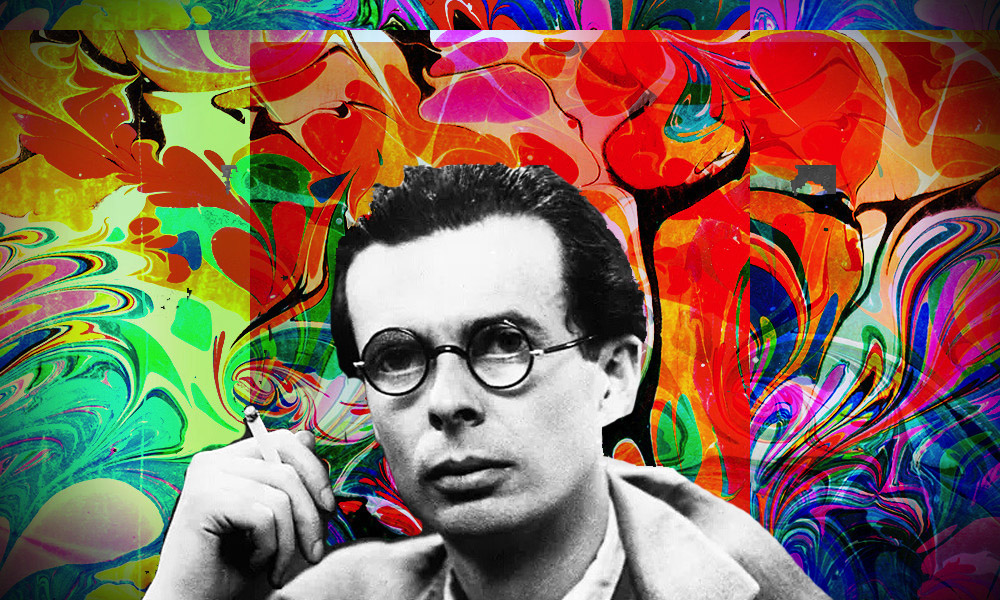
The 1953 Mescaline Experiment and Historical Genesis
On a bright morning in May 1953 at his home in West Hollywood, California, Aldous Huxley ingested four-tenths of a gram of mescaline dissolved in water under the clinical supervision of British psychiatrist Humphry Osmond.[1:1] Osmond was a leading figure in the early wave of psychedelic psychiatry, conducting cutting-edge clinical research at the Weyburn Mental Hospital in Saskatchewan into the neurochemical etiology of schizophrenia and investigating how mescaline (the primary psychoactive alkaloid of the peyote cactus, Lophophora williamsii) alters perceptual gating.[2]
It was during their subsequent correspondence that Osmond coined the term "psychedelic" (combining the Greek psyche, "mind" or "soul," and deloun, "to manifest" or "to reveal") as an alternative to the clinically stigmatizing and pathologizing labels "psychotomimetic" or "hallucinogen."[2:1]
"If the doors of perception were cleansed every thing would appear to man as it is, Infinite. For man has closed himself up, till he sees all things thro' narrow chinks of his cavern." [3]
Borrowing his title from William Blake's prophetic aphorism, Huxley approached the experiment not as a recreational diversion or an escape from reality, but as a rigorous epistemological investigation. Crucially, the experiment departed fundamentally from the classical Freudian psychoanalytic paradigm:
- Rejection of Freudian Subjectivity: Mescaline did not open a trapdoor into Huxley's personal subconscious or dredge up repressed childhood traumas, neurotic conflicts, or castration anxieties.[1:2]
- Encounter with Transpersonal Objectivity: Instead of confronting subjective memory debris, Huxley found himself propelled into an autonomous, non-egoic domain of objective perception—an encounter with what he termed Mind at Large.[1:3][4]
The Eliminative Theory: The Brain as a Reducing Valve
Drawing extensively upon the philosophical metaphysics of Henri Bergson in Matter and Memory (1896) and the epistemological formulation of Cambridge philosopher C.D. Broad, Huxley inverted the orthodox neuro-physicalist assumption that the brain generates conscious experience.[1:4][4:1]
               [ Infinite Reality / Mind at Large ]
                                │
                                ▼
  ┌───────────────────────────────────────────────────────────┐
  │   Biological Reducing Valve (Brain & Central Nervous      │
  │   System) ──> Gates sensory data for physical survival    │
  └─────────────────────────────┬─────────────────────────────┘
                                │
                                ▼
  ┌───────────────────────────────────────────────────────────┐
  │   Semantic Reducing Valve (Language, Concepts, & Culture) │
  │   ──> Standardizes direct perception into abstract labels │
  └─────────────────────────────┬─────────────────────────────┘
                                │
                                ▼
               [ Biologically Conditioned Waking Ego ]
Huxley argues that each individual is theoretically capable of remembering everything that has ever happened to them and perceiving everything that is happening everywhere in the universe (Mind at Large). However, if conscious awareness were exposed to this unceasing, boundless sea of sensory and mnemonic information, physical survival would be impossible; the organism would experience instantaneous cognitive paralysis.[1:5][4:2]
To facilitate biological survival, the central nervous system acts as an organ of elimination rather than an organ of representation:[1:6]
- Pragmatic Compression: The brain funnels the infinite torrent of Mind at Large into a minuscule, survival-oriented trickle—only that precise quantity of sensory data required to find food, evade predators, and reproduce.[1:7]
- The Glucose Mechanism: Huxley hypothesized that the biological reducing valve is maintained metabolically by the brain's continuous consumption of glucose.[1:8] By interfering with the enzymatic systems that regulate glucose supply to the cerebral cortex, mescaline temporarily depresses the efficiency of the biological filter.
- Hyperaesthesia vs. Hallucination: With the filter lowered, what floods conscious awareness is not an illusory psychiatric hallucination, but an authentic hyperaesthesia—an intensified, unmediated apprehension of reality as it exists prior to utilitarian selection.[1:9]
Modern Neurocognitive Mapping: The Default Mode Network & Predictive Processing
Remarkably, Huxley's mid-twentieth-century intuitive model has found direct, empirical neuroimaging validation within contemporary cognitive neuroscience.
The Default Mode Network (DMN) as Biological Gating
Discovered by Marcus Raichle and colleagues in 2001, the Default Mode Network (DMN)—encompassing the medial prefrontal cortex (mPFC), posterior cingulate cortex (PCC), precuneus, and angular gyrus—operates as the high-level conductor of the human cortical hierarchy.[5] Functionally and anatomically isolated at the maximal distance from primary sensory and motor cortices, the DMN acts as the neural seat of the egoic self-model, autobiographical narrative, and top-down attentional modulation.[5:1]
In 2012 and subsequent landmark fMRI studies, neuropharmacologist Robin Carhart-Harris and colleagues discovered that classical psychedelics (psilocybin, LSD, DMT, and mescaline) do not increase overall brain metabolism; rather, they cause a dramatic downregulation of metabolic activity and functional connectivity within the primary hubs of the DMN.[6]
When the structural conductor of the ego is silenced, the brain's biological reducing valve opens, unlocking latent cross-network communication between sensory cortices that are normally strictly segregated.[6:1]
     Top-Down Predictive Constraints (DMN)                Unconstrained Bottom-Up Input
┌──────────────────────────────────────────────┐    ┌──────────────────────────────────────────────┐
│ Rigid Priors / Egoic Filters / Mental Labels │    │ Raw Sensory Data / Limbic Resonances /       │
│ (mPFC, PCC, Precuneus)                       │    │ Unfiltered Perceptual Bandwidth              │
└──────────────────────┬───────────────────────┘    └──────────────────────┬───────────────────────┘
                       │                                                   │
                       ▼ [Downregulated under Mescaline]                   ▼ [Floods Awareness]
┌──────────────────────────────────────────────┐    ┌──────────────────────────────────────────────┐
│ Waking Consciousness:                        │    │ "Mind at Large" / Visionary State:           │
│ Compressed, functional survival simulation   │    │ High cortical entropy, "Isness" (Istigkeit)  │
└──────────────────────────────────────────────┘    └──────────────────────────────────────────────┘
The REBUS Model and Predictive Coding
Within Karl Friston's predictive coding framework, the brain is an active inference engine that minimizes energy by projecting "top-down" predictive models (priors) onto incoming sensory streams, processing only the discrepancy (prediction error).[7]
In 2019, Carhart-Harris and Friston formulated the REBUS model (Relaxed Beliefs Under Psychedelics), establishing that:[7:1]
- Psychedelics stimulate serotonin
receptors concentrated heavily in deep layer V pyramidal neurons within high-level association cortices. - This receptor activation selectively reduces the precision-weighting of high-level top-down beliefs, rendering the brain's internal models pliable and permeable.
- As high-level constraints collapse, the brain enters a state of elevated cortical entropy, allowing bottom-up sensory streams—previously filtered out as noise—to flood awareness without intermediate censorship. This bio-computational dynamic maps identically to Huxley's description of opening the doors of perception.[1:10][7:2]
The Phenomenology of Direct Perception: "Isness" (Istigkeit)
Free from the functional constraints of the biological reducing valve, Huxley observed everyday physical objects transfigured into manifestations of pure, self-sufficient being. To characterize this perceptual breakthrough, Huxley adopted the 14th-century Rhineland mystic Meister Eckhart's concept of Istigkeit—the "isness," "suchness," or intrinsic reality of things freed from their utilitarian functions.[1:11][8]
[ Utilitarian Perception ]                    [ Visionary Perception ("Isness") ]
 Object = Tool / Commodity                    Object = Self-luminous, Sacred Manifestation
 Space = Metric Distance to Traverse         Space = Indifferent Topological Horizon
 Time = Urgent Sequence of Tasks              Time = Infinite, Perpetual Present
 Language = Rigid Symbolic Counter            Language = Fundamentally Inadequate Abstraction
The Vase of Flowers: Visual Genesis
Looking upon a small vase containing three flowers—a Belle of Portugal rose, a carnation, and an iris—Huxley did not perceive them as decorative botanical specimens or domestic ornaments. Instead, he saw what Adam must have seen on the morning of his creation: "the visual gift of seeing... a miracle, moment by moment, of naked existence." [1:12] The flowers did not point to something else; their meaning was entirely identical with their immediate being. The vividness of their colors surpassed any conventional optical category, shining with an intense, breathing vitality that seemed independent of ordinary physical illumination.[1:13]
The Folds of the Flannel Trousers: Topological Significance
Looking down at his own flannel trousers, Huxley experienced an aesthetic revelation: the creases and folds of the fabric were no longer recognized merely as tailored cloth, but revealed themselves as a labyrinth of endless, self-justifying significance.[1:14]
He recognized that great classical painters—such as Sandro Botticelli in The Return of Judith to Bethulia, Caravaggio, and Andrea Mantegna—had accessed this identical perceptual state.[1:15] When Renaissance masters painted immense, cascading folds of drapery, they were not merely demonstrating technical virtuosity or clothing biblical figures; they were attempting to express the luminous, non-conceptual mystery of pure form and texture experienced when the utilitarian reducing valve is bypassed.[1:16]
Spatiotemporal Dissolution
Under mescaline, the conventional coordinates of space and time lost their operational dominance:[1:17]
- Spatial Indifference: Distance, perspective, and three-dimensional metrics became profoundly irrelevant. Huxley was aware that his chair was several feet away from a table, but the metric distance held no meaning; mind was engaged not in relationships of measurement, but in relationships of intensity and presence.[1:18]
- The Perpetual Present: Linear time dissolved into an absolute, unchanging "now." The compulsive psychological momentum driving the mind toward the next second, hour, or appointment evaporated, replaced by an eternal present where being sufficed completely.[1:19]
The Four Phenomenological Pillars of the Experience
| Pillar | Phenomenological Manifestation | Epistemological Consequence |
|---|---|---|
| Preternatural Light | Objects appear self-luminous, radiating from an interior spiritual source rather than merely reflecting external photons.[1:20] | Overrides mechanical optics; reveals the physical universe as energized, living matter. |
| The Sacredness of the Ordinary | Mundane objects (books, chair legs, floorboards) are apprehended as holy, absolute ends in themselves (Istigkeit).[1:21][8:1] | Destroys consumerist and instrumental valuation; aligns with deep Animism. |
| Ego Dissolution | The rigid dualism separating the subjective observer from the observed environment softens and disappears.[1:22] | Bridges the Cartesian divide; knowing and being merge into non-dual communion. |
| Linguistic Inadequacy | Discursive words and conceptual categories are experienced as clumsy, falsifying caricatures of immediate reality.[1:23] | Exposes the semantic reducing valve; validates apophatic mysticism. |
Language as the Secondary Reducing Valve
While the brain and nervous system operate as the primary biological reducing valve, Huxley identifies human language as an equally potent cultural reducing valve.[1:24]
From infancy, society conditions the individual to substitute standardized verbal symbols, categories, and abstract labels for immediate, concrete reality.[1:25] This semantic conditioning is indispensable for social cohesion, cooperative labor, and technology; without shared symbolic systems, human culture could not exist. However, the tragic consequence of this linguistic triumph is that human beings habitually mistake the semantic map for the territorial reality:[1:26]
"Every culture is an incarnation of an education in words, and every culture has its own brand of verbal blindness... We must learn how to handle words effectively; but at the same time we must preserve and, if necessary, intensify our ability to look at the world directly and not through that half-opaque medium of concepts." [1:27]
By categorizing a living botanical phenomenon under the static word "rose," the linguistic reducing valve reduces an infinite, pulsing mystery of color, form, and atomic motion into a flat, predictable utility counter.[1:28] Mescaline temporarily strips away this verbal varnish, allowing the observer to look past the conceptual tag directly into the unnamable reality beneath.[1:29]
Social, Ethical, and Chemical Implications
Huxley did not restrict his analysis to personal aesthetics; he extended his findings into a sharp critique of Western social policy, institutional religion, and pharmacology.[1:30]
The Contemplative Paradox and the Problem of Action
One of the most profound admissions in The Doors of Perception is Huxley's confrontation with the problem of action.[1:31] While mescaline bestows an incomparable revelation of divine unity, it simultaneously incapacitates the subject's capacity for practical, ethical action in the human social sphere:[1:32]
- The mescaline taker becomes a "pure spectator"—supremely indifferent to human concerns, family obligations, political struggles, and social injustice.[1:33]
- Confronted with portraits of human suffering or political strife, the observer under mescaline remains mesmerized by the sheer aesthetic splendor of the fabric or light, viewing human drama with aloof detachment.[1:34]
- Huxley concedes that while contemplation is the ultimate end of existence, active moral charity, social reform, and ethical responsibility are essential for living in the everyday world. A civilization consisting entirely of mescaline takers would collapse from sheer administrative and biological neglect.[1:35]
Social Pharmacology: Alcohol vs. The Chemical Door
Huxley leveled a scathing critique against the hypocritical pharmacology of Western industrialized society:[1:36]
- Western civilization fully endorses and commercializes alcohol and tobacco—two drugs that are physically addictive, highly toxic, organically destructive, and directly linked to violent crime, domestic abuse, and automobile fatalities.[1:37]
- Conversely, society demonizes and outlaws chemical substances that produce visionary states without creating physical addiction or provoking violent behavioral outbursts.[1:38]
- Huxley cited the Native American Church, where the ritual ingestion of peyote functions as a powerful spiritual sacrament that promotes communal solidarity, deep reverence for nature, and psychological temperance, reliably weaning indigenous adherents away from destructive alcoholism.[1:39]
Visionary Perception as "Gratuitous Grace"
Crucially, Huxley warns against conflating visionary experience with spiritual enlightenment.[1:40] Borrowing a classical theological term from Roman Catholic scholasticism, Huxley categorizes the mescaline experience as a "gratuitous grace" (gratia gratis data):[1:41]
- It is a psychological gift, an eye-opening window into the vast topography of the mind, but it does not confer moral elevation, personal holiness, or spiritual salvation.[1:42]
- As Huxley elaborates in The Perennial Philosophy and Heaven and Hell, authentic spiritual liberation requires sustained self-transcendence, ethical discipline, and active charity practiced within the prosaic conditions of the everyday world.[1:43][8:2]
Comparative Matrix: Pragmatic Survival Mind vs. Mind at Large
| Dimension | Pragmatic Survival Consciousness (Reducing Valve Active) | "Mind at Large" / Visionary State (Reducing Valve Lowered) |
|---|---|---|
| Ontological Role | Biological adaptation, competitive survival, tool use.[1:44][4:3] | Pure contemplation, direct apprehension of Istigkeit ("isness").[1:45][8:3] |
| Attentional Scope | Narrow, selective, heuristic; discards 99% of sensory data.[1:46] | Expansive, holistic, unconstrained, highly synesthetic.[1:47][6:2] |
| Temporal Dynamic | Linear, fragmented; driven by past regret and future anxiety.[1:48] | Eternal "perpetual present"; time dissolved into continuous now.[1:49] |
| Spatial Framing | Geometric metrics, Cartesian distance, navigable obstacles.[1:50] | Qualitative relationships of visual intensity, texture, and light.[1:51] |
| Linguistic Framing | Governed by abstract symbols, rigid labels, and verbal concepts.[1:52] | Pre-verbal, non-conceptual, inherently ineffable.[1:53][3:1] |
| Neurobiology | High DMN functional connectivity; strong top-down predictive priors.[5:2][7:3] | DMN metabolic suppression; elevated cortical entropy and bottom-up flow.[6:3][7:4] |
| Affective Tone | Utilitarian anxiety, egoic preservation, goal-directed striving.[1:54] | Preternatural awe, cosmic serenity, sacred communion.[1:55] |
🎴 Interactive Web Practice (Comprehension Check)
Question 1 (The Reducing Valve & Eliminative Epistemology): Drawing upon Henri Bergson and C.D. Broad, how does Aldous Huxley invert the standard neuro-physicalist model of consciousness, and what is the biological function of the "reducing valve"?
Answer: Standard neuro-physicalism posits that the brain generates consciousness and stores memory traces as physical engrams. Huxley inverts this model by asserting that consciousness in its unbounded form (Mind at Large) is an infinite, cosmic reality. The brain and central nervous system are not organs of representation or generation, but organs of elimination. Their evolutionary function is to act as a biological "reducing valve," compressing the infinite sea of incoming sensory and mnemonic data into a narrow, utilitarian trickle necessary for physical survival. If the organism perceived reality unfiltered, it would experience total cognitive paralysis. When the efficiency of this biological valve is lowered (through mescaline, ascetic fasting, or sensory deprivation), unmediated reality floods conscious awareness.
Question 2 (The Phenomenology of "Isness" / Istigkeit): What does Huxley mean by Meister Eckhart's concept of Istigkeit, and how is this phenomenological state illustrated by his perception of ordinary objects like flowers and flannel trousers?
Answer: Istigkeit ("isness" or "suchness") denotes the intrinsic, self-justifying reality of an object when stripped entirely of its practical human utility, commercial value, or conceptual classifications. Under the influence of mescaline, Huxley observed a vase of flowers not as decorative botanical specimens, but as a transfigured miracle of naked existence radiating preternatural light—seeing them as Adam saw creation on the first morning. Similarly, looking at the folds of his flannel trousers, he perceived a topological labyrinth of pure formal significance, recognizing that classical painters (such as Botticelli and Caravaggio) depicted vast draperies precisely to capture this luminous, non-utilitarian revelation of being.
Question 3 (Modern Neurocognitive Correlation & The REBUS Model): How do contemporary discoveries regarding the Default Mode Network (DMN) and Karl Friston's predictive coding validate Huxley's intuitive "reducing valve" hypothesis?
Answer: Contemporary neuroimaging by Marcus Raichle and Robin Carhart-Harris reveals that the Default Mode Network (mPFC, PCC) functions as the master conductor enforcing top-down constraints and maintaining the egoic narrative self. Under classical psychedelics, metabolic activity and functional connectivity within the DMN are significantly suppressed rather than elevated. Within Karl Friston and Carhart-Harris's REBUS model (Relaxed Beliefs Under Psychedelics), this suppression relaxes the precision-weighting of high-level top-down predictive priors. As a result, the brain's internal predictive filter dissolves, shifting neural dynamics toward a state of higher cortical entropy where unconstrained bottom-up sensory streams bypass customary gating—directly confirming Huxley's proposal that psychedelics inhibit a central neural filter.
Question 4 (The Contemplative Paradox & "Gratuitous Grace"): Why does Huxley classify visionary perception as "gratuitous grace," and what ethical danger does he identify in the mescaline state regarding human action?
Answer: Huxley adopts the theological concept of "gratuitous grace" (gratia gratis data) to emphasize that visionary perception is a psychological and aesthetic gift that reveals the profound latent capacity of the mind, but does not inherently confer moral righteousness, spiritual maturity, or salvation. The ethical danger Huxley identifies is the "problem of action": under mescaline, the subject becomes a detached "pure spectator," experiencing total indifference to human suffering, social injustice, and practical responsibilities. Because human survival and ethical life require active moral charity, compassion, and structural engagement in the everyday world, visionary experiences must not be mistaken for genuine spiritual enlightenment, which demands disciplined moral transformation.
Resonant Notes
The following notes in the vault share direct thematic, cognitive, and philosophical connections with Aldous Huxley's The Doors of Perception:
🔴 Eliminative Epistemology, Gating & Cognitive Architecture
- Bergson’s Eliminative Model of Perception and Memory & Henri Bergson — Huxley explicitly anchors his "reducing valve" thesis in Bergson's eliminative philosophy (Matter and Memory). Both assert that the brain's evolutionary imperative is not to construct mental representations from scratch, but to systematically filter out Mind at Large so the physical organism can act practically in duration (la durée).
- Default Mode Network (DMN) — Operates as the contemporary bio-computational counterpart to Huxley's reducing valve; neuroimaging demonstrates that DMN downregulation under psychedelics relaxes top-down predictive constraints, allowing unconstrained sensory and mnemonic flow.
- The Interface Theory of Perception (ITP) — Donald Hoffman's evolutionary theorem (Fitness-Beats-Truth) formalizes Huxley's reducing valve via evolutionary game theory, proving that natural selection systematically favors perceptual interfaces tuned to survival payoffs rather than the veridical perception of objective reality.
- Gestalt Psychology-The Mechanics of the Whole — Illustrates how cognitive processing organizes sensory inputs into holistic configurations before analyzing constituent parts; mescaline alters this Gestalt grouping, allowing component textures, colors, and spatial contours to be experienced as autonomous wholes.
- Confirmation Bias Connections & Confirmation Bias — Cognitive bias functions as an evolutionary and psychological byproduct of the reducing valve, wherein the brain actively filters and discards contradictory sensory or conceptual data to preserve cohesive, survival-oriented world models.
🟡 Altered States, Psychopathology & Visionary Art
- Aldous Huxley's Heaven and Hell (1956) — The critical companion essay to The Doors of Perception. While Doors documents the luminous, beatific revelation of Mind at Large, Heaven and Hell explores the terrifying reverse polarity—negative transfiguration, claustrophobic spatial agony, temporal paralysis, and the phenomenological bridge between bad trips and acute schizophrenia.
- Aldous Huxley's The Perennial Philosophy & Perennial Philosophy — Provides the metaphysical and ethical superstructure for Huxley's psychedelic writings, synthesizing Eastern and Western mystical traditions to argue that chemical visionary states are merely "gratuitous grace" pointing toward the primordial divine Ground (Istigkeit).
- William James and the Landscape of Eastern Thought & William James — James's pioneering nitrous oxide investigations and his landmark formulation in The Varieties of Religious Experience—asserting that normal waking consciousness is merely one special type parted by the filmiest of screens—directly inspired Huxley's pharmacological inquiry.
- Déjà Vu — Represents an involuntary, transient micro-failure of the brain's eliminative gating, where incoming real-time sensory data is erroneously routed into memory recognition circuits, creating an uncanny temporal overlap analogous to the dissolution of time under mescaline.
- Animism — When the utilitarian reducing valve is chemically or contemplatively loosened, physical objects are perceived not as inert, exploitable commodities, but as intrinsically animated, sacred, and glowing with self-luminous presence.
🟢 Language, Literature & Societal Deconditioning
- Beyond Representation-Shared Epistemology of Thoreau and Kerouac — Examines how Henry David Thoreau's "Wildness" and Jack Kerouac's "Spontaneous Prose" seek to bypass verbal abstractions and utilitarian filters, striving for an unmediated, embodied contact with raw reality that closely parallels Huxley's critique of the semantic reducing valve.
- American Transcendentalism & Ralph Waldo Emerson — Emerson's concept of the "transparent eyeball" (where the ego dissolves into pure unmediated sight) directly anticipates Huxley's description of becoming a "not-self" beholding the infinite miracle of existence.
- Jack Kerouac (1922-1969) — Kerouac's restless search for pure, unmediated ecstasy ("IT") through jazz, road mysticism, and Buddhist meditation mirrors Huxley's attempt to decondition the mind from bourgeois verbal habits.
- Portmanteau (also known as a lexical blend or blend word) — Beyond the title's homage to William Blake's The Marriage of Heaven and Hell, the linguistic reducing valve demonstrates how human culture relies on rigid lexical tokens that compress and obscure the multidimensional fluid continuum of direct perception.
- Neuroproductivity — Inverts traditional work models; if human cognition relies on selective gating, creative breakthrough and sustainable cognitive performance require conscious management of the reducing valve rather than the relentless accumulation of information.
- Yuval Noah Harari — Connects the semantic reducing valve to macro-historical sociological fictions; just as language filters individual sensory awareness, shared cultural mythologies construct intersubjective realities that coordinate human societies while masking empirical truth.
Backlinks
- Bergson’s Eliminative Model of Perception and Memory — Serves as the primary theoretical engine for Huxley's reducing valve; the two notes form an essential conceptual pair bridging 19th-century French phenomenology with 20th-century psychedelic research and 21st-century neuroimaging.
- Aldous Huxley's Heaven and Hell (1956) — Forms the indispensable counterpart to this text, detailing how the lowering of the reducing valve under unfavorable conditions of anxiety or physiological distress produces the nightmarish inferno of negative transfiguration.
- The Interface Theory of Perception (ITP) — Donald Hoffman's computational model proves mathematically what Huxley argued phenomenologically: that sensory perception evolved to hide objective reality behind an adaptive, survival-oriented interface desktop.
- Beyond Representation-Shared Epistemology of Thoreau and Kerouac — Operationalizes Huxley's linguistic and epistemological critique into a literary framework, showing how American writers developed stylistic strategies to break through the conceptual reducing valve.
References
Aldous Huxley / The Doors of Perception / Harper & Row ↩︎ ↩︎ ↩︎ ↩︎ ↩︎ ↩︎ ↩︎ ↩︎ ↩︎ ↩︎ ↩︎ ↩︎ ↩︎ ↩︎ ↩︎ ↩︎ ↩︎ ↩︎ ↩︎ ↩︎ ↩︎ ↩︎ ↩︎ ↩︎ ↩︎ ↩︎ ↩︎ ↩︎ ↩︎ ↩︎ ↩︎ ↩︎ ↩︎ ↩︎ ↩︎ ↩︎ ↩︎ ↩︎ ↩︎ ↩︎ ↩︎ ↩︎ ↩︎ ↩︎ ↩︎ ↩︎ ↩︎ ↩︎ ↩︎ ↩︎ ↩︎ ↩︎ ↩︎ ↩︎ ↩︎ ↩︎
Humphry Osmond / A Review of the Clinical Effects of Psychotomimetic Agents / Annals of the New York Academy of Sciences ↩︎ ↩︎
William Blake / The Marriage of Heaven and Hell / The William Blake Archive ↩︎ ↩︎
Henri Bergson / Matter and Memory / Zone Books / Internet Archive ↩︎ ↩︎ ↩︎ ↩︎
Marcus E. Raichle et al. / A Default Mode of Brain Function / PNAS ↩︎ ↩︎ ↩︎
Robin L. Carhart-Harris et al. / Neural Correlates of the Psychedelic State as Determined by fMRI Studies with Psilocybin / PNAS ↩︎ ↩︎ ↩︎ ↩︎
Robin L. Carhart-Harris & Karl J. Friston / REBUS and the Anarchic Brain: Toward a Unified Model of the Brain Action of Psychedelics / Pharmacological Reviews ↩︎ ↩︎ ↩︎ ↩︎ ↩︎
Aldous Huxley / The Perennial Philosophy / Harper & Row ↩︎ ↩︎ ↩︎ ↩︎