Walter Benjamin’s Theses on the Philosophy of History
[!summary]
Walter Benjamin's Theses on the Philosophy of History (also known as On the Concept of History / Über den Begriff der Geschichte), composed in early 1940 on the eve of his tragic flight from Nazi-occupied Europe, represents one of the most radical reformulations of historical materialism and cultural theory in the twentieth century.[1] Blending unorthodox Western Marxism with Jewish messianism, Benjamin dismantles the Enlightenment dogma of linear historical progress. Rather than viewing history through the triumphalist lens of the victors, Benjamin demands that the historical materialist "brush history against the grain" (die Geschichte gegen den Strich bürsten), seizing fleeting constellations between the past and the present (Jetztzeit) to redeem the forgotten suffering of crushed generations.[2]
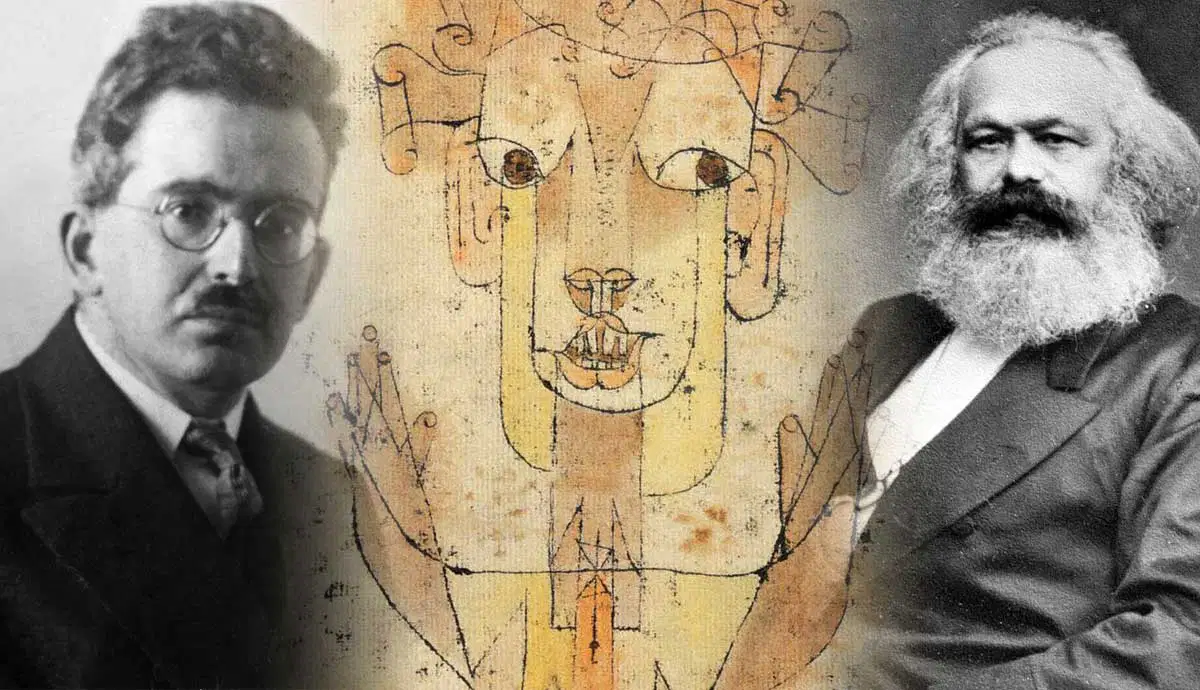
Historical and Political Genesis: The Catastrophe of 1939–1940
Walter Benjamin (1892–1940) composed the eighteen theses (accompanied by two supplementary notes, designated Appendices A and B) in Paris between late 1939 and the spring of 1940, shortly after being released from an internment camp for German refugees at Camp Vernuche in Nevers.[1:1] Writing under conditions of imminent physical peril, statelessness, and deep personal isolation, Benjamin witnessed the total disintegration of the European geopolitical order. His eventual suicide in September 1940 in the Catalan border town of Portbou—precipitated by the sudden threat of being surrendered to the Gestapo by Francoist border guards—imparts an agonizing existential urgency to every thesis.[2:1]
Two catastrophic political shocks directly motivated Benjamin's composition:
- The Ascendancy of European Fascism: The rapid, unhindered expansion of National Socialism revealed that fascism was not a temporary aberration or pre-modern relapse into savagery, but an organic outgrowth of modern industrial rationality, imperial violence, and capitalist crisis.[3]
- The Molotov-Ribbentrop Pact (August 1939): The non-aggression pact between Nazi Germany and Stalin's Soviet Union dealt a devastating ideological blow to Western Marxist intellectuals. For Benjamin, this cynical realpolitik exposed the moral and philosophical bankruptcy of orthodox Soviet Marxism, which had subordinated revolutionary internationalism to totalitarian self-preservation and mechanized party bureaucracy.[4]
Benjamin aimed his sharpest criticisms at the reformist complacency of German Social Democracy (the SPD). By anchoring their political philosophy in the Gotha and Erfurt programs, the Social Democrats had succumbed to a secularized myth of continuous, automatic progress driven by technological advance and industrial productivity.[5] Drawing on philosophers like Josef Dietzgen—who uncritically glorified labor as the savior of humanity—Social Democracy disarmed the proletariat by treating working-class emancipation as an inevitable historical outcome rather than a precarious struggle requiring revolutionary rupture.[6] This ideological intoxication left the European working class psychologically and organizationally helpless before the fascist onslaught.[6:1]
In response, Benjamin abandoned the conventional form of the systematic treatise, constructing instead eighteen aphoristic, dialectical lightning-bolts designed to blast open the continuum of historical complacency.[7]
The Allegorical Architecture of the Theses
Benjamin’s philosophical exposition eschews conventional academic argumentation in favor of dense allegorical tableaux, cabalistic motifs, and literary montage—a methodology deeply connected to his work in Walter Benjamin's The Arcades Project.[8] Rather than abstract concepts, Benjamin deploys concrete physical metaphors that condense dialectical tensions into memorable images.
| Allegorical Vehicle | Manifest / Surface Object | Subterranean / Theological Signification | Philosophical Target & Critique |
|---|---|---|---|
| The Mechanical Turk (Thesis I) | Chess-playing automaton disguised in Turkish garb | The wizened dwarf of Jewish messianism, remembrance (anamnesis), and Tikkun | Positivist, deterministic Marxism claiming scientific inevitability |
| The Secret Index (Thesis II) | An invisible inscription on past generations | The "weak messianic power" (schwache messianische Kraft) binding the present to the dead | Generational deferral; sacrificing the living and the dead for unborn heirs |
| Empathy with Victors (Thesis VII) | Triumphal procession carrying cultural spoils | The barbaric exploitation underlying civilizational monuments | Bourgeois historicism (Ranke) and aestheticized heritage worship |
| The Angelus Novus (Thesis IX) | Paul Klee's startled angel looking backward | Historical reality as a single catastrophic heap of ruins seeking resurrection | Enlightenment teleology and Social Democratic faith in "progress" |
| The Shooting of Clocks (Thesis XV) | Revolutionaries firing rifles at Paris clock towers in 1830 | The arrest of clock-time; blasting open the continuum (Jetztzeit) | Quantitative, homogeneous, empty industrial time (homogene und leere Zeit) |
| The Emergency Brake (Preparatory Notes) | Train passengers pulling the emergency cord | Revolutionary intervention as the deliberate cessation of industrial momentum | Karl Marx's metaphor of revolutions as the runaway "locomotives of history" |
| The Small Gate (Appendix B) | Narrow architectural portal in Jewish messianism | The revolutionary potential immanent in every present split-second | Astrological divination, fatalism, and future-oriented technocracy |
The Mechanical Turk and Theology (Thesis I)
Benjamin opens the Theses with the allegory of the Mechanical Turk—the famous eighteenth-century chess-playing automaton constructed by Wolfgang von Kempelen in 1769 and later exhibited across Europe and North America by Johann Mälzel:[7:1]
"The story is told of an automaton constructed in such a way that it could play winning games of chess, answering each move of an opponent with a countermove. A puppet in Turkish attire and with a hookah in its mouth sat before a chessboard placed on a large table... In reality, a hunchbacked dwarf who was a master at chess sat inside and guided the puppet's hand by means of strings. One can envision a corresponding counterpart in philosophy: the puppet called 'historical materialism' is always supposed to win. It can easily be a match for anyone if it enlists the services of theology, which today, as we know, is wizened and has to keep out of sight."[7:2]
Benjamin draws directly upon Edgar Allan Poe's famous 1836 investigative essay "Maelzel's Chess-Player," which unmasked the human trick hidden behind the machine's mechanical gears.[7:3] In Benjamin's dialectical reversal:
- The Puppet (Historical Materialism): Represents Marxist theory, which, in its dogmatic Second and Third International guises, had withered into a mechanistic, determinist apparatus convinced that economic laws guaranteed inevitable socialist victory.[8:1]
- The Wizened Dwarf (Theology): Represents Jewish messianism, mysticism, and the remembrance of redemption (Tikkun Olam—the healing of broken vessels), communicated to Benjamin through his lifelong friendship with Gershom Scholem.[9] While Enlightenment secularism and vulgar Marxism ridiculed theology as obsolete and grotesque, Benjamin insists that materialism is completely sterile without the spiritual demand to redeem the past.[9:1]
[ THE ILLUSION: AUTOMATED HISTORICAL VICTORY ]
                     │
                     ▼
┌────────────────────────────────────────────────────────┐
│             THE PUPPET (Historical Materialism)        │
│   Mechanistic Determinism • Positivist Optimism        │
│   Claims inevitable victory through economic laws      │
└───────────────────────────┬────────────────────────────┘
                            │ (Secret Puppet Strings)
                            ▼
┌────────────────────────────────────────────────────────┐
│           THE WIZENED DWARF (Theology / Messianism)    │
│   *Tikkun* (Redemption) • Remembrance (*Anamnesis*)    │
│   Hidden from sight; provides the animating impulse    │
└────────────────────────────────────────────────────────┘
The Angel of History (Thesis IX)
The centerpiece of the Theses is Benjamin's meditation on Paul Klee's 1920 monoprint watercolor, Angelus Novus, a cherished work Benjamin purchased in Munich in 1921 and kept in his study for nearly two decades:[10]
"A Klee painting named Angelus Novus shows an angel looking as though he is about to move away from something he is fixedly contemplating. His eyes are staring, his mouth is open, his wings are spread. This is how one pictures the angel of history. His face is turned toward the past. Where we perceive a chain of events, he sees one single catastrophe which keeps piling wreckage upon wreckage and hurls it in front of his feet. The angel would like to stay, awaken the dead, and make whole what has been smashed. But a storm is blowing from Paradise; it has got caught in his wings with such violence that the angel can no longer close them. The storm irresistibly propels him into the future to which his back is turned, while the pile of debris before him grows skyward. This storm is what we call progress."[10:1]
The allegorical anatomy of this passage upends Enlightenment teleology from Georg Wilhelm Friedrich Hegel (1770–1831) to Condorcet:
- The Gaze of the Angel: Unlike human observers who assemble historical chronologies into comforting evolutionary narratives, the Angel perceives the true reality of history: an unceasing, cumulative heap of ruins, extinguished lives, and unredeemed suffering.[11]
- The Impulse toward Redemption: The Angel longs to perform the Kabbalistic act of Tikkun—to pause, heal the fractured world, resurrect the slain, and reconstruct the shattered fragments of human existence.[12]
- The Storm of Progress: The relentless gale blowing from Paradise represents the bourgeois ideology of linear temporal progression. This wind traps the Angel's wings, rendering him impotent to halt the catastrophe, perpetually pushing humanity backward into an unmapped future while industrial violence escalates below.[13]
Revolutions as the Emergency Brake
In orthodox Marxist historiography, following Karl Marx's famous dictum, revolutions are conceived as the "locomotives of world history." In his preparatory notes for the Theses, Benjamin famously reversed this technological metaphor:
"Marx says that revolutions are the locomotive of world history. But perhaps it is quite otherwise. Perhaps revolutions are an attempt by the passengers on this train—namely, the human race—to pull the emergency brake."[14]
For Benjamin, the runaway locomotive is capitalist modernity hurtling along the tracks of homogeneous, empty time toward barbarism and war. Revolutionary praxis is not an acceleration of industrial and technological momentum, but a radical interruption—a divine violence that brings the catastrophic machinery of progress to an abrupt halt.[14:1]
Core Philosophical Formulations
Historicism vs. Revolutionary Historical Materialism
Benjamin establishes an unbridgeable ontological and methodological gulf between bourgeois historicism and revolutionary historical materialism:
| Comparative Dimension | Bourgeois Historicism | Revolutionary Historical Materialism |
|---|---|---|
| Pioneering Theorists | Leopold von Ranke, Fustel de Coulanges | Walter Benjamin, Karl Marx |
| Epistemological Aim | Reconstructing the past "the way it really was" (wie es eigentlich gewesen) | Seizing a memory as it flashes up in a moment of mortal danger |
| Affective Stance | Universal empathy (Einfühlung) with the historical rulers | Solidary remembrance of the subjugated, enslaved ancestors |
| Conception of Cultural Heritage | Cultural treasures celebrated as monuments of genius and civilization | "There is no document of civilization which is not at the same time a document of barbarism" |
| Temporal Dynamic | Additive cataloging in empty, linear, homogeneous clock-time | Blasting open the continuum (Jetztzeit); forming sudden dialectical constellations |
| Methodological Praxis | Passive narration of unbroken chronological causality | "Brushing history against the grain" (die Geschichte gegen den Strich bürsten) |
- Empathy with the Victors (Thesis VII): Bourgeois historicism demands that the historian emotionally empathize with historical figures. Benjamin points out that whoever emerges victorious in historical conflicts inherits the cultural spoils. Consequently, historicism inevitably identifies with the rulers, marching in their triumphal procession and stepping over those who lie prostrate on the battlefield.[15]
- The Barbarism of Culture: The cultural treasures displayed in national museums and celebrated in literary canons do not owe their existence solely to the genius of the great minds who created them, but also to the anonymous toil and brutal exploitation of nameless multitudes. Hence, every monument of high civilization carries an indelible residue of barbarism.[16]
- Brushing History Against the Grain: The historical materialist refuses to narrate the triumph of the conquerors. Instead, the historian's task is genealogical and excavatory—recovering the discarded artifacts, unfulfilled revolutions, and silenced cries of the defeated—a method that anticipates Michel Foucault's archaeology of subjugated knowledges.[16:1]
"Weak Messianic Power" (Eine schwache messianische Kraft)
In Thesis II, Benjamin argues that every living generation maintains a secret, reciprocal bond with the past:
"The past carries with it a secret index by which it is referred to redemption... There is a secret agreement between past generations and the present one. Our coming was expected on earth. Like every generation that preceded us, we have been endowed with a weak Messianic power, a power on which the past has a claim. Such a claim cannot be settled cheaply."[17]
For Benjamin, the goal of revolution is not merely to construct a harmonious future for our grandchildren (the standard Social Democratic narrative), but to avenge and redeem our enslaved ancestors (Thesis XII):
- Humanity cannot mobilize revolutionary passion through technocratic promises or futuristic utopias.
- True revolutionary hatred and sacrifice are nourished by the living memory of defeated struggles—such as the peasant uprisings of Thomas Müntzer, the Paris Commune of 1871, and the Spartacist rebellion of Rosa Luxemburg—whose hopes were violently extinguished.[18]
- The living generation acts as trustees of the past, charged with fulfilling the promises that previous generations were prevented from realizing.[18:1]
Temporal Architectures: "Homogeneous, Empty Time" vs. Jetztzeit
A cornerstone of Benjamin's critique is the attack on the temporal architecture of capitalism, contrasting the spatialized time of industrial production with revolutionary now-time:
| Dimension of Temporality | Homogeneous, Empty Time (homogene und leere Zeit) | Messianic Now-Time (Jetztzeit) |
|---|---|---|
| Ontological Nature | Quantitative, uniform, mechanical clock-time | Qualitative, intense, filled with the presence of the now |
| Philosophical Vehicle | Bourgeois industrial labor, clock towers, assembly lines | Revolutionary rupture, messianic arrest, dialectical image |
| Subject of History | Abstract, generalized humanity moving through empty space | The struggling, oppressed class in a specific moment of crisis |
| Historical Continuity | Unbroken causal chain; additive accumulation of facts | Blasted open (aufgesprengt); dialectical constellation |
| Affective Motivation | Complacent optimism; faith in automatic progress | Urgent solidarity; redeeming the suffering of ancestors |
| Theological Horizon | Infinite postponement of redemption into an elusive future | Every single second is a small gate through which the Messiah enters |
- Homogeneous, Empty Time (homogene und leere Zeit): The quantifiable, mechanical clock-time analyzed by Georg Simmel (1858-1918) in The Philosophy of Money (Philosophie des Geldes) and The Metropolis and Mental Life, wherein moments are identical, interchangeable containers marching infinitely toward an ever-receding horizon of progress.[19] This conception directly mirrors Henri Bergson's critique of spatialized clock-time, though Benjamin historicizes and politicizes Bergson's subjective duration (durée).[19:1]
- Jetztzeit (Now-Time): A temporal rupture wherein the uniform continuum of history is blasted wide open (aufgesprengt). Jetztzeit represents a time charged with messianic presence, where a specific historical moment in the past suddenly forms a lightning-like constellation with the present crisis.[14:2]
Benjamin illustrates this rupture through the French Revolution (Thesis XV): on the evening of the first day of the July Revolution of 1830, revolutionaries simultaneously and independently fired rifles at clock towers across Paris to bring mechanical time to a dead halt (Stillstellung). True revolution does not celebrate clock-time; it institutes a new calendar to commemorate the rupture of history.[20]
The State of Emergency: The Exception vs. The Rule (Thesis VIII)
Addressing the stunned disbelief of European liberals who regarded the rise of fascism as an incomprehensible relapse into medieval savagery, Benjamin writes:
"The tradition of the oppressed teaches us that the 'state of emergency' in which we live is not the exception but the rule. We must attain to a conception of history that accords with this insight. Then we will clearly see that it is our task to bring about a real state of emergency, and this will improve our position in the struggle against fascism."[21]
In this thesis, Benjamin engages in a critical counter-offensive against right-wing jurist Carl Schmitt’s Political Theology (1922), which posited that sovereign authority resides in whoever decides on the state of exception (Ausnahmezustand):[22]
| Dimension | Carl Schmitt's Sovereign Exception | Walter Benjamin's Real State of Emergency |
|---|---|---|
| Sovereign Agent | The Dictator / Bourgeois Executive Sovereign | The Oppressed Working Class / Revolutionary Collective |
| Objective | Suspending constitutional law to preserve state order | Shattering the entire continuum of capitalist exploitation |
| Diagnosis of Normality | The state of exception is a temporary disruption of normal law | Emergency and violence have always been the permanent baseline for the oppressed |
| Structural Effect | Consolidation of authoritarian state power and fascism | Dissolution of bourgeois class domination and imperial power |
For the marginalized and exploited, violence, martial law, and crisis have never been an anomaly, but the permanent baseline of civilization. To defeat fascism, one must abandon the liberal illusion that fascism is an abnormal deviation from enlightened progress, and instead construct a "real state of emergency" (wirklicher Ausnahmezustand) that dismantles the underlying continuum of exploitation once and for all—a perspective directly linked to Postscript on the Societies of Control.[21:1]
The Historical Monad and the Messianic Portal (Thesis XVII & Appendices)
Rather than assembling historical data additively, the historical materialist isolates a historical monad—a dialectical image frozen in a state of arrest (Dialektik im Stillstand):[23]
- In the historical monad, all the tensions and contradictions of an entire historical epoch crystallize into a singular, explosive moment.[23:1]
- The Dialectical Crystal: When thought suddenly stops in a configuration pregnant with tensions, it gives the configuration a shock, crystallizing it into a monad. The historical materialist approaches a historical object solely where it confronts him as a monad.[23:2]
- The Messianic Portal (Thesis XVIII B): In the concluding Appendix, Benjamin evokes the Jewish prohibition against investigating the future: for Jews, the future was not an empty temporal corridor, because remembrance (Gedenken) was paramount, and every single second of time was "the straight gate through which the Messiah might enter" (die kleine Pforte, durch die der Messias treten konnte). Every present moment contains the potential for radical, messianic disruption.[24]
Systematic Structural Taxonomy of the Theses
The table below outlines the complete architectural progression of Benjamin's eighteen theses and two appendices, detailing their conceptual anchors and theoretical interventions:
| Thesis / Section | Primary Allegory / Conceptual Anchor | Theoretical Adversary / Dogma Challenged | Core Dialectical & Messianic Thesis |
|---|---|---|---|
| Thesis I | The Mechanical Turk & Wizened Dwarf | Vulgar Marxist Positivism & Scientific Determinism | Materialism can only triumph by enlisting the hidden services of theology and messianic redemption (Tikkun).[7:4] |
| Thesis II | The Secret Index & Weak Messianic Power | Historicist Detachment & Generational Egoism | Past generations hold an unpaid claim on the living; we are endowed with a weak messianic power to redeem them.[17:1] |
| Thesis III | The Chronicler & The Day of Judgment | Additive Selectivity & Elite Canons | Only redeemed mankind receives the fullness of its past; every moment becomes quotable on the Day of Judgment.[7:5] |
| Thesis IV | Spiritual Courage, Humor & Cunning | Mechanistic Base-Superstructure Economism | The class struggle is fought not merely for raw material goods, but for the spiritual qualities that animate resistance.[7:6] |
| Thesis V | The Fleeting Image Flashing in the Pan | The Permanent, Fixed Archival Past | The true image of the past flits by; it can be seized only as an image flashing up at the moment of its recognizability.[7:7] |
| Thesis VI | The Danger of Being Made Tool of Rulers | Conformism & Official Institutional History | Even the dead will not be safe from the enemy if he wins; and this enemy has never ceased to be victorious.[7:8] |
| Thesis VII | Triumphal Procession & Documents of Barbarism | Bourgeois Empathy (Einfühlung) with Conquerors | Every document of civilization is simultaneously a document of barbarism; brush history against the grain.[15:1] |
| Thesis VIII | The State of Emergency as Structural Rule | Liberal Disbelief regarding Fascism's Ascent | The emergency is the rule, not the exception; defeat fascism by organizing a "real state of emergency."[21:2] |
| Thesis IX | Paul Klee's Angelus Novus (Angel of History) | Enlightenment Teleology & Evolutionary Progress | Progress is the catastrophic storm blowing from Paradise that incessantly piles wreckage before the Angel's feet.[10:2] |
| Thesis X | Monastic Discipline & Political Betrayal | Comintern Servility to the Soviet Bureaucracy | The materialist must liberate the political world from the snares of politicians who betrayed the revolution.[7:9] |
| Thesis XI | Josef Dietzgen's Glorification of Industrial Labor | Social Democratic Productivism & Technocracy | The uncritical celebration of labor exploits nature, promotes conformism, and disarms the working class.[5:1] |
| Thesis XII | Avenging Defeated Ancestors vs. Liberating Grandchildren | Sacrificing the Living for Future Generations | Revolutionary passion draws strength from the memory of enslaved ancestors, not visions of liberated grandchildren.[18:2] |
| Thesis XIII | Social Democratic Progressivist Dogma | Homogeneous, Empty Time (leere Zeit) | The concept of the historical progress of mankind cannot be sundered from the concept of its progression through empty time.[19:2] |
| Thesis XIV | Jetztzeit & The French Revolutionary Roman Robes | Continuous Chronological Succession | The French Revolution viewed itself as Rome incarnate; Jetztzeit blasts open the homogeneous continuum of history.[14:3] |
| Thesis XV | Shooting at the Paris Clock Towers in 1830 | The Tyranny of Continuous Clock-Time | Revolutions introduce new calendars and blast mechanical time to a dead halt (Stillstellung).[20:1] |
| Thesis XVI | The Materialist Historian's Dialectical Standstill | Positivist Historians Floating in Fluid Streams | The historical materialist grasps the constellation which his own era has formed with a definite earlier one.[14:4] |
| Thesis XVII | The Historical Monad & Dialectical Shock | Additive Historicism Gathering Masses of Data | A historical monad crystallizes the entire epoch into a single dialectical crystal pregnant with tension.[23:3] |
| Thesis XVIII | Modern Humanity as Five Seconds on the Organic Clock | The Cosmic Vastness of Empty Time | Jetztzeit, which encompasses the history of mankind in an enormous abridgment, coincides with the history of humanity.[7:10] |
| Appendix A | Historicism's Universal History vs. Historical Materialism | The Additive Accumulation of World History | Universal history merely piles up facts in empty time; historical materialism establishes dialectical constellations.[7:11] |
| Appendix B | The Jewish Prohibition on Divination & The Small Gate | Fortune-Telling, Fatalism & Futurology | Remembrance (Gedenken) unspells the future; every split-second is the small gate through which the Messiah enters.[24:1] |
🎴 Interactive Web Practice (Comprehension Check)
Question 1 (Theology & Historical Materialism - Thesis I): Why does Benjamin employ the allegory of the Mechanical Turk in Thesis I, and why must the "wizened dwarf" of theology remain hidden within historical materialism?
Answer: Benjamin uses the eighteenth-century chess-playing automaton—which secretly concealed a hunchbacked chess master inside—to diagnose the intellectual crisis of Marxism in the early twentieth century. Orthodox Marxism had degenerated into a mechanistic, deterministic dogma (the puppet) that naively believed scientific progress guaranteed inevitable socialist victory. Benjamin asserts that historical materialism can only recover its revolutionary, winning vitality if it enlists the animating spirit of theology—specifically Jewish messianism, remembrance (*anamnesis*), and the moral imperative of redemptive justice (*Tikkun*). Theology must remain "wizened and kept out of sight" because secular Enlightenment rationality and Marxist orthodoxy disavow metaphysical and religious frameworks; nevertheless, without this subterranean spiritual impulse to avenge and redeem past suffering, materialism remains an inert and impotent apparatus.
Question 2 (The Angel of History & The Critique of Progress - Thesis IX): How does Benjamin's interpretation of Paul Klee's Angelus Novus in Thesis IX completely invert the conventional Enlightenment and Social Democratic doctrine of "progress"?
Answer: While the Enlightenment and nineteenth-century Social Democracy conceived history as an unbroken, continuous continuum of moral, technological, and intellectual ascent, Benjamin's Angel of History reveals progress to be an unmitigated disaster. With his face turned backward toward the past, the Angel perceives what humans misread as a causal sequence of events as "one single catastrophe" that continuously accumulates wreckage and debris at his feet. The Angel desires to pause, heal the fractured world, and awaken the dead, but he is violently propelled into the future by a tempest blowing from Paradise that has ensnared his wings. In Benjamin's radical formulation, this catastrophic storm that blinds humanity and piles ruins to the heavens is precisely what modern civilization erroneously calls "progress."
Question 3 (Historicism vs. Jetztzeit & The State of Emergency - Theses VII, VIII & XV): In what ways does Benjamin's concept of Jetztzeit (Now-Time) and his analysis of the "state of emergency" (Thesis VIII) confront bourgeois historicism and liberal complacency toward fascism?
Answer: Bourgeois historicism (championed by Leopold von Ranke) treats time as "homogeneous and empty," passively reconstructing the past "the way it really was" and inevitably empathizing with the conquerors who carry the spoils of civilization. In contrast, Benjamin introduces Jetztzeit—a revolutionary, messianic rupture that blasts the continuum of history open, allowing the contemporary struggle to form an immediate constellation with past moments of oppression (symbolized by revolutionaries shooting at clock towers in 1830). Furthermore, European liberals viewed fascism as an anomalous, shocking departure from enlightened 20th-century civilization. Benjamin refutes this by asserting that for the oppressed, the "state of emergency is not the exception but the rule." Defeating fascism requires abandoning the illusion of gradual historical progress and actively creating a "real state of emergency" that shatters the capitalist status quo entirely.
Question 4 (The Historical Monad, Weak Messianic Power & The Appendices - Theses II, XVII & XVIII B): What is the relationship between Benjamin's "weak messianic power," the historical monad, and the Jewish concept of remembrance (*Gedenken*) in Appendix B?
Answer: Benjamin posits that living generations hold a "weak messianic power" on which the past has a claim (Thesis II); we owe an intergenerational debt to avenge and fulfill the unredeemed hopes of defeated ancestors rather than sacrificing the present for hypothetical future descendants. To enact this redemption, the materialist does not collect additive historical data, but arrests thought into a "historical monad" (Thesis XVII)—a dialectical crystal where all the contradictions of an epoch are frozen at a standstill. Finally, in Appendix B, Benjamin highlights the Jewish prohibition against investigating the future: by focusing on remembrance (*Gedenken*) rather than divination or futurology, time is stripped of its homogeneous, empty flow, rendering every split-second "the small gate through which the Messiah might enter."
Resonant Notes
The following notes in the vault share direct thematic, sociological, and literary connections with Walter Benjamin’s historical philosophy:
🔴 Critical Theory, Western Marxism & Political Philosophy
- Walter Benjamin (1892–1940) — The comprehensive biographical and conceptual profile of Benjamin, contextualizing the Theses alongside his broader intellectual trajectory, his friendships with Gershom Scholem, Theodor Adorno, and Bertolt Brecht, and his tragic death at Portbou.
- Walter Benjamin's The Arcades Project — Benjamin’s unfinished magnum opus; Convolute N provides the foundational epistemological engine for the Theses, elaborating the dialectical image, montage, and the critique of progress.
- The Work of Art in the Age of Mechanical Reproduction — Benjamin’s companion 1935 masterpiece, analyzing how industrial reproduction liquidates the traditional "aura" of art, shifting culture from sacred ritual contemplation to mass political mobilization and the struggle against fascism.
- Karl Marx - Economic and Philosophic Manuscripts of 1844 — Marx's foundational theory of alienation (Entfremdung) and species-being, which Benjamin radicalizes through theology, the critique of bourgeois labor, and the rejection of productivism.
- Michel Foucault — Foucault’s archaeological and genealogical methods directly inherit Benjamin’s imperative to "brush history against the grain," unmasking institutional violence, discipline, and subjugated knowledges obscured by official historiography.
- George Orwell (1903-1950) — Orwell’s dissection of totalitarian historical erasure in Nineteen Eighty-Four ("Who controls the past controls the future") parallels Benjamin’s urgent warning in Thesis VI that even the dead will not be safe if the enemy triumphs.
- Postscript on the Societies of Control — Gilles Deleuze’s diagnosis of how modern institutions evolve from disciplinary enclosures into continuous digital modulation deepens Benjamin’s thesis that crisis and surveillance are structural norms rather than historical anomalies.
- Jürgen Habermas's The Structural Transformation of the Public Sphere — Traces the historical rise and commodification of the bourgeois public sphere, offering a systematic institutional counterpart to Benjamin's critique of bourgeois cultural institutions.
🟡 Aesthetics, Modernity & The Allegorical Method
- Paul Klee (1879–1940) — The Swiss-German Bauhaus master whose 1920 watercolor monoprint Angelus Novus served as the physical catalyst for Benjamin’s central philosophical allegory of the Angel of History.
- The flâneur & The Painter of Modern Life, a seminal 1863 essay by French poet and art critic Charles Baudelaire — Benjamin’s analysis in the Arcades Project transforms Baudelaire’s aesthetic observer into an emblem of commodity estrangement, navigating the dialectical tensions of nineteenth-century urban capitalism.
- Franz Kafka (1883-1924) — Benjamin’s extensive literary essays on Kafka treat the Prague writer's surreal parables of guilt and opaque law as glimpses of fallen tradition and pre-mythic terror awaiting messianic redemption.
- Don DeLillo Major Themes Analysis — DeLillo’s postmodern anatomy of televised disaster spectacle, crowds, and historical trauma in White Noise and Mao II extends Benjamin’s reflections on mechanical reproduction and the Angel’s gaze into late consumer capitalism.
- Defining a Simulacrum — Jean Baudrillard's hyperreality—where copies exist without an authentic original—marks the final stage of Benjamin's liquidation of the aura and the total triumph of the commodity phantasmagoria.
- Anthony Vidler-The Architectural Uncanny — Vidler utilizes Benjamin’s urban writings to theorize how modern architecture and metropolitan spaces evoke historical estrangement, psychic dislocation, and the haunting presence of buried catastrophes.
- The Bauhaus School — Weimar design movement that embraced industrial materials, providing the immediate German cultural context for Benjamin's debates on technology, mass culture, and modernist aesthetics.
- The Avant-Garde & Peter Bürger-Theorie der Avantgarde — Traces the historical avant-garde's effort to reintegrate art into revolutionary life practice, clarifying Benjamin's Surrealist roots and his radical montage technique.
- Unoriginal Genius-Poetry by Other Means in the New Century & Uncreative Writing-Managing Language in the Digital Age — Connects Benjamin's citational poetics and montage methodology in the Theses and Arcades to contemporary conceptual writing and database aesthetics.
- The Dehumanization of Art — Ortega y Gasset’s exploration of avant-garde art's break with emotional realism offers a conservative aristocratic contrast to Benjamin’s revolutionary politicization of the modernist aesthetic.
- Edgar Allan Poe (1809-1849) — Author of the famous 1836 investigative essay "Maelzel's Chess-Player," which unmasked the mechanical chess automaton that Benjamin adopts as the allegorical vehicle for Thesis I.
🟢 Temporality, Metaphysics & Epistemology
- Henri Bergson — Bergson’s philosophy of subjective duration (durée réelle) against spatialized clock-time forms a crucial epistemological interlocutor for Benjamin’s contrast between homogeneous, empty time and Jetztzeit.
- Husserl's Internal Time-Consciousness — Edmund Husserl's phenomenological analysis of retention, protention, and primal impression provides a philosophical baseline for understanding how temporal consciousness operates prior to spatialized industrial clock-time.
- Time as Change — Interrogates the fundamental metaphysical nature of temporal succession, change, and duration, providing philosophical grounding for Benjamin’s dialectical arrest (Stillstellung).
- Continental Philosophy — Locates Benjamin’s radical synthesis of Western Marxism, phenomenology, and German Romanticism within the broader genealogy of modern European thought and Frankfurt School Critical Theory.
- Georg Simmel (1858-1918) & The Philosophy of Money (Philosophie des Geldes) — Simmel’s sociological dissection of the rationalizing, quantizing power of money and metropolitan time provided the sociological foundations for Benjamin’s critique of empty, quantified industrial time.
- Simmel and the Attention Economy — Abstraction, Alienation, and Cognitive Capture — Explores how money and urban stimuli fragment human attention, directly prefiguring Benjamin's contrast between contemplative absorption (Sammlung) and distracted reception (Zerstreuung).
- Entropy — The thermodynamic and cultural drift toward disorder, waste, and systemic exhaustion mirrors the Angel of History’s vision of progress as an ever-growing mountain of wreckage.
- Johann Wolfgang von Goethe (1749-1832) — Benjamin's early essay on Goethe's Elective Affinities established his foundational distinction between the material content (Sachgehalt) and truth content (Wahrheitsgehalt) of art, informing his dialectical reading of history.
- Friedrich Nietzsche — Nietzsche's critique of monumental and antiquarian historicism in On the Use and Abuse of History for Life directly anticipates Benjamin's assault on Rankean historicism and the need for critical history.
Backlinks
- Walter Benjamin (1892–1940) — The central biographical and philosophical profile detailing Benjamin's life, his Frankfurt School affiliations, and the Theses as his final intellectual testament composed before his death at Portbou.
- Walter Benjamin's The Arcades Project — Directly draws upon the methodological foundations of Convolute N ("On the Theory of Knowledge, Theory of Progress"), crystallizing its critique of empty time into Jetztzeit.
- The Work of Art in the Age of Mechanical Reproduction — Companion aesthetic text exploring the decay of the aura and the politicization of art against fascist aestheticization.
- Paul Klee (1879–1940) — Monographic study of the Bauhaus painter whose watercolor Angelus Novus provided Benjamin with the central allegorical image of the Angel of History.
- Continental Philosophy — Surveys 20th-century European thought, positioning Benjamin's messianic historical materialism alongside Adorno, Horkheimer, and European phenomenology.
- The flâneur — Sociological analysis of the modern street stroller, illustrating how bourgeois capitalism domesticated urban perception into consumer complacency.
- The Painter of Modern Life, a seminal 1863 essay by French poet and art critic Charles Baudelaire — Foundational aesthetic text defining the fleeting and ephemeral in modernity, serving as a key reference point for Benjamin's dialectical image.
- Anthony Vidler-The Architectural Uncanny — Explores spatial estrangement and the haunting presence of historical catastrophes in modern architecture, utilizing Benjamin's analysis of historical trauma.
- Don DeLillo Major Themes Analysis — Postmodern examination of disaster spectacles, crowds, and historical trauma extending Benjamin's Angel of History into late consumer capitalism.
- Unoriginal Genius-Poetry by Other Means in the New Century & Uncreative Writing-Managing Language in the Digital Age — Identifies Benjamin's citational montage in the Theses as a direct precursor to 21st-century conceptual writing.
- The Transformation of the Roman World-Knowledge, Culture, and Society in the Early Middle Ages — Historical analysis engaging the historiographical question of civilizational collapse, cultural continuity, and Benjaminian documents of barbarism.
- The Bauhaus School — Explores the Weimar design school's synthesis of art and industrial production, providing historical grounding for Benjamin's critique of technological progress.
References
Howard Eiland and Michael W. Jennings / Walter Benjamin: A Critical Life / Harvard University Press ↩︎ ↩︎
Michael Löwy / Fire Alarm: Reading Walter Benjamin's 'On the Concept of History' / Verso Books ↩︎ ↩︎
Theodor W. Adorno and Max Horkheimer / Dialectic of Enlightenment (trans. Edmund Jephcott) / Stanford University Press ↩︎
Gershom Scholem / Walter Benjamin: The Story of a Friendship (trans. Harry Zohn) / New York Review Books ↩︎
Peter Osborne / The Politics of Time: Modernity and Avant-Garde / Verso Books ↩︎ ↩︎
Rolf Tiedemann / "Historical Materialism or Political Messianism? An Interpretation of the Theses 'On the Concept of History'" / The Philosophical Forum, Vol. 15, No. 1/2 (1983), pp. 71–104. ↩︎ ↩︎
Walter Benjamin / "On the Concept of History" (Theses I–XVIII) in Selected Writings, Volume 4: 1938–1940 (eds. Howard Eiland and Michael W. Jennings) / Harvard University Press ↩︎ ↩︎ ↩︎ ↩︎ ↩︎ ↩︎ ↩︎ ↩︎ ↩︎ ↩︎ ↩︎ ↩︎
Susan Buck-Morss / The Dialectics of Seeing: Walter Benjamin and the Arcades Project / MIT Press ↩︎ ↩︎
Stéphane Mosès / The Angel of History: Rosenzweig, Benjamin, Scholem / Stanford University Press ↩︎ ↩︎
Walter Benjamin / "On the Concept of History" (Thesis IX) in Illuminations: Essays and Reflections (ed. Hannah Arendt, trans. Harry Zohn) / Schocken Books ↩︎ ↩︎ ↩︎
O.K. Werkmeister / "Walter Benjamin's Angel of History, or the Transfiguration of the Revolutionary into the Historian" / Critical Inquiry, Vol. 22, No. 3 (1996), pp. 456–483. ↩︎
Gershom Scholem / Major Trends in Jewish Mysticism / Schocken Books ↩︎
Giorgio Agamben / The Time That Remains: A Commentary on the Letter to the Romans (trans. Patricia Dailey) / Stanford University Press ↩︎
Walter Benjamin / "On the Concept of History" (Theses XIV–XVII & Preparatory Notes) in Selected Writings, Volume 4 / Harvard University Press ↩︎ ↩︎ ↩︎ ↩︎ ↩︎
Walter Benjamin / "On the Concept of History" (Thesis VII) in Selected Writings, Volume 4 / Harvard University Press ↩︎ ↩︎
Hannah Arendt / "Walter Benjamin: 1892–1940" (Introduction to Illuminations) / Schocken Books ↩︎ ↩︎
Walter Benjamin / "On the Concept of History" (Thesis II) in Illuminations / Schocken Books ↩︎ ↩︎
Michael Löwy / "Against the Grain: Walter Benjamin's Concept of History" / Historical Materialism, Vol. 13, No. 4 (2005), pp. 3–13. ↩︎ ↩︎ ↩︎
Peter Osborne / A Philosophy of History: Walter Benjamin and the Arcades / Palgrave Macmillan ↩︎ ↩︎ ↩︎
Walter Benjamin / "On the Concept of History" (Thesis XV) in Selected Writings, Volume 4 / Harvard University Press ↩︎ ↩︎
Walter Benjamin / "On the Concept of History" (Thesis VIII) in Illuminations / Schocken Books ↩︎ ↩︎ ↩︎
Carl Schmitt / Political Theology: Four Chapters on the Concept of Sovereignty (trans. George Schwab) / University of Chicago Press ↩︎
Walter Benjamin / "On the Concept of History" (Thesis XVII) in Selected Writings, Volume 4 / Harvard University Press ↩︎ ↩︎ ↩︎ ↩︎
Walter Benjamin / "On the Concept of History" (Appendices A & B) in Selected Writings, Volume 4 / Harvard University Press ↩︎ ↩︎