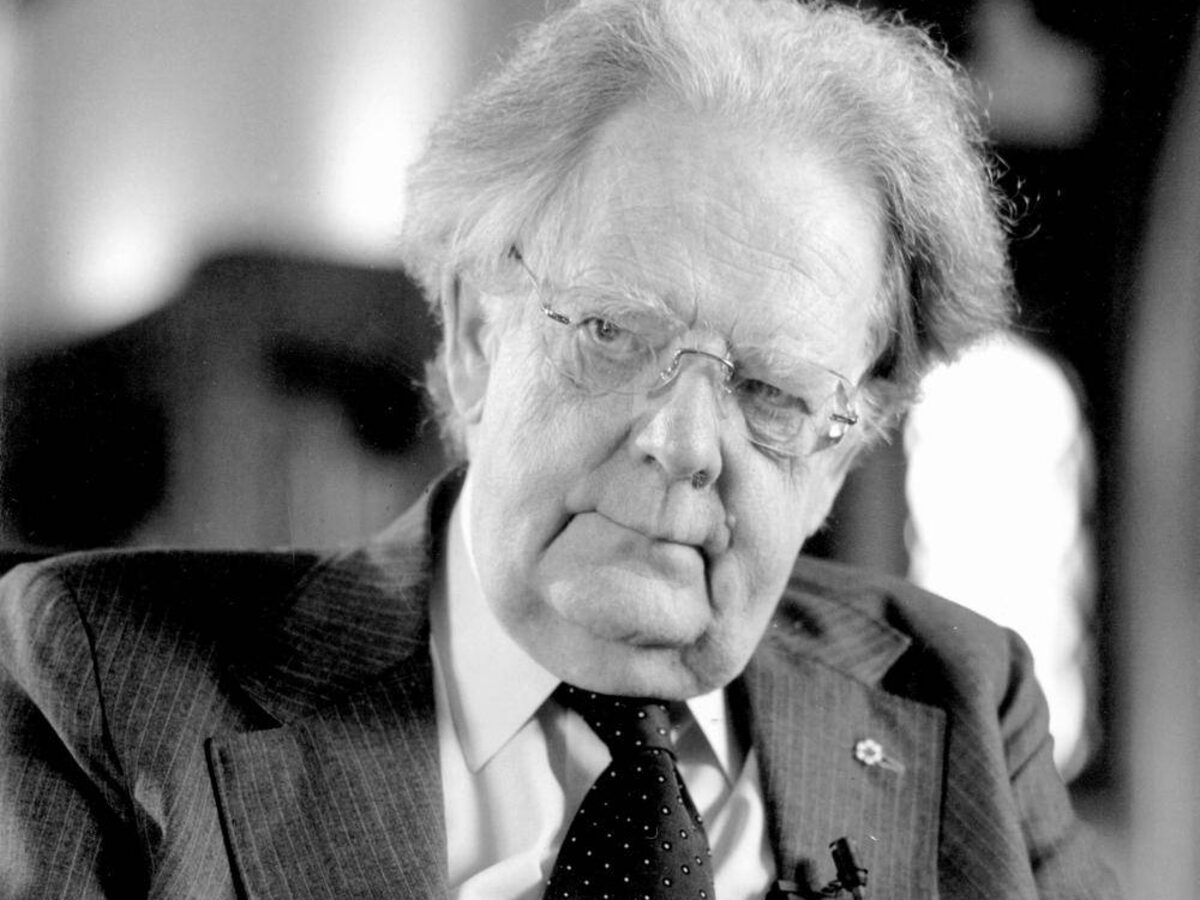
Northrop Frye
Herman Northrop Frye (1912–1991) was a preeminent twentieth-century Canadian literary theorist, cultural critic, and ordained theologian whose seminal treatises established the foundations of archetypal criticism and structural poetics. Best known for Anatomy of Criticism (1957) and Fearful Symmetry (1947), Frye revolutionized literary studies by demonstrating that literature is not an aggregate of isolated, subjective impressions or a passive reflection of socio-political history, but an autonomous, self-contained "verbal universe" structured by universal symbolic patterns, seasonal narrative cycles (mythoi), and biblical typologies. Beyond theoretical taxonomy, Frye formulated the concept of the garrison mentality in The Bush Garden (1971), providing the foundational framework for Canadian cultural identity and anticipating modern urban alienation.
Biography and Intellectual Context
Herman Northrop Frye was born in Sherbrooke, Quebec, in 1912, raised in Moncton, New Brunswick, and spent the majority of his academic career at Victoria College in the University of Toronto.[1] In 1936, he was ordained as a minister in the United Church of Canada, a vocation that profoundly shaped his hermeneutic vision. Rather than treating theology and literature as competing discourses, Frye approached biblical scripture as the primary imaginative grammar of Western civilization—a matrix of typology, metaphor, and myth that informs the entire continuum of European and North American literature.[2]
Frye's decisive critical breakthrough arrived with Fearful Symmetry: A Study of William Blake (1947). Prior to Frye's intervention, Blake’s visionary prophetic books (The Four Zoas, Milton, Jerusalem) were largely dismissed by academic critics as the erratic, private ravings of a madman.[3] Frye demonstrated that Blake was not operating in idiosyncratic isolation, but within an exceptionally coherent, highly disciplined mythic system rooted in the Bible, Miltonic epic, and Western hermetic traditions.[4]
Through his analysis of Blake's mythological figures—such as Urizen (the petrifying god of abstract rationalism and mechanical law), Orc (the fiery spirit of revolutionary desire), and Los (the eternal prophetic imagination)—Frye grasped that Blake had intuitively reconstructed the archetypal architecture of Western consciousness.[3:1] This insight spurred Frye to pose his defining methodological question: if Blake's seemingly eccentric verse was actually governed by an overarching grammar of myth, did all of Western literature share a singular, interconnected structural anatomy?[5]
During the mid-twentieth century, literary scholarship was polarized between traditional biographical-historical philology and Anglo-American New Criticism (championed by Cleanth Brooks, I.A. Richards, and W.K. Wimsatt). While New Criticism performed brilliant "close readings" of isolated poems, it lacked an overarching theory connecting individual texts into a unified discipline. In his "Polemical Introduction" to Anatomy of Criticism, Frye attacked this fragmentation, warning against two pervasive errors:
- Subjective Value Judgments: The fallacy of reducing literary criticism to transient matters of personal taste, moral approval, or prestige-ranking.
- The Deterministic Fallacy: The reduction of literature to external non-literary frameworks—such as Freudian psychopathology, Marxist dialectical materialism, or orthodox dogmatics—thereby treating literary texts as mere symptoms or documentation rather than autonomous structural creations.[6]
Frye insisted that literary criticism must function as an inductive, autonomous science. Just as physics examines nature without trying to alter physical laws, and history studies human events without imposing private wishes, criticism must discover the organizing principles that inhere directly within the total body of literature.[5:1] [6:1]
Core Theoretical Frameworks
1. Archetypal Criticism and the "Verbal Universe"
At the core of Frye's poetics is the principle that literature does not directly imitate physical reality or everyday human experience; rather, literature imitates other literature.[7] When a poet writes a poem, they do not transcribe raw nature into language; they reproduce and reconfigure inherited poetic conventions, genres, tropes, and rhythmic structures:
"Poetry can only be made out of other poems; novels out of other novels. Literature shapes itself, and is not shaped by the outside world, any more than the stars are shaped by the astronomer's telescope."[8]
Literature exists as a self-referential, unified structural cosmos—a "verbal universe" containing the total imaginative articulation of human desire and dread.[8:1] Within this universe, the primary unit of communication is the archetype: a recurring image, symbol, association, or narrative design that connects an individual text to the collective tradition of literature.[9]
                     [ THE VERBAL UNIVERSE ]
            Total Imaginative Form of Human Desire
                               │
            ┌──────────────────┴──────────────────┐
            ▼                                     ▼
   Centripetal Reading                   Centrifugal Reading
(Inward focus on literal             (Outward reference toward
verbal motifs & structure)             external signs & facts)
            │                                     │
            └──────────────────┬──────────────────┘
                               ▼
                    [ ARCHETYPAL SYNTHESIS ]
            Universal Narrative Codes & Conventions
Frye Versus Carl Gustav Jung
Although both thinkers popularized the term "archetype" in twentieth-century humanities, Frye was careful to distinguish his literary framework from the depth psychology of Carl Gustav Jung:
| Theoretical Dimension | Carl Gustav Jung | Northrop Frye |
|---|---|---|
| Ontological Domain | Psychological / Metaphysical | Purely Structural & Literary |
| Origin of Archetypes | Biological inheritance stored in the "collective unconscious." | Communicable conventions and structural forms within the verbal universe. |
| Methodological Function | Archetypes serve to analyze the psyche, neurotic symbols, and dream life. | Archetypes serve to analyze literary genres, plots, and poetic imagery. |
| Primary Direction | Backward toward primordial instinct and racial memory. | Forward into conscious cultural articulation, art, and poetic form. |
While Jung posited that archetypes are innate biological predispositions imprinted upon human neurology, Frye treated archetypes as purely formal literary instruments—communicable units of human imagination that enable writers and readers to share meaning across disparate eras.[9:1]
2. The Four Mythoi (The Great Wheel of Seasonal Narrative)
In the third essay of Anatomy of Criticism ("Archetypal Criticism: Theory of Myths"), Frye formulated his most celebrated taxonomy: mapping all narrative fiction into four fundamental cyclical categories, termed mythoi (singular: mythos), which correspond to the four seasons of the natural astronomical cycle.[10]
                       SUMMER: ROMANCE
                   (The Heroic Quest / Agon)
                              ▲
                             ╱ ╲
                            ╱   ╲
                           ╱     ╲
        SPRING: COMEDY   ◄         ►   AUTUMN: TRAGEDY
     (Rebirth / Integration)     (Fall / Hamartia / Isolation)
                           ╲     ╱
                            ╲   ╱
                             ╲ ╱
                              ▼
                   WINTER: SATIRE & IRONY
                 (Bondage / Unmasking / Realism)
Each mythos embodies a distinctive rhythm of human experience, shifting between the fulfillment and frustration of human desire:[10:1]
Spring: Comedy (Mythos of Spring)
- Primary Movement: The rebirth of life, resurrection, and the triumph of vitality over societal sterility and parental repression.
- Narrative Archetype: The plot typically begins with a rigid, legalistic social order dominated by an obstructionist older figure (senex iratus). A youthful hero and heroine struggle against these arbitrary barriers. Through reversals, clever contrivance, or fortunate discoveries, the old society is displaced, and a new, harmonious community is consecrated—invariably symbolized by a festive banquet or wedding.[11]
Summer: Romance (Mythos of Summer)
- Primary Movement: The pure realization of human desire, the heroic ideal, and the adventurous quest.
- Narrative Archetype: The romance follows a tripartite structural rhythm: the perilous departure (agon), the crucial struggle or confrontation with death/monsters (pathos), and the triumphant exaltation or rebirth of the hero (anagnorisis). Characters inhabit an idyllic landscape where natural laws yield to magical providence or moral virtue.[12]
Autumn: Tragedy (Mythos of Autumn)
- Primary Movement: The decline, disillusionment, and downfall of human greatness; the movement from social inclusion toward irreversible isolation.
- Narrative Archetype: An exceptional individual—superior in dignity, power, or moral stature—disturbs the cosmic, natural, or political equilibrium through an act of overreaching (hamartia). The inexorable wheel of fate or moral necessity (nemesis) closes in, culminating in sacrificial death, exile, and the somber recognition of human limitations.[13]
Winter: Satire and Irony (Mythos of Winter)
- Primary Movement: The unmasking of illusions, cold empirical realism, and the dissolution of heroic ideals.
- Narrative Archetype:
- Satire operates as militant irony: it applies moral norms to ridicule human stupidity, religious hypocrisy, and intellectual arrogance, demanding that society recognize its grotesque deviations from reason.
- Irony proper depicts a world stripped of divine providence or poetic justice. The protagonist is trapped in helplessness, absurdity, or social servitude. Human beings are shown as victims of mechanical laws, bureaucracy, and inescapable physical decay.[14]
| Season | Mythos | Underlying Plot Mechanism | Archetypal Conflict | Terminal Social State |
|---|---|---|---|---|
| Spring | Comedy | Overcoming the obstructive order (senex) | Youth vs. Age; Vitality vs. Law | Inclusive community; Marriage feast |
| Summer | Romance | The heroic quest and monster-slaying | Good vs. Evil; Light vs. Darkness | Spiritual exaltation; Idyllic paradise |
| Autumn | Tragedy | Hubristic violation and fateful collapse | Hero vs. Destiny / Natural Law | Sacrificial death; Solemn isolation |
| Winter | Satire / Irony | Deconstruction of myth and human vanity | Reality vs. Illusion; Fact vs. Wish | Empirical skepticism; Prison / Absurdity |
3. Historical Fictional Modes
In the first essay of Anatomy of Criticism, Frye classified narrative literature into five historical fictional modes, determined by the protagonist's power of action relative to ordinary human beings and their physical environment:[15]
  POWER OF PROTAGONIST
     ▲
     │  1. Mythic        (Superior in kind to humans & environment — Divine)
     │  2. Romantic      (Superior in degree to humans & environment — Marvelous)
     │  3. High Mimetic  (Superior in degree to humans, subject to environment — Tragic/Epic)
     │  4. Low Mimetic   (Equal to humans & environment — Realistic/Bourgeois)
     │  5. Ironic        (Inferior in power/intellect to reader — Trapped/Absurd)
     ▼
- Mythic Mode: The protagonist is a divine or supernatural being, superior in kind both to ordinary human beings and to the laws of physical nature (e.g., ancient creation myths, classical pantheons, biblical narratives).[15:1]
- Romantic Mode: The protagonist is human, but superior in degree to other mortals and to natural constraints. They perform feats of extraordinary strength, survive impossible trials, and operate in a world populated by enchantments and magical beasts (e.g., chivalric romances, King Arthur legends, fairy tales).[15:2]
- High Mimetic Mode: The protagonist is superior in degree to ordinary people, but strictly bound by the physical laws of nature. They are societal leaders, monarchs, or demigods whose greatness commands admiration, yet their mortality ensures that an error in judgment produces catastrophe (e.g., classical Greek tragedy, Homeric epic, Shakespearean tragedy).[16]
- Low Mimetic Mode: The protagonist is superior neither to other mortals nor to their physical environment; they are entirely equal to the reader. They inhabit the everyday world of cause and effect, domestic relationships, and sociological reality (e.g., eighteenth- and nineteenth-century realistic fiction, comedy of manners, domestic drama).[15:3]
- Ironic Mode: The protagonist is inferior in power, intelligence, or emotional fortitude to the reader. They are trapped in states of psychological paralysis, social humiliation, or absurdity, unable to alter the oppressive systems that enclose them (e.g., Franz Kafka, Samuel Beckett, modern existentialism).[16:1]
Frye observed that Western literary history followed a linear downward sequence across centuries: from the mythic narratives of classical antiquity, to medieval romance, Renaissance high mimetic drama, eighteenth/nineteenth-century low mimetic realism, and twentieth-century irony.
However, Frye noted a crucial dialectical reversal: when the ironic mode reaches its absolute nadir—as seen in the modern masterpieces of James Joyce, Thomas Mann, or T.S. Eliot—it curves back into myth. Joyce’s Ulysses or Eliot’s The Waste Land use the most intense, degraded urban irony to resurrect and re-encode ancient mythic structures, completing the Great Wheel.[16:2]
4. Theory of Symbols (The Five Interpretive Phases)
In the second essay, Frye developed a comprehensive schema of symbol interpretation, expanding medieval fourfold allegory into five hermeneutic phases:[17]
- Literal Phase (The Symbol as Motif): The text is analyzed internally as a self-referential pattern of verbal signs. Reading is centripetal (inward-turning), attending to acoustic rhythm, syntax, and verbal ambiguity.[17:1]
- Descriptive Phase (The Symbol as Sign): The text is analyzed externally as a representation of reality. Reading is centrifugal (outward-turning), matching words to real-world objects, facts, or historical events.[18]
- Formal Phase (The Symbol as Image): The work is evaluated as a conscious artistic imitation of human action (praxis) and thought (theoria), unifying form and content into an autonomous aesthetic artifact.[17:2]
- Mythic Phase (The Symbol as Archetype): The symbol is examined as a recurring structural element that connects the work to the broader literary canon, linking the individual author to universal human rituals and imaginative conventions.[18:1]
- Anagogic Phase (The Symbol as Monad): Literature is comprehended in its totality as the universal containing vessel of human desire. At the anagogic level, literature ceases to imitate nature; nature is absorbed inside the infinite human imagination. The symbol functions as a monad—a singular imaginative point holding the entirety of being.[19]
5. Polarities of Imagery: Apocalyptic Versus Demoniac
Across all phases and genres, Frye showed that poetic imagery polarizes between two metaphysical extremes representing the fulfillment or negation of human desire:[18:2]
| Categorical Domain | Apocalyptic Imagery (Fulfilled Desire) | Demoniac Imagery (Frustrated Desire / Nightmare) |
|---|---|---|
| Divine World | A unified, benevolent deity; the society of gods; communion. | A capricious, tyrannical tyrant; the cruel, indifferent fate (moira). |
| Human World | One universal human body (the mystical Body of Christ; Albion); brotherhood. | Enslaved mobs; isolated outcasts; cannibalism; the executioner. |
| Animal World | Gentle, pastoral flocks; the lamb, dove, and faithful hound. | Monstrous predators; the dragon, serpent, wolf, vulture, and chimera. |
| Vegetable World | The Garden of Eden, the orchard, the grove, the fertile Tree of Life. | The sinister dark wood, the wasteland, the briar, hemlock, and rotting swamp. |
| Mineral World | The Golden City (Jerusalem); the temple; gleaming architectural gems. | The prison, the torture chamber, jagged barren rocks, ruins, and stone labyrinths. |
| Water / Fluid World | The Water of Life; calm fountains; refreshing streams and holy rivers. | The raging sea; the abyss; stagnant marshes; the deluge. |
Between these poles lies the analogical world of physical nature, where ordinary mortals continually navigate the tension between apocalyptic yearning and demoniac horror.[18:3]
6. Theory of Genres (The Radicals of Presentation)
In the fourth essay, Frye redefined genre not through superficial verse meters or subject matter, but through the radical of presentation—the physical and rhetorical relationship established between the artist and their audience:[18:4]
- Epos: Literature that is spoken or chanted aloud directly to an assembled, physically present audience (e.g., oral epic, recited bardic poetry). The organizing rhythm is recurrence (meter, rhyme).
- Fiction: Literature preserved in printed format, intended for an individual reader in private contemplation (e.g., the modern novel, short story). The organizing rhythm is continuity (prose sentence structure).
- Drama: Literature enacted before a physically present audience by masked performers or actors who impersonate the characters directly (e.g., theatrical plays). The organizing rhythm is decorum (character-specific speech).
- Lyric: Literature that is technically "overheard"; the poet turns their back on the audience, speaking internally to themselves, an intimate lover, or an unseen god. The organizing rhythm is association (dream-logic, psychological leaps).[18:5]
Within poetic language, Frye identified three primary dialectical textures: Melos (musicality, rhythm, and auditory resonance), Opsis (pictorial imagery, visualization, and spectacles), and Lexis (the verbal surface texture and vocabulary).[18:6]
Canadian Cultural Poetics: The Bush Garden
In his landmark essays collected in The Bush Garden: Essays on the Canadian Imagination (1971)—and particularly his 1965 "Conclusion" to the Literary History of Canada—Frye turned his structural lens upon Canadian cultural consciousness.[20]
The Garrison Mentality
Frye argued that early Anglo-Canadian culture was profoundly conditioned by a distinct geographical trauma: European settlers arrived in an immense, unmapped, and physically forbidding landscape characterized by extreme cold, vast shields of granite, and impassable waterways.[21] Unlike the American settlers—who developed an expansive, individualistic "frontier myth" centered on conquering virgin land—Canadian settlers experienced the wilderness as an alien, indifferent, and crushing physical entity.[20:1]
To survive against this psychological and physical terror, settlers formed tightly enclosed outposts, producing the Garrison Mentality:[20:2] [21:1]
- Psychological Isolation: Settlements were physically cut off from one another and severed from their British or American cultural roots.
- Compulsory Conformity: Survival demanded rigid adherence to institutional authority, church discipline, and communal law. Deviation or moral eccentricity was perceived as an existential danger that would invite destruction from the wild.[21:2]
- Defensive and Didactic Art: Literary imagination within the garrison was conservative and moralizing, prioritizing collective order and survival over aesthetic experimentation.[22]
               [ IMMENSE INDIFFERENT WILDERNESS ]
                     (Terror / Disintegration)
                                │
               ┌────────────────┴────────────────┐
               │    THE GARRISON WALLS           │
               │  - Strict Institutional Law     │
               │  - Moral Conformity             │
               │  - Collective Solidarity        │
               │  - Suppression of Deviancy      │
               └────────────────┬────────────────┘
                                │
                  [ PSYCHOLOGICAL CONTRACTION ]
From Garrison Mentality to Condominium Mentality
In his later reflections during the late 1980s, Frye observed that modern urbanization had radically altered the architectural landscape without curing Canadian alienation.[23] The historic wooden fort had been replaced by the vertical high-rise of steel and glass:
- Historic Garrison: "Social but not creative." While it suppressed individual genius in favor of moral consensus, it forced genuine human cooperation and interdependence out of physical necessity.[20:3] [23:1]
- Modern Condominium: "Neither social nor creative." The high-rise condominium packs thousands of individuals together across vertical concrete slabs while atomizing them into sterile privacy. Inhabitants retreat from civic life into keyfob-secured enclaves, achieving spatial proximity without community.[23:2]
Biblical Typology: The Great Code and Words with Power
In the culmination of his intellectual career, Frye produced The Great Code: The Bible and Literature (1982) and Words with Power (1990). Frye argued that the Christian Bible provided the overarching imaginative syntax of Western literature, supplying its archetypal plots, metaphors, and narrative arc from Genesis (Creation) to Revelation (Apocalypse).[24]
Frye highlighted two essential interpretive dimensions:
- Typology: The historical mechanism wherein events and figures in the Old Testament function as "types" (prefigurations) that find their fulfillment in the New Testament "antitypes" (e.g., the Exodus through the Red Sea prefigures Christian Baptism; the sacrifice of Isaac prefigures the Crucifixion). Typology is not causal history; it is a metaphorical and imaginative grammar connecting distinct moments across time.[24:1]
- Kerygma: Frye categorized biblical language as kerygmatic—the language of existential proclamation, myth, and imperative metaphor. Kerygma does not function as descriptive, logical proposition (truth vs. falsehood); rather, it operates as an imaginative revelation that demands a personal, transformative response from human consciousness.[24:2]
Critical Reception and Theoretical Legacy
"Northrop Frye was the most important living student of Western literature... He demonstrated a systematic power and imaginative scope that made him the rival of Samuel Johnson and Samuel Taylor Coleridge."[25]
Enduring Impact
- Architect of North American Structuralism: Operating independently from Parisian structuralists (Claude Lévi-Strauss, Roland Barthes, Tzvetan Todorov), Frye established an equally rigorous, formalist taxonomy of cultural narrative, transforming literary studies from an impressionistic pastime into a coherent scholarly discipline.[26]
- Foundational Impact on Canadian Literature: Frye's garrison thesis served as the bedrock for modern Canadian criticism. Margaret Atwood’s landmark critical work Survival: A Thematic Guide to Canadian Literature (1972) adopted Frye's thematic thesis, cementing survival against an antagonistic wilderness as the central Canadian literary motif.[27]
Critiques and Counter-Arguments
Despite his towering stature, Frye’s system provoked intense theoretical opposition following the post-structuralist and cultural materialist turns:
- Ahistorical Formalism: Marxist critics (such as Terry Eagleton and Fredric Jameson) argued that Frye detached literature from material, economic, and class struggles, turning literary history into a closed, self-generating aesthetic universe insulated from real historical violence.[28]
- Eurocentric Universalism: Post-colonial and feminist scholars challenged Frye's assertion that biblical typology and Greco-Roman myths constituted "universal" archetypes of all human consciousness, arguing that his framework canonized Western, patriarchal, and colonial assumptions as objective truths.[29]
- Erasure of Indigenous Peoples: Canadian decolonial theorists pointed out that the garrison thesis treated Canada as an unpeopled, terrifying "wilderness," completely erasing the millennia-old presence, oral traditions, and harmonious ecological coexistence of Indigenous nations.[20:4] [29:1]
Key Theoretical Concepts Summary
| Term | Domain | Operational Definition |
|---|---|---|
| Verbal Universe | Structural Poetics | The total, self-contained cosmos of imaginative writing that imitates other literature rather than physical nature. |
| Archetype | Symbolic Theory | A recurring literary convention, symbol, or narrative design that links individual texts to the broader literary tradition. |
| Mythos (pl. Mythoi) | Narrative Theory | One of four primary cyclical plots aligned with the natural seasons: Comedy (Spring), Romance (Summer), Tragedy (Autumn), Satire/Irony (Winter). |
| Radical of Presentation | Theory of Genres | The physical or rhetorical relationship between author and audience determining genre (Epos, Fiction, Drama, Lyric). |
| Anagogy | Hermeneutics | The ultimate phase of symbolism, where the entire natural universe is contained within infinite human imagination. |
| Garrison Mentality | Cultural Poetics | The inward-turned, defensive psychological stance of isolated settler communities confronting an indifferent wilderness. |
| Condominium Mentality | Urban Poetics | Modern high-rise urban existence characterized by dense physical proximity coupled with absolute social atomization. |
| Kerygma | Biblical Hermeneutics | Proclamatory, mythic language in biblical scripture that transcends descriptive logic to provoke existential transformation. |
🎴 Interactive Web Practice (Comprehension Check)
Question 1 (Archetypal Poetics & The Verbal Universe): How does Northrop Frye define the "verbal universe," and why does his conceptualization of the literary archetype differ fundamentally from Carl Gustav Jung's psychological model?
Answer: Northrop Frye defines the "verbal universe" as the autonomous, self-contained totality of imaginative writing. In Frye's poetics, literature does not directly imitate physical reality or empirical nature; rather, it imitates other literature, drawing upon inherited genres, structural tropes, and symbolic codes. Within this framework, an archetype is a communicable structural unit, convention, or recurring symbol that integrates an individual literary work into the broader literary continuum.
This diverges fundamentally from Carl Gustav Jung's archetype:
- Jung's Archetype: Grounded in evolutionary psychology and the occult unconscious; viewed as an innate, inherited neuro-biological trace or racial memory residing in the human "collective unconscious."
- Frye's Archetype: Grounded purely in literary form and structural semiotics; treated as a communicable artistic convention circulating within the social and verbal universe. Frye rejects psychological reductionism, insisting that literary archetypes must be understood through the formal grammar of storytelling rather than clinical case studies.
Question 2 (The Seasonal Mythoi & Historical Fictional Modes): Explain how Frye's four seasonal mythoi map the movement of human desire, and explain how the historical descent of fictional modes eventually completes a dialectical cycle back to myth.
Answer: Frye's four seasonal mythoi represent the cyclical movement of human narrative matching the natural rhythm of death and rebirth:
- Spring (Comedy): Rebirth, renewal, and social liberation; the youthful hero overcomes rigid parental and legal barriers to integrate society into a festive, wedding-centered new order.
- Summer (Romance): The pure fulfillment of desire; the heroic quest (agon, pathos, anagnorisis) culminating in triumph over monsters, darkness, and mortality in an idealized world.
- Autumn (Tragedy): The decline and sacrifice of human greatness; an exceptional protagonist violates moral or cosmic law (hamartia) and suffers inevitable downfall (nemesis), leading to isolation and death.
- Winter (Satire & Irony): Disillusionment and human bondage; satire mocks social hypocrisy, while irony depicts a realistic, unredeemed world where the hero is helpless, paralyzed, or absent.
Question 3 (The Garrison Mentality & Urban Spatial Evolution): What historical and psychological conditions produced the Canadian "garrison mentality," and how does Frye's diagnosis of the modern "condominium mentality" critique contemporary urban life?
Answer: The "garrison mentality" emerged from the historical reality of early European settlers confronting Canada's vast, unforgiving, and unmapped northern geography. Unlike the American frontier myth—which framed nature as an open territory to be heroically mastered through rugged individualism—Canadian settlers experienced the wilderness as an alien, indifferent, and psychologically annihilating force. To survive, settlers retreated into tightly fortified physical and cultural outposts (the garrison). This condition fostered intense moral conservatism, unquestioning deference to institutional law, and the strict suppression of artistic eccentricity or non-conformity, since social deviance was perceived as an existential threat to collective survival. Frye summarized this historical garrison as "social but not creative."
In his later essays, Frye argued that modern urbanization replaced the wooden stockade with the vertical high-rise of steel and glass, producing the condominium mentality, which he diagnosed as "neither social nor creative." The condominium establishes a profound spatial paradox: hyper-density combined with radical social atomization. Thousands of individuals live stacked separated by inches of concrete, yet withdraw into keyfob-gated, private amenities, deliberately avoiding civic engagement, neighborly responsibility, or eye contact. Space is transformed into a financialized, transient real estate asset rather than an enduring community, yielding an introverted urban fortress that insulates inhabitants from the public street and fosters sterile existential estrangement.
Resonant Notes
The following notes in the vault share direct thematic, philosophical, and literary connections with Northrop Frye:
🔴 Archetypal Poetics, Myth & Narrative Structure
- Northrop Frye's - Anatomy of Criticism — The dedicated companion treatise detailing the fourfold structural anatomy of literature, the historical descent of fictional modes, and the five phases of symbolic interpretation.
- Joseph Campbell and the Hero's Journey — Campbell's Monomyth represents the Jungian psychological parallel to Frye's Summer mythos of Romance; while Campbell interprets the quest cycle through internal psychological individuation, Frye treats it as an objective structural pattern circulating within the verbal universe.
- Arnold van Gennep (1873–1957) — Van Gennep's tripartite anthropological schema of rites of passage (Separation, Transition, Incorporation) directly informed the archetypal quest rhythm (agon, pathos, anagnorisis) that Frye systematizes in the seasonal mythoi.
- Goethe's Faust — Goethe's two-part verse tragedy encapsulates Frye's entire modal wheel, ascending from the Low Mimetic bourgeois crisis of the scholar's study into the High Mimetic Gretchen tragedy, the Romantic realm of Helen of Troy, and the final Mythic-Anagogic redemption governed by the Eternal Feminine.
- Friedrich Nietzsche (1844-1900) — Nietzsche's diagnosis of the tragic worldview in The Birth of Tragedy—balancing the Apollonian drive for formal architectural clarity against the Dionysian abyss of dissolution—resonates with Frye's dialectic between apocalyptic form and the demoniac chaos of the unredeemed world.
🟡 Canadian Cultural Identity, Landscape & Isolation
- From Walls of Wood to Walls of Glass - Northrop Frye’s Geography of Isolation — The primary vault monograph tracing Frye's spatial poetics from the early settler garrison fort defending against northern wilderness to the vertical, atomized high-rise condominium tower.
- English-language Canadian Literature (English CanLit) — The historical canon survey illustrating how Frye's garrison thesis and Margaret Atwood's Survival shaped Canadian Prairie realism, thematic criticism, and contemporary post-colonial revisions.
- Group of Seven (also known as the Algonquin School) — The visual arts manifestation of the garrison crisis; Canadian landscape painters confronted the vast, unyielding granite of the Canadian Shield, translating settler terror and topographical sublime into a national visual iconography.
- Innis (1951) - The Bias of Communication — Innis and Frye stand as the intellectual twin pillars of the Toronto School of Communication and culture; where Innis examined how space-binding and time-binding media physicalize empires across geography, Frye examined how the verbal universe binds imaginative consciousness against geographic emptiness.
- Edmund Burke-The Physiological Sublime — Burke's somatic sublime—centered on terror, vastness, obscurity, and the threat of self-preservation—provides the affective philosophical vocabulary for settler dread of the Canadian wilderness, explaining the defensive contraction into the garrison.
- American Transcendentalism — The sharpest ideological counter-model to Frye's garrison mentality; while Emerson and Thoreau celebrated untamed nature as a Romantic temple of individual freedom and divine communion, the Canadian imagination historically experienced untamed nature as an indifferent, crushing antagonist.
🟢 Structuralism, Semiotics & Symbolic Systems
- Marshall McLuhan (1911-1980) & McLuhan's The Medium is the Message — Frye's Victoria College colleague at the University of Toronto; while Frye mapped the internal symbolic codes of the "verbal universe," McLuhan investigated the sensory and psychic impact of the media environments that house and transmit those codes.
- Jacques Lacan — Lacan's formulation of the Symbolic Order as an autonomous linguistic network that pre-exists and constructs human subjectivity closely mirrors Frye's insistence that literature constitutes a self-contained verbal universe that shapes human consciousness.
- Carl Gustav Jung — The primary psychological interlocutor for archetypal theory; Frye's structural criticism adapts Jung's concept of the archetype while stripping away its biological and occult claims, transposing the archetype into a purely communicable literary convention.
- Don DeLillo Major Themes Analysis — DeLillo's postmodern novels operate squarely within Frye's Winter mythos of Satire and Irony, dramatizing a society where heroic agency is paralyzed by media saturation, systems paranoia, and commercial simulation.
- The Dehumanization of Art — Ortega y Gasset's modernist thesis that art must achieve autonomy from human sentimentality and direct realism directly mirrors Frye's formalist principle that literature does not imitate physical life, but rather refines its own internal formal codes.
- Edgar Allan Poe (1809-1849) — Poe's aesthetic doctrine of the "Unity of Effect"—insisting that every linguistic element within a tale must serve a predetermined structural architecture—exemplifies Frye's centripetal literal reading phase.
- Norman Mailer — Mailer's literary battles with American totalitarianism and existential dread operate in the turbulent intersection of High Mimetic ambition and Ironic defeat, echoing Frye's dialectic between apocalyptic vision and demoniac entrapment.
References
The Editors of Encyclopaedia Britannica / Northrop Frye | Canadian Literary Critic / Britannica ↩︎
Victoria University in the University of Toronto / Northrop Frye Biography / Victoria University ↩︎
Northrop Frye / Fearful Symmetry: A Study of William Blake / Princeton University Press ↩︎ ↩︎
Literary Theory and Criticism / Myth Criticism of Northrop Frye / Literariness ↩︎
EBSCO Research Starters / Anatomy of Criticism by Northrop Frye / EBSCO ↩︎ ↩︎
Northrop Frye / Anatomy of Criticism: Four Essays / Princeton University Press, 1957. ↩︎ ↩︎
David Rampton / Northrop Frye and the Verbal Universe / University of Toronto Quarterly, Vol. 81, No. 1, 2012. ↩︎
Northrop Frye / The Educated Imagination / Indiana University Press, 1964. ↩︎ ↩︎
Robert D. Denham / Northrop Frye and Critical Method / Pennsylvania State University Press, 1978. ↩︎ ↩︎
McMaster University / Northrop Frye and Critical Method: Theory of Myths / McMaster University Fryeblog ↩︎ ↩︎
A. C. Hamilton / Northrop Frye: Anatomy of his Criticism / University of Toronto Press, 1990. ↩︎
Tzvetan Todorov / The Fantastic: A Structural Approach to a Literary Genre / Cornell University Press, 1975. ↩︎
Harold Bloom / The Western Canon: The Books and School of the Ages / Harcourt Brace, 1994. ↩︎
Northrop Frye / Anatomy of Criticism: Four Essays / "Third Essay: Archetypal Criticism: Theory of Myths." ↩︎
Northrop Frye / Anatomy of Criticism: Four Essays / "First Essay: Historical Criticism: Theory of Modes." ↩︎ ↩︎ ↩︎ ↩︎
Paul Ricoeur / Time and Narrative (Volume 2) / University of Chicago Press, 1985. ↩︎ ↩︎ ↩︎
Northrop Frye / Anatomy of Criticism: Four Essays / "Second Essay: Ethical Criticism: Theory of Symbols." ↩︎ ↩︎ ↩︎
Northrop Frye / Anatomy of Criticism: Four Essays / "Fourth Essay: Rhetorical Criticism: Theory of Genres." ↩︎ ↩︎ ↩︎ ↩︎ ↩︎ ↩︎ ↩︎
Fredric Jameson / The Political Unconscious: Narrative as a Socially Symbolic Act / Cornell University Press, 1981. ↩︎
Northrop Frye / The Bush Garden: Essays on the Canadian Imagination / House of Anansi Press, 1971. ↩︎ ↩︎ ↩︎ ↩︎ ↩︎
The Canadian Encyclopedia / Garrison Mentality / The Canadian Encyclopedia ↩︎ ↩︎ ↩︎
Eli Mandel / Contexts of Canadian Criticism / University of Chicago Press, 1971. ↩︎
Ouno Design / Of Culture and Condos - Northrop Frye on condo mentality/garrison mentality / Ouno Design ↩︎ ↩︎ ↩︎
Northrop Frye / The Great Code: The Bible and Literature / Harcourt Brace Jovanovich, 1982. ↩︎ ↩︎ ↩︎
Harold Bloom / A Map of Misreading / Oxford University Press, 1975. ↩︎
Jonathan Culler / Structuralist Poetics: Structuralism, Linguistics and the Study of Literature / Routledge, 1975. ↩︎
Margaret Atwood / Survival: A Thematic Guide to Canadian Literature / House of Anansi Press, 1972. ↩︎
Terry Eagleton / Literary Theory: An Introduction / University of Minnesota Press, 1983. ↩︎
Frank Davey / Surviving the Paraphrase: Eleven Essays on Canadian Literature / Turnstone Press, 1983. ↩︎ ↩︎