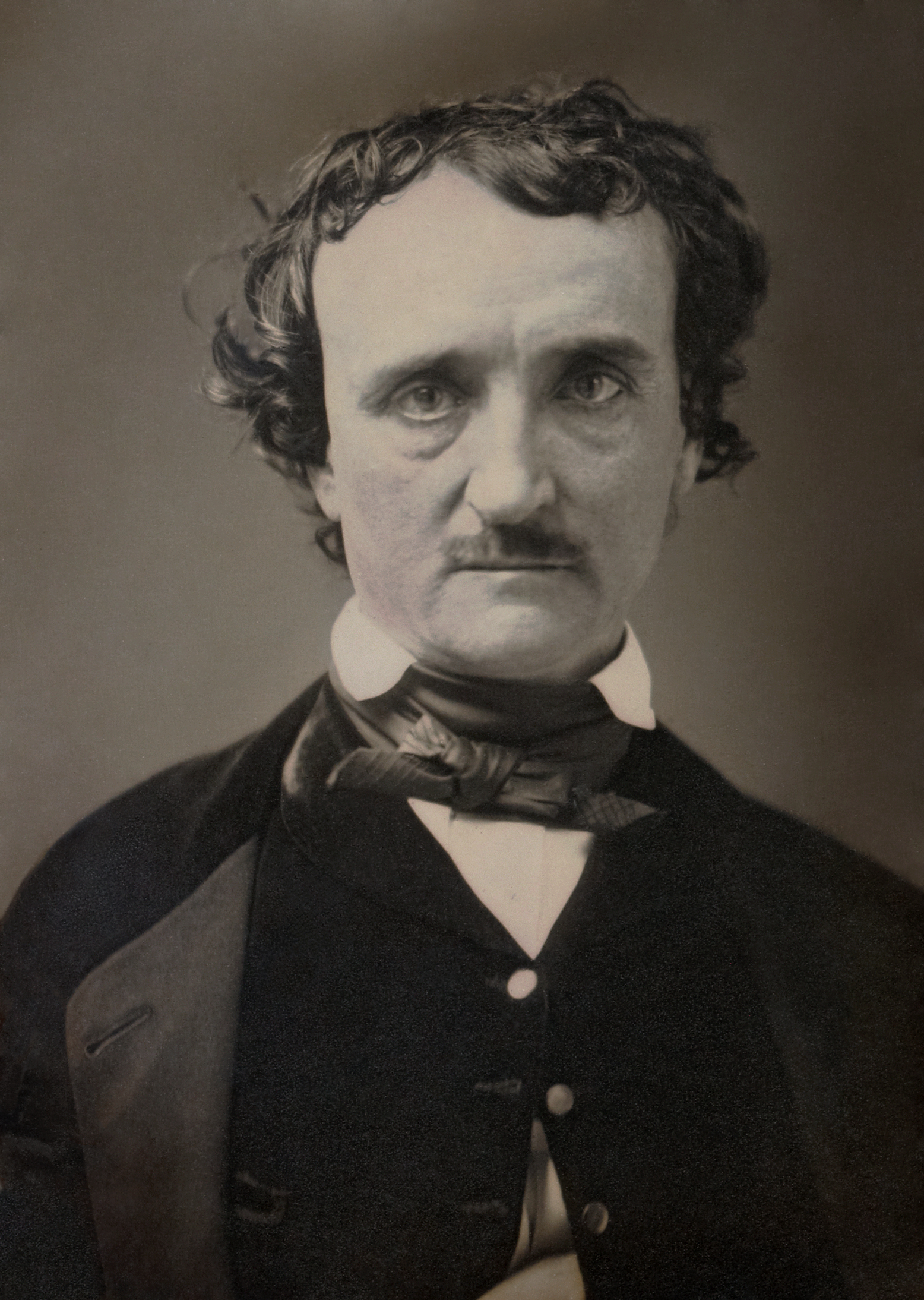
Edgar Allan Poe (1809-1849)
Edgar Allan Poe (1809—1849) stands as one of the most transformative figures in 19th-century American literature and world aesthetics.[1][2] Beyond his popular reputation as the master of Gothic macabre, Poe was a pioneering literary theorist, the inventor of detective fiction, an early architect of psychological realism, and an acute cosmologist.[2:1][3] His critical doctrines—most notably the "Unity of Effect" and the rejection of didacticism—repudiated Romantic excess in favor of rigorous formal precision, profoundly shaping French Symbolism, modern narrative theory, and psychoanalysis.[1:1][4]
1. Biographical Foundation & The Architecture of Bereavement
Born in Boston on January 19, 1809, to traveling actors David Poe Jr. and Elizabeth Arnold Hopkins Poe, Edgar Allan Poe's early life was marked by immediate bereavement.[1:2] His father abandoned the family in 1810, and his mother died of tuberculosis in Richmond, Virginia, in December 1811, before Poe reached the age of three.[2:2] Taken in—though never formally adopted—by John Allan, a prosperous Scottish merchant, Poe experienced a fractured childhood torn between aristocratic southern entitlement and financial dependency.[1:3][3:1]
Poe's strained relationship with Allan ruptured completely over gambling debts accrued during his brief enrollment at the University of Virginia in 1826 and a truncated stint at the United States Military Academy at West Point in 1830.[1:4][2:3] Stripped of inheritance, Poe committed himself to surviving solely as an editor, critic, and creative writer—making him the first prominent American author to attempt a livelihood entirely dependent on the nascent, chaotic commercial print market of the antebellum era.[2:4][4:1]
In 1836, Poe married his thirteen-year-old cousin, Virginia Clemm, with whom he established a fragile domestic refuge alongside her mother, Maria.[1:5] Virginia's rupture of a blood vessel while singing in 1842 initiated a agonizing, five-year decline from consumption, plunging Poe into cyclic bouts of despair, heavy drinking, and manic creative productivity.[2:5][4:2] Her eventual death in 1847 permanently crystallized the central aesthetic obsession of his oeuvre: the premature death of a beautiful, idealized woman and the unbearable psychological afterlife endured by the surviving lover.[3:2][5]
Poe died under mysterious circumstances in Baltimore on October 7, 1849, after being discovered delirious on the street near Ryan's Tavern.[1:6] His legacy was immediately subjected to venomous character assassination by his literary executor, Rufus Wilmot Griswold, whose pseudonymously published "Ludwig" obituary and fabricated biographical memoir depicted Poe as an unprincipled, opium-addled madman.[2:6][4:3] Paradoxically, Griswold's sensationalized portrait amplified Poe's transatlantic allure, forging the archetype of the doomed, alienated poète maudit that later enchanted European modernists.[4:4][6]
2. Aesthetics & Theory of Composition: The "Unity of Effect"
In stark contrast to the dominant Romantic ethos of his contemporary New England Transcendentalists—who viewed art as an inspired, organic outpouring of moral truth—Poe championed a rationalist, quasi-mathematical approach to creative composition.[3:3][5:1]
[ Predetermined Emotional Effect / Impression ]
                     │
                     ▼
[ Calculated Architecture of Plot, Cadence, & Tone ]
                     │
                     ▼
[ Single Sitting: 1–2 Hours of Sustained Psychological Spell ]
The Philosophy of Composition & Anti-Inspiration
In his seminal 1846 essay The Philosophy of Composition, Poe demystified the creative process by reconstructing the step-by-step writing of his celebrated poem The Raven (1845):[5:2]
"Most writers—poets in especial—prefer having it understood that they compose by a species of fine frenzy—an ecstatic intuition... It is my design to render it manifest that no one point in its composition is referable either to accident or intuition—that the work proceeded, step by step, to its completion with the precision and rigid consequence of a mathematical problem."[5:3]
Poe claimed to have determined the length of the poem (around one hundred lines), its overarching mood (melancholy), its thematic pivot (the death of a beautiful woman, which he famously declared "unquestionably, the most poetical topic in the world"), and its hypnotic sonic refrain ("Nevermore") before setting down a single line of verse.[3:4][5:4]
The "Heresy of the Didactic" & Pure Aestheticism
In The Poetic Principle (1850), Poe attacked what he termed the "Heresy of the Didactic"—the puritanical demand that literature must inculcate ethical instruction or political virtue:[5:5]
- The Intellect vs. The Taste: Truth addresses the intellect and demands severe, unadorned precision; Passion agitates the heart and seeks raw vitality; Beauty alone engages the Taste and elevates the soul.[5:6]
- Autonomous Form: Art exists for its own sake, anticipating the l'art pour l'art doctrine of Walter Pater, Charles Baudelaire, and late 19th-century Aestheticism.[6:1]
- The Totality of Effect (Single Impression): In reviewing Nathaniel Hawthorne's Twice-Told Tales (1842), Poe argued that a short tale holds a structural superiority over the novel because it can be read in a single sitting (one to two hours).[3:5] A novel inevitably breaks the psychological spell through the intrusions of daily life, while the unified tale preserves an uninterrupted communion between writer and reader.[3:6][5:7]
3. The Psychology of Perversity & Depth Psychology
Decades before Sigmund Freud mapped the unconscious, Poe systematically analyzed the non-rational, self-sabotaging drives of the human psyche.[3:7][7]
The "Imp of the Perverse" and the Death Drive
In his 1845 tale The Imp of the Perverse, Poe defined a radical psychological impulse that conventional moral philosophy and faculty psychology had failed to catalog: the irresistible urge to do wrong solely because it is forbidden, dangerous, or fatal:[7:1]
"We stand upon the brink of a precipice. We peer into the abyss—we grow sick and dizzy. Our first impulse is to shrink from the danger. Unaccountably we remain... it is merely the idea of what would be our sensations during the fall... And because our reason violently deters us from the brink, therefore do we the most impetuously approach it."[7:2]
This psychological vertigo directly anticipates Freud's conceptualization of the Death Drive (Thanatos) in Beyond the Pleasure Principle (1920)—an autonomous compulsion toward dissolution, risk, and self-destruction that subverts the pleasure principle.[7:3]
Unreliable Narrators and Somatic Guilt
Poe pioneered the psychological monologue delivered by manic, morally fractured narrators who frantically assert their rationality while detailing their descent into psychosis:[2:7][3:8]
- The Tell-Tale Heart (1843): The narrator conflates hyper-acute sensory perception with sanity, insisting that his methodical assassination of an old man with a "vulture eye" proves his clarity of mind. His eventual unraveling occurs through internal somatic projection: mistaking the accelerating pulse of his own terror and guilt for the beating of the dismembered victim's heart beneath the floorboards.[3:9]
- The Black Cat (1843): Tracking the moral disintegration of an alcoholic who mutilates and hangs his beloved pet, the tale documents how repressed guilt metastasizes into paranoia and domestic violence, culminating in the murder of his wife and an accidental, compulsive self-betrayal to the investigating police.[3:10]
- The Cask of Amontillado (1846): Montresor's cold, premeditated immurement of Fortunato explores revenge unsullied by remorse, executed with ritualistic calculation within subterranean catacombs.[2:8]
4. The Uncanny, Somatic Dread, and Entombed Spaces
Poe's fiction serves as a foundational sourcebook for the uncanny (das Unheimliche) and the architectural uncanny, exploiting the horror of the homely made unhomely.[7:4][8]
Architectural Doubling: The Fall of the House of Usher (1839)
In The Fall of the House of Usher, the distinction between psychological interiority and external physical architecture collapses entirely:[3:11][8:1]
- The Living Mansion: The decaying Usher mansion, with its "vacant eye-like windows" and fungal encrustations, functions as an externalized corporeal body.[8:2] The barely perceptible zig-zag fissure running down the facade prefigures the psychic fracture dividing the twins, Roderick and Madeline.[8:3]
- The Somatic Incubus: The narrator's first glimpse of the house elicits "an utter depression of soul which I can compare to no earthly sensation more properly than to the after-dream of the reveller upon opium." Inside, the narrator explicitly references Henry Fuseli's painting The Nightmare, sensing upon his heart "an incubus of utterly causeless alarm."[3:12]
- Entombment and Resurfacing: Madeline's premature burial in a vault deep within the family foundation dramatizes the literal return of the repressed. When she bursts through the iron doors to fall upon Roderick in a lethal embrace, the mansion splits along its fissure and collapses into the subterranean tarn, extinguishing the ancestral line and the psychic structure in a single cataclysm.[7:5][8:4]
[ Exterior Architecture ]   <==== Identical Psychic Entity ====>   [ Interior Mind ]
 (Decaying Usher Mansion)                                            (Roderick's Shattered Psyche)
            │                                                                     │
            ▼                                                                     ▼
[ Fissure on the Facade ]                                             [ Complete Mental Rupture ]
            │                                                                     │
            └───────────────> [ Catastrophic Collapse ] <─────────────────────────┘
The Doppelgänger: William Wilson (1839)
Poe's tale William Wilson provides one of literature's purest treatments of the double.[7:6] Pursued across prestigious European boarding schools and gambling dens by a namesake who shares his birthdate, physical appearance, and mannerisms—yet can speak only in an eerie whisper—Wilson attempts to extinguish his externalized conscience. In stabbing the double in a mirrored room, Wilson realizes too late that he has murdered himself, sealing his own damnation.[7:7]
5. Ratiocination & The Genesis of Detective Fiction
In the early 1840s, Poe single-handedly forged the modern detective genre through three tales featuring the eccentric Parisian aristocrat C. Auguste Dupin:[1:7][2:9]
- The Murders in the Rue Morgue (1841): Inaugurates the "locked-room mystery," solving the savage, seemingly inexplicable slaughter of two women through forensic acoustic analysis and physical deduction.[2:10]
- The Mystery of Marie Rogêt (1842): The first attempt to apply fictional detective methods to an actual, unsolved real-world crime (the murder of Mary Cecilia Rogers in New York), executed purely through comparative newspaper analysis.[1:8]
- The Purloined Letter (1844): Dupin recovers a stolen royal letter not through the brute physical searches of the Parisian police prefect, but by psychologically mapping the mind of the blackmailer, Minister D——.[2:11][9]
The Poetics of "Ratiocination"
Poe distinguished his detective method—which he christened "ratiocination"—from mere mechanical logic.[2:12] Dupin embodies a dual temperament: he is simultaneously an analytical mathematician and an imaginative poet.[9:1]
In The Purloined Letter, the Prefect of Police fails because his methods are exhaustive but inflexible; he searches microscopic hollows, table legs, and chair cushions, assuming the thief thinks like a criminal hiding contraband. Dupin succeeds because he realizes the Minister has left the letter folded inside out and placed in plain sight in a card rack. Dupin identifies his intellect with that of his opponent, perceiving that hyper-visibility is the ultimate disguise.[9:2]
Poe established every foundational trope of the detective genre later popularized by Sir Arthur Conan Doyle (who modeled Sherlock Holmes and Dr. Watson directly on Dupin and Poe's unnamed narrator), Agatha Christie, and modern forensic procedurals.[2:13]
6. Cosmological Speculation: Eureka and Intuitive Synthesis
In 1848, a year before his death, Poe delivered a lecture and published a book-length treatise titled Eureka: A Prose Poem, dedicated to the Prussian naturalist Alexander von Humboldt.[1:9][10] Though dismissed by contemporaries as the incoherent rambling of a dying eccentric, Eureka is recognized today as a work of staggering intuitive prescience.[10:1]
Poe rejected the absolute hegemony of Baconian induction and Cartesian deduction, asserting that cosmic truth is discovered through aesthetic intuition, symmetry, and poetic harmony:[10:2]
- The Primordial Particle and Expansion: Poe posited that the universe originated from a single, indivisible particle of absolute Simplicity ("Oneness") that radiated outward into space through a repulsive force.[10:3]
- The Big Crunch: He argued that gravitational attraction is the cosmic yearning of dispersed matter to return to its original unity, predicting that the universe would eventually contract and collapse back into nothingness.[10:4]
- Olbers' Paradox: Poe provided the first scientifically valid qualitative resolution to Olbers' Paradox (why the night sky is dark despite an infinite array of stars): he explained that the distance to the most remote stars is so colossal that their light has not yet had sufficient time to travel across space to reach the Earth.[10:5]
"The universe is a plot of God... A perfect consistency can be nothing but an absolute truth."[10:6]
7. Transatlantic Legacy: French Symbolism to Modern Theory
While 19th-century American literary establishments (particularly the Boston Brahmins; Ralph Waldo Emerson famously dismissed Poe as "the jingle man") viewed him with moral suspicion, European writers recognized his formal genius:[4:5][6:2]
- Charles Baudelaire and French Symbolism: Baudelaire discovered Poe in 1847 and spent sixteen years translating his tales (Histoires extraordinaires, 1856), claiming to have found an author who had given voice to his own innermost nightmares and artistic principles.[4:6][6:3] Through Baudelaire, Stéphane Mallarmé, and Paul Valéry, Poe became the intellectual godfather of French Symbolism, Decadence, and modern European aesthetics.[6:4]
- Psychoanalysis and Structuralism: Beyond Freud's thematic resonance with the uncanny, French psychoanalyst Jacques Lacan dedicated his famous 1956 Seminar on 'The Purloined Letter' to Poe's text, using the wandering letter to demonstrate how the signifier determines the subject's position in the Symbolic order.[9:3]
Summary of Core Concepts
| Concept | Theoretical / Aesthetic Definition | Key Works |
|---|---|---|
| Unity of Effect | The doctrine that every sentence, cadence, and image must serve a single predetermined emotional impression, sustained within a single sitting. | The Philosophy of Composition, Nathaniel Hawthorne Review |
| Heresy of the Didactic | The categorical rejection of moralizing, ethical lecturing, or sociopolitical utility as the proper purpose of high literary art. | The Poetic Principle, The Raven |
| The Imp of the Perverse | The autonomous, irrational psychological compulsion to commit self-destructive acts solely because they are forbidden. | The Imp of the Perverse, The Black Cat |
| Architectural Uncanny | The collapse of boundaries between domestic space and psychic decay; spatial entrapment and the somatic return of the repressed. | The Fall of the House of Usher, The Premature Burial |
| Ratiocination | Analytical deduction fused with poetic imagination, solving mysteries through psychological identification with the adversary. | The Murders in the Rue Morgue, The Purloined Letter |
| Cosmic Unity (Eureka) | An intuitive metaphysical cosmology asserting matter's radiation from a single point and its cyclical return to nothingness. | Eureka: A Prose Poem |
🎴 Interactive Web Practice (Comprehension Check)
Question 1 (Aesthetics & Compositional Theory): How does Poe's doctrine of the "Unity of Effect" and his repudiation of the "Heresy of the Didactic" challenge conventional Romantic notions of poetic inspiration and literary purpose?
Answer: In The Philosophy of Composition and The Poetic Principle, Poe rejects the Romantic belief that creative work stems from spontaneous, ecstatic inspiration or moral instruction. Instead, he treats composition as a deliberate, quasi-mathematical calculation: the author predetermines a single emotional impression, selecting every meter, tone, and plot device to serve that singular aim within a single sitting (one to two hours). Concurrently, his attack on the "Heresy of the Didactic" asserts that literary art exists for its own sake—elevating the soul through Beauty and Taste—repudiating the puritanical demand that literature must deliver ethical instruction or intellectual truth.
Question 2 (Depth Psychology & Perversity): What constitutes Poe's concept of the "Imp of the Perverse," and in what ways does it anticipate Sigmund Freud's psychoanalytic formulation of the death drive (Thanatos)?
Answer: Poe defines the "Imp of the Perverse" as an autonomous, irrational psychological impulse to commit self-sabotaging, dangerous, or fatal acts solely because reason and self-preservation violently forbid them (symbolized by the compulsive vertigo felt on the brink of an abyss). This conceptualization anticipated Sigmund Freud's formulation of the Death Drive (Thanatos) in Beyond the Pleasure Principle by several decades, positing an innate, non-rational drive toward dissolution, self-destruction, and boundary-violation that subverts enlightened self-interest and the pleasure principle.
Question 3 (Spatial Psychology & The Architectural Uncanny): How does the mansion in The Fall of the House of Usher embody the "architectural uncanny," and how does physical space mirror the psychic disintegration of its inhabitants?
Answer: In The Fall of the House of Usher, the boundary between domestic architecture and human interiority dissolves entirely. The decaying mansion—marked by vacant eye-like windows, fungal growth, and a fine zig-zag fissure—functions as an externalized corporeal body that mirrors Roderick Usher's fragmented psyche and the decomposing ancestral line. Madeline's premature burial within the deep subterranean vaults dramatizes the spatial return of the repressed; when she bursts forth to embrace Roderick in death, the mansion splits along its facade and plunges into the dark tarn, unifying psychological collapse with total architectural destruction.
Resonant Notes
The following notes in the vault share direct thematic, sociological, and literary connections with Edgar Allan Poe:
🔴 Psychoanalysis, Somatic Dread & The Uncanny
- Freud's The Uncanny (Das Unheimliche) — Poe's fiction is the ultimate literary dramatization of Freud's uncanny: the return of the repressed, the horrifying double (William Wilson), premature burial, and the anxiety of somatic dismemberment (The Tell-Tale Heart). Poe directly anticipated Freud's concept of Thanatos (the death drive) in The Imp of the Perverse.
- Anthony Vidler-The Architectural Uncanny — Vidler's architectural critique directly investigates how 19th-century literature alienated the domestic home. Poe's The Fall of the House of Usher serves as the archetype of the architectural uncanny, where stone walls, sentient fissures, and buried vaults mirror the psychological decomposition of the human subject.
- The Nightmare — Henry Fuseli's 1781 Gothic painting visually crystallizes the sleep paralysis, incubus terror, and eroticized morbidity that suffuses Poe's tales. Poe explicitly cites Fuseli in The Fall of the House of Usher, linking visual Gothicism to literary somatic dread.
- Jacques Lacan — Lacan's foundational 1956 Seminar on 'The Purloined Letter' uses Poe's detective tale to demonstrate the primacy of the signifier in psychoanalysis, showing how the wandering letter dictates the subjective positions of the King, the Queen, the Prefect, and Dupin within the Symbolic order.
🟡 Aesthetic Autonomy, Modernism & Mythic Structure
- Northrop Frye & Northrop Frye's - Anatomy of Criticism — Poe's "Unity of Effect" operationalizes Frye's structuralist thesis that literature constitutes an autonomous, internally coherent system free from biographical reductionism. Poe's macabre narratives exemplify Frye's demonic imagery (the subterranean tomb, the predatory bird, the collapsing house) and the ironic mode of myth.
- The Sublime & Edmund Burke-The Physiological Sublime — Burke's formulation of the physiological sublime as founded upon terror, obscurity, darkness, and vastness finds its clearest narrative realization in Poe's tales of maritime vortexes (A Descent into the Maelström) and abyssal precipices.
- The Painter of Modern Life, a seminal 1863 essay by French poet and art critic Charles Baudelaire — Baudelaire's modern aesthetic philosophy was forged through his decade-long project of translating Poe. Poe's anonymous urban observer in The Man of the Crowd directly prefigures Baudelaire's concept of the flâneur navigating the modern metropolitan labyrinth.
🟢 Psychological Realism, Confinement & Dialectical Foils
- Fyodor Dostoevsky (1821-1881) — Dostoevsky admired Poe's psychological precision, reviewing his tales in 1861. The frantic inner monologue, feverish guilt, and compulsive confession of Raskolnikov in Crime and Punishment directly echo the psychology of the murderer in Poe's The Tell-Tale Heart.
- Franz Kafka (1883-1924) — Kafka's claustrophobic narratives of bureaucratic entrapment, guilt, and bodily punishment (In the Penal Colony, The Metamorphosis) share Poe's nightmare logic of physical immurement and helpless psychic suffering (The Pit and the Pendulum).
- Henry James (1843—1916) — James's psychological realism and limited narrative perspective in The Turn of the Screw inherit Poe's use of the unreliable narrator and epistemological ambiguity, shifting Gothic dread from external specters to the claustrophobia of the subjective mind.
- Jack Kerouac (1922-1969) — Poe's calculated "Unity of Effect"—where every word is mathematically arranged toward a predetermined climax—stands in stark dialectical opposition to Kerouac's "Spontaneous Prose" and "First Thought, Best Thought." Yet both shared an obsession with altered states of consciousness, nocturnal restlessness, and immediate psychological impact.
References
Arthur Hobson Quinn / Edgar Allan Poe: A Critical Biography / Johns Hopkins University Press ↩︎ ↩︎ ↩︎ ↩︎ ↩︎ ↩︎ ↩︎ ↩︎ ↩︎ ↩︎
Kevin J. Hayes (ed.) / The Cambridge Companion to Edgar Allan Poe / Cambridge University Press ↩︎ ↩︎ ↩︎ ↩︎ ↩︎ ↩︎ ↩︎ ↩︎ ↩︎ ↩︎ ↩︎ ↩︎ ↩︎ ↩︎
Edgar Allan Poe / The Complete Tales and Poems of Edgar Allan Poe / Vintage Books ↩︎ ↩︎ ↩︎ ↩︎ ↩︎ ↩︎ ↩︎ ↩︎ ↩︎ ↩︎ ↩︎ ↩︎ ↩︎
Daniel Hoffman / Poe Poe Poe Poe Poe Poe Poe / Louisiana State University Press ↩︎ ↩︎ ↩︎ ↩︎ ↩︎ ↩︎ ↩︎
Edgar Allan Poe / Essays and Reviews: The Philosophy of Composition, The Poetic Principle, and Hawthorne / Library of America ↩︎ ↩︎ ↩︎ ↩︎ ↩︎ ↩︎ ↩︎ ↩︎
Lois Davis Vines / Poe Abroad: Influence, Reputation, Affinities / University of Iowa Press ↩︎ ↩︎ ↩︎ ↩︎ ↩︎
Sigmund Freud / The Uncanny (1919) / MIT Press Archive ↩︎ ↩︎ ↩︎ ↩︎ ↩︎ ↩︎ ↩︎ ↩︎
Anthony Vidler / The Architectural Uncanny: Essays in the Modern Unhomely / MIT Press ↩︎ ↩︎ ↩︎ ↩︎ ↩︎
Jacques Lacan / Seminar on 'The Purloined Letter' (1956) / Écrits, W. W. Norton & Company ↩︎ ↩︎ ↩︎ ↩︎
Edgar Allan Poe / Eureka: A Prose Poem (1848) / Project Gutenberg ↩︎ ↩︎ ↩︎ ↩︎ ↩︎ ↩︎ ↩︎