Franz Kafka (1883–1924)
Franz Kafka (1883–1924) was a German-speaking Bohemian novelist, short-story writer, and legal scholar whose posthumously published masterworks stand as defining monuments of 20th-century modernist literature and philosophical alienation.[1][2] Blending meticulous, legalistic realism with surreal, nightmarish scenarios, Kafka mapped the terrifying intersections of bureaucratic opacity, paternal intimidation, somatic vulnerability, and inexplicable metaphysical guilt.[2:1][3] His distinctive aesthetic vision gave rise to the universal adjective "Kafkaesque," capturing the existential terror of the autonomous individual trapped within irrational, self-perpetuating institutional labyrinths.[1:1][4]
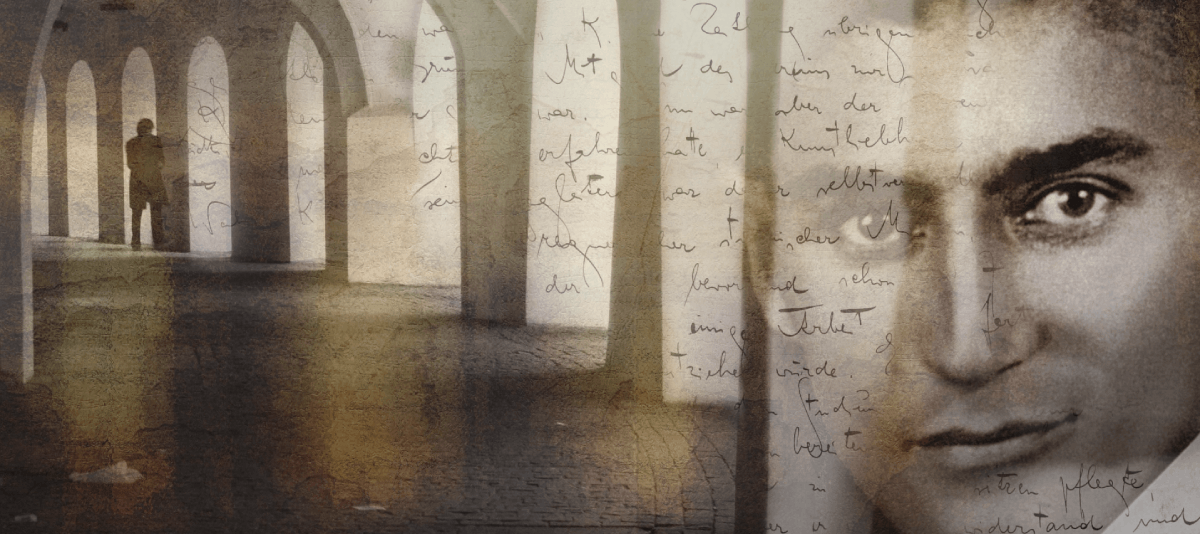
1. Biographical Foundation: Prague, Paternal Authority & The Bureaucratic Flesh
The Prague Borderland and Linguistic Liminality
Born on July 3, 1883, in Prague—then part of the multi-ethnic Austro-Hungarian Empire—Kafka occupied an intensely fractured, tripartite cultural periphery.[1:2] He was a German-speaking, secular Ashkenazi Jew residing in a predominantly Czech-speaking Roman Catholic metropolis.[1:3][2:2] This acute triple displacement isolated him from the Czech nationalist revival, from the mainstream Austro-German bourgeois culture, and from the traditional religious orthodoxies of Eastern European Hasidism.[2:3][5]
Kafka's native idiom was Prager Deutsch (Prague German), an enclave dialect detached from regional German folk idioms, which exerted a profound pressure toward linguistic austerity, syntactic rigor, and semantic precision.[5:1] As philosophers Gilles Deleuze and Félix Guattari later diagnosed, Kafka’s status as an outsider within his own language became the foundation of his revolutionary aesthetic: writing as a linguistic minority within a major imperial tongue.[5:2]
Paternal Sovereignty and Existential Intimidation
The central psychological crucible of Kafka's life was his relationship with his father, Hermann Kafka (1852–1931), a self-made, physically imposing dry-goods merchant.[1:4] Hermann’s coarse vitality, social ambition, and overbearing domestic tyranny cast a lifelong shadow over his frail, hyper-sensitive son, instilling a chronic sense of inadequacy, bodily shame, and inherited culpability.[1:5][3:1]
In his monumental, unsent 100-page Brief an den Vater (Letter to His Father, November 1919), Kafka anatomized this paternal trauma with forensic precision, depicting Hermann not merely as an authoritarian parent, but as a despotic sovereign who established arbitrary domestic commandments only to exempt himself from their observance:[3:2]
"From your armchair you ruled the world. Your opinion was correct, every other was crazy, wild, meshugge, not normal... For me you took on that enigmatic quality that all tyrants have whose rights are based on their person and not on their reason."[3:3]
This primal scene of arbitrary, unappealable paternal judgment served as the psychological architecture for Kafka's fictional authorities: the crushing patriarch in The Judgment (Das Urteil), the unlocatable judges of The Trial (Der Process), and the inaccessible lords of The Castle (Das Schloss).
The Insurance Bureaucracy and Industrial Mutilation
After completing his Doctorate of Law (Dr. jur.) at the Charles-Ferdinand University in Prague in 1906, Kafka entered professional life not as a bohemian artist, but as a civil servant.[1:6][2:4] In 1908, he secured a position at the semi-nationalized Arbeiter-Unfall-Versicherungs-Anstalt für das Königreich Böhmen in Prag (Workers' Accident Insurance Institute for the Kingdom of Bohemia), where he served until his medical retirement in 1922.[1:7][6]
Far from being a detached, pencil-pushing drone, Kafka was an exceptionally conscientious and valued legal specialist who drafted annual legislative reports, inspected factories, and adjudicated industrial injury claims.[6:1] He witnessed first-hand the catastrophic somatic human cost of early industrial capitalism: workers torn apart by unguarded mechanical planers, stonecutters blinded by flying debris, and disabled laborers navigating Byzantine administrative corridors to plead for meager disability pensions.[6:2]
This daily immersion in bureaucratic paper-shuffling, statutory hairsplitting, and mechanized corporal violence directly informed his literary imagination. Kafka did not fantasize his labyrinths out of thin air; he extracted them directly from the filing cabinets, official circulars, and bodily amputations of the imperial state apparatus.[6:3]
[ Industrial Factory Floor ] ──> [ Mutilated Human Flesh ]
             │                               │
             ▼                               ▼
[ Legal Accident Claims ]    ──> [ Byzantine State Bureaucracy ]
             │                               │
             ▼                               ▼
[ Stifling Files & Attics ]  ──> [ Inaccessible Sovereign Authority ]
Neuroses, Engagements, and Tuberculosis
Kafka lived in a state of chronic psychosomatic tension, suffering from insomnia, migraines, anxiety, and digestive disorders.[1:8] He viewed his creative writing as a sacred, demanding vocation that required monastic solitude, creating agonizing conflicts with the bourgeois imperative to marry and establish a family.[1:9][2:5]
His tumultuous romantic relationships were conducted largely through voluminous epistolary correspondence:
- Felice Bauer: A Berlin business representative to whom Kafka was twice engaged (1914 and 1917) and twice broke the engagement, agonizing over the loss of creative isolation.[1:10]
- Milena Jesenská: A brilliant Czech journalist, translator, and intellectual whose intense letters (Briefe an Milena) fueled Kafka's emotional life between 1920 and 1923.[1:11]
- Dora Diamant: An orthodox Jewish kindergarten teacher and activist with whom Kafka finally left Prague in 1923 to live independently in Berlin during the height of the Weimar hyperinflation.[1:12]
In August 1917, Kafka suffered a pulmonary hemorrhage and was diagnosed with tuberculosis.[1:13] He initially welcomed the illness with fatalistic irony, regarding it as the somatic physical manifestation of his psychic incapacity for bourgeois life—the body finally fulfilling the mind's desire for retreat.[1:14][3:4]
Deathbed Decree and Max Brod’s Posthumous Betrayal
As his tuberculosis progressed to the larynx—making speech and the swallowing of food agonizingly painful—Kafka spent his final months in Austrian sanatoriums, attended by Dora Diamant and medical student Robert Klopstock.[1:15] He died on June 3, 1924, at the Kierling sanatorium near Vienna, exactly one month shy of his forty-first birthday.[1:16]
Before his death, Kafka instructed his closest friend, literary champion, and executor, Max Brod, to burn all of his unpublished manuscripts, diaries, and notebooks without reading them.[1:17][7] Brod openly refused to execute this testamentary destruction, arguing that Kafka's literary genius belonged to world heritage.[7:1] Brod's deliberate disobedience rescued the unfinished manuscripts of The Trial, The Castle, and Amerika, ensuring Kafka's emergence as one of the towering titans of world literature.[7:2]
2. Aesthetic Architecture & Narrative Method: The Logic of Sober Nightmare
In contrast to 19th-century fantastic literature (such as E.T.A. Hoffmann or Edgar Allan Poe) or the radical linguistic pyrotechnics of his modernist contemporary James Joyce, Kafka’s aesthetic breakthrough relies on a radical, destabilizing friction between surreal content and bureaucratic prose style (Kanzleideutsch).[2:6][4:1]
The Poetics of Unruffled Realism
Kafka never resorts to sensationalism, gothic melodrama, or overt rhetorical markers of terror.[2:7] His prose is austere, crystalline, and rigorously understated, maintaining the dispassionate, legalistic tone of a police memorandum or an insurance claim.[2:8][4:2]
The impossible, nightmare event is never introduced as a hallucinatory trance or an allegorical dream; it is posited as an undeniable, matter-of-fact empirical reality in the very opening sentence of the narrative:[2:9]
"When Gregor Samsa woke up one morning from unsettling dreams, he found himself changed in his bed into a monstrous vermin (ungeheures Ungeziefer)."[2:10]
Once the baseline impossibility is declared, Kafka rigorously applies the laws of everyday domestic cause and effect.[2:11] Gregor does not panic about metaphysical curses or bodily anatomy; his immediate anxiety is that he has overslept, that his alarm was set for four o'clock, and that the firm's chief clerk will appear at his apartment to investigate his absence.[2:12] This juxtaposition of the cosmic aberration with petty, mundane bourgeois obligations produces an intoxicating, claustrophobic vertigo.
The Breakdown of Symbolism (Adorno's Literalness)
In his seminal essay Notes on Kafka (1953), cultural theorist Theodor W. Adorno cautioned against reading Kafka through comfortable, ready-made allegorical templates (whether psychoanalytic, existential, or religious):[8]
"Each sentence says 'interpret me', and none will permit it... His figures are not allegories in the sense of expressing abstract ideas through concrete images; rather, they are literal expressions of an alienated world."[8:1]
When Kafka describes an insect, an execution machine, or an inaccessible castle, he does not employ a decorative metaphor for human feelings; he literalizes the existential metaphor.[8:2] In bourgeois commercial life, the unproductive worker is treated like vermin; Kafka strips away the protective simile and transforms the worker into the vermin itself.[8:3]
Restricted Focalization (Einsinnigkeit)
Kafka revolutionizes narrative point of view by binding the narration ruthlessly to the protagonist's immediate, limited consciousness (Einsinnigkeit).[2:13] The reader never possesses an omniscient bird's-eye view of the courtroom, the castle hierarchy, or the legal statute books.[2:14] We see only what Josef K. sees in the dim attics, hear only what the land surveyor K. hears from village rumors, and share their epistemological blindness.[2:15] The boundary between external, objective institutional brutality and internal, subjective psychological paranoia dissolves completely.[2:16]
3. Major Works & Deep Textual Analysis
| Title | German Title | Year (Pub.) | Format | Central Thematic Engine |
|---|---|---|---|---|
| The Judgment | Das Urteil | 1913 | Short Story | Paternal sovereignty, filial guilt, and self-executing death sentences |
| The Metamorphosis | Die Verwandlung | 1915 | Novella | Labor alienation, instrumental family duty, and somatic dehumanization |
| In the Penal Colony | In der Strafkolonie | 1919 | Novella | Mechanical justice, bodily inscription of the law, and punitive obsolescence |
| A Hunger Artist | Ein Hungerkünstler | 1922 / 1924 | Short Story Collection | Ascetic spectacle, the obsolescence of modern art, and bodily denial |
| The Trial | Der Process | 1925 | Unfinished Novel | Opaque jurisprudence, metaphysical guilt, and autonomous bureaucratic courts |
| The Castle | Das Schloss | 1926 | Unfinished Novel | Institutional inaccessibility, futile pursuit of social recognition, and secular grace |
| Amerika | Der Verschollene | 1927 | Unfinished Novel | Industrial mechanization, capitalist displacement, and modern mass exile |
The Metamorphosis (1915): Ontological Alienation & Dehumanizing Domesticity
In The Metamorphosis, Kafka constructs modern literature’s most searing indictment of the capitalist work ethic and the instrumentalization of familial affection.[2:17]
- The Vermin (Ungeziefer): The German term Ungeziefer stems from Middle High German denoting an "unclean animal not fit for sacrifice." In imperial Austrian law and military jargon, it was used to classify pests and vermin to be exterminated.[2:18] Gregor Samsa's transformation is not a magical fairy tale enchantment; it is the physical manifestation of his complete social degradation.[2:19]
- The Primacy of Economic Duty: Tellingly, Gregor's initial monologue focuses neither on the loss of his human limbs nor on existential terror, but on the relentless grind of his commercial traveling schedule, his tyrannical boss, and his family's debt.[2:20] His body has broken down and refused to participate in the circuit of production, while his conscious mind remains colonized by corporate servitude.[2:21]
- Familial Cannibalism & The Apple: Gregor’s family—his aging father, asthmatic mother, and sister Grete—have lived comfortably as parasites off his exhausting labor.[2:22] When Gregor becomes unable to generate income, their initial horror rapidly mutates into domestic resentment and physical hostility.[2:23] The fatal climax occurs when his father bombards him with domestic apples; one apple lodges in Gregor’s dorsal carapace, left to fester and rot, crystallizing the lethal wound inflicted by patriarchal rejection.[2:24]
- The Triumphant Bourgeois Future: After Gregor dies of starvation and infection, his corpse is disposed of by the charwoman as household waste.[2:25] The novella concludes with an unsettling, sunlit bourgeois pastoral: the Samsa parents take a tram ride into the countryside with Grete, noting with commercial satisfaction that their daughter has blossomed into a healthy young woman, ready for an advantageous marriage that will replenish the family finances.[2:26] Gregor’s humanity has been completely liquidated to maintain the bourgeois family machine.
The Trial (1925): Inscrutable Jurisprudence & The Cathedral Parable
Written in 1914–1915 amidst the outbreak of World War I and the breaking of his engagement to Felice Bauer, The Trial investigates the total juridical and existential entrapment of the modern individual.[3:5][4:3]
- The Arrest: The novel begins with one of the most famous opening lines in world literature: "Someone must have slandered Josef K., for one morning, without having done anything wrong, he was arrested." Two anonymous warders enter K.’s bedroom, eat his breakfast, and confiscate his linen, yet inform him that he may continue his daily work as a bank chief clerk.[3:6]
- The Architecture of Corruption: Josef K. expects a majestic, neoclassical courtroom symbolizing statutory Enlightenment justice.[3:7] Instead, he discovers that the Court operates in the stifling, dust-choked garrets and attics of impoverished working-class tenements, where soot falls through skylights and the air is suffocating.[3:8] The law is not an elevated realm of pure reason; it is an organic, decomposing, subterranean parasite on urban life.[3:9]
- The Parable Before the Law (Vor dem Gesetz): In the darkened Cathedral, the prison chaplain recites to K. the core parable of the novel.[3:10] A man from the country seeks entry to the Law, but is halted by an intimidating doorkeeper, who warns that beyond him stand endless concentric thresholds guarded by increasingly powerful doorkeepers.[3:11] The man waits for decades, expending his wealth on bribes and begging the fleas in the doorkeeper's fur collar for assistance.[3:12] As he lies dying, he asks why no one else has sought admission over all these years. The doorkeeper roars into his failing ears: "No one else could ever be admitted here, since this gate was made only for you. I am now going to shut it."[3:13]
- The Collusion of Guilt and Execution: Josef K.’s fatal error is attempting to prove his innocence using rational procedural logic against an apparatus that presupposes guilt a priori.[3:14][4:4] By hiring shady advocates (Huld), courting corrupt court painters (Titorelli), and filing formal petitions, K. ratifies the court's jurisdiction over him.[3:15] On the eve of his thirty-first birthday, two pale executioners lead K. to an abandoned stone quarry, pass a double-edged butcher's knife between them, and plunge it into his heart.[3:16] K.’s dying words—"Like a dog!" ("Wie ein Hund!")—testify to the complete destruction of his human dignity, as the narrator concludes: "it was as if the shame of it should outlive him."[3:17]
The Castle (1926): The Labyrinth of Unreachable Grace & Recognition
In The Castle, Kafka transposes the urban, claustrophobic legal dread of The Trial into a freezing, snow-bound rural landscape governed by an enigmatic, mountain-top fortress.[3:18]
- The Illusion of Arrival: The protagonist, designated solely as K., arrives late at night in a desolate village buried in snow, claiming to have been summoned by Castle authorities to serve as a Land Surveyor (Landvermesser).[3:19] Yet the Castle neither confirms nor denies his appointment with finality; its messages, conveyed by the erratic messenger Barnabas or over crackling telephone lines, are contradictory, ambiguous, and non-committal.[3:20]
- The Proliferation of Administration: The Castle administration represents bureaucracy raised to a cosmic, quasi-theological absolute.[3:21] The high official Klamm remains an invisible, elusive phantom seen only through keyholes; secretaries work endlessly through the night, dictating reams of documents that are lost in infinite registries.[3:22] Every attempt by K. to reach the Castle directly is deflected by protocol, snowdrifts, exhaustion, and local villagers who regard Castle authority with superstitious veneration.[3:23]
- The Futility of Social Recognition: Whereas Josef K. in The Trial seeks to defend himself and escape an encroaching prosecution, K. in The Castle desperately seeks inclusion, legitimacy, and an official residence permit.[3:24] He exhausts his vitality fighting for the most basic civic existence, demonstrating how modern administrative systems subjugate human subjects not by overt violence, but by withholding bureaucratic recognition.[3:25]
In the Penal Colony (1919): The Mechanical Inscription of Law on Flesh
Written in 1914, In the Penal Colony is Kafka's most harrowing investigation of corporal punishment, juridical technology, and institutional fanaticism.[2:27]
- The Apparatus: An elaborate, gleaming machine consisting of three parts: the Bed (das Bett), the Designer (der Zeichner), and the Harrow (die Egge).[2:28] The machine carries out capital punishment by methodically writing the violated statute across the naked body of the condemned soldier using vibrating glass needles.[2:29]
- Guilt is Never in Doubt: When the visiting European Explorer questions whether the condemned man had an opportunity to defend himself at trial, the Officer in charge replies with terrifying simplicity: "Guilt is never to be doubted." ("Die Schuld ist immer zweifellos.")[2:30] The accused does not even know the sentence handed down against him; he learns it somatically through his wounds over a twelve-hour torture process.[2:31]
- The Transfiguration of Enlightenment: The Officer explains that at the sixth hour of inscription, the condemned man achieves a mystical, radiant epiphany—understanding the metaphysical majesty of the Law through the destruction of his own nervous system.[2:32]
- The Collapse of the Machine: When the Explorer refuses to endorse this archaic torture apparatus to the new, reformist Commandant, the fanatic Officer sets the condemned soldier free, programmatically sets the machine to carve "Be Just!" ("Sei gerecht!"), and places himself beneath the Harrow.[2:33] However, the decaying machine ruptures: its brass cogs fly loose, and instead of providing ecstatic enlightenment, it brutally impales the Officer's skull, leaving him dead with an unblinking, hollow stare of sheer horror.[2:34] The tale stands as a prophetic parable of the mechanical, automated extermination technologies that would define the mid-20th century.
4. Deconstructing the "Kafkaesque": Ontological Guilt & Institutional Absurdity
The adjective Kafkaesque has entered global vernacular, yet it is frequently misapplied to trivial administrative inconveniences or common bureaucratic red tape.[4:5] In its rigorous literary and sociological sense, the Kafkaesque denotes an irreducible, nightmarish existential condition defined by four structural vectors:[2:35][4:6]
               [ The Opaque Sovereign Law / Apparatus ]
                                   │
              ┌────────────────────┴────────────────────┐
              ▼                                         ▼
   1. Bureaucratic Absurdity                 2. Inaccessible Authority
 (Self-referential, circular logic)        (Felt everywhere, localized nowhere)
              │                                         │
              └────────────────────┬────────────────────┘
                                   │
                                   ▼
                      [ The Caught Individual ]
                                   │
              ┌────────────────────┴────────────────────┐
              ▼                                         ▼
     3. Ontological Guilt                      4. Futile Complicity
 (Presupposed without crime;               (Every rational appeal enmeshes
  the accusation IS the conviction)         the subject deeper in doom)
- Autonomous Bureaucratic Absurdity: The institutional apparatus is divorced from ethical purpose, human empathy, or rational utility. It operates according to its own self-generating procedural momentum, viewing human beings merely as raw material to feed registries, forms, and tribunals.[4:7]
- Inaccessible Transcendence: Power structures are omnipresent yet unlocatable. Sovereign authority is never seated upon an accessible throne; it recedes behind an endless hierarchy of doorkeepers, clerks, and closed doors. There is no supreme appellate judge to whom one can appeal.[3:26][4:8]
- Ontological Pre-Existence of Guilt: Guilt is not a consequence of statutory transgressions or moral crimes; guilt is an existential baseline condition of human being-in-the-world. In Kafka's courts, innocence is a purely theoretical abstraction that has never once resulted in a definitive acquittal.[3:27]
- Complicity Through Resistance: The tragedy of Kafka's protagonists is that they remain Enlightenment rationalists inside an irrational labyrinth. By hiring lawyers, arguing jurisdictional points, or searching for land titles, they validate the corrupt system's authority over them, transforming their own defense into their death warrant.[3:28][4:9]
5. Critical & Philosophical Frameworks
Deleuze & Guattari: Kafka: Toward a Minor Literature (1975)
French philosophers Gilles Deleuze and Félix Guattari revolutionized Kafka studies by rejecting psychoanalytic readings (which reduce his work to Oedipal paternal fixations) and theological readings (which reduce his castles to divine grace).[5:3] Instead, they read Kafka as an intensely political cartographer of desire and social machines:[5:4]
- Deterritorialization of Language: A minority writing in a dominant language (a German-speaking Jew in Prague) strips the major language of its imperial rhetoric, drying it up, making it stammer, and transforming it into an intensely political sonic instrument.[5:5]
- The Political Connection of Every Individual Concern: In major literatures, individual dramas (family, romance) exist in a private sphere distinct from the political; in minor literatures, the domestic cell is immediately wired into the state, the commercial market, and racial hierarchies.[5:6]
- Collective Assemblage of Enunciation (Agencement collectif): Kafka does not speak as an isolated Romantic ego; his writing serves as an echo chamber for oppressed, marginalized, and pre-revolutionary collective voices awaiting historic articulation.[5:7]
Walter Benjamin: Mythic Law and Distorted Tradition
Walter Benjamin devoted several foundational essays to Kafka, identifying him as the chronicler of a catastrophic historical twilight.[7:3] For Benjamin, Kafka’s world is not modern in the progressive sense, but an archaism: a regress into a pre-mythic era of terrifying, primeval law where humanity is held captive by dark, unaccountable demonic powers.[7:4]
Benjamin famously noted that Kafka's parables resemble lost fragments of the Haggadah or the Talmud whose accompanying Halakha (legal code) has been erased.[7:5] Kafka’s characters are tragic students who have forgotten the sacred text, desperately searching through distorted, everyday gestures for a secret clue to redemption.[7:6]
Classical Sociology: Max Weber & Karl Marx
Kafka's literary universe constitutes the ultimate narrative diagnostic of the sociological transformations analyzed by classical European theorists:
- Max Weber's "Iron Cage" (stahlhartes Gehäuse): In Max Weber (1864-1920), rationalized bureaucracy is analyzed as the most technically superior form of modern administration—yet Weber warned that it threatened to imprison humanity in an inflexible, soulless cage of specialized instrumental reason.[4:10] Kafka presents the horrifying culmination of this trajectory: when instrumental bureaucracy becomes autonomous, reason collapses into total unreason.[4:11]
- Marxian Alienation (Entfremdung): In The Metamorphosis, Karl Marx's theory of estranged labor under capitalism receives its literal somatic manifestation.[2:36] Gregor Samsa is alienated from the product of his labor, from the act of production, from his fellow human beings, and finally from his species-being (Gattungswesen), degenerating into an insect the moment he ceases to generate surplus value.[2:37]
- Georg Simmel and the Stranger: In Georg Simmel's concept of The Stranger, the stranger is defined as the one who comes today and stays tomorrow, physically near yet culturally remote.[1:18] Kafka's land surveyor K. in The Castle and Karl Rossmann in Amerika are the quintessential modern strangers, permanently denied organic community assimilation.[1:19]
Michel Foucault: Biopolitics & Disciplinary Apparatuses
Kafka's In the Penal Colony anticipates Michel Foucault’s thesis in Discipline and Punish (1975) with uncanny exactitude.[2:38] The transitional moment between the Old Commandant’s torture machine and the New Commandant’s humane administrative reforms mirrors Foucault’s historical shift from sovereign spectacle (punishment branded upon the flesh) to panoptic biopower (discipline internalizing surveillance and micro-regulation within the subject’s psyche).[2:39]
🎴 Interactive Web Practice (Comprehension Check)
Question 1 (Socio-Political / The Kafkaesque): What specific structural characteristics define the "Kafkaesque" condition, and how does Kafka's depiction of bureaucratic authority subvert traditional conceptions of legal and institutional power?
Answer: The "Kafkaesque" denotes a systemic condition marked by four core attributes: (1) Bureaucratic Absurdity, where institutional mechanisms operate according to an opaque, self-referential logic divorced from human needs; (2) Inaccessible Authority, wherein sovereign power is felt everywhere but cannot be localized or confronted; (3) Inexplicable Guilt, where the subject is presumed culpable a priori without ever being informed of a specific transgression; and (4) Futile Struggle, where rational procedural appeals only entangle the individual deeper into the apparatus. Kafka subverts traditional notions of legal and institutional power by exposing modern bureaucracy not as a neutral or rational instrument of social order (as conceptualized by classical sociology), but as an autonomous, self-perpetuating labyrinth that alienates and crushes the human subject.
Question 2 (Ontological Alienation / The Metamorphosis): In The Metamorphosis (1915), how does Gregor Samsa's physical transformation into an insect expose the dehumanizing mechanics of modern labor and familial duty?
Answer: Gregor Samsa's metamorphosis dramatizes extreme socio-economic and existential alienation. Tellingly, upon waking as a monstrous vermin, Gregor's immediate psychological anxiety centers not on his somatic horror or lost humanity, but on missing his train and facing retribution from his employer. His identity and perceived self-worth have been entirely colonized by the demands of commercial productivity and his role as sole financial provider. Once rendered economically useless, his family—who had previously instrumentalized his labor—progressively distances themselves, shifting from initial shock to resentment, physical hostility (culminating in his father wounding him with an apple), and ultimate relief at his demise. The transformation externalizes and literalizes the psychic degradation already imposed upon him by wage labor and instrumental familial expectations.
Question 3 (Modernist Epistemology / The Trial): How does Josef K.'s arrest in The Trial (1925) illustrate the breakdown of objective truth and the entrapment of the rational subject within an irrational legal order?
Answer: In The Trial, Josef K. is arrested "one morning, without having done anything wrong," confronting a tribunal that exists entirely outside transparent statutory codes and normal civic courts. The court's proceedings take place in dingy attics, tenements, and obscure corridors, demonstrating that its jurisdiction is omnipresent yet structurally unlocatable. Josef K.'s fundamental error is attempting to deploy conventional, rational legal arguments against an apparatus that does not operate on rational truth or innocence. In Kafka's universe, the accusation itself constitutes the conviction; innocence is merely a theoretical concept unacknowledged by the court. By attempting to prove his innocence within the court's own procedural maze, K. validates the court's authority over him, demonstrating how Enlightenment rationalism collapses when confronted with opaque institutional violence.
Question 4 (Juridical Technology & Flesh / In the Penal Colony): How does the execution machine in In the Penal Colony dramatize the relationship between law, corporal punishment, and metaphysical enlightenment?
Answer: In In the Penal Colony, the execution apparatus—comprising the Bed, the Designer, and the Harrow—embodies the absolute literalization of the law. The condemned prisoner is never informed of his crime or given an opportunity to mount a defense ("Guilt is never to be doubted"). Instead, the violated commandment is mechanically etched directly into his flesh with vibrating glass needles over twelve hours of methodical torment. The Officer claims that at the sixth hour, the condemned man achieves a radiant, metaphysical enlightenment, comprehending justice somatically through physical dissolution. The subsequent breakdown of the apparatus when the Officer places himself inside it signals the collapse of archaic sovereign violence in the face of modern humanitarian critique, presaging the mechanized, automated barbarism of 20th-century industrial warfare and totalitarian camps.
Question 5 (Linguistic Theory / Deleuze & Guattari's Minor Literature): What do Gilles Deleuze and Félix Guattari mean by classifying Kafka's work as a "minor literature," and how does Kafka's linguistic position in Prague shape his aesthetic strategy?
Answer: Deleuze and Guattari define a "minor literature" not as literature written in a marginal or little-spoken dialect, but as the literature that a minority constructs within a major, dominant language. As a German-speaking Jew in Czech-dominated Prague, Kafka occupied an intensely liminal space: isolated from both Czech nationalism and German regional vernaculars. Kafka's response was not to adopt the ornate, hyper-cultivated German of the imperial bourgeoisie, but to subject German to radical "deterritorialization"—stripping it down to an austere, legalistic, and rhythmic dryness. In a minor literature, Deleuze and Guattari argue, every individual dilemma (such as domestic or familial friction) is immediately bound up with political and institutional structures, and every artistic utterance functions as a collective assemblage of enunciation representing marginalized voices.
Resonant Notes
The following notes in the vault share direct thematic, sociological, and literary connections with Franz Kafka:
🔴 Bureaucracy, Totalitarianism & Institutional Power
- George Orwell (1903-1950) — Both writers explore the dehumanizing machinery of institutional power, though Orwell focuses on political totalitarianism, historical revisionism, and state surveillance, whereas Kafka exposes an absurd, metaphysical bureaucracy where guilt is presupposed and appeal is structurally impossible.
- Walter Benjamin (1892–1940) & Walter Benjamin’s Theses on the Philosophy of History — Benjamin was one of Kafka's most profound early interpreters, reading his opaque courtrooms and castles not merely as secular satires of modern administration, but as parables of corrupted law, forgotten scripture, and pre-mythic terror.
- Max Weber (1864-1920) — Weber's sociological prophecy of the "Iron Cage" (stahlhartes Gehäuse)—the rationalized administrative apparatus that traps humanity in specialized instrumental calculation—finds its literary and existential realization in Kafka's courts and castles.
- Michel Foucault — Foucault’s genealogy of disciplinary power and the transition from bodily torture to panoptic micro-surveillance (Discipline and Punish) directly parallels the historical and mechanical tensions depicted in Kafka’s In the Penal Colony.
- Don DeLillo Major Themes Analysis — DeLillo updates Kafka's paranoid, inscrutable institutions for late-capitalist society, where characters find themselves trapped in labyrinthine corporate systems, consumerist distractions, and procedural absurdities.
🟡 Psychoanalysis, the Uncanny & Phenomenological Estrangement
- Freud's The Uncanny (Das Unheimliche) & Sigmund Freud — Kafka's narratives are quintessential literary embodiments of the Freudian uncanny (das Unheimliche), where intimate domestic shelters and familiar family relationships unexpectedly transform into alien, terrifying spaces governed by repressed guilt and paternal judgment.
- Jacques Lacan — Lacan's concept of the Symbolic Order—the impersonal, rigid architecture of language and law that precedes and constructs the subject—finds literal manifestation in Kafka's inaccessible tribunals. The arbitrary disruptions of Josef K.'s arrest and Gregor Samsa's transformation represent traumatic eruptions of the Lacanian Real that shatter the Symbolic order.
- Anthony Vidler-The Architectural Uncanny — Vidler examines the modern built environment as a site of spatial disorientation and estrangement, drawing directly on Kafka's claustrophobic domestic traps (The Metamorphosis) and endless, unnavigable bureaucratic corridors (The Trial).
- Louis Sass - Phenomenological Psychopathology and the Self — Sass draws direct parallels between schizophrenic experience and modernist literature, noting that the hyperreflexive fragmentation of self, loss of natural immersion in the world, and perceptual alienation find their literary twin in Kafka's protagonists.
- Georg Simmel's concept of The Stranger & Georg Simmel (1858-1918) — Simmel’s spatial and sociological archetype of the Stranger—the individual who is physically present within a community yet socially and culturally unassimilated—crystallizes the perpetual homelessness of K. in The Castle and Karl Rossmann in Amerika.
🟢 Modernist Aesthetics, Narrative Form & Continental Philosophy
- Continental Philosophy & Albert Camus — Kafka stands as a foundational precursor to 20th-century Continental existentialism and absurdism. Camus celebrated Kafka's ability to maintain the perpetual tension between human longing for meaning and the world's irrational silence without resolving it through artificial theological leaps.
- Søren Kierkegaard — Kafka was an obsessive reader of Kierkegaard (particularly Fear and Trembling), seeing in Abraham's silent dread and suspension of the ethical a profound parallel to his own theological isolation and guilt before the paternal and divine law.
- Jacques Derrida — Derrida’s influential deconstructive essay Devant la loi (Before the Law) reads Kafka’s parable as an allegory of the impossibility of accessing pure origin, justice, or unmediated statutory authority, where the text of the Law exists only in its deferral.
- The Dehumanization of Art — Ortega y Gasset's diagnosis of modern art—the systematic extraction of human pathos and sentimental realism in favor of formal, estranged structures—is epitomized by Kafka's austere prose and characters reduced to initials, insects, or procedural functions.
- James Joyce (1882-1941) — Twin pillars of literary modernism who dismantled 19th-century realism: while Joyce engineered linguistic abundance and mythic maximalism in Ulysses, Kafka perfected a sober, meticulous realism deployed within impossible, nightmarish architectures.
- Henry James (1843—1916) — Both writers revolutionize narrative point of view through psychological interiority and epistemological entrapment, restricting perspective to the protagonist's subjective crisis so that the reader cannot discern the boundary between objective reality and psychic projection.
- Paul Klee (1879–1940) — Klee's visual modernism parallels Kafka's prose; both operate on the boundary between recognizable precision and grotesque distortion, transforming ordinary figures into enigmatic allegories of modern alienation.
- Edgar Allan Poe (1809-1849) — Kafka shares Poe's nightmare logic of psychological immurement, obsessive guilt, and physical torment (In the Penal Colony), transposing 19th-century Gothic horror into the clean, procedural dread of the 20th century.
Backlinks
- Anthony Vidler-The Architectural Uncanny — Vidler's spatial critique of the modern "unhomely" draws extensively on Kafka's domestic and legal labyrinths, where tenement attics house tribunals and familial bedrooms become verminous tombs.
- The Dehumanization of Art — Kafka exemplifies José Ortega y Gasset's modern aesthetic paradigm: dismantling romantic sentimentality and naturalistic identification to compel the reader to gaze upon the formal, estranged mechanics of the narrative apparatus.
- Edgar Allan Poe (1809-1849) — Poe's claustrophobic tales of premature burial (The Fall of the House of Usher) and mechanical execution (The Pit and the Pendulum) serve as 19th-century precursors to Kafka's somatic immurement and torture machines.
- George Orwell (1903-1950) — Kafka's faceless courtrooms and unlocatable judges prefigure Orwell's Ministry of Truth and Big Brother, contrasting metaphysical guilt with state-enforced ideological conformity.
- James Joyce (1882-1941) — Modernist contemporaries who revolutionized narrative form in the 1910s and 1920s: Joyce via stream-of-consciousness and mythological maximalism, Kafka via restricted focalization and forensic minimalist horror.
- Walter Benjamin (1892–1940) — Benjamin's extensive writings on Kafka establish him as a central figure in 20th-century critical theory, parsing the tension between Jewish messianism, fallen law, and modern commodity estrangement.
- Paul Klee (1879–1940) — Klee's enigmatic, fragile line drawings and allegorical figures share a visual and psychic vocabulary with Kafka's minimalist parables of estrangement and spiritual suspension.
- Jacques Lacan — Kafka's unwritten, unlocatable Law operates as an exact literary representation of the Lacanian Symbolic Order, whose arbitrary commands structure human subjectivity through castration and impossible desire.
References
Reiner Stach / Kafka: The Decisive Years, The Years of Insight, & The Early Years (3 vols., trans. Shelley Frisch) / Princeton University Press ↩︎ ↩︎ ↩︎ ↩︎ ↩︎ ↩︎ ↩︎ ↩︎ ↩︎ ↩︎ ↩︎ ↩︎ ↩︎ ↩︎ ↩︎ ↩︎ ↩︎ ↩︎ ↩︎ ↩︎
Franz Kafka / The Complete Stories (ed. Nahum N. Glatzer) / Schocken Books ↩︎ ↩︎ ↩︎ ↩︎ ↩︎ ↩︎ ↩︎ ↩︎ ↩︎ ↩︎ ↩︎ ↩︎ ↩︎ ↩︎ ↩︎ ↩︎ ↩︎ ↩︎ ↩︎ ↩︎ ↩︎ ↩︎ ↩︎ ↩︎ ↩︎ ↩︎ ↩︎ ↩︎ ↩︎ ↩︎ ↩︎ ↩︎ ↩︎ ↩︎ ↩︎ ↩︎ ↩︎ ↩︎ ↩︎ ↩︎
Franz Kafka / The Trial & The Castle (trans. Mark Harman) / Schocken Books ↩︎ ↩︎ ↩︎ ↩︎ ↩︎ ↩︎ ↩︎ ↩︎ ↩︎ ↩︎ ↩︎ ↩︎ ↩︎ ↩︎ ↩︎ ↩︎ ↩︎ ↩︎ ↩︎ ↩︎ ↩︎ ↩︎ ↩︎ ↩︎ ↩︎ ↩︎ ↩︎ ↩︎ ↩︎
Stanley Corngold / Franz Kafka: The Necessity of Form / Cornell University Press ↩︎ ↩︎ ↩︎ ↩︎ ↩︎ ↩︎ ↩︎ ↩︎ ↩︎ ↩︎ ↩︎ ↩︎
Gilles Deleuze & Félix Guattari / Kafka: Toward a Minor Literature (trans. Dana Polan) / University of Minnesota Press ↩︎ ↩︎ ↩︎ ↩︎ ↩︎ ↩︎ ↩︎ ↩︎
Stanley Corngold, Jack Greenberg, & Benno Wagner (eds.) / Franz Kafka: The Office Writings / Princeton University Press ↩︎ ↩︎ ↩︎ ↩︎
Walter Benjamin / Illuminations: Essays and Reflections (ed. Hannah Arendt) / Schocken Books ↩︎ ↩︎ ↩︎ ↩︎ ↩︎ ↩︎ ↩︎
Theodor W. Adorno / "Notes on Kafka" in Prisms (trans. Samuel and Shierry Weber) / MIT Press ↩︎ ↩︎ ↩︎ ↩︎