Innis (1951): The Bias of Communication
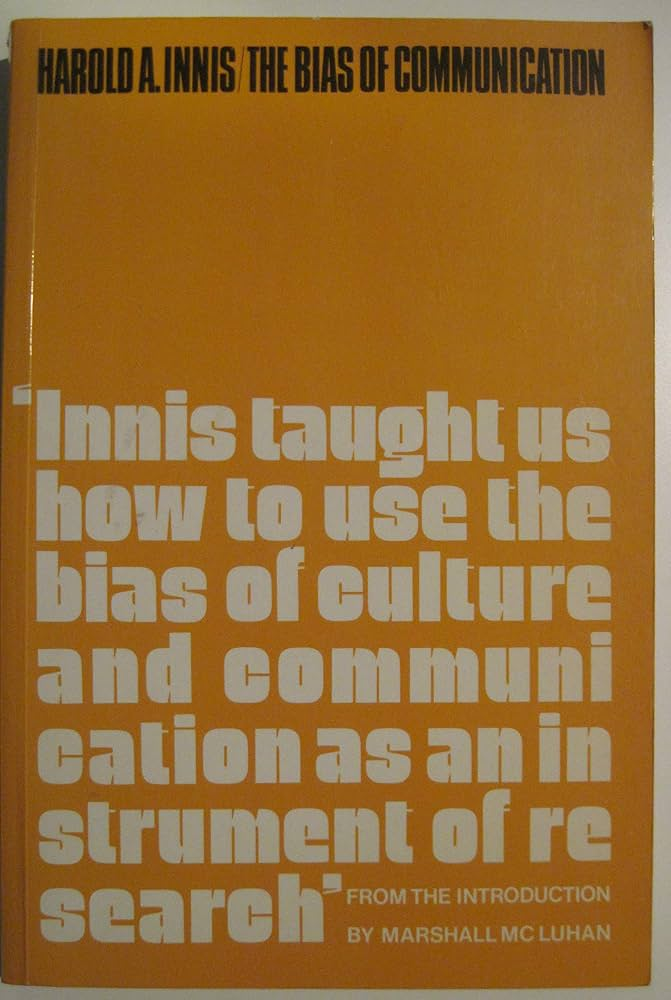
The Bias of Communication (1951) is a seminal collection of essays by Canadian political economist and media theorist Harold Adams Innis (1894–1952). Deepening the historical investigations begun in Empire and Communications (1950), Innis demonstrates how the physical and economic properties of communication media impart an inescapable structural bias toward time (durability, continuity, sacred authority) or bias toward space (portability, administrative reach, secular empire). Innis diagnoses modern Western civilization as afflicted with a pathological obsession with spatial conquest and real-time electronic transmission, producing an erasure of historical duration he famously termed "present-mindedness."
Theoretical Foundations: From Staples to Media Ecology
Harold Innis transitioned into media theory following decades as Canada's foremost economic historian. Through his foundational "staples thesis"—articulated in masterworks on the fur trade and cod fisheries—Innis argued that Canada’s political institutions, geographical boundaries, and cultural character were shaped by the extraction and export of raw staple commodities (fur, fish, timber, wheat, minerals) to imperial metropoles (Great Britain and the United States).[1]
In the late 1940s, Innis recognized that information and communication media function as economic staples. Just as physical commodities require transport networks and dictate the spatial organization of trade, communication media determine how knowledge is gathered, stored, distributed, and monopolized. Media technologies are not passive channels for neutral content; their material substrates actively shape human perception, political governance, and civilizational longevity.[2]
"A medium of communication has an important influence on the dissemination of knowledge over space and over time and it becomes necessary to study its characteristics in order to appraise its influence in its cultural setting." — Harold Innis, The Bias of Communication[1:1]
The Core Dichotomy: Time-Bias vs. Space-Bias
Innis divides all communication systems according to whether their material infrastructure favors temporal endurance or spatial extension:
1. Time-Biased Media
- Physical Characteristics: Heavy, durable, labor-intensive, scarce materials (carved stone, baked clay, animal parchment, oral memory, manuscript calligraphy).
- Institutional Alignment: Decentralized political organization, religious hierarchies, customary law, monastic orders, and oral storytelling traditions.
- Cultural Ethos: Fosters long-term continuity, reverence for ancestors and sacred memory, metaphysical contemplation, and stable, inward-looking communities resistant to geographic expansion.
2. Space-Biased Media
- Physical Characteristics: Light, portable, ephemeral, easily reproducible materials (papyrus, rag paper, industrial newsprint, telegraph wires, radio waves, digital packets).
- Institutional Alignment: Centralized imperial bureaucracies, militarized territorial administration, legalistic codification, commercial trading leagues, and secular nation-states.
- Cultural Ethos: Facilitates rapid geographic conquest, administrative coordination across vast frontiers, and market integration, but cultivates a hyper-accelerated temporality and an indifference toward historical depth.
| Media Dimension | Time-Biased Media | Space-Biased Media |
|---|---|---|
| Material Substrate | Stone monuments, clay tablets, parchment codices, oral cadence | Papyrus scrolls, rag paper, rotary newsprint, radio frequencies, fiber optics |
| Physical Attributes | Heavy, durable, resilient, difficult to transport | Lightweight, portable, ephemeral, rapid circulation |
| Governing Institutions | Ecclesiastical hierarchies, monasteries, customary councils | Bureaucracies, standing armies, commercial cartels, central banks |
| Societal Priority | Temporal preservation, tradition, moral and sacred continuity | Territorial administration, trade networks, real-time command and control |
| Vulnerability | Insular stagnation, localized fragmentation, military conquest | Administrative overstretch, cultural amnesia, obsession with the immediate |
Monopolies of Knowledge and the Dialectic of Center and Margin
A central concept in Innis's political economy of communication is the monopoly of knowledge (monopolies of knowledge). Whenever a complex medium becomes dominant, it demands specialized technical skills, institutional infrastructure, or esoteric literacy to operate.[3]
| Dialectical Stage | Structural Dynamics | Historical & Institutional Manifestation |
|---|---|---|
| 1. Established Knowledge Monopoly | Centralized elite consolidates absolute control over the dominant, technically complex medium | Scribal castes (hieroglyphics), ecclesiastical scriptoria (parchment), telegraph cartels, centralized digital platforms |
| 2. Accumulation of Systemic Friction | Institutional rigidity sets in; orthodoxies are enforced, heterodoxy is suppressed, and spatial or temporal imbalances widen | Exploitation of the periphery, neglect of civic/cultural balance, bureaucratic ossification |
| 3. Revolt from the Margins | Peripheral communities adopt cheaper, lighter, or vernacular media to bypass elite gatekeepers and shatter the monopoly | Phoenician alphabet vs. cuneiform, vernacular print vs. Latin church, penny press vs. elite party organs |
- Elite Consolidation: Dominant institutions—such as Egyptian priests guarding hieroglyphics, medieval monks controlling parchment scriptoria, or press barons controlling newsprint—consolidate political and economic authority around their control of the medium.
- Institutional Rigidity: As the monopoly ossifies, the ruling class becomes protective of its privileged status, suppressing alternative viewpoints, calcifying dogma, and ignoring systemic imbalances in the society.
- The Revolt from the Periphery: Radical technological and cultural disruption rarely originates at the imperial center, where vested interests maintain the status quo. Instead, innovation emerges from the margins (the geographical or cultural hinterland). Marginal groups appropriate or invent more flexible, less expensive media to bypass the central monopoly:
- The Phoenician alphabet subverted cuneiform and hieroglyphic elite monopolies.
- The printing press enabled vernacular Protestant reformers to shatter Latin ecclesiastical hegemony.
- The industrial penny press democratized reading at the expense of aristocratic political tracts.
Major Essays in The Bias of Communication
Unlike the continuous chronological narrative of Empire and Communications, The Bias of Communication gathers Innis's most penetrating topical essays delivered between 1947 and 1951:
1. "Minerva's Owl"
Delivered as his presidential address to the Royal Society of Canada in 1947, this essay borrows its title from G.W.F. Hegel’s famous aphorism in the Philosophy of Right: "The owl of Minerva spreads its wings only with the falling of the dusk."
Innis applies Hegel's dictum to civilizational media ecology: societies attain deep philosophical consciousness of their communication apparatuses only when those systems are already decaying.[4] Intense intellectual and artistic reflection on communication media is not a harbinger of enduring triumph, but the cultural twilight of an empire facing terminal decline and overextension.
2. "A Plea for Time"
Innis's most passionate humanitarian critique. Writing in the shadow of World War II and the emergent Cold War, Innis warns that Western civilization has succumbed to an all-consuming space-bias driven by industrial printing presses, mechanized news production, radio broadcasting, and commercial advertising.
- The Pathology of "Present-Mindedness": The unending cascade of real-time headlines, breaking bulletins, and instant updates traps the modern populace in a permanent present. Historical continuity, intergenerational responsibility, and reflective contemplation are annihilated by the demands of immediate market circulation and political propaganda.[5]
- The Call for Balance: Innis pleads for a conscious retrieval of time-binding institutions—such as liberal universities, oral seminar dialogue, philosophical reflection, and civic humanist traditions—to counterbalance the destabilizing spatial frenzy of modern industrial states.
3. "The Problem of Space"
Traces the technological acceleration of geographic conquest from Roman paved roads and papyrus distribution to transcontinental railways, telegraph lines, and modern postal services. Innis demonstrates how space-binding technologies inevitably demand bureaucratic central planning and militarized protection, turning liberal democracies into aggressive imperial engines.
4. "Industrialism and Cultural Values" & "Technology and Public Opinion in the USA"
These essays examine the commercialization of American public life. Innis analyzes how private media cartels and yellow journalism converted news into a high-speed commodity. By pandering to sensationalism, fear, and emotional volatility, modern broadcast media undermine deliberate democratic debate, transforming citizens into passive consumer audiences susceptible to demagogues and militaristic state propaganda.[6]
The Toronto School: Lineage and Legacy
Harold Innis laid the empirical, economic, and historical foundation for what became known worldwide as the Toronto School of Communication:
While Marshall McLuhan achieved global celebrity for his provocative slogans ("the medium is the message," "the global village," "cool vs. hot media"), McLuhan explicitly acknowledged Innis as his intellectual progenitor. In his introduction to the 1964 edition of Innis's The Bias of Communication, McLuhan wrote that his own work was merely an extended footnote to Innis’s research.[7]
- Innis analyzed media from the outside: as a macro-economic historian examining physical staples, empires, institutional power, and geopolitical borders.
- McLuhan analyzed media from the inside: as a literary critic and phenomenologist examining sensory ratios, human nervous system extensions, and cognitive restructuring.
Together with literary theorist Northrop Frye, Innis and McLuhan positioned the University of Toronto as the epicenter of twentieth-century media ecology, proving that the structural architecture of communication determines the destiny of human civilization.
🎴 Interactive Web Practice (Comprehension Check)
Question 1 (Time-Bias vs. Space-Bias): How does Harold Innis distinguish between time-biased and space-biased media, and why does an exclusive civilizational reliance on space-biased media lead to cultural crisis?
Answer: Innis differentiates media based on physical durability, weight, and ease of transportation:
- Time-Biased Media (e.g., carved stone, parchment codices, oral traditions) are heavy, durable, and labor-intensive. Because they are difficult to transport across space, they favor temporal continuity, historical memory, decentralized governance, and religious/moral authority.
- Space-Biased Media (e.g., papyrus, cheap newsprint, telegraphy, radio, digital networks) are lightweight, portable, and ephemeral. They facilitate rapid, centralized administrative control, trade networks, and military coordination across vast territories.
A civilization that relies exclusively on space-biased media suffers from an acute lack of temporal ballast. It expands rapidly over physical space but destroys its historical memory, civic cohesion, and capacity for long-term ethical planning. This produces what Innis diagnosed as "present-mindedness"—an obsession with immediate sensory stimuli, instant news cycles, and commercial turnover that renders the society vulnerable to structural amnesia, cultural decay, and administrative collapse.
Question 2 (Monopolies of Knowledge & The Periphery): What constitutes a "monopoly of knowledge" in Innisian theory, and why do revolutionary technological breakthroughs typically originate on the geographic or institutional margins?
Answer: A monopoly of knowledge occurs when a specialized elite (such as Egyptian hieroglyphic scribes, medieval Latin scriptoria, 20th-century newspaper syndicates, or modern Silicon Valley algorithm architects) masters the technical complexity of the dominant communication medium. This elite leverages its gatekeeping power to monopolize institutional authority, suppress heterodox ideas, and extract economic surplus.
Systemic disruption emerges from the margins (peripheries) rather than the imperial core because established elites are ideologically invested in the existing medium and possess heavy capital infrastructure tied to the status quo. Marginal cultures—facing economic exploitation and geographical exclusion—have every incentive to adopt cheaper, lighter, more accessible, or vernacular communication technologies (such as the phonetic alphabet, the movable-type printing press, or decentralized internet protocols) to bypass elite gatekeepers and dismantle the central monopoly.
Question 3 (Minerva's Owl & Modern Ephemerality): How does Innis interpret Hegel's metaphor of "Minerva's Owl," and what was the core thesis of his essay "A Plea for Time"?
Answer: In the essay "Minerva's Owl," Innis adapts Hegel's aphorism ("the owl of Minerva begins its flight only with the falling of dusk") to media ecology. He asserts that a civilization achieves profound, self-conscious philosophical and technological mastery over its communication networks only at the historical moment when its imperial institutions have reached their apex and begun their structural decline. The burst of media awareness is not a sign of youthful vigor, but the twilight illumination of an overextended empire.
In "A Plea for Time," Innis offered a direct ethical and institutional warning to modern Western democracies. He argued that the twentieth-century rise of mechanized printing, radio propaganda, and advertising had created an extreme space-bias that eradicated human contemplation of deep historical time. In response, Innis made a passionate plea to preserve time-binding institutions—most notably the university seminar, oral Socratic debate, unhurried scholarship, and philosophical humanities—to insulate human consciousness from the relentless, destabilizing velocity of commercialized news and administrative propaganda.
Resonant Notes
The following notes in the vault share direct thematic, sociological, and literary connections with Harold Innis and The Bias of Communication:
🔴 Media Ecology, The Toronto School & Technological Determinism
- Innis (1950) - Empire and Communications — The companion historical masterwork deriving from Innis's 1948 Oxford lectures; provides the sweeping, five-millennium historical case studies (Egypt, Babylonia, Greece, Rome, Middle Ages, print modernity) that substantiate the theoretical essays collected in The Bias of Communication.
- Marshall McLuhan (1911-1980) & McLuhan's The Medium is the Message — McLuhan’s foundational media ecology translates Innis's macro-economic staple theory into cognitive and sensory terms; McLuhan famously acknowledged The Bias of Communication as the foundational text that sparked his investigation into media as extensions of the human nervous system.
- Northrop Frye & Northrop Frye's - Anatomy of Criticism — The third pillar of the Toronto School; while Innis examined how physical communication media build empires across geography, Frye examined how imaginative archetypes and verbal structures construct a mental universe against spatial isolation.
- Martin Heidegger — Heidegger's critique of modern technology in The Question Concerning Technology frames technology as Gestell (enframing), which reduces the earth and humanity to calculable standing reserve (Bestand), directly paralleling Innis's diagnosis of how space-binding industrial media reduce knowledge to an administrative commodity.
🟡 Knowledge Monopolies, Bureaucratic Power & Digital Networks
- George Orwell (1903-1950) & Dystopian Counterpoints - Brave New World vs. Nineteen Eighty-Four — Orwell’s Ministry of Truth represents the institutionalized apex of a state-managed monopoly of knowledge, demonstrating Innis’s principle that controlling communication infrastructure allows ruling oligarchies to erase historical time and rewrite consensus reality.
- Postscript on the Societies of Control — Gilles Deleuze’s transition from physical disciplinary enclosures to continuous digital modulation and algorithmic tracking updates Innis's space-bias framework for the cybernetic era, where data flows modulate human behavior across unbounded virtual space.
- Timothy John Berners-Lee & How the Internet Works — Berners-Lee’s World Wide Web protocol and packet-switching infrastructure instantiate the most radical space-biased communication system in human history: global, frictionless, and instantaneous, fulfilling Innis's warnings regarding the erosion of temporal continuity by electronic immediacy.
- The Internet of Things (IoT) — Charts the ambient physical expansion of space-binding digital networks into material hardware, embedding real-time surveillance and administrative feedback loops directly into domestic and civic architecture.
- Entropy — Claude Shannon’s mathematical theory of communication and thermodynamic entropy demonstrates how the hyper-acceleration of space-biased electronic signals degrades message integrity, drowning civic discourse in informational noise and cognitive exhaustion.
🟢 Canadian Political Economy, Spatial Frontiers & Cultural Forms
- English-language Canadian Literature (English CanLit) — Innis's staples thesis and media theory directly shaped Canadian cultural self-understanding; CanLit’s recurring motifs of garrison isolation, wilderness confrontation, and regional tension mirror Innis's center-periphery dialectic.
- From Walls of Wood to Walls of Glass - Northrop Frye’s Geography of Isolation — Explores the spatial and architectural evolution of Canadian cultural survival; directly pairs Innis's space-binding railway and communication networks with Frye's "garrison mentality," tracing the progression into modern glass high-rises.
- Group of Seven (also known as the Algonquin School) — The visual parallel to Innis's political economy; operating from the Toronto metropolitan core, the Group traveled along industrial railway corridors through the Canadian Shield to translate the resource hinterland into a national visual iconography.
- The Renaissance — Demonstrates Innis's center-margin thesis in practice: how the introduction of movable type and paper shattered the Roman Catholic Church's parchment monopoly of knowledge, fostering secular nation-states, vernacular print capitalism, and merchant banking.
- The Transformation of the Roman World-Knowledge, Culture, and Society in the Early Middle Ages — Analyzes the civilizational shift from Roman papyrus networks (which enabled administrative Mediterranean empire) to medieval monastic parchment (which bound Europe to a localized, time-biased ecclesiastical order).
- Simmel and the Attention Economy — Abstraction, Alienation, and Cognitive Capture — Georg Simmel’s analysis of urban sensory overstimulation and monetary abstraction anticipates Innis's warning that mechanized media speed up psychological tempo, inducing emotional detachment and the destruction of sustained contemplation.
- Don DeLillo Major Themes Analysis — DeLillo’s postmodern fiction portrays the terminal crisis of modern space-bias: characters inundated by 24-hour news cycles, brand mantras, and televisual spectacles that annihilate historical duration into "blur and glut."
Backlinks
- George Orwell (1903-1950) — Innis's analysis of how communication media establish monopolies of knowledge and control historical memory provides the macro-sociological foundation for Orwell's depiction of the Ministry of Truth, Newspeak, and totalitarian narrative engineering.
- Northrop Frye — Standing alongside Innis as a founding mind of Canadian cultural theory, Frye examined how literature organizes human imaginative time, serving as the aesthetic counterpart to Innis’s economic and spatial media ecology.
- Timothy John Berners-Lee — The inventor of the World Wide Web created the ultimate space-biased medium—instantaneous, decentralized, and borderless—embodying Innis's prophetic thesis on the political, cultural, and cognitive consequences of global communication technologies.
- English-language Canadian Literature (English CanLit) — Innis’s foundational staples thesis and center-margin analysis provide the structural economic framework for understanding CanLit's core thematic anxieties: geographical survival, frontier alienation, and resistance to imperial cultural monopolies.
- Group of Seven (also known as the Algonquin School) — Harold Innis's staples thesis maps directly onto the visual geography of the Group of Seven, whose members traversed the resource-extraction corridors of northern Ontario to fashion a Canadian national aesthetic from the hinterland.
- Signal vs Static - Breaking Down Communication Noise — Innis's media bias framework illustrates how choosing an ephemeral spatial medium over a durable temporal medium introduces systemic organizational noise and destroys institutional continuity in corporate systems.
- The Great Classroom Screen Debate - Device Bans vs. Digital Integration in Higher Education — Innis’s distinction between time-binding oral dialogue and space-binding digital devices underpins the institutional clash between traditional academic seminar deep work and real-time laptop screen distraction.
References
Harold Adams Innis / The Bias of Communication / University of Toronto Press ↩︎ ↩︎
Harold Adams Innis / Empire and Communications / University of Toronto Press ↩︎
Paul Heyer / Harold Innis / Rowman & Littlefield Publishers, 2003 ↩︎
G.W.F. Hegel / Elements of the Philosophy of Right / Translated by H.B. Nisbet, Cambridge University Press, 1991 ↩︎
Graeme Patterson / History and Communications: Harold Innis, Marshall McLuhan, the Interpretation of History / University of Toronto Press, 1990 ↩︎
Robin Neill / A New Theory of Value: The Canadian Economics of H.A. Innis / University of Toronto Press, 1972 ↩︎
Marshall McLuhan / "Introduction" in Harold A. Innis, The Bias of Communication / University of Toronto Press, 1964 ↩︎