The Dehumanization of Art
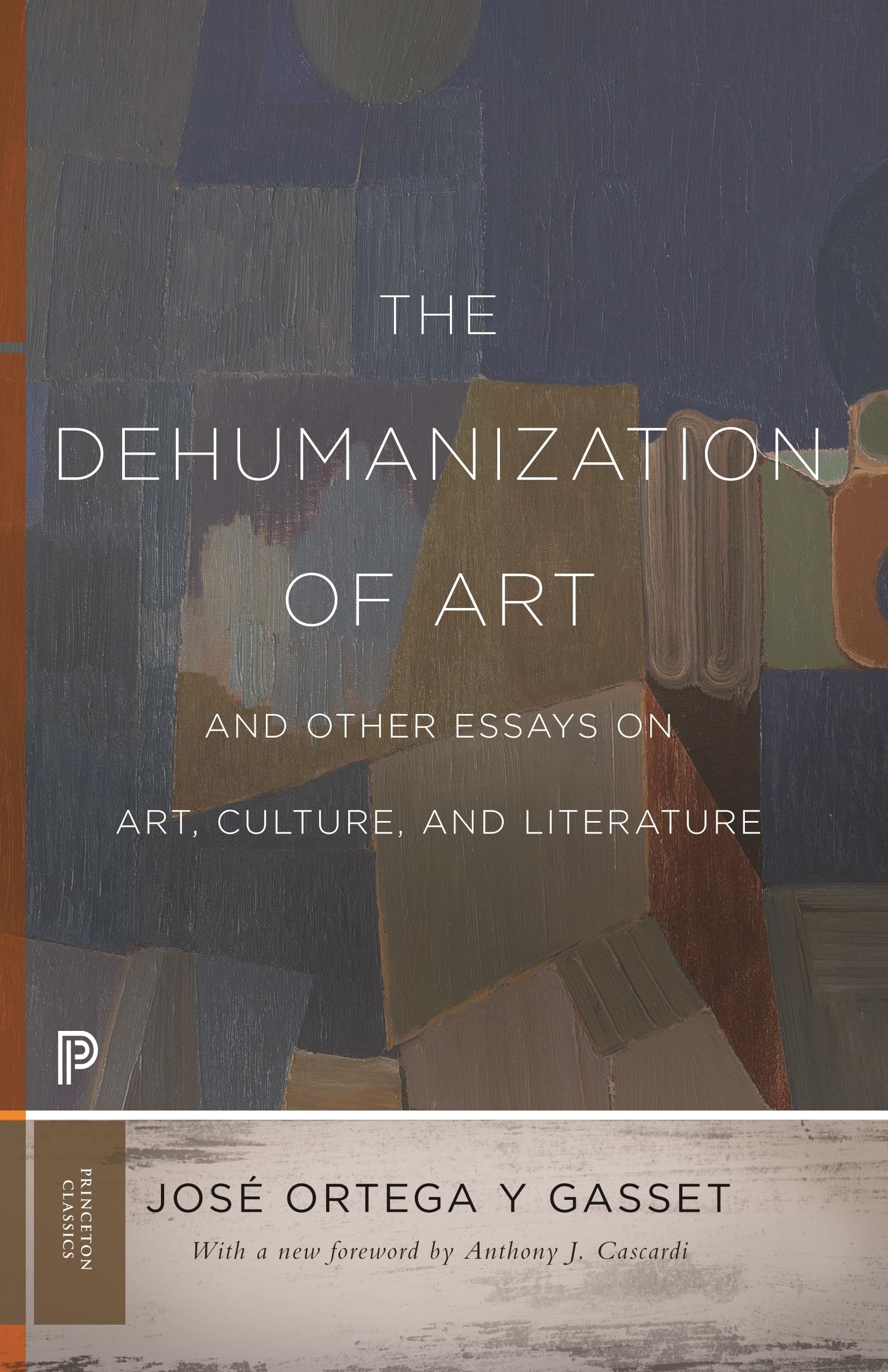
In his seminal 1925 essay The Dehumanization of Art (La deshumanización del arte), Spanish philosopher José Ortega y Gasset provided a foundational theoretical framework for interpreting modern avant-garde culture. Ortega y Gasset argues that the "new art" (exemplified by Cubism, Expressionism, Symbolism, and musical atonality) deliberately severs ties with relatable human sentiment, biological passions, and mimetic representation—a process he terms "dehumanization" (deshumanización). By prioritizing pure aesthetic form, geometric abstraction, and self-referential medium reflexivity over lived reality (la realidad vivida), modernism demands an unnatural optical and intellectual focus. Consequently, modern art functions as an anti-bourgeois social catalyst, inevitably cleaving the public into two antithetical castes: an aristocratic minority possessing a specialized "organ of comprehension" capable of disinterested contemplation, and an alienated, hostile mass majority who feel insulted by an aesthetic language they cannot emotionally consume.
Historical and Epistemological Context: The Crisis of 19th-Century Realism
Published in Madrid in 1925 by Revista de Occidente, The Dehumanization of Art emerged amidst the profound cultural and existential convulsions of interwar Europe. Witnessing the rapid ascendance of avant-garde movements across the continent—including the architectural radicalism of The Bauhaus School, the fractured geometry of Cubism (Pablo Picasso, Georges Braque), the metaphysical enigmas of Giorgio de Chirico (1888-1978), the poetic hermeticism of Stéphane Mallarmé and Guillaume Apollinaire (1880–1918), and the compositional disruptions of Claude Debussy and Igor Stravinsky—Ortega sought to deduce the unifying philosophy governing this radical stylistic rupture.[1]
For Ortega, nineteenth-century art—encompassing Romanticism, Realism, and Naturalism—was fundamentally parasitic on "human reality." Bourgeois audiences patronized nineteenth-century art because it acted as a sentimental mirror: they wept at tragic theatrical protagonists, fell in love with painted portraits, and recognized familiar moral dilemmas in naturalistic novels. Art was treated merely as an "extract of life," where aesthetic appreciation was conflated with emotional empathy and psychological projection.[2]
| Aesthetic Stage | Movement / Stance | Perceptual Focus & Social Function |
|---|---|---|
| 19th-Century Aesthetic | Mimetic Realism & Romanticism | Art as an emotional mirror; focus through the medium onto lived reality and empathy. |
| Interwar Avant-Garde Turn | Modernist Rupture | Rejection of bourgeois sentimental identification; assertion of artistic autonomy. |
| Bifurcated Reception | Mass Audience vs. Avant-Garde Initiates | Mass Audience: Demands emotional identification with human content. Avant-Garde: Embraces pure geometry, ironic play, and formal distance. |
| Ultimate Outcome | Sociological Fracture | Modern art functions as an anti-popular cultural reagent, dividing society into two opposing groups. |
The modernist revolution permanently ruptured this pact. Rather than offering emotional reassurance, the avant-garde systematically purged everyday human dramas from its creations. The new artists refused to serve as emotional concubines to the public, asserting instead the sovereign autonomy of the aesthetic object.[3]
The Window Metaphor: Transparency vs. Opacity of the Medium
To clarify the radical optical and cognitive transformation required by modern art, Ortega formulated his famous metaphor of the window pane—one of the most celebrated allegories in twentieth-century aesthetics:[4]
"Imagine we are looking at a garden through a window pane. Our eyes adapt themselves so that our gaze passes through the glass without stopping and fixes itself upon the flowers and foliage. Since the garden is the object seen, our vision accommodates itself to its distance... But with a deliberate effort we can alter our focus: we can withdraw our gaze from the garden and fix it upon the glass pane. We see then that the glass has certain imperfections, reflections, colors. Now the garden disappears; our eyes see only the glass itself, and the garden is reduced to a confused blur behind it."
— José Ortega y Gasset, The Dehumanization of Art[1:1]
| Optical Paradigm | Primary Object of Vision | Status of the Glass (Medium) | Status of the Garden (Lived Reality) |
|---|---|---|---|
| 19th-Century Realism (Transparency) | The Garden / Lived Reality | Invisible / Transparent: The medium serves only as an unobserved conduit. | In Focus: Emotional empathy, biographical drama, recognizable human forms. |
| 20th-Century Avant-Garde (Opacity) | The Glass Pane / Pure Form | Visible / Opaque: Focus fixes directly on brushstrokes, pitch, syntax, and geometry. | Evaporates / Dissolves: Human drama recedes into an illegible, extraneous blur. |
The Optical Mechanics of Perception
Ortega demonstrates that aesthetic perception and emotional living are mutually exclusive operations:
- Viewing the Garden (Traditional Mimesis): The observer accommodates ocular focus to look through the glass at the garden beyond. The garden represents lived human experiences: love, grief, social injustice, and bodily passion. The glass itself (the artistic medium: canvas texture, pigment viscosity, syntax, musical timbre) remains completely invisible, functioning merely as a transparent, instrumental vehicle.[5]
- Viewing the Glass (Modern Dehumanization): Modern art demands an unnatural optical act: pulling the focus back from the garden and fixing the gaze directly upon the glass. The moment the glass becomes the primary object of perception, its scratches, chromatic refraction, and physical materiality emerge into sharp focus, while the garden dissolves into an illegible, extraneous blur.[6]
Ortega maintains that the vast majority of people are physically or temperamentally unwilling to fixate on the glass. Accustomed to looking straight through to the garden, when presented with modern art where the garden has been excised, they angrily protest that there is "nothing to see."[7]
The Mechanics of "Dehumanization" (La deshumanización)
The term "dehumanization" frequently provokes moral panic, evoking industrial cruelty, totalitarian degradation, or nihilism. Ortega emphatically clarifies that in aesthetics, dehumanization is neither malicious nor destructive; rather, it denotes the methodological extraction of lived human reality from the art object.[8]
Ortega draws a rigorous phenomenological boundary between la realidad vivida (lived, biographical reality) and la realidad contemplada (disinterested, aesthetic contemplation). When a person weeps at a funeral, they are living a biological reality. To demand that a spectator weep at a painting or a string quartet is to confuse biological sentimentality with pure aesthetic ecstasy.[3:1]
Modern artists achieve dehumanization through several distinct aesthetic maneuvers:
- Eradication of Organic Anatomy: Modernist painting (as seen in Cubism and the works of Paul Klee (1879–1940)) rejects the organic curves, flesh tones, and anatomical fidelity of the human body, transmuting living flesh into crystalline polygons, mathematical lines, and spatial vectors.
- De-realization and Stylization: Stylization is inherently an act of violence against the real. To stylize an object is to distort, subordinate, and disfigure its natural appearance so that the artist's subjective formal concept triumphs over nature.[9]
- The Inversion of Sign and Referent: In classical art, the signifier (the paint) existed to evoke the signified (the Virgin Mary or the Roman soldier). In avant-garde modernism, the signified is obliterated so that the signifier can be celebrated in its pristine, autonomous materiality.[1:2]
| Framework | Role of Art | Role of Human Reality |
|---|---|---|
| Traditional Art | Serves as a transparent vessel and vehicle for human emotion. | Primary focal subject, emotional anchor, and purpose of creation. |
| Modernist Art (Inversion) | Exists as an autonomous, self-contained universe of pure form. | Discarded scaffold; raw, secondary material subservient to formal construction. |
The Metaphor as an Instrument of Evasion
Among Ortega's most brilliant contributions to literary theory is his analysis of the metaphor. Historically, classical rhetoric treated metaphor as an ornamental device designed to clarify or embellish an already existing reality (e.g., comparing a woman's teeth to pearls to accentuate their whiteness).[10]
In modern art, however, the metaphor ceases to be an ornament and becomes an instrument of evasion and derealization (un instrumento de evasión):[1:3]
"The metaphor is perhaps one of man's most fruitful potentialities. Its efficacy verges on magic... All other abilities keep us within the boundaries of the real. The metaphor alone allows us to escape, creating between real things imaginary reefs, blossoms of an unreal world... In poetry, the metaphor is used not to ornament an object, but to strip it of its reality, to annihilate it."
— José Ortega y Gasset, The Dehumanization of Art[1:4]
Modern poets (such as Mallarmé) utilize metaphor to place a taboo upon everyday objects. By comparing an object to an improbable counterpart, the artist obliterates the mundane presence of the original object, erecting in its place an unearthly, purely aesthetic phantom. Rather than connecting two known entities, modern metaphor establishes a refuge where consciousness escapes the weight of material existence.[10:1]
Sociological Impact: The Elite vs. The Masses
Beyond its aesthetic insights, The Dehumanization of Art is celebrated for its prophetic sociological diagnosis. Ortega observes that every historical art form possesses a specific social reception, but modern art is uniquely characterized by its inherent antipopularity.[11]
Unpopular Art vs. Anti-Popular Art
Ortega makes an indispensable analytical distinction between art that is simply not popular and art that is anti-popular:
- Unpopular Art (Quantitative Failure): An old romantic play might fail at the box office because it is poorly executed or mediocre. The audience understands its narrative codes, but finds it boring. It is unpopular in a purely quantitative sense.[11:1]
- Anti-Popular Art (Qualitative Exclusion): Modern avant-garde art is not merely unpopular; it is actively anti-popular. Its internal structure is deliberately engineered to resist mass assimilation. It produces an immediate, structural allergy in the general public.[1:5]
| Dimension | The Mass Majority | The Cultivated Minority |
|---|---|---|
| Perceptual Experience | Cannot locate recognizable human emotion or sentimental drama. | Possesses the specialized "organ of comprehension" for abstract form. |
| Emotional Reaction | Feels excluded, perplexed, and existentially humiliated. | Experiences pure, disinterested aesthetic delight. |
| Social Interpretation | Perceives the artwork as an aristocratic insult and elitist mockery. | Recognizes fellow initiates and peers across social strata. |
| Cultural Response | Reacts with collective resentment, defensiveness, and moral outrage. | Engages in intellectual appreciation and ludic, formal play. |
The Mechanism of Mass Humiliation
When an average person attends an exhibition of abstract painting or a concert of atonal music, they find themselves unable to participate in the experience. They realize that their everyday emotional equipment—their common humanity, their capacity to love, hate, weep, and empathize—is completely useless.[8:1]
This inability to understand does not register as a benign aesthetic preference; it registers as an existential humiliation. The spectator realizes that the artist has constructed a realm from which they are categorically barred. Consequently, the mass public reacts not with dispassionate disinterest, but with aggressive indignation, accusing the artist of fraud, insanity, or elitist insolence.[12]
Modern art thus acts as a chemical reagent, separating society into two distinct castes:
- The Aristocratic Minority: Those rare individuals who possess the specific "organ of comprehension" required to perceive pure formal relations independent of emotional utility.
- The Democratic Masses: The overwhelming majority who demand that all cultural artifacts reflect their own everyday existence, viewing any art that refuses to flatter them as an affront to democratic equality.[11:2]
This dynamic anticipated Ortega's seminal political treatise, The Revolt of the Masses (La rebelión de las masas, 1930), wherein he warned that mass society would increasingly demand the leveling of all intellectual and cultural hierarchies.[11:3]
The Seven Defining Characteristics of the New Art
Ortega systematically condensed the avant-garde aesthetic into seven defining, interlocking tendencies that distinguish twentieth-century modernism from all preceding artistic epochs:[1:6]
| # | Characteristic | Operational Mechanism |
|---|---|---|
| 1 | To Dehumanize Art (Deshumanizar el arte) | Systematic extraction of sentimental human content; eradication of personal biography and melodrama. |
| 2 | To Avoid Living Forms (Evitar las formas vivas) | Substitution of organic naturalism with geometric, crystalline, and abstract configurations. |
| 3 | To See Art as Nothing but Art (Obra de arte sólo obra de arte) | Rejection of utilitarian, moral, or didactic obligations; radical aesthetic autonomy and medium self-reflexivity. |
| 4 | To Consider Art as Play (El arte como juego) | Stripping art of heavy religious and philosophical gravity; cultivating joyful, inventive, and ludic freedom. |
| 5 | To Be Essentially Ironical (Ironía esencial) | Internal self-mockery; the artwork mocks its own aesthetic pretensions, preventing solemn idolatry. |
| 6 | To Beware of Sham (Cuidarse de la falsedad) | Scrupulous refusal of bourgeois emotional deception; honest fidelity to the limitations of the chosen medium. |
| 7 | To Regard Art as Consequentialess (Sin transcendencia alguna) | Relinquishing grandiose 19th-century messianism; acknowledging that art cannot redeem or save civilization. |
1. To Dehumanize Art (Deshumanizar el arte)
The deliberate purging of relatable human feelings, sentimental relationships, and biological passions from the aesthetic sphere. The artist does not paint a grieving woman; the artist paints a structural harmony of lines, angles, and color tensions for which grief is merely incidental or entirely absent.[8:2]
2. To Avoid Living Forms (Evitar las formas vivas)
Modernism demonstrates a deep aversion to the forms of organic nature. Living forms remind human beings of their biological vulnerability and psychological compulsions. By substituting organic curves with crystalline prisms, geometric planes, and mechanical rigidity, the modern artist liberates the artwork from the decay of the biological world.[9:1]
3. To Ensure the Work of Art Is Nothing but a Work of Art (Que la obra de arte no sea sino obra de arte)
Nineteenth-century culture burdened art with titanic external responsibilities: educating the working class, promoting national unity, advocating moral righteousness, or serving as a substitute for decaying religious dogma. Modernism casts off all ideological luggage. A painting is not a sermon, a manifesto, or a history lesson; it is pigment distributed across canvas.[1:7]
4. To Consider Art as Play and Nothing Else (El arte como juego)
Stripped of transcendent gravitas, modern art reveals its true nature: a game of extraordinary ingenuity and intellectual playfulness. Ortega observes that when art stops attempting to save the soul of humanity, it recovers a delightful "boyishness" and youthful lightness. It ceases to take itself with agonizing seriousness.[1:8]
5. To Be Essentially Ironical (La ironía esencial)
Because modern art understands itself as an arbitrary, playful invention rather than a divine revelation, it incorporates an intrinsic layer of self-directed irony. The modernist artwork always includes a subtle, knowing wink: it mocks the spectator, it mocks traditional art, and most importantly, it mocks itself. By laughing at its own existence, modern art preserves its freedom and avoids the fossilized pomposity of nineteenth-century academicism.[12:1]
6. To Beware of Sham (El escrupuloso cuidado de evitar la falsedad)
Traditional realism relies upon elaborate illusions: using perspective, chiaroscuro, and sentimental tropes to fool the viewer into believing they are looking at real bodies in real space. Modern art denounces this illusionism as fraudulent trickery. It insists upon material honesty: a canvas must proclaim its flatness; a sculptor must honor the grain of the stone; an author must expose the mechanics of narration.[1:9]
7. To Regard Art as a Matter of No Transcending Consequence (El arte como una cosa sin trascendencia)
In the nineteenth century, artists (from Victor Hugo to Richard Wagner) viewed themselves as high priests and prophets destined to deliver salvation to suffering humanity. Modern artists thoroughly disavow this megalomania. They accept, with stoic modesty, that art is an activity without cosmic consequence—a marvelous, non-utilitarian ornament of consciousness that does not alter world politics, cure disease, or solve the metaphysical riddle of death.[1:10]
Musical and Poetic Paradigms: Debussy and Mallarmé
To demonstrate that dehumanization was not confined to painting, Ortega examined the paradigm shifts in modern European music and French Symbolist poetry.
| Attribute | 19th-Century Music (Richard Wagner) | 20th-Century Music (Claude Debussy) |
|---|---|---|
| Aesthetic Goal | Grandiose emotional overwhelm and visceral climax. | Dispassionate sonic architecture and textural subtlety. |
| Listener Stance | Ecstatic, hypnotic submission to dramatic sentiment. | Disinterested auditory contemplation and perceptual alertness. |
| Structural Conception | Music as melodrama, cosmic philosophy, and mythic teleology. | Sound freed from narrative teleology and thematic burden. |
Claude Debussy and the Liberation of Sound
In music, Ortega identifies Richard Wagner as the absolute zenith of nineteenth-century emotionalism. Wagnerian opera overwhelmed the listener with dramatic hysteria, physical vibrations, and intoxicating leitmotifs, reducing the audience to a weeping, swooning collective.[2:1]
Claude Debussy carried out the definitive dehumanization of music. In works such as Prélude à l'après-midi d'un faune and Pelléas et Mélisande, Debussy ceased using sound to convey biographical agony or heroic triumph:\n- Sound was released from thematic narrative and sentimental teleology.
- Dissonance and subtle timbral textures were appreciated for their self-sufficient acoustic beauty rather than their capacity to express emotional turmoil.
- Debussy turned musical listening into a dispassionate, contemplative act, converting sound from a visceral stimulant into a pure architectural pattern.[2:2]
Stéphane Mallarmé and the Pure Word
In literature, Ortega identifies Stéphane Mallarmé as the pioneer who performed surgical extraction upon language:
- Conventional poetry employed words as transparent utilitarian labels to describe recognizable landscapes, lost loves, or melancholic memories.
- Mallarmé systematically decoupled the poetic word from its worldly referent. Words were chosen for their phonetic resonance, syntactic ambiguity, and conceptual purity.
- In Mallarmé's verse, the personal voice of the biographical author is annihilated, replaced by the autonomous music of language itself. The reader can no longer identify with the poet; they must contemplate the autonomous constellation of the poem.[10:2]
Comparative Matrix: Bourgeois Realism vs. Avant-Garde Dehumanization
| Analytical Dimension | 19th-Century Bourgeois Realism & Romanticism | 20th-Century Avant-Garde Modernism |
|---|---|---|
| Primary Focal Point | The Garden (Lived human content, biographical emotion, natural landscapes). | The Glass Pane (The materiality of the medium, formal structure, syntax, texture). |
| Audience Engagement | Emotional identification, empathy, catharsis, and sentimental projection. | Disinterested contemplation, intellectual alertness, and aesthetic distance. |
| Status of the Human Body | Organic mimesis, anatomical fidelity, physical vitality, and heroic posture. | Geometric abstraction, fragmentation, anatomical distortion, and crystalline forms. |
| Conception of Metaphor | Decorative ornament used to clarify, magnify, or embellish existing reality. | Instrument of evasion, derealization, and ontological annihilation of the object. |
| Cultural Stance & Tone | Melodramatic seriousness, messianic moralism, and emotional gravitas. | Essential irony, ludic play, self-satire, and radical lightheartedness (boyishness). |
| Psychological Function | Emotional crutch and psychological refuge for bourgeois daily anxieties. | Provocative challenge, cognitive disruption, and purification of perception. |
| Sociological Reception | Broadly accessible, popular, and universally digestible across class lines. | Structurally anti-popular, creating a fracture between initiates and the mass public. |
| Existential Claim | Art as spiritual redemption, social reform, and moral beacon. | Art as an autonomous, consequentialess game of pure formal invention. |
Critical Legacy and Theoretical Resonance
Ortega's analysis in The Dehumanization of Art exerted an immense influence on modern aesthetic theory, provoking enduring debates across philosophy, sociology, and literary criticism:
- Theodor Adorno and Autonomous Art: While Marxist critics initially attacked Ortega for celebrating aristocratic aestheticism, Theodor Adorno would later arrive at a structurally parallel conclusion in his Aesthetic Theory (1970). Adorno argued that art's true critical power resides precisely in its refusal to be easily consumed or instrumentalized by late-capitalist society. Art must preserve its hermetic, "dehumanized" difficulty to avoid degenerating into commercial propaganda or culture-industry kitsch.
- Walter Benjamin's Politicization of Art: In The Work of Art in the Age of Mechanical Reproduction, Walter Benjamin (1892–1940) articulated the historical counter-thesis to Ortega. Benjamin recognized that the loss of traditional aura and bourgeois contemplation was irrevocable, but argued that modernism should not retreat into pure formalist hermeticism. Instead of Ortega's "aestheticization of politics" (which Benjamin identified as the hallmark of fascism), Benjamin demanded the radical "politicization of art" by the revolutionary proletariat.
- Clement Greenberg and High Modernist Formalism: American art critic Clement Greenberg's defense of Abstract Expressionism in Avant-Garde and Kitsch (1939) and Modernist Painting (1960) directly inherits Ortega's window metaphor. Greenberg argued that modernist painting evolved by progressively rejecting illusionistic depth in favor of flat canvas planes and pigment properties—in effect, demanding that the viewer permanently fixate upon the window pane.
- Marshall McLuhan and Media Ecology: Ortega's formulation that the glass pane obscures the garden directly anticipates Marshall McLuhan's famous aphorism in McLuhan's The Medium is the Message. McLuhan's contention that audiences obsess over the nominal "content" of media while remaining blind to how the medium itself restructures human sensory ratios is the exact media-ecological translation of Ortega's aesthetic theory.
🎴 Interactive Web Practice (Comprehension Check)
Question 1 (The Window Metaphor & Aesthetic Distance): How does José Ortega y Gasset's allegory of the window pane explain the fundamental cognitive difference between appreciating 19th-century realism and appreciating 20th-century avant-garde art?
Answer: Ortega uses the window pane allegory to illustrate that aesthetic contemplation and emotional involvement require mutually exclusive optical and cognitive accommodations.
When observing a garden through a glass window, an ordinary viewer naturally focuses their vision straight through the glass to take in the flowers, trees, and paths beyond. In this mode, the glass itself remains entirely invisible. This represents 19th-century realism and Romanticism, where the artistic medium (canvas, paint, grammar, musical tone) functions as a transparent vehicle designed to immerse the spectator in familiar human realities: romantic love, personal grief, social injustice, and recognizable landscapes. The viewer treats art as an emotional mirror.
Conversely, modern avant-garde art demands that the spectator consciously pull their focus back to look at the glass itself—examining its scratches, thickness, impurities, and refractive qualities. When the viewer adjusts their focus to the glass pane, the garden in the background dissolves into an illegible, extraneous blur. In modernism, the medium itself (geometric brushstrokes, planar compositions, rhythmic dissonances, syntactic distortions) becomes the sole object of aesthetic engagement. Most traditional spectators fail to appreciate modern art because they lack the willingness or cognitive capacity to abandon the "garden" (sentimental human content), and when confronted with an opaque "glass" devoid of realistic narrative, they claim that the artwork contains nothing at all.
Question 2 (Sociological Fracture & Anti-Popular Art): Why does Ortega categorize modern art as inherently \"anti-popular\" rather than simply \"unpopular,\" and what psychological mechanism causes the mass public to react with indignation?
Answer: Ortega establishes a vital sociological distinction between art that is quantitatively unpopular and art that is qualitatively anti-popular:
- Unpopular art fails to gain a large following due to internal flaws, mediocrity, or poor execution. The broad public understands its generic conventions, narrative aims, and human sentiments, but simply finds it unentertaining or uninspired.
- Anti-popular art is intrinsically engineered to resist mass consumption. By systematically purging relatable human sentiments, biological passions, and realistic narratives, modern avant-garde art lacks the universal emotional hooks through which non-specialized audiences participate in culture.
When an ordinary person encounters traditional art they dislike, their basic intellectual dignity remains intact because they understand what the artist intended. However, when the mass audience encounters modern art, their inability to decode its formal abstractions produces an acute sense of existential humiliation. The spectator realizes that their everyday emotional equipment—their common humanity, their heart, their empathy—is useless. They perceive that an aesthetic domain has been erected from which they are categorically excluded, which they interpret as an aristocratic affront to their egalitarian rights. Consequently, the mass public reacts not with quiet disinterest, but with defensive anger, labeling the modern artist a charlatan, an elitist, or an enemy of society. Modern art thus acts as a social reagent, cleaving society into an initiated minority possessing the "organ of comprehension" and an alienated, hostile mass majority.
Question 3 (The Ludic Nature of Art & The Seven Characteristics): How do the concepts of \"art as play\" (*el arte como juego*) and \"essential irony\" dismantle the 19th-century messianic ideal of the artist?
Answer: Throughout the 19th century, European culture elevated art to a quasi-religious status. Romantic and Victorian thinkers (such as Victor Hugo, Richard Wagner, and Matthew Arnold) positioned the artist as an inspired prophet, sage, or moral legislator whose mission was to redeem civilization, heal existential suffering, and reveal cosmic truths. Art was weighed down with immense philosophical, social, and spiritual gravity.
Ortega demonstrates that modernism systematically dismantles this messianic burden through the interconnected principles of art as play and essential irony:
- Art as Play: Modern avant-garde art divests itself of monumental seriousness, embracing an aesthetic of youthful lightness, invention, and game-playing (boyishness). By liberating art from the obligation to save souls or reform the state, the artist treats creation as an autonomous, self-contained game whose rules are defined entirely by formal constraints rather than ethical or utilitarian mandates.
- Essential Irony: Because the modernist artist fully recognizes that their work is an arbitrary, non-transcendent human invention rather than a sacred revelation, the artwork incorporates internal self-mockery. Modern art refuses to take itself with grave, pompous solemnity; it winks at the audience and satirizes its own pretensions.
By declaring art to be a matter of "no transcending consequence," modernism paradoxically secures the supreme freedom of the artist. The artist ceases to be a solemn preacher catering to public moral expectations, becoming instead a master player operating within a purified, joyful domain of pure aesthetic invention.
Resonant Notes
The following notes in the vault share direct thematic, sociological, and literary connections with José Ortega y Gasset's aesthetic philosophy:
🔴 Modernist Literature, Formalism & The Break from Realism
- James Joyce (1882-1941) — The literary pinnacle of Ortega's thesis; in Ulysses and Finnegans Wake, Joyce deliberately dismantles traditional narrative mimesis in favor of radical syntactic polyphony, linguistic games, and formal reflexivity, demanding that the reader focus entirely on the linguistic "glass" rather than the narrative "garden."
- Virginia Woolf — Woolf's stream-of-consciousness technique, celebrated in To the Lighthouse and The Waves, dissolves external plot and conventional social realism, directing attention to the interior flow of perception and formal cadence, thereby exemplifying Ortega's rejection of art as an emotional crutch.
- Franz Kafka (1883-1924) — Kafka's parables enact a radical form of narrative dehumanization; by reducing human protagonists to grotesque vermin (The Metamorphosis) or anonymous bureaucratic initials (The Trial), Kafka purges sentimental psychological realism to construct cold, autonomous allegories of systemic estrangement.
- Henry James (1843—1916) — Serving as the vital historical bridge between nineteenth-century realism and high modernism, James's late style progressively subordinates plot and physical event to complex, self-conscious perceptual mechanics and syntactic opacity.
- Guillaume Apollinaire (1880–1918) — Apollinaire's revolutionary typographic calligrams and avant-garde manifestos (L'Esprit Nouveau) realized Ortega's call for poetry to abandon sentimental confession and embrace playful, cubist spatial construction and technological modernity.
🟡 Visual Abstraction, Medium Specificity & The Avant-Garde
- Paul Klee (1879–1940) — As a master at The Bauhaus School, Klee articulated a philosophy of form (The Thinking Eye) that directly mirrors Ortega's principles: treating painting not as an imitation of visible nature, but as the autonomous visible genesis of geometric primitives, color scales, and graphic play.
- The Bauhaus School — Walter Gropius and Ludwig Mies van der Rohe's radical institutionalization of functionalism and geometric reduction stripped architecture and industrial design of nineteenth-century historicist ornament, realizing the dehumanized imperative of pure material honesty and formal clarity.
- Giorgio de Chirico (1888-1978) — De Chirico’s metaphysical cityscapes (Pittura Metafisica) construct an eerie, dehumanized architectural world devoid of organic human warmth, where mannequin-like ciphers and cold geometric shadows displace living biological reality.
- René Magritte — Magritte's conceptual surrealism (The Treachery of Images) literally dramatizes Ortega's window metaphor and linguistic evasion, explicitly severing the link between the painted signifier ("This is not a pipe") and the real-world object.
- The Painter of Modern Life, a seminal 1863 essay by French poet and art critic Charles Baudelaire — Baudelaire's formulation of modern art capturing the ephemeral and the contingent provided the historical transition from classical academic mimesis toward the radical autonomy and medium-consciousness diagnosed by Ortega.
- Group of Seven (also known as the Algonquin School) — The Canadian modernist landscape movement that broke with European academic realism, transforming the northern wilderness into bold, decorative, and semi-abstract patterns that asserted the physical authority of the painted surface.
🟢 Aesthetics, Media Theory & Sociological Divides
- The Work of Art in the Age of Mechanical Reproduction & Walter Benjamin (1892–1940) — Benjamin provides the essential historical counterpart to Ortega; where Ortega examined how the avant-garde deliberately extracted human sentiment to maintain aristocratic aesthetic distance, Benjamin diagnosed how industrial mass reproduction destroyed the ritual "aura" of art, opening the path for its revolutionary politicization.
- Marshall McLuhan (1911-1980) & McLuhan's The Medium is the Message — McLuhan's famous insight that the structural effects of a medium are ignored because human attention remains fixated on its superficial "content" is the direct media-ecological counterpart to Ortega's allegory of looking through the glass window at the garden.
- Northrop Frye's - Anatomy of Criticism & Northrop Frye — Frye's systematic archetypal taxonomy treats literature as an autonomous, self-contained universe governed by formal structural laws rather than a transcript of external life, fulfilling Ortega's demand that art be understood as "nothing but a work of art."
- Don DeLillo Major Themes Analysis — DeLillo explores the late-capitalist afterlife of the avant-garde, illustrating how the cold formal systems and aesthetic reclamation of industrial waste (such as Klara Sax's B-52 installation in Underworld) continue Ortega's trajectory of dehumanized, post-sentimental art.
- Anthony Vidler-The Architectural Uncanny — Vidler's architectural critique demonstrates how the modern crusade for geometric purity, transparency, and the elimination of historical ornament produced an alienating, uncanny built environment that estranges the human subject.
- Good Taste and Naïve Realism — Explores the cognitive and social psychology of aesthetic judgment, connecting directly to Ortega's analysis of how the masses confuse their subjective emotional demands with objective aesthetic standards, generating resentment when confronted with inaccessible art.
- Schopenhauerian Pessimism — Arthur Schopenhauer's concept of aesthetic contemplation as a pure, will-less state of consciousness that frees humanity from biological striving serves as a direct philosophical precursor to Ortega's insistence on disinterested aesthetic distance.
- Friedrich Nietzsche (1844-1900) — Nietzsche's diagnosis of the Apollonian formal impulse counteracting the Dionysian emotional torrent in The Birth of Tragedy directly informs Ortega's exploration of artistic stylization as a defense against chaotic biological sentiment.
- The Existential Paradox of Annie Hall's Opening Monologue & Woody Allen — Demonstrates the comic, self-reflexive tension between high-modernist alienation and popular neurotic entertainment, negotiating the sociological boundary between the intellectual elite and the mass public.
References
José Ortega y Gasset / The Dehumanization of Art and Other Essays on Art, Culture, and Literature / Translated by Helene Weyl / Princeton University Press ↩︎ ↩︎ ↩︎ ↩︎ ↩︎ ↩︎ ↩︎ ↩︎ ↩︎ ↩︎ ↩︎
Maria João Neves / The Dehumanization of Art: Ortega y Gasset's Vision of New Music / Scribd ↩︎ ↩︎ ↩︎
Jorge Valle Álvarez / Two Opposing Visions of Art: José Ortega y Gasset and María Zambrano / Philosophy Journal of the Higher School of Economics ↩︎ ↩︎
Alexander Adams / José Ortega y Gasset, 'The Dehumanization of Art and Other Essays' / Alexander Adams Art ↩︎
Editor / The Dehumanization of Art / Tvrđa Visual Arts ↩︎
Howard Mancing / The Dehumanization of Art and the Concept of the Aesthetic Object / Hispania ↩︎
Maria João Neves / The Dehumanization of Art: Ortega y Gasset's Vision of New Music / Scribd ↩︎
Alexander Adams / José Ortega y Gasset, 'The Dehumanization of Art and Other Essays' / Alexander Adams Art ↩︎ ↩︎ ↩︎
Howard Mancing / The Dehumanization of Art and the Concept of the Aesthetic Object / Hispania ↩︎ ↩︎
José Ortega y Gasset / The Dehumanization of Art and Other Essays on Art, Culture, and Literature / Princeton University Press ↩︎ ↩︎ ↩︎
José Ortega y Gasset / The Revolt of the Masses / W.W. Norton & Company ↩︎ ↩︎ ↩︎ ↩︎
Alexander Adams / José Ortega y Gasset, 'The Dehumanization of Art and Other Essays' / Alexander Adams Art ↩︎ ↩︎