René Magritte
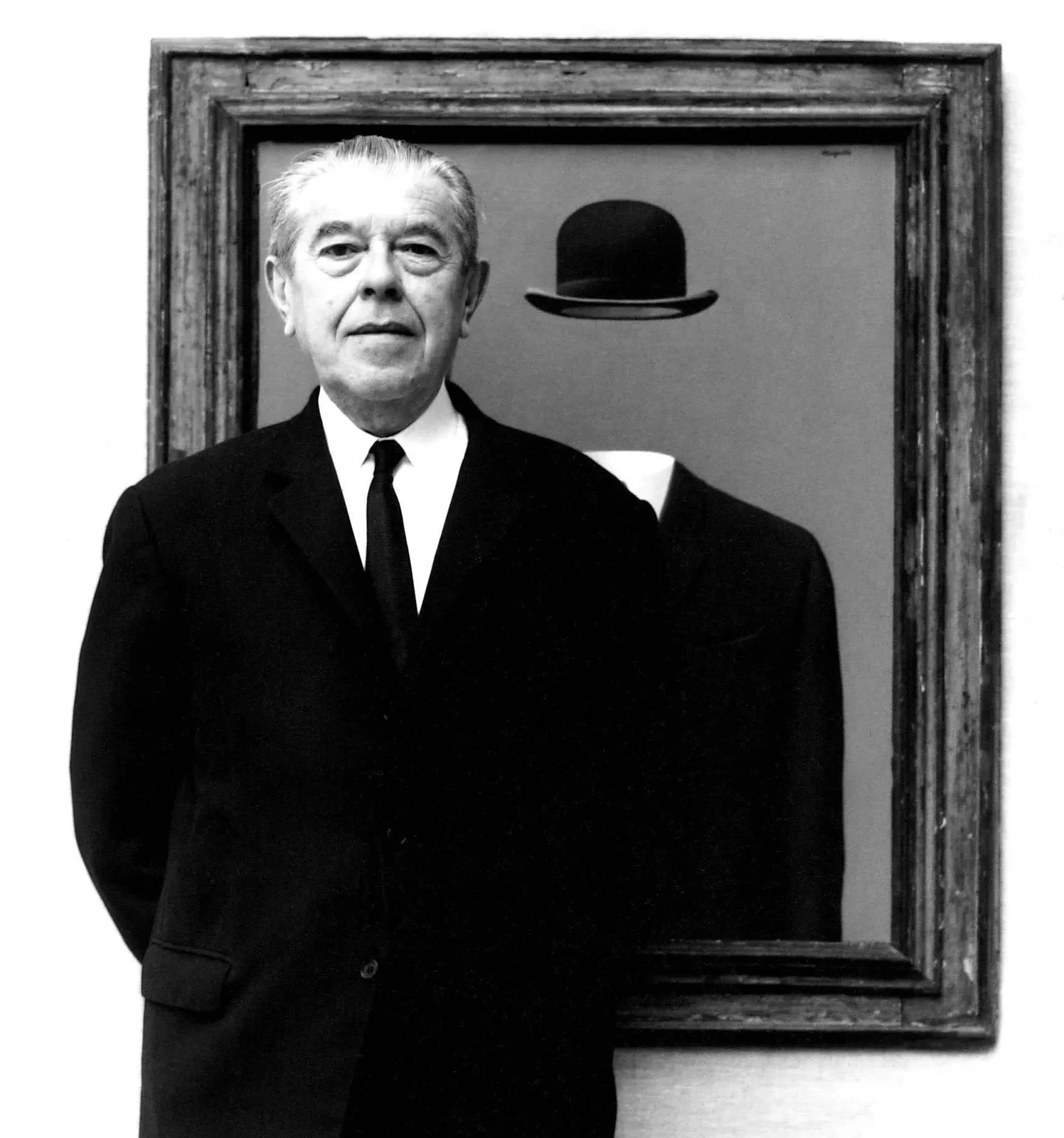
René Magritte (1898–1967) was a towering Belgian Surrealist painter, theorist, and visual philosopher who transformed modern art into a rigorous critique of human perception and linguistic representation. Unlike the French Surrealists who pursued automatic writing, psychoanalytic dreamscapes, and distorted hallucinations, Magritte cultivated a cool, deadpan, and illustrative realism to construct profound visual paradoxes. By methodically severing ordinary objects—bowler hats, pipes, green apples, mirrors, and clouds—from their habitual contexts and utilitarian functions, he exposed the arbitrary nature of signs, the fragility of sensory confidence, and the unbridgeable chasm between representation and reality. His subversive semiotic investigations profoundly shaped Pop Art, Conceptual Art, and post-structuralist philosophy.
Biographical Genesis and Intellectual Crucible
René François Ghislain Magritte was born on November 21, 1898, in Lessines, Belgium. His youth was marked by itinerant family relocations across industrial Walloon towns and an acute personal catastrophe: in March 1912, when Magritte was thirteen, his mother, Régina Bertinchamps, drowned herself in the River Sambre.[1] Legend held that when her corpse was recovered, her nightdress was wrapped around her face—an image critics persistently linked to Magritte's recurring motifs of veiled heads and smothered identities, though Magritte lifelong repudiated such psychoanalytic reductions.
Between 1916 and 1918, Magritte studied at the Académie Royale des Beaux-Arts in Brussels under Constant Montald, though he found academic training sterile and pedantic.[2] His early artistic output flirted with Impressionism, Cubism, and the mechanical kinetics of Futurism. However, two formative crucibles fundamentally configured his mature method:
- The Commercial Studio and the Craft of Graphic Design: In the early 1920s, Magritte earned his living designing wallpaper for the Peters-Lacroix factory and drafting commercial advertisements, fashion catalogues, and sheet-music covers for Studio Dongo (a cooperative agency he ran with his brother Paul).[3] Far from a distracting compromise, commercial advertising provided Magritte with his signature visual grammar: flat, uninflected brushwork, crisp outlines, literal lighting, and the objective, deadpan clarity of the sales catalogue. He weaponized this bourgeois illustrative clarity against bourgeois complacency itself.
- The Encounter with Metaphysical Art: Around 1922–1923, Magritte was shown a black-and-white reproduction of The Song of Love (Le chant d'amour, 1914) by Giorgio de Chirico (1888-1978). The collision of a classical marble bust, a rubber surgeon's glove, and a railway locomotive profoundly shattered his understanding of painting. As Magritte famously recalled:
"My eyes saw thought for the first time... This triumphant poetry supplanted the stereotyped effect of traditional painting. It represented a complete break with the mental habits of artists who were prisoners of talent, virtuosity, and all the little aesthetic specialities." — René Magritte[4]
De Chirico demonstrated that painting's highest calling was not formal virtuosity, atmospheric impression, or emotional expression, but an epistemological inquiry into the mystery of existence through the poetic displacement of objects.
The Brussels Surrealist Group vs. The Parisian Hegemony
In 1926, Magritte painted what he considered his first authentic Surrealist canvas, The Lost Jockey (Le jockey perdu), and together with poet Paul Nougé, musician E.L.T. Mesens, and Camille Goemans, formed the Belgian Surrealist circle.[5]
When Magritte moved to the Parisian suburb of Le Perreux-sur-Marne in 1927 to join André Breton’s inner circle, ideological tensions quickly emerged:
- Rejection of Automatism: Breton’s Parisian group championed psychic automatism, trance mediums, and irrational psychoanalytic improvisation. Magritte and Nougé rejected automatism as passive, undisciplined self-indulgence. For Magritte, mystery had to be constructed with cool, conscious calculation.
- Resistance to Freudian Dogma: While the Parisians deified Sigmund Freud and combed canvases for neuroses, repressed libido, and dream symbols, Magritte insisted his paintings were deliberate philosophical propositions, not psychiatric symptoms.
- Return to Brussels: Following personal friction with Breton over Magritte’s wife Georgette wearing a crucifix, Magritte returned to Brussels in 1930, establishing his lifelong base in the quiet, suburban domesticity of Jette. He deliberately styled himself as an ordinary, bowler-hatted bourgeois clerk, painting in his dining room with methodical precision, utterly disdaining the romantic myth of the bohemian artist.
The Epistemology of the Ordinary: Severing Image from Reality
Unlike Salvador Dalí’s soft watches and hallucinatory "paranoiac-critical" distortions, Magritte approached the subconscious through hyper-articulated, naturalistic clarity. He deliberately pursued a figurative, almost photographic style to generate visual paradoxes that would, in his own words, "challenge the real world."[1:1]
Magritte’s foundational operational method was contextual displacement (le dépaysement). He extracted mundane, mass-produced objects from their functional, domestic context and forced them into impossible, contradictory, or uncanny arrangements. His ambition was to make everyday things "shriek aloud," forcing the viewer to confront the profound unreliability of sensory perception and the fragility of common-sense reality.[2:1]
     HABITUAL PERCEPTION                MAGRITTEAN DISPLACEMENT
┌─────────────────────────────┐      ┌─────────────────────────────┐
│ Everyday Familiar Object    │      │ Familiar Object Extracted   │
│ Bound to Utilitarian Chain  │ ───► │ Severed from Function/Scale │
│ Perceived Unconsciously     │      │ Juxtaposed with Impossible  │
└─────────────────────────────┘      └──────────────┬──────────────┘
                                                    │
                                                    ▼
                                     ┌─────────────────────────────┐
                                     │     Epistemological Shock   │
                                     │  • Cognitive Dissonance     │
                                     │  • The Uncanny (Unheimlich) │
                                     │  • Deconstruction of Mimesis│
                                     └─────────────────────────────┘
By painting ordinary items (a cloudy sky, an apple, an easel, a candle, a locomotive) with pristine precision, Magritte induced acute Cognitive Dissonance: the viewer's rational intellect recognizes the literal elements, but the mind’s associative architecture fails to reconcile their structural juxtaposition.
The Dialectic of the Visible and the Hidden
A central axiom of Magritte’s philosophical metaphysics is that the visible world is never transparent; it is an opaque screen that simultaneously conceals and excites desire:
"Everything we see hides another thing, we always want to see what is hidden by what we see. There is an interest in that which is hidden and which the visible does not show us. This interest can take the form of a quite intense feeling, a sort of conflict, one might say, between the visible that is hidden and the visible that is present." — René Magritte[6]
In Magritte's cosmology, concealment is not a temporary defect waiting to be corrected by better lighting or closer scrutiny; it is an ontological condition of reality. To reveal one layer of the visible is inevitably to construct another barrier.
Key Motifs in Magritte's Visual Alphabet
Magritte's iconography functioned as an enigmatic, recurring alphabet. He systematically deployed specific objects across decades, deliberately destabilizing their conventional symbolic values:
- The Bowler Hat (Le Chapeau Melon): The quintessential emblem of the anonymous European middle-class clerk. By cladding his protagonists—and himself—in bowler hats, Magritte obliterated individual heroism, transforming the human subject into a faceless, mass-produced unit. It represents both bourgeois conformity and the ultimate camouflage for an artistic saboteur.
- The Green Apple: An object of crisp geometric simplicity that Magritte deployed to disrupt human scale, hover weightlessly before faces, or expand into room-filling monuments (The Listening Room). It evokes biblical temptation while refusing religious allegory, operating purely as an instrument of perceptual obstruction.
- Skies, Clouds, and Birds: Cumulus clouds drifting across azure skies are framed within eyes (The False Mirror), cut into wooden silhouettes (The Flavour of Tears), or hybridized into birds made entirely of sky (The Return, The Large Family). Magritte collapses the distinction between interior contemplation and exterior infinity.
- Curtains, Windows, and Easels: Theatrical thresholds that interrogate the Renaissance definition of painting as an open window onto the world (Leon Battista Alberti's finestra aperta). Magritte continually fractures this window, proving that the vista is an opaque painted surface.
- Petrification and Gravitational Defiance: Heavy stone boulders float effortlessly across skies (The Castle of the Pyrenees), or organic living bodies, tables, and landscapes are turned to petrified granite (The Domain of Arnheim, The Song of the Violet), inverting physical laws while preserving surface texture.
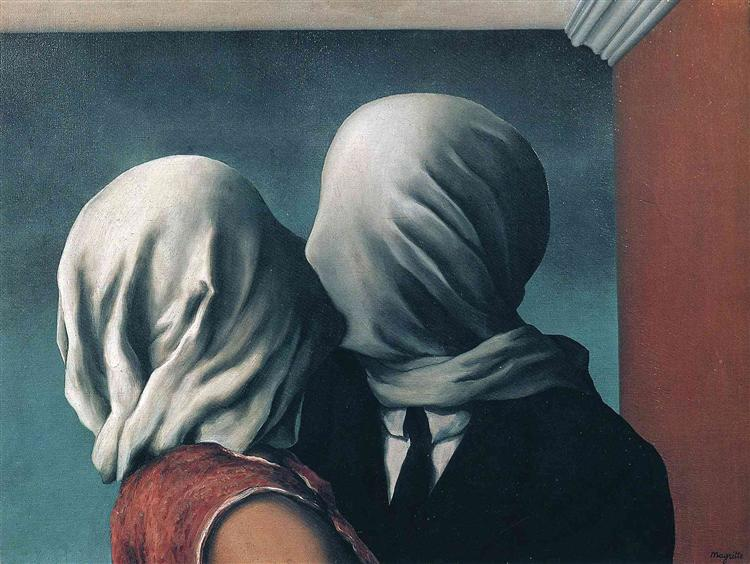
Biographers persistently argue that the recurring motif of fabric-veiled heads (as in The Lovers, The Story of Central, and The Invention of Life) originates in the childhood trauma of seeing his mother's water-soaked nightgown covering her dead face.
Magritte fiercely rejected this biographical determinism, warning that psychoanalysis reduces philosophical mystery to trivial pathology. For Magritte, fabric masks do not represent a dead mother; they represent the structural blindness inherent in human vision and the impossible barrier separating two conscious minds attempting intimate union.[4:1]
Semiotic Subversion: Words, Images, and Michel Foucault
Magritte was not merely a painter; he was a pioneering semiotician. In December 1929, he published an illustrated manifesto titled "Les Mots et les Images" (Words and Images) in the final issue of La Révolution surréaliste.[5:1] Across eighteen illustrated propositions, Magritte systematically dismantled the traditional relationship between language, visual representation, and material reality:
- "An object is not so possessed of its name that one cannot find for it another which suits it better."
- "Everything tends to make one think that there is little connection between an object and that which represents it."
- "A word can take the place of an object in reality; an image can take the place of a word in a proposition."
Foucault's Deconstruction: Ceci n'est pas une pipe
In 1973, French philosopher Michel Foucault published his celebrated monograph Ceci n'est pas une pipe (This Is Not a Pipe), conducting an exhaustive archaeological critique of Magritte's semiotic strategies, based partly on an exchange of letters with the painter before his death.[7]
                     [ THE MATERIAL REALITY ]
                     (A physical pipe to smoke)
                                ▲
                    Fissure /   │   Arbitrary
                   Ontological  │   Connection
                      Void      │
                                ▼
[ THE PAINTED IMAGE ] ◄──────────────────► [ THE WRITTEN TEXT ]
 (Visual representation;                    (Linguistic signifier;
   oil on canvas)                             "Ceci n'est pas une pipe")
Foucault identified that Western painting since the Renaissance had relied on two fundamental, tacit axioms:
- The Subordination of Language to Image (or vice versa): Text and image were strictly separated; either text illustrated the canvas or the canvas illustrated the text.
- The Equivalence of Resemblance and Affirmation: To paint a recognizable likeness of an object was implicitly to declare: "This is that object."
Magritte violently shattered both axioms simultaneously:
- Resemblance vs. Similitude: Resemblance presupposes a primary, sovereign original model that commands and validates its copies. Similitude, by contrast, operates through a lateral network of circulating copies that lack any foundational origin. Magritte’s painted pipe resembles a pipe, but does not assert identity with it.
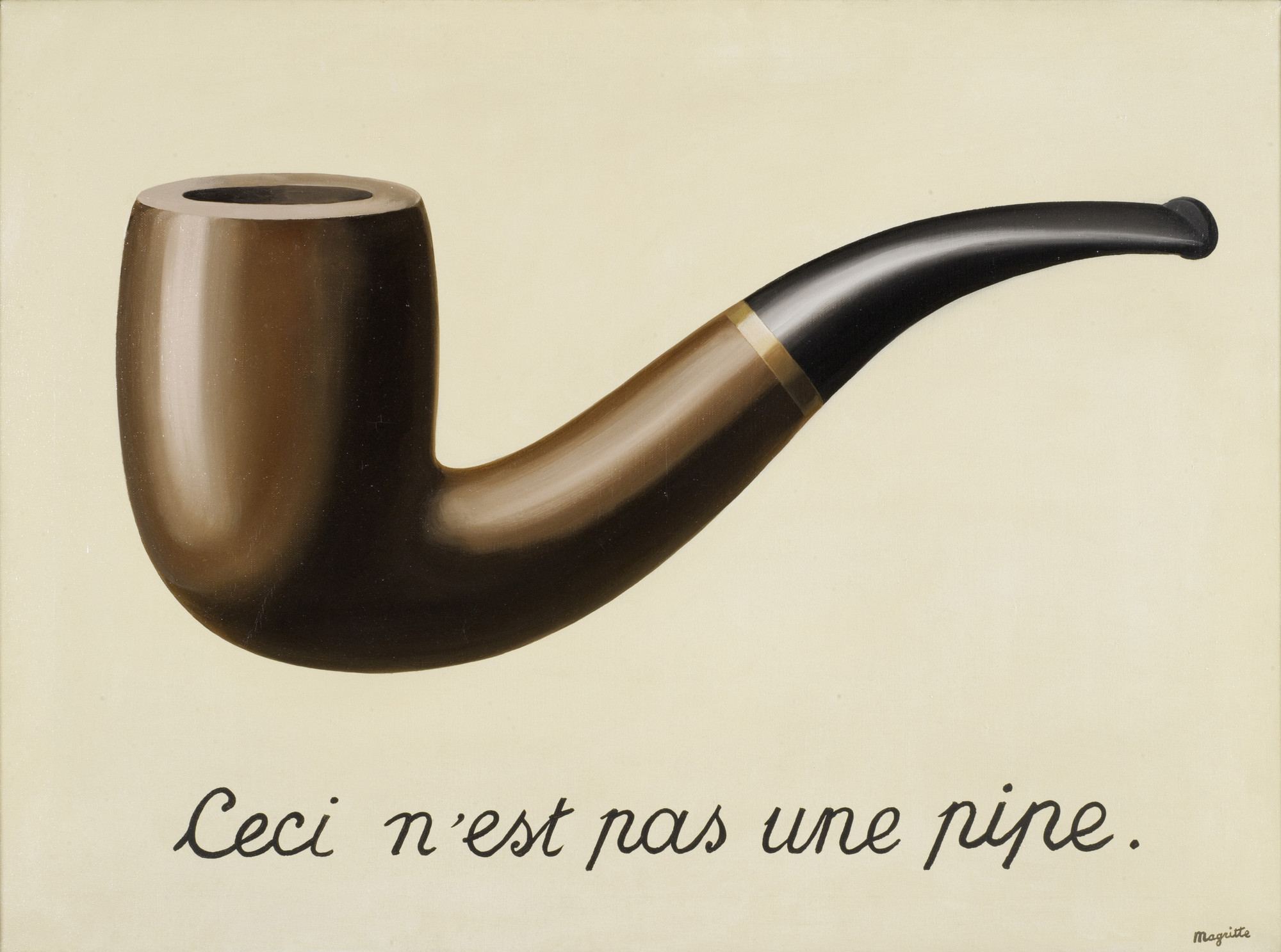
- The Collapsed Calligram: Magritte constructs the canvas like an unraveled calligram—a form where words traditionally outline the shape of the thing they name. By placing the script "Ceci n'est pas une pipe" beneath the hyper-realistic image, the text explicitly denies what the eye instinctively asserts. The word "Ceci" (This) is radically ambiguous: Does it refer to the painting? The sentence itself? The act of representation? The pipe that is absent?
- The Empty Canvas: Foucault demonstrated that Magritte systematically hollowed out the visual field, leaving an ontological void where neither the signifier, nor the signified, nor the referent can claim sovereignty. Representation is unmasked as an autonomous linguistic and visual game.
Stylistic Mutinies: The "Renoir" and "Vache" Periods
While Magritte is globally recognized for his polished, deadpan technique, he executed two deliberate, radical disruptions of his own style during the 1940s:
1. The "Renoir Period" / "Sunlit Surrealism" (1943–1947)
Living in occupied Brussels during World War II, surrounded by Nazi terror, deportation, and rationing, Magritte refused to paint dark, grim apocalyptic allegories. Instead, he staged a subversive aesthetic rebellion: he adopted the bright, feathery brushwork, luminous pastel palette, and sensual warmth of Pierre-Auguste Renoir.[8]
Magritte termed this phase "Sunlit Surrealism" (Surréalisme en plein soleil). He declared that the artist's duty in times of overwhelming misery was not to mirror despair, but to restore charm, joy, and spiritual vitality to human consciousness. Though baffled critics and orthodox Surrealists condemned the canvases as bourgeois kitsch, Magritte viewed them as radical acts of psychological resistance.
2. The "Vache Period" (Période Vache, May 1948)
In 1948, invited by the Parisian gallery Galerie du Faubourg to stage his first major post-war solo exhibition in Paris, Magritte launched an aggressive assault on the Parisian cultural establishment.[9] Resenting the historical condescension of French critics toward Belgian art, Magritte produced approximately thirty paintings and gouaches in less than six weeks.
Executed in a violently crude, garish, and deliberately amateurish style—reminiscent of comic strips, folk art, Fauvism, and crude caricatures—this became known as the Période Vache ("Cow Period"):
- Figures were depicted with swollen noses, pipe-stems jutting from skulls, and garish neon pigments.
- The exhibition catalog contained a mocking preface by Louis Scutenaire praising the works' total lack of seriousness.
- The Parisian public was profoundly scandalized; not a single canvas sold. Having achieved his objective of mocking the solemnity and commercialism of the French art market, Magritte immediately returned to his signature deadpan figurative style, having demonstrated that style itself is merely an arbitrary costume.
Masterpieces and Critical Analysis
Magritte's major canvases function as rigorous philosophical treatises executed in paint:
The Treachery of Images (La Trahison des images, 1929)
Perhaps his most philosophically enduring work, The Treachery of Images depicts a meticulously rendered briar pipe hovering above flowing cursive schoolbook script: "Ceci n'est pas une pipe" ("This is not a pipe"). This canvas serves as a manifesto against the naive realism of visual culture. It generates instant cognitive friction by dividing a single concept into two warring sign systems (the pictorial sign and the linguistic sign). Magritte exposes the foundational error of human perception: confusing the representation with the thing represented. As Magritte pithily remarked: "Could you stuff my pipe? No, it's just a representation, is it not? So if I had written on my picture 'This is a pipe,' I would have been lying!"[5:2] The work forms the cornerstone for structuralist semiotics, Jacques Lacan's split subject, and post-structuralist media theory.
The Son of Man (Le Fils de l'homme, 1964)
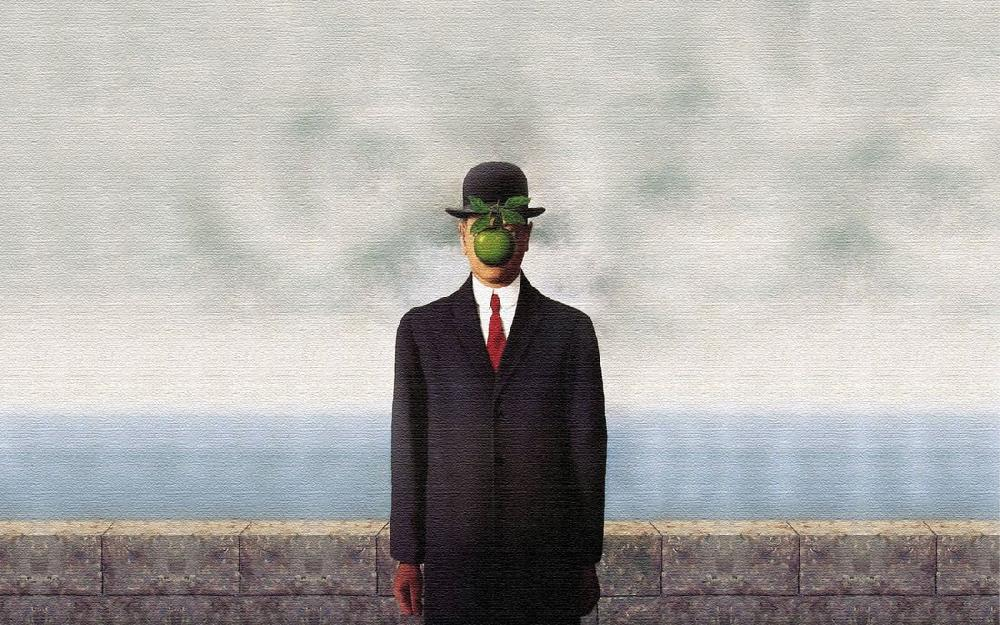
Painted as a self-portrait late in his career, The Son of Man stands as a radical subversion of traditional portraiture and bourgeois identity. A stiffly posed man in a charcoal overcoat and bowler hat stands before a low sea wall and a cloud-swept sky. Directly in front of his face hovers a vibrant green apple, nearly concealing his features save for a single eye peering through the leaves. The portrait delivers all the conventional social signifiers of identity, class, and respectability, only to deny the viewer the essential revelation of the human countenance.[6:1] It operates as an existential meditation on the relentless conflict between what is visible and what is hidden by the visible, illustrating that even in the most intimate encounters, human identity remains perpetually masked.
The Lovers (Les Amants, 1928)
Executed during his intense Parisian period, The Lovers portrays two figures locked in a passionate embrace, their heads completely swathed in white fabric as they attempt to kiss through the cloth barrier. Set against an ambiguous domestic wall and moulding, the canvas transforms an act of intimate communion into an experience of profound isolation, blindness, and sensory frustration.[7:1] The fabric operates as an insurmountable barrier, visually externalizing the impossibility of absolute interpersonal knowledge: even in love's closest proximity, human beings remain ultimately unknowable, separated by the opaque fabrics of ego, projection, and language.
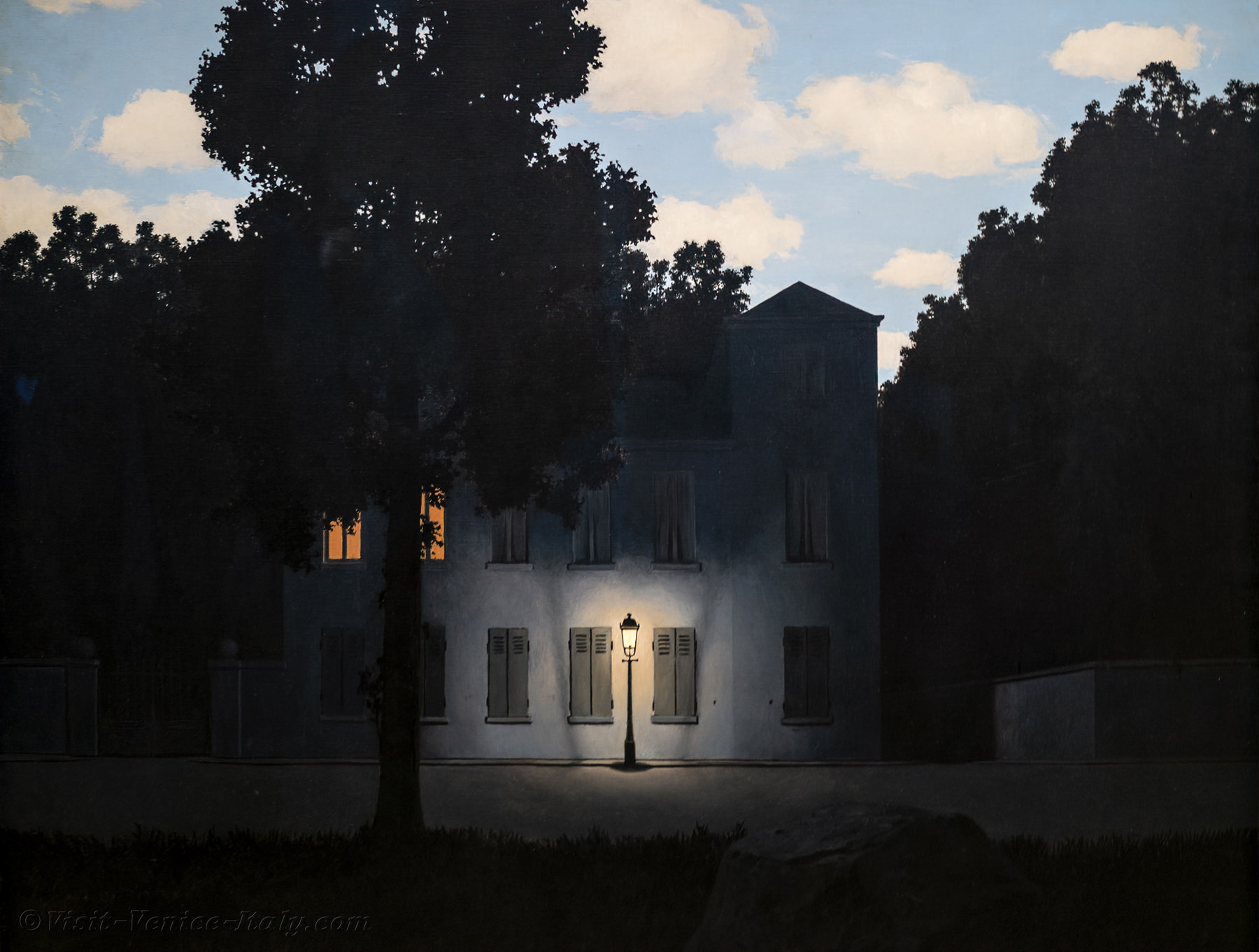
The Empire of Light Series (L'Empire des lumières, 1949–1964)
Across twenty-seven oil paintings and gouaches, Magritte executed this definitive exploration of temporal paradox. A tranquil, shadowy bourgeois street scene—enshrouded in deep nocturnal darkness and illuminated by a solitary glowing streetlamp—is crowned by an expansive, luminous daylight sky filled with soft white cumulus clouds.[8:1] By unifying two mutually exclusive temporal states (day and night) into a single, seamless, and optically unified composition, Magritte achieves visual poetry without resorting to physical distortion. The image induces quiet cognitive wonder: rational logic declares the landscape impossible, yet visual perception accepts it as harmonious and serene.
Supplementary Critical Works
- The Human Condition (La Condition humaine, 1933): An easel bearing a painted landscape is positioned directly in front of an open window, perfectly aligning with and concealing the real landscape outside. Magritte exposes the fundamental illusion of painting: the viewer automatically assumes the painted canvas matches the reality behind it, yet there is no external reality accessible to human consciousness except through mediated representations. The map entirely subsumes the territory.
- Not to Be Reproduced (La Reproduction interdite, 1937): Commissioned by surrealist patron Edward James, the portrait depicts a man standing before a mantelpiece mirror, looking into the glass. However, the mirror reflects not his face, but the back of his head once more, while an open copy of Edgar Allan Poe's The Narrative of Arthur Gordon Pym of Nantucket lying on the mantel is reflected accurately. The painting sabotages the primary mechanism of human self-recognition (the Lacanian mirror stage), depicting an uncanny universe where the human subject is barred from self-knowledge while inanimate consumer objects obey optical laws.
- Golconda (1953): Countless identical men in overcoats and bowler hats hover suspended in mid-air across a suburban streetscape of red-roofed buildings, arrayed like a vast geometric lattice. Magritte balances individuality against mass conformity: each figure is painted distinctly, yet their sheer multiplication reduces them to static raindrops of uniform bourgeois existence.
Structural Comparison: Magritte's Semiotic Mechanisms
| Work | Primary Iconography | Perceptual / Semiotic Mechanism | Philosophical Implication |
|---|---|---|---|
| The Treachery of Images (1929) | Realistic pipe over cursive script | Verbal-Visual Contradiction: Split between linguistic label and painted signifier | Severance of signifier, signified, and physical referent; exposure of mimesis as cognitive trickery. |
| The Human Condition (1933) | Easel seamlessly aligned over window view | Trompe-l'œil Collapse: Seamless merging of representation and represented space | Perception as internal mental projection; human inability to access unmediated objective reality. |
| The Empire of Light (1954) | Daytime sky over nocturnal streetscape | Temporal Binarism: Simultaneous unification of mutually exclusive states of time | Defiance of non-contradiction; creation of poetic mystery through harmonious visual impossibility. |
| The Lovers (1928) | Kissing figures shrouded in wet fabric | Tactile & Visual Enclosure: Intimate contact barred by opaque barrier | Existential estrangement; the radical opacity and unknowability of the human subject to others. |
| Not to Be Reproduced (1937) | Mirror reflecting back of subject's head | Reflective Sabotage: Violation of optical symmetry and self-identification | Disruption of the ego; subversion of self-recognition and the Lacanian mirror stage. |
| Golconda (1953) | Grid of suspended bowler-hatted men | Serial Multiplication: Repetition of identical bourgeois figures in space | Annihilation of unique individuality; humans reduced to mass-produced units and social wallpaper. |
Legacy and Influence on Contemporary Art
Magritte’s intellectualized approach to the canvas—shifting the primary purpose of art from aesthetic contemplation or expressive emotion to an epistemological inquiry into how signs generate meaning—radically emancipated 20th-century culture from traditional easel painting.
                    [ RENÉ MAGRITTE ]
              (Painting as Thought & Semiotic Riddle)
                                │
        ┌───────────────────────┴───────────────────────┐
        ▼                                               ▼
  [ POP ART ]                                  [ CONCEPTUAL ART ]
  • Andy Warhol: Deadpan commodity             • Joseph Kosuth: One and Three
    repetition, commercial flatness              Chairs (Object, Photo, Definition)
  • Ed Ruscha: Text-over-landscape,            • John Baldessari: Text-image
    linguistic signboards                        interrogations, erasing faces
  • Jasper Johns: Targets, flags,              • Marcel Broodthaers: Museum
    numbers as painted signs                     critiques, eagles, open poetry
                                │
                                ▼
                 [ POSTMODERN MEDIA THEORY ]
                 • Michel Foucault: Ceci n'est pas une pipe
                 • Jean Baudrillard: Defining a Simulacrum
                 • Advertising & Visual Semiotics
- Pop Art: In the 1960s, American Pop artists embraced Magritte’s deadpan, commercial illustrative precision. Andy Warhol adopted Magritte’s repetitive serialization of everyday commodity icons (soup cans, dollar bills). Jasper Johns found in Magritte permission to paint signs (flags, targets, stenciled numbers) that are simultaneously the object and its representation. Ed Ruscha directly inherited Magritte’s radical synthesis of typography, landscape, and linguistic absurdity.
- Conceptual Art: Magritte is the direct intellectual forefather of Conceptual Art. In 1965, Joseph Kosuth created One and Three Chairs—exhibiting a physical wooden folding chair, a photographic print of that chair, and a dictionary definition of the word "chair." This landmark conceptual work is the direct, unmediated offspring of Magritte’s The Treachery of Images and Words and Images. Artists such as John Baldessari systematically deployed Magritte’s techniques of obscuring human faces with solid colored dots and juxtaposing ironic text with photographic reality.
- Postmodern Media and the Simulacrum: In an era dominated by hyper-saturated media environments, digital interfaces, and virtual simulations, Magritte’s deconstruction of representation anticipates Jean Baudrillard’s theory of the simulacrum. When digital copies circulate without reference to an underlying physical reality, Magritte's paintings serve as the foundational intellectual warning against confusing media representations with living truth.
🎴 Interactive Web Practice (Comprehension Check)
Question 1 (The Semiotic Rift): In The Treachery of Images (1929), why does René Magritte assert that writing "This is a pipe" would have been a lie, and how does Michel Foucault's analysis of the painting dismantle traditional Western mimesis?
Answer: Magritte asserts that writing "This is a pipe" would be a lie because the object on the canvas is merely oil pigment configured on fabric—it cannot be filled with tobacco, lit, or smoked. It is a pictorial representation, not the physical entity itself. In his 1973 analysis Ceci n'est pas une pipe, Michel Foucault demonstrates that Magritte dismantles two foundational axioms of Western art since the Renaissance: the strict subordination of text to image (or image to text) and the assumption that resemblance carries affirmative ontological truth (that an accurate depiction equals the object). By setting a cursive linguistic denial beneath a hyper-realistic visual signifier, Magritte disrupts the calligram, creating an irreconcilable fissure between the word, the image, and the referent. The canvas exposes the "efficient error" of human perception—our habitual mistake of conflating representations with objective reality.
Question 2 (Contextual Displacement & The Epistemology of the Ordinary): How does Magritte's method of "displacement" (dépaysement) diverge from Salvador Dalí's Surrealist techniques, and through what psychological mechanisms does it induce cognitive dissonance?
Answer: Salvador Dalí relied on psychological automatism, distorted hallucinations, and melted, oneiric forms (the "paranoiac-critical method") to visualize the irrational dreamscape of the Freudian subconscious. In contrast, René Magritte approached the subconscious through cold, deadpan, and illustrative realism, depicting ordinary, mass-produced items (bowler hats, apples, combs, streetlamps) with pristine clarity. Magritte’s method of displacement extracted these familiar objects from their expected utilitarian contexts and reassembled them in impossible or contradictory configurations (such as a nighttime street beneath a daytime sky in The Empire of Light). This generates acute cognitive dissonance and the Freudian uncanny (das Unheimliche): the viewer's rational intellect instantly identifies each ordinary object, but the brain cannot integrate their contradictory spatial or temporal arrangement, forcing the observer to confront the unreliability of habitual sensory perception.
Question 3 (The Bowler Hat & Bourgeois Camouflage): What philosophical and sociological role does the recurring figure of the bowler-hatted man play in Magritte's iconography, particularly in works like The Son of Man and Golconda?
Answer: The bowler hat functioned in early-to-mid 20th-century Europe as the standard uniform of the middle-class clerk, representing anonymous bourgeois conformity, social standardization, and the erasure of heroic individuality. In works like The Son of Man, Magritte adopts this anonymous archetype to subvert traditional portraiture: the subject possesses all the social markers of respectable identity, yet his face is obstructed by a hovering green apple, illustrating the existential tension between what is visible and what is concealed. In Golconda, Magritte serializes the bowler-hatted man across a suburban grid, transforming human individuals into identical, suspended raindrops of mass-produced existence. Crucially, the bowler hat also served as personal camouflage for Magritte himself: by dressing as a conventional clerk and painting in his tidy dining room, he rejected the romantic myth of the flamboyant, bohemian artist, operating as a subversive visual philosopher in plain sight.
Resonant Notes
The following notes in the vault share direct thematic, philosophical, and aesthetic connections with René Magritte's art and philosophy:
🔴 The Uncanny, Perception & Cognitive Estrangement
- Giorgio de Chirico (1888-1978) — The profound artistic catalyst for Magritte's career. De Chirico's Pittura Metafisica—with its deserted piazzas, decontextualized objects, and metaphysical stillness in The Song of Love—revealed to Magritte that painting could depict thought itself and use contextual displacement to rupture everyday perception.
- Freud's The Uncanny (Das Unheimliche) & Sigmund Freud — Magritte's displacement method systematically stages das Unheimliche: extracting the familiar, domestic, and ordinary (heimlich) and rendering it alien, alarming, and strange (unheimlich) through impossible arrangements.
- On the Psychology of the Uncanny (Zur Psychologie des Unheimlichen) — Ernst Jentsch's foundational concept of intellectual uncertainty—where the mind cannot reconcile whether a perceived object obeys natural laws—identifies the exact cognitive tension produced by Magritte's weightless boulders and veiled faces.
- The Uncanny Valley (不気味の谷現象) — Magritte's faceless everymen and cloth-shrouded lovers evoke the perceptual recoil of the uncanny valley, presenting human forms that possess all exterior signals of life while denying the vital expressive humanity of the face.
- Anthony Vidler-The Architectural Uncanny — Vidler's thesis that the uncanny erupts when the secure domestic envelope is defamiliarized directly corresponds to Magritte's canvases, where bourgeois living rooms, windows, fireplaces, and streetlamps become sites of spatial estrangement.
- The Interface Theory of Perception (ITP) — Donald Hoffman's cognitive model demonstrates that human perception is an evolved desktop interface rather than a veridical window on objective reality, providing a modern neuro-computational validation of Magritte's thesis that our mental images must never be mistaken for the territory.
- Gestalt Psychology-The Mechanics of the Whole — Magritte systematically manipulates Gestalt principles (figure-ground segregation, closure, and visual grouping) in works like The Blank Signature and The Human Condition, sabotaging the brain's automatic drive to construct unified visual wholes.
- Louis Sass - Phenomenological Psychopathology and the Self — Sass's analysis of hyperreflexivity and the "truth-taking stare"—where ordinary objects lose their tacit, functional background and appear starkly isolated with eerie significance—provides the psychiatric counterpart to Magritte's decontextualized objects.
- Cognitive Dissonance — Magritte's visual paradoxes generate acute cognitive friction by forcing the mind to hold two irreconcilable cognitions simultaneously (e.g., daytime sky and nighttime street in The Empire of Light).
🟡 Semiotics, Representation & Postmodern Simulation
- Michel Foucault — Author of Ceci n'est pas une pipe (1973), Foucault provided the definitive philosophical treatise on Magritte, dissecting how the painter collapsed the Renaissance harmony of language and resemblance to expose representation as an autonomous, ungrounded network.
- Jacques Lacan — Magritte’s The Treachery of Images visually enacts Lacan’s radical bar of repression between signifier and signified (
), while Not to Be Reproduced subverts the Lacanian mirror stage by barring the subject from self-recognition. - Defining a Simulacrum — Jean Baudrillard’s hyperreality is the ultimate cultural culmination of Magritte’s project: if Magritte warned that the painted pipe is not the object, Baudrillard describes a postmodern media landscape where copies have entirely replaced originals, generating pure simulacra.
- Marshall McLuhan (1911-1980) & McLuhan's The Medium is the Message — Magritte's dissection of visual signboards and print advertising anticipates McLuhan's insight that the sensory grammar of the medium reshapes human cognition far more than its nominal content.
- The Work of Art in the Age of Mechanical Reproduction & Walter Benjamin (1892–1940) — Magritte's flat, uninflected commercial painting technique and serial motifs deconstruct the unique ritual "aura" of high art, embracing the reproductive, graphic clarity of mass-circulated visual media.
🟢 Modernist Avant-Garde, Aesthetics & The Divided Subject
- Guillaume Apollinaire (1880–1918) — The avant-garde theorist who coined the term surréalisme and pioneered typographical ideograms in Calligrammes, directly anticipating Magritte's experimental fusion and collision of text and painting.
- Paul Klee (1879–1940) — Master of modern visual epistemology whose exploration of graphic symbols, musical counterpoint, and semiotic runes parallels Magritte's investigation of painting as an intellectual language of signs.
- The Dehumanization of Art — José Ortega y Gasset’s 1925 diagnostic on modern avant-garde art stripping away sentimentalism, subjective emotional empathy, and literal mimesis in favor of pure conceptual form perfectly encapsulates Magritte's cool, anti-sentimental figurative puzzles.
- Continental Philosophy — Magritte occupies a central position in the visual branch of 20th-century continental philosophy, translating the phenomenological skepticism of Husserl and Heidegger into direct pictorial interrogations of Being and appearance.
References
Museum of Modern Art (MoMA) / René Magritte Biography / moma.org ↩︎ ↩︎
Anne Umland / Magritte: The Mystery of the Ordinary, 1926–1938 / The Museum of Modern Art, New York ↩︎ ↩︎
David Sylvester / Magritte: The Silence of the World / Harry N. Abrams ↩︎
James Thrall Soby / René Magritte / The Museum of Modern Art, New York ↩︎ ↩︎
Suzi Gablik / Magritte / Thames & Hudson ↩︎ ↩︎ ↩︎
Harry Torczyner / Magritte: Ideas and Images / Harry N. Abrams ↩︎ ↩︎
Michel Foucault / This Is Not a Pipe / Translated and edited by James Harkness / University of California Press ↩︎ ↩︎
Sarah Whitfield / Magritte / The South Bank Centre / Hayward Gallery ↩︎ ↩︎
Marcel Paquet / René Magritte: Thought Rendered Visible / Taschen ↩︎