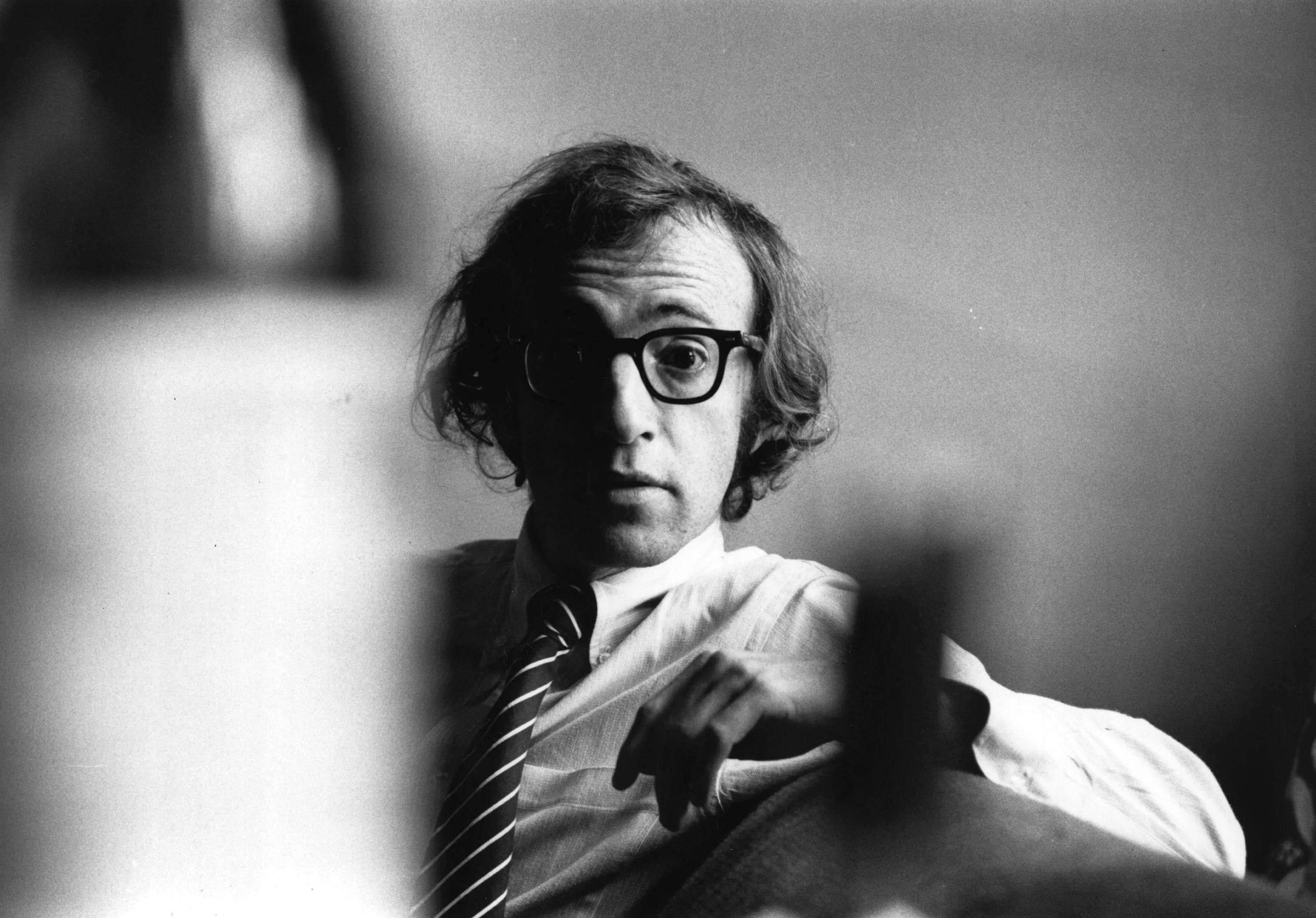
Woody Allen
Woody Allen’s cinematic canon serves as an incisive tragicomic diagnosis of the modern intellectual's existential predicament. Through neurotic, hyper-articulate urban protagonists, Allen maps the psychology of the "Square"—a thinker acutely aware of cosmic meaninglessness, mortality, and moral ambiguity who retreats into bourgeois convention, compulsive psychoanalysis, and aesthetic escapism to evade the terrifying burden of radical freedom.
The Terror of Freedom and the Intellectual Abyss
Throughout Woody Allen's filmography, the modern urban intellectual is paralyzed by an acute awareness of mortality and the absolute meaninglessness of a post-religious, post-metaphysical universe.[1] His central characters—professors, television writers, comedy performers, and physicians—are steeped in European existentialism, citing Kierkegaard, Sartre, Nietzsche, and Ernest Becker (The Denial of Death). Yet far from conferring liberation or spiritual autonomy, this high-level intellectual sophistication acts as a source of unrelenting dread.[2]
The Allen protagonist is caught in a fundamental existential contradiction: an instinctive, desperate hunger for cosmic meaning and moral order pitted against the crushing certainty of an indifferent universe. Having recognized that neither transcendent providence nor absolute moral imperatives exist, the intellectual is left wholly responsible for inventing their own purpose ex nihilo. Rather than welcoming this radical freedom as an invitation to authentic self-actualization, Allen's characters experience it as a dizzying, paralyzing abyss—a state of perpetual existential anguish (angst) that stalls action and poisons romantic fulfillment.
The "Square" Condition: Bourgeois Convention as Fortress
To survive this cosmic vertigo, Allen's protagonists systematically adopt the archetype of the intellectual "Square"—the risk-averse conformist directly opposed to the rebellious outsider articulated in Norman Mailer's American existentialism. Mailer's "Hipster" seeks authenticity by leaping into the perilous, violent, and instinctual unknown; Allen's "Square" chooses the protective enclosure of suburban or Upper East Side bourgeois domesticity, cultural prestige, and institutional ritual.
"He adored New York City. He idolized it all out of proportion. Uh, no, make that: he romanticized it all out of proportion. To him, no matter what the season was, this was still a town that existed in black and white and pulsed to the great tunes of George Gershwin." — Manhattan (1979)
In masterworks like Annie Hall (see The Existential Paradox of Annie Hall's Opening Monologue) and Manhattan, characters employ high culture not as an instrument of subversion, but as an elaborate shield against the void.[3] They attend gallery openings, argue the nuances of Ingmar Bergman and Federico Fellini, obsess over academic reputations, and debate political theory in fashionable delis. This cultural snobbery constructs an insular, predictable universe that keeps cosmic chaos at bay. The Square trades existential authenticity for bourgeois security, actively choosing a state of quiet, civilized neurosis over the terrifying danger of true psychic liberation.
Neurosis, Hypochondria, and Psychoanalysis as Defense Mechanisms
The comic signature of Allen's work is generated directly from this friction between philosophical awareness and moral cowardice. The neurotic, hyper-verbal persona is not an accidental quirk, but a sophisticated psychological defense matrix designed to protect the fragile ego from confronting annihilation.
In Allen's cinematic landscape, decades of psychoanalysis never achieve clinical resolution or cure. Instead, the analytic hour functions as a high-status bourgeois sacrament—a ritualized theater where existential dread is comfortably domesticated into harmless self-absorption.
By keeping consciousness hyper-focused on petty grievances, romantic anxieties, and imagined physical ailments, the protagonist successfully evades cosmic dread:
- Hypochondria as Displacement: In Hannah and Her Sisters (1986), Mickey Sachs panics over an imaginary brain tumor. While undergoing medical tests, he is consumed by terror; upon receiving a clean bill of health, he is suddenly confronted by the far worse realization that even without cancer, he is still doomed to die in an indifferent universe. The physical symptom operates as a manageable substitute for unmanageable metaphysical dread.
- Intellectualization: Emotional vulnerability and moral guilt are converted into rapid-fire verbal debate, deflecting authentic feeling through intellectual citations and irony.
- Tendentious Humor: As explored in Freud's Jokes and Their Relation to the Unconscious, jokes serve as psychic release valves. For Allen, self-deprecating comedy discharges unbearable existential anxiety without demanding actual lifestyle change.
The Dostoevskian Crisis: Guilt, Moral Luck, and Cosmic Silence
While Allen's early work approaches existential dread through romantic comedy and parody, his mature dramatic cinema—most notably Crimes and Misdemeanors (1989) and Match Point (2005)—directly transposes Fyodor Dostoevsky's Crime and Punishment into a secular, late-20th-century moral vacuum.[4]
In Crimes and Misdemeanors, prominent ophthalmologist Judah Rosenthal arranges the contract murder of his mistress to safeguard his wealthy marriage, social reputation, and financial security. Allen explicitly interrogates whether a cultured individual can commit murder without facing divine retribution or psychological disintegration:
- The Blind Eyes of God: Judah is haunted by memories of his orthodox religious father, who taught that the eyes of God see all human action. Yet Rosenthal's profession—restoring physical eyesight—contrasts with his metaphysical blindness. The blind Rabbi Ben represents pure, uncorrupted faith, but his physical sightlessness underscores that in the empirical universe, the heavens are silent and unseeing.
- The Evaporation of Guilt: Dostoevsky's Raskolnikov finds redemption through confession, suffering, and spiritual rebirth in Siberia. Rosenthal, by contrast, endures temporary panic and moral anguish, only to discover that with time, guilt simply evaporates. He returns to his champagne galas and social prestige unscathed.
- The Primacy of Moral Luck: In Match Point, Allen removes even the pretense of psychological crisis. The opening image of a tennis ball striking the top of the net—hovering between falling forward or bouncing back—establishes that human survival and moral outcome are dictated by arbitrary chance rather than moral dessert. Chris Wilton murders his lover, escapes detection through a bizarre stroke of luck involving a discarded wedding ring, and flourishes in aristocratic society.
The Catskills Paradox and Romantic Self-Sabotage
Allen's narrative architecture frequently synthesizes the popular Jewish humor of the Catskill Mountains (the Borscht Belt) with the philosophical pessimism of Arthur Schopenhauer.
This dynamic is crystallized in the twin jokes framing the opening of Annie Hall:
- The Catskills Paradox (The Misery of Existence): Life is likened to a resort where "the food at this place is really terrible... and such small portions." The paradox captures the human condition: existence is dominated by physical decay, emotional disappointment, and loneliness, yet human beings cling desperately to it, lamenting how swiftly it vanishes.
- The Groucho Marx Paradox (Romantic Contempt): "I would never want to belong to any club that would have someone like me for a member." Applied to intimate relationships, this psychological mechanism dooms love to self-destruction. The moment a romantic partner reciprocates affection, the protagonist devalues them: if they have low enough standards to love someone as flawed as him, they are disqualified from respect.
In accordance with Schopenhauer's diagnosis that human desire oscillates perpetually between the torment of unfulfilled longing and the boredom of attainment, Allen's characters actively sabotage romantic bliss to preserve the comfortable familiarity of their neuroses.
Illusion, Escapism, and the Consolation of Art
Confronted by the unbearable reality of mortality, physical decline, and moral indifference, Allen's cinema positions artistic illusion not as superficial deceit, but as a vital psychological necessity.
| Thematic Dimension | Classical / Philosophical Precursor | Allen's Cinematic Transposition | Representative Work / Manifestation |
|---|---|---|---|
| Existential Freedom | Sartre (L'être et le néant) & Kierkegaard (The Concept of Anxiety) | Radical freedom experienced not as agency, but as paralyzing dread; retreat into bourgeois convention ("The Square"). | Manhattan (1979); Annie Hall (1977) |
| Transgression & Justice | Dostoevsky (Crime and Punishment) | Murder committed without cosmic consequence; guilt as an impermanent psychological discomfort; reign of moral luck. | Crimes and Misdemeanors (1989); Match Point (2005) |
| Ego Defenses & Death | Freud (The Ego and the Id) & Ernest Becker (The Denial of Death) | Psychoanalysis as ritual performance; hypochondria as manageable proxy for mortal annihilation. | Hannah and Her Sisters (1986); Deconstructing Harry (1997) |
| Aesthetic Illusion | Friedrich Schiller & Schopenhauer (Aesthetic Contemplation) | Cinema and magical fantasy serving as temporary reprieves from harsh empirical suffering; "we need the eggs." | The Purple Rose of Cairo (1985); Midnight in Paris (2011) |
| Identity & Conformity | Mailer (The Hipster vs. Square) & Lacan (The Imaginary Ego) | Extreme chameleonic transformation to evade social ostracization; total liquidation of the authentic self. | Zelig (1983) |
In The Purple Rose of Cairo (1985), Cecilia escapes the domestic violence and poverty of Great Depression America inside the movie theater, culminating in the fictional character Tom Baxter stepping off the screen to romance her. While Baxter discovers the harshness of real life and Cecilia is abandoned when the Hollywood actor chooses ambition over love, Allen affirms that the cinematic daydream, however fragile, is the only shelter humanity possesses against cosmic coldness.
As Alvy Singer concludes at the end of Annie Hall, relationships and human life are utterly irrational, painful, and absurd, "but we keep going through it because most of us need the eggs."
🎴 Interactive Web Practice (Comprehension Check)
Question 1 (Existential Dread & The "Square"): How does Woody Allen's portrayal of the urban intellectual redefine Norman Mailer's archetype of the "Square," and why does hyper-intellectualism fail to produce Sartrean authenticity?
Answer: In Norman Mailer's existential framework, the "Square" is the conformist who submits to bureaucratic routine and suburban security to avoid the dangerous friction of life, contrasted with the "Hipster" who embraces instinct, risk, and marginality. Allen adapts this dynamic to the high-culture urban intelligentsia. His protagonists read Sartre, Kierkegaard, and Becker, understanding conceptually that God is absent and human beings are radically free. However, rather than translating this recognition into authentic self-creation (which Sartre demands), Allen's intellectuals are paralyzed by the burden of absolute responsibility. They use their formidable intellects defensively—retreating into Upper East Side brownstones, dinner party debates, and cultural snobbery. Intellectualization and aesthetic consumption become an impenetrable fortress against the abyss, turning high philosophy into an instrument of Sartrean bad faith (mauvaise foi).
Question 2 (Morality, Guilt & Cosmic Silence): How do Crimes and Misdemeanors and Match Point secularize Dostoevsky's Crime and Punishment, particularly regarding the role of conscience and moral luck?
Answer: Dostoevsky's Crime and Punishment is structured around a metaphysical moral order: Raskolnikov's transgression disintegrates his psyche because human conscience is divinely attuned to moral truth, ensuring that confession, suffering, and spiritual redemption are inescapable. In contrast, Allen's films secularize the narrative into a godless universe characterized by cosmic silence. In Crimes and Misdemeanors, Dr. Judah Rosenthal arranges his mistress's murder and discovers that guilt is merely a biological and social conditioning reflex that gradually fades with time; once past the initial panic, he resumes his affluent lifestyle with zero cosmic retribution. In Match Point, Allen underscores the supremacy of "moral luck": Chris Wilton's evasion of justice hinges entirely on a tennis ball-like bounce of an incriminating ring off a railing. By showing that the wicked prosper while the righteous (such as the blind Rabbi Ben) are marginalized, Allen rejects providential justice in favor of existential absurdity.
Question 3 (Psychoanalysis, Humor & Defense Mechanisms): How do Freudian psychoanalysis, hypochondria, and Borscht Belt comedy operate as ego defense mechanisms rather than therapeutic cures in Allen's work?
Answer: In traditional clinical psychology, psychoanalysis aims to bring repressed unconscious material into conscious awareness to achieve integration and cure. In Allen's cinematic universe, however, decades of analysis serve as a chronic, institutionalized defense mechanism. Engaging in perpetual self-interrogation allows the neurotic protagonist to simulate self-improvement without ever risking behavioral change. Similarly, hypochondria operates as psychological displacement: worrying obsessively about a phantom brain tumor or heart condition provides an acute, manageable problem that temporarily diverts consciousness from the unmanageable metaphysical terror of universal mortality (as diagnosed in Ernest Becker's terror management framework). Finally, drawing on Freud's Jokes and Their Relation to the Unconscious and Catskills vaudeville, tendentious humor acts as a psychic safety valve—diffusing unbearable existential dread through irony and self-deprecation, allowing the ego to acknowledge cosmic futility while preserving daily bourgeois functioning ("needing the eggs").
Resonant Notes
The following notes in the vault share direct thematic, sociological, and literary connections with Woody Allen:
🔴 Philosophical & Existential Roots
- The Existential Paradox of Annie Hall's Opening Monologue — Explores the seminal opening sequence of Annie Hall, tracing how Alvy Singer's Borscht Belt jokes synthesize Schopenhauerian metaphysical pessimism, Freudian romantic self-sabotage, and the absurd clinging to existence.
- Jean-Paul Sartre — Allen's neurotic urbanites are definitive character studies in Sartrean bad faith (mauvaise foi); terrified of radical freedom and the responsibility of constructing an authentic essence, they flee into rigid social roles and bourgeois intellectual routines.
- Søren Kierkegaard — Allen's protagonists inhabit Kierkegaard's Aesthetic Sphere, seeking temporary novelty, ironic distance, and romantic distraction to stave off ethical commitment and existential anxiety (angst).
- Schopenhauerian Pessimism — Serves as the metaphysical engine of Allen's worldview; life swings like a relentless pendulum between suffering and boredom, with compulsive artistic output, humor, and romantic delusion providing temporary reprieves from the blind Will.
- Albert Camus — Allen dramatizes the Absurd—the irreconcilable clash between human longing for meaning and the silence of an indifferent universe. Where Camus commands lucid revolt and heroic defiance, Allen's comic antiheroes settle for neurotic retreat and self-mocking compromise.
- Continental Philosophy — Allen translates abstract Continental philosophy (phenomenology, existential dread, the critique of the autonomous subject) into an accessible, tragicomic cinematic idiom of contemporary urban life.
🟡 Literary & Psychological Parallels
- Norman Mailer — Mailer's seminal distinction between the risk-taking Hipster and the conformist Square provides the precise sociological diagnosis of Allen's characters: intellectuals who retreat from authentic existential peril into the comfort of convention.
- Fyodor Dostoevsky (1821-1881) — Allen's major moral works (Crimes and Misdemeanors, Match Point, Irrational Man) directly interrogate Crime and Punishment, testing the viability of human conscience, murder, and moral luck in a universe devoid of divine surveillance.
- Sigmund Freud & Jokes and Their Relation to the Unconscious — Freudian psychoanalysis, Oedipal guilt, transference, and ego defense mechanisms (displacement, intellectualization, reaction formation) form the psychological substructure of Allen's entire filmography.
- John Updike's Main Literary Themes — Both Updike and Allen portray the post-war crisis of American male identity, marital dissatisfaction, and death-anxiety, demonstrating how intellectual and spiritual ideals are continually shipwrecked by erotic impulses.
- Viktor Frankl — Frankl's "existential vacuum" and the Tragic Triad (pain, guilt, death) stand as the philosophical foil to Allen: where Frankl argues that meaning must be discovered through heroic attitude in the face of suffering, Allen's protagonists remain paralyzed within cynical rationalization.
- Franz Kafka (1883-1924) — Kafka's claustrophobic alienation, bureaucratic guilt, and surreal anxiety find direct expression in Allen's parodic writings and films like Shadows and Fog and Stardust Memories.
🟢 Cultural, Aesthetic & Narrative Frameworks
- Travis Bickle — Travis Bickle and Allen's neurotic antiheroes represent the two opposite poles of 1970s urban alienation in New York: while Travis weaponizes loneliness into violent vigilantism, the Allen protagonist weaponizes it into compulsive verbal irony and domestic retreat.
- Don DeLillo Major Themes Analysis — Both DeLillo (in White Noise) and Allen recognize that contemporary consumerism, academic posturing, and media saturation serve as elaborate psychological defense systems against mortal terror.
- Ralph Waldo Emerson — Allen's protagonists dramatize the comic collapse of Emersonian self-reliance, perpetually unable to trust inner intuition and remaining dependent on the very institutional orthodoxies they mock.
- The Dehumanization of Art — Ortega y Gasset's analysis of artistic irony and the separation of high aesthetic contemplation from middle-class sentimentalism parallels Allen's reflexivity, fourth-wall breaks, and meta-cinematic staging.
- Northrop Frye's - Anatomy of Criticism — Allen's protagonists embody the Low Mimetic and Ironic modes within Frye's Winter mythos, chronicling the frustration, bondage, and comic paralysis of individuals trapped in an absurd society.
References
Philip Pecorino / Philosophy As Defined in Woody Allen's Films / scribd.com ↩︎
Woody Allen Films / Woody Allen's Influences: How European Cinema and Literature Shaped His Work / medium.com ↩︎
Peter J. Bailey / The Reluctant Film Art of Woody Allen / University Press of Kentucky, 2001 ↩︎
Miao Miao / The Philosophy of “Crime and Punishment” and “Existentialism” in Woody Allen's Film / atlantis-press.com ↩︎