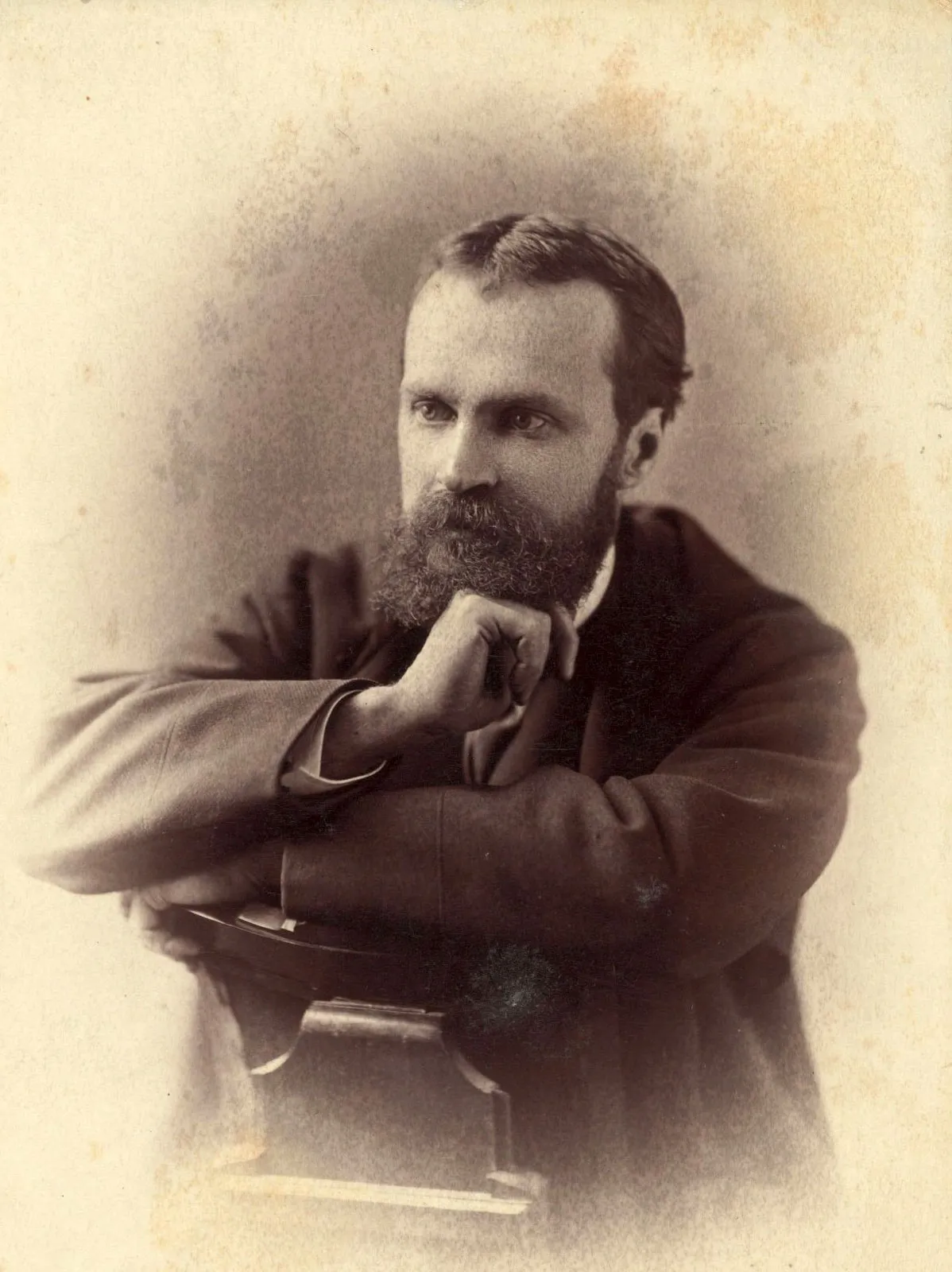
William James (1842–1910)
William James (1842–1910) was a monumental American philosopher, psychologist, and physician widely heralded as the "Father of American Psychology" and a co-founder of philosophical Pragmatism alongside Charles Sanders Peirce and John Dewey.[1] In open revolt against both the sterile rationalism of European absolute idealism and the mechanical determinism of 19th-century associationism, James conceptualized human consciousness not as an aggregate of static, modular building blocks, but as a continuous, teleological stream of consciousness navigating an open-ended, plastic universe.[2] His interdisciplinary framework unites physiological laboratory research, functionalist psychology, cognitive science, and radical metaphysics—encompassing the James-Lange theory of emotion, the plasticity of habit, the transmission theory of consciousness, Radical Empiricism, Pure Experience, the pragmatist theory of truth, and the pioneering phenomenological taxonomy of religious states in The Varieties of Religious Experience.[1:1][3]
1. Epistemological Foundations & Intellectual Trajectory
William James’s intellectual trajectory reflects a lifelong synthesis of biological naturalism, introspective phenomenology, and metaphysical inquiry.[1:2]
| Phase / Intellectual Pillar | Context & Works | Key Focus & Conceptual Breakthrough |
|---|---|---|
| 1. Transatlantic Crucible | Henry James Sr., Swedenborgianism, European schooling | Cosmopolitan upbringing, artistic sensibility, immersion in continental culture. |
| 2. Medical & Laboratory Science | Harvard Medical School (M.D. 1869), Agassiz Expedition (1865), Helmholtz & Wundt | Biological naturalism, physiological empiricism, exposure to German psychophysics. |
| 3. Existential Crisis & Free Will | 1870 crisis; encounter with Charles Renouvier | Volitional affirmation: "My first act of free will shall be to believe in free will." |
| 4. Harvard Academic Evolution | Comparative Physiology (1872) → Lawrence Hall Lab (1875) → Psychology (1889) → Philosophy (1897) | Institutionalization of North American experimental psychology; transition to metaphysics. |
| 5. Functional Psychology | The Principles of Psychology (1890) | Stream of thought, habit & brain plasticity, James-Lange emotion, ideo-motor action. |
| 6. Pragmatism | The Will to Believe (1897) Pragmatism (1907) | Instrumental truth ("cash-value"), anti-block universe, pluralistic meliorism. |
| 7. Radical Empiricism | A Pluralistic Universe (1909) Essays in Radical Empiricism (1912) | Pure Experience, elimination of Cartesian dualism, transmission theory of consciousness. |
The James Family and the Transatlantic Crucible
William James was born at the Astor House in New York City into one of the most culturally gifted intellectual families of 19th-century America.[1:3] His father, Henry James Sr., was an independently wealthy Swedenborgian theologian and intimate friend of Ralph Waldo Emerson, who subjected his children to an eccentric, peripatetic education across boarding schools in Paris, Geneva, London, and Newport.[4]
This rich transatlantic upbringing cultivated William's cosmopolitan worldview, fluency in French and German, and deep artistic sensibility (he initially trained as an oil painter under William Morris Hunt in Newport before pursuing natural science).[1:4] The family produced towering figures of modern literature and biography, including his brother, the novelist Henry James (1843—1916), and his sister, the diarist Alice James.
Medical Training and the 1870 Existential Crisis
In 1861, James entered the Lawrence Scientific School at Harvard, later entering Harvard Medical School in 1864.[1:5] In 1865, he interrupted his studies to join Harvard naturalist Louis Agassiz on an arduous scientific expedition down the Amazon River to collect zoological specimens. The expedition proved transformative: physical exhaustion and a severe bout of smallpox confirmed to James that tedious field taxonomies did not suit his intellectual temper.[4:1]
Continuing his medical studies in Germany (1867–1868), James immersed himself in physiological psychology under the influence of Hermann von Helmholtz and Wilhelm Wundt. Concurrently, he was beset by severe back pain, acute eye strain, chronic digestive agony, and crippling depressive episodes accompanied by intense suicidal ideation.[1:6][4:2]
James's despair was profoundly philosophical: educated in rigorous mechanical determinism, he felt trapped by the premise that if the universe is a closed, clockwork machine ruled by physical causality, human consciousness is an impotent epiphenomenon and moral freedom is an illusion.[1:7]
The decisive turning point occurred in April 1870 upon reading the French neo-Kantian philosopher Charles Renouvier.[1:8] Renouvier defined free will as "the sustaining of a thought because I choose to, when I might have other thoughts." James experienced a dramatic spiritual liberation, writing in his diary:
"My first act of free will shall be to believe in free will."[1:9]
He resolved that even if determinism could not be disproven theoretically, human beings possessed the practical imperative to live as if their volitional agency mattered. This insight laid the bedrock for his mature Pragmatism.
Academic Architecture at Harvard
In 1869, James earned his M.D. from Harvard, though he never entered clinical medical practice.[1:10] In 1872, Harvard President Charles William Eliot appointed him instructor in comparative physiology.[4:3] James's academic career evolved organically over thirty-five years, reflecting his multidisciplinary genius:
- 1875: Established the first psychological demonstration laboratory in North America at Harvard (Lawrence Hall), prefiguring Wilhelm Wundt's formal research laboratory in Leipzig (1879).[1:11]
- 1876: Appointed Assistant Professor of Physiology; began teaching the legendary course "The Relations between Physiology and Psychology."
- 1880: Transferred to the Department of Philosophy as Assistant Professor.
- 1889: Appointed Professor of Psychology.
- 1897: Appointed Professor of Philosophy, where he remained until his retirement in 1907.
2. Functional Psychology & The Stream of Consciousness
In 1890, after twelve grueling years of composition, James published his monumental two-volume masterwork, The Principles of Psychology (1,400 pages), which instantly established modern American psychology and codified the school of Functionalism.[1:12][2:1]
| Dimension | Structuralism & British Associationism (Wundt, Titchener, Hume) | Jamesian Stream of Thought (Functionalism) |
|---|---|---|
| Model of Mind | Static mosaic of discrete building blocks ("mental atoms"). | Unbroken hydrodynamic current of becoming. |
| Constituent Units | Isolated sensations, simple ideas mechanically compounded. | Undivided stream; personal, mutating, and continuous states. |
| Dynamic Structure | Fixed spatial aggregation of ideas ( | Alternating rhythm of Flights (transitive parts) and Perches (substantive parts). |
| Relational Context | External association between atomistic elements. | Internal, felt relations surrounded by a cognitive Fringe (halos of meaning). |
The Rejection of Mental Atomism
James directed his sharpest polemical critique against British Associationism (John Locke, David Hume, John Stuart Mill) and German psychophysics (Wilhelm Wundt, Edward Titchener), which conceived of the mind as a spatial mosaic composed of static sensory atoms ("simple ideas," "sensory elements") mechanically glued together by association.[2:2]
James countered that such discrete psychological atoms are laboratory artifacts invented by theorists, completely foreign to actual, unreflective experience:
"No one ever had a simple sensation by itself. Consciousness, from our natal day, is of a teeming multiplicity of objects and relations, and what we call simple sensations are results of discriminative attention, pushed often to a very high degree." — The Principles of Psychology (1890)[2:3]
The Five Characteristics of Consciousness
James formulated five universal characteristics that define conscious life as experienced from within:[2:4]
| Dimension | Dynamic Feature | Operational Formulation & Phenomenological Nuance |
|---|---|---|
| 1. Personal Consciousness | Every thought tends to be part of a personal self. | Thoughts do not wander unowned in space; each thought belongs to a specific, subjective "I" or "mine." The absolute elementary psychological fact is not "feelings exist," but "I think" and "I feel." |
| 2. Perpetual Mutation | Within each personal consciousness, thought is always changing. | No state of mind, once gone, can recur and be identical with what it was before. Even when we confront the identical sensory object (e.g., hearing a symphonic chord twice), our second perception is conditioned by the memory of the first, occurring in a fresh neural and temporal context. |
| 3. Sensible Continuity | Within each personal consciousness, thought is sensibly continuous. | Consciousness is not jointed or chopped into discrete bits; it flows like a river. Transitions between thoughts are felt experiences. Even when sleep or anesthesia interrupts awareness, the waking mind effortlessly reaches back across the void to reconnect with its own historical stream. |
| 4. Cognitive Intentionality | It always appears to deal with objects independent of itself. | Consciousness is never mere self-enclosed interiority; it is fundamentally cognitive, referential, and directed toward a shared, external reality (aboutness). |
| 5. Selective Attention | It is interested in some parts of these objects to the exclusion of others. | Consciousness is an organ of selection. Confronted by an infinite, chaotic deluge of environmental stimuli—what James famously called the "blooming, buzzing confusion"—the mind actively selects, emphasizes, accentuates, and ignores according to its teleological interests. |
Substantive Parts, Transitive Parts, and the "Fringe"
James compared the stream of consciousness to the life of a bird, composed of an alternating rhythm of "perches" and "flights":[2:5]
- Substantive Parts (Perches): Resting places where an idea or sensory image can be contemplated steadily for a time without rapid change (e.g., lingering on the mental image of a painting or a musical note).
- Transitive Parts (Flights): Rapid, elusive transitions that carry the mind from one substantive state to another. Traditional empiricists failed to recognize transitive states because as soon as one attempts to introspect a transition, it freezes into a static substantive object (like turning on a gas lamp to see what darkness looks like).
- The Fringe and Halos of Meaning: Every definite image in consciousness is bathed in a subtle penumbra or "fringe" of unformulated relations, feelings of tendency, and felt horizons. The classic example is the "tip-of-the-tongue" state: an active, highly distinct gap in consciousness where we know with absolute certainty what the forgotten word is not, feeling its rhythm and contour before the verbal sign materializes.[2:6]
"Sciousness" vs. "Con-sciousness"
In a radical linguistic exploration anticipation of non-dual philosophy, James noted that the English language forces an artificial separation between the thinker and the thought.[5] He proposed that at the baseline of awareness:
"If we could say in English 'it thinks,' as we say 'it rains' or 'it blows,' we should be stating the fact most simply and with the minimum of assumption. As we cannot, we must simply say that thought goes on."[2:7]
James differentiated between:
- Sciousness: Pure, pre-reflective, unowned awareness prior to the arising of the reflexive self-concept.
- Con-sciousness: Dualistic awareness where the ego steps in, claims proprietary ownership of the experience, and bifurcates reality into "me" (the subject) and "that" (the object).[5:1]
3. The Embodied Mind: Habit, Emotion, and Sensorimotor Action
Long before contemporary cognitive science coined the term "embodied cognition," James insisted that the mind cannot be comprehended in abstraction from the biological nervous system.[1:13]
| Stage in Circuit | Neural / Cognitive Mechanism | Functional Manifestation |
|---|---|---|
| 1. Sensory Stimulus | Ingoing afferent sensory excitation | Reception of external environmental object. |
| 2. Cortical Association | Central neural processing & ideation | Perception, mental representation, and meaning. |
| 3. Volitional Attention | Selective mental focus / effortful inhibition | Sustains focal representation against competing ideas. |
| 4. Motor Discharge | Outgoing efferent neural transmission | Somatic reaction, muscular execution, or visceral change. |
Habit and Neuroplasticity: The Great Fly-Wheel of Society
In Chapter IV of The Principles of Psychology, James presented a pioneering account of neuroplasticity—the capacity of neural tissue to be modified by experience and retain those structural modifications:[2:8]
- Physiological Baselines: Habits are formed because electrical impulses moving through nervous tissue encounter diminishing resistance along frequently traveled neural pathways. Just as water carves a riverbed through soil, repeated behaviors carve physical conduits into the central nervous system.
- Sociological Function: James termed habit "the enormous fly-wheel of society, its most precious conservative agent." Habit keeps the miner in his pit, the sailor on his deck, and social classes performing their specialized labors without civil rebellion.[2:9]
- Ethical Maxims: James formulated practical rules for character formation:
- Launch oneself with as strong an initiative as possible.
- Never suffer an exception to occur until the new habit is securely rooted.
- Seize the very first possible opportunity to act on every resolution you make.
- Keep the faculty of effort alive by a little gratuitous exercise every day.
| Paradigm | Causal Sequence | Mechanistic Premise |
|---|---|---|
| Common-Sense (Folk View) | Stimulus (Bear) ➔ Psychic Emotion (Fear) ➔ Somatic Reaction (Running, Tachycardia) | Bodily symptoms are secondary physical effects caused by prior mental feeling states. |
| James-Lange Theory | Stimulus (Bear) ➔ Somatic Reaction (Running, Tachycardia) ➔ Cortical Perception (Fear) | Bodily changes follow immediately upon sensory perception; the feeling of the bodily changes is the emotion. |
The James-Lange Theory of Emotion
Formulated independently by William James (1884) and Danish physician Carl Lange (1885), the James-Lange Theory of Emotion inverted common-sense folk psychology.[1:14][2:10]
The conventional view maintained that an external event triggers a mental emotion, which subsequently provokes a physiological somatic response:
James demonstrated that this sequence is back-to-front. Physiological changes follow directly upon the perception of the exciting fact, and our feeling of the bodily changes as they occur IS the emotion:[2:11]
"Common-sense says, we lose our fortune, are sorry and weep; we meet a bear, are frightened and run; we are insulted by a rival, are angry and strike. The hypothesis here to be defended says that this order of sequence is incorrect... that we feel sorry because we cry, angry because we strike, afraid because we tremble, and not that we cry, strike, or tremble, because we are sorry, angry, or fearful." — The Principles of Psychology (1890)[2:12]
To validate this thesis, James proposed an introspective thought experiment: imagine a terrifying or rageful emotion, and mentally subtract every somatic symptom—the pounding heart, shallow breath, trembling limbs, visceral tightness, flushed skin. When all bodily reverberations are stripped away, nothing remains of the emotion except a cold, neutral intellectual perception.[2:13]
Modern neuroscience—most notably Antonio Damasio’s Somatic Marker Hypothesis—has rehabilitated James’s core intuition, demonstrating that emotional feeling states are cortical mappings of homeostatic body states.
Ideo-Motor Action and the Will
James rejected the homuncular view that "Will" is an independent metaphysical muscle that physically pushes thoughts into action.[2:14] Instead, he introduced the concept of Ideo-Motor Action:
- Every representation of a movement awakens in some degree the actual movement itself. Unless an idea is actively checked by an antagonistic, competing idea, it automatically discharges into physical execution.[2:15]
- The sole function of Volition (Free Will) is Selective Attention: holding a difficult, resisted idea in the center of consciousness until it fills the mind, thereby allowing it to discharge into motor action.[1:15] Volitional effort is not muscular push; it is the cognitive effort to sustain focal attention.
Vestibular Research: Uncovering the "Sixth Sense"
Though James often expressed distaste for tedious bench experimentation, he executed brilliant clinical investigations into the physiology of equilibrium.[6]
Testing 511 deaf-mute individuals alongside Harvard instructors on a rotating swing apparatus, James demonstrated that individuals with damaged inner ears experienced zero dizziness or vertigo when rotated at high speed.[6:1] This provided conclusive empirical evidence that the semicircular canals of the inner ear constitute the sensory organ of the vestibular system—unveiling the biological mechanism of spatial equilibrium as a discrete sensory modality.[6:2]
4. The Architecture of the Self
In Chapter X of The Principles of Psychology, James presented the first comprehensive taxonomy of personal identity in Western psychology, dividing the Self into two fundamental aspects:[2:16]
| Self Category | Primary Role | Constituent Components & Characteristics |
|---|---|---|
| The "I" (Pure Ego) | The Subjective Knower | The active, ephemeral stream of thought; synthesizing awareness in real time; vehicle of personal continuity. |
| The "Me" (Empirical Self) | The Objective Known | The sum total of everything a person can designate as "mine"; multi-layered structural hierarchy: |
| ↳ Material Self | Somatic & physical realm | Somatic body, clothes, family, ancestral home, and material possessions. |
| ↳ Social Self | Relational & interpersonal realm | Recognition from others; distinct personas ("as many social selves as distinct groups about whose opinion one cares"). |
| ↳ Spiritual Self | Psychic & deliberative realm | Inner dispositions, reflective moral conscience, and the subjective feeling of active psychic agency. |
The "I" (The Pure Ego) vs. The "Me" (The Empirical Self)
- The "I" (The Knower): The subjective, thinking subject in real time; the active vehicle of personal consciousness that streams through time, synthesizing past memories with present perceptions.[2:17]
- The "Me" (The Known): The objective empirical self; the total sum of everything that an individual can point to and designate as "mine."[2:18]
The Tripartite Hierarchy of the Empirical "Me"
James divided the Empirical Self into three descending, concentric rings:[2:19]
- The Material Self: The biological physical body, clothes, immediate family, home, and material possessions. James noted that an attack on a person's family or property is experienced somatically as an attack on their own flesh.[2:20]
- The Social Self: The recognition that an individual receives from fellow human beings. In a brilliant formulation that laid the bedrock for modern sociology, symbolic interactionism, and social psychology, James declared:
"A man has as many social selves as there are distinct groups of persons about whose opinion he cares. He generally shows a different side of himself to each of these different groups."[2:21]
- The Spiritual Self: The individual's inner psychological dispositions, capacity for active moral deliberation, conscience, and the subjective feeling of psychic activity.
The Self-Esteem Ratio
James formulated the first mathematical and psychological equation for self-esteem, showing that emotional satisfaction is an index of expectations rather than objective achievement alone:[2:22]
To increase self-esteem, an individual has two algebraic paths:
- Increase objective successes.
- Relinquish unrealistic pretensions.
As James wryly observed, giving up pretensions brings as blessed a relief as having them gratified:
"How pleasant is the day when we give up striving to be young, or slender! 'Thank God!' we say, 'those illusions are gone.' Everything added to the self is a burden as well as a pride."[2:23]
5. Philosophical Pragmatism & The Will to Believe
Following the publication of The Principles of Psychology, James redirected his primary intellectual output toward philosophy, championing Pragmatism alongside Charles Sanders Peirce and John Dewey.[1:16]
| Epistemological Feature | Rationalist Absolutism | Jamesian Pragmatism |
|---|---|---|
| Definition of Truth | Static correspondence with antecedent reality. | Dynamic event in experience ("Truth happens to an idea; it becomes true"). |
| Ontological Status | Eternal, immutable, Platonic forms independent of human inquiry. | Instrumental, plastic, and processual; forged in lived engagement. |
| Verification Method | Deductive consistency and formal intellectual correspondence. | Experiential "cash-value" and practical guidance through reality. |
| Practical Impact | Abstract dogmatism and sterile metaphysical disputes. | Melioristic problem-solving and actionable consequences for life. |
The Pragmatic Maxim and "Cash-Value"
First formulated by Charles Sanders Peirce in 1878, the Pragmatic Maxim was popularized and transformed by James in his 1907 lecture series, Pragmatism: A New Name for Some Old Ways of Thinking.[1:17][7]
James illustrated the method through his famous parable of the squirrel on the tree trunk:[7:1]
A man tries to get sight of a squirrel clinging to the opposite side of a tree trunk. The man runs quickly around the tree, but the squirrel moves around the trunk just as fast in the opposite direction, keeping the tree between them. The philosophical dispute ensues: Does the man go round the squirrel, or not?
James resolved the deadlock by asking what "going round" means in practical terms:
- If you mean passing from north of him to east, south, west, and north again: the man goes round him.
- If you mean facing his belly, then his side, then his back: the man does not go round him.
Once the practical distinctions are made, the metaphysical dispute evaporates.[7:2]
James argued that the meaning of any abstract concept is entirely exhausted by its observable experiential consequences. If two rival philosophical doctrines (such as materialism and spiritualism) yield identical practical consequences for human life, they mean the same thing, and debate between them is vacuous verbalism.[1:18][7:3]
James famously described this practical efficacy as the "cash-value" of an idea: what experiential return does holding this belief pay into the bank of daily life?[7:4]
The Mutation of Truth: Truth as an Event
James formulated a radical, processual theory of truth that scandalized rationalist philosophers like Bertrand Russell and F.H. Bradley.[1:19] Rejecting the correspondence theory (that truth is an immutable, static mirror of an independent Platonic reality), James argued that:
"Truth happens to an idea. It becomes true, is made true by events. Its verity is in fact an event, a process: the process namely of its verifying itself, its veri-fication. Its validity is the process of its valid-ation." — Pragmatism (1907)[7:5]
An idea is true in so far as it helps us navigate experience smoothly, connect new sensations with prior beliefs, and guide us toward successful action without running into painful recalcitrant realities.[7:6]
| Dimension | Evidentialist Stance (W.K. Clifford) | Pragmatist Stance (William James) |
|---|---|---|
| Core Epistemic Maxim | "It is wrong always, everywhere, and for everyone, to believe anything upon insufficient evidence." | "Our passional nature not only lawfully may, but must, decide an option between propositions." |
| Criterion of Applicability | Universal imperative across all scientific and existential domains. | Restricted to Genuine Options (simultaneously Living, Forced, and Momentous). |
| View on Agnosticism / Neutrality | Moral virtue; intellectual suspension of judgment preserves integrity. | Practical illusion; in forced options, suspending judgment equals choosing negative default. |
| Agency in Truth-Making | Passive spectator; evidence must precede assent. | Active participant; faith in a fact can actively help bring the fact into existence. |
The Will to Believe (1896/1897)
In his seminal essay The Will to Believe, James delivered a devastating rebuttal to the hyper-rationalist, agnostic evidentialism of mathematician W.K. Clifford, who famously asserted that "It is wrong always, everywhere, and for everyone, to believe anything upon insufficient evidence."[1:20][8]
James demonstrated that Clifford's rule, while applicable to neutral scientific inquiries (such as measuring the orbit of a comet), paralyzes human action in vital existential realms where evidence cannot be secured in advance.[8:1]
James defined a "Genuine Option" as one that satisfies three strict criteria:[8:2]
- Living: Both alternatives appeal as real possibilities to the person choosing (e.g., choosing between agnosticism and Christianity in Boston, as opposed to choosing between Islam and Shintoism).
- Forced: You cannot avoid choosing; there is no third, neutral ground. To say "I will suspend judgment on whether to marry or not" is practically identical to choosing not to marry.
- Momentous: The opportunity is unique, the stakes are profound, and the decision is practically irreversible.
James demonstrated that in genuine, forced options where intellectual evidence is structurally unattainable—such as moral convictions, interpersonal love, and religious faith—our passional nature has the legitimate right to decide.[8:3]
Moreover, in many human situations, faith in a fact can help create the fact:[8:4]
- A mountain climber stranded on a chasm must leap across. If he requires proof of success before leaping, he hesitates and falls to his death. If he believes he can make the leap, his faith energizes his muscles and brings about the successful jump.
- Interpersonal trust: if a person demands definitive evidence that someone likes them before treating them warmly, they will never make friends. Trust must be ventured ahead of the evidence.
6. Radical Empiricism & Pure Experience
In his mature metaphysical treatises—collected posthumously in Essays in Radical Empiricism (1912) and A Pluralistic Universe (1909)—James dismantled the foundational Cartesian dualism that had plagued Western philosophy since the seventeenth century.[1:21][9]
| Ontological Framework | Primary Substance | Epistemological Relationship |
|---|---|---|
| Cartesian Dualism | Two irreconcilable substances: Res Cogitans (thinking mind) and Res Extensa (matter). | Unbridgeable metaphysical void; intractable mind-body interaction problem. |
| Jamesian Radical Empiricism | Single primal baseline: Pure Experience (undifferentiated phenomenological flux). | Mind ("Knower") and matter ("Known") are retrospective functional groupings of the same experiential stuff. |
The Postulates of Radical Empiricism
James distinguished his radical empiricism from classical British empiricism through two non-negotiable principles:[9:1]
- The Postulate of Experience: The only things that shall be debatable among philosophers shall be things definable in terms drawn from experience.[9:2]
- The Direct Reality of Relations: Traditional empiricists (like Hume) claimed that sensations are received as disconnected, atomistic fragments, requiring the mind to invent relations. James insisted that conjunctive and disjunctive relations between things are as directly experienced as the things themselves:[9:3]
"Prepositions, copulas, and conjunctions ('and', 'if', 'by', 'with', 'but') designate real, felt transitions in the stream of experience. We ought to say a feeling of and, a feeling of if, a feeling of but, and a feeling of by, quite as readily as we say a feeling of blue or a feeling of cold."[2:24]
Does 'Consciousness' Exist? (1904)
In his revolutionary 1904 essay Does 'Consciousness' Exist?, James answered with an uncompromising: No—not as an independent metaphysical substance or entity.[9:4]
Consciousness is not an aboriginal Cartesian stuff (res cogitans) opposed to physical matter (res extensa). It is purely a function:[9:5]
- The primary stuff of reality is "Pure Experience"—the immediate flux of life prior to retrospective intellectual categorization.[5:2][9:6]
- A pure experience is intrinsically neither mental nor physical. It is an undifferentiated event that can subsequently be classified into two different functional contexts:
- If we trace the experience through its associations with personal history, memories, and emotions, we classify it as "mind" (the Knower).
- If we trace the identical experience through its external physical relations, spatial coordinates, and causal mechanics, we classify it as "matter" (the Known).[9:7]
| Metaphysical Dimension | The "Block Universe" (Hegel, Bradley, Royce) | The Pluralistic Universe (James, Bergson, Dewey) |
|---|---|---|
| Ontological Structure | Absolute Monism: Reality is an all-inclusive, seamless, finished whole. | Radical Pluralism: Reality is an open, concatenated web of "ever-not-quite." |
| Status of Time & Novelty | Deterministic; temporal change and novelty are phenomenal illusions. | Open-ended; genuine contingency, objective novelty, and real risk exist. |
| Problem of Evil | Evil is minimized as necessary contrast or dialectical harmony. | Evil is real, recalcitrant, and tragic; demands concrete human intervention. |
| Human Agency & Destiny | Spectator Epistemology: Fatalism or passive cosmic optimism. | Meliorism: The universe is salvageable; its progress depends on human action. |
The Revolt Against the "Block Universe"
Throughout his career, James waged relentless philosophical warfare against what he called the "block universe"—the absolute monism of Hegelian idealism (represented in America by his Harvard colleague Josiah Royce and in Britain by F.H. Bradley).[1:22][10]
Absolute idealists asserted that the universe is a finished, eternal, all-inclusive Absolute Mind, in which all temporal change, individual suffering, and moral struggle are resolved into an immutable cosmic whole. James found this view spiritually suffocating, ethically paralyzing, and intellectually dishonest:[10:1]
- The Problem of Evil: If the Absolute is all-inclusive and perfect, evil is merely an optical illusion or a necessary harmonic contrast, stripping human outrage against cruelty of authentic moral validity.[1:23]
- Pluralism and "Ever-Not-Quite": James championed a Pluralistic Universe: a cosmos that is open-ended, unfinished, and imperfect, characterized by real contingency, genuine novelties, and loose ends.[10:2] Reality is not a monistic block, but a "concatenated web"—a series of overlapping, interconnected relationships where some parts are connected to others, but not everything is connected to everything else at once.[5:3][10:3]
- Meliorism: James rejected both passive optimism (that the world will inevitably be saved) and hopeless pessimism (that the world is doomed). He championed Meliorism: the belief that the world is salvageable, and that its ultimate improvement depends directly on the concrete, risky, and courageous moral choices of individual human beings.[1:24][7:7]
7. The Varieties of Religious Experience (1902) & Transmissive Consciousness
Delivered at the University of Edinburgh as the prestigious Gifford Lectures (1901–1902), James's The Varieties of Religious Experience: A Study in Human Nature transformed the modern psychological and philosophical investigation of religion.[3:1]
| Temperament | Core Psychological Disposition | Philosophical Manifestations | Evaluative Realism |
|---|---|---|---|
| The Healthy-Minded ("Once-Born") | Innate optimism, harmony, and constitutional cheerfulness; natural immunity to angst. | Emersonian Transcendentalism, Christian Science, New Thought "mind-cure" movement. | Epistemologically shallow: Systematically ignores radical evil, pain, and physical mortality. |
| The Sick Soul ("Twice-Born") | Acute awareness of radical evil, melancholy, physical decay, and cosmic vanity. | Tolstoy, Bunyan, mystical dark nights, profound existential conversion experiences. | Deeper, comprehensive realism: Refuses superficial solace; requires symbolic psychic death and rebirth. |
Direct Experience Over Institutional Dogma
James bypassed institutional ecclesiasticism, theological dogmatics, and church rituals, defining religion as:
"The feelings, acts, and experiences of individual men in their solitude, so far as they apprehend themselves to stand in relation to whatever they may consider the divine." — The Varieties of Religious Experience (1902)[3:2]
James asserted that religious institutions merely live second-hand off the original, fiery, and eccentric mystical experiences of individual founders and prophets.[3:3] Applying his pragmatic criterion, James judged religious experiences not by their "roots" (their biological or neurotic origins—what he dismissed as "medical materialism"), but exclusively by their "fruits" (their ethical, transformative, and psychological consequences in lived life).[3:4]
The Healthy-Minded vs. The Sick Soul
James bifurcated human religious psychology into two fundamental temperaments:[3:5]
- The Healthy-Minded (The "Once-Born"): Optimistic, cheerful personalities who view the universe as inherently benevolent. They possess a natural immunity to existential angst, practicing what James called the "religion of healthy-mindedness" (exemplified by Walt Whitman, Ralph Waldo Emerson, and the New Thought "mind-cure" movement). Suffering and evil are treated as temporary illusions to be dispelled by positive affirmation.[3:6]
- The Sick Soul (The "Twice-Born"): Personalities burdened by a profound, unshakeable awareness of radical evil, physical decay, existential dread, and cosmic vanity (exemplified by Leo Tolstoy, John Bunyan, and James’s own anonymous account of severe melancholia). For the sick soul, the world cannot be redeemed by superficial cheerfulness; they must pass through a symbolic psychic death and undergo a radical "twice-born" conversion to achieve spiritual equilibrium.[3:7]
James explicitly argued that the sick soul possesses a deeper, more philosophically complete worldview than the healthy-minded, because it refuses to turn a blind eye to the reality of human suffering and death.[3:8]
The Four Marks of Mystical Consciousness
James established the classical phenomenological framework for defining mystical experiences, which remains the foundational standard in contemporary psychology and neuroscience:[3:9]
| Mark of Mysticism | Phenomenological Core | Operational Description |
|---|---|---|
| 1. Ineffability | Defies discursive language | Cannot be adequately rendered in verbal propositions; must be experienced firsthand, functioning like a primary sensory quality. |
| 2. Noetic Quality | Direct, authoritative illumination | Imparts profound cognitive insight, revelation, and epistemic depth beyond discursive intellectual reasoning. |
| 3. Transiency | Fleeting temporal boundary | Cannot be sustained indefinitely; typically endures from minutes to 1–2 hours before fading, leaving enduring residue. |
| 4. Passivity | Suspension of egoic agency | While preparatory disciplines can be practiced, the onset suspends personal volition; the subject feels grasped by a superior presence. |
- Ineffability: The experience defies discursive linguistic representation; it must be experienced firsthand to be understood, functioning like a primary sensation (such as tasting sweetness or hearing a tone).[3:10]
- Noetic Quality: Mystical states are not merely emotional thrills; they are authoritative states of insight, illumination, and knowledge. They unveil profound metaphysical and ethical depths unplumbed by discursive reason, leaving an indelible conviction of meaning.[3:11]
- Transiency: Mystical states cannot be sustained indefinitely. Except in rare cases, they last from a few minutes to an hour or two before fading back into ordinary consciousness, though their memory continues to transform character.[3:12]
- Passivity: Although an individual may cultivate preliminary meditative disciplines (such as asceticism, prayer, or breath control), when the mystical threshold is crossed, personal egoic volition feels suspended. The subject feels grasped, held, and operated upon by a superior autonomous presence.[3:13]
The Transmission Theory of Brain Function
In his 1898 Ingersoll Lecture, Human Immortality: Two Supposed Objections to the Doctrine, James confronted the materialist argument that because brain injury destroys mental faculties, the brain must generate consciousness (the Production Theory).[11]
James demonstrated that physical correlation does not necessitate physical production. He proposed the Transmission Theory of Consciousness:[11:1]
- The brain does not produce consciousness any more than a glass prism produces light, or an organ pipe produces wind.
- The brain acts as a selective biological filter, reducing valve, or transmission organ that canalizes, sifts, and constrains a vastly wider, cosmic continuum of consciousness down into the narrow, utilitarian aperture required for biological survival in a physical environment.[5:4][11:2]
- If the brain is damaged or altered, the transmission changes or ceases locally, but the transpersonal field of consciousness itself is not annihilated.[11:3]
This insight led to James's most famous and prescient declaration regarding the boundaries of the mind:
"Our normal waking consciousness, rational consciousness as we call it, is but one special type of consciousness, whilst all about it, parted from it by the filmiest of screens, there lie potential forms of consciousness entirely different. We may go through life without suspecting their existence; but apply the requisite stimulus, and at a touch they are there in all their completeness... No account of the universe in its totality can be final which leaves these other forms of consciousness quite disregarded." — The Varieties of Religious Experience (1902)[3:14]
Nitrous Oxide and Psychical Research
To test the boundaries of these alternate states firsthand, James conducted self-experiments with nitrous oxide (laughing gas), discovering that chemical alteration systematically collapsed dualistic categories and unveiled a profound dialectical unity:[3:15]
"With me, as with every other person of whom I have heard, the keynote of the experience is the tremendous sense of an inevitable reconciliation... It is that every opposition, that every distinction vanishes... all opposites meet and merge in a higher unity."[3:16]
Furthermore, James was deeply engaged in scientific parapsychology, serving as co-founder of the American Society for Psychical Research (ASPR) in 1885 and president of the British Society for Psychical Research (SPR) from 1894 to 1895.[12] Over two decades of rigorous clinical investigation into the Boston trance medium Leonora Piper, James established his famous inductive principle:
"If you wish to upset the law that all crows are black, you mustn't mention the crows that are black; you need only produce one white crow."[12:1]
James maintained that Piper was his personal "white crow," proving empirically that authentic paranormal telepathy or anomalous cognition occurred, even while he maintained healthy skepticism toward popular spiritualist explanations.[12:2]
8. Critical Evaluation and Contemporary Interdisciplinary Legacy
William James’s interdisciplinary output provoked vigorous debate during his lifetime and continues to illuminate twenty-first-century cognitive science, philosophy, and neuroscience.[1:25]
| Domain | Historical Critiques & Adaptations | Contemporary Vindication & Trajectory |
|---|---|---|
| Philosophical Reception | • Peirce: Rebranded to "pragmaticism" to disavow James's psychological framing. • Russell & Moore: Attacked cash-value truth as conflating utility with reality. • Husserlian Phenomenology: Drew directly on James's stream of thought for the epoché. | Modern pragmatism (Rorty, Putnam) and enactive epistemology recognize James's contextual realism. |
| Psychological Evolution | • J.B. Watson & Behaviorism (1913): Purged introspection, stream of thought, and mentalism. • Cognitive Revolution (1960s): Reinstated internal representations and attention. | Reintegration of first-person phenomenological reports with objective neurobiological data. |
| Contemporary Cognitive Science | • Mechanistic computationalism originally replaced biological functionalism. | • 4E Cognition: Mind as Embodied, Embedded, Enactive, and Extended. • Antonio Damasio: Somatic Marker Hypothesis verifies James-Lange emotion. • Default Mode Network (DMN): Neuroimaging confirms fluid stream of consciousness and filter theories. |
Epistemological and Methodological Critiques
- Peirce's Pragmaticist Disavowal: Charles Sanders Peirce, who originated the pragmatic maxim as a rigorous logical tool for clarifying scientific concepts, was so dismayed by James’s popularization—which Peirce felt blurred logical precision with personal, psychological, and subjective inclinations—that in 1905 he officially changed his own philosophy's name to "pragmaticism," a word he hoped was "ugly enough to be safe from kidnappers."[1:26]
- Analytic Critiques of Truth (Russell and Moore): Early British analytic philosophers Bertrand Russell and G.E. Moore launched devastating attacks on James’s pragmatic theory of truth. Russell famously argued that James conflated the definition of truth with the criterion for verifying truth, pointing out the absurdity that under a subjective cash-value standard, belief in Santa Claus or theological dogmas becomes "true" simply because it provides emotional comfort or moral stability.[1:27]
- The Behaviorist Purge: With the rise of John B. Watson’s radical Behaviorism in 1913, psychology purged introspection, subjective feeling, and the "stream of consciousness" from academic discourse for nearly half a century, dismissing Jamesian functionalism as unscientific mentalism.[2:25]
Contemporary Scientific and Intellectual Vindication
Modern scientific developments have profoundly rehabilitated James's core empirical and theoretical intuitions:
- 4E Cognitive Science: Contemporary cognitive science has abandoned Cartesian computationalism (the view of the mind as an abstract software program running on brain hardware) in favor of 4E Cognition (Embodied, Embedded, Enactive, Extended). James’s insistence on the sensorimotor loop, ideo-motor action, and the physical situatedness of the organism serves as the foundational text of enactivism.[2:26]
- Affective Neuroscience (Antonio Damasio): In Descartes' Error (1994) and The Feeling of What Happens (1999), neuroscientist Antonio Damasio established that rational decision-making is dependent upon somatic feedback—cortical and subcortical mappings of visceral bodily states ("somatic markers"). This provides direct empirical validation for the James-Lange theory of emotion.
- The Default Mode Network (DMN): Functional neuroimaging has unveiled the brain's Default Mode Network (DMN), a distributed neural network active during spontaneous mind-wandering, unconstrained thought, and autobiographical memory retrieval. The fluid, fluctuating low-frequency oscillations of the DMN mirror James’s qualitative description of the uninterrupted "stream of consciousness."
- Filter Theories and Psychedelic Science: The neurobiology of altered states—specifically research by Robin Carhart-Harris and David Nutt on psychedelic compounds (psilocybin, LSD, DMT)—demonstrates that psychedelics temporarily downregulate the DMN, loosening the brain's sensory-filtering gating. This directly confirms James's transmission theory and his famous observation that ordinary consciousness is separated from extraordinary modes of cognition by the filmiest of screens.
- Sociology and Symbolic Interactionism: James's formulation of the Social Self directly inspired Charles Horton Cooley's "looking-glass self" and George Herbert Mead's social behaviorism, founding the Chicago school of symbolic interactionism and Alfred Schütz’s phenomenology of the social lifeworld.[1:28]
- Modernist Literature: James's concept of the "stream of consciousness" escaped the psychological laboratory to become the defining aesthetic engine of modernist literature, pioneered by his brother Henry James (1843—1916), Virginia Woolf, and James Joyce (1882-1941).[2:27]
🎴 Interactive Web Practice (Comprehension Check)
Question 1 (The Stream of Consciousness vs. Mental Atomism): How does William James's formulation of the "stream of consciousness" systematically refute the atomistic assumptions of British Associationism and Wundtian Structuralism, and what are the specific functions of the "substantive parts," "transitive parts," and the cognitive "fringe"?
Answer: British Associationism (John Locke, David Hume, J.S. Mill) and German psychophysical structuralism (Wilhelm Wundt, Edward Titchener) modeled human consciousness on Newtonian physics and chemistry: treating mental life as an aggregate of static, discrete "mental atoms" or elemental sensations (such as a bare patch of yellow or a raw auditory pitch) mechanically bound together through external laws of association. James dismantled this "mosaic" theory by demonstrating that a pure, isolated sensation is an artificial theoretical abstraction that is never encountered in actual living experience.
In contrast, James established five foundational characteristics of consciousness: it is personal, perpetually changing, sensibly continuous, cognitively directed toward external objects, and intrinsically selective. Consciousness does not present itself in jointed segments; it flows like a river or hydrodynamic current. Within this stream, James identified a rhythmic alternation between:
- Substantive Parts ("Perches"): Relatively stable resting places where a mental image or sensory impression can be held before the mind without rapid change.
- Transitive Parts ("Flights"): Rapid, elusive transitions of thought that carry consciousness between substantive perches. Classical empiricists failed to recognize transitive states because introspecting them arrests their motion, transforming them into static substantive objects. James insisted that we have direct, felt experiences of relations—a "feeling of and," a "feeling of if," and a "feeling of but"—just as vivid as our sensations of blue or warm.
- The Fringe (or Halo of Relations): The penumbra of unarticulated context, directional affinities, and felt horizons that surround every clear substantive image. The cognitive fringe is best illustrated by the tip-of-the-tongue state: an intensely active void in awareness where the mind vividly grasps the exact relational contour, rhythm, and boundaries of a forgotten word without yet accessing its verbal form.
Question 2 (The James-Lange Theory of Emotion & Sensorimotor Embodiment): What constitutes the counter-intuitive theoretical core of the James-Lange Theory of Emotion, how did James validate it through introspective subtraction, and how does contemporary affective neuroscience corroborate this framework?
Answer: Common-sense folk psychology presumes a linear causal sequence wherein the mental perception of an external stimulus generates a primary psychic emotion, which in turn causes an involuntary physiological bodily reaction (e.g., encountering a bear causes mental terror, which then triggers trembling, tachycardia, and running). The James-Lange Theory (formulated independently by William James and Carl Lange) inverts this sequence: the physiological and motor reactions occur immediately upon the sensory perception, and our conscious perception of these somatic changes as they occur IS the emotion. In James's famous dictum, we do not run because we are afraid; we feel afraid because our heart pounds and our muscles sprint.
James defended this thesis through his thought experiment of introspective subtraction: if a person mentally isolates a state of intense rage, terror, or sorrow and systematically strips away every somatic manifestation—paralyzing the racing pulse, relaxing the clenched muscles, steadying the respiration, and warming the viscera—no emotional feeling remains. What is left is merely a cold, dispassionate intellectual perception of an objective situation.
Contemporary affective neuroscience has fundamentally validated James's somatic paradigm through Antonio Damasio's Somatic Marker Hypothesis. Damasio demonstrated that rational deliberation and emotional awareness depend on neural mappings of homeostatic bodily states within the insula, somatosensory cortex, and ventromedial prefrontal cortex. Without continuous visceral somatic feedback, cognitive evaluation is divorced from emotional meaning.\n
Question 3 (Radical Empiricism, Pure Experience & The Anti-Block Universe): Why did William James declare that consciousness does not exist as an independent entity, how does the doctrine of "Pure Experience" dissolve Cartesian dualism, and what is the relationship between Radical Empiricism and his rejection of the Hegelian "block universe"?
Answer: In his 1904 essay Does 'Consciousness' Exist?, James answered that consciousness does not exist as an aboriginal, independent substance or entity (res cogitans) opposed to physical matter (res extensa). Instead, James argued that consciousness is purely a functional relation. The single, primal stuff of reality is \"Pure Experience\": the immediate, undivided flux of life prior to any retrospective intellectual sorting.
Pure Experience is intrinsically neither subjective nor objective, neither mental nor physical. It is a single immediate event that can retrospectively be sorted into two divergent functional contexts:
- When an experience is contextualized alongside a person's inner memories, emotions, and biographical trajectory, it functions as \"mind\" (the Knower).
- When that exact same experience is contextualized alongside external spatial coordinates, physical trajectories, and causal laws, it functions as \"matter\" (the Known). Mind and matter are thus not distinct ontological substances, but two practical groupings carved out of a single underlying phenomenological continuum.
This metaphysical stance directly powered James's assault against the \"block universe\" of absolute monism (championed by Hegelian idealists like F.H. Bradley and Josiah Royce). The block universe posited reality as an eternally finished, static, all-inclusive Absolute Mind, in which all human suffering, evil, and contingency are pre-determined components of an immutable whole. James rejected this as ethically paralyzing and spiritually claustrophobic. Under Radical Empiricism, relations are real, open-ended, and shifting: the universe is a Pluralism—a concatenated web characterized by real novelty, genuine contingency, and loose ends (\"ever-not-quite\"). This yields Meliorism: the moral conviction that the ultimate salvation of the universe is not pre-guaranteed, but depends directly upon the risky, courageous choices of human beings.
Resonant Notes
The following notes in the vault share direct thematic, psychological, and philosophical connections with William James:
🔴 Cognitive Science, Embodiment & Depth Psychology
- Carl Gustav Jung — James's radical empiricism, his open-minded investigation of mystical states in The Varieties of Religious Experience, and his rejection of medical materialism deeply influenced Jung's empirical methodology regarding the autonomous reality of the psyche and transpersonal archetypes.
- Sigmund Freud — Met James at the historic 1909 Clark University lectures; while Freud reduced mystical states to infantile regression (the "oceanic feeling") and modeled the psyche on repressed biological drives, James championed the prospective, spiritual, and conscious agency of the human subject.
- Default Mode Network (DMN) — The fluctuating low-frequency oscillations of the brain's default mode network orchestrate autobiographical narrative, mind-wandering, and spontaneous mentation during task-negative states, validating James’s formulation of the continuous, un-re-presented "stream of consciousness."
- Iain McGilchrist — McGilchrist’s divided-brain thesis directly mirrors James’s epistemological duality: the holistic, contextual, and flowing right hemisphere perceives the un-re-presented "blooming, buzzing confusion" of lived reality, while the reifying left hemisphere arrests the stream into utilitarian abstractions.
- The Interface Theory of Perception (ITP) — Donald Hoffman’s evolutionary thesis that perceptual reality is a species-specific desktop interface rather than objective truth directly descends from James’s pragmatic epistemology and his transmission theory of brain filtering.
- Paranormal Research - History, Parapsychology, and Anomalistic Psychology — James was a foundational figure in psychical research, co-founding the American Society for Psychical Research (ASPR) and establishing the classic "white crow" epistemological criterion through his two-decade investigation of medium Leonora Piper.
- Gestalt Psychology-The Mechanics of the Whole — Christian von Ehrenfels and the Gestaltists expanded James's critique of atomistic associationism, proving that perceptual wholes possess emergent properties irreducible to the sum of sensory atoms.
- Louis Sass - Phenomenological Psychopathology and the Self — Sass's analysis of ipseity disturbance and the breakdown of tacit background awareness in schizophrenia illuminates James's description of the "fringe of consciousness" and the collapse of the pre-reflective "I."
🟡 Philosophy, Phenomenology & Social Theory
- Alfred Schütz (1899–1959) — Schütz systematically synthesized William James's concept of the "stream of consciousness" and "multiple realities" with Husserlian phenomenology to establish the foundations of phenomenological sociology and the structures of the social lifeworld (Lebenswelt).
- Henri Bergson & Bergson’s Eliminative Model of Perception and Memory — Bergson and James engaged in an intense intellectual friendship and mutual admiration; Bergson's concept of pure duration (durée réelle) and his eliminative model of the brain as an organ of action rather than representation directly parallel James's stream of thought and transmission theory.
- Søren Kierkegaard — Kierkegaard’s insistence on subjective truth ("truth is subjectivity") and the perilous leap of faith directly prefigures James’s defense of the passional nature in The Will to Believe; both thinkers rebelled against totalizing Hegelian rationalism to champion the existential stakes of individual commitment.
- Yuval Noah Harari — Harari's macro-historical analysis of intersubjective myths (money, nations, human rights) as practical coordination technologies echoes James’s pragmatist definition of truth as beliefs that prove their "cash-value" by organizing human action.
- Continental Philosophy — Contextualizes James's radical empiricism and functional critique of Cartesian substance dualism within the broader Western revolt against foundational metaphysics, prefiguring both French existentialism and German phenomenology.
- American Transcendentalism & Metaphysics of Henry David Thoreau — Transcendentalists Ralph Waldo Emerson and Henry David Thoreau were personal presences in the James household; their radical individualism, celebration of nature, and suspicion of institutional dogma formed the spiritual incubator for James's psychology of religious experience.
- Charles Darwin (1809–1882) — Darwinian natural selection provided the foundational biological bedrock for James's Functionalism: consciousness evolved not as an ornamental byproduct, but as a teleological, selective organ whose utility is to guide bodily action and enhance survival.
🟢 Mysticism, Altered States & Modern Literature
- William James and the Landscape of Eastern Thought — Explores James’s historic 1894 meeting with Swami Vivekananda, his alignment with Samkhya-Yoga dualism, and his profound convergences with Buddhist Anattā (the no-self doctrine) and non-dual Pure Experience.
- Aldous Huxley's The Doors of Perception (1954) & Perennial Philosophy — Huxley’s mescaline investigations and his model of the central nervous system as a biological "reducing valve" protecting consciousness from "Mind-at-Large" directly adapted James's transmission theory and his Gifford Lectures on mystical consciousness.
- Virginia Woolf — Woolf transformed James’s psychological formulation of the "stream of consciousness" into a pioneering literary technique, structuring Mrs Dalloway and To the Lighthouse around the rhythmic alternation of substantive moments of being and transitive interior flows.
- James Joyce (1882-1941) — Joyce’s radical narrative experiments in Ulysses and Finnegans Wake pushed the Jamesian stream of consciousness to its aesthetic zenith, mirroring James's insight into the pre-reflective layer of "sciousness" before the linguistic ego intervenes.
- Henry James (1843—1916) — William’s younger brother transformed William's psychological theories of the social self, selective attention, and relational fringes into the intricate interiority, moral ambiguity, and narrative point of view of the late modern novel.
- Jack Kerouac (1922-1969) & Beyond Representation-Shared Epistemology of Thoreau and Kerouac — Kerouac’s aesthetic method of "Spontaneous Prose" and "First Thought, Best Thought" operates as an embodied literary practice of Jamesian pure experience, bypassing discursive editing to capture the raw, uninterrupted flow of consciousness.
- Jean Klein — Klein's Advaitic distinction between "primal awareness" and self-referential thought mirrors James's distinction between pure "sciousness" (awareness-without-self) and "con-sciousness" (egoic reflective identity).
- Emanuel Swedenborg — The Swedish visionary whose theology saturated the James household; James’s four criteria of mystical states provide the psychological scaffolding for evaluating Swedenborgian visionary experiences without endorsing literal dogma.
References
Stanford Encyclopedia of Philosophy / William James / plato.stanford.edu ↩︎ ↩︎ ↩︎ ↩︎ ↩︎ ↩︎ ↩︎ ↩︎ ↩︎ ↩︎ ↩︎ ↩︎ ↩︎ ↩︎ ↩︎ ↩︎ ↩︎ ↩︎ ↩︎ ↩︎ ↩︎ ↩︎ ↩︎ ↩︎ ↩︎ ↩︎ ↩︎ ↩︎ ↩︎
William James / The Principles of Psychology / Henry Holt and Company, New York, 1890 / archive.org ↩︎ ↩︎ ↩︎ ↩︎ ↩︎ ↩︎ ↩︎ ↩︎ ↩︎ ↩︎ ↩︎ ↩︎ ↩︎ ↩︎ ↩︎ ↩︎ ↩︎ ↩︎ ↩︎ ↩︎ ↩︎ ↩︎ ↩︎ ↩︎ ↩︎ ↩︎ ↩︎ ↩︎
William James / The Varieties of Religious Experience: A Study in Human Nature / Longmans, Green, and Co., London, 1902 / gutenberg.org ↩︎ ↩︎ ↩︎ ↩︎ ↩︎ ↩︎ ↩︎ ↩︎ ↩︎ ↩︎ ↩︎ ↩︎ ↩︎ ↩︎ ↩︎ ↩︎ ↩︎
Robert D. Richardson / William James: In the Maelstrom of American Modernism / Houghton Mifflin, 2006. ↩︎ ↩︎ ↩︎ ↩︎
David Scott / William James and Buddhism: American Pragmatism and the Orient / d-scott.com ↩︎ ↩︎ ↩︎ ↩︎ ↩︎
American Psychological Association / William James and the sixth sense / apa.org ↩︎ ↩︎ ↩︎
William James / Pragmatism: A New Name for Some Old Ways of Thinking / Longmans, Green, and Co., New York, 1907 / gutenberg.org ↩︎ ↩︎ ↩︎ ↩︎ ↩︎ ↩︎ ↩︎ ↩︎
William James / The Will to Believe, and Other Essays in Popular Philosophy / Longmans, Green, and Co., New York, 1897 / gutenberg.org ↩︎ ↩︎ ↩︎ ↩︎ ↩︎
William James / Essays in Radical Empiricism / Longmans, Green, and Co., New York, 1912 / gutenberg.org ↩︎ ↩︎ ↩︎ ↩︎ ↩︎ ↩︎ ↩︎ ↩︎
William James / A Pluralistic Universe: Hibbert Lectures at Manchester College on the Present Situation in Philosophy / Longmans, Green, and Co., New York, 1909 / gutenberg.org ↩︎ ↩︎ ↩︎ ↩︎
William James / Human Immortality: Two Supposed Objections to the Doctrine / Houghton, Mifflin and Company, Boston, 1898. ↩︎ ↩︎ ↩︎ ↩︎
Gardner Murphy & Robert O. Ballou (Eds.) / William James on Psychical Research / Viking Press, New York, 1960. ↩︎ ↩︎ ↩︎