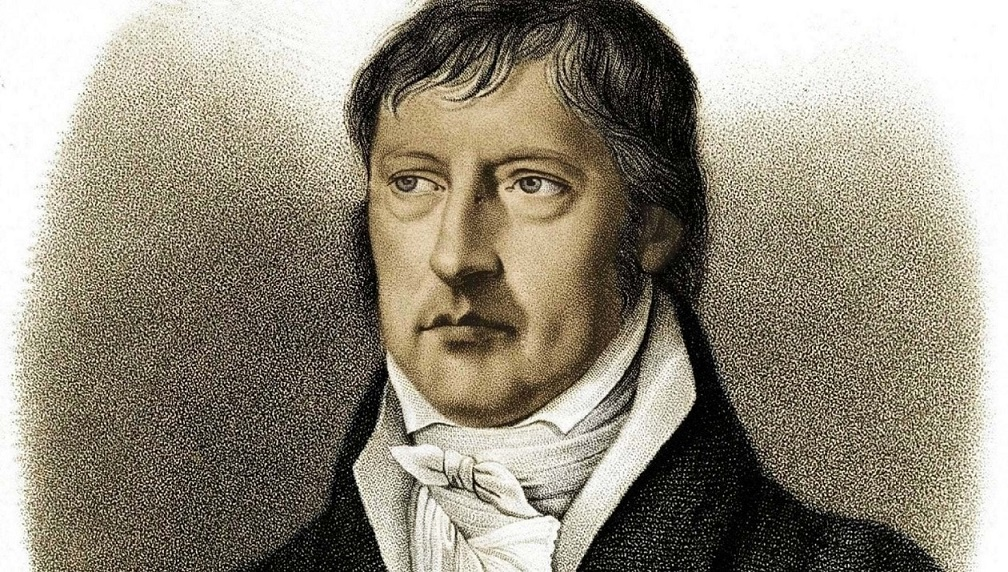
Georg Wilhelm Friedrich Hegel (1770–1831)
Georg Wilhelm Friedrich Hegel (1770–1831) was the culmination of German Idealism and one of the most formidable systemic thinkers in Western intellectual history. Developing an overarching philosophical edifice known as Absolute Idealism, Hegel sought to overcome the dualisms of Enlightenment thought—mind and world, subject and object, freedom and necessity—by demonstrating that reality is an evolutionary, self-actualizing historical process. Driven by the unfolding of Geist (Spirit, Mind, or Collective Consciousness) through the dialectical sublation (Aufhebung) of its own internal contradictions, Hegel integrated logic, metaphysics, epistemology, political theory, and aesthetics into a unified rational system. His philosophy profoundly reshaped subsequent intellectual history, providing the conceptual foundation for Marxist historical materialism, modern existentialism, French psychoanalysis, and 20th-century social theory.
1. Core Philosophy: Absolute Idealism and the Hegelian Dialectic
Hegel's philosophy is notoriously dense, rejecting isolated, static propositions in favor of an all-encompassing systemic totality: "The true is the whole" (Das Wahre ist das Ganze).[1] Where previous Western philosophy from Descartes to Immanuel Kant operated on rigid binary dualisms—separating knower from known, subject from object, and phenomenal appearances from inaccessible noumena (things-in-themselves)—Hegel asserted that reality is dynamic, rational, and developmental. Reality is not a collection of static substances waiting to be observed; it is the living historical process through which rational consciousness comes to comprehend itself.
Dispelling the "Thesis-Antithesis-Synthesis" Myth
In popular culture and introductory textbooks, Hegel's dialectic is almost universally summarized as the mechanical triad of thesis, antithesis, and synthesis. In reality, Hegel rarely used this terminology, which was popularized by his Romantic contemporary Johann Gottlieb Fichte and later simplified by Heinrich Moritz Chalybäus.[2] Hegel considered mechanical formulas superficial. Instead, his speculative logic describes an organic, tripartite movement of thought:
- Abstract or Immediate (The Understanding / Verstand): A concept is apprehended in its fixed, isolated, and one-sided determination. The analytical intellect separates ideas into discrete, rigid categories, treating them as self-sufficient and independent.
- Dialectical or Negative (Dialectical Reason / Dialektische Vernunft): Upon rigorous inspection, the concept reveals its own inherent limitations and internal contradictions. Its static boundary collapses, inevitably passing over into its opposite (e.g., pure, indeterminate Being without content reveals itself to be functionally identical to Nothing).
- Speculative or Concrete (Speculative Reason / Spekulative Vernunft): Dialectical reason grasps the unity of the opposing determinations. The contradictory elements are reconciled and integrated into a richer, higher-order concept that comprehends both terms within a broader context (e.g., Becoming sublates the opposition between Being and Nothing).
| Dialectical Phase | Cognitive Faculty | Operational Dynamic | Functional Role in Thought |
|---|---|---|---|
| Abstract (Immediate) | Understanding (Verstand) | Posits fixed definitions and isolated boundaries. | Establishes preliminary identity and conceptual distinction. |
| Negative (Dialectical) | Dialectical Reason | Uncovers internal contradiction and instability. | Dissolves dogmatic rigidity; generates movement through negation. |
| Concrete (Speculative) | Speculative Reason (Vernunft) | Unifies opposites within an expanded conceptual horizon. | Achieves speculative reconciliation and systemic progression. |
The Mechanism of Sublation (Aufhebung)
The driving engine of this dialectical movement is the German concept Aufheben (noun: Aufhebung). Hegel noted with satisfaction that ordinary German usage embeds a profound philosophical paradox: the word carries three distinct, contradictory meanings simultaneously:[2:1]
- To Cancel or Negate (tollere): The one-sided, limited formulation of the prior stage is dissolved and transcended.
- To Preserve or Retain (conservare): The essential insight and conceptual truth of the prior stage are safeguarded and carried forward.
- To Elevate or Sublate (elevare): The reconciled elements are elevated to a higher, more sophisticated plane of comprehension.
Nothing in Hegelian dialectics is discarded as an arbitrary error. Error is merely partial, incomplete truth on its journey toward speculative completion. Each historical era, philosophical system, and cognitive stage is preserved as an indispensable structural moment within the completed architecture of knowledge.
2. The Architecture of Geist and Speculative Actuality
At the metaphysical core of Hegel's thought lies Geist, an untranslatable German term encompassing Spirit, Mind, Intellect, and Collective Consciousness. Hegel was an Absolute Idealist, but his idealism is distinct from George Berkeley's subjective mentalism (which reduced the physical world to ideas inside individual human minds). For Hegel, Geist is not an otherworldly divine ghost or transcendent deity operating beyond the physical universe; rather, it is the dynamic, self-organizing rationality immanent within nature and actualized through human culture, language, social institutions, and history.[3]
Actuality vs. Mere Existence: The Rational and the Real
In the preface to his Elements of the Philosophy of Right (1820), Hegel penned his most famous and controversial philosophical maxim:
"Was vernünftig ist, das ist wirklich; und was wirklich ist, das ist vernünftig."
("What is rational is actual; and what is actual is rational.")[3:1]
Critics frequently misinterpreted this statement as a reactionary justification for the existing Prussian state, assuming Hegel was claiming that whatever physically exists is morally justified. However, Hegel drew a sharp technical distinction between two German terms:
- Mere Existence (Realität or Dasein): Contingent, accidental, transient phenomena (e.g., a corrupt tax law, an error in judgment, a passing thunderstorm). These exist empirically, but lack inherent rational necessity.
- Actuality (Wirklichkeit): That which has fully actualized its rational essence in objective reality. Actuality is the unity of essence and existence; it represents what is historically durable, structurally necessary, and expressive of human freedom.
To say that the actual is rational is not to canonize arbitrary political power, but to assert that historical reality is intelligible, governed by rational development rather than chaotic chance.
The System: Logic, Nature, and Spirit
In the Encyclopedia of the Philosophical Sciences (1817), Hegel mapped out the entire tripartite edifice of his speculative philosophy:
| Systemic Division | Ontological Domain | Hegelian Formula | Core Areas of Inquiry |
|---|---|---|---|
| I. Science of Logic | Pure Thought & Categories | Idea in-itself (an sich) | Being, Essence, Concept (Begriff); pure logical categories prior to physical instantiation. |
| II. Philosophy of Nature | Physical World & Materiality | Idea outside-itself (anders-sein) | Mechanics, Physics, Organics; Spirit alienated into space, time, and external contingency. |
| III. Philosophy of Spirit | Human Consciousness & Culture | Idea in-and-for-itself (an und für sich) | Subjective Spirit (Psychology), Objective Spirit (Law, Morality, State), and Absolute Spirit (Art, Religion, Philosophy). |
Within Absolute Spirit, human consciousness achieves absolute self-knowledge through three progressive historical media:
- Art: Expresses the Idea through physical, sensuous form (architecture, classical Greek sculpture, romantic painting and poetry).
- Religion: Expresses the Idea through representational, narrative, and pictorial faith (Vorstellung), culminating in Christian Incarnation and Trinity.
- Philosophy: Grasps the Idea in its pure, conceptual form (Begriff), where Spirit knows itself conceptually without reliance on external myth or material symbols.
3. The Phenomenology of Spirit (1807): Consciousness and Recognition
Published as Napoleon's forces were bombarding the university town of Jena—prompting Hegel to famously write to a friend that he had seen "the Emperor—this world-soul—riding through the city on reconnaissance"—The Phenomenology of Spirit (Phänomenologie des Geistes) represents Hegel's epistemological breakthrough.[4] It functions as a pedagogical "ladder" leading ordinary, unreflective human consciousness from its simplest, most naive assumptions up to Absolute Knowing (Absolutes Wissen).
The Bankruptcy of Sense-Certainty
The Phenomenology begins by investigating Sense-Certainty (sinnliche Gewissheit), the instinctive conviction that our most genuine, direct, and rich knowledge of reality comes through immediate sensory perception of the "Here" and "Now."
Hegel subjects this claim to dialectical analysis:
- If you ask sense-certainty what is real, it answers: "This piece of paper, Here, Now."
- If you write down "Now it is night" and examine the paper at noon, the truth of sense-certainty has dissolved into falsehood.
- The specific sensory "Now" has vanished, but the universal term "Now" remains.
Hegel demonstrates that sense-certainty cannot utter the specific, particular truth it claims to possess. The moment consciousness attempts to communicate its immediate sensory experience, it is forced to use universal linguistic categories ("Here", "Now", "Being"). Far from being the richest and most concrete form of knowledge, immediate perception is the poorest, most abstract, and entirely dependent upon mediating conceptual structures.
The Master-Slave Dialectic (Herrschaft und Knechtschaft)
The most celebrated section of the Phenomenology is the analysis of Self-Consciousness and the struggle for recognition (Anerkennung). Hegel asserts a foundational thesis of modern social theory: self-consciousness is not an isolated, solipsistic Cartesian ego; it exists only in being acknowledged and recognized by another self-consciousness.[4:1]
| Dimension | The Master (Herr) | The Bondsman / Slave (Knecht) |
|---|---|---|
| Initial Stance & Risk | Refuses to surrender; risks biological life for pure prestige | Capitulates out of fear of death; surrenders autonomy for survival |
| Relation to Nature | Effortless consumption; consumes and destroys material goods | Formative labor (Arbeit / Bildung); works upon and transforms matter |
| Existential Posture | Trapped in an existential dead-end of parasitic dependence | Confronts the absolute terror of death; dissolves parochial egoism |
| Form of Recognition | Recognized only by an unfree, degraded instrument; unfulfilled | Imprints consciousness and agency directly onto the enduring physical world |
| Historical Trajectory | Passive consumer; stagnant historical endpoint | Creative producer; becomes the true engine of cultural and historical emancipation |
The dialectic unfolds across four decisive moments:
- The Encounter: Two autonomous consciousnesses encounter each other. Each desires to confirm its own absolute independence and sovereignty. Because each sees the other as an alien object limiting its own freedom, an inevitable collision occurs.
- The Life-and-Death Struggle: To prove that its spiritual autonomy transcends mere animal nature and biological survival, each consciousness must risk its life. Those who prefer freedom over life fight; those who fear physical death capitulate.
- The Master's Existential Dead-End: The victor becomes the Master (Herr); the vanquished becomes the Bondsman or Slave (Knecht). The master commands the slave to work the material world and provide luxuries, enjoying effortless consumption. However, the master encounters an existential impasse:
- The master desired recognition from an equal, autonomous self-consciousness.
- But the slave has been reduced to an unfree, dependent object.
- The master is thus recognized only by a degraded instrument, rendering the master's self-consciousness alienated and unfulfilled.
- The Slave's Liberation Through Labor (Arbeit): The slave undergoes two transformative experiences:
- The Fear of Death: In confronting death—the "absolute master"—the slave's ego is shaken to its core, dissolving all rigid, parochial attachments.
- Formative Labor (Bildung): While the master merely consumes objects (destroying them), the slave works upon raw nature, shaping and transforming material reality. In looking upon the crafted artifact, the slave sees their own thoughts and human agency permanently objectified in the physical world. Through creative, disciplinary labor, the slave overcomes alienation and becomes the true engine of cultural, technological, and historical emancipation.
This passage profoundly influenced subsequent philosophical thought: Karl Marx adapted it into the theory of alienated labor and proletarian revolution; Jacques Lacan utilized it to formulate the formation of human desire through the gaze of the Other; and Frantz Fanon applied it to the psychology of anti-colonial liberation.
From Skepticism to the Unhappy Consciousness
Following the master-slave dialectic, consciousness attempts to evade the harsh realities of material dependence through sequential historical strategies:
- Stoicism: Consciousness asserts that it is entirely free within its own mind, regardless of whether it sits on a royal throne (Marcus Aurelius) or in chains (Epictetus). However, this freedom is abstract, quietist, and leaves the actual world untransformed.
- Skepticism: Consciousness realizes the emptiness of abstract freedom and turns to radical doubt, dismantling all external truths. Yet skepticism falls into self-contradiction: it claims that nothing is true, while insisting on the truth of its own assertion.
- The Unhappy Consciousness (das unglückliche Bewußtsein): Realizing its own division, consciousness becomes alienated from itself. It experiences its own mortal, biological self as finite, sinful, and worthless, while projecting all truth, goodness, and eternity onto an unreachably distant, transcendent God. This tragic, divided psyche represents the psychological posture of medieval monasticism and modern religious guilt, waiting to be sublated into rational reconciliation.
4. Objective Spirit, Ethical Life (Sittlichkeit), and the State
In his mature political philosophy, codified in the Elements of the Philosophy of Right (1820), Hegel addressed how human freedom is concretely institutionalized in the modern world. He rejected both the abstract atomism of social contract theorists (such as Hobbes, Locke, and Rousseau) and the formalistic moral rigor of Kant.
Moralität vs. Sittlichkeit
Hegel established a celebrated distinction between two concepts of normative life:[5]
- Morality (Moralität): The individual, reflective, subjective conscience emphasized by Kant. While essential for modern autonomy, Kantian Moralität operates with an abstract "categorical imperative" that provides no concrete content, degenerating into endless moralizing or hypocritical self-righteousness detached from social reality.
- Ethical Life (Sittlichkeit): Objective, living ethical norms embedded in the organic institutions, customs, and practices of a historical community. Ethical life is freedom actualized within social reality, structured through three interdependent spheres:
| Sphere of Ethical Life | Structural Foundation | Primary Principle | Institutional Expression |
|---|---|---|---|
| 1. The Family | Immediate emotional solidarity | Love and altruistic unity | Marriage, child-rearing, shared family property. |
| 2. Civil Society (die bürgerliche Gesellschaft) | Economic interdependence & self-interest | The "system of needs" (System der Bedürfnisse) | Markets, division of labor, legal administration, professional corporations. |
| 3. The State (der Staat) | Universal rational integration | Concrete freedom; unity of individual & collective | Constitutional monarchy, representative legislature, universal civil service. |
Hegel recognized the dark side of modern free-market capitalism within Civil Society: unbridled market competition creates dramatic economic inequality, atomization, alienation, and the emergence of a destitute underclass ("the rabble" / der Pöbel). Because the market cannot heal its own social wounds, Hegel argued that a rational, constitutional state—staffed by an impartial, educated civil service (der allgemeine Stand)—is required to regulate commerce, protect public welfare, and provide institutional belonging.
History and the "Cunning of Reason" (List der Vernunft)
Hegel's philosophy of history asserts that world history is not a meaningless slaughter-bench of senseless violence, but "the progress of the consciousness of freedom" (der Fortschritt im Bewußtsein der Freiheit):[6]
- The Oriental World: Only one person is free—the absolute ruler or despot; all others are subjects without legal rights.
- The Greco-Roman World: Some individuals are free—citizens possess rights and political agency, but freedom is structurally dependent upon the enslavement of others.
- The Germanic-Christian / Modern World: Through the historical impact of Christianity and the Enlightenment, humanity achieves the realization that all human beings as such are free.
To achieve this historical trajectory, Spirit utilizes the "Cunning of Reason" (List der Vernunft). History uses the subjective passions, blind ambitions, and personal vanities of world-historical individuals (such as Alexander the Great, Julius Caesar, and Napoleon Bonaparte) to achieve its overarching goals. These figures believe they are pursuing their own selfish conquest, but they are merely the unconscious instruments of Geist. Once their historical task of overturning outmoded institutional structures is complete, they are discarded by history—often dying in exile, disgrace, or violent ruin.[6:1]
| Dialectical Phase | Agent / Vector | Operational Mechanism & Historical Outcome |
|---|---|---|
| 1. World-Historical Individuals | Alexander, Caesar, Napoleon, etc. | Driven by subjective passion, personal ambition, pride, and vanity. |
| 2. The Cunning of Reason | Universal Reason (List der Vernunft) | Manipulates selfish human drives as unwitting instruments to overthrow outmoded institutions. |
| 3. Objective Progress of Freedom | Historical Spirit (Geist) | Discards the individual once structural transformation is achieved; historical consciousness moves forward. |
The Owl of Minerva
Hegel famously warned that philosophy cannot dictate utopian blueprints for how the future should look. In the preface to the Philosophy of Right, he delivered his most evocative poetic metaphor:
"Die Eule der Minerva beginnt erst mit der einbrechenden Dämmerung ihren Flug."
("The owl of Minerva spreads its wings only with the falling of dusk.")[5:1]
Minerva (the Roman goddess of wisdom) sends forth her owl not in the morning dawn of an era, but only at twilight. Philosophical wisdom always arrives after the fact; it can only comprehend a historical shape of life after that culture has reached maturity and begun its twilight decline. Philosophy paints its gray in gray, understanding the past rather than magically rejuvenating the aged.
5. Major Works & Canonical Texts
Reading Hegel presents legendary difficulties. He systematically discarded classical formal logic and conventional linear exposition, writing in an idiosyncratic speculative idiom where grammatical subjects, predicates, and conceptual categories continually invert and transform into their opposites.
- The Phenomenology of Spirit (Phänomenologie des Geistes, 1807): The journey of consciousness from immediate sensory perception through the master-slave dialectic, the unhappy consciousness, and cultural alienation to Absolute Knowing.[4:2]
- Science of Logic (Wissenschaft der Logik, 1812–1816): The pure metaphysical engine of the system. Hegel deduces the fundamental categories of reality (Being, Essence, the Concept) through pure dialectical necessity, without empirical presuppositions.[2:2]
- Encyclopedia of the Philosophical Sciences (Enzyklopädie der philosophischen Wissenschaften, 1817; expanded 1827, 1830): The definitive, three-part compendium outlining his entire philosophical architecture: Logic, Philosophy of Nature, and Philosophy of Spirit.
- Elements of the Philosophy of Right (Grundlinien der Philosophie des Rechts, 1820): His mature sociopolitical treatise, presenting his theory of property, abstract right, morality, civil society, and the constitutional state.[5:2]
- Posthumous Lecture Series (published from student transcripts):
- Lectures on the Philosophy of History
- Lectures on Aesthetics / Philosophy of Art
- Lectures on the Philosophy of Religion
- Lectures on the History of Philosophy
6. The Post-Hegelian Schism and Modern Intellectual Heritage
Following Hegel's sudden death during the 1831 Berlin cholera epidemic, his intellectual followers fractured into two fiercely opposed camps, triggering the major ideological battles of modern Europe:[6:2]
| Dimension | Old / Right Hegelians | Young / Left Hegelians |
|---|---|---|
| Interpretive Framework | Systemic, conservative, and defensive | Dialectical, revolutionary, and critical |
| Methodological Focus | Emphasized systemic closure, equilibrium, and synthesis | Emphasized perpetual negation, contradiction, and transformative praxis |
| Religious Stance | Rational defense of Protestant orthodoxy and Christian theism | Anthropological critique and dissolution of religious illusion (e.g., Feuerbach) |
| Socio-Political Posture | Justification of the existing Prussian state and constitutional monarchy | Revolutionary critique of existing institutions; materialist inversion into class struggle (e.g., Marx) |
The Left Hegelians and Karl Marx
The Young Hegelians seized upon the dialectic as a critical weapon against institutional oppression. Ludwig Feuerbach argued that religion was merely the alienated projection of human species-essence into an imaginary heaven. Building upon this critique, Karl Marx transformed Hegelian idealism into historical materialism. Marx famously declared in Das Kapital that Hegel's dialectic was "standing on its head" and had to be "turned right side up again." Rather than Geist determining material reality, Marx asserted that the material relations of production and class struggle determine human ideas, culture, and consciousness.
The 20th-Century French Renaissance (Kojève's Seminars)
Hegel's twentieth-century revival was catalyzed in 1930s Paris by Russian-French philosopher Alexandre Kojève. Between 1933 and 1939 at the École Pratique des Hautes Études, Kojève delivered legendary lectures on the Phenomenology of Spirit. His audience included future luminaries of French thought: Jacques Lacan, Jean-Paul Sartre, Maurice Merleau-Ponty, Georges Bataille, and Raymond Aron.
Kojève positioned the master-slave dialectic and the "end of history" at the very center of modern intellectual life:
- Lacan adapted Hegelian recognition to explain how the human ego is constituted through the gaze and desire of the Other.
- Sartre secularized the struggle for recognition into the existential terror of "The Look" (Le Regard) in Being and Nothingness.
- Post-structuralists like Michel Foucault and Jacques Derrida spent their careers attempting to escape the all-consuming horizon of Hegelian dialectics.
The Analytic Counter-Revolution and the Pittsburgh Renaissance
In the English-speaking world, Analytic Philosophy was born out of a direct, aggressive revolt against British Idealism (represented by F.H. Bradley and J.M.E. McTaggart). Bertrand Russell and G.E. Moore rejected Hegelian holistic relations, inventing formal symbolic logic and conceptual atomism to rescue philosophy from Hegelian obscurity.
However, in late-twentieth-century analytic philosophy, the "Pittsburgh Neo-Hegelians" (most notably Wilfrid Sellars, John McDowell, and Robert Brandom) orchestrated a dramatic Hegelian rehabilitation. By utilizing Hegel to dismantle the "Myth of the Given" and to demonstrate that conceptual meaning is instituted through social practices of giving and asking for reasons, contemporary analytic philosophy has re-embraced Hegel's insight that human knowledge is socially and historically situated.
7. Comparative Matrix: Hegel and His 19th-Century Foils
| Dimension | G.W.F. Hegel (1770–1831) | Arthur Schopenhauer (1788–1860) | Søren Kierkegaard (1813–1855) | Karl Marx (1818–1883) |
|---|---|---|---|---|
| Fundamental Reality | Rational Idea (Geist) unfolding in history. | Blind, irrational, purposeless Will (Wille). | The single, concrete Individual (Den Enkelte) before God. | Material conditions and modes of economic production. |
| Engine of Movement | Dialectical contradiction and sublation (Aufhebung). | Perpetual, insatiable, tragic striving. | Qualitative leap of faith into the religious Absurd. | Class struggle over surplus value and property. |
| Status of Human Reason | Supreme; the real is rational and reality is intelligible. | Subordinate; reason is merely the servant of blind desire. | Inadequate; human logic collapses before divine paradox. | Ideological; philosophical systems reflect class interests. |
| Teleology / Destination | Reconciliation in Absolute Knowledge and the Ethical State. | Cosmic pessimism; ascetic extinction of the Will. | Personal redemption through absolute individual commitment. | Classless communist society through proletarian revolution. |
🎴 Interactive Web Practice (Comprehension Check)
Question 1 (The Dialectical Method & Sublation): Why is the popular characterization of the Hegelian dialectic as \"thesis, antithesis, synthesis\" inaccurate, and what three distinct operational meanings are unified within the concept of Aufhebung?
Answer: The triad of \"thesis, antithesis, synthesis\" was not Hegel's own formulation; it was popularized by Johann Gottlieb Fichte and popularized by later textbook commentators. Hegel found mechanical formulas simplistic. Instead, his dialectic moves from the Abstract/Immediate (the Understanding / Verstand isolating concepts in fixed boundaries), through the Negative/Dialectical (the concept revealing its own internal contradictions and passing into its opposite), to the Concrete/Speculative (Speculative Reason / Vernunft reconciling the opposites in a richer, higher unity).
Central to this dynamic is Aufhebung (sublation), a term uniting three simultaneous meanings:
- To cancel/negate (tollere): Dissolving the one-sided, limited formulation of the prior concept.
- To preserve/retain (conservare): Safeguarding and incorporating the essential insight of the earlier stage.
- To elevate (elevare): Raising the unified understanding to a more mature, comprehensive plane of knowledge.
Question 2 (The Master-Slave Dialectic & Recognition): In The Phenomenology of Spirit, why does the Master encounter an existential dead-end while the Slave becomes the authentic driver of human historical emancipation?
Answer: In the struggle for recognition (Anerkennung), self-consciousness can confirm its autonomy only by being recognized by another free, self-conscious agent. When the Master subdues the Slave in the life-and-death struggle, the Master creates an existential impasse:
- The Master reduces the Slave to an unfree, objectified instrument. Consequently, the recognition the Master receives comes from a debased, dependent entity, which cannot confirm the Master's genuine spiritual sovereignty. The Master is left in an idle, paralyzed dead-end of passive consumption.
- The Slave, conversely, undergoes two emancipatory transformations: first, confronting the fear of death (the \"absolute master\"), which shatters all narrow, selfish complacency; and second, engaging in formative labor (Arbeit / Bildung). By working upon raw physical matter, the Slave permanently imprints human consciousness, reason, and purpose onto the physical world. Through transformative labor, the Slave realizes their own creative power and becomes the true architect of human culture and historical freedom.
Question 3 (Actuality & The Owl of Minerva): How does Hegel's distinction between Realität (mere existence) and Wirklichkeit (actuality) clarify his claim that \"what is rational is actual,\" and what is the philosophical warning of \"The Owl of Minerva\"?
Answer: Hegel's famous dictum—\"What is rational is actual; and what is actual is rational\"—is often misunderstood as a defense of tyranny or existing political corruption. However, Hegel drew a sharp distinction between Realität (mere empirical existence, which includes accidental, transient, and corrupt phenomena that lack rational necessity) and Wirklichkeit (actuality, which is reality that has fully actualized its rational essence and necessity in the world). The dictum asserts that historical development is intelligible and that true freedom necessarily embeds itself in durable, rational social institutions.
The metaphor of \"The Owl of Minerva\" (\"The owl of Minerva spreads its wings only with the falling of dusk\") serves as an epistemological warning: philosophy can never serve as a prescriptive guide or utopian blueprint for the future. Wisdom arrives only retrospectively, when a historical culture has fully matured and entered its twilight. Philosophy comprehends history in thought only after its historical form has run its course.
Resonant Notes
The following notes in the vault share direct thematic, sociological, and philosophical connections with Georg Wilhelm Friedrich Hegel:
🔴 German Idealism, Dialectics & Epistemology
- Immanuel Kant-The Transcendental Sublime — Kant’s critical philosophy established the foundational divide between phenomena and noumena that Hegel's Absolute Idealism sought to sublate; Hegel unified Kant's divided faculties of Understanding (Verstand) and Reason (Vernunft) into an organic, self-actualizing dialectic.
- Johann Wolfgang von Goethe (1749-1832) & Goethe's Metaphysics of Polarity — Goethe's organic morphology, dynamic polarity (Polarität), and upward intensification (Steigerung) served as the physical and aesthetic counterpart to Hegel's dialectic; Hegel saw Goethe’s scientific works as the empirical validation of speculative development.
- Goethe's Faust — Faust’s restless striving, dramatic wager with the demonic spirit of negation, and historical evolution from subjective melancholy to public statecraft directly dramatize the path of consciousness in the Phenomenology of Spirit.
- Continental Philosophy — Hegel stands as the foundational architect and primary foil of modern Continental thought; the entire tradition from Marx and Kierkegaard to Heidegger, Sartre, and post-structuralism developed either by expanding or aggressively revolting against Hegelian systematization.
- Analytic Philosophy — Founded at Cambridge by Bertrand Russell and G.E. Moore through an explicit rejection of British Neo-Hegelianism (Bradley and McTaggart); yet late-20th-century analytic thinkers (the Pittsburgh School of Sellars, McDowell, and Brandom) dramatically resurrected Hegelian holism and social inferentialism.
- Ludwig Wittgenstein — Wittgenstein’s philosophical journey reflects a dialectical shift: his early Tractatus attempted a static, formal atomism, while his later Philosophical Investigations surrendered to the Hegelian insight that linguistic meaning is embedded in social customs, historical context, and communal "forms of life" (Lebensformen).
- Perennial Philosophy — Examines the tension between Hegel’s historicized, progressive realization of the Absolute in time and the Perennialist doctrine of a timeless, unconditioned primordial reality apprehendable through direct contemplation.
🟡 Recognition, Intersubjectivity & Psychoanalysis
- Jacques Lacan — Lacan’s central psychological axiom that "human desire is the desire of the Other" (le désir de l'homme est le désir de l'Autre) is directly inherited from Hegel's master-slave dialectic via Alexandre Kojève’s Paris seminars; Lacan translates Hegel's struggle for recognition into the structural alienation of the Mirror Stage and the Symbolic order.
- Sigmund Freud — Freud's psychological topography (Id, Ego, Super-Ego) and the internal civil war of consciousness mirror Hegel's "Unhappy Consciousness," where the self is agonistically divided against its own drives and institutional guilt.
- The Social Construction of Reality - A Treatise in the Sociology of Knowledge — Peter Berger and Thomas Luckmann’s core sociological dialectic (externalization, objectivation, internalization) is an explicit methodological adaptation of Hegel's dialectic of Spirit externalizing and recognizing itself in the objective social world.
- Constructs of the Mind-Unmasking Consciousness in East and West — Analyzes the dialectical structures of consciousness across Western idealism and Eastern traditions, examining how cognitive boundaries and reified dualisms collapse upon speculative reflection.
- Gilbert Ryle's-The Concept of Mind & Ghost in the Machine — Ryle’s behaviorist dismantling of Cartesian "substance dualism" (the "ghost in the machine") parallels Hegel's absolute rejection of an isolated soul trapped inside physical matter; for Hegel, mind (Geist) is not a hidden homunculus, but embodied expressive activity in the world.
🟢 Historical Teleology, Social Theory & Power
- Karl Marx - Economic and Philosophic Manuscripts of 1844 — Marx’s transformative critique of Hegelianism: standing Hegel’s dialectic on its feet by transmuting the idealist movement of Geist into historical materialism, class struggle, and the critique of capitalist alienated labor.
- Yuval Noah Harari — Harari’s macro-historical thesis in Sapiens—that human supremacy is driven by collective "intersubjective myths" (money, nations, empires, human rights) that evolve over millennia—is a contemporary evolutionary translation of Hegel's Objective Spirit.
- Innis (1951) - The Bias of Communication — Harold Adams Innis explicitly borrowed Hegel's aphorism of "Minerva's Owl" to formulate his core media ecology thesis: civilizations achieve profound philosophical and technological comprehension over their communication apparatuses only at the twilight hour of imperial decline.
- Michel Foucault — Foucault’s historical genealogies of power, madness, and disciplinary institutions represent a radical post-structuralist revolt against Hegelian teleological progress, demonstrating that historical shifts produce new regimes of surveillance rather than pure expansions of human freedom.
- Capitalism and Schizophrenia — Gilles Deleuze and Félix Guattari mount an aggressive assault against Hegelian dialectics and the negative; they replace Hegelian contradiction, lack, and sublation with a philosophy of pure affirmative difference, immanence, and desiring-production.
- Peter Bürger-Theorie der Avantgarde — Bürger utilizes the Hegelian concept of sublation (Aufhebung) to explain the central ambition of the historical avant-garde (Dada, Surrealism, Constructivism): the simultaneous destruction and preservation of art to integrate its emancipatory aesthetic potential into daily life-praxis (Lebenspraxis).
🔵 Existential, Hemispheric & Methodological Rebellions
- Søren Kierkegaard — The fierce 19th-century progenitor of existentialism who spent his life opposing Hegelian systematic philosophy; Kierkegaard insisted that "an existential system is impossible" because abstract historical logic forgets the living, agonizing individual (Den Enkelte) and the subjective leap of faith into the absurd.
- Friedrich Nietzsche — Replaced Hegel's rational Geist and moral teleology with the chaotic, tragic Will to Power (Wille zur Macht); Nietzsche exposed historical systems as secularized Christian theodicies, mocking the idea that history is a triumphant march toward rational perfection.
- Fyodor Dostoevsky (1821-1881) — Dostoevsky’s Underground Man and Ivan Karamazov wage a violent literary rebellion against Hegelian rational optimization and historical theodicy, defending the right of human beings to spit on historical progress to protect their irrational freedom.
- Schopenhauerian Pessimism — Arthur Schopenhauer was Hegel's bitterest academic rival in Berlin; where Hegel posited reality as rational Spirit (Geist), Schopenhauer diagnosed reality as a blind, irrational, suffering-generating Will (Wille), rejecting historical teleology as an infantile delusion.
- William James — Waged relentless warfare against what he called the "block universe" of Hegelian and British Absolute Idealism; James’s Radical Empiricism and Pragmatism defended an open, pluralistic universe of contingency, novelty, and genuine moral risk.
- Iain McGilchrist — McGilchrist identifies Hegel's totalizing philosophical system as an archetype of left-hemisphere overreach—abstracting reality into sterile conceptual categories—while acknowledging that Hegel's intuitive grasp of dialectical process, polarity, and the coincidence of opposites carries right-hemisphere depth.
- Jean-Paul Sartre — Synthesized Husserlian phenomenology and Kojèvian Hegelianism into existentialism; Sartre retained the struggle of consciousness with the Other, but rejected Hegelian rational reconciliation, insisting that "conflict is the original meaning of being-for-others."
- Albert Camus — In The Rebel and The Myth of Sisyphus, Camus critiques Hegelian historical teleology for unleashing totalitarian political terror, arguing that sacrificing living human beings for an idealized historical end-state constitutes a betrayal of authentic revolt.
Backlinks
- Continental Philosophy — Hegel's Absolute Idealism, dialectical sublation (Aufhebung), the unfolding architecture of Geist, and the master-slave dialectic provide the foundational bedrock and primary target of critique for the entire Continental tradition.
- Søren Kierkegaard — Kierkegaard's entire authorship is organized as a polemical counter-attack against Hegelian systematic philosophy, defending subjective truth and the solitary individual against objective historical systems.
- Friedrich Nietzsche — Nietzsche's genealogical critique and doctrine of the Will to Power stand as an absolute dismantling of Hegelian historical teleology and rationalist theodicy.
- Fyodor Dostoevsky (1821-1881) — Dostoevsky's Underground Man and the rebellion of Ivan Karamazov in The Brothers Karamazov function as visceral assaults against Hegelian rational optimization and historical necessity.
- Jacques Lacan — Lacan's psychoanalytic theory of the ego, the gaze, and the desire of the Other is structurally rooted in Hegel's dialectic of recognition as transmitted through Alexandre Kojève.
- Innis (1951) - The Bias of Communication — Innis applies Hegel's "Minerva's Owl" metaphor to media ecology, demonstrating that civilizational awareness of communication technologies occurs during imperial twilight and institutional decay.
- Yuval Noah Harari — Harari's macro-historical model of humanity evolving through shared intersubjective fictions adapts Hegelian Objective Spirit to modern anthropological history.
- Peter Bürger-Theorie der Avantgarde — Bürger frames the historical avant-garde's attack on the autonomous institution of art as a drive toward Hegelian sublation (Aufhebung) into the praxis of life.
- William James — James's pragmatist revolt against the absolute monism of the "block universe" was aimed directly at Hegelian Absolute Idealism.
- Iain McGilchrist — Analyzes Hegel's dialectical system as a complex hemispheric struggle between left-hemisphere totalizing systematization and right-hemisphere dynamic process and contradiction.
References
G.W.F. Hegel / The Phenomenology of Spirit / Translated by A.V. Miller, Oxford University Press, 1977 ↩︎
Julie E. Maybee / Hegel's Dialectics / Stanford Encyclopedia of Philosophy ↩︎ ↩︎ ↩︎
Paul Redding / Georg Wilhelm Friedrich Hegel / Stanford Encyclopedia of Philosophy ↩︎ ↩︎
Terry Pinkard / Hegel: A Biography / Cambridge University Press, 2000 ↩︎ ↩︎ ↩︎
Stephen Houlgate / An Introduction to Hegel: Freedom, Truth and History / 2nd Edition, Wiley-Blackwell, 2005 ↩︎ ↩︎ ↩︎
Peter Singer / Hegel: A Very Short Introduction / Oxford University Press, 2001 ↩︎ ↩︎ ↩︎