Northrop Frye's - Anatomy of Criticism
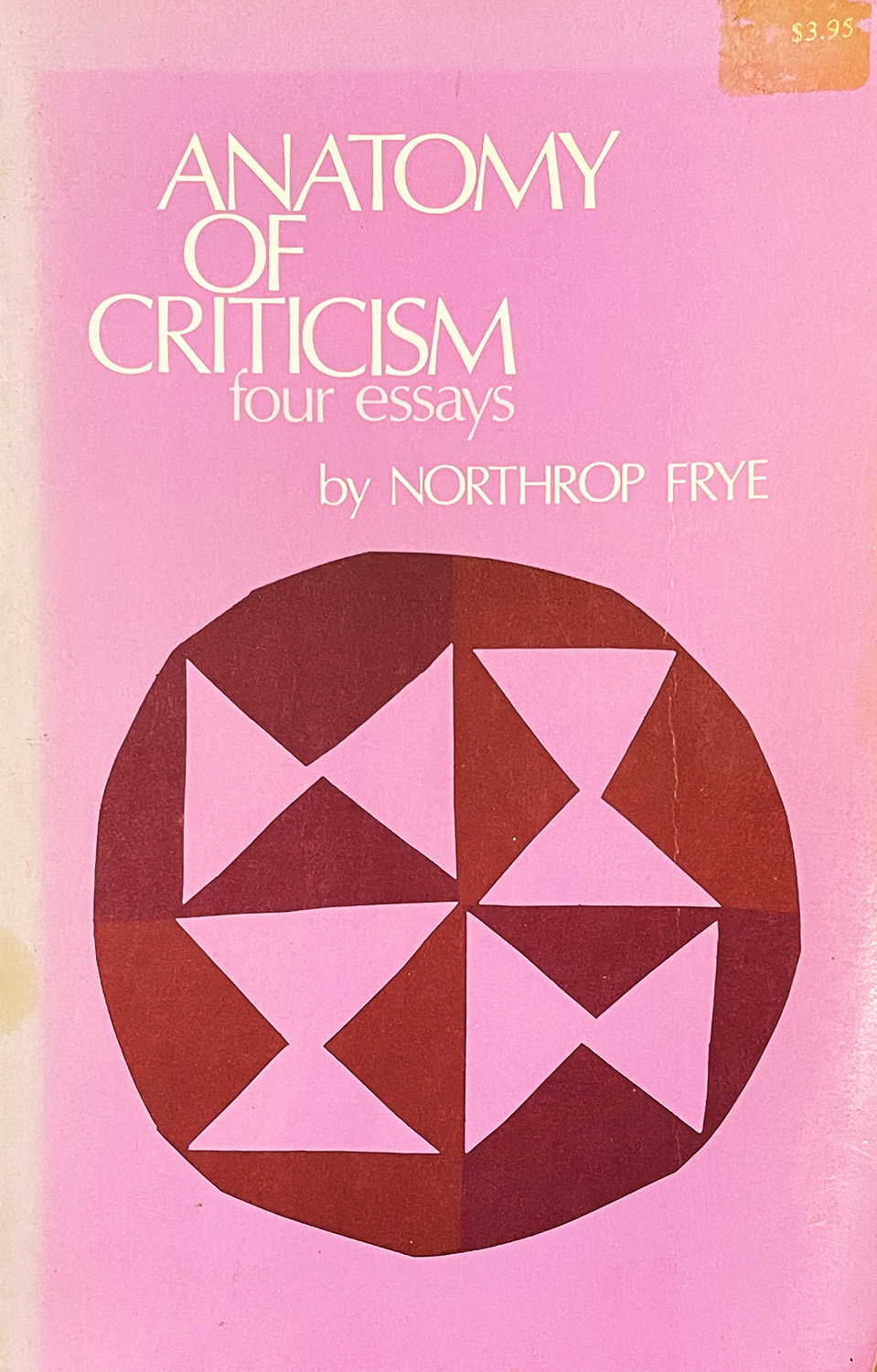
Published in 1957 by Princeton University Press, Northrop Frye's Anatomy of Criticism: Four Essays remains a foundational monument in twentieth-century literary theory and structural poetics.[1] Seeking to emancipate literary criticism from derivative servitude to biographical trivia, social history, and imported ideological dogmas, Frye proposes an autonomous, inductive science of literature grounded in its own internal structural logic.[2] By organizing imaginative writing into an interconnected synoptic taxonomy—comprising five historical fictional modes, five interpretive phases of symbols, four seasonal archetypal mythoi, and four rhetorical radicals of presentation—Frye demonstrates that all literature forms an autonomous "verbal universe" structured by the recurrent archetypes of human desire and imagination.[3]
The Polemical Introduction: Criticism as an Autonomous Science
Before introducing his four core essays, Frye lays out a rigorous "Polemical Introduction" to challenge the fragmented and unscientific condition of mid-twentieth-century literary scholarship.[1:1] At the time, academic criticism was sharply divided between traditional biographical-historical philology and the formalist "close reading" methods of Anglo-American New Criticism. While praising New Criticism for examining texts directly rather than treating them as historical footnotes, Frye argues that it remains structurally paralyzed: it offers no overarching conceptual framework connecting one poem to another.[4]
Frye diagnoses two pervasive theoretical fallacies crippling literary studies:
- Subjective Value Judgments: The error of confusing objective critical analysis with transitory matters of personal taste, moral approval, social prestige, or literary canon-policing. For Frye, value judgments are inherently subjective and culturally transient; genuine criticism must discover organizing structures rather than hand out report cards.[1:2]
- The Deterministic Fallacy: The reduction of literary art to non-literary external disciplines—such as Freudian psychopathology, Marxist dialectical materialism, or orthodox Christian theology.[3:1] deterministic critics treat literary texts as mere symptoms, case studies, or economic propaganda, rather than autonomous verbal designs.[2:1]
Literature is not a passive mirror reflecting external history or private psychology; it is an autonomous verbal cosmos with its own internal structural syntax.[1:3] Criticism must be an inductive science, deriving its hypotheses and organizing laws directly from the total body of literature itself (an order of words), just as physics induces its laws from the physical cosmos and linguistics induces grammar from living language.[2:2] [3:2]
Centripetal Versus Centrifugal Reading
Frye distinguishes between two simultaneous vectors of critical attention operating in any reading act:
- Centripetal Reading (Inward-Turning): Directs the reader's attention inward toward the text's autonomous verbal pattern, structural motifs, acoustic rhythms, and rhetorical design. In centripetal reading, the primary question is how the verbal elements relate to each other within the closed literary system.[1:4]
- Centrifugal Reading (Outward-Turning): Directs the reader's attention outward toward external reality, referencing empirical facts, historical contexts, moral propositions, and dictionary definitions.[3:3]
Frye asserts that while informational and scientific prose is primarily centrifugal, imaginative literature is fundamentally centripetal: its primary meaning arises from its internal verbal coherence and its relation to the broader literary universe.[1:5] [4:1]
First Essay: Historical Criticism (Theory of Modes)
In the first essay, Frye establishes a comprehensive historical classification of narrative literature based on the concept of fictional modes.[1:6] Rejecting vague chronological categories, Frye classifies modes by the power of action possessed by the central protagonist relative to ordinary human beings and to their physical environment.[2:3]
  POWER OF PROTAGONIST
     ▲
     │  1. Mythic Mode       (Superior in KIND to humans & natural environment — Divine)
     │  2. Romantic Mode     (Superior in DEGREE to humans & environment — Marvelous/Heroic)
     │  3. High Mimetic Mode (Superior in DEGREE to humans, SUBJECT to environment — Tragic/Epic)
     │  4. Low Mimetic Mode  (EQUAL in degree to humans & environment — Realistic/Bourgeois)
     │  5. Ironic Mode       (INFERIOR in power/awareness to reader — Trapped/Absurd)
     ▼
The Five Fictional Modes
- Mythic Mode: The protagonist is a divine or supernatural entity, superior in kind both to ordinary human beings and to the laws of physical nature.[2:4] The narrative recounts cosmic creation, miraculous interventions, and divine warfare (e.g., classical Greco-Roman mythologies, Mesopotamian epics, biblical scriptural narratives).
- Romantic Mode: The protagonist is a human being, but superior in degree to other human beings and to the natural environment.[1:7] Physical laws are suspended or softened: the hero possesses superhuman courage, wields enchanted weapons, and survives perils through marvelous providence (e.g., medieval chivalric romances, Arthurian legend, fairy tales, modern fantasy).
- High Mimetic Mode: The protagonist is superior in degree to ordinary human beings, but strictly subject to the unforgiving physical laws of nature and society.[3:4] The hero is a king, general, or societal aristocrat whose elevated status amplifies the social and existential consequences of their actions. Their fall shakes the foundations of the state (e.g., classical Greek tragedy, Homeric epic, Shakespearean tragedy).
- Low Mimetic Mode: The protagonist is superior neither to other mortals nor to their environment; they are an "everyman" operating on the exact same plane of power and vulnerability as the reader.[2:5] The narrative explores psychological realism, domestic manners, and bourgeois socio-economic reality (e.g., eighteenth- and nineteenth-century realism, Defoe, Austen, Eliot, Dickens, naturalism).
- Ironic Mode: The protagonist is inferior in power, intelligence, or emotional comprehension to the ordinary human being.[3:5] The character is trapped in bondage, absurdity, bureaucratic humiliation, or psychological paralysis. The reader looks down upon a scene of frustration or degradation from a position of superior awareness (e.g., Franz Kafka, Samuel Beckett, modern existentialism, black satire).
Tragic and Comic Variations Across Modes
Frye notes that each fictional mode subdivides into two overarching narrative orientations: tragic (isolating the protagonist from society) and comic (integrating the protagonist into society):[1:8]
| Fictional Mode | Tragic Aspect (Downfall / Isolation) | Comic Aspect (Integration / Renewal) |
|---|---|---|
| Mythic | The dying and resurrected god; cosmic sacrifice (e.g., Dionysus, Osiris, the Crucifixion). | The apotheosis of the hero; acceptance into the pantheon of gods. |
| Romantic | The elegiac death of the chivalric knight (e.g., The Song of Roland, Morte d'Arthur). | The successful quest, dragon-slaying, and redemption of the maiden/kingdom. |
| High Mimetic | Aristocratic tragedy; fatal hubris (hamartia) breaking cosmic order (e.g., Oedipus Rex, King Lear). | Aristocratic comedy; restorative courtly festivals and civic reconciliation. |
| Low Mimetic | Pathos of ordinary failure, bourgeois destruction, or social ruin (e.g., Tess of the d'Urbervilles, Madame Bovary). | Domestic comedy of manners; overcome obstacles culminate in marriage and social harmony. |
| Ironic | The complete victimization of the scapegoat (pharmakos); inexplicable suffering and alienation (e.g., Kafka's The Trial). | Absurdist exposure of human vanity; intellectual detachment; black comedy (e.g., Waiting for Godot). |
The Historical Curve: From Irony Back to Myth
Frye demonstrates that Western literary history over the past fifteen centuries has followed a progressive downward trajectory across these five modes: moving from the early medieval Christian and pagan myth, through medieval chivalric romance, Renaissance high mimetic drama, eighteenth- and nineteenth-century low mimetic realism, down to the twentieth-century ironic mode.[1:9]
Crucially, Frye uncovers a dialectical reversal: when the ironic mode reaches its absolute extreme—stripping the protagonist of all heroic pretensions and plunging into raw alienation—it curves back into mythic structure.[3:6] Modernist and postmodernist literature (such as James Joyce's Ulysses, T.S. Eliot's The Waste Land, or Franz Kafka's parables) employs ruthless urban irony to reactivate and re-encode primordial mythic archetypes, completing the full wheel of literary history.[4:2]
Second Essay: Ethical Criticism (Theory of Symbols)
In his second essay, Frye constructs a multifaceted theory of literary symbolism. Expanding the medieval fourfold hermeneutic schema (literal, allegorical, tropological, and anagogical), Frye isolates five progressive levels or phases of critical reading, demonstrating how the definition of a symbol changes depending on the critical lens applied.[1:10]
Frye defines a symbol expansively as "any unit of any literary structure that can be isolated for critical attention"—ranging from a single letter or acoustic phoneme to an overarching mythic plot.[2:6]
                       [ ANAGOGIC PHASE ]
                   (Symbol as Monad / Archetypal Whole)
                                ▲
                                │
                       [ MYTHIC PHASE ]
                 (Symbol as Archetype / Social Code)
                                ▲
                                │
                       [ FORMAL PHASE ]
                 (Symbol as Image / Aesthetic Unity)
                                ▲
                                │
                       [ DESCRIPTIVE PHASE ]
                 (Symbol as Sign / Centrifugal Reference)
                                ▲
                                │
                       [ LITERAL PHASE ]
                 (Symbol as Motif / Centripetal Verbal Pattern)
The Five Interpretive Phases
- Literal Phase (The Symbol as Motif): The text is read centripetally as a closed verbal web. The symbol functions strictly as a motif—an internal structural element valued for its recurring acoustic texture, syntax, rhyme, and linguistic balance within the autonomous work.[1:11]
- Descriptive Phase (The Symbol as Sign): The text is read centrifugally as an external representation. The symbol functions as a sign, pointing outward to real-world objects, historical contexts, biographical facts, or philosophical concepts.[3:7]
- Formal Phase (The Symbol as Image): The text is evaluated as a conscious work of art that balances centripetal design with centrifugal imitation (mimesis). The symbol functions as an image, harmonizing poetic form (gestalt) and emotional content to recreate a universal human aesthetic experience.[2:7]
- Mythic Phase (The Symbol as Archetype): The text is contextualized within the collective continuum of human culture. The symbol functions as an archetype—a recurring convention, image, or plot pattern (e.g., the quest, the garden, the labyrinth) that connects the individual work to the universal body of literature.[4:3]
- Anagogic Phase (The Symbol as Monad): Literature is comprehended in its cosmic totality as the imaginative container of all human experience and desire.[4:4] At this level, literature ceases to imitate nature; nature is absorbed inside the boundless human imagination. The symbol functions as a monad—an imaginative universe containing all being within itself.[1:12]
| Phase of Interpretation | Primary Critical Focus | Symbol Conception | Direction of Meaning |
|---|---|---|---|
| Literal | Internal verbal texture and syntax | Motif | Purely Centripetal (Inward) |
| Descriptive | Verisimilitude and historical reference | Sign | Purely Centrifugal (Outward) |
| Formal | Aesthetic unity of form and content | Image | Dialectical Equilibrium |
| Mythic | Canon-wide narrative conventions | Archetype | Intertextual / Cultural |
| Anagogic | Total imaginative containment of reality | Monad | Infinite / Universal |
Third Essay: Archetypal Criticism (Theory of Myths)
The third essay represents the theoretical epicenter of Anatomy of Criticism.[1:13] Frye moves beyond isolated symbols to map the foundational narrative patterns of human culture, termed mythoi (singular: mythos). Frye argues that narrative structure in literature is an imaginative displacement of the natural rhythms of the cosmos—specifically the astronomical seasons, the solar cycle of day and night, and the biological cycle of birth, maturation, death, and renewal.[3:8]
                       SUMMER: ROMANCE
                   (The Heroic Quest / Agon)
                              ▲
                             ╱ ╲
                            ╱   ╲
                           ╱     ╲
        SPRING: COMEDY   ◄         ►   AUTUMN: TRAGEDY
     (Rebirth / Integration)     (Fall / Hamartia / Isolation)
                           ╲     ╱
                            ╲   ╱
                             ╲ ╱
                              ▼
                   WINTER: SATIRE & IRONY
                 (Bondage / Unmasking / Realism)
The Four Mythoi and Seasonal Cycles
- Spring: Comedy (Mythos of Spring):
- Rhythm: The resurgence of life, fertility, and renewal over winter sterility.[3:9]
- Narrative Pattern: The narrative typically begins under an irrational, repressive social law dominated by an obstructionist older patriarch (senex iratus). A young hero and heroine face seemingly impossible social or legal barriers. Through sudden reversals, clever contrivances, or hidden identities revealed, the old order is circumvented, culminating in social reconciliation, the founding of an integrated society, and a festive wedding banquet.[1:14]
- Summer: Romance (Mythos of Summer):
- Rhythm: The triumph of light, heroism, and the uninhibited realization of human desire.[2:8]
- Narrative Pattern: The romance follows an idealized quest structure divided into three distinct stages:
- Agon (The perilous departure and preliminary trials).
- Pathos (The crucial death-struggle or descent into the underworld).
- Anagnorisis (The exaltation, resurrection, and recognition of the hero). Characters operate in an enchanted world where virtue defeats monstrous evil.[1:15]
- Autumn: Tragedy (Mythos of Autumn):
- Rhythm: The decline of the sun, harvest, decay, and the onset of winter mortality.[3:10]
- Narrative Pattern: An exceptional individual, exalted above common humanity, disrupts the moral, social, or cosmic equilibrium through an error in judgment (hamartia). The inexorable order of natural necessity (nemesis) closes in around the hero, precipitating their downfall, isolation, and sacrificial death, leaving behind a solemn recognition of human limits.[2:9]
- Winter: Satire and Irony (Mythos of Winter):
- Rhythm: The cold darkness of winter, bodily bondage, and the frustration of desire.[1:16]
- Narrative Pattern:
- Satire operates as militant irony: it adopts moral standards to ridicule human stupidity, religious hypocrisy, and institutional corruption, demanding that society recognize its grotesque deviation from sanity.
- Irony proper abandons moral crusades to present an unsparing depiction of the human condition trapped in bureaucratic paralysis, physical suffering, and existential absurdity, devoid of poetic justice or redemption.[3:11]
| Season | Mythos | Structural Dynamic | Archetypal Conflict | Terminal Social Resolution |
|---|---|---|---|---|
| Spring | Comedy | Overcoming the blocking order (senex) | Youth vs. Age; Vitality vs. Law | Inclusive community; Marriage banquet |
| Summer | Romance | The heroic quest and dragon-slaying | Good vs. Evil; Light vs. Shadow | Spiritual exaltation; Restored paradise |
| Autumn | Tragedy | Hubristic violation and fateful collapse | Hero vs. Destiny / Natural Law | Sacrificial death; Somber isolation |
| Winter | Satire / Irony | Deconstruction of heroic illusions | Reality vs. Illusion; Fact vs. Wish | Empirical skepticism; Prison / Absurdity |
Polarities of Imagery: Apocalyptic Versus Demoniac
Across all four mythoi, Frye shows that poetic imagery gravitates between two metaphysical poles, representing the complete realization or complete frustration of human desire:[2:10]
| Categorical Domain | Apocalyptic Imagery (Fulfilled Desire) | Demoniac Imagery (Nightmare / Bondage) |
|---|---|---|
| Divine World | A loving, unified deity; the divine communion; holy society. | A tyrannical, capricious deity; blind, indifferent fate (moira). |
| Human World | One universal brotherhood (Albion, Body of Christ); community. | Enslaved mobs; isolated outcasts; cannibalism; the executioner. |
| Animal World | Pastoral flocks; the gentle lamb, faithful hound, and dove. | Predatory monsters; the dragon, serpent, wolf, vulture, chimera. |
| Vegetable World | The Garden of Eden, the fertile orchard, the sacred Tree of Life. | The dark sinister forest, the wasteland, briars, rotting swamp. |
| Mineral World | The Golden City (Jerusalem); palaces of marble and precious gems. | The stone dungeon, torture chamber, barren crags, labyrinth. |
| Fluid / Water World | The Water of Life, sacred fountains, calm refreshing rivers. | The tempestuous ocean abyss, stagnant marshes, the lethal deluge. |
Between these apocalyptic and demoniac poles lies the analogical world of physical nature, where ordinary human existence takes place amidst continuous moral struggle, compromise, and seasonal variation.[3:12]
Fourth Essay: Rhetorical Criticism (Theory of Genres)
In his final essay, Frye redefines literary genre, discarding superficial verse forms or thematic tags in favor of what he introduces as the radical of presentation—the physical and rhetorical conditions under which a literary work is communicated to its audience.[1:17]
                     RADICALS OF PRESENTATION
                                │
        ┌───────────────────────┼───────────────────────┐
        ▼                       ▼                       ▼
      EPOS                   FICTION                  DRAMA
 (Spoken Word /          (Printed Book /         (Acted Word /
 Recited Aloud)          Individual Reader)      Enacted Onstage)
                                │
                                ▼
                              LYRIC
                         (Overheard Word /
                          Private Speech)
The Four Major Genres
- Epos: Literature in which the author addresses a physically assembled listening audience through the spoken or chanted word (e.g., oral epic, bardic recitations, balladry). The primary organizing rhythm is recurrence (meter, accent, rhyme).[1:18]
- Fiction: Literature communicated through the printed book, conceived for an individual reader engaged in silent, private contemplation (e.g., the modern novel, short story). The primary organizing rhythm is continuity (prose syntax and paragraph architecture).[4:5]
- Drama: Literature enacted before a physically present audience by actors who embody and speak the roles directly (e.g., stage plays). The primary organizing rhythm is decorum (character-appropriate dialogue and dramatic timing).[2:11]
- Lyric: Literature that is rhetorically "overheard"; the poet speaks as if turning their back to the audience, addressing their own internal soul, an absent lover, or a transcendent divinity.[3:13] The primary organizing rhythm is association (dream-logic, psychological montage, and sudden symbolic leaps).
Frye also introduces three fundamental textural elements operating within poetic diction: Melos (acoustic rhythm, musicality, and sound texture), Opsis (visual design, pattern, and spectacle), and Lexis (the verbal diction, vocabulary, and semantic surface).[1:19]
The Four Forms of Continuous Prose Fiction
One of Frye's most enduring contributions in the Fourth Essay is his classification of continuous prose fiction into four distinct, intersecting traditions:[1:20]
| Form of Prose | Psychological Focus | Structural Dynamic | Historical Examples |
|---|---|---|---|
| Novel | Personal character and domestic society | Realistic, extroverted, social observation | Jane Austen, George Eliot, Gustave Flaubert |
| Romance | Idealized heroic figures and quest archetypes | Mythic, stylized, projection of desire | Chivalric romances, Nathaniel Hawthorne, Walter Scott |
| Confession | Intellectual autobiography and internal subjectivity | Introspective, philosophical, spiritual | St. Augustine, Jean-Jacques Rousseau, Thomas De Quincey |
| Anatomy (Menippean Satire) | Intellectual concepts, pedantry, and eccentric theories | Encyclopedic, dialectical, systemic ridicule | Robert Burton, Jonathan Swift, Laurence Sterne, Thomas Pynchon |
Frye highlights that major prose masterpieces frequently synthesize these forms (for instance, Melville's Moby-Dick unites romance, novel, and anatomy, while Joyce's Ulysses integrates all four).[1:21]
Critical Reception, Post-Structuralist Debates, and Enduring Legacy
Anatomy of Criticism established Northrop Frye as one of the preeminent theorists of the twentieth century.[5] By demonstrating that literature is not an aggregate of isolated texts but a coherent symbolic system, Frye laid the theoretical foundation for North American Structuralism and archetypal poetics.[4:6]
Scholars across multiple disciplines incorporated Frye's taxonomy:
- Harold Bloom adapted Frye's focus on literary continuity, transforming Frye's dialectic of archetypes into his theory of poetic influence and misreading.[6]
- Fredric Jameson drew upon Frye's multi-tiered interpretive schema in The Political Unconscious, transposing Frye's anagogic phase into a Marxist vision of collective utopian liberation.[4:7]
- Paul Ricoeur praised Frye's seasonal mythoi for illuminating the hermeneutics of narrative time and human imagination.[6:1]
Theoretical Critiques and Counter-Arguments
Following the post-structuralist, deconstructive, and cultural materialist turns in academia, Frye's system faced intense critical debate:
- Ahistorical Formalism: Marxist critics (notably Terry Eagleton) argued that Frye detached literature from class struggle, material production, and ideological violence, enclosing art within a self-generating, politically sanitized "verbal universe."
- Eurocentric Universalism: Post-colonial and feminist theorists argued that Frye's assertion that biblical typology and Greco-Roman myth constituted universal human archetypes was a Eurocentric totalization, projecting Western cultural norms as objective metaphysical truths.
Despite these critiques, Anatomy of Criticism remains an irreplaceable map of literary archetypes, narrative grammar, and structural form.[5:1]
Key Theoretical Concepts Summary
| Term | Domain | Operational Definition |
|---|---|---|
| Verbal Universe | Structural Poetics | The total, autonomous cosmos of imaginative literature that imitates other literature rather than empirical nature. |
| Archetype | Symbolic Theory | A recurring literary convention, motif, or plot pattern connecting an individual text to the collective literary tradition. |
| Mythos (pl. Mythoi) | Narrative Theory | One of four primary cyclical plots aligned with astronomical seasons: Comedy (Spring), Romance (Summer), Tragedy (Autumn), Satire/Irony (Winter). |
| Radical of Presentation | Theory of Genres | The physical and rhetorical relationship between author and audience determining genre (Epos, Fiction, Drama, Lyric). |
| Anagogy | Hermeneutics | The ultimate phase of symbolism wherein the natural universe is completely absorbed inside infinite human imagination. |
| Centripetal Reading | Critical Method | Inward-turning analysis focusing on internal verbal motifs, syntax, and structural patterns. |
| Centrifugal Reading | Critical Method | Outward-turning analysis referencing external historical facts, biographical data, and empirical realities. |
| Anatomy | Prose Theory | Menippean satire characterized by encyclopedic erudition, intellectual debates, and systemic critique of human folly. |
🎴 Interactive Web Practice (Comprehension Check)
Question 1 (Fictional Modes & Dialectical Reversal): How does Northrop Frye classify the five historical fictional modes, and what constitutes the dialectical reversal that occurs when the ironic mode reaches its extreme limit?
Answer: Frye classifies fictional modes based on the central protagonist's power of action relative to other human beings and their physical environment:
- Mythic: The hero is a divine being, superior in kind both to humans and to natural laws.
- Romantic: The hero is human, but superior in degree to others and to natural constraints (performing marvelous feats under enchanted laws).
- High Mimetic: The hero is superior in degree to ordinary humans, but strictly bound by physical and social laws (aristocratic, tragic, or national leaders).
- Low Mimetic: The hero is an everyday "everyman," equal in degree to the reader and bound by ordinary realistic laws.
- Ironic: The protagonist is inferior in power, intellect, or awareness to the reader, trapped in frustration, absurdity, or social servitude.
Question 2 (The Four Seasonal Mythoi & Polarities of Imagery): Explain the operational relationship between Frye's four seasonal mythoi and the two metaphysical extremes of poetic imagery (Apocalyptic vs. Demoniac).
Answer: Frye's four seasonal mythoi represent the cyclical movement of narrative matching the natural astronomical and biological cycles:
- Spring (Comedy): Movement from social rigidity and repression to rebirth, social integration, and festive communion.
- Summer (Romance): The pure realization of human desire through the tripartite heroic quest (agon, pathos, anagnorisis).
- Autumn (Tragedy): The decline from greatness into isolation, hubris (hamartia), and inevitable sacrificial death (nemesis).
- Winter (Satire & Irony): The cold unmasking of illusions, moral satire, and the depiction of unredeemed human bondage.
- Apocalyptic Imagery: The world of completely fulfilled human desire (Heaven, New Jerusalem, the fertile Garden of Eden, gentle pastoral flocks, divine communion). Romance operates in proximity to the apocalyptic pole, while Comedy moves upward toward it.
- Demoniac Imagery: The world of rejected desire and nightmare (the labyrinth, the torture chamber, barren wastelands, ferocious monsters, predatory wolves, and social enslavement). Tragedy moves toward the demoniac pole, while Satire and Irony depict existence trapped within it.
Question 3 (Radicals of Presentation & The Four Forms of Prose): What does Frye mean by the "radical of presentation," and how does his classification of continuous prose into four distinct forms expand our understanding beyond the conventional "novel"?
Answer: The radical of presentation defines literary genre not by verse meters or superficial themes, but by the physical and rhetorical relationship established between the author and the audience:
- Epos: The spoken or recited word delivered directly to an assembled, listening audience (rhythm of recurrence).
- Fiction: The printed text intended for private contemplation by an individual reader (rhythm of continuity).
- Drama: The enacted word performed onstage by actors before a spectator audience (rhythm of decorum).
- Lyric: The "overheard" word, where the poet speaks privately to themselves, an intimate beloved, or a god (rhythm of association).
- Novel: Extroverted and socio-psychological; focuses on realistic human characters interacting within a concrete domestic and social fabric.
- Romance: Introverted and stylized; focuses on idealized quest figures, marvelous perils, and archetypal projections of desire.
- Confession: Highly subjective and introspective; traces intellectual, spiritual, or autobiographical self-development.
- Anatomy (Menippean Satire): Intellectual, encyclopedic, and dialectical; focuses on eccentric ideas, pedantic theories, and systemic satire of human intellectual folly (e.g., Robert Burton's Anatomy of Melancholy or Swift's Gulliver's Travels).
Resonant Notes
The following notes in the vault share direct thematic, sociological, and literary connections with Northrop Frye's Anatomy of Criticism:
🔴 Archetypal Poetics, Myth & Narrative Structure
- Northrop Frye — The dedicated biographical companion note detailing Frye's life, his theological grounding, the "garrison mentality," and his foundational study of William Blake (Fearful Symmetry) that gave birth to the structural poetics of Anatomy of Criticism.
- Joseph Campbell and the Hero's Journey — Campbell's Monomyth represents the Jungian psychological parallel to Frye's Summer mythos of Romance; while Campbell interprets the quest cycle through internal psychic individuation, Frye treats it as an objective structural pattern circulating within the verbal universe.
- Arnold van Gennep (1873–1957) — Van Gennep's tripartite anthropological schema of rites of passage (Separation, Transition, Incorporation) directly parallels the archetypal quest rhythm (agon, pathos, anagnorisis) that Frye systematizes in the seasonal mythoi.
- Goethe's Faust — Goethe's two-part verse tragedy encapsulates Frye's entire modal wheel, ascending from the Low Mimetic bourgeois crisis of the scholar's study into the High Mimetic Gretchen tragedy, the Romantic realm of Helen of Troy, and the final Mythic-Anagogic redemption governed by the Eternal Feminine.
- Friedrich Nietzsche (1844-1900) — Nietzsche's tragic paradigm in The Birth of Tragedy—balancing the Apollonian drive for architectural form and clarity against the Dionysian abyss of dissolution—resonates directly with Frye's dialectic between apocalyptic form and the demoniac chaos of the unredeemed world.
🟡 Modernist Alienation, Realism & Formal Aesthetics
- Don DeLillo Major Themes Analysis — DeLillo's postmodern novels operate squarely within Frye's Winter mythos of Satire and Irony, dramatizing a late-capitalist society where individual heroic agency is paralyzed by media simulation, consumerism, and systems paranoia.
- Edgar Allan Poe (1809-1849) — Poe's aesthetic doctrine of the "Unity of Effect"—insisting that every linguistic unit within a tale must serve a predetermined structural architecture—exemplifies Frye's centripetal literal reading phase and the autonomy of the verbal artifice.
- Henry James (1843—1916) — James's historical progression from international social realism to dense psychological interiority mirrors Frye's modal descent from Low Mimetic observation to Ironic fragmentation, while his use of the "central consciousness" exemplifies the formal radical of presentation.
- The Dehumanization of Art — Ortega y Gasset's modernist thesis that art must achieve autonomy from sentimental humanism and direct naturalism directly mirrors Frye's formalist principle that literature does not imitate physical life, but rather refines its own internal formal codes.
- Norman Mailer — Mailer's literary battles with American totalitarianism and existential dread operate at the turbulent intersection of High Mimetic ambition and Ironic defeat, echoing Frye's dialectic between apocalyptic vision and demoniac entrapment.
- The Existential Paradox of Annie Hall's Opening Monologue — Alvy Singer functions as the quintessential Low Mimetic/Ironic antihero trapped in the Winter mythos of disillusionment and neurotic fragmentation, illustrating Frye's taxonomy of modern comic irony.
🟢 Structuralism, Semiotics & Philosophy of Language
- From Walls of Wood to Walls of Glass - Northrop Frye’s Geography of Isolation — Traces Frye's spatial poetics from the early settler garrison fort defending against an indifferent northern wilderness to the vertical, atomized high-rise condominium tower.
- Marshall McLuhan (1911-1980) & McLuhan's The Medium is the Message — Frye's Victoria College colleague at the University of Toronto; while Frye mapped the internal symbolic codes of the "verbal universe," McLuhan investigated the sensory and psychic impact of the media environments that transmit those codes.
- Jacques Lacan — Lacan's formulation of the Symbolic Order as an autonomous linguistic network that pre-exists and constructs human subjectivity closely mirrors Frye's insistence that literature constitutes a self-contained verbal universe that shapes human consciousness.
- Carl Gustav Jung — The primary psychological interlocutor for archetypal theory; Frye's structural criticism adapts Jung's concept of the archetype while stripping away its biological and occult claims, transposing the archetype into a purely communicable literary convention.
- Analytic Philosophy — While approaching language from a logical rather than poetic orientation, this note's engagement with systematic classification, formal rigor, and the demarcation problem mirrors Frye's ambition to establish literary criticism as an autonomous, inductive discipline.
References
Northrop Frye / Anatomy of Criticism: Four Essays / Princeton University Press ↩︎ ↩︎ ↩︎ ↩︎ ↩︎ ↩︎ ↩︎ ↩︎ ↩︎ ↩︎ ↩︎ ↩︎ ↩︎ ↩︎ ↩︎ ↩︎ ↩︎ ↩︎ ↩︎ ↩︎ ↩︎ ↩︎
Wikipedia / Anatomy of Criticism / Wikipedia ↩︎ ↩︎ ↩︎ ↩︎ ↩︎ ↩︎ ↩︎ ↩︎ ↩︎ ↩︎ ↩︎ ↩︎
GradeSaver / Anatomy of Criticism Study Guide / GradeSaver ↩︎ ↩︎ ↩︎ ↩︎ ↩︎ ↩︎ ↩︎ ↩︎ ↩︎ ↩︎ ↩︎ ↩︎ ↩︎ ↩︎
EBSCO Research Starters / Anatomy of Criticism by Northrop Frye / EBSCO ↩︎ ↩︎ ↩︎ ↩︎ ↩︎ ↩︎ ↩︎ ↩︎
A. C. Hamilton / Northrop Frye: Anatomy of his Criticism / University of Toronto Press ↩︎ ↩︎
Harold Bloom / A Map of Misreading / Oxford University Press, 1975. ↩︎ ↩︎