George Orwell (1903–1950)
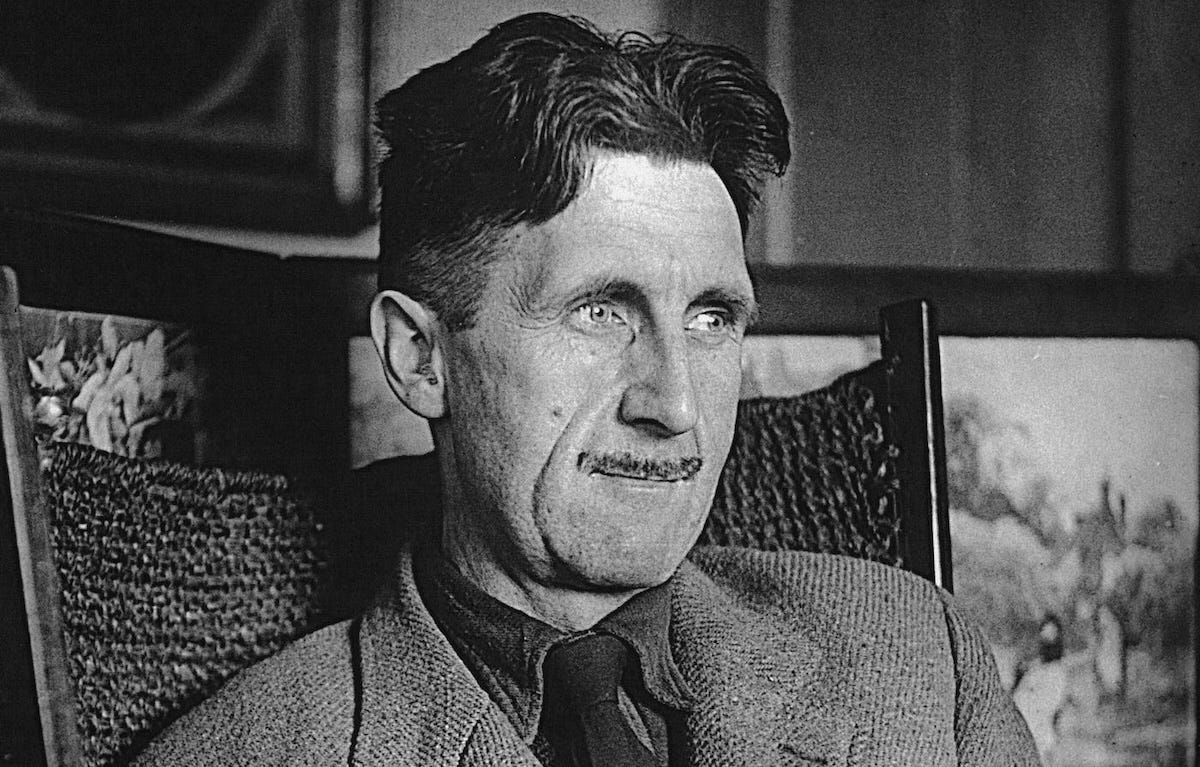
George Orwell (pen name of Eric Arthur Blair, 1903–1950) was an English novelist, essayist, journalist, and cultural critic whose literary output stands as the 20th century's definitive diagnosis of totalitarian pathology, bureaucratic deception, and ideological violence.[1] Characterized by an austere, windowpane prose style and an unwavering commitment to democratic socialism and "common decency," Orwell anatomized the mechanisms by which centralized power colonizes human interiority.[1:1][2] His allegorical novella Animal Farm (1945) and dystopian masterpiece Nineteen Eighty-Four (1949) furnished modern political discourse with its foundational lexicon—including Big Brother, doublethink, Newspeak, and thoughtcrime—cementing his legacy as a vital defender of cognitive autonomy and historical truth.[1:2][3]
1. Biographical Foundation & Political Crucible
Imperial Heritage & Burmese Awakening (1903–1927)
Born Eric Arthur Blair on June 25, 1903, in Motihari, Bengal, British India, Orwell was the son of Richard Walmesley Blair, a sub-deputy opium agent in the Opium Department of the Indian Civil Service.[1:3] Brought to England as an infant by his mother Ida, Blair was educated in the rigid class hierarchy of the British public school system. He attended St Cyprian's preparatory school—an experience of snobbery, corporal humiliation, and institutional hypocrisy that he later eviscerated in the posthumous memoir "Such, Such Were the Joys" (1952)—before winning a King's Scholarship to Eton College (1917–1921), where he was tutored briefly in French by Aldous Huxley.[1:4]
Rather than advancing to Oxford or Cambridge, Blair enlisted in the Indian Imperial Police in Burma in 1922.[1:5] Over five years of serving as an instrument of imperial rule in towns across Burma (including Insein and Moulmein), Blair developed a profound moral revulsion toward British colonialism.[1:6] He witnessed firsthand the somatic and psychological dehumanization inherent in the colonial apparatus: the routine flogging of indigenous prisoners, the racial arrogance of British officials, and the systemic subjugation of native populations.[1:7]
This crucible produced two of his finest early essays:
- "A Hanging" (1931): A crystalline narrative of an execution in which the simple gesture of a condemned Hindu man stepping aside to avoid a puddle reveals the unspeakable enormity of destroying a living, breathing human consciousness.[2:1]
- "Shooting an Elephant" (1936): An acute psychological study of imperial power dynamics, showing how an armed white officer is forced to execute an elephant against his moral conscience merely to preserve face before a native crowd: "When the white man turns tyrant it is his own freedom that he destroys."[2:2]
In 1927, while home on leave, Blair resigned his imperial commission to pursue writing full-time, determined to expiate what he regarded as his complicity in institutional tyranny.[1:8]
Voluntary Outcast, Poverty, and Pseudonym (1928–1936)
Seeking to immerse himself among the dispossessed and understand the lived reality of class exploitation, Blair undertook voluntary expeditions into the subterranean underworld of Western capitalism.[1:9][3:1] Between 1928 and 1931, he lived in Parisian working-class slums, laboring as an impoverished dishwasher (plongeur) in luxury hotel kitchens, and roamed the roads of southern England as a tramp, lodging in filthy casual wards (spikes) alongside vagrants and beggars.[1:10]
In 1933, he published the record of these experiences, Down and Out in Paris and London, adopting the pseudonym George Orwell—combining the patron saint of England (St. George) with his favorite English river, the River Orwell in Suffolk—to spare his family embarrassment and mark his rebirth as a class-conscious writer.[1:11]
In early 1936, the left-wing publisher Victor Gollancz commissioned Orwell to investigate industrial poverty and unemployment in northern England.[3:2] Orwell descended into coal mines in Lancashire and Yorkshire, lived in squalid miner boardinghouses, and meticulously documented wage rates, housing conditions, and public health indicators.[3:3] The resulting book, The Road to Wigan Pier (1937), was divided into two distinct parts: a documentary exposé of working-class squalor, followed by a provocative critique of the British socialist movement, which Orwell accused of middle-class priggishness, ideological pedantry, and alienation from working-class "common decency."[3:4]
The Spanish Crucible & The Anti-Stalinist Shift (1936–1939)
In December 1936, Orwell traveled to Spain to report on the Spanish Civil War and promptly enlisted in the militia of the POUM (Partido Obrero de Unificación Marxista), an anti-Stalinist socialist workers' party aligned with the Independent Labour Party (ILP).[1:12][4] Assigned to the freezing Aragon front near Zaragoza, Orwell experienced the radical egalitarianism of revolutionary Barcelona, where classes appeared to have dissolved, waiters looked customers in the eye, and human solidarity seemed an achievable reality.[4:1]
However, the dream turned into a political nightmare. In May 1937, Stalinist-controlled communist forces orchestrated street fighting in Barcelona to suppress anarchists and the POUM.[4:2] Orwell was shot through the neck by a fascist sniper on the front lines, narrowly missing his carotid artery.[1:13] Returning to Barcelona to convalesce, he found the POUM outlawed as "Trotskyist fascists," his comrades hunted down and imprisoned in clandestine GPU prisons, and his papers confiscated.[4:3] Orwell and his wife Eileen O'Shaughnessy escaped across the French border into safety.[1:14]
Documented in Homage to Catalonia (1938), this trauma irrevocably shaped Orwell's worldview. He realized that totalitarianism was not unique to the fascist Right (Hitler, Franco, Mussolini), but was an equal and insidious danger on the totalitarian Left (Stalinism). From that point onward, his writing was dedicated to defending democratic socialism by exposing totalitarian deception.[2:3][4:4]
[ Colonial Subjugation (Burma) ] ──> [ Class Marginalization (Paris & Wigan) ]
                 │                                        │
                 ▼                                        ▼
    Anti-Imperial Conscience                 Working-Class "Common Decency"
                 │                                        │
                 └───────────────────┬────────────────────┘
                                     │
                                     ▼
                  [ Spanish Civil War: POUM vs. Stalinism ]
                                     │
                                     ▼
            [ Absolute Hostility to Totalitarian Ideology ]
          Direct Defense of Truth, Language & Democratic Socialism
Wartime Resistance & The Isle of Jura (1939–1950)
Declared medically unfit for active military duty during World War II due to damaged lungs and early signs of tuberculosis, Orwell joined the Home Guard and produced cultural and informational broadcasts for the BBC Eastern Service (1941–1943) aimed at India.[1:15] Disillusioned by bureaucratic censorship and the manipulation of wartime information—which provided direct source material for the Ministry of Truth—he resigned to become the literary editor of the left-wing weekly Tribune.[1:16]
Between November 1943 and February 1944, Orwell wrote Animal Farm, his satirical fable of the Russian Revolution.[1:17] The manuscript was repeatedly rejected by British publishers, including T.S. Eliot at Faber & Faber and Victor Gollancz, who feared offending Britain's wartime Soviet ally.[1:18] Published in August 1945 by Secker & Warburg after the European war had ended, the book became an immediate international sensation, affording Orwell financial independence for the first time in his life.[1:19]
Grief-stricken following the sudden death of his wife Eileen during surgery in 1945, Orwell retreated in 1946 to Barnhill, an isolated, electricity-free farmhouse on the northern tip of the Isle of Jura in the Inner Hebrides of Scotland.[1:20] There, battling recurring fever, hemorrhages, and advanced pulmonary tuberculosis, he labored heroically on the manuscript of Nineteen Eighty-Four.[1:21] Orwell collapsed shortly after typing the final draft himself. Transferred to hospitals in Gloucestershire and London, he married Sonia Brownell on his deathbed in October 1949 and succumbed to tuberculosis on January 21, 1950, aged 46.[1:22]
2. Aesthetic Architecture & Prose Style: "Windowpane" Realism
Orwell's literary breakthrough was inseparable from his ethical philosophy of language. In an era dominated by high modernist experimentation (James Joyce, Virginia Woolf) on the one hand, and totalitarian ideological jargon on the other, Orwell championed a return to transparent, unadorned documentary realism.[2:4][5]
Prose Like a Windowpane
In his celebrated 1946 manifesto "Why I Write", Orwell reflected on his lifelong literary struggle:[2:5]
"Good prose is like a windowpane. I cannot say with certainty which of my motives are the strongest, but I know which of them deserve to be followed... My starting point is always a feeling of partisanship, a sense of injustice. When I sit down to write a book, I do not say to myself, 'I am going to produce a work of art.' I write it because there is some lie that I want to expose, some fact to which I want to draw attention, and my initial concern is to get a hearing."[2:6]
For Orwell, stylistic aestheticism was never an end in itself; aesthetic form derived its vitality exclusively from political purpose, clarity of thought, and ethical responsibility to empirical fact.[2:7]
The Pathology of Political Jargon ("Politics and the English Language")
In "Politics and the English Language" (1946), Orwell diagnosed the dialectical decay between debased prose and corrupt political regimes:[2:8]
"In our time, political speech and writing are largely the defence of the indefensible... Political language—and with variations this is true of all political parties, from Conservatives to Anarchists—is designed to make lies sound truthful and murder respectable, and to give an appearance of solidity to pure wind."[2:9]
Orwell demonstrated how authoritarian regimes deploy euphemism, inflated phraseology, and dead metaphors (pacification, elimination of unreliable elements, rectification of frontiers) to bypass mental imaging and numb moral disgust.[2:10] To counter this intellectual degeneration, he prescribed six pragmatic rules for prose composition:
- Never use a metaphor, simile, or other figure of speech which you are used to seeing in print.
- Never use a long word where a short one will do.
- If it is possible to cut a word out, always cut it out.
- Never use the passive where you can use the active.
- Never use a foreign phrase, a scientific word, or a jargon word if you can think of an everyday English equivalent.
- Break any of these rules sooner than say anything outright barbarous.[2:11]
3. Major Works & Deep Textual Analysis
| Title | Year | Genre / Format | Core Thematic Engine |
|---|---|---|---|
| Down and Out in Paris and London | 1933 | Literary Memoir | Class stigma, wage exploitation, social invisibility of the poor |
| Burmese Days | 1934 | Novel | Imperial corruption, racial prejudice, psychological decay of the colonizer |
| The Road to Wigan Pier | 1937 | Social Reportage / Essay | Industrial labor conditions, miners' dignity, critique of middle-class socialism |
| Homage to Catalonia | 1938 | War Memoir | Revolutionary egalitarianism, POUM militias, Stalinist betrayals and purges |
| Animal Farm | 1945 | Allegorical Fable | The Russian Revolution, Stalinist betrayal, language corruption, autocracy |
| Nineteen Eighty-Four | 1949 | Dystopian Novel | Totalitarianism, doublethink, Newspeak, mass surveillance, erasure of history |
Down and Out in Paris and London (1933): Somatic Poverty & Economic Invisibility
Orwell's first published book dismantles the Victorian bourgeois moralization of poverty.[1:23] Living among dishwashers in Paris and vagrants in London, Orwell demonstrates that poverty is not a moral failing or character defect, but a mechanical economic trap.[1:24] He exposes the absurdity of the hospitality sector, where human beings are worked eighteen hours a day in airless underground caverns merely to supply meaningless luxury for wealthy consumers.[1:25] His portrayal of London's vagrancy laws demonstrates how the state deliberately criminalizes destitution by forcing tramps to move incessantly between casual wards, ensuring they remain socially fragmented and economically helpless.[1:26]
The Road to Wigan Pier (1937): Coal, Class, and Common Decency
Commissioned to examine the industrial north during the Great Depression, Orwell grounded his analysis in visceral physical observation.[3:5]
- The Subterranean Miner: Orwell describes the coal miner as the invisible subterranean Atlas upon whose blackened shoulders the entire edifice of Western civilization rests: "All of us really owe the fact that we are not living in the Stone Age to the miners who shovel coal below the ground."[3:6]
- The Ideological Disconnect: In Part Two, Orwell leveled a blistering critique against middle-class socialist intellectuals—whom he caricatured as eccentric faddists (vegetarians, fruit-juice drinkers, nudists, and Marxist theoreticians)—whose pedantic jargon alienated working-class Britons.[3:7] Orwell argued that true socialism must be anchored not in dialetical materialism, but in the elementary moral concept of common decency and economic justice.[3:8]
Homage to Catalonia (1938): The Revolution Betrayed
Homage to Catalonia represents Orwell's political baptism by fire.[4:5]
- The Revolutionary Ideal: Arriving in Barcelona in late 1936, Orwell experienced an authentic egalitarian society where private cars were collectivized, tips were forbidden as servile, and social hierarchy was overturned.[4:6] For the first time, Orwell saw socialism not as a theoretical doctrine, but as an actual, functioning human reality.[4:7]
- The Stalinist Counter-Revolution: Orwell witnessed firsthand how the Comintern and the Soviet-backed Unified Socialist Party of Catalonia (PSUC) systematically undermined the revolutionary workers' militias to consolidate bureaucratic control.[4:8] When the Stalinists banned the POUM, Orwell saw the foreign press propagate grotesque fabrications—accusing anti-fascist fighters of being paid agents of Franco.[4:9] This deliberate divorce between printed news and empirical reality planted the seed for Oceania's Ministry of Truth.[4:10]
Animal Farm (1945): Satirical Allegory & The Mechanics of Betrayal
Conceived as a cautionary beast fable that could be translated into any language, Animal Farm translates the history of Soviet Russia from the 1917 Bolshevik Revolution to the 1943 Tehran Conference into an accessible farmyard setting.[1:27]
[ Manor Farm: Capitalist / Tsarist Exploitation ]
                       │
                       ▼
         [ The Rebellion: Animalism ]
    ("All animals are equal" — Seven Commandments)
                       │
                       ▼
  [ Bureaucratic Consolidation & The Pig Oligarchy ]
        (Napoleon: Stalin | Snowball: Trotsky)
                       │
                       ▼
         [ Semantic Revisionism & Terror ]
    (Squealer: Propaganda | Dogs: NKVD / Secret Police)
                       │
                       ▼
 [ Totalitarian Inversion: Manor Farm Re-established ]
  ("All animals are equal, but some animals are more equal than others")
- The Seven Commandments & Squealer's Revisionism: The core political tragedy is mediated through language.[1:28] Squealer functions as the regime's chief propagandist, systematically revising the Seven Commandments painted on the barn wall under cover of darkness.[1:29] The absolute prohibition "No animal shall drink alcohol" becomes "No animal shall drink alcohol TO EXCESS"; "No animal shall sleep in a bed" becomes "No animal shall sleep in a bed WITH SHEETS"; culminating in the ultimate oligarchic corruption: "All animals are equal, but some animals are more equal than others."
- Boxer and the Liquidation of the Proletariat: Boxer, the loyal, illiterate cart-horse whose twin slogans are "I will work harder" and "Napoleon is always right," represents the exploited working class.[1:30] When Boxer collapses from physical exhaustion, the pigs do not retire him to green pasture as promised; they sell him to the knacker for slaughter to purchase whiskey, proving that totalitarian systems discard the very workers who build and sustain them.[1:31]
Nineteen Eighty-Four (1949): Totalitarianism, Surveillance & Linguistic Obliteration
Set in a grim, air-conditioned nightmare version of London—designated Airstrip One in the superstate of Oceania—Nineteen Eighty-Four is Orwell's final, prophetic warning against the total eradication of human liberty.[1:32][3:9]
The Architecture of Oceania
Oceania is governed by the Party under the mythical figurehead of Big Brother, supported by four monolithic ministries:
- Ministry of Truth (Minitrue): Responsible for news, entertainment, education, and the fine arts—in reality, the systematic forging of historical records, falsification of statistics, and manufacturing of propaganda.[3:10]
- Ministry of Peace (Minipax): Responsible for conducting permanent, unwinnable warfare between Oceania, Eurasia, and Eastasia, designed to consume surplus industrial goods without raising the standard of living.[3:11]
- Ministry of Love (Miniluv): Responsible for maintaining law and order—in reality, the terrifying apparatus of surveillance, interrogation, psychological torture, and ideological reconditioning run by the Thought Police (Thinkpol).[3:12]
- Ministry of Plenty (Miniplenty): Responsible for economic production, overseeing chronic shortages, rationing, and fabricated economic surpluses.[3:13]
Core Conceptual Engines
- Newspeak & Linguistic Reduction: Newspeak is the only language in human history whose vocabulary shrinks every year.[3:14] Structured into three vocabularies (A: everyday business; B: ideologically constructed compound words; C: scientific/technical terms), its explicit goal is to narrow the range of thought so that heterodox or dissenting ideas become literally unthinkable.[3:15] If freedom cannot be formulated linguistically, thoughtcrime (crimethink) becomes an impossible cognitive act.[3:16]
- Doublethink: Defined as the power of holding two contradictory beliefs in one's mind simultaneously, and accepting both of them ("to tell deliberate lies while genuinely believing in them, to forget any fact that has become inconvenient, and then, when it becomes necessary again, to draw it back from oblivion"). Doublethink is the psychological mechanism through which the Party elite maintains sincere fanatical belief while executing cynical deceptions.[3:17]
- Mutability of the Past & The Memory Hole: The Party's famous slogan—"Who controls the past controls the future: who controls the present controls the past"—is operationalized through continuous historical revisionism.[3:18] Winston Smith's job at the Ministry of Truth is to rewrite back issues of The Times so that the Party's predictions are always vindicated and purged dissidents (unpersons) are obliterated from the historical ledger.[3:19]
- O'Brien and the Catechism of Pure Power: In Room 101 of the Ministry of Love, the Party interrogator O'Brien shatters Winston's humanist illusions.[3:20] The Party does not seek power for wealth, luxury, or happiness, nor as a means to an end; power is the end itself:[3:21]
"The Party seeks power entirely for its own sake. We are not interested in the good of others; we are interested solely in power, pure power... Power is not a means; it is an end. One does not establish a dictatorship in order to safeguard a revolution; one makes the revolution in order to establish the dictatorship... If you want a picture of the future, imagine a boot stamping on a human face—forever."[3:22]
4. Philosophical, Sociological & Political Frameworks
Democratic Socialism vs. Authoritarian Collectivism
Orwell's intellectual legacy is frequently co-opted by right-wing commentators as a wholesale condemnation of socialism. In reality, Orwell was an unyielding democratic socialist who insisted that true socialism required political democracy, freedom of speech, and individual liberty.[1:33][2:12] He viewed Soviet totalitarianism not as the fulfillment of socialism, but as its fatal perversion—an authoritarian collectivism managed by an entrenched managerial oligarchy.[3:23] For Orwell, democratic socialism was the only viable economic bulwark against fascism and capitalist inequality.[2:13]
The Sapir-Whorf Hypothesis & Semantic Narrowing
Orwell's construction of Newspeak directly anticipates the linguistic determinism popularized by the Sapir-Whorf hypothesis: the proposition that the structure and vocabulary of a language determine or heavily constrain the cognitive categories available to its speakers.[5:1] By replacing nuanced conceptual registers with stark polarities (e.g., replacing bad with ungood, and excellent with doubleplusgood), the state eliminates semantic friction, nuance, and critical distinction.[3:24][5:2]
Totalitarianism vs. Authoritarianism: The Colonization of Interiority
Unlike traditional authoritarian autocracies (which demand external political obedience while largely ignoring the subject's private conscience), totalitarianism demands complete internal capitulation.[3:25] The Party in Nineteen Eighty-Four does not merely execute Winston Smith as a martyr; it tortures and reconditions him until he genuinely surrenders his private reason, loves Big Brother, and betrays Julia from the depths of his soul.[3:26] Totalitarianism represents the absolute destruction of the autonomous self (interiority) in favor of total collective identification.[3:27]
Dystopian Counterpoints: Orwell vs. Huxley
The enduring debate of 20th-century political dystopias contrasts Orwell's Nineteen Eighty-Four with Aldous Huxley's Brave New World (1932):
- Orwellian Control: Enforced through pain, state violence, physical deprivation, omnipresent surveillance (telescreens), and fear of the secret police.
- Huxleyan Control: Enforced through pleasure, chemical sedation (soma), genetic caste engineering, entertainment spectacles, and the saturation of sensory desire.
As cultural and media theorists have noted, while 20th-century totalitarian dictatorships (Stalinism, Maoism) mirrored Orwell's hard coercion, 21st-century consumer capitalism and digital media ecosystems frequently execute control through Huxleyan amusement and algorithmic sedation, even as biometric surveillance apparatuses incorporate Orwellian tracking.[5:3] (For an exhaustive comparative analysis incorporating Neil Postman's media ecology and Buddhist psychological frameworks, see Dystopian Counterpoints - Brave New World vs. Nineteen Eighty-Four.)
🎴 Interactive Web Practice (Comprehension Check)
Question 1 (Linguistic Determinism & Newspeak): How does Orwell's concept of Newspeak operationalize linguistic determinism, and why is the systematic elimination of synonyms and antonyms essential to totalitarian statecraft in Nineteen Eighty-Four?
Answer: Newspeak operationalizes linguistic determinism (the principle that language determines the limits of thought, akin to the Sapir-Whorf hypothesis) by systematically restricting vocabulary and narrowing semantic nuance. In Nineteen Eighty-Four, the Party's linguists (exemplified by Syme) work to destroy words rather than create them, eliminating synonymous shades of meaning and replacing complex antonyms with rigid prefix-modified stems (e.g., replacing "bad" with "ungood," and "splendid" with "doubleplusgood"). By eliminating words that express concepts of individual liberty, political dissent, and spiritual autonomy, the Party renders unorthodox thought (crimethink) literally impossible to formulate in language. Without the vocabulary to conceptualize rebellion, subversive ideas cannot take root in human consciousness, ensuring permanent cognitive subjugation without requiring continuous external intervention.
Question 2 (The Spanish Crucible & Political Realignment): How did Orwell's firsthand experience fighting with the POUM during the Spanish Civil War permanently alter his political philosophy and his understanding of Soviet Communism?
Answer: Orwell's participation in the Spanish Civil War in 1936–1937 was the defining political turning point of his life. Initially, fighting on the Aragon front alongside the anti-Stalinist socialist POUM militia, Orwell witnessed authentic revolutionary egalitarianism and human solidarity in Barcelona, which cemented his lifelong commitment to democratic socialism. However, during the May Days of 1937 in Barcelona, he witnessed Soviet-controlled Comintern forces ruthlessly purge the POUM, assassinate anti-fascist allies, fabricate slanderous propaganda accusing socialists of being fascist agents, and unleash secret police terror. This direct encounter with Stalinist counter-revolution shattered any illusions Orwell harbored about the Soviet Union, establishing his permanent conviction that Soviet Communism was not a manifestation of socialism, but a totalitarian oligarchy whose destruction of historical truth and individual freedom was as lethal as fascism.
Question 3 (Allegorical Degeneration in Animal Farm): Through what specific mechanisms does Animal Farm demonstrate the betrayal of revolutionary ideals into bureaucratic autocracy, and what role does language manipulation play in this degeneration?
Answer: In Animal Farm, Orwell illustrates the systemic degeneration of popular revolution into tyranny through three interdependent mechanisms: (1) The emergence of a privileged technocratic caste (the pigs under Napoleon), who leverage intellectual superiority to claim economic privileges (milk and apples) under the pretext of managerial necessity; (2) State-sanctioned terror and secret police enforcement (the vicious guard dogs), which intimidate the working animals and eliminate political rivals like Snowball; and (3) The systematic revision of collective memory and language orchestrated by Squealer. By altering the Seven Commandments written on the barn wall to justify oligarchic privileges (culminating in the contradictory commandment "All animals are equal, but some animals are more equal than others"), the regime exploits the working animals' illiteracy and blind loyalty (exemplified by Boxer). The revolution ends by reproducing the very tyranny it sought to overthrow, proving that revolutions devour their own ideals when centralized authority is detached from democratic transparency and free expression.
Resonant Notes
The following notes in the vault share direct thematic, sociological, and literary connections with George Orwell:
🔴 Totalitarianism, Surveillance & Institutional Control
- Dystopian Counterpoints - Brave New World vs. Nineteen Eighty-Four — Comprehensive comparative essay analyzing the opposing control paradigms of Orwell and Huxley, framing their sociopolitical models through Neil Postman's media ecology and early Buddhist epistemology.
- Don DeLillo Major Themes Analysis — DeLillo provides the postmodern successor to Orwell's Nineteen Eighty-Four. Where Orwell anatomizes "hard totalitarianism" enforced by direct state violence, the Ministry of Truth, and linguistic curtailment (Newspeak), DeLillo examines "soft totalitarianism" sustained by media spectacle, consumer capitalism, and informational glut.
- Franz Kafka (1883-1924) — Both writers investigate the terrifying subsumption of the individual by bureaucratic machinery; whereas Kafka depicts an irrational, metaphysical labyrinth where guilt is presupposed and the law is structurally unlocatable, Orwell portrays a calculated, ideological police state that demands the total eradication of interiority through doublethink.
- Fyodor Dostoevsky (1821-1881) — Dostoevsky's prophetic portraits in Demons (Shigalyov's formula: "starting from unlimited freedom, I arrive at unlimited despotism") and "The Grand Inquisitor" directly anticipate Orwell's Oceania, O'Brien's catechism of pure power, and the exchange of human freedom for state-managed security and ideological orthodoxy.
- Norman Mailer — Mailer's critique of technological standardization, corporate bureaucracy, and "plastic totalitarianism" extends Orwell's warnings about the dehumanizing forces of modern institutional control into post-WWII American culture.
- Postscript on the Societies of Control & Michel Foucault — Orwell's depiction of the panoptic telescreen in Oceania represents the zenith of Foucault's disciplinary society of surveillance and enclosure, while presaging Deleuze's control society where monitoring becomes continuous, decentralized, and ubiquitous.
🟡 Media Ecology, Knowledge Monopolies & Propaganda
- Innis (1951) - The Bias of Communication & Innis (1950) - Empire and Communications — Harold Innis's concept of "monopolies of knowledge"—wherein administrative elites capture communication media to consolidate centralized political authority—directly underpins Orwell's Ministry of Truth and the systematic monopolization of history and vocabulary.
- Marshall McLuhan (1911-1980) & McLuhan's The Medium is the Message — McLuhan's insight that communication technologies radically restructure human perception and cognition mirrors Orwell's Newspeak, where the syntactical structure and vocabulary of language are deliberately engineered to make heterodox thought psychologically impossible.
- Yuval Noah Harari — Harari's analysis in Nexus regarding the structural tension between truth and social order, the weaponization of bureaucratic orthodoxy, and the "Dictator's Dilemma" directly updates Orwell's critique of historical negationism and totalitarian information networks for the algorithmic age.
- The Attention Economy — The systemic capture and commodification of human attention in contemporary digital networks reflects the modern inversion of Orwell's telescreen: rather than top-down coercive surveillance, cognitive sovereignty is eroded through seductive algorithmic environmental control.
🟢 Political Ethics, Class Alienation & Existential Commitment
- Jean-Paul Sartre — Sartre's doctrine of littérature engagée (the absolute moral duty of the writer to engage with the political crises of their historical epoch) closely parallels Orwell's declaration in "Why I Write" that all serious creative work since the Spanish Civil War must be directed against totalitarianism and for democratic socialism.
- Albert Camus — Both Orwell and Camus were dissident left-wing moralists who broke courageously with orthodox Soviet Marxism, championing anti-authoritarian socialist ethics, lucidity, and humanistic solidarity while rejecting the ideological justification of state terror and political murder.
- Lipman-Blumen - The Allure of Toxic Leaders — Jean Lipman-Blumen's psychological analysis of why populations willingly surrender autonomy and submit to authoritarian and toxic figures provides the social-psychological foundation for the mass fervor and collective hysteria engineered by Oceania's Two Minutes Hate and the cult of Big Brother.
- The Social Construction of Reality - A Treatise in the Sociology of Knowledge — Berger and Luckmann's sociological treatise on how social institutions construct subjective reality provides a theoretical framework for Orwell's Ministry of Truth, demonstrating how institutional power systematically manufactures and institutionalizes "common sense" and objective truth.
References
🌐 Curated by Rob Amo • Designed for ambitious global minds.
D.J. Taylor / Orwell: The Life & Biography of George Orwell / The Orwell Foundation ↩︎ ↩︎ ↩︎ ↩︎ ↩︎ ↩︎ ↩︎ ↩︎ ↩︎ ↩︎ ↩︎ ↩︎ ↩︎ ↩︎ ↩︎ ↩︎ ↩︎ ↩︎ ↩︎ ↩︎ ↩︎ ↩︎ ↩︎ ↩︎ ↩︎ ↩︎ ↩︎ ↩︎ ↩︎ ↩︎ ↩︎ ↩︎ ↩︎ ↩︎
George Orwell / The Collected Essays, Journalism and Letters of George Orwell (4 vols., eds. Sonia Orwell & Ian Angus) / Orwell.ru Library ↩︎ ↩︎ ↩︎ ↩︎ ↩︎ ↩︎ ↩︎ ↩︎ ↩︎ ↩︎ ↩︎ ↩︎ ↩︎ ↩︎
George Orwell / Nineteen Eighty-Four & The Road to Wigan Pier / Penguin Modern Classics ↩︎ ↩︎ ↩︎ ↩︎ ↩︎ ↩︎ ↩︎ ↩︎ ↩︎ ↩︎ ↩︎ ↩︎ ↩︎ ↩︎ ↩︎ ↩︎ ↩︎ ↩︎ ↩︎ ↩︎ ↩︎ ↩︎ ↩︎ ↩︎ ↩︎ ↩︎ ↩︎ ↩︎
George Orwell / Homage to Catalonia (ed. Peter Davison) / Penguin Books ↩︎ ↩︎ ↩︎ ↩︎ ↩︎ ↩︎ ↩︎ ↩︎ ↩︎ ↩︎ ↩︎
Christopher Hitchens / Why Orwell Matters / Basic Books ↩︎ ↩︎ ↩︎ ↩︎