Carlo Rovelli (1956–Present)
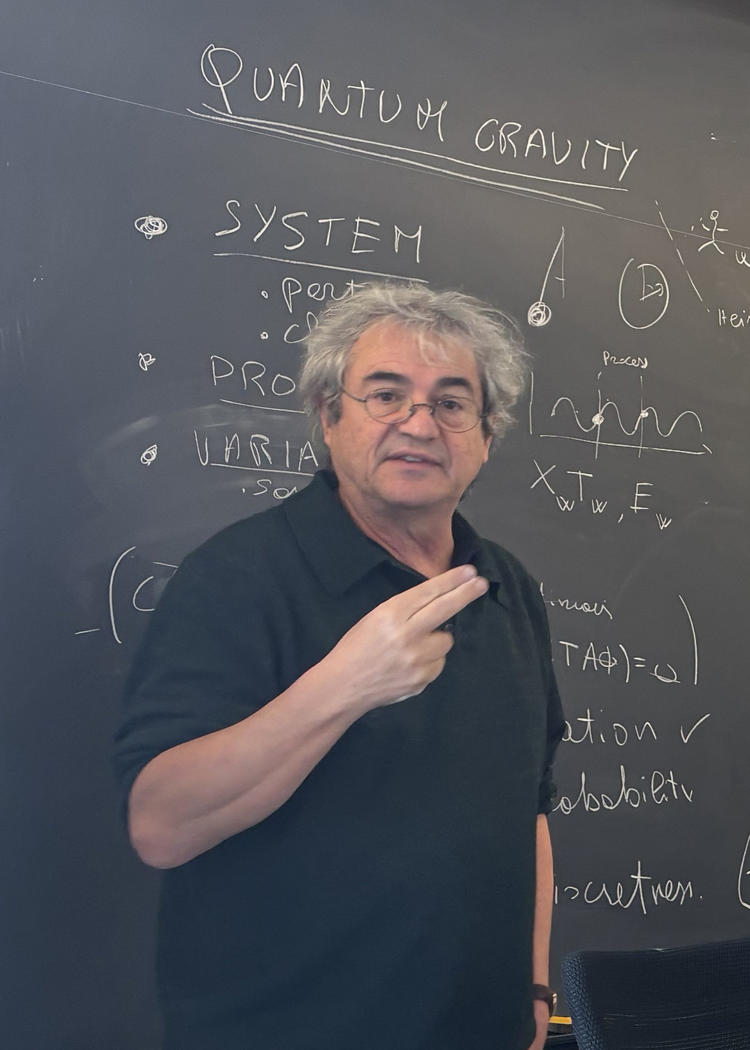
Carlo Rovelli (1956–Present) is an Italian theoretical physicist, philosopher of science, and author recognized as a co-founder of Loop Quantum Gravity (LQG) alongside Lee Smolin and Abhay Ashtekar. Rovelli's radical contributions extend far beyond technical quantum gravity: he pioneered Relational Quantum Mechanics (RQM), which dissolves the classical notion of observer-independent physical substances and posits that the physical state of any system exists solely relative to another interacting system. In his investigations into temporality, Rovelli formulated the Thermal Time Hypothesis, demonstrating that at the fundamental Planck scale the universe is entirely timeless; the apparent forward flow of time and thermodynamic irreversibility emerge solely from the blurred, coarse-grained perspective through which macroscopic observers interact with quantum reality. In his philosophical treatise Helgoland, Rovelli built a groundbreaking bridge between relational physics and Nāgārjuna's Buddhist philosophy of Śūnyatā (Emptiness) and Pratītyasamutpāda (Dependent Origination), demonstrating that the ultimate architecture of the cosmos is not an aggregate of isolated substances, but an ongoing web of interdependent relations and perceptual encounters.
I. Intellectual Trajectory & Foundational Architecture
Carlo Rovelli’s intellectual journey bridges radical political dissent, rigorous mathematical physics, and continental philosophy. Educated at the University of Bologna and the University of Padua, Rovelli participated actively in the countercultural movements of 1970s Italy before turning to theoretical physics, driven by an urgent desire to understand the nature of space, time, and human knowledge.
| Phase / Intellectual Domain | Institutional & Historical Context | Conceptual Breakthrough & Core Contribution |
|---|---|---|
| Early Formative Years & Dissent | University of Bologna, Free Radio Alice (1970s) | Rejection of authoritarian dogmatism; cultivation of open-ended, anti-dogmatic inquiry. |
| Foundations of Quantum Gravity | University of Padua, Syracuse University (1980s–1990s) | Co-creation of Loop Quantum Gravity with Lee Smolin and Abhay Ashtekar; background independence. |
| Relational Quantum Mechanics (RQM) | Marseille Centre de Physique Théorique (1996) | Relational interpretation: quantum properties are actualized only in physical interactions between systems. |
| Thermal Time & Timelessness | Marseille & Pittsburgh collaborations with Alain Connes | Formulation of the Thermal Time Hypothesis; time as an emergent macroscopic statistical artifact. |
| Philosophy of Science & Antiquity | Research on Anaximander (The First Scientist) | Defense of scientific inquiry as continuous subversion of dogma and conceptual revision. |
| Transdisciplinary Philosophy | Publication of The Order of Time (2018) and Helgoland (2020) | Synthesis of relational quantum theory with Nāgārjuna's Madhyamaka, cognitive science, and phenomenology. |
The Demise of the Classical Background Arena
In classical Newtonian mechanics, space and time were conceived as an immutable, static stage—a rigid background grid across which particles moved and collided. Albert Einstein's general relativity dismantled this rigid stage by showing that space and time are dynamic entities: gravitational fields that can curve, ripple, and stretch in the presence of mass and energy.
However, standard quantum mechanics remained trapped inside the Newtonian assumption, calculating quantum probabilities against a pre-existing background time parameter. Rovelli’s primary theoretical breakthrough in Loop Quantum Gravity was Background Independence:
- Space is not an empty container in which quantum events take place.
- Space itself is quantized into discrete, microscopic quanta—interconnected grains of space knit into a dynamic relational network called a spin network.
- There is no spatial container outside this network; the relations between the grains constitute space itself.
- Consequently, physics does not describe how objects evolve in space and time; rather, it describes how dynamic quantum fields interact with one another without any absolute spatio-temporal backdrop.
II. Relational Quantum Mechanics (RQM): The Dissolution of Absolute Substance
Formulated by Rovelli in his seminal 1996 paper, Relational Quantum Mechanics (RQM) directly confronts the central paradoxes of the quantum world: the measurement problem, wave-function collapse, and quantum entanglement.
| Ontological Dimension | Classical Substance Ontology (Democritus / Newton / Descartes) | Relational Quantum Mechanics (Carlo Rovelli) |
|---|---|---|
| Primary Unit of Reality | Isolated, self-existent material substances (things / particles). | Relational physical interactions and dynamic happenings (events / facts). |
| Nature of Physical States | Absolute, intrinsic properties possessed by the object in isolation. | Frame-dependent variables actualized solely relative to an interacting system. |
| Role of the Observer | Detached spectator outside the physical arena, observing objective facts. | Any physical system (particle, measuring apparatus, human brain) in physical interaction. |
| Wave-Function Status | Objective physical wave collapsing in space (Copenhagen / Penrose) or branching worlds (Everett). | Epistemic tool summarizing available information relative to a specific observer. |
| Location of Reality | Inside the boundary of the isolated particle or physical body. | At the interaction boundary where two physical systems exchange physical effects. |
Reality as a Network of Interactions
Classical Western metaphysics, from Aristotle to René Descartes, presumed that reality is composed of independent substances (substantia)—entities that require nothing other than themselves in order to exist. Under this substance-based model, properties such as position, velocity, and color belong inherently to the object itself.
Rovelli turns this ancient metaphysics on its head:
- Properties Exist Only in Interaction: An electron does not possess a definite position or momentum while isolated in the dark. Its position is actualized only at the precise moment it collides with a phosphor screen, an atom, or a photon.
- Relational Truths vs. Absolute Truths: The value of a physical variable is real only relative to the interacting system. It does not exist as an absolute, universal fact for the rest of the cosmos. System A may actualize a definite value when interacting with System B, while relative to a third System C, the combined system of A and B remains in a state of open potential.
- No Privileged Observers: In RQM, an "observer" is not a conscious human mind or a Cartesian soul. Any elementary particle, water droplet, or mechanical sensor is an observer. Whenever physical systems interact and leave a trace on one another, relational properties are actualized.
By treating physical states as purely relational, Rovelli dissolves the need for mysterious non-physical collapses of the wave-function or infinite parallel universes. Reality is an open, interconnected matrix of relational events.
III. The Thermal Time Hypothesis & The Architecture of Time
Perhaps Rovelli’s most celebrated philosophical insight—developed extensively in The Order of Time—is the radical deconstruction of universal, linear time.
| Paradigm | Conception of Time | Status of the "Present Moment" | Driver of Temporal Flow |
|---|---|---|---|
| Newtonian Absolute Time | Universal, uniform, absolute river flowing identically everywhere. | A single, cosmic "Now" spanning across the entire universe simultaneously. | Fundamental metaphysical baseline of reality. |
| Einsteinian Spacetime | Relativistic metric; time dilates with speed and gravitational proximity. | The cosmic "Now" evaporates; simultaneity is frame-dependent and localized. | Geometry of four-dimensional curved spacetime. |
| Rovellian Quantum Time | Timeless at the Planck scale; fundamental quantum gravity contains no time variable. | Completely non-existent at the fundamental microscopic level of nature. | Thermal Time Hypothesis: Emerges from thermodynamic coarse-graining and observer ignorance. |
1. Fundamental Timelessness at the Planck Scale
In fundamental quantum gravity, the universal time coordinate completely vanishes from the primary equations of nature. As Rovelli and contemporary physicists demonstrate, when the principles of general relativity are unified with quantum mechanics:
- There is no global clock ticking behind the cosmos.
- The fundamental laws of the universe do not govern how variables change with respect to time; they govern how physical variables change with respect to one another.
- At the Planck scale—the most fundamental microscopic layer of reality—the concepts of past, present, future, and temporal duration have no meaning. Reality is composed of timeless quantum events.
2. Time is Ignorance: Coarse-Graining and Thermal Time
If the fundamental world is timeless, why do human beings experience an unrelenting, unidirectional arrow of time flowing from the fixed past into the open future?
Rovelli's answer unites Ludwig Boltzmann's statistical mechanics with the Thermal Time Hypothesis:
- Microscopic Indifference: At the microscopic level, all mechanical interactions are completely reversible. Spilled milk returning to a glass or heat flowing from cold to hot does not violate any fundamental microscopic mechanical law.
- Macroscopic Blurring (Coarse-Graining): Macroscopic observers (such as biological organisms and scientific instruments) cannot track the trillions of microscopic quantum degrees of freedom in an environment. We interact with reality exclusively through blurred, macroscopic averages—such as temperature, pressure, and volume.
- Entropy as a Relational Property: In accordance with Boltzmann, entropy measures the volume of microscopic states that correspond to our macroscopic labels. Crucially, Rovelli argues that entropy is not an intrinsic property of the physical system alone; it is a relational property between the system and the observer's limited resolution.
- Thermal Time: The arrow of time, the feeling of temporal succession, and the distinction between past and future exist only because of this macroscopic blurring. If an observer possessed infinite informational resolution and could track every microscopic variable simultaneously, there would be no heat, no entropy increase, and no flow of time. In Rovelli's striking aphorism:
"Time is ignorance."
IV. The Madhyamaka Resonance: Helgoland and Nāgārjunian Emptiness
In his 2020 book Helgoland, Rovelli examines the philosophical roots of quantum mechanics, recounting Werner Heisenberg's revolutionary breakthrough on the barren North Sea island of Helgoland in 1925. In searching for a philosophical framework adequate to express the relational nature of quantum physics, Rovelli turned away from Western Cartesian metaphysics and looked to classical Indian thought—specifically Nāgārjuna and the Madhyamaka (Middle Way) school of Buddhism.
| Diagnostic Feature | Nāgārjuna's Madhyamaka Philosophy | Carlo Rovelli's Relational Physics |
|---|---|---|
| Core Deconstructive Target | Svabhāva (intrinsic nature, self-essence, independent existence). | Substance Ontology (isolated particles possessing absolute, intrinsic states). |
| Primary Positive Principle | Śūnyatā (Emptiness) = Pratītyasamutpāda (Dependent Origination). | Relational Reality = Properties exist only as interactions between physical systems. |
| Mereological Insight | Wholes and parts are mutual dependent designations (prajñaptir upādāya). | Quantum systems cannot be isolated; boundaries are defined by relational interactions. |
| Status of the Observer | Subject and object arise interdependently; no unconditioned Cartesian ego. | The observer is a physical system coupled to another physical system; no transcendent witness. |
| Escape from Extremes | The Middle Way between Eternalism (Substantialism) and Nihilism (Void). | Middle Way between Naive Realism (hidden variables) and Solipsism / Anti-Realism. |
1. Deconstructing Inherent Existence (Svabhāva)
In the Mūlamadhyamakakārikā, Nāgārjuna demonstrated that if an object possessed svabhāva (intrinsic, independent self-nature), it could never change, interact, cause effects, or cease to exist. A cosmos of self-sufficient essences would be permanently static and impotent.
Rovelli recognizes that 20th-century physics ran directly into this ancient philosophical trap:
- Classical physicists assumed that an electron must have an intrinsic position, charge, and mass that exist independently of anything else in the cosmos.
- Quantum mechanics proved that treating physical values as intrinsic and observer-independent generates insoluble paradoxes.
- Rovelli argues that Nāgārjuna’s central realization is identical to that of relational quantum mechanics: entities do not exist in themselves; they exist solely in relation to other entities.
2. Dependent Designation (Prajñaptir Upādāya) and Quantum Events
Nāgārjuna equates emptiness directly with dependent designation (prajñaptir upādāya): an object (such as a chariot, a flame, or an ego) does not have an intrinsic boundary separating it from the rest of the cosmos. Its boundaries are dependently designated based on parts, causes, and the perspective of the observer.
In Rovelli's physics, this exact principle governs physical objects:
- A "stone," a "chair," or a "planet" is not an eternal, isolated substance.
- It is a temporary, low-entropy nexus of relational interactions that persists over a certain timescale.
- Cut off an entity from all physical interactions, and it does not remain as an empty substratum—its physical properties completely evaporate.
3. Avoiding the Trap of Nihilism
Crucially, both Nāgārjuna and Rovelli navigate between the twin traps of Substantialism (believing things exist with absolute self-nature) and Nihilism (believing that because things lack inherent essence, nothing exists at all):
- Nāgārjuna’s Two Truths doctrine establishes that conventional reality (saṃvṛti-satya) functions with genuine causal efficacy (arthakriyā) precisely because it is empty of intrinsic essence.
- Rovelli maintains that the world of everyday tables, chairs, people, and scientific measurements is not a hallucination or an empty illusion. It is functionally real, predictable, and causally potent—but its reality is relational and perspectival, not absolute.
V. Cognitive Science, Perception, and Perspective-Dependent Reality
Rovelli’s relational framework carries profound implications for cognitive science, philosophy of mind, and the neurobiology of perception.
| Perceptual Model | Model Architecture & Epistemic Claim | Status of the Sensory Interface |
|---|---|---|
| Naive Realism | Direct window; sensory faculties passively mirror objective, mind-independent objects. | Transparent lens delivering raw, untransformed ontological reality. |
| Cartesian / Computational Cognitive Model | Mind as an internal computing software decoding incoming sensory bits from an external world. | Mediating representation; reinforces dualism between thinking subject and material object. |
| Rovellian Relational Perception | Organism as an interacting physical system whose perception is an internal correlation with its niche. | Scale-dependent relational boundary; actualizes properties through thermodynamic coupling. |
| Evolutionary Interface Theory (Hoffman) | Fitness-driven desktop interface; sensory icons hide complex reality to ensure biological survival. | Functional user interface optimizing metabolic fitness rather than veridical truth. |
1. The Embedded Physical Observer
Classical epistemologies frequently placed the human observer outside the universe—a disembodied spectator peering through a window at nature.
Rovelli insists on the thorough physicalization of the observer:
- The human brain is not a transcendent soul observing nature from the outside; it is a physical system composed of atoms and neurons, entirely governed by the laws of physics.
- Perception is a physical interaction between two subsystems of the universe: the organism and its local environment.
- When an organism perceives an object, the physical state of the organism’s neural tissue correlates with the physical state of the environment. The resulting perception is not a revelation of the object's absolute essence, but an index of the relational interaction between the two.
2. Convergence with Predictive Processing and Eliminative Filtering
Rovelli’s relational model converges with leading contemporary frameworks in cognitive science and philosophy of perception:
- The Interface Theory of Perception (ITP): Donald Hoffman’s evolutionary proof demonstrates that natural selection tunes sensory systems to guide adaptive action, not to reveal objective metaphysical truth. Rovelli’s physics provides the foundational physical basis for Hoffman's interface: space, time, and discrete objects are the coarse-grained interface through which macroscopic observers interact with the relational quantum flux.
- Karl Friston’s Active Inference: The brain maintains homeostatic boundaries by generating hierarchical generative models that coarse-grain environmental perturbations into actionable hypotheses. The brain operates as a thermodynamic engine minimizing free energy by selectively ignoring microscopic details.
- Henri Bergson and Bergson’s Eliminative Model of Perception and Memory: In Matter and Memory, Bergson demonstrated that the physical brain does not generate images of the world; it acts as an eliminative reducing valve, filtering out extraneous realities to focus motor action on biological survival. Rovelli’s relational physics confirms that macroscopic reality is literally defined by what the observer's interaction eliminates or coarse-grains away.
VI. Comprehensive Comparative Matrix
The following analytical matrix summarizes how Rovelli’s core concepts correlate with classical physics, statistical thermodynamics, Buddhist epistemology, and modern cognitive science:
| Diagnostic Axis | Classical Newtonian Physics | Ludwig Boltzmann (Thermodynamics) | Carlo Rovelli (Relational Physics) | Nāgārjuna (Madhyamaka Buddhism) | Modern Cognitive Science (Hoffman / Friston) |
|---|---|---|---|---|---|
| Fundamental Nature of Reality | Absolute particles moving in continuous space and time. | Enormous microscopic phase space of particles in reversible flux. | Relational network of quantum events; timeless and background-independent. | Dependently co-arisen flux (pratītyasamutpāda); empty of essence (svabhāva). | Dynamic physical and informational environment; Markov blankets. |
| Status of Objects | Durable, self-standing substances possessing inherent attributes. | Macrostates formed by grouping vast numbers of microstates. | Temporary nodes in an interactive network; real only relative to an interacting system. | Nominal designations (prajñapti) dependent on parts, causes, and concepts. | Species-specific desktop icons optimized for metabolic utility. |
| Origin of Time's Arrow | Absolute, fundamental background river flowing everywhere. | Emergent statistical probability resulting from coarse-graining over phase space. | Thermal Time Hypothesis: Emerges from coarse-graining and limited observer resolution. | Conventional metric of change; time has no independent self-nature (svabhāva). | Predictive prospective temporal horizons generated by neural models. |
| Role of the Observer | Passive detached spectator viewing external reality. | Macro-system whose scale determines the partition of phase space. | A physical subsystem interacting and correlating with another subsystem. | An interdependent participant; subject and object arise together. | Active inference agent predicting sensory states to preserve homeostasis. |
| Core Epistemic Error | Assuming that sensory appearance is a separate mental illusion. | Reifying macrostates (temperature, pressure) into fundamental entities. | Reifying relational events into isolated, observer-independent substances. | Reification (Samāropa): Grasping at intrinsic existence and an enduring ego (ātman). | Naïve Realism: Mistaking the desktop interface icons for objective reality. |
| Ultimate Insight | Nature is a deterministic, clockwork machine. | Macroscopic stability is scale-dependent statistical order. | Reality is a luminous, open web of relations without absolute foundations. | Insight into Emptiness (Prajñā) dissolves conceptual clinging and suffering. | Perception is a generative, action-oriented model, not an ontological mirror. |
🎴 Interactive Web Practice (Comprehension Check)
Question 1 (Relational Quantum Mechanics & Substance Ontology): How does Carlo Rovelli's Relational Quantum Mechanics (RQM) dismantle the classical Cartesian and Democritean concept of substance ontology, and what does it mean to state that a physical variable is "real only relative to an interacting system"?
Answer: Classical substance ontology, stemming from Democritus, Aristotle, and Descartes, assumed that physical reality is composed of independent, self-contained entities (substances) that exist in isolation and inherently possess fixed properties such as position, velocity, and boundary. In this classical view, interactions merely modify the states of pre-existing substances.
Rovelli's Relational Quantum Mechanics dismantles this framework by demonstrating that physical properties are not intrinsic attributes locked inside isolated objects:
- Properties are Relational Events: A physical variable (such as an electron's position or momentum) does not exist with a definite value between interactions. It is actualized solely at the precise moment of physical interaction with another system.
- Relative Actualization: A variable is actualized exclusively relative to the specific system with which it interacts. If System A interacts with System B, a definite value is established for System B relative to System A. However, relative to a third System C that has not participated in this interaction, no collapse or definite value has occurred; for System C, the combined system of A and B remains in a state of open quantum potential.
- Dissolution of the Isolated Substance: Strip away all physical interactions from an entity, and there is no underlying material essence or substance left behind. Reality is not an inventory of things, but an ongoing network of relational happenings and physical correlations.
Question 2 (The Thermal Time Hypothesis & The Arrow of Time): In what way does Rovelli's Thermal Time Hypothesis explain why the fundamental quantum laws of the universe contain no time parameter, and how does macroscopic coarse-graining generate the human perception of time's arrow?
Answer: In modern fundamental physics—particularly Loop Quantum Gravity and relativistic quantum mechanics—the universal time coordinate completely drops out of the primary equations describing the cosmos. At the fundamental Planck scale, the universe is timeless: physical laws do not dictate how things change with respect to an external master clock, but rather how quantum variables correlate with one another.
Rovelli's Thermal Time Hypothesis explains that the sensation of time flowing from the past toward the future is an emergent macroscopic phenomenon driven by thermodynamic coarse-graining:
- Microscopic Reversibility: At the microscopic scale, all elementary interactions are time-reversible; there is no fundamental arrow distinguishing the past from the future.
- Macroscopic Blurring (Coarse-Graining): Macroscopic observers cannot track the astronomical number of microscopic quantum degrees of freedom. We interact with the environment exclusively through blurred, macroscopic averages (such as pressure, volume, and temperature).
- Relational Entropy: Thermodynamic entropy—and therefore the irreversible direction of heat flow—is not an absolute property of the external system in isolation, but a relational consequence of our blurred perspective.
- Time as Perspective: Because our interaction ignores microscopic details, the system appears to evolve toward higher-entropy macrostates. Thus, the arrow of time, memory of the past, and uncertainty of the future are not woven into the fundamental fabric of the cosmos; they are the direct experiential consequence of our partial, coarse-grained engagement with reality.
Question 3 (The Madhyamaka Synthesis & Helgoland): Why did Carlo Rovelli draw directly upon Nāgārjuna's Buddhist doctrine of Śūnyatā (Emptiness) in Helgoland, and how does the Middle Way navigate between naive scientific realism and nihilistic anti-realism?
Answer: In Helgoland, Rovelli turned to Nāgārjuna's Mūlamadhyamakakārikā because Western philosophy lacked a mature conceptual vocabulary to describe a universe devoid of absolute substances without falling into subjectivism or solipsism.
Nāgārjuna's doctrine of Śūnyatā (Emptiness) provided the exact philosophical parallel to Relational Quantum Mechanics:
- Emptiness of Inherent Nature (Svabhāva-śūnyatā): Nāgārjuna showed that entities cannot possess an uncaused, independent, unchanging essence (svabhāva). If they did, they could never interact or change. This precisely mirrors Rovelli's insight that quantum particles do not possess independent, isolated physical states.
- Equating Emptiness with Dependent Origination (Pratītyasamutpāda): Nāgārjuna emphasized that emptiness is not a void of non-existence, but the realization that things exist dependently—upon causes, parts, and conceptual designation (prajñaptir upādāya). Things are relations.
- The Middle Way: The Madhyamaka framework allows Rovelli to avoid two destructive extremes:
- Against Naive Realism: It rejects the idea that objects exist with observer-independent, absolute properties (hidden variables or classical substances).
- Against Nihilism / Solipsism: It rejects the claim that because things lack inherent essence, they are meaningless illusions or merely subjective figments of a human mind. Conventional reality (saṃvṛti-satya) functions with genuine, predictable causal efficacy (arthakriyā) precisely because it is relational, open, and dependently originated.
Resonant Notes
The following notes in the vault share direct thematic, sociological, and philosophical connections with Carlo Rovelli:
🔴 Loop Quantum Gravity, Relational Physics & Thermodynamics
- Boltzmannian Coarse-Graining and Nagarjunian Emptiness — Establishes the mathematical and conceptual convergence between Ludwig Boltzmann's statistical entropy and Nāgārjuna's Two Truths doctrine, directly corroborating Rovelli's relational formulation of thermal time and coarse-grained entropy.
- Two Kinds of Nothingness-Astrophysics and Buddhist Philosophy — Examines the boundary between physical vacuum states and ontological emptiness, grounding Rovelli’s relational critique of cosmological genesis and quantum field theory.
- Time as Change — Deconstructs absolute Newtonian time in favor of relational temporality through Aristotle, Leibniz, and Loop Quantum Gravity, synthesizing Rovelli’s timeless quantum framework with phenomenological duration.
- Ludwig Boltzmann (1844-1906) — Primary theoretical profile detailing Boltzmann’s statistical derivation of entropy and the emergence of macroscopic irreversibility, serving as the physical foundation for Rovelli's Thermal Time Hypothesis.
- Entropy — Charts thermodynamic and information-theoretic formulations of disorder, illuminating how macroscopic time asymmetry and organizational structures emerge from statistical probabilities rather than fundamental absolutes.
🟡 Madhyamaka Ontology, Emptiness & Comparative Metaphysics
- Nāgārjuna — The definitive philosophical anchor of Madhyamaka philosophy, articulating the deconstruction of svabhāva, the identity of emptiness with dependent origination (pratītyasamutpāda), and the relational epistemology central to Rovelli’s Helgoland.
- Constructs of the Mind-Unmasking Consciousness in East and West — Investigates how cognitive models, Buddhist emptiness, and Western epistemologies deconstruct substance dualism and expose the relational construction of phenomenal experience.
- Gottfried Wilhelm Leibniz and Perennial Philosophy — Connects Leibniz’s relational critique of absolute space and time to the relational physics of Loop Quantum Gravity and the perennial insight of cosmic interdependence.
- Dzogchen & The Core Instruction - Turning the Gaze Inward — Contemplative frameworks exploring primordial awareness (rigpa), which abides beyond reified conceptual boundaries of existence and non-existence, mirroring the relational dissolution of objective substance.
- Epistemology of Preference-Avijjā, Māna, and the Emptiness of Aesthetic Taste in Buddhist Philosophy — Demonstrates how cognitive ignorance (avijjā) reifies transient relational experiences into fixed essences, paralleling the human tendency to reify relational quantum events into classical substances.
🟢 Perception, Cognitive Science & Phenomenological Duration
- The Interface Theory of Perception (ITP) — Donald Hoffman’s evolutionary proof that sensory perception functions as a species-specific desktop interface rather than a veridical mirror of objective reality, providing the cognitive parallel to Rovelli's relational and perspectival physics.
- Henri Bergson & Bergson’s Eliminative Model of Perception and Memory — Explores Bergson's critique of spatialized clock-time in favor of lived duration (la durée) and his model of the brain as an eliminative reducing valve, anticipating Rovelli's insight that time emerges through coarse-grained filtering.
- Husserl's Internal Time-Consciousness & Internal Time-Consciousness and Buddhist Psychology — Investigates Edmund Husserl’s tripartite intentional architecture (Primal Impression, Retention, Protention), showing how subjective temporal duration is constituted by intentional synthesis in the absence of a rigid external timeline.
- Default Mode Network (DMN) — Analyzes the neural architecture mediating autobiographical narrative and past-future mental projection, providing the biological mechanics that construct the psychological arrow of time.
- Gestalt Psychology-The Mechanics of the Whole — Examines how human perception spontaneously constructs emergent, relational Gestalts that cannot be reduced to the sum of isolated sensory atoms, reinforcing Rovelli’s relational mereology.
- William James — Details James’s functional psychology, the continuous stream of consciousness, and radical empiricism, which dismantled Cartesian substance dualism in favor of pure relational experience.
- Iain McGilchrist — Explores the divided-brain hypothesis, contrasting the left hemisphere’s reifying drive to isolate static, decontextualized parts with the right hemisphere’s grasp of flowing, interconnected relational wholes.
- Science vs. Pseudoscience - The Demarcation Problem — Explores Karl Popper’s falsificationism and scientific epistemology, paralleling Rovelli’s historical analysis of Anaximander and the duty of scientific inquiry to continually subvert entrenched dogmatic assumptions.
Backlinks
- Boltzmannian Coarse-Graining and Nagarjunian Emptiness — Cites Rovelli's relational thermodynamics and quantum gravity to establish that macroscopic entropy and the arrow of time are relational designations generated by coarse-grained observers.
- Two Kinds of Nothingness-Astrophysics and Buddhist Philosophy — Directly engages Rovelli’s Relational Quantum Mechanics (RQM) to demonstrate that physical variables and quantum vacuum states are dependently originated rather than self-existent substances.
- Time as Change — References Rovelli’s work in Loop Quantum Gravity and The Order of Time to prove that at the fundamental level of theoretical physics, time is an emergent metric of relational transformation rather than an absolute container.
- The Interface Theory of Perception (ITP) — Integrates Rovelli’s relational ontology to demonstrate that physical objects and spacetime coordinates are interface heuristics produced by scale-dependent, coupled interactions.
- Nāgārjuna — Connects the classical Madhyamaka deconstruction of svabhāva directly to Rovelli’s Helgoland and modern relational quantum mechanics.