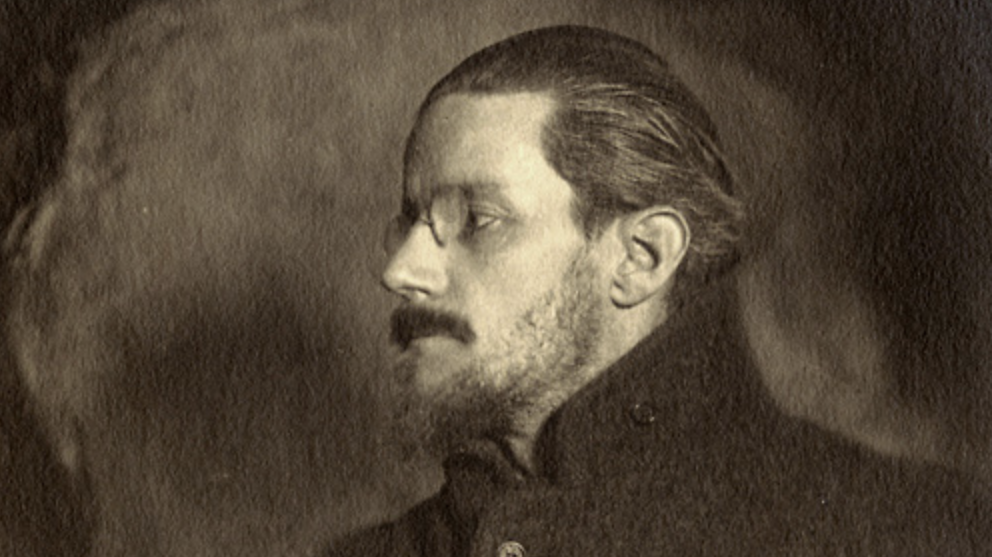
James Joyce (1882–1941)
James Joyce (1882–1941) was an Irish novelist and poet widely regarded as one of the most influential figures of Modernist literature. Known for his pioneering use of stream-of-consciousness narrative, complex linguistic punning, and intimate portrayals of Dublin life, Joyce reshaped the boundaries of 20th-century fiction through works such as Dubliners, A Portrait of the Artist as a Young Man, Ulysses, and Finnegans Wake.
1. Biography and Life in Exile
Early Life and Education in Ireland
Born on February 2, 1882, in Rathgar, Dublin, James Augustine Aloysius Joyce was the eldest of ten surviving children.[1] His father, John Stanislaus Joyce, was a talented singer and witty storyteller, but financially reckless, causing the family to plunge into progressive poverty during Joyce's youth.[1:1]
Joyce received a rigorous Jesuit education, attending Clongowes Wood College and Belvedere College before entering University College Dublin (UCD) in 1898.[1:2] Although he eventually rejected Roman Catholic religious dogma, his Jesuit schooling deeply infused his philosophical framework, rhetorical style, and symbolic imagination.[1:3]
Self-Imposed Exile
Dissatisfied with what he viewed as Irish provincialism and the parochial nature of the contemporary Irish Literary Revival, Joyce left Ireland in 1904 with Nora Barnacle, who became his lifelong partner and later his wife.[1:4] He spent the vast majority of his adult life living in European cities, including:
- Trieste (Austro-Hungarian Empire / Italy): Taught English at the Berlitz School, perfected his mastery of languages, and befriended Italian writer Italo Svevo.
- Zurich (Switzerland): Resided here during World War I and the final months of his life, developing his central aesthetic theories.
- Paris (France): Served as the epicenter of his literary fame during the 1920s and 1930s, supported by key literary patrons such as Harriet Shaw Weaver and publisher Sylvia Beach.[1:5]
Despite his lifelong physical separation from his homeland, Dublin remained the setting for virtually all of Joyce's fiction.[1:6]
"For myself, I always write about Dublin, for if I can get to the heart of Dublin I can get to the heart of all the cities of the world. In the particular is contained the universal."
— James Joyce
2. Major Works
Dubliners (1914)
Dubliners is a collection of 15 short stories offering a realistic and unsparing portrayal of middle-class Irish life in and around Dublin at the turn of the 20th century.[2]
- Core Themes: Moral paralysis, emotional stagnation, and political disillusionment under British colonial rule and Roman Catholic influence.[2:1]
- Structure: The stories progress chronologically through four stages of human life: childhood, adolescence, maturity, and public life.
- Key Innovation: The narrative technique of the epiphany—a sudden intuitive leap or spiritual illumination triggered by an ordinary gesture, object, or sound.
- Notable Stories: "Araby", "Eveline", and "The Dead" (frequently cited as one of the finest short stories in modern literature).
A Portrait of the Artist as a Young Man (1916)
A semi-autobiographical Bildungsroman tracing the intellectual, aesthetic, and religious evolution of Stephen Dedalus, Joyce's fictional alter ego.[1:7]
- Narrative Evolution: The language evolves dynamically as Stephen matures—beginning with babyish sensory impressions and progressing to sophisticated artistic theories influenced by Aristotle and Saint Thomas Aquinas.
- Key Themes: The tension between artistic autonomy and the restrictive claims of family, nationality, and religion.
- Famous Creed: Stephen resolves his internal struggle by declaring: "I will not serve that in which I no longer believe, whether it call itself my home, my fatherland, or my church."
Ulysses (1922)
Published in Paris on Joyce's 40th birthday by Sylvia Beach (Shakespeare and Company), Ulysses stands as a central pillar of literary modernism.[1:8]
- Premise: The novel chronicles a single day—June 16, 1904—in the lives of three Dublin residents: Leopold Bloom (a Jewish advertising canvasser), Stephen Dedalus (a young schoolteacher), and Molly Bloom (Leopold's wife).
- Homeric Parallels: Its 18 episodes correspond structurally and allegorically to episodes in Homer's Odyssey, mapping ancient mythic archetypes onto modern urban life.[2:2]
- Technical Mastery: Each chapter employs a distinct narrative style, color scheme, science, body organ association, and literary motif (e.g., catechism, newspaper headlines, music, and internal monologue).
The Structure of Ulysses
- Setting: Dublin, Ireland (June 16, 1904)
- Protagonists: Leopold Bloom (Odysseus), Stephen Dedalus (Telemachus), Molly Bloom (Penelope)
- Structure: 18 distinct episodes matching classical Homeric motifs
Finnegans Wake (1939)
Joyce's final and most radically experimental work, written over 17 years and initially circulated under the working title Work in Progress.[1:9]
- Linguistic Architecture: Constructed using a complex multilingual matrix composed of puns, portmanteau words, and dream logic drawing from over 60 languages.
- Cyclical Nature: Influenced by the historiographical philosophies of Giambattista Vico, the novel begins mid-sentence ("riverrun, past Eve and Adam's...") and ends on an unfinished sentence that cycles directly into the opening line.
- Interpretation: Represents the unconscious night-world of human existence through the dream state of the central character, Humphrey Chimpden Earwicker (HCE).
3. Key Literary Innovations
| Innovation | Description | Primary Example |
|---|---|---|
| Stream of Consciousness | A continuous, unfiltered flow of thoughts, sensory impressions, and memories rendering a character's interior monologue. | Molly Bloom's 4,000+ word unpunctuated soliloquy in "Penelope" (Ulysses) |
| The Epiphany | A sudden moment of revelation where the essential truth of a character or situation is brought into clear focus. | Gabriel Conroy's realization during the snowfall in "The Dead" (Dubliners) |
| Multilingual Punning | Blending linguistic roots and syntax to layer multiple historical, literary, and symbolic meanings simultaneously. | The linguistic web of Finnegans Wake |
| Stylistic Pastiche | Adapting historical prose styles to reflect cultural evolution and psychological states. | "Oxen of the Sun" episode in Ulysses, which mimics the history of English prose |
4. Censorship and Legal Landmark: United States v. One Book Called Ulysses
Ulysses faced immediate censorship in both the United Kingdom and the United States due to its frank depictions of sexuality, bodily functions, and irreverence toward established institutions.[3]
The Serialization Ban (1921)
In 1920, the New York Society for the Suppression of Vice filed a complaint after The Little Review serialized the "Nausicaa" episode, which depicted Leopold Bloom masturbating.[3:1] The New York Court of Special Sessions declared the work obscene in 1921, effectively banning the book in the U.S. for over a decade.[3:2]
The Landmark 1933 Court Decision
In 1932, Random House orchestrated a legal test case to challenge the import ban. On December 6, 1933, Judge John M. Woolsey of the U.S. District Court for the Southern District of New York issued a landmark ruling in United States v. One Book Called Ulysses:[4]
Key Legal Precedent
Judge Woolsey established that alleged obscenity must be evaluated based on the literary work in its entirety rather than isolated passages, and evaluated against the average person rather than the most easily corrupted reader.[4:1] He concluded that Ulysses was a sincere literary achievement containing no "leer of the sensualist."
This ruling was affirmed by the Second Circuit Court of Appeals, setting a precedent that liberated artistic expression from nineteenth-century obscenity laws in the United States.[4:2]
5. Legacy and Modern Impact
Joyce's work fundamentally reshaped modern fiction and influenced generations of writers:
- Bloomsday Celebrations: Every year on June 16, readers around the world celebrate Bloomsday by dressing in period attire, holding public readings, and retracing Leopold Bloom's route across Dublin.[2:3]
- Literary Influence: Joyce's structural and linguistic experiments directly inspired major modernists and postmodernists, including Samuel Beckett, William Faulkner, Jorge Luis Borges, Virginia Woolf, and Salman Rushdie.
- Modernist Canon: Ulysses consistently occupies the top spot on modern literary lists, including Modern Library's 100 Best Novels of the 20th Century.
🎴 Interactive Web Practice (Comprehension Check)
Question 1 (Narrative Technique / Stream of Consciousness & Epiphany): How do Joyce's core narrative innovations—specifically the stream of consciousness and the literary epiphany—diverge from traditional 19th-century realism?
Answer: Traditional 19th-century realism relied heavily on externalized social plotting, omniscient authorial commentary, and chronologically ordered events. Joyce transformed this paradigm by shifting narrative focus entirely inward: 1. Stream of Consciousness: Exemplified by Molly Bloom's closing unpunctuated monologue in Ulysses, Joyce captures the raw, continuous, associative flow of thoughts, sensory impressions, memories, and physiological responses without editorial mediation or artificial grammatical structuring. 2. The Epiphany: Introduced in Dubliners, Joyce replaces melodramatic narrative climaxes with sudden intuitive flashes of psychological and spiritual illumination triggered by mundane sights, gestures, or sounds (such as Gabriel Conroy's existential insight during the snowfall in "The Dead"), capturing the moral and cultural paralysis of modern life.
Question 2 (Mythic Architecture / Homeric Scaffolding in Ulysses): What function do Homeric parallels serve in Ulysses, and how does Joyce's structural design elevate the ordinary Dublin day?
Answer: In Ulysses, Joyce maps the 18 episodes of Homer's ancient epic, the Odyssey, onto the seemingly trivial events of a single day (June 16, 1904) in Dublin. Leopold Bloom corresponds to Odysseus (wandering through the urban labyrinth), Stephen Dedalus represents Telemachus (searching for a spiritual father), and Molly Bloom corresponds to Penelope. Rather than merely parodying classic antiquity, this mythic architecture acts as an allegorical scaffold that universalizes mundane bourgeois experience. By linking ordinary biological functions, domestic grievances, and city errands to archetypal mythic quests, Joyce enacts his aesthetic maxim that "in the particular is contained the universal."
Question 3 (Jurisprudence & Censorship / United States v. One Book Called Ulysses): What foundational legal principles did Judge John M. Woolsey establish in the landmark 1933 Ulysses ruling?
Answer: In United States v. One Book Called Ulysses (1933), Judge John M. Woolsey dismantled the repressive nineteenth-century English Hicklin test for obscenity, which judged works based on isolated passages taken out of context and their potential corruptive impact on the most impressionable minds. Woolsey established two decisive standards: 1. The Work as an Organic Whole: Obscenity cannot be determined by isolated, explicit scenes; rather, the entire work must be evaluated contextually to determine whether its dominant effect and intent are panderous or sincerely artistic. 2. The Average Person Standard: The psychological impact of the work must be measured against a normal person with average sex instincts (l'homme moyen sensuel), rather than an abnormally susceptible reader. Concluding that Joyce's work was a sincere, emetic exploration of human consciousness devoid of the "leer of the sensualist," Woolsey's decision established a pivotal First Amendment precedent protecting modern artistic and literary expression.
Resonant Notes
The following notes in the vault share direct thematic, sociological, and literary connections with James Joyce:
🔴 Modernist Aesthetics, Avant-Garde Form & Dehumanization
- Virginia Woolf — Woolf and Joyce are twin pillars of literary modernism, both pioneering stream-of-consciousness narrative in the 1920s. While Joyce's Ulysses mapped Homeric myth onto Dublin, Woolf's Mrs Dalloway and To the Lighthouse rendered the granular flow of subjective time with extraordinary precision. Both rejected 19th-century realist conventions in favor of capturing consciousness as it actually moves.
- Franz Kafka (1883-1924) — Modernist contemporaries who dismantled conventional 19th-century narrative form: while Joyce engineered linguistic abundance and mythic maximalism in Ulysses, Kafka perfected a sober, minimalist horror deployed within impossible, nightmarish architectures.
- The Dehumanization of Art — Joyce serves as the primary literary embodiment of José Ortega y Gasset's thesis. Ulysses and Finnegans Wake deliberately abandon relatable, sentimental human narrative in favour of radical formal experimentation, forcing the reader to look at the "glass" of the aesthetic apparatus rather than the "garden" of mimetic reality.
- Jack Kerouac (1922-1969) — Kerouac's Spontaneous Prose is a direct 20th-century descendant of Joyce's stream-of-consciousness method. Both writers sought to capture the unfiltered flow of thought and experience, privileging immediate, embodied apprehension ("First Thought, Best Thought") over analytical and polite editorial revision.
🟡 Consciousness, Subjective Time & Interiority
- Henri Bergson — Bergson's philosophy of time (la durée)—the distinction between clock time and lived, qualitative duration—provides the philosophical foundation for Joyce's stream-of-consciousness technique. Joyce's manipulation of temporal flow in Ulysses, compressing Homeric epic into a single day while vastly expanding subjective internal moments, is a literary realization of Bergson's temporal ontology.
- William James & William James and the Landscape of Eastern Thought — William James coined the term "stream of consciousness" in The Principles of Psychology (1890), providing the psychological framework of consciousness as a flowing, continuous process that Joyce transformed into high modernist narrative technique.
- Henry James (1843—1916) — Henry James's "central consciousness" technique and his "House of Fiction" metaphor—filtering narrative through a single character's subjective perception—directly anticipated Joyce's interior monologue, shifting the primary locus of dramatic tension from external social events to granular internal perception.
🟢 Language, Mythic Archetypes & Semiotics
- Portmanteau (also known as a lexical blend or blend word) — Joyce's Finnegans Wake is an extended exercise in portmanteau and multilingual fusion; his "multilingual punning" blends linguistic roots across dozens of languages, operating through the same lexical fusion mechanism to construct polysemic dream logic.
- Joseph Campbell and the Hero's Journey — Campbell borrowed the foundational term "monomyth" directly from Finnegans Wake, formalizing the universal archetypal hero journey that Joyce mapped onto the modern urban landscape of Leopold Bloom's Dublin in Ulysses.
References
Encyclopædia Britannica / James Joyce: Biography, Books, Ulysses, & Facts / britannica.com ↩︎ ↩︎ ↩︎ ↩︎ ↩︎ ↩︎ ↩︎ ↩︎ ↩︎ ↩︎
Los Angeles Public Library / Remembering the Literary Genius of James Joyce / lapl.org ↩︎ ↩︎ ↩︎ ↩︎
The First Amendment Encyclopedia / Ulysses Censorship and Publication / firstamendment.mtsu.edu ↩︎ ↩︎ ↩︎
Wikipedia / United States v. One Book Called Ulysses / wikipedia.org ↩︎ ↩︎ ↩︎