Charles Darwin (1809–1882)
Charles Robert Darwin (1809—1882) was an English naturalist, geologist, and biologist best known for establishing the scientific theory that all species of life have descended over time from common ancestors through the mechanism of natural selection. His seminal work, On the Origin of Species (1859), transformed the biological sciences and reshaped humanity's understanding of life on Earth.
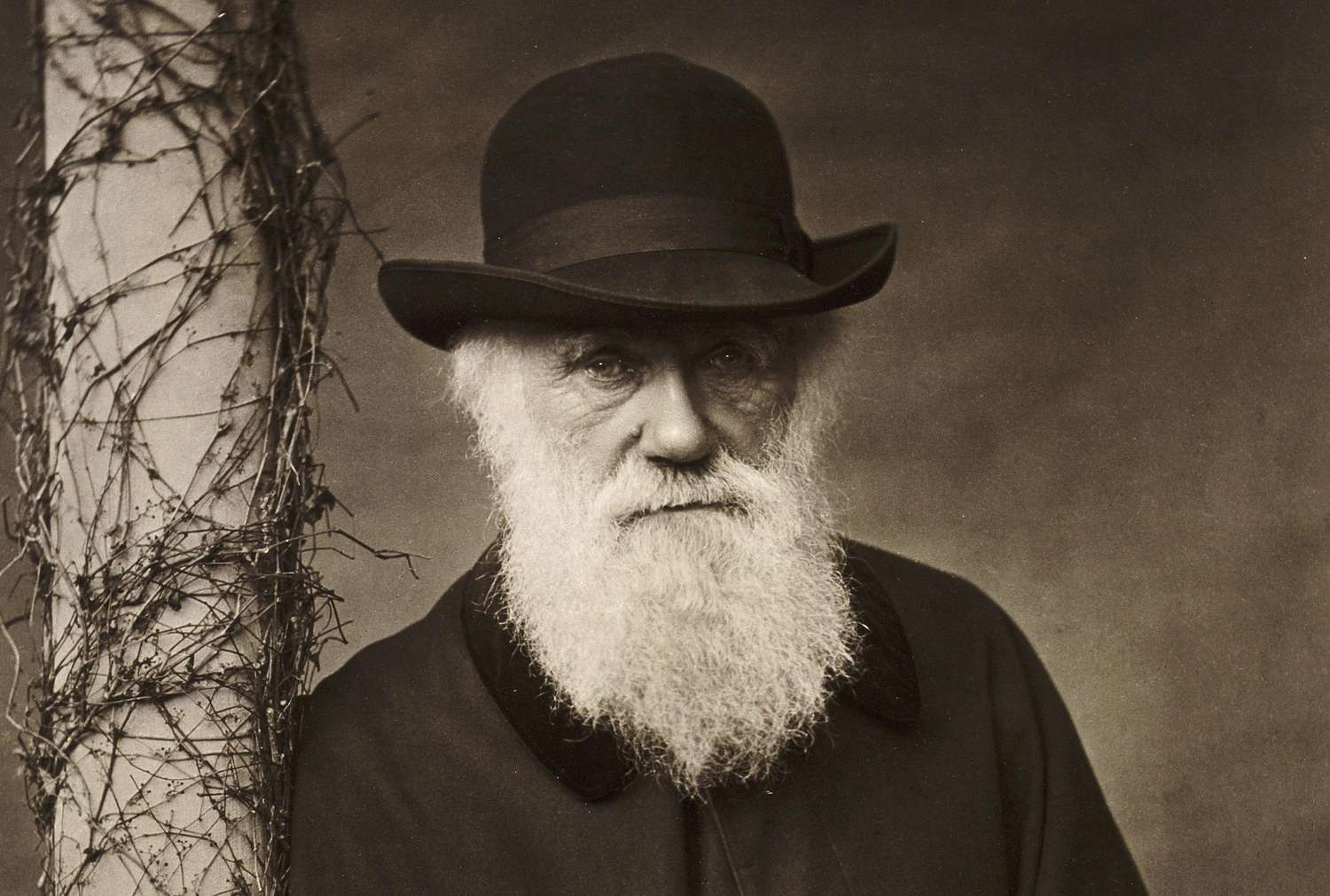
Early Life and Academic Formation
Charles Darwin was born in Shrewsbury, Shropshire, on February 12, 1809, into a wealthy and intellectual family.[1] His father, Robert Darwin, was a successful medical doctor, and his grandfathers were Erasmus Darwin (a prominent physician, philosopher, and early evolutionist) and Josiah Wedgwood (the industrialist founder of the Wedgwood pottery company).
Family Legacy -> Medical Studies (Edinburgh) -> Theology/Natural History (Cambridge)
Medical Studies at Edinburgh (1825—1827)
In 1825, Darwin matriculated at the University of Edinburgh to study medicine. However, he found the lectures dull and surgical procedures without anesthesia traumatizing. Instead, he pursued natural history, joining the Plinian Society and learning marine biology under the tutelage of Lamarckian anatomist Robert Edmond Grant.[1:1]
Theological Studies at Cambridge (1828—1831)
Realizing Charles would not become a physician, his father enrolled him at Christ's College, Cambridge, to obtain a Bachelor of Arts degree in preparation for becoming an Anglican clergyman. At Cambridge, Darwin befriended botany professor John Stevens Henslow and geology professor Adam Sedgwick, who fueled his passion for field work and natural collection.[1:2]
The Voyage of HMS Beagle (1831—1836)
In 1831, upon Henslow's recommendation, Darwin secured a position as an unpaid naturalist aboard HMS Beagle, commanded by Captain Robert FitzRoy. The intended two-year survey mission to South America expanded into a five-year global expedition.[2]
Departure (Plymouth, 1831) -> South America (1832-1835) -> Galápagos Islands (1835) -> Australia & Africa (1836) -> Return (England, 1836)
Key Field Discoveries
- Geological Observations: In South America, Darwin discovered fossilized remains of giant extinct mammals—such as Megatherium and Glyptodon—embedded in layers alongside modern marine shells, supporting Charles Lyell's principle of Uniformitarianism.[2:1]
- Geographic Distribution (Biogeography): Darwin noted how species changed gradually across physical barriers on the South American continent.
- The Galápagos Archipelago (1835): Darwin collected specimens of mockingbirds, finches, and tortoises across the islands. He noticed subtle physical differences between island populations, later recognizing these as adaptations to specific ecological niches.[2:2]
"Seeing this gradation and diversity of structure in one small, intimately related group of birds, one might really fancy that from an original paucity of birds in this archipelago, one species had been taken and modified for different ends."
— Charles Darwin, Journal of Researches (1839)
Formulation of Evolutionary Theory
Upon returning to England in October 1836, Darwin analyzed his specimens with experts at the Zoological Society of London, including ornithologist John Gould.[3] Gould revealed that the Galápagos finches were not distinct species families, but closely related ground-dwelling and tree-dwelling finches endemic to individual islands.
Notebooks on Transmutation of Species (1837—1839)
By July 1837, Darwin began his secret "B Notebook" on the transmutation of species, sketching his famous "Tree of Life" diagram showing branching biological lineage.[3:1]
               [ 1 ]
               /   \
             [A]   [B]
             / \     \
           [C] [D]   [E]
Influence of Thomas Malthus
In October 1838, Darwin read Thomas Malthus's An Essay on the Principle of Population. Malthus argued that human populations grow exponentially while food production increases linearly, leading to a struggle for existence.[3:2] Darwin realized this dynamic applied to all biological organisms:
- Overproduction: Organisms produce more offspring than can survive.
- Variation: Individuals within a species possess distinct physical and behavioral variations.
- Differential Survival: Individuals with traits best suited to their environment are more likely to survive and reproduce.
- Inheritance: Favorable traits are passed down to subsequent generations.
The 20-Year Delay
Darwin drafted a manuscript of his theory in 1844 but delayed publication for fifteen years. He spent this time conducting exhaustive research—including an eight-year taxonomic study of barnacles (Cirripedia), selective pigeon breeding, and plant germination experiments—to build an undeniable empirical foundation.[3:3]
Publication of On the Origin of Species (1859)
In June 1858, Darwin received an essay from Alfred Russel Wallace, a natural historian working in the Malay Archipelago, detailing an identical mechanism of evolution by natural selection.[4]
To avoid priority disputes, naturalists Charles Lyell and Joseph Dalton Hooker arranged for a joint presentation of Darwin's and Wallace's papers at the Linnean Society of London on July 1, 1858.
Darwin quickly synthesized his decades of research into On the Origin of Species by Means of Natural Selection, published on November 24, 1859.[4:1] The entire initial printing of 1,250 copies sold out on the first day.
Major Published Works
| Title | Publication Year | Primary Focus / Significance |
|---|---|---|
| The Voyage of the Beagle | 1839 | Travel narrative detailing geological and biological observations |
| On the Origin of Species | 1859 | Formal introduction of natural selection and common descent |
| The Variation of Animals and Plants Under Domestication | 1868 | Artificial selection; introduced his "Pangenesis" inheritance hypothesis |
| The Descent of Man, and Selection in Relation to Sex | 1871 | Applied evolutionary theory to humans; detailed sexual selection |
| The Expression of the Emotions in Man and Animals | 1872 | Explored evolutionary roots of human psychology and emotional response |
Scientific Legacy and Misconceptions
Darwin died on April 19, 1882, at Down House in Kent, and was granted a state funeral at Westminster Abbey, buried near Sir Isaac Newton.[1:3]
While Darwin correctly identified natural selection and descent with modification, he did not know the genetic mechanisms of inheritance. In the 1930s and 1940s, scientists unified Darwinian natural selection with Mendelian genetics to create the Modern Evolutionary Synthesis, cementing evolutionary theory as the unifying framework of modern biology.[5]
Common Misconceptions
- "Survival of the Fittest": This phrase was coined by sociologist Herbert Spencer after reading On the Origin of Species, not by Darwin himself (though Darwin adopted the phrase in later editions). Here, "fittest" refers to reproductive suitability, not physical strength.
- Direct Human Descent from Modern Apes: Darwin proposed that humans and modern apes share a common ancestor, not that humans evolved directly from living species like chimpanzees or gorillas.[4:2]
🎴 Interactive Web Practice (Comprehension Check)
Question 1 (Core Mechanics of Natural Selection): What were the key conceptual components and empirical observations that led Charles Darwin to formulate the mechanism of natural selection?
Answer: Darwin's formulation synthesized empirical observations from the HMS Beagle—especially uniformitarian geology (Lyell) and island-specific biogeographical variations in Galápagos finches, mockingbirds, and tortoises—with Thomas Malthus's demographic model. From Malthus, Darwin recognized that organisms routinely produce more offspring than environmental carrying capacities can support (overproduction), generating a relentless struggle for existence. Because individuals within any population exhibit heritable variations, those possessing traits best aligned with local ecological niches experience higher survival and reproductive success (differential reproduction), passing advantageous characteristics down to successive generations (descent with modification).
Question 2 (Historical Synthesis & Genetics): Why did Darwin delay publishing his evolutionary theory for fifteen years, and what historical event prompted publication followed by the eventual resolution of his theory's primary explanatory gap?
Answer: Having drafted an initial sketch in 1844, Darwin delayed publication to amass an indisputable empirical foundation, conducting an eight-year taxonomic monograph on barnacles (Cirripedia), pigeon breeding trials, and botanical germination experiments to withstand anticipated scientific and theological backlash. This delay abruptly ended in June 1858 when Alfred Russel Wallace sent him an essay outlining an identical mechanism of natural selection, prompting Charles Lyell and Joseph Dalton Hooker to arrange a joint reading at the Linnean Society before Darwin published On the Origin of Species in 1859. The fundamental explanatory gap in Darwin's model—the unknown biological mechanism of inheritance (for which Darwin had hypothesized flawed "Pangenesis")—was ultimately resolved in the 1930s and 1940s by the Modern Evolutionary Synthesis, which merged Darwinian natural selection with Mendelian genetics.
Question 3 (Theoretical Discriminations & Common Misconceptions): How does the biological definition of evolutionary fitness differ from Herbert Spencer's concept of "survival of the fittest," and how does Darwinian common descent refute the popular notion that humans evolved from modern apes?
Answer: The term "survival of the fittest" was coined by sociologist Herbert Spencer after reading Darwin's work and is frequently misunderstood as referring to individual physical strength or ruthless competition. In biological evolutionary theory, however, "fitness" refers strictly to reproductive success within a specific environment—an organism's relative ability to survive, reproduce, and pass viable genetic traits to offspring. Regarding human origins, Darwin never posited that humans evolved directly from extant apes (such as chimpanzees or gorillas). Instead, his model of common descent demonstrates that humans and contemporary apes share an extinct common ancestor, having diverged along separate evolutionary lineages represented as branching limbs on his "Tree of Life."
Resonant Notes
The following notes in the vault share direct thematic, sociological, and evolutionary connections with Charles Darwin:
🔴 Evolutionary Biology & Speciation
- Punctuated Equilibrium — Niles Eldredge and Stephen Jay Gould's theory refines and challenges Darwinian gradualism, proposing that evolutionary history is characterized by long periods of morphological stasis interrupted by rapid geological bursts of speciation.
- Johann Wolfgang von Goethe (1749-1832) — Goethe's pioneering morphological studies and concept of organic transformation (Metamorphosis of Plants) anticipated Darwinian common descent and morphological change across natural organisms.
🟡 Philosophy, Epistemology & Perception
- Henri Bergson — In Creative Evolution, Bergson directly critiques mechanistic Darwinian selection, proposing the concept of élan vital (a creative, non-mechanical evolutionary impetus) to explain biological novelty and temporal duration (durée).
- The Interface Theory of Perception (ITP) & Game Theory — Donald Hoffman's "Fitness-Beats-Truth" (FBT) theorem uses evolutionary game theory to demonstrate that natural selection optimizes perceptual systems for ecological fitness payoffs rather than veridical accuracy, extending Darwin's evolutionary framework directly into cognitive science.
🟢 Sociology, Anthropology & Depth Psychology
- Sigmund Freud — Freud's drive theory (Trieblehre—Eros and Thanatos) grounds the unconscious, psychosexual development, and psychic defenses in Darwinian self-preservation and evolutionary survival imperatives.
- The Organic Analogy — Herbert Spencer coined the phrase "survival of the fittest" upon reading Darwin's On the Origin of Species, applying biological evolution and physiological specialization to sociological systems and functionalist social theory.
- Yuval Noah Harari — Grounding human history in material primate biology, Harari utilizes Darwinian natural selection as the foundational baseline from which cognitive, agricultural, and scientific revolutions emerge.
References
Janet Browne / Charles Darwin: Voyaging / Princeton University Press ↩︎ ↩︎ ↩︎ ↩︎
Frank J. Sulloway / Darwin and His Finches: The Evolution of a Legend / Journal of the History of Biology ↩︎ ↩︎ ↩︎
James Moore & Adrian Desmond / Darwin: The Life of a Tormented Evolver / W. W. Norton & Company ↩︎ ↩︎ ↩︎ ↩︎
Charles Darwin / On the Origin of Species by Means of Natural Selection / Standard Ebooks ↩︎ ↩︎ ↩︎
Ernst Mayr / The Growth of Biological Thought / Harvard University Press ↩︎