Emanuel Swedenborg
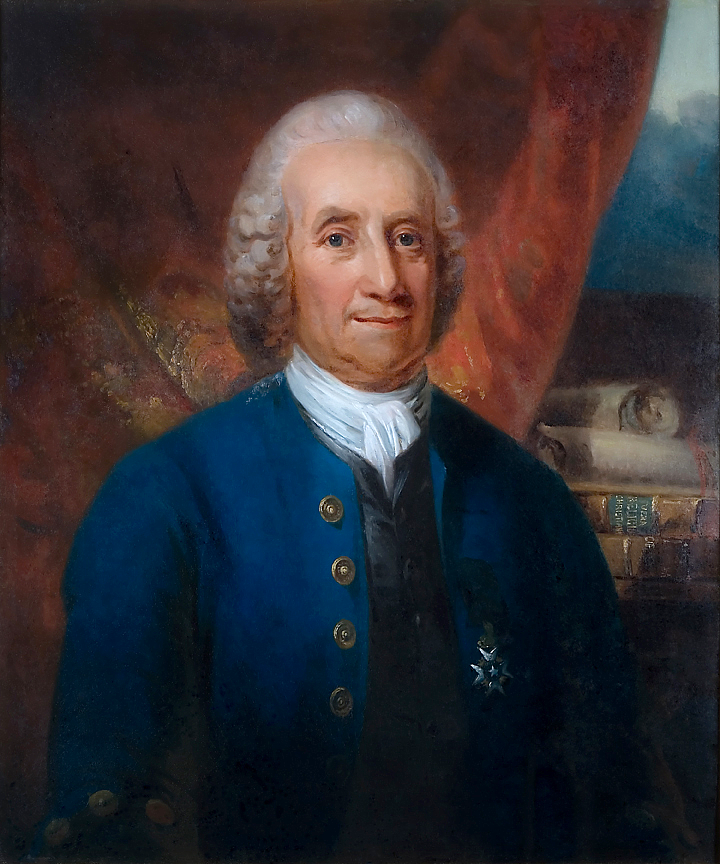
Emanuel Swedenborg (1688—1772) was a Swedish scientist, philosopher, theologian, and mystic whose visionary writings profoundly influenced Western esotericism, Transcendentalism, and modern spiritual psychology. After a distinguished scientific career dedicated to mathematics, metallurgy, physiology, and neuroanatomy, Swedenborg experienced an acute mid-life spiritual crisis that culminated in claimed direct, waking communication with the spiritual world. Rather than presenting his encounters as subjective allegories, Swedenborg described heaven, hell, and the angelic societies with the systematic, empirical precision of an eighteenth-century naturalist, producing a monumental theological corpus that redefined the relationship between natural matter and divine influx.[1][2]
From Scientist to Seer: The Empirical Mystic
Swedenborg spent the first five decades of his life as one of Europe's premier natural philosophers, inventors, and polymaths. Appointed as an assessor on Sweden's Royal Board of Mines by King Charles XII, he published pioneering treatises on metallurgy, paleontology, and astronomy, and anticipated modern nebular hypotheses. His intellectual ambitions culminated in extensive physiological and anatomical research across England, France, and Italy—seeking the precise physical locus where the immaterial soul interfaces with the biological brain and nervous system.[2:1]
In the mid-1740s, while completing The Animal Kingdom (Regnum Animale), Swedenborg underwent an intense internal transition marked by profound dreams, psychological disorientation, and spontaneous mystical epiphanies recorded in his private Journal of Dreams. By 1745, he claimed that his spiritual vision had been permanently opened by the divine, enabling him to consciously experience the spiritual world while remaining awake in his physical body. Resigning his government post, Swedenborg dedicated the remaining three decades of his life to writing exhaustive, multi-volume exegeses of Scripture—most notably Arcana Coelestia (1749—1756) and Heaven and Hell (De Caelo et Eius Mirabilibus et de Inferno, 1758)—framing his mystical cartography as a revelatory disclosure for a new spiritual age.[1:1]
Core Theological & Metaphysical Doctrines
                        [ THE DIVINE HUMAN / INFLUX ]
                                      │
                                      ▼
                       [ THE CELESTIAL / SPIRITUAL ]
                         Internal causes & meanings
                                      │
                                      ▼  (Correspondences)
                       [ THE NATURAL / MATERIAL ]
                         External effects & symbols
1. The Doctrine of Correspondences
The cornerstone of Swedenborg's metaphysical architecture is the Doctrine of Correspondences, which asserts that the physical cosmos is an external manifestation continuously generated and sustained by divine influx through the spiritual realm.[1:2]
- Cause and Effect: Physical entities do not exist autonomously; every natural object, biological organism, and material process corresponds to a specific spiritual reality, affection, or truth.
- Symbolic Hermeneutics: Scripture was written according to this correspondential language. Beneath the literal, historical narrative of the Bible lies an internal, spiritual sense that describes the spiritual development of the soul and the regeneration of humanity.
2. The Spiritual World and "Ruling Love"
Swedenborg rejected traditional medieval depictions of heaven and hell as places of arbitrary divine reward or judicial torture:
- Continuity of Consciousness: Death is not an ontological rupture but a seamless awakening. An individual enters the intermediate "World of Spirits," retaining their personality, memories, and core emotional nature.
- The Law of Ruling Love: A person's ultimate spiritual state is determined by their dominant internal affection (amor regens). Those whose ruling love is selfless and aligned with the divine naturally gravitate toward communities of mutual charity (heaven), whereas those dominated by selfish egoism and the lust for dominion draw into self-tormenting, discordant societies that constitute hell.
3. The Divine Human (Maximus Homo)
Swedenborg radically reinterpreted traditional Christian orthodoxy:
- Rejection of Tri-Personal Trinity: God is not divided into three distinct persons, which Swedenborg argued leads to covert polytheism. Instead, the Trinity resides entirely within the single, undivided person of Jesus Christ—the Father being the divine soul, the Son the divine human manifestation, and the Holy Spirit the radiating divine operation.
- The Grand Man: The entire spiritual universe, in its collective unity and reciprocal order, is structured in the form of a cosmic human being (Maximus Homo), reflecting the premise that the divine essence is inherently relational, personal, and organized according to spiritual humanity.
4. Free Will, Divine Influx, and Regeneration
- Asymmetrical Influx: All life, wisdom, and love flow continuously into creation from the Divine Sun. Humanity has no independent life in itself, but functions as a receptive vessel (organum recipientis).
- Spiritual Equilibrium: To preserve genuine human freedom, God maintains an exact equilibrium between heavenly influences and hellish forces acting upon every human mind. Regeneration is thus an active, cooperative process in which individuals freely choose to resist selfish impulses and align their wills with divine charity.[1:3][2:2]
Intellectual Influence and Historical Legacy
Swedenborg’s idiosyncratic blend of empirical rigor and mystical revelation exerted an immense, far-reaching influence across European Romanticism, nineteenth-century American philosophy, and early twentieth-century psychology:
- Transcendentalism and Concord Idealism: Through Ralph Waldo Emerson, who devoted an essay to him in Representative Men (1850), Swedenborg's doctrine of correspondences supplied the structural grammar for American Transcendentalism. Henry David Thoreau and Walt Whitman transformed this correspondential vision into an American sacramental view of wild nature, while William James and his brother Henry James (1843—1916) grew up in a household deeply immersed in Swedenborgian theology via their father, Henry James Sr.
- Enlightenment & Romantic Literature: Johann Wolfgang von Goethe (1749-1832) drew heavily upon Swedenborgian cosmology when composing Faust, while English poet and artist William Blake engaged in a complex, lifelong dialogue with Swedenborg's writings, simultaneously praising his visionary clarity and subverting his moralistic dualism in The Marriage of Heaven and Hell.
- Philosophical and Psychological Critique: Immanuel Kant felt compelled to publish a skeptical critique of Swedenborg's claims in Dreams of a Spirit-Seer (Träume eines Geistersehers, 1766), an inquiry that helped crystallize Kant’s critical boundary between sensory phenomena and noumenal speculation. Later, Carl Gustav Jung examined Swedenborg’s clairvoyance and spirit visions as early historical documentation of archetypal dynamics, the collective unconscious, and the technique of active imagination.
🎴 Interactive Web Practice (Comprehension Check)
Question 1 (Scientific Epistemology & Visionary Transition): How did Swedenborg's prior career as a natural scientist and neuroanatomist shape the methodology, style, and claims of his visionary theological works?
Answer: Unlike classical mystics whose encounters are characterized by apophatic silence, poetic metaphors, or emotional raptures, Emanuel Swedenborg approached the spiritual world with the empirical, systematic mindset of an eighteenth-century naturalist. During his scientific career, Swedenborg conducted rigorous studies in metallurgy, physics, and brain anatomy (seeking the physiological seat of the soul in the cerebral cortex). When he underwent his visionary opening in the 1740s, he imported this descriptive, taxonomic method into the spiritual realm.
Swedenborg did not claim to experience God in an ecstatic, unitive trance that dissolved reason; rather, he claimed that his spiritual senses were opened while remaining fully conscious, allowing him to observe, categorize, and record the geography, angelic societies, laws of motion, and architectural structures of heaven and hell as objective, empirical realities governed by precise metaphysical laws.
Question 2 (The Doctrine of Correspondences & The Architecture of Hell): In what ways does Swedenborg's Doctrine of Correspondences dismantle medieval notions of heaven and hell as places of external punishment or arbitrary divine reward?
Answer: Swedenborg's Doctrine of Correspondences posits that the physical world is an external effect continuously generated by internal spiritual causes. Applying this principle to the afterlife, Swedenborg argues that an individual's outward environment in the spiritual world is an exact correspondent mirror of their internal psychic and spiritual state. Consequently, heaven and hell are not physical penal colonies or pleasure gardens assigned by an arbitrary divine tribunal.
Instead, human beings gravitate to the spiritual sphere that matches their "ruling love" (amor regens). Those whose interior love is characterized by charity, humility, and divine connection find themselves in heavenly communities bathed in spiritual light. Conversely, those whose ruling love is rooted in selfish egoism, deceit, and malice create their own infernal misery; hell is the psychological projection of unrestrained egoism experiencing its own discord when confronted with divine truth.
Question 3 (Transatlantic Philosophical Influence & Modern Psychology): How did Swedenborgian thought influence the emergence of American Transcendentalism and twentieth-century depth psychology?
Answer: Swedenborgian thought profoundly shaped both movements in distinct ways:
- American Transcendentalism: Through Ralph Waldo Emerson's inclusion of Swedenborg in Representative Men, Swedenborg's doctrine of correspondences provided the philosophical scaffold for the Transcendentalist understanding of nature. Emerson and Henry David Thoreau adapted Swedenborg's insight that natural objects symbolize spiritual facts, stripping away Swedenborg's rigid biblical allegories to argue that wild nature itself is a living scripture and an avenue for direct contact with the Over-Soul.
- Depth Psychology: Carl Gustav Jung recognized Swedenborg as a pioneering explorer of the human psyche whose visionary encounters prefigured modern discoveries concerning the unconscious. Jung saw Swedenborg's conversations with spirits not as external apparitions, but as spontaneous encounters with autonomous archetypal complexes, viewing Swedenborg's methods as an early forerunner to active imagination. Similarly, William James investigated Swedenborgian religious experience through the lens of psychological pragmatism and radical empiricism.
Resonant Notes
The following notes in the vault share direct thematic, theological, and philosophical connections with Emanuel Swedenborg:
🔴 Transcendentalism, Nature & Correspondences
- American Transcendentalism — Swedenborg's doctrine of correspondences served as a major metaphysical catalyst for New England Transcendentalism. The belief that every natural fact is an emblem of spiritual reality provided Emerson, Thoreau, and their circle with a theological foundation for viewing nature as a living scripture rather than dead mechanism.
- Ralph Waldo Emerson — Emerson celebrated Swedenborg in Representative Men (1850) as "The Mystic," adopting Swedenborgian correspondence theory into his formulation of the "transparent eyeball" and the Over-Soul, while critiquing Swedenborg's tendency toward rigid, literalistic theological dogmatism.
- Metaphysics of Henry David Thoreau & Beyond Representation-Shared Epistemology of Thoreau and Kerouac — Thoreau inherited Swedenborg's correspondential vision through Emerson, but radicalized it: rather than treating natural phenomena merely as allegorical signs of a separate spiritual realm, Thoreau insisted on the intrinsic sacredness and unmediated reality of wild nature itself.
- Goethe's Metaphysics of Polarity & Johann Wolfgang von Goethe (1749-1832) — Goethe was deeply familiar with Swedenborgian thought (which influenced Faust and his botanical morphology); both rejected purely mechanical Cartesian-Newtonian physics in favor of a dynamic, living cosmos where outward physical forms manifest inward spiritual and archetypal principles.
🟡 Mystical Theology, Perennial Philosophy & Visionary States
- Perennial Philosophy & Aldous Huxley's The Perennial Philosophy — Swedenborg's layered cosmology—positing that the material realm is an effect produced and sustained by divine influx from spiritual causes—directly anticipates the perennialist conception of a hierarchical universe grounded in a transcendent Divine Reality.
- Aldous Huxley's Heaven and Hell (1956) & Aldous Huxley's The Doors of Perception (1954) — Huxley explicitly draws upon Swedenborg's topographical descriptions of heavens and hells to map the visionary landscapes of the psychological "Antipodes," arguing that Swedenborg traversed the same preternatural territory revealed by mescaline and spontaneous mystical trance.
- Gottfried Wilhelm Leibniz and Perennial Philosophy — Leibniz and Swedenborg both operated in the fertile intersection between early modern natural science and metaphysics; Leibniz’s theory of pre-established harmony and monadology parallels Swedenborg's doctrine of influx and correspondences between the physical and spiritual planes.
- Animism — Swedenborg's vision of an ensouled, spiritually animated universe where material objects vibrate with spiritual significance shares deep structural affinities with animist cosmologies that refuse to reduce nature to inert matter.
🟢 Psychology of Consciousness, Active Imagination & Pragmatism
- Carl Gustav Jung — Jung studied Swedenborg extensively and was profoundly influenced by his visionary method; Swedenborg's conversations with spirits and vivid journeys into the spiritual realm served as historical prototypes for Jung’s technique of active imagination and his understanding of archetypal projections of the collective unconscious.
- William James & William James and the Landscape of Eastern Thought — Raised by a Swedenborgian theologian father (Henry James Sr.), William James applied his radical empiricism and psychological criteria of mystical experience (ineffability, noetic quality, transiency, passivity) to evaluate visionary consciousness like Swedenborg's by its pragmatic fruits rather than its orthodox theological claims.
- Henry James (1843—1916) — The Swedenborgian immersion of the James household directly shaped Henry James's narrative technique, where external settings, architecture, and physical artifacts function correspondentially as psychological projections of internal moral and psychic dramas.
- Immanuel Kant-The Transcendental Sublime — Kant penned Dreams of a Spirit-Seer (1766) specifically to grapple with Swedenborg's visionary claims; while publicly satirical, the encounter forced Kant to define the limits of human reason and sensory knowledge, setting the stage for his critical philosophy and transcendental idealism.
References
Emanuel Swedenborg / Heaven and Hell / Swedenborg Foundation ↩︎ ↩︎ ↩︎ ↩︎
George F. Dole / The Essential Swedenborg / Swedenborg Foundation ↩︎ ↩︎ ↩︎