Giorgio de Chirico (1888-1978)
Giorgio de Chirico (1888–1978) was a pioneering Greek-born Italian painter, writer, and theorist who founded Pittura Metafisica (Metaphysical Art). Synthesizing Friedrich Nietzsche's philosophy of the enigma, Arthur Schopenhauer's aesthetics, and Symbolist iconography, de Chirico forged a visual vocabulary of deserted Mediterranean piazzas, claustrophobic arcades, looming mannequins, and warped linear perspectives. His pre-World War I masterpieces directly catalyzed Surrealism, fundamentally altering modern representations of space, dream states, and the uncanny. In his controversial later career, his rejection of modernism in favor of classical craftsmanship, followed by his serial self-replication of his early metaphysical works, prefigured postmodern critiques of authenticity, artistic aura, and the simulacrum.
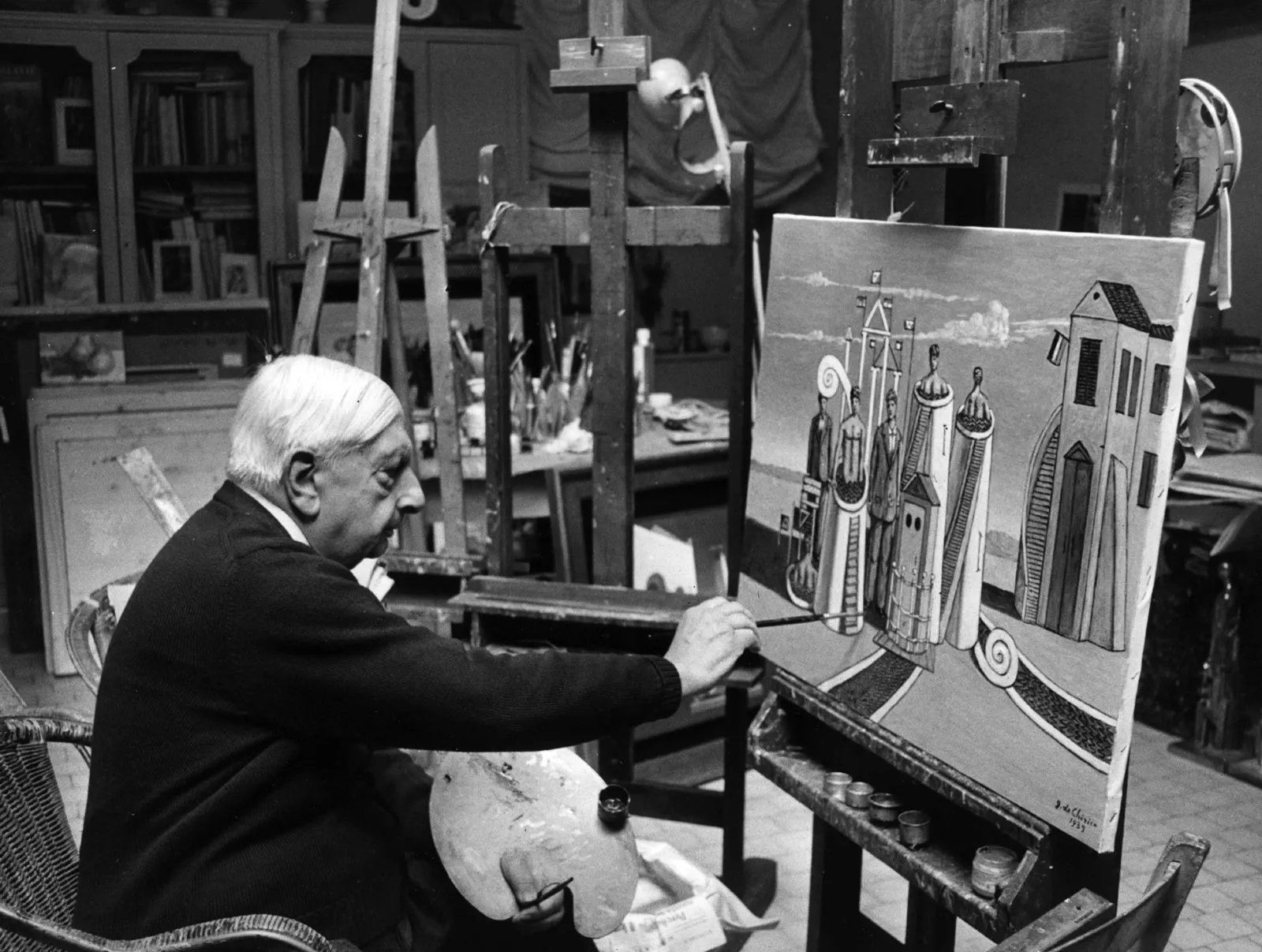
Early Life and Philosophical Crucible
Giorgio de Chirico was born on July 10, 1888, in Volos, Greece, to Italian parents. His father, Evaristo de Chirico, was a prominent railway engineer overseeing the construction of the Thessalian railway network.[1] This biographical origin left an indelible mark on de Chirico's iconography: locomotives billowing white steam behind high brick walls, arched viaducts, transit clocks, and industrial smokestacks recur relentlessly against classical backdrops.
Following his father's sudden death in 1905, the family relocated to Munich, where de Chirico enrolled at the Academy of Fine Arts (1906–1909). Munich served as his foundational intellectual and aesthetic crucible:
- German Symbolism: He fell under the spell of Arnold Böcklin and Max Klinger, whose mythological landscapes, brooding ruins, and ominous psychological allegories demonstrated how visual realism could be mobilized in service of subjective interiority.[2]
- Arthur Schopenhauer: Through Schopenhauer's The World as Will and Representation, de Chirico absorbed the concept that the everyday world of practical utility is merely a veil. True aesthetic contemplation requires isolating an object from its casual functional context, stripping away its instrumental purpose to reveal its uncanny thing-in-itself (Ding an sich).[3]
- Friedrich Nietzsche: Nietzsche's autobiographical writings (Ecce Homo) and philosophical aphorisms exercised the deepest impact. Nietzsche's rapturous encounters with the autumn light, classical symmetry, and deep melancholic stillness of Turin's public squares convinced de Chirico that the modern city harbored an ancient, metaphysical dread.[3:1] Nietzsche taught him that art should not transcribe subjective emotional turmoil, but uncover the enigmatic, non-human reality lurking beneath mundane appearances.
"What is especially needed is great sensitivity: to look upon everything in the world as enigma… To live in the world as in an immense museum of strange things, of curious toys that change their appearance, that we as children broke to see how they were made inside, and then, disappointed, realized they were empty." — Giorgio de Chirico[4]
Pittura Metafisica (Metaphysical Art)
Between 1910 and 1917, de Chirico developed the aesthetic framework of Pittura Metafisica (Metaphysical Painting). The genesis occurred in the autumn of 1910 in Florence's Piazza Santa Croce. While recovering from a severe intestinal illness, de Chirico sat in the sunlit square:
"I had the strange impression that I was looking at all these things for the first time. And the composition of my picture came to my mind's eye; and each time I look at this painting I see again that moment. Nevertheless, the moment is an enigma to me, for it is inexplicable. And I like also to call the work which resulted from it an enigma." — Giorgio de Chirico[4:1]
In 1911, de Chirico moved to Paris, exhibiting at the Salon d'Automne and Salon des Indépendants. The influential poet and critic Guillaume Apollinaire (1880–1918) immediately recognized his revolutionary genius, hailing him as "the most astonishing painter of his generation" and hosting de Chirico's first solo exhibition in his studio in 1913.[4:2]
With the outbreak of World War I, de Chirico enlisted in the Italian army and was stationed at Ferrara. Following a nervous breakdown, he was admitted to the Villa del Seminario military neuropsychiatric hospital in 1917. There, alongside his brother Alberto Savinio (Andrea de Chirico), the former Futurist Carlo Carrà, and Filippo de Pisis, he formally codified the Scuola Metafisica.[5] Ferrara's Renaissance grid, walled Jewish ghetto, and claustrophobic streetscapes catalyzed a dense, claustrophobic phase dominated by biscuity geometric tools, maps, and mannequins.
Core Aesthetic Principles
Metaphysical art does not depict an invisible spirit world; rather, it renders the physical world with hyper-clarity until its familiar legibility collapses into psychological dread:
- Distorted and Polycentric Perspective: Rather than utilizing Renaissance single-point linear perspective to establish spatial stability, de Chirico employs multiple, conflicting vanishing points, steeply raked stage-like ground planes, and impossible architectural angles. The resulting space disorients vestibular perception, producing chronic spatial agoraphobia and vertigo.[4:3]
- The Geometry of Melancholy and Frozen Time: De Chirico's piazzas are bathed in the raking, amber light of an eternal Mediterranean late afternoon. Shadows stretch unnaturally across vast expanses of flagstone, while station clocks and sundials register ambiguous, paralyzed hours. Time appears suspended, caught in an uneasy pause before an imminent, unspecified catastrophe.
- Decontextualized Juxtaposition: Ordinary objects—tailor's chalk, wooden laths, plaster casts of Greco-Roman deities, medical rubber gloves, green artichokes, factory chimneys—are severed from their functional chains of meaning and forced into sterile proximity. This semantic estrangement anticipates the Surrealist collage and the Freudian return of the repressed.[5:1]
- The Faceless Mannequin (Il Manichino): Introduced in 1914–1915, articulated wooden dummies, seamstress mannequins, and faceless drafting mannequins replace living human beings. Marked with geometric diagrams, compasses, and stitched seam-lines, these figures embody the alienation of the modern industrial subject, while evoking blind mythological seers (such as Tiresias) who perceive truths inaccessible to ordinary human eyes.[2:1]
Notable Works and Critical Analysis
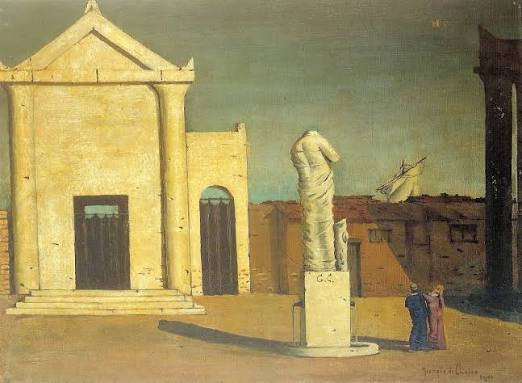
The Enigma of an Autumn Afternoon (L'énigme d'un après-midi d'automne) (1910)
Conceived in Florence's Piazza Santa Croce, this canvas marks the inaugural breakthrough of Pittura Metafisica. The central monument of Dante is stripped of historical specificity, transformed into a blind classical statue silhouetted against a stark, blinding sky. A high brick curtain wall severs the plaza from the surrounding city, behind which the mast of an invisible sailing ship glides past—an impossible maritime intrusion that ruptures geographical logic. The painting establishes de Chirico's signature atmosphere: blinding clarity married to impenetrable silence.
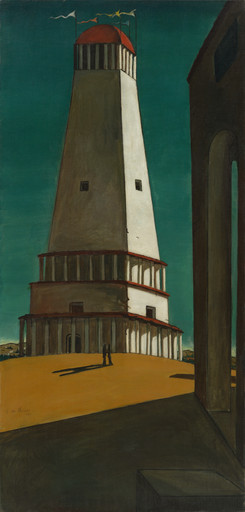
The Nostalgia of the Infinite (La nostalgie de l'infini) (1911–1913)
Dominated by an immense, square stone tower piercing a green-tinted sky, this canvas demonstrates de Chirico's command of the architectural sublime. Two miniscule, featureless silhouettes stand in the deep foreground shadow, overwhelmed by the colossal, monolithic masonry. The exaggerated low-angle perspective, juxtaposed with the geometric ramp and trembling porticoes, induces acute agoraphobic anxiety. The tower operates not as functional shelter, but as a monument to metaphysical estrangement and human insignificance.
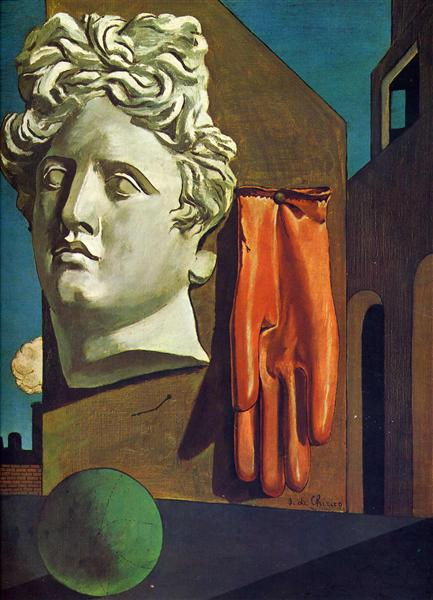
The Song of Love (Le chant d'amour) (1914)
One of the most consequential paintings of the twentieth century, The Song of Love features a giant, red surgical rubber glove nailed to a wooden board alongside the classical plaster bust of the Apollo Belvedere and a green sphere. In the background, a dark train glides past behind a brick wall under a pale sky. By violently pairing an ancient symbol of classical humanism with a modern industrial latex artifact, de Chirico achieved the supreme visual manifestation of defamiliarization. The canvas proved a revelation to the Parisian avant-garde, demonstrating that meaning arises from the poetic rupture between disassociated signs.
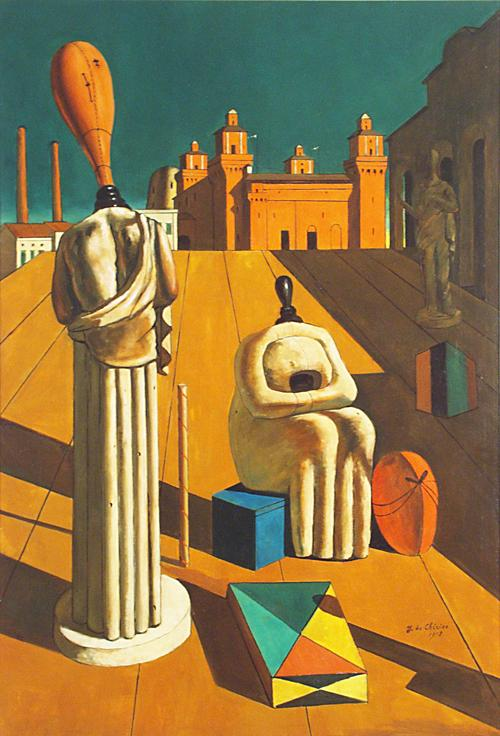
The Disquieting Muses (Le muse inquietanti) (1916–1918)
Painted during de Chirico's Ferrara internment, this work synthesizes his metaphysical motifs. On a steeply tilted wooden stage overlooking the red-brick Castello Estense and an industrial chimney, two robotic, draped mannequins stand in silent vigil. One figure possesses the head of a smooth tailor's dummy; the other has had its head removed, resting at its feet like an African tribal mask or an ancient cast. Surrounded by brightly colored geometric solids and drafting instruments, these mute muses stand as uncanny sentinels of modern mechanized existence.
Catalyst for Surrealism and Avant-Garde Rupture
De Chirico's pre-war Metaphysical period served as the primary visual foundation for French Surrealism. While literary Surrealism emerged from Dada's anti-rational nihilism, visual Surrealism inherited its spatial syntax, dream-logic, and object-displacement directly from de Chirico.
André Breton regarded de Chirico as the supreme "sentry" of modern art, declaring that his early canvases constituted the visual blueprint of the unconscious mind.[4:4] The impact on individual artists was immediate and profound:
- René Magritte: In 1922, Magritte broke into tears upon viewing a black-and-white reproduction of The Song of Love, famously stating: "My eyes saw thought for the first time." Magritte adopted de Chirico's deadpan, figurative precision and contextual displacement as the cornerstone of his own semiotic surrealism.[6]
- Yves Tanguy: In 1923, Tanguy jumped off a moving Parisian bus after spotting de Chirico's The Child's Brain displayed in Paul Guillaume's gallery window, resolving instantly to become a painter without prior formal training.[6:1]
- Max Ernst and Salvador Dalí: Both adapted de Chirico's long shadows, infinite horizons, and hyper-precise rendering of impossible objects into their respective dreamscapes and "paranoiac-critical" methods.
However, an irreconcilable ideological divide soon fractured the alliance. Breton interpreted de Chirico's art through dogmatic Freudian psychoanalysis, treating the paintings as automatic transcriptions of dream states and repressed childhood neuroses. De Chirico vehemently rejected this psychoanalytic reductionism. For de Chirico, his art was strictly philosophical and conscious—a rigorous, Nietzschean investigation into the mystery of existence, classical geometry, and the metaphysics of seeing, rather than an involuntary discharge of Freudian pathology.
The "Return to Order" and the Serial Replicas
Following the trauma of World War I, de Chirico's artistic philosophy underwent a radical, reactionary transformation. In 1919, he published his polemical manifesto, "The Return of Craftsmanship" (Il ritorno al mestiere), in the avant-garde journal Valori plastici.[6:2]
In this essay, de Chirico renounced modernism, abstraction, and the avant-garde, diagnosing contemporary art as technically bankrupt, chaotic, and rootless. He called for a restoration of traditional studio techniques, meticulous draftsmanship, egg tempera, and oil glazes modeled after Renaissance and Baroque Old Masters (Raphael, Titian, Rubens, and Courbet).
The Surrealists viewed this classical pivot as an unforgivable ideological betrayal. In 1928, Breton and the Surrealist group formally excommunicated him, organizing a vitriolic mock-retrospective titled Here Lies Giorgio de Chirico, exhibiting his early metaphysical masterpieces alongside barbed wreaths and funeral inscriptions.[2:2]
From the late 1920s until his death, an increasingly embittered de Chirico waged war against the modernist art market and Parisian critics. To undermine dealers who profited exclusively from his early metaphysical works while dismissing his contemporary classical output, de Chirico began painting exact replicas and thematic variations of his 1910–1918 masterpieces.[7]
Furthermore, he systematically backdated these newly executed replicas to the 1910s, flooding the market with intentional anachronisms and sparking protracted legal battles with collectors and auction houses. While dismissed by mid-century art historians as cynical commercial forgery or creative decline, de Chirico's serial self-appropriation was later re-evaluated by Pop Artists and postmodern theorists:
- Andy Warhol: Acquired several late de Chirico works and paid tribute in a 1982 exhibition series, recognizing de Chirico as the true pioneer of serial image multiplication: "He made the same painting over and over. I liked that."[3:2]
- Postmodern Critique: De Chirico's serial replication dismantled the modern cult of "originality," anticipating Jean Baudrillard's concepts of the hyperreal and the simulacrum—where the copy precedes and destabilizes the privileged status of the original.[3:3]
Literary Contributions: Hebdomeros (1929)
Beyond his visual output, de Chirico made a singular contribution to modern literature with his 1929 novel Hebdomeros: With the Scenario for The Mannequin's Son, written in French.[8]
The text dispenses with conventional plot, psychological character development, and narrative progression. Instead, it unfolds through rolling, dreamlike syntax and hypnotic paragraphs, charting the peregrinations of the eponymous protagonist, Hebdomeros, through mysterious, labyrinthine architectural spaces:
- Literary Metaphysics: The novel functions as a verbal equivalent of Pittura Metafisica. Hebdomeros navigates endless marble porticoes, deserted hotel rooms, banquet halls frozen mid-feast, and encounters gladiators, mannequins, and philosophers trapped in enigmatic conversations.
- Critical Reception: Despite de Chirico's bitter feud with André Breton's circle, Hebdomeros was widely recognized by literary critics as one of the supreme achievements of Surrealist prose, illustrating that de Chirico's metaphysical worldview transcended medium, whether rendered in pigment or language.[8:1]
🎴 Interactive Web Practice (Comprehension Check)
Question 1 (Philosophical Foundations & The Enigma): How did Friedrich Nietzsche's philosophy of the enigma and Arthur Schopenhauer's concept of representation shape de Chirico's formulation of Pittura Metafisica, and how did this diverge from French Impressionism and traditional mimesis?
Answer: While Impressionism sought to capture the fleeting optical sensations of light and modern life through sensory immersion, and traditional mimesis aimed to faithfully represent the physical world, de Chirico deployed Pittura Metafisica as a conscious philosophical investigation of reality's hidden enigma. Drawing directly from Arthur Schopenhauer, de Chirico posited that aesthetic contemplation requires severing an object from its mundane, utilitarian context to expose its eerie thing-in-itself (Ding an sich). From Friedrich Nietzsche, de Chirico inherited the conviction that the everyday world is merely a fragile crust over a profound, unsettling void, and that the modern city (exemplified by Nietzsche's revelatory encounters with Turin's geometric piazzas) contains an ancient, non-human mystery. Rather than expressing subjective emotion or transcribing optical impressions, de Chirico constructed clean, hyper-articulated spaces where rational coherence breaks down, transforming the canvas into a metaphysical puzzle.
Question 2 (Spatial Disorientation & The Visual Uncanny): Through what specific compositional techniques does de Chirico generate the spatial dread and psychological estrangement characteristic of the architectural uncanny?
Answer: De Chirico generates the visual uncanny through four primary spatial and formal manipulations: 1. Polycentric & Warped Perspective: He violates classical single-point linear perspective by forcing multiple conflicting vanishing points and tilted ground planes into a single composition, inducing somatic vertigo and agoraphobic anxiety. 2. Exaggerated Shadows & Suspended Time: He bathes desolate plazas in the low, raking light of late afternoon, projecting long, ominous shadows from unseen figures or structures beyond the picture frame, while frozen station clocks suggest an unnerving arrest of temporal progression. 3. Radical Contextual Displacement: He juxtaposes incongruous, decontextualized objects (such as surgical rubber gloves alongside classical marble busts and factory smokestacks), severing familiar signifiers from their established semantic networks. 4. The Faceless Mannequin: By replacing human figures with featureless, articulated tailor's dummies and geometric drafting armatures, he externalizes modern alienation and confronts the viewer with the unhomely (das Unheimliche)—the boundary between animate humanity and inanimate machinery.
Question 3 (The "Return to Order" & Postmodern Simulation): What precipitated de Chirico's post-WWI split with the avant-garde, and how did his controversial practice of painting serial replicas challenge the modern conception of artistic originality?
Answer: In 1919, de Chirico published "The Return of Craftsmanship" (Il ritorno al mestiere), rejecting modernism and avant-garde experimentation as technically deficient and culturally hollow. He advocated a return to traditional Renaissance studio practices, classical drawing, and Old Master techniques. The Surrealists, led by André Breton, regarded this classicism as a reactionary betrayal and formally excommunicated him in 1928. In response, de Chirico mounted a deliberate campaign against the modernist art market by executing exact replicas and variations of his celebrated 1910–1918 Metaphysical paintings, frequently backdating them to infuriate critics and undermine dealers. While contemporaries dismissed this serial reproduction as commercial cynicism or decline, Pop Artists (such as Andy Warhol) and postmodern theorists recognized it as a radical deconstruction of artistic "authenticity" and the Walter Benjaminian "aura," demonstrating that the mass-produced copy and the simulacrum fundamentally destabilize the primacy of the original.
Resonant Notes
The following notes in the vault share direct thematic, philosophical, and aesthetic connections with Giorgio de Chirico's metaphysical art:
🔴 The Uncanny, Spatial Dread & Architectural Alienation
- Anthony Vidler-The Architectural Uncanny — De Chirico's Pittura Metafisica—with its deserted arcades, exaggerated shadows, distorted linear perspectives, and faceless mannequins—stands as the definitive visual counterpart to Vidler's unhomely metropolis, capturing the eerie dread of vacated urban space.
- Freud's The Uncanny (Das Unheimliche) & Sigmund Freud — De Chirico visually manifests Freud's das Unheimliche: the familiar rendered alien through the return of the repressed. His deserted Italian piazzas convert domestic, architectural safety into a stage for ominous estrangement.
- On the Psychology of the Uncanny (Zur Psychologie des Unheimlichen) — Ernst Jentsch's foundational theory identifies the uncanny as intellectual uncertainty regarding whether an apparently animate being is really alive, or whether a lifeless object might be endowed with life—the precise psychological mechanism activated by de Chirico's faceless mannequins.
- The Uncanny Valley (不気味の谷現象) — Masahiro Mori's concept of emotional revulsion triggered by entities that appear nearly human yet lack life directly explains the visceral discomfort produced by de Chirico's seamstress dummies and articulated prosthetics.
- Louis Sass - Phenomenological Psychopathology and the Self — Sass analyzes schizophrenia through the "truth-taking stare" and Trema—a hyper-rational perceptual state where familiar objects lose their tacit, everyday context and loom with terrifying, unnamable significance, perfectly mirroring de Chirico's hyper-articulated stillness.
- Edgar Allan Poe (1809-1849) & Franz Kafka (1883-1924) — Literary masters of spatial anxiety and bureaucratic estrangement. Poe's externalized architectural psyches and Kafka's opaque, labyrinthine spaces provide the narrative equivalent of de Chirico's claustrophobic arcades and frozen squares.
🟡 Philosophy of the Enigma, Time & Representation
- Friedrich Nietzsche (1844-1900) — Nietzsche's concept of the world as a profound enigma and his aesthetic reveling in the architectural melancholy of Turin formed the philosophical bedrock for de Chirico's metaphysical vision.
- Schopenhauerian Pessimism — Schopenhauer's aesthetic theory posited that art offers temporary liberation from the blind Will by isolating objects from causal utility into pure representation, directly inspiring de Chirico's extraction of mundane objects from functional life.
- Henri Bergson — Bergson's distinction between clock time (spatialized, quantitative time) and durée (lived psychological duration) provides an essential foil for de Chirico's paralyzed station clocks and timeless, petrified shadows.
- The Sublime — De Chirico transposes the natural sublime (vast mountains, oceans) into an architectural and metaphysical sublime, where the vastness of human-built voids and towering monuments inspires existential dread rather than pastoral contemplation.
- The flâneur — The Baudelairean and Benjaminian stroller who navigates the modern city is inverted by de Chirico: rather than observing the vibrant spectacle of Parisian crowds, de Chirico's solitary observer encounters a city evacuated of human life, walking through the architecture of memory and dream.
🟢 Avant-Garde Disruption, Modernism & The Simulacrum
- René Magritte — Magritte considered seeing de Chirico's The Song of Love the defining moment of his career ("my eyes saw thought for the first time"), adopting de Chirico's deadpan illustrative realism and cognitive juxtaposition to deconstruct language and perception.
- Guillaume Apollinaire (1880–1918) — Apollinaire was de Chirico's foremost early champion in Paris, coining the term "surrealism" and defending the painter's enigmatic visual structures against academic and Futurist critics.
- Paul Klee (1879–1940) — Contemporary modernist whose enigmatic, symbolic visual languages and exploration of metaphysical dream worlds parallel de Chirico's investigation of reality beneath physical appearance.
- The Dehumanization of Art — José Ortega y Gasset's 1925 thesis on the avant-garde systematically removing human sentimentalism, living forms, and emotional empathy in favor of pure geometric distance finds its quintessential visual specimen in de Chirico's mannequin figures.
- The Work of Art in the Age of Mechanical Reproduction & Walter Benjamin (1892–1940) — Benjamin's analysis of the dissolution of the artistic "aura" illuminates de Chirico's late-career serial self-replication, where identical copies of early works were produced to systematically deconstruct the modernist cult of originality.
- Defining a Simulacrum — Jean Baudrillard's theory of the hyperreal and simulation provides the theoretical framework for de Chirico's late self-appropriation and intentional backdating: generating copies of copies until the privileged priority of the "original" Metaphysical canvas collapses.
References
Galleria dello Scudo / Giorgio de Chirico Biography / galleriadelloscudo.com ↩︎
Fondation Vincent Van Gogh / Giorgio De Chirico / fondation-vincentvangogh-arles.org ↩︎ ↩︎ ↩︎
Estorick Collection / Giorgio de Chirico / estorickcollection.com ↩︎ ↩︎ ↩︎ ↩︎
Museum of Modern Art (MoMA) / Giorgio de Chirico / moma.org ↩︎ ↩︎ ↩︎ ↩︎ ↩︎
Tate / Metaphysical Art / tate.org.uk ↩︎ ↩︎
James Thrall Soby / Giorgio de Chirico / The Museum of Modern Art, New York ↩︎ ↩︎ ↩︎
Phil Beard / Giorgio de Chirico, La fabrique des rêves / buttes-chaumont.blogspot.com ↩︎
Giorgio de Chirico / Hebdomeros / PAJ Publications / MIT Press ↩︎ ↩︎