The Feelies
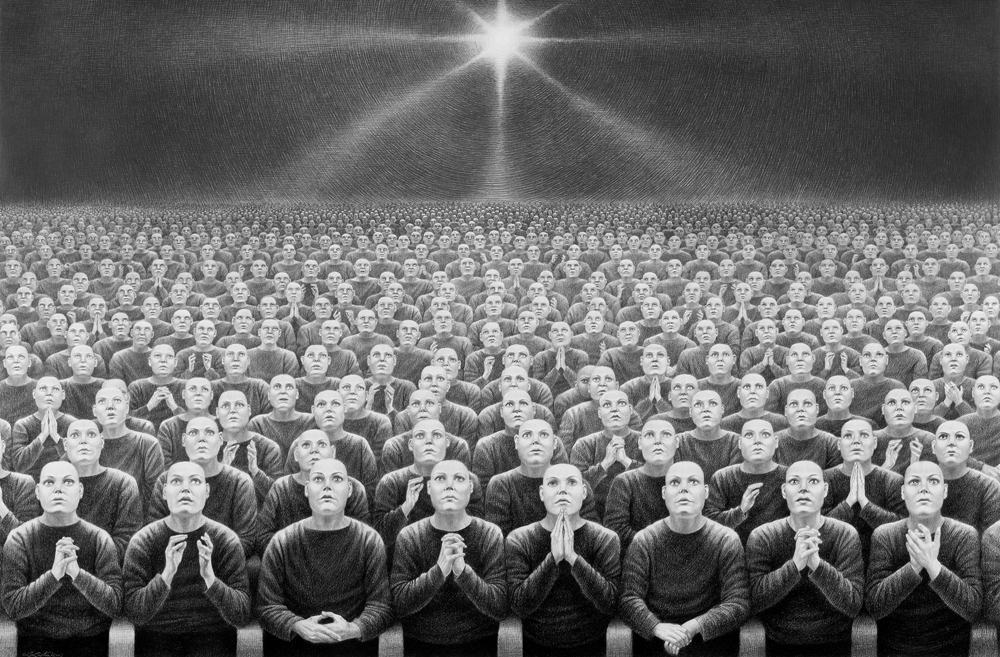
In Aldous Huxley's 1932 dystopian novel Brave New World, the "feelies" represent an advanced form of multi-sensory cinema designed to provide total immersive distraction. By stimulating touch and smell alongside sight and sound, the World State utilizes the feelies as a primary instrument of emotional pacification, replacing critical reflection, interiority, and authentic human passion with standardized sensory gratification.
1. Mechanics and Sensory Engineering of the Feelies
The feelies expand traditional cinematography into a fully synchronized haptic and olfactory medium. Attending a "feely-palace" involves engaging multiple sensory apparatuses engineered to maximize cognitive immersion and eliminate psychological distance between the spectator and the screen:
- Tactile Feedback (Haptics): Theater seats are equipped with polished metal knobs on the armrests. Spectators hold these electro-tactile nodes, which transmit physical sensations directly to the user's peripheral nervous system. This apparatus allows viewers to experience every physical sensation depicted on screen, from the tactile texture of a bearskin rug to the somatic sensation of a passionate kiss.
- Synchronized Olfactory Release: Feely theaters feature specialized scent organs that disperse synchronized aromatic compounds harmonized with the scene's emotional tone and physical environment (e.g., cedar, rosemary, thyme, sandalwood, or synthetic musk).
- Stereoscopic Audio and Visuals: Massive three-dimensional color projection screens are paired with multi-channel surround-sound acoustic systems designed to saturate the human sensorium and overpower internal dialogue, private thought, and introspective reflection.
Production of feely content is centralized under direct technocratic state oversight at facilities such as the Hounslow Feely Studio and managed across twenty-two floors within the Bureaux of Propaganda in London.
The primary feely depicted in the novel, titled Three Weeks in a Helicopter, features a simplistic plot revolving around an Alpha-Plus hero, a Beta-Plus blonde, and a Black antagonist who kidnaps her. The narrative emphasizes titillation, sensational physical jeopardy, and explicit intimacy over moral dilemma or interior character development.
2. Socio-Political Function: Hedonistic Social Control
Unlike classical totalitarian regimes that enforce ideological compliance through secret police surveillance, physical deprivation, and terror, the World State governs through the systematic distribution of instant pleasure. The feelies fulfill three critical systemic functions:
Pacification and Emotional Neutralization
By delivering immediate, effort-free sensory stimulation, the feelies satisfy the human desire for emotional intensity without demanding vulnerability, ethical commitment, or emotional risk. Citizens exit the feely-palace purged of discontent and emotionally sated, preventing the buildup of existential dread, boredom, or subversive longing.
Elimination of Solitude and Introspection
In the World State, solitude is viewed as an antisocial pathology that fosters non-conformity and philosophical doubt. The feelies are consumed collectively as part of compulsory "synchronized amusement," ensuring that individuals spend their leisure hours immersed in dense, state-sanctioned crowds rather than engaged in private reflection.
Substitution for High Art and Tragedy
Authentic art requires moral conflict, suffering, and existential choices—conditions deliberately engineered out of World State society. The feelies replace aesthetic depth with tactile sensationalism, ensuring the population remains cognitively incapable of comprehending tragedy, spiritual gravity, or complex ethics.
After attending Three Weeks in a Helicopter with Lenina Crowne, John the Savage recoils from the exhibition in disgust, branding the medium "base" and "ignoble." He contrasts the superficial physical titillation of the feelies with the enduring moral weight and spiritual reality of William Shakespeare's Othello.
3. Contextual Background: The Advent of "Talkies" and Silence is Golden
Huxley's satirical conception of the feelies was directly inspired by historical technological shifts in the motion picture industry during the late 1920s:
- The Advent of Synchronized Sound: The rapid displacement of silent cinema by synchronized sound pictures ("talkies"), initiated by The Jazz Singer in 1927, alarmed cultural critics, including Huxley. He regarded synchronized audio as an over-sensory gimmick that stunted cinema's visual artfulness and stripped audiences of interpretive participation.
- Critical Essay Silence is Golden (1929): In this foundational critique published in Vanity Fair, Huxley argued that talkies degraded human imagination by spoon-feeding sensory elements that viewers once constructed internally. The feelies represent Huxley's satirical extrapolation of this technological trajectory to its ultimate mechanical extreme.
| Cinematic Modality | Primary Sensory Channels | Cognitive & Imaginative Demand | Sociocultural Function |
|---|---|---|---|
| Silent Cinema | Pure visual composition; textual intertitles | High: requires active interpretive imagination to supply voice and interior tone | Contemplative aesthetic engagement; artistic restraint |
| Synchronized Sound ("Talkies") | Combined visual projection and synchronized speech/sound | Moderate: eliminates spectator's vocal imagination; externalizes narrative pacing | Commercial amusement; mass-market auditory appeal |
| The Feelies | Visuals, 3D audio, galvanic haptic nodes, and automated scent organs | Minimal: complete sensory saturation; bypasses interpretive cognition entirely | Technocratic pacification, emotional infantilization, and social control |
4. Comparative Matrix: Huxleyan vs. Orwellian Media Ecologies
In media theory and political philosophy, the feelies stand as the archetype of Huxleyan "soft" totalitarianism, contrasting directly with George Orwell's vision of media in Nineteen Eighty-Four:
| Diagnostic Dimension | Orwellian Control (Nineteen Eighty-Four) | Huxleyan Control (Brave New World) |
|---|---|---|
| Primary Mechanism | Pain, coercion, fear, physical rationing, and state terror | Pleasure, distraction, abundance, and sensory gratification |
| Media Modality | Two-way Telescreen (constant surveillance & ideological propaganda) | The Feelies & Synthetic Music (multi-sensory immersive diversion) |
| Information Policy | Deliberate concealment, censorship, and historical falsification | Drowning truth in a sea of irrelevance, noise, and trivial amusement |
| Psychological Target | Mobilizing hatred (Two Minutes Hate) and absolute ideological loyalty | Eradicating negative emotions, anxiety, and introspective depth |
| Citizen Disposition | Paralyzed by fear, surveillance anxiety, and physical deprivation | Pacified by uninterrupted comfort, amusement, and consumer satisfaction |
5. Contemporary Resonance: Algorithmic Stimulation and Immersive Media
Modern media theorists, sociologists, and cognitive scientists frequently cite the feelies as an accurate forecast of 21st-century digital media systems:
- Haptic Wearables and 4DX Cinema: Modern commercial entertainment—ranging from virtual reality (VR) headsets with haptic feedback suits to 4DX cinema theaters equipped with motion chairs, water sprays, and atmospheric scent bursts—materializes Huxley's mechanical vision of total multi-sensory capture.
- Algorithmic Dopamine Loops: Short-form video platforms (TikTok, Instagram Reels) deliver rapid-fire micro-stimulations specifically calibrated to trigger continuous neurochemical dopamine responses, mirroring the rapid, non-contemplative pacification of the feelies.
- Neil Postman's Media Ecological Diagnosis: In Amusing Ourselves to Death (1985), Neil Postman argued that Western societies are governed not by Orwell's authoritarian censor, but by Huxley's trivializing entertainment complex, where serious public discourse, art, and politics are transformed into superficial show business.
🎴 Interactive Web Practice (Comprehension Check)
Question 1 (Sensory Saturation & Cognitive Pacification): How does the multi-sensory engineering of the feelies systematically eliminate the psychological capacity for introspective thought and political dissent?
Answer: The feelies engineer social compliance by occupying the entire human sensorium simultaneously. By pairing stereoscopic visuals and immersive surround sound with galvanic haptic armrests and synchronized olfactory compounds, the medium leaves no sensory bandwidth available for internal monologue, private reflection, or critical comparison. Because critical thought requires psychological distance between the observer and the stimulus, flooding the nervous system with synchronized haptic and chemical sensations induces a state of passive emotional exhaustion. Spectators exit the theater pacified and sensory-sated, preventing the emergence of existential angst or social grievances that could mobilize rebellion.
Question 2 (Aesthetic Substitution & Tragedy): Why does John the Savage contrast the feelies with Shakespeare's Othello, and why is high tragedy fundamentally incompatible with the World State's social architecture?
Answer: John the Savage identifies the feelies as base and ignoble because they substitute physical sensation for moral and spiritual depth. Shakespearean tragedy requires genuine suffering, romantic fidelity, existential agony, and moral choices between good and evil—such as the devastating jealousy and heartbreak depicted in Othello. In the World State, however, all biological desires are immediately sated through compulsory promiscuity, emotional distress is chemically neutralized with soma, and citizens are conditioned to prioritize frictionless stability. Because authentic tragedy cannot exist without severe adversity and genuine passion, high art becomes completely unintelligible to citizens, requiring the state to substitute superficial sensationalism in its place.
Question 3 (Huxleyan vs. Orwellian Media Theory): In what ways does Neil Postman's media critique in Amusing Ourselves to Death validate Huxley's prophecy of the feelies over Orwell's model of the telescreen?
Answer: Neil Postman demonstrated that advanced consumer societies are controlled far more effectively through amusement than through physical terror. Orwell's telescreen in Nineteen Eighty-Four operates through continuous surveillance, state censorship, and violent coercion to restrict access to information. In contrast, Huxley's feelies illustrate a culture where people love their servitude because they are drowning in trivial entertainment. Postman argued that Western commercial media did not ban books or suppress dissent with force; rather, it converted all cultural discourse—journalism, politics, education, and religion—into entertaining, fast-paced show business, fulfilling Huxley's warning that truth would be defeated not by the prison guard, but by the relentless desire for amusement.
Resonant Notes
The following notes in the vault share direct thematic, sociological, and literary connections with the feelies and Aldous Huxley's media critique:
🔴 Totalitarianism, Biopolitics & Sensory Conditioning
- Aldous Huxley's Brave New World (1932) — The overarching textual and sociological foundation of the World State, detailing the Hatchery and Conditioning Centre, hypnopaedia, and the dialectic between Mustapha Mond and John the Savage.
- Dystopian Counterpoints - Brave New World vs. Nineteen Eighty-Four — Comprehensive comparative study contrasting Huxley's hedonic, pharmacologically sedated World State with Orwell's punitive, surveillance-driven Oceania.
- George Orwell (1903-1950) — The foundational profile of Orwellian political philosophy, establishing the dialectical tension between hard state violence and Huxleyan soft amusement.
- Postscript on the Societies of Control — Gilles Deleuze's formulation of control societies transitioning from physical disciplinary enclosures to continuous, network-based sensory modulation mirrors the self-administering pacification of the feelies.
- Michel Foucault — Foucault's analysis of biopolitics and the somatic governance of living bodies illuminates how sensory technologies like the feelies manage emotional stability at the physiological level.
🟡 Media Ecology, Spectacle & The Attention Economy
- Marshall McLuhan (1911-1980) & McLuhan's The Medium is the Message — McLuhan's core insight that technological media alter human sensory ratios directly explains why the feelies' multi-sensory apparatus overpowers the rational faculties of the linear print mind.
- The Work of Art in the Age of Mechanical Reproduction & Walter Benjamin (1892–1940) — Benjamin's analysis of the liquidation of the traditional artistic "aura" and the transition from contemplative absorption to distracted mass reception provides the exact aesthetic framework for the feelies.
- The Attention Economy — Explores how contemporary algorithmic feeds, variable-ratio dopamine loops, and push notifications fulfill Huxley's prediction of social control through continuous, voluntary sensory capture.
- Defining a Simulacrum — Jean Baudrillard's hyperreality illustrates how synthetic sensations and simulated physical intimacy in the feelies replace authentic lived experience with pure signifiers.
- Innis (1950) - Empire and Communications & Innis (1951) - The Bias of Communication — Harold Innis's framework on media monopolies demonstrates how the World State's Bureaux of Propaganda centrally controls sensory production to preserve imperial equilibrium.
🟢 Aesthetic Theory, High Art & Existential Alienation
- The Dehumanization of Art — José Ortega y Gasset's critique of the progressive purging of human pathos, transcendence, and tragic seriousness from modern culture parallels the World State's elimination of high literature.
- Don DeLillo Major Themes Analysis — DeLillo traces how late-capitalist electronic media ecologies, brand mantras, and consumer spectacles reproduce Huxley's soft totalitarianism in contemporary American culture.
- Simmel and the Attention Economy — Abstraction, Alienation, and Cognitive Capture — Georg Simmel's analysis of urban overstimulation and the blasé attitude clarifies the psychological necessity for ever-increasing sensory intensity (haptics and scents) to overcome sensory numbness.
- Fyodor Dostoevsky (1821-1881) — The Grand Inquisitor parable in The Brothers Karamazov provides the philosophical blueprint for trading spiritual autonomy and tragic struggle for material security and sensory comfort.
- Albert Camus — Camus's philosophy of the Absurd and the lucid refusal to accept synthetic illusions aligns with John the Savage's demand to retain the right to suffer rather than surrender to artificial contentment.
Backlinks
- Aldous Huxley's Brave New World (1932) — Primary parent analysis examining the full sociopolitical apparatus of the World State and hedonic totalitarianism.
- Dystopian Counterpoints - Brave New World vs. Nineteen Eighty-Four — In-depth comparative monograph contrasting Orwellian coercive discipline with Huxleyan sensory pacification.
- Don DeLillo Major Themes Analysis — Postmodern literary critique investigating how electronic white noise, televisual saturation, and consumer seduction operationalize Huxleyan pacification.
- The Work of Art in the Age of Mechanical Reproduction — Aesthetic critique exploring the destruction of traditional contemplative art by industrialized mass entertainment media.
- McLuhan's The Medium is the Message — Media ecological theory investigating how sensory-saturating media restructure human consciousness and cognitive ratios.
- The Attention Economy — Contemporary technological inquiry analyzing algorithmic captology and micro-dopamine stimulation as modern descendants of the feelies.