IBM - International Financial Management
🗂️ Interactive Notebook: Open Study Companion (Video Summary, Flashcards, Mind Map) ↗
International Financial Management addresses the financial mechanisms, capital allocation decisions, and risk management strategies employed by multinational enterprises (MNEs) operating across sovereign borders. Unlike purely domestic financial operations, cross-border corporate finance must navigate multi-currency volatility, asynchronous interest rate regimes, international taxation discrepancies, transfer pricing friction, sovereign risk, and capital repatriation controls. Mastering global finance demands structured currency hedging through financial derivatives, rigorous evaluation of foreign direct investment (FDI) opportunities, and strategic navigation of modern fintech rails and digital payment ecosystems.
1. The Architecture of International Financial Management & Foreign Exchange (FX) Risk
Operating across national borders introduces foreign exchange (FX) volatility into corporate financial statements. While domestic financial management focuses primarily on capital budgeting, operational liquidity, and capital structure, international financial management must insulate balance sheets and operating cash flows against currency fluctuations governed by IBM - Global Market Dynamics.
Dimensions of Foreign Exchange Exposure
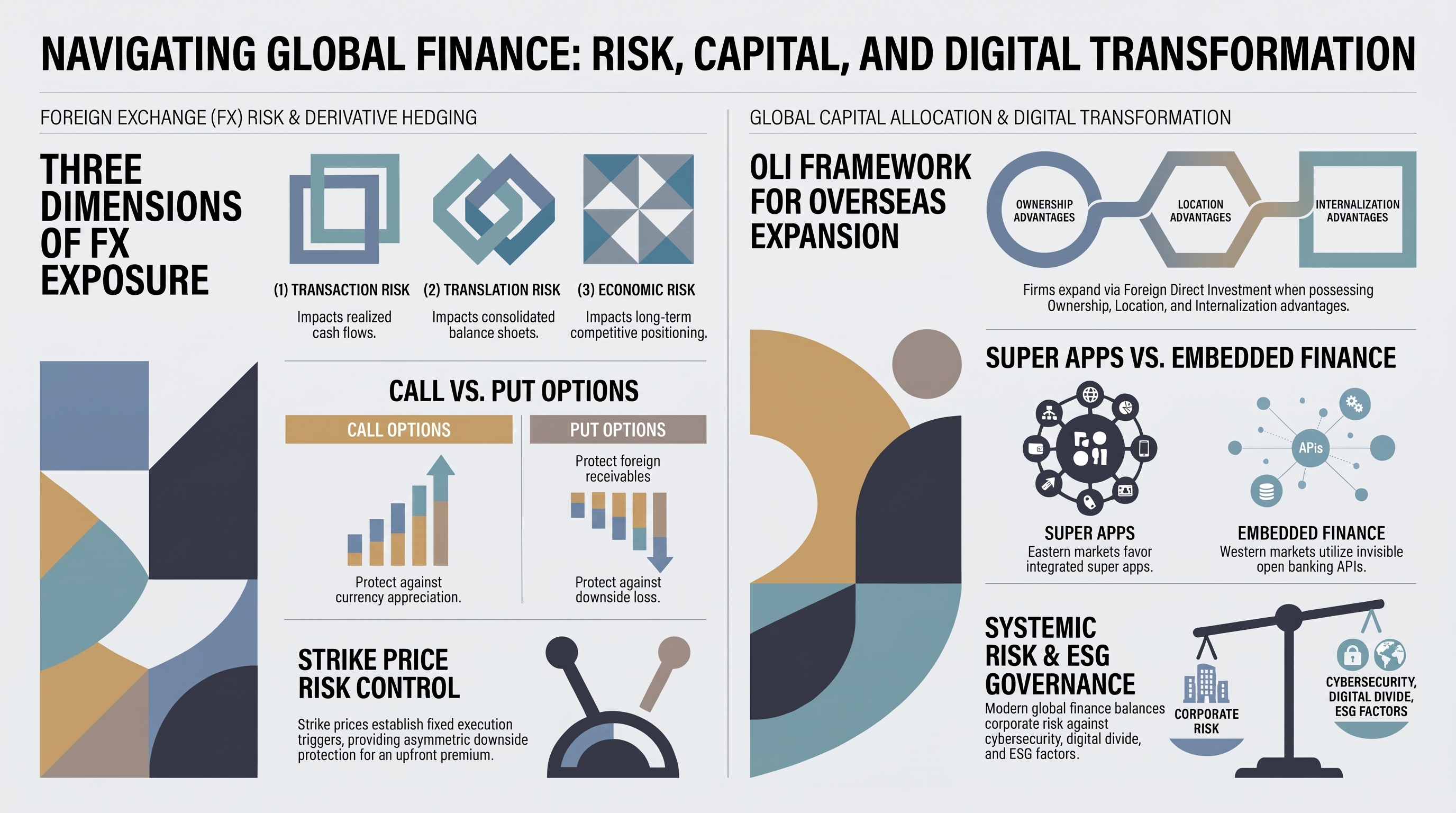
Multinational firms face three distinct categories of currency exposure:
- Transaction Exposure: The sensitivity of realized contract cash flows to exchange rate fluctuations between the date a transaction is initiated and the date it settles.
- Scenario: An exporter invoices €1,000,000 receivable in 90 days. If the euro depreciates against the exporter's home currency during that window, the realized domestic cash inflow drops, directly affecting short-term operating liquidity as explored in Difference Between Cash Flow vs. Profit.
- Translation Exposure (Accounting Exposure): The paper gain or loss arising from consolidating foreign-denominated assets and liabilities into the parent company’s reporting currency under international accounting standards.
- Scenario: A parent firm in the United States owns a subsidiary in Tokyo. When translating the subsidiary's yen-denominated balance sheet into US dollars for consolidated reporting, currency depreciation lowers the reported book value of foreign equity, impacting headline earnings without triggering immediate cash outflows, an important distinction detailed in Difference Between Revenue and Profit.
- Economic (Operating) Exposure: The degree to which long-term changes in real exchange rates alter a company’s fundamental cost competitiveness, market demand, and enterprise valuation.
- Scenario: Persistent currency appreciation in a home country can make domestic manufacturing facilities uncompetitive against foreign rivals, forcing structural shifts in global supply chains or offshore manufacturing decisions under IBM - Global Market Entry.
The Policy Environment: The Impossible Trinity (The Monetary Trilemma)
Multinational financial planners must evaluate sovereign macroeconomic policies through the lens of the Impossible Trinity (Mundell-Fleming model), which dictates that a country cannot simultaneously maintain all three of the following policy objectives:
- A fixed foreign exchange rate.
- Free capital movement (absence of capital controls).
- An independent monetary policy (sovereign interest rate autonomy).
Understanding where host nations position themselves along this trilemma enables financial executives to anticipate devaluation risks, central bank interventions, and statutory capital controls.
Foreign Exchange Exposure Classification Matrix
| Exposure Dimension | Time Horizon | Nature of Impact | Accounting Treatment | Primary Mitigation Strategy |
|---|---|---|---|---|
| Transaction Exposure | Short to Medium Term (1–12 months) | Direct cash flow variation; contractual receivables/payables | Realized profit/loss on income statement | Forward contracts, futures, options, currency invoicing |
| Translation Exposure | Medium to Long Term (Periodic reporting) | Paper asset/liability valuation changes upon consolidation | Cumulative translation adjustment in equity reserves | Balance sheet asset-liability matching, debt denomination |
| Economic Exposure | Long Term (Multi-year strategic cycle) | Structural competitive erosion, shifted operating margins | Diffuse; impacts future operating cash flows and valuation | Geographic diversification, multi-sourcing, flexible manufacturing |
2. Currency Hedging and Derivative Instruments
To mitigate transaction exposure and preserve operational margins, corporate treasurers utilize financial derivatives. Hedging functions like a specialized insurance contract: it locks in foreign exchange rates or establishes floor prices to neutralize downside volatility.
Derivative Structures: Commitments vs. Contingent Claims
Hedging tools fall into two broad structural classes:
- Firm Commitments (Forwards and Futures): Obligate both contractual counterparties to execute an exchange at an agreed rate, eliminating downside risk while simultaneously forfeiting potential gains from favorable currency movements.
- Contingent Claims (Financial Options): Grant the buyer the contractual right—without the legal obligation—to execute a currency exchange at a predetermined strike price on or before a specified date, allowing upside participation while capping downside loss.
Mechanics of Currency Options
Options contracts provide asymmetric payoff profiles, funded by an upfront premium paid to the option seller:
- Call Option: Grants the right to buy an underlying asset or foreign currency at the predetermined strike price.
- Treasury Application: Employed when a company has future foreign-denominated payables (liabilities) and anticipates that the foreign currency will appreciate.
- Put Option: Grants the right to sell an underlying asset or foreign currency at the predetermined strike price.
- Treasury Application: Employed when a firm holds future foreign-denominated receivables (revenues) and anticipates that the foreign currency will depreciate.
Moneyness Terminology
An option’s economic viability at any given moment is characterized by its "moneyness":
- In-the-Money (ITM): Exercising the option yields an immediate economic gain relative to the prevailing spot rate.
- At-the-Money (ATM): The strike price equals the current prevailing spot exchange rate.
- Out-of-the-Money (OTM): Exercising the option is disadvantageous compared to spot transactions; the option expires worthless if it remains OTM until maturity.
Currency Swaps
A currency swap involves the simultaneous exchange of principal and interest payments in one currency for equivalent amounts in another currency between two multinational entities or commercial banks. Swaps allow corporate treasuries to obtain lower-cost debt financing in foreign currencies where domestic market access is limited, while completely neutralizing exchange rate volatility over multi-year financing terms.
Financial Derivatives Comparison Matrix
| Derivative Instrument | Counterparty / Marketplace | Legal Obligation | Upfront Cash Outlay | Downside Protection | Upside Participation | Primary Corporate Use Case |
|---|---|---|---|---|---|---|
| Forward Contract | Over-the-counter (Bespoke bank agreement) | Binding obligation on both buyer and seller | Zero upfront premium; bank credit line required | Complete | Forfeited entirely | Locking in exact cash flow values for large cross-border vendor invoices |
| Futures Contract | Standardized exchange (e.g., CME) | Binding obligation; daily marked-to-market margin calls | Initial and maintenance margin requirements | Complete | Forfeited entirely | Hedging standardized commodity purchases or broad currency positions |
| Call Option | Exchange-traded or Over-the-counter | Buyer holds right; seller holds obligation | Upfront option premium paid by buyer | Complete below strike price | Full upside above strike price minus premium | Hedging future foreign currency accounts payable while retaining upside |
| Put Option | Exchange-traded or Over-the-counter | Buyer holds right; seller holds obligation | Upfront option premium paid by buyer | Complete below strike price | Downside protected; retains benefit if spot rate appreciates | Insuring international export sales receipts against foreign currency depreciation |
| Currency Swap | Over-the-counter (Interbank intermediary) | Bilateral contractual exchange of debt service streams | Zero initial premium; structural spread costs | Complete over multi-year horizon | Fixed spread; no market upside | Securing long-term cross-border capital financing and matching asset-liability currencies |
3. Foreign Direct Investment (FDI) & Cross-Border Capital Allocation
When international expansion requires physical operational footprints rather than transactional exporting, multinational enterprises execute Foreign Direct Investment (FDI). FDI occurs when an enterprise acquires a lasting managerial interest (typically 10% or more of voting equity) in an overseas operating business entity, integrating international assets into the company's broader operational network as examined in IBM - International Business Strategy.
The OLI Eclectic Paradigm (John Dunning)
Multinational enterprises determine whether to engage in direct capital deployment using John Dunning's OLI theoretical framework:
- Ownership Advantages (O): Firm-specific proprietary assets, such as patents, superior technological capabilities, managerial systems, and global brand equity that compensate for the foreign liability of newness.
- Location Advantages (L): Market-specific characteristics of the host country, including cheap factor endowments (labor, natural resources), favorable tax structures, logistics infrastructure, and proximity to regional customer clusters.
- Internalization Advantages (I): The economic benefit of keeping transactions, technology, and operations within corporate boundaries rather than licensing them to external foreign operators, avoiding contract enforcement failure and IP theft under IBM - International Business Law.
Modes of Cross-Border Capital Deployment
Capital budgeting for international operations must account for distinct entry formats:
- Greenfield Investments: Creating entirely new foreign operations, production facilities, and distribution hubs from the ground up.
- Financial Attributes: Maximum capital commitment, prolonged negative cash flow incubation, absence of legacy operational debt, complete architectural control, and high exposure to sovereign regulatory changes.
- Cross-Border Mergers & Acquisitions (M&A): Purchasing existing corporate entities, operational facilities, or distribution networks in the host nation.
- Financial Attributes: Immediate operating cash flows, acquisition premium over book value, post-merger integration risks, and potential inherited legal liabilities.
- Cross-Border Joint Ventures (JVs): Co-investing capital alongside a domestic operating partner to establish a newly formed, co-owned legal corporate entity.
- Financial Attributes: Shared equity capital commitment, split dividend payouts, partner governance friction, and complex dividend repatriation covenants.
Capital Repatriation, Transfer Pricing, and Sovereign Risk
Cross-border corporate finance must account for statutory and institutional frictions that do not exist within domestic capital markets:
- Capital Repatriation Constraints: Sovereign governments may impose withholding taxes, foreign exchange quotas, or strict capital controls that limit an MNE's ability to transfer dividends, management fees, or capital back to parent headquarters.
- Transfer Pricing: The pricing of intermediate goods, services, and intellectual property traded between interconnected subsidiaries of the same multinational group. Regulated under OECD guidelines, transfer pricing must satisfy the "arm's length principle" to prevent improper tax avoidance while optimizing consolidated corporate tax liabilities across diverse tax jurisdictions.
- Sovereign and Political Risk: The threat that host government policies—ranging from sudden regulatory expropriation and discriminatory tax codes to nationalization of private infrastructure—will compromise asset valuations and project cash flows, requiring rigorous assessment under Risk Evaluation & Case Study Analysis.
Cross-Border Capital Deployment Matrix
| Investment Vehicle | Capital Outlay | Operational Control | Financial Risk Exposure | Speed to Cash Flow Generation | IP Protection Security | Repatriation Flexibility |
|---|---|---|---|---|---|---|
| Exporting & Licensing | Minimal | Very Low | Minimal | Rapid | Low to Moderate (licensing leakage risk) | High (royalties and trade receivables) |
| International Joint Venture (JV) | Moderate (shared equity) | Shared (split board representation) | Shared | Moderate | Moderate (partner exposure risk) | Constrained by JV bylaws and host tax codes |
| Cross-Border M&A | High (acquisition premium) | Complete (100%) | High (integration risk) | Immediate | High (wholly owned proprietary IP) | Dependent on target capital structure and local laws |
| Greenfield FDI | Very High | Complete (100%) | Highest (full capital exposure) | Slow (extended construction / ramp-up) | Maximum (custom operational safeguards) | High operational autonomy; exposed to national capital controls |
4. The Digital Financial Ecosystem: Fintech, Super Apps & Cross-Border Rails
Technological innovation has fundamentally disrupted traditional cross-border banking, settlement rails, and consumer payment mechanisms, introducing agile financial architectures that challenge legacy institutional networks.
The Fintech Transformation
Financial technology (fintech) disaggregates conventional retail and commercial banking activities through software-first platforms:
- Digital Wallets & Neo-Banks: Mobile interfaces operating on high-speed API layers, offering instant currency conversion, micro-lending, and borderless bank accounts without brick-and-mortar overhead.
- Cross-Border Remittances: Peer-to-peer (P2P) platforms bypassing the legacy Society for Worldwide Interbank Financial Telecommunication (SWIFT) network, utilizing algorithmic liquidity routing to dramatically lower interchange fees and foreign exchange spreads.
- Alternative Underwriting & Algorithmic Lending: Machine-learning models assessing international borrower creditworthiness using real-time cash flow metrics, point-of-sale data, and supply-chain transactional histories rather than conventional domestic credit scores.
The Super App Model vs. Western Embedded Finance
A defining development in global digital commerce is the Super App (exemplified by Tencent's WeChat and Ant Group's Alipay in China, and Grab in Southeast Asia).
- The Super App Ecosystem: Functions as an all-in-one digital operating environment bundling instant messaging, ridesharing, grocery delivery, mobile payments, wealth management, and micro-loans into a single closed-loop application.
- Economic Engine: Super apps generate user retention by eliminating app switching and capitalizing on high transaction frequency. By owning the underlying payment rail (e.g., WeChat Pay), the platform eliminates credit card processing fees, accumulates vast behavioral data lakes, and cross-sells high-margin financial products directly to users.
- Structural Divergence in Western Markets: As documented in Why Canada Will Never Have a WeChat, the super app model faces insurmountable structural and institutional barriers in Western economies:
- Banking Hegemony and Flat-Fee Domestic Rails: Entrenched, trusted interbank monopolies (such as Interac in Canada or mature debit networks in Europe) eliminate the merchant incentive to adopt closed-loop private wallets.
- Data Privacy Guardrails: Stringent regulatory regimes (such as PIPEDA, GDPR, and modern antitrust surveillance) forbid the cross-vertical data bundling that fuels super-app monetization algorithms.
- Embedded Finance Alternative: Western digital economies are instead adopting invisible embedded finance, where specialized software-as-a-service (SaaS) platforms integrate payments, financing, and banking services via open-banking APIs directly into specialized niche applications, as explored in Every Business Is a Software Business - Core Frameworks and Enterprise Transformation.
Blockchain, Decentralized Finance (DeFi) & Cross-Border Settlements
Distributed ledger technology (DLT) and digital currencies introduce alternative settlement infrastructure that operates independently of sovereign banking cartels:
- Stablecoins & Instant Settlement: Asset-backed digital currencies pegged to reserve fiat currencies facilitate real-time, 24/7 cross-border wholesale transactions, eliminating multi-day clearing delays and intermediate correspondent banking fees.
- Cryptographic Assets: Concepts detailed in Crypto for Dummies demonstrate how public and permissioned blockchains create alternative sovereign-agnostic payment rails, though high volatility, smart contract vulnerabilities, and energy consumption remain material bottlenecks.
Global Payment Rails & Fintech Architectures Matrix
| Payment / Financial Rail | Settlement Speed | Transaction Cost Profile | Regulatory Governance | Intermediary Friction | Primary Geographic Adoption |
|---|---|---|---|---|---|
| Traditional Correspondent Banking (SWIFT) | T+2 to T+5 business days | High (multiple correspondent fees + FX spreads) | High (national central banks, Basel accords) | Heavy (nostro/vostro bank accounts required) | Global standard for enterprise B2B settlements |
| National Payment Monopolies (e.g., Interac) | Real-time / Near instant | Extremely low (flat merchant/clearing fee) | Very High (state-chartered central banking rails) | Minimal (direct member bank routing) | Domestic retail and P2P in mature markets (e.g., Canada) |
| Closed-Loop Super Apps (WeChat/Alipay) | Instant (in-app ledger transfer) | Negligible internal fee; high ecosystem lock-in | High (subject to state surveillance and antitrust) | Zero internal friction; closed private ecosystem | China and Southeast Asia (emerging digital-first markets) |
| Embedded Open-Banking APIs (Stripe, Plaid) | Instant API auth; T+1 settlement | Moderate interchange + SaaS subscription | High (data minimization, banking licenses) | Decoupled; connects frontend apps to regulated banks | North America, European Union, OECD economies |
| Blockchain / Stablecoin Settlement Rails | Near instant (seconds to minutes) | Variable network gas fees; eliminates FX spreads | Evolving / Fragmented (AML, travel rule, SEC/MiCA) | Zero traditional bank intermediaries; relies on validators | Cross-border remittances, crypto-native commerce, LatAm/Africa |
5. Systemic Vulnerabilities, Governance & ESG in International Finance
While digital transformation accelerates transaction velocity and broadens international market participation, it introduces significant systemic operational risks, regulatory tensions, and environmental dilemmas that require structured risk frameworks like PM - Assessing Risk.
Operational Fragility and Cybersecurity
Consolidating global financial flows onto digital software platforms magnifies systemic exposure:
- Single Point of Failure: When digital ecosystems consolidate communications, identity verification, and financial transactions into monolithic apps or shared cloud architectures, server outages or targeted cyberattacks can freeze regional commerce entirely.
- Data Sovereignty and Regulatory Fracturing: Sovereign states increasingly enforce data localization laws requiring cross-border financial transactions involving domestic citizens to be processed and stored on physical servers within national borders, creating compliance complexity under IBM - International Business Law.
The Digital Divide and Socioeconomic Exclusion
The rapid decommissioning of physical currency and cash handling in favor of digital payment rails creates financial exclusion:
- Marginalized demographics, rural communities with deficient broadband infrastructure, and low-income populations without smartphones or formal credit histories risk total exclusion from modern automated commerce.
- In emerging markets, financial inclusion initiatives must navigate the delicate line between empowering the unbanked and trapping consumers in predatory digital micro-lending schemes.
Environmental Footprint of Modern Financial Infrastructure
Global financial operations generate significant environmental externalities:
- Hyperscale enterprise data centers driving artificial intelligence, algorithmic trading, and continuous cloud banking consume immense quantities of municipal electricity and cooling water.
- Proof-of-work blockchain protocols and global distributed server networks demand vast energy resources, conflicting directly with international climate benchmarks.
Corporate Governance: Milton Friedman vs. ESG Frameworks
Multinational financial strategy is increasingly contested along theoretical lines of corporate governance, evolving from the mid-century corporate conformism analyzed in William H. Whyte's The Organization Man toward contemporary accountability paradigms:
- Shareholder Primacy: The classical doctrine articulated in Shareholder Primacy (Milton Friedman) asserts that a corporation's sole social responsibility is to deploy resources and engage in open competition to maximize profits and returns for its equity shareholders. Under this paradigm, capital allocation decisions focus strictly on net present value (NPV) and return on equity (ROE).
- Stakeholder Governance & ESG: In direct contrast, modern institutional frameworks documented in Corporate Social Responsibility (CSR) and Environmental, Social, and Governance (ESG) and Stakeholder Theory (R. Edward Freeman) argue that international corporations must balance profitability against their obligations to broader stakeholders (employees, suppliers, local communities, and the biosphere). Global institutional investors now tie access to capital to rigorous Environmental, Social, and Governance metrics, forcing treasurers to factor climate risk and ethical supply chain audits directly into corporate hurdle rates.
International Financial Risk Governance Matrix
| Risk Dimension | Primary Root Cause | Operational Impact on MNE | Regulatory / Societal Consequence | Actionable Corporate Mitigation |
|---|---|---|---|---|
| Cybersecurity & Data Vulnerability | Cloud centralization, software vulnerabilities | Immediate financial theft, brand destruction, litigation | Aggressive statutory fines (GDPR, PIPEDA, CPRA) | Zero-trust architecture, end-to-end encryption, multi-cloud redundancy |
| Digital Divide & Market Exclusion | Purely mobile/cashless transaction mandates | Lost market share at the bottom of the economic pyramid | Public backlash, legislative mandates to accept legal tender | Hybrid omnichannel payment options, offline digital cash rails |
| Environmental & Energy Intensity | Massive computing loads (data centers, crypto consensus) | Escalating utility overhead, scope 2 carbon liabilities | Carbon border adjustment mechanisms, ESG divestment | Transition to renewable energy PPA contracts, proof-of-stake migration |
| Geopolitical & Sanction Exposure | Regional conflicts, economic warfare, trade decoupling | Asset freezing, disconnected SWIFT access, trapped equity | Sovereign asset seizures, secondary sanctions penalties | Multi-currency reserve management, localized operational joint ventures |
| Governance & Ethical Misalignment | Over-indexing on short-term quarterly shareholder returns | Reputational crises, worker churn, activist proxy battles | Exclusion from sustainable sovereign wealth and pension funds | Integrating ESG targets into executive compensation, sustainability audits |
🎴 Interactive Web Practice (Comprehension Check)
Question 1 (Foreign Exchange Exposure & Hedging Mechanics): How do transaction, translation, and economic foreign exchange exposures differ in their balance sheet and cash flow impact, and why would an international corporate treasurer choose an asymmetric currency option over a forward contract to hedge an upcoming foreign currency account payable?
Answer: The three categories of foreign exchange exposure operate across different time horizons and financial dimensions:
- Transaction Exposure: Affects realized, contractual cash flows. It occurs when exchange rates fluctuate between the inception and settlement of a contract (e.g., accounts receivable or payable), directly altering the net cash generated by operations.
- Translation (Accounting) Exposure: Represents an unrealized paper gain or loss resulting from the consolidation of foreign subsidiaries' financial statements into the parent company’s reporting currency. It affects reported equity reserves on the balance sheet but does not trigger an immediate operational cash flow impact.
- Economic (Operating) Exposure: Represents the long-term structural impact of permanent real exchange rate shifts on a firm's pricing power, production costs, and overall market competitiveness.
Question 2 (Cross-Border Capital Allocation & Dunning's OLI Framework): According to John Dunning's Eclectic (OLI) Paradigm, what three conditions must be satisfied before a multinational corporation chooses Foreign Direct Investment (FDI) over international licensing, and what financial frictions complicate cross-border capital repatriation?
Answer: Under John Dunning's Eclectic Paradigm, an enterprise will only deploy equity capital into Foreign Direct Investment (such as greenfield construction or cross-border acquisitions) when all three elements of the OLI framework are present:
- Ownership Advantage (O): The enterprise must possess unique, proprietary firm-specific assets (e.g., patented technology, managerial processes, global brand equity) capable of overcoming the inherent liabilities of operating in an unfamiliar foreign environment.
- Location Advantage (L): The destination market must possess immovable country-specific factor advantages (e.g., lower labor costs, natural resources, favorable taxation, strategic geographic proximity to consumers) that make local overseas production more economically advantageous than exporting from the home market.
- Internalization Advantage (I): It must be more profitable and strategically secure for the enterprise to manage and exploit its proprietary assets internally within its own organizational boundaries rather than licensing or contracting them out to a third-party foreign entity. Internalization prevents contract opportunism, protects intellectual property from theft or leakage, and eliminates quality control failures.
Question 3 (Fintech Architecture & Structural Market Divergence): Why has the all-in-one "Super App" model (e.g., WeChat) dominated in markets like China while failing to establish a foothold in Western economies like Canada, and how are Western financial systems evolving an alternative digital financial architecture?
Answer: The structural divergence between Chinese super-app dominance and Western market resistance stems from three institutional and historical differences:
- Infrastructural Leapfrogging vs. Entrenched Banking Rails: In China, super apps capitalized on a historic transition where a vast, unbanked or underbanked population bypassed physical credit/debit card infrastructure and adopted mobile smartphone QR-code transactions directly. Conversely, Western economies like Canada possess deeply entrenched, trusted interbank monopolies (such as the "Big Six" Canadian banks and the national flat-fee Interac rail). Merchants and consumers have virtually no economic incentive to abandon secure, low-friction domestic rails in favor of closed-loop commercial wallets.
- Regulatory Guardrails & Data Minimization: Super apps rely on monetizing cross-vertical consumer data—bundling chat records, ride-hailing geolocation, and payment histories into a unified profiling algorithm. Western regulatory frameworks (such as Canada's PIPEDA and European GDPR) enforce strict data minimization and explicit, unbundled user consent, legally forbidding platforms from conditioning service usage on multi-vertical data sharing.
- Consumer Psychology & UX Preferences: Western consumers exhibit deep cultural skepticism toward monolithic corporate digital surveillance and prefer clean, specialized, "best-of-breed" applications (e.g., separate apps for messaging, banking, and shopping) to avoid single-point-of-failure vulnerabilities.
Resonant Notes
The following notes in the vault share direct thematic, economic, and strategic connections with IBM - International Financial Management:
🔴 Global Trade, Macroeconomics & Regulatory Architectures
- IBM - Global Market Dynamics — Establishes the macroeconomic foundations, balance of trade mechanisms, and institutional monetary frameworks that drive international financial volatility.
- IBM - Global Market Entry — Analyzes the strategic spectrum of entry modes (exporting, licensing, joint ventures, and FDI) through risk, control, and capital commitment trade-offs.
- IBM - International Business Strategy — Explores global integration versus local responsiveness (Prahalad & Doz) and corporate value chain configuration.
- IBM - International Business Law — Details cross-border legal systems, treaty frameworks, dispute settlement, and intellectual property protections that safeguard overseas assets.
- IBM - The Corporate Ecosystem — Maps the internal and external stakeholder networks multinational firms must navigate across global operating environments.
🟡 Corporate Finance, Risk Management & Valuation
- Difference Between Cash Flow vs. Profit — Delineates operational liquidity from accrual accounting profits, a critical distinction when managing foreign currency receivables and hedging transaction exposure.
- Difference Between Revenue and Profit — Examines top-line earnings dynamics and operational margins as shaped by cross-border exchange rates and international supply chain costs.
- Difference Between Gross Profit and Net Profit — Deconstructs cost-of-goods-sold and administrative overhead, essential for analyzing transfer pricing and international subsidiary profit margins.
- PM - Assessing Risk — Outlines qualitative and quantitative risk matrix frameworks applicable to evaluating overseas financial vulnerabilities and project hurdles.
- PM - Budgeting — Covers capital allocation, contingency planning, and cost-control systems essential for multinational subsidiary budgeting.
- Risk Evaluation & Case Study Analysis — Provides structured methodologies for deconstructing institutional risk, operational failures, and foreign project viability.
🟢 Digital Economy, Platform Governance & Technological Disruption
- Why Canada Will Never Have a WeChat — Investigates why super apps thrive in emerging mobile-first economies but fail against Western banking monopolies, Interac rails, and strict privacy laws (PIPEDA).
- Crypto for Dummies — Deconstructs cryptographic assets, blockchain consensus mechanisms, and decentralized finance protocols altering cross-border payment rails.
- Every Business Is a Software Business - Core Frameworks and Enterprise Transformation — Examines API platform models, digital ecosystem lock-in, and the transition toward embedded finance across enterprise verticals.
- Net Neutrality — Analyzes regulatory frameworks preventing ISP gatekeeping, paralleling financial antitrust measures against monopolistic digital payment gateways.
- Corporate Social Responsibility (CSR) and Environmental, Social, and Governance (ESG) — Evaluates how modern capital allocation and institutional investor mandates require multinational firms to integrate sustainability and governance metrics alongside financial ROI.
- William H. Whyte's The Organization Man — Chronicles the rise of mid-century corporate bureaucratic dominance, offering historical sociological grounding to the structural tension between institutional conformity and ethical capital stewardship.
- Shareholder Primacy (Milton Friedman) — Explores the classical economic model prioritizing equity returns, providing the historical counterpoint to modern stakeholder-driven international financial management.
- Stakeholder Theory (R. Edward Freeman) — Examines holistic value creation across all institutional stakeholders, framing modern multinational ESG governance and international capital strategy.