Theodor W. Adorno's Aesthetic Theory (1970)
🗂️ Interactive Notebook: Open Study Companion (Video Summary, Flashcards, Mind Map) ↗
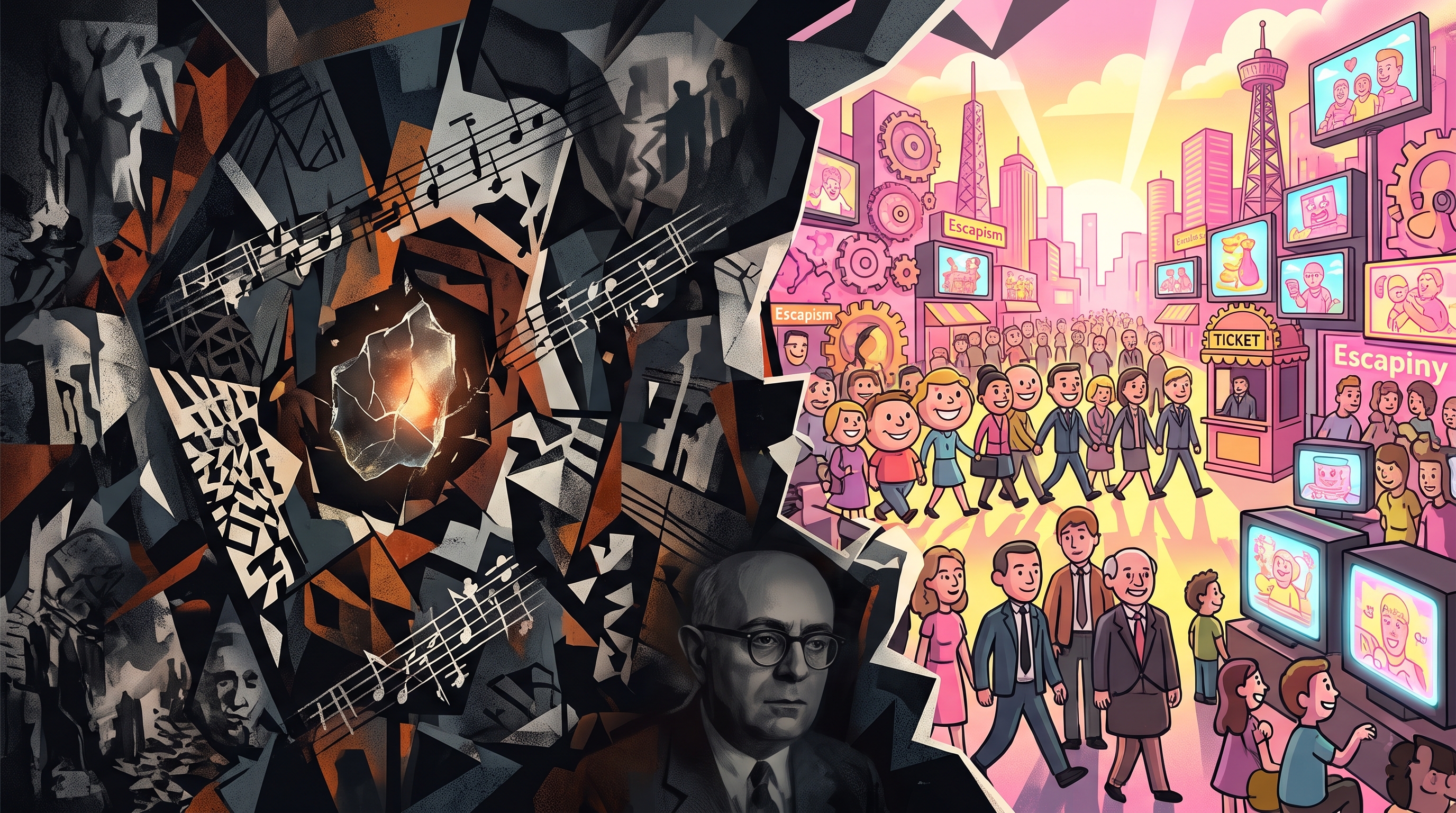
Theodor W. Adorno's posthumously published Ästhetische Theorie (1970) represents the culmination of his lifelong philosophical engagement with art, music, literature, and critical social theory.[1] Synthesizing dialectical materialism, German Idealism (specifically Immanuel Kant and G.W.F. Hegel), and aesthetic modernism, Adorno interrogates how authentic art can survive within late-capitalist administered society. Adorno argues that authentic modern art possesses a constitutively dialectical double character (Doppelcharakter): it is simultaneously autonomous (governed strictly by its internal formal laws, aloof from utilitarian commerce) and a social fact (fait social, crystallizing the unresolved contradictions of the historical totality).[2] Rejecting both vulgar Marxist didacticism and bourgeois sentimental escapism, Adorno positions the hermetic, dissonant artwork as a reservoir of truth content (Wahrheitsgehalt)—a non-affirmative witness to historical suffering that silently indicts the false harmony of the culture industry.
Historical and Editorial Context
Adorno composed the manuscripts for Aesthetic Theory between May 1961 and July 1969, with the primary body of dictation and drafting taking place between October 1966 and January 1968.[1:1] He died of a heart attack in August 1969 before completing his final structural revisions.[1:2]
Textual Composition and Parataxis
- Posthumous Assembly: Edited by his widow, Gretel Adorno, and his student Rolf Tiedemann, the text was published in 1970 as Volume 7 of Adorno's Gesammelte Schriften by Suhrkamp Verlag.[1:3]
- Paratactical Method: Inspired by the late hymns and fragments of Friedrich Hölderlin, Adorno rejected traditional deductive, hierarchical chapter divisions.[3] Instead, he mobilized parataxis—arranging arguments in dense, unsubordinated constellations around an intellectual center so that the book's formal syntax mirrors its anti-systemic philosophical substance.[3:1]
- Dedication: Adorno planned to dedicate the treatise to the playwright Samuel Beckett, whose bleak, anti-illusionistic postwar masterworks (Endgame, Waiting for Godot) served as Adorno's supreme exemplar of negative modernist fidelity.[1:4]
- Translation History: First translated into English by Christian Lenhardt in 1984 (which smoothed out and divided Adorno's monolithic text blocks into conventional paragraphs), the work received its definitive, reconstructive English translation in 1997 from Robert Hullot-Kentor, restoring the uncompromising paratactical density of the German manuscript.[3:2]
"It is self-evident that nothing concerning art is self-evident anymore, not its inner life, not its relation to the world, not even its right to exist."[3:3]
Core Theoretical Pillars
The Double Character of Art: Autonomy and Social Fact
At the core of Aesthetic Theory lies the dialectical tension between art's institutional independence and its socio-historical entanglement. Adorno rejects both vulgar Marxist sociology (which demotes art to an ideological superstructure mirroring economic bases) and bourgeois formalism (which isolates art into an ethereal sanctuary of disinterested beauty):[2:1]
- Autonomy (Autonomie): As modern art gradually emancipated itself from religious ritual, feudal courtly panegyric, and immediate functional utility, it constituted its own immanent formal law (Formgesetz).[1:5] By refusing to serve external commercial or bureaucratic imperatives, autonomous art mounts a silent resistance against the capitalist law of universal exchange value: art criticizes society simply by virtue of its sovereign existence.[2:2]
- Social Fact (Fait Social): Borrowing the sociological concept from Émile Durkheim, Adorno insists that art remains fundamentally social. Art does not absorb society through literal thematic representation; rather, historical antagonisms, productive forces, and technological developments sediment directly into the artwork's medium as unsolved problems of form.[3:4]
- The Leibnizian Monad: Adorno conceptualizes the autonomous artwork as a Gottfried Wilhelm Leibniz-style "windowless monad." Even while sealing its borders against the empirical world to achieve formal coherence, the internal fissures, tensions, and contradictions of the closed aesthetic object register the historical trauma of the external social totality.[3:5]
| Aesthetic Paradigm | Ontological Status of the Artwork | Primary Social Function | Mode of Critique |
|---|---|---|---|
| Bourgeois Aestheticism (L'art pour l'art) | Pure, untainted contemplation; radical detachment. | Compensatory emotional solace and bourgeois distinction. | None; affirms existing social order by providing an idealized refuge. |
| Socialist Realism / Didactic Art | Direct ideological instrument and political vehicle. | Agitation, state propaganda, and social moralization. | Explicit propagandistic content; reproduces instrumental logic. |
| Critical Modernist Dialectic (Adorno) | Double character: autonomous form and historical social fact. | Preserving the non-identical; refuge of historical suffering. | Immanent formal critique; dissonance exposes systemic injustice. |
Mimesis and Instrumental Rationality
Extending the critique initiated with Max Horkheimer in Dialectic of Enlightenment (1947), Adorno examines the civilizational conflict between instrumental rationality (Zweckrationalität) and mimesis (the archaic, non-conceptual affinity of the human organism with otherness and nature):[2:3]
- Instrumental Domination: In everyday capitalist life, instrumental reason violently reduces diverse, qualitative realities to abstract concepts, calculable commodities, and exploitable resources—a process Adorno termed "identity thinking" (Identitätsdenken).
- Aesthetic Synthesis: While ordinary life represses mimesis in favor of self-preservation and control, authentic modern art rescues mimesis by yoking advanced rationality (artistic technique, material construction, and formal discipline) to the service of non-conceptual expression.[3:6]
- Non-Violent Synthesis: Through technical construction, the artwork unites heterogeneous, fragmented elements without violently obliterating their particularity. Art thus provides a fragile historical model of reconciled relation between subject and object, where difference is respected rather than dominated.[2:4]
Truth Content (Wahrheitsgehalt)
Against Kantian subjectivism (which locates aesthetic value in the spectator's subjective faculty of taste) and traditional Hegelian idealism (which views art merely as the sensory illustration of an unfolding philosophical concept), Adorno anchors truth content (Wahrheitsgehalt) objectively inside the immanent formal configuration of the artifact:[1:6]
- The Enigmatic Quality (Rätselcharakter): Artworks present themselves as insoluble riddles. They speak an enigmatic, non-discursive language that simultaneously demands and resists conceptual translation.[3:7]
- Reciprocal Need of Art and Philosophy: Art cannot articulate its own truth conceptually without dissolving its aesthetic form into philosophy; conversely, philosophy cannot access the non-identical without freezing it into dogmatic categories. Aesthetics is the dialectical terrain where philosophy and art interpret and complete one another.[2:5]
- Negativity and Suffering: Because late-capitalist society is structured by exploitation, reification, and violence, authentic artistic truth cannot be positive or affirmative. Genuine art gives voice to what official history represses: physical suffering, existential dissonance, and the unredeemed trauma of human history.[3:8]
- Historical Mortality of Artworks: Truth content is neither static nor eternal. Works that once carried critical, explosive truth can over time decay into domesticated museum relics or consumer commodities once their formal shocks are assimilated by the market.[2:6]
Key Aesthetic Categories Reworked
Natural Beauty vs. Artistic Beauty
G.W.F. Hegel famously banished natural beauty from the philosophical domain of aesthetics, arguing that only art produced by human spirit (Geist) possessed genuine speculative dignity. Adorno undertakes a radical rehabilitation of natural beauty (das Naturschöne), diagnosing Hegel's exclusion as symptomatic of the philosophical drive to subjugate untamed nature:[3:9]
- Natural beauty constitutes the historical trace of the non-identical—that which eludes the totalizing grip of conceptual categorization and capitalist exchange value.[2:7]
- Rather than mimicking physical scenery (which is constantly colonized by the tourist industry and kitsch landscape painting), authentic art must imitate the enigmatic, non-signifying dignity of natural beauty itself: a silent promise of liberation that refuses to be bought, sold, or used.[3:10]
Semblance (Schein), Dissonance, and the Category of the Ugly
- The Collapse of Harmonious Semblance: Classical and bourgeois art rested upon harmonious illusion (Schein), presenting a reconciled, symmetrical whole that tacitly assured spectators that the universe was rational and just. Following the catastrophic horrors of the twentieth century—epitomized in Adorno's famous dictum that "to write poetry after Auschwitz is barbaric"—harmonious beauty became an ideological lie, complicit with violence.[2:8]
- Dissonance as the Voice of Truth: Modern art shatters harmonious semblance by admitting the ugly, the jagged, the fragmented, and the dissonant into its formal grammar.[4] In the atonal compositions of Arnold Schoenberg, the labyrinthine nightmares of Franz Kafka, and the post-apocalyptic stages of Samuel Beckett, dissonance becomes the aesthetic witness to historical trauma.[1:7]
Committed Art vs. Autonomous Art: The Polemic with Sartre and Brecht
Adorno mounts a rigorous critique against Jean-Paul Sartre's doctrine of "committed literature" (littérature engagée) and Bertolt Brecht's didactic epic theatre:[2:9]
- The Pitfall of Didactic Commitment: When an artist forces an artwork to convey an explicit political moral or socialist thesis, the work inevitably resorts to the transparent, communicative language of the administrative apparatus. By speaking the discursive tongue of everyday utility, committed art unwittingly endorses the very instrument of capitalist reification it claims to oppose.[2:10]
- The Subversive Autonomy of Form: Hermetic, autonomous masterworks—such as Kafka's The Castle or Picasso's Guernica—strike a far deeper blow against ideological false consciousness. By destabilizing syntax, perspective, and narrative coherence, autonomous art fractures habituated perception from within, preserving radical alterity without degrading itself into political advertising.[2:11]
| Dimension | Autonomous Modernist Art (Adorno) | The Culture Industry (Kulturindustrie) |
|---|---|---|
| Production Logic | Governed by internal formal necessity (Formgesetz). | Subordinated to market research, mass distribution, and profit. |
| Receptivity Mode | Demands concentrated, strenuous intellectual immersion. | Promotes passive distraction, consumption, and recognition. |
| Formal Architecture | Fragmented, dissonant, challenging, non-affirmative. | Formulaic, predictable, smoothed-out, harmonized. |
| Social Function | Negation of exchange value; preservation of suffering. | Pacification of the working class; reconciliation with the status quo. |
| Truth Value | Objective truth content (Wahrheitsgehalt). | Pure ideological illusion and commercial manipulation. |
Reception and Critical Legacy
While widely recognized as a twentieth-century masterwork of critical aesthetics, Aesthetic Theory prompted extensive debate across sociology and philosophy:[2:12]
- Peter Bürger (Theory of the Avant-Garde): Argued that Adorno dogmatically elevated high-modernist autonomy (Schoenberg, Beckett) while unfairly dismissing the Historical Avant-Garde (Dada, Surrealism, Constructivism), which sought not to retreat into formal hermeticism, but to dismantle the bourgeois institution of art and sublate aesthetic energy into everyday revolutionary life-praxis (Lebenspraxis).[2:13]
- Walter Benjamin: In their long-running correspondence, Benjamin challenged Adorno's elitist suspicion of mass culture, arguing in The Work of Art in the Age of Mechanical Reproduction that the loss of contemplative "aura" enabled cinematic montage and democratic collective reception. Adorno retorted that mass culture under capitalism is not emancipatory, famously maintaining that high art and mass culture are "two torn halves of an integral freedom, to which however they do not add up."
- Jürgen Habermas: Contended that Adorno's relentless negative dialectics drove Critical Theory into a dead end of total suspicion. Habermas sought to transcend Adorno's aesthetic sanctuary by shifting from the philosophy of consciousness toward communicative rationality, discourse ethics, and democratic public spheres.[2:14]
- Albrecht Wellmer and Lambert Zuidervaart: Sought to redeem Adorno's aesthetic theory from historical fatalism, detaching his profound insights on truth content and formal critique from his rigid disdain for popular, vernacular, and postmodern idioms.[1:8]
🎴 Interactive Web Practice (Comprehension Check)
Question 1 (The Double Character of Art): How does Adorno resolve the apparent contradiction between art's autonomous formal isolation and its status as a historical "social fact"?
Answer: Adorno resolves this apparent contradiction through his dialectical conception of art's "double character" (Doppelcharakter). Unlike vulgar Marxist aesthetics, which treats art as a direct ideological reflection of economic base conditions, Adorno argues that art does not register society by depicting political headlines or social misery.
Instead, art is a "social fact" because its artistic materials, production techniques, syntactic codes, and formal problems are inherited directly from historical reality. When an artist engages in creative production, social antagonisms crystallize into the artwork as unsolved problems of form.
Simultaneously, art achieves "autonomy" by refusing to obey the capitalist law of universal exchange and instrumental utility. Operating like a Leibnizian windowless monad, the artwork closes its boundaries against external social demands to pursue its own internal formal law (Formgesetz). Paradoxically, it is precisely this hermetic refusal of utilitarian function that constitutes art's greatest social critique: by remaining useless, autonomous art stands as an uncompromising indictment of a totally administered, commodified society.
Question 2 (Truth Content vs. Committed Propaganda): Why does Adorno argue that autonomous modernist works (like Kafka or Beckett) possess greater critical truth content than politically committed or didactic art (like Brecht or Sartre)?
Answer: Adorno rejects politically committed or didactic art (tendenzkunst) because it inevitably borrows the instrumental, discursive language of the existing social apparatus. In attempting to deliver explicit socialist or moral messages, didactic art uses the very communicative clarity and means-end rationality that characterizes capitalist administration and propaganda. By subordinating aesthetic form to a pre-packaged thesis, committed art flatters the audience's reified consciousness, leaving the fundamental structure of commodified perception unchallenged.
Conversely, autonomous modernist works—such as the austere plays of Samuel Beckett or the claustrophobic narratives of Franz Kafka—refuse discursive moralizing. Instead, they enact their critique at the level of structure, syntax, and perspective. By dismantling narrative cohesion, linear causality, and harmonious resolution, they shatter the spectator's habituated perceptual conditioning. Their radical formal difficulty preserves non-identical historical suffering that cannot be smoothed over by ideology. For Adorno, authentic truth content resides not in political slogans, but in the uncompromising dissonance of the autonomous form itself.
Question 3 (The Dialectic of Mimesis and Construction): How does modern art mobilize advanced technical construction in the service of archaic mimesis without falling into the trap of total domination?
Answer: In Dialectic of Enlightenment and Aesthetic Theory, Adorno diagnoses how Western instrumental reason historically suppressed mimesis (the primal, non-conceptual affinity with the natural object) in order to achieve mastery and control over nature. In late capitalism, this rationality degenerates into "identity thinking," forcing heterogeneous entities into interchangeable, calculable commodities.
Modern art achieves a non-violent synthesis through the dialectical interplay of mimesis and construction. Rather than regressing into naive, pre-rational imitation of nature, modern art employs the highest historical levels of technical mastery, material construction, and formal discipline. However, unlike bureaucratic engineering or industrial extraction, artistic construction is deployed strictly to protect and articulate mimesis.
Through advanced technique, the artist arranges disparate, fragmented, and non-identical materials into a constellation where individual elements are integrated without being violently subordinated to an overarching, tyrannical concept. The authentic artwork thus prefigures a reconciled relationship between humanity and nature, modeling an emancipatory rationality that articulates alterity rather than annihilating it.
Resonant Notes
The following notes in the vault share direct thematic, sociological, and philosophical connections with Theodor W. Adorno's aesthetic theory:
🔴 Critical Theory, Frankfurt School & Dialectical Philosophy
- Walter Benjamin (1892–1940) & The Work of Art in the Age of Mechanical Reproduction — Adorno's closest lifelong interlocutor; their celebrated debate over the decay of the ritual "aura," film technology, and the political efficacy of mass culture remains the cornerstone of modern aesthetic theory.
- Walter Benjamin's The Arcades Project — Benjamin's monumental study of nineteenth-century Paris, saved and edited posthumously by Adorno, analyzing how commodity fetishism and architectural phantom forms condition the modern sensorium.
- Walter Benjamin’s Theses on the Philosophy of History — Directly parallels Adorno's radical critique of linear progress and Enlightenment triumphalism, reading civilization and culture as documents of historical barbarism.
- Georg Lukács's formulation of reification (Verdinglichung) in History and Class Consciousness (1923) — Lukács's theory of reification and commodity fetishism provided the foundational conceptual machinery that Adorno and Horkheimer extended into the culture industry and negative dialectics.
- Hegelian Philosophy-Geist, Actuality, and the Dialectics of Recognition & Georg Wilhelm Friedrich Hegel (1770–1831) — Hegel's dialectic represents the indispensable bedrock of Adorno's thought; however, in Negative Dialectics and Aesthetic Theory, Adorno revolts against Hegel's drive for totalizing identity and affirmative closure ("The whole is the false").
- Immanuel Kant-The Transcendental Sublime — Kant's Critique of Judgment established the classic doctrine of aesthetic autonomy and disinterested pleasure, which Adorno reinterprets dialectically through historical materialism.
- Continental Philosophy — Comprehensive survey tracing the trajectory of Western Marxism, phenomenology, and critical theory that informs the intellectual environment of Adorno's Frankfurt School.
- Jürgen Habermas's The Structural Transformation of the Public Sphere — The second-generation Frankfurt School critique of Adorno's aesthetic pessimism, pivoting from negative dialectics toward communicative rationality and democratic institutions.
🟡 Aesthetic Modernism, Autonomy & Avant-Garde Rupture
- The Dehumanization of Art — José Ortega y Gasset's 1925 diagnosis of modernist antipopularity; while Ortega adopts an aristocratic lens, his description of modern art purging sentimental human realism directly anticipates Adorno's defense of difficult, autonomous modernism.
- Peter Bürger-Theorie der Avantgarde — The primary critical foil to Adorno's aesthetic model; Bürger argues that Adorno dogmatically fetishized high-modernist autonomy while ignoring the historical avant-garde's radical attempt to sublate art into revolutionary life-praxis (Lebenspraxis).
- The Avant-Garde & Renato Poggioli-Teoria dell'arte d'avanguardia — Overarching historical hubs tracing the institutional tensions between modernist formal purity, political vanguardism, and institutional self-critique.
- Franz Kafka (1883-1924) — Adorno's paradigm of literary modernism; Kafka's literal expressions of an alienated world refuse allegorical reduction, exemplifying how unresolved social contradictions sediment into pristine, terrifying narrative forms.
- Paul Klee (1879–1940) & The Bauhaus School — Explores the modernist integration of constructive technique and aesthetic autonomy, examining the delicate threshold between functional design and non-instrumental form.
- The Painter of Modern Life, a seminal 1863 essay by French poet and art critic Charles Baudelaire & The flâneur — The historical emergence of modern aesthetic autonomy under nineteenth-century capitalism, tracking how the artist negotiated the urban crowd before the onset of the total culture industry.
- Anthony Vidler-The Architectural Uncanny — Explores Adorno's famous thesis from Minima Moralia that "dwelling, in the proper sense, is now impossible," demonstrating how modernist architecture embodies somatic anxiety and structural estrangement.
🟢 Mass Culture, Alienation & Sociological Critique
- Kitsch — Clement Greenberg's classic formulation of the divide between avant-garde autonomy and industrial kitsch, complementing Adorno's analysis of commodification within the culture industry.
- Georg Simmel's Tragedy of Culture & The Metropolis and Mental Life — Simmel's diagnosis of objective culture outstripping subjective capacity provided the vital sociological framework that Adorno translated into his critique of consumer capitalism and reified consciousness.
- Don DeLillo Major Themes Analysis — A literary manifestation of Adorno's warning regarding total administration; DeLillo depicts late-capitalist hyper-reality where even trauma, terrorism, and avant-garde subversion are smoothly packaged into consumable media spectacle.
- Zygmunt Bauman's sociological framework of Liquid Modernity — Examines the post-panoptic dissolution of solid institutional structures, tracking the transition from Adorno's administered society to deregulated, precariously privatized consumer culture.
- Good Taste and Naïve Realism — Explores the cognitive and social psychology of aesthetic judgment, illustrating how bourgeois audiences project normative moral standards onto artworks, reinforcing Adorno's critique of mass cultural consumption.
- McLuhan's The Medium is the Message & Marshall McLuhan (1911-1980) — Interrogates how media structures dictate cognitive perception; while McLuhan examines technical affordances neutrally, Adorno diagnoses their ideological role in pacifying political consciousness.
- Defining a Simulacrum — Jean Baudrillard's post-Marxist semiotics, illustrating how late-stage capitalism realizes Adorno's darkest warnings: the complete replacement of authentic truth content with self-referential simulation and pure exchange value.
References
Wikipedia Contributors / Aesthetic Theory / en.wikipedia.org ↩︎ ↩︎ ↩︎ ↩︎ ↩︎ ↩︎ ↩︎ ↩︎ ↩︎
Stanford Encyclopedia of Philosophy / Aesthetics in Critical Theory / plato.stanford.edu ↩︎ ↩︎ ↩︎ ↩︎ ↩︎ ↩︎ ↩︎ ↩︎ ↩︎ ↩︎ ↩︎ ↩︎ ↩︎ ↩︎ ↩︎
Theodor W. Adorno (trans. Robert Hullot-Kentor) / Aesthetic Theory / University of Minnesota Press ↩︎ ↩︎ ↩︎ ↩︎ ↩︎ ↩︎ ↩︎ ↩︎ ↩︎ ↩︎ ↩︎
Lambert Zuidervaart / Adorno's Aesthetic Theory: The Redemption of Illusion / MIT Press ↩︎