The Dialectic of Orthodoxy and Avant-Garde in Art and Buddhism
🗂️ Interactive Notebook: Open Study Companion (Video Summary, Flashcards, Mind Map) ↗
The Cycle of Institutional Ossification and Radical Rupture
Across both aesthetic and spiritual domains, systems of knowledge transmission begin as dynamic discoveries. Over generations, these discoveries are formalized into closed pedagogical circuits—the traditional art atelier or the scholastic monastery—where a master sits at the center and apprentices occupy the periphery, advancing only through strict mimesis and canon preservation. When the medium of transmission becomes mistaken for the truth itself, an avant-garde emerges to shatter the hierarchy. Yet, because human institutions require structure to survive across time, the iconoclastic breakthrough inevitably calcifies into a new canon, awaiting the next generation of heretics.[1]
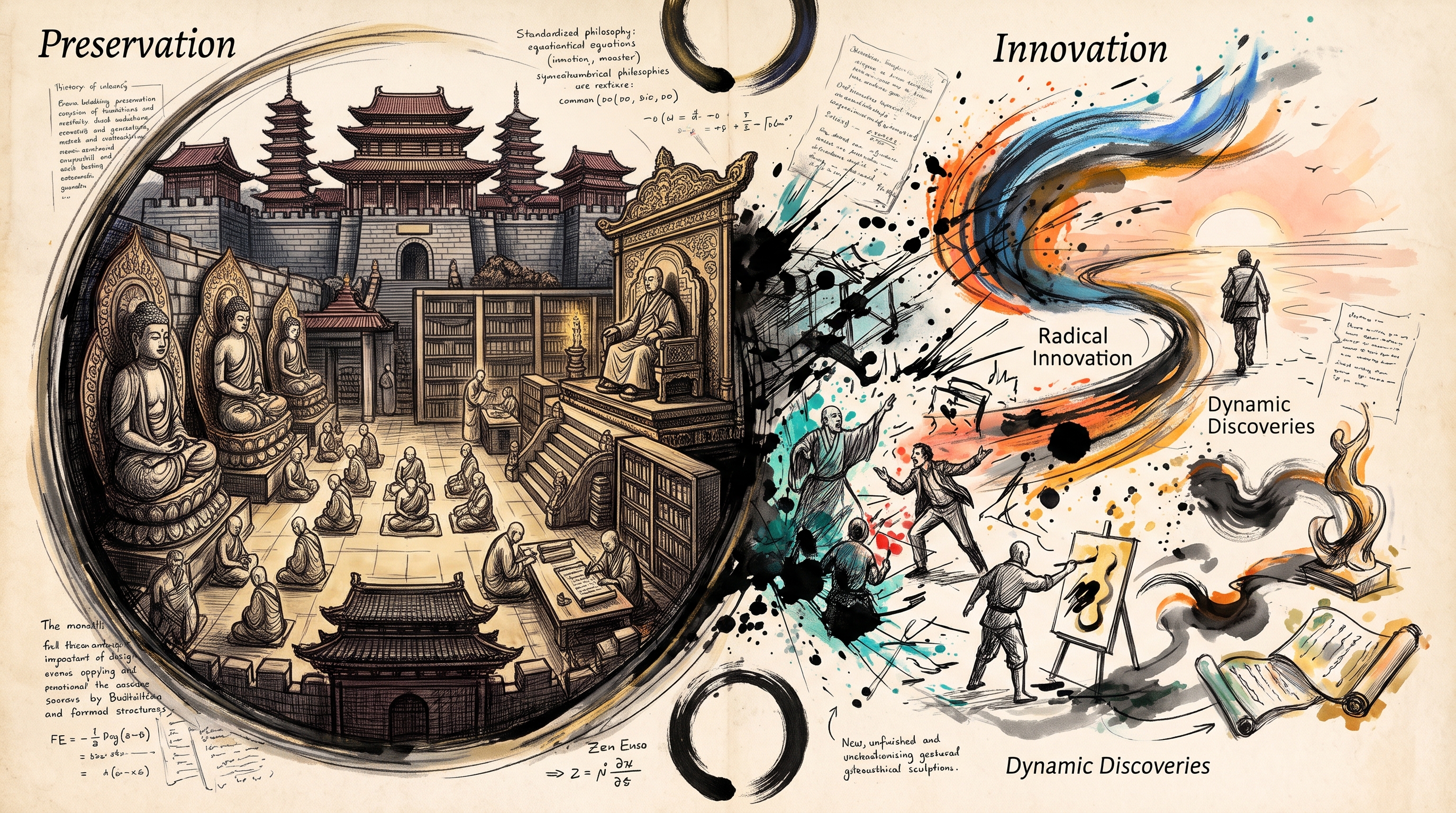
Both the history of visual art and the history of Buddhist philosophy operate through a recurring dialectical cycle: a centripetal orthodoxy focused on preserving a sacred canon is periodically fractured by a radical avant-garde seeking unmediated experience, only for that revolutionary movement to eventually codify into the very institutional orthodoxy it once sought to destroy.[1:1]
The Centripetal Model: Canon Preservation and the Closed Circuit
Before examining the rupture, one must understand the mechanics of the closed circuit. In both classical art academies and orthodox monasticism, knowledge is treated as a fixed, finite deposit held at the center of an institutional hierarchy. As Peter L. Berger and Thomas Luckmann observe in The Social Construction of Reality - A Treatise in the Sociology of Knowledge, human practices inevitably undergo institutionalization, habituation, and objectivation; the primary objective of the mature institution shifts from raw exploratory innovation to historical fidelity—ensuring that technique or doctrine does not degrade as it passes across generations.[2]
The Traditional Art Studio and the Academic System
From the Italian Renaissance guild workshops (bottegas) to the nineteenth-century French Académie des Beaux-Arts, artistic training operated as a centripetal system of "legitimate peripheral participation."[2:1]
- The Master as the Axis: At the absolute center of the atelier stood the master, who embodied the living link to the historical canon (the Grand Manner derived from Classical antiquity and the High Renaissance, codified in treatises such as Leonardo da Vinci's A Treatise on Painting (Trattato della pittura)).[3]
- The Apprentice on the Periphery: The novice entered at the outer edge of the studio. Initially relegated to menial tasks—grinding pigments, preparing canvases, or sweeping floors—the apprentice slowly moved inward only by erasing their individual stylistic impulses in favor of the master's hand.[3:1]
- The Closed Circuit of Technique: Pedagogy was strictly mimetic and sequential. In the French Academic system, students spent years drawing from flat engravings (estompes), then from plaster casts of classical sculptures (bosses), before ever being permitted to paint a living human model.[4]
- Hierarchy of Genres: The canon was policed through a strict hierarchy of subject matter—history painting and biblical scenes at the apex, with landscape and genre still life at the bottom—enforced by the institutional gatekeeping apparatus of the annual Paris Salon.[4:1]
Centripetal Pedagogy
In a closed-circuit studio, creativity is defined as the recombinatory mastery of established rules. The apprentice does not look directly at nature; they look at nature through the corrective lens of the master and the antique canon, reifying historical models into eternal standards of normative "good taste".
Scholastic Monasticism and Early Buddhist Orthodoxy
A virtually identical structural dynamic emerged in early institutional Buddhism following the Parinirvana (death) of Siddhartha Gautama. As the wandering community of mendicants settled into permanent monasteries (viharas), the preservation of the Buddha's spoken words became the paramount concern.
- The Elder (Thera) at the Center: Authority became concentrated in the hands of senior monks who had memorized the oral canon preserved in texts like The Dhammapada and mastered the Vinaya (monastic disciplinary code).[5]
- The Novice (Samanera) on the Periphery: Spiritual progression required decades of rote memorization, commentary recitation, and strict adherence to hundreds of behavioral precepts under the supervision of an Acariya (master).[5:1]
- The Abhidharma as Closed Technical Circuit: During the period of the early Nikaya schools (most notably the Sarvāstivāda and early Theravāda traditions), Buddhist thought became increasingly scholastic. Monks compiled the Abhidharma—exhaustive, microscopic taxonomies of irreducible reality-constituents (dharmas) and mental factors, an analytical enterprise later critiqued in Vasubandhu's-Triṃśikā-vijñaptimātratā and Jay L. Garfield on the Three Turnings.[6]
- Orthodoxy as Gatekeeping: Awakening (Arhatship) was increasingly framed as an arduous, multi-lifetime technical achievement accessible only to monastic elites who had mastered the analytical matrices of the Abhidharma, leaving laypeople and unlettered novices on the spiritual periphery.[6:1]
The Avant-Garde Rupture: Shattering the Center
When a closed circuit becomes overly self-referential, an acute crisis of authenticity occurs. The academic painter realizes that studio lighting, neoclassical drapery, and mythological allegories bear no resemblance to the pulsating industrial metropolis; the Buddhist contemplative realizes that categorizing mental dharmas in a cloistered library fails to eradicate existential anguish (dukkha). At this threshold of exhaustion, the avant-garde strikes.
Aesthetic Iconoclasm: From the Salon des Refusés to the Readymade
As examined in The Avant-Garde, the modernist vanguard—adopting a military metaphor denoting the "advance guard"—sought to dismantle the master-apprentice hierarchy and bypass institutional mediation entirely.[1:2] In Peter Bürger-Theorie der Avantgarde, this dynamic is conceptualized as the shift from system-immanent stylistic modification to a wholesale critique of the "institution of art."
- Impressionism and Direct Sensory Perception: In the 1860s and 1870s, painters like Claude Monet, Pierre-Auguste Renoir, and Camille Pissarro abandoned the dark, formula-bound atelier to paint en plein air (outdoors), capturing the ephemeral sensations celebrated in The Painter of Modern Life, a seminal 1863 essay by French poet and art critic Charles Baudelaire.[7] By rejecting smooth academic finish (fini) in favor of broken, visible brushstrokes that documented instantaneous light, they asserted that the painter's immediate sensory impression superseded centuries of academic rules.[7:1]
- Dada and the Anti-Art Rupture: Following the catastrophic slaughter of World War I, the Dada movement concluded that European bourgeois high culture was morally bankrupt. When Marcel Duchamp submitted a standard porcelain urinal signed "R. Mutt" (Fountain, 1917) to the Society of Independent Artists, he severed the connection between art and manual craft (ars mechanica).[8] As Walter Benjamin demonstrates in The Work of Art in the Age of Mechanical Reproduction, the unique ritual "aura" of the masterwork was liquidated, opening art to political and conceptual interrogation.
- Decentering the Master: If art is defined by intentional framing and conceptual selection rather than hereditary manual virtuosity transmitted by a guild master, the traditional studio hierarchy collapses. The periphery—found objects, industrial detritus, mass culture, and the untrained eye—violently displaces the academic center.
"The creative act is not performed by the artist alone; the spectator brings the work in contact with the external world by deciphering and interpreting its inner qualifications." — Marcel Duchamp[8:1]
Spiritual Iconoclasm: The Mahāyāna, Vajrayāna, and Chan Revolutions
The history of Buddhist thought is punctuated by identical avant-garde rebellions against institutional scholasticism. Each historical wave accused the prevailing monastic establishment of clinging to the conceptual raft while forgetting the distant shore, mistaking the finger pointing at the moon for the moon itself.
- The Mahāyāna Disruption (c. 1st Century BCE – 1st Century CE): Dissatisfied with the insular, monk-centric focus of the early scholastic schools (polemically characterized as Hīnayāna, or the "Lesser Vehicle"), the emerging Mahāyāna movement introduced radical scriptures like the Prajñāpāramitā (Perfection of Wisdom) sūtras.[6:2]
- Nāgārjuna's Deconstruction: Operating as an intellectual iconoclast, Nāgārjuna (c. 150–250 CE) mobilized the dialectic of radical emptiness (śūnyatā) to dismantle the Abhidharma's rigid ontological building blocks, demonstrating that no entity, doctrine, or state possesses inherent existence (svabhāva).[9] Furthermore, as explored in Two Kinds of Nothingness-Astrophysics and Buddhist Philosophy, the Mahāyāna elevated the Bodhisattva—an engaged figure operating dynamically within the suffering world of Saṃsāra—above the cloistered, ascetic Arhat, declaring that Saṃsāra and Nirvāṇa are non-dual.[6:3]
- The Tantric / Vajrayāna Subversion: Centuries later, when Mahāyāna philosophy itself calcified into a massive, scholastic university bureaucracy (epitomized by Indian mega-monasteries like Nālandā), the Mahāsiddhas (great adepts) arose.[10] Living as antinomian yogis, social outcasts, and cremation-ground dwellers, they deployed transgressive imagery, somatic embodiment, and ritual shock to trigger awakening in a single lifetime, bypassing decades of scholastic commentary.[10:1]
- Chan/Zen and the Destruction of the Text: In China, the Chan (Zen) lineage staged the ultimate iconoclastic revolt against textual pedantry, defining its lineage as "a special transmission outside the scriptures, not founded upon words and letters."[11] As detailed in The Core Instruction - Turning the Gaze Inward, masters like Linji Yixuan (Rinzai) deployed spontaneous shouts (katsu), strikes with a staff, and paradoxical dialogue (kōans) to shock disciples out of conceptual reification, declaring: "If you meet the Buddha on the road, kill him"—demanding the complete destruction of any reified mental idol of enlightenment.[12]
Structural Parallels: The Atelier vs. The Sangha
Despite occupying distinct cultural spheres, the structural dynamics of how the avant-garde dismantles orthodoxy across visual art and Buddhism exhibit striking morphological parallels:
| Structural Dimension | The Academic Atelier (Fine Art) | Scholastic Monasticism (Buddhist Sangha) | The Avant-Garde Rupture (Art & Buddhism) |
|---|---|---|---|
| Locus of Authority | Central Master (Maître) embodying classical lineage and the Grand Manner. | Senior Elder (Thera) / Monastic Abbot possessing scriptural command of the Vinaya. | Dispersed across everyday practitioners, lay Bodhisattvas, found objects, and the direct observer. |
| Mode of Transmission | Strict mimetic reproduction: engravings → plaster casts → live studio model. | Hierarchical scholasticism: rote recitation, commentary memorization, Abhidharma matrices. | Spontaneous, unmediated encounter: plein air painting, readymades, Chan kōan paradoxes. |
| Boundary Discipline | Sharp segregation between "High Art" (history/myth) and vulgar everyday life. | Strict monastic separation between the pure Sangha enclosure and profane Saṃsāra. | Complete collapse of hierarchies: soup cans in galleries; "Nirvāṇa is Saṃsāra"; sacredness in daily chores. |
| Epistemic Trap | Conflating academic draftsmanship and decorative finish (fini) with authentic artistic vision. | Conflating scholastic classification of dharmas and sutra erudition with existential liberation (bodhi). | Denunciation of technical virtuosity: challenging sterile aestheticism and dogmatic textual idolatry. |
- Rejection of Mediated Authority: The academic studio demands that the student view reality through the master's hand; scholastic monasticism demands that the meditator experience consciousness through Abhidharmic taxonomies. Both the modernist painter (plein air, Readymade) and the radical Buddhist contemplative (Chan direct pointing, Mahāmudrā) insist upon direct, unmediated, first-person encounter.
- Collapse of the Sacred/Profane Hierarchy: The Royal Academy separated fine art from commercial life; early monasticism cordoned off the holy monastery from the corrupted world. Modernism dragged mass-produced consumer goods into the museum; Mahāyāna and Chan proclaimed that absolute truth is discovered not in metaphysical withdrawal, but in chopping wood and carrying water.[9:1]
- Critique of Technical Virtuosity: Just as Abstract Expressionism and Conceptual Art rejected academic drawing as a deceptive trap, Zen masters mocked scholars capable of reciting thousands of sūtras who remained entirely devoid of experiential insight (kenshō).[11:1]
The Irony of Institutionalization: When the Avant-Garde Becomes the Orthodoxy
The final, decisive phase of this historical dialectic is the tragedy of institutional success. In Max Weber (1864-1920), this inevitable transformation is diagnosed as the "routinization of charisma" (Veralltäglichung des Charismas): the incandescent, destabilizing personal insight of a prophetic founder or avant-garde pioneer cannot be sustained in its pure, incandescent state across generations.[1:3] To ensure historical durability, preserve lineage continuity, and administer material resources, every revolutionary movement is forced to construct administrative machinery, formalize training curricula, and codify orthodox canons.
In doing so, the avant-garde inevitably reconstructs the very closed circuit of center-master and peripheral-apprentice it was forged to overthrow.
The Paradox of Canonization
Every successful heresy eventually becomes a rigid orthodoxy. The moment an iconoclastic breakthrough is preserved, canonized, and taught as an authoritative standard to be imitated, its revolutionary function inverts into canon preservation. As Georg Simmel diagnosed in Georg Simmel's Tragedy of Culture, the living creative impulses of the human spirit (subjective culture) inevitably crystallize into external, autonomous institutional structures (objective culture) that outgrow, constrain, and reify human consciousness.
The Academization of Modernism
Within decades of their radical ruptures, the subversive movements of modern art were thoroughly absorbed into the institutional matrix of museums, commercial blue-chip galleries, and university MFA departments.[1:4]
- High Modernist Formalist Dogma: By the 1940s and 1950s, Abstract Expressionism—initially an agonizing existential revolt against European easel painting—was codified by influential critics like Clement Greenberg into an uncompromising, dogmatic orthodoxy of "medium specificity" and optical flatness, as analyzed in Kitsch.[13] Artists who reintroduced figurative imagery or narrative content were cast out as regressive heretics by the newly entrenched formalist establishment.
- The Institutionalized Readymade: Duchamp's Fountain, originally conceived to explode the ideological boundary of the museum, today rests on velvet pedestals under climate-controlled glass, insured for tens of millions of dollars. As analyzed in Peter Bürger-Theorie der Avantgarde and Defining a Simulacrum, the anti-art gesture has been completely absorbed into the circulation of institutional prestige and commodity sign-value. Rebellious aesthetic movements are systematically co-opted, packaged, and monetized by the corporate culture industries, reflecting the lifecycle of modern Counter-Culture.
- The MFA Academy: Contemporary MFA programs teach institutional critique, deconstruction, and conceptual practices through standardized pedagogical syllabi. Renowned tenured professors occupy the institutional center, evaluating graduate students on the periphery through a codified technical vocabulary of post-structuralist critique—re-enacting the pedagogical mechanics of the nineteenth-century Paris Academy under postmodern terminology.[1:5]
The Ossification of Radical Buddhism
An identical trajectory transformed Buddhism's most iconoclastic breakthroughs into conservative monastic institutions.
- The Routinization of Chan and Zen: Chan began as a spontaneous, text-renouncing rebellion against bureaucratic scholasticism. Yet, by China's Song Dynasty and Japan's Tokugawa period, Zen had become thoroughly institutionalized.[11:2] The spontaneous shouts, blows, and encounter dialogues of the Tang Dynasty masters were transcribed, indexed, and compiled into canonical compendia such as the Blue Cliff Record (Biyan Lu) and The Gateless Gate (Wumenguan), calcifying into a rigid, standardized curriculum of kōan introspection.[11:3]
- The Hierarchical Monastery as Closed Circuit: In contemporary Japanese Rinzai and Sōtō monastic complexes, an unbending master-apprentice hierarchy governs every action. Novices (unsui) inhabit the strict periphery, regimented down to the millimeter in how they fold their robes, handle eating bowls (ōryōki), and step across thresholds. The Rōshi (master) at the center retains exclusive patriarchal power to confer inka shōmei (the institutional seal of legitimate transmission)—re-establishing a gatekeeping circuit as tightly policed as the French Salon.[14]
- Tantric Scholasticism: The wild, antinomian practices of the Indian Mahāsiddhas met the same institutional fate in Tibet. Systematized by Je Tsongkhapa (1357–1419) in the Gelug school, esoteric Tantric yogas were sequestered at the conclusion of a rigorous, twenty-year scholastic curriculum centered on formal debate, textual memorization, and monastic logic, as contextualized in Jay L. Garfield on the Three Turnings.[10:2] The transgressive impulse was thoroughly integrated into an imperial monastic state.
The Eternal Return of the Periphery
Once an avant-garde movement solidifies into an institutional orthodoxy, the dialectical cycle resets. In art, Pop Art, Fluxus, and Institutional Critique arose during the 1960s to puncture the solemn metaphysical dogma of Abstract Expressionism; in Buddhism, modern reform efforts—from the non-sectarian (Rimé) movement in nineteenth-century Tibet to contemporary secular and socially engaged Buddhism led by thinkers like Stephen Batchelor and examined in Traditional vs. Secular Buddhist vs. General Spiritual Teachers—continually emerge from the cultural periphery to challenge cloistered monastic insularity.[15]
The centripetal master and the codified canon remain historically necessary to safeguard and transmit human discoveries across centuries; yet the iconoclastic heretic on the periphery remains equally indispensable to shatter the institutional vessel whenever the container is mistaken for the living spirit within.
Resonant Notes
The following notes in the vault share direct thematic, sociological, and literary connections with the dialectic of orthodoxy and the avant-garde:
🔴 Institutional Theory, Avant-Garde Rupture & Modernism
- The Avant-Garde — Serves as the vault's master conceptual and historical overview of the vanguard; analyzes the transition from Saint-Simonian socio-political activism to aesthetic autonomy, framing the avant-garde's structural conflict with institutional systems.
- Peter Bürger-Theorie der Avantgarde — Provides the essential materialist framework differentiating system-immanent modernism from the historical avant-garde's systemic attack on the "institution of art," explaining the inevitable neutralization and museum absorption of anti-art gestures.
- Renato Poggioli-Teoria dell'arte d'avanguardia — Offers a psychological and sociological counter-model to Bürger, theorizing the avant-garde as a cyclical, agonistic movement characterized by romantic antagonism, activism, and dialectical self-immolation.
- The Work of Art in the Age of Mechanical Reproduction — Walter Benjamin's seminal analysis of the decay of the ritual "aura" through mechanical reproducibility, providing the technical basis for why traditional academic studio painting collapsed before modern montage and the Readymade.
- Kitsch — Clement Greenberg's classic formulation of the avant-garde's defense of medium specificity and artistic purity against industrial kitsch; demonstrates how modernism's radical formal innovations codified into an unbending high-art establishment.
- The Bauhaus School — Explores Walter Gropius's and Hannes Meyer's architectural avant-garde, which attempted to transcend the insular fine-art atelier by unifying fine art, manual craftsmanship, and industrial mass production into everyday Lebenspraxis.
- A Treatise on Painting (Trattato della pittura) — Leonardo da Vinci's foundational text defending painting as a supreme intellectual science (scienza e discorso mentale) against manual craft (arte meccanica), establishing the theoretical foundation for the classical academic hierarchy.
- The Painter of Modern Life, a seminal 1863 essay by French poet and art critic Charles Baudelaire — Baudelaire's manifesto for modern sensibility that inspired the Impressionists to abandon academic history painting and capture the transient, fleeting energy of contemporary urban life.
🟡 Buddhist Dialectics, Scholasticism & Radical Deconstruction
- Nāgārjuna — The central philosophical iconoclast of Indian Buddhism; deployed the dialectic of dependent origination and emptiness (śūnyatā) to dismantle the rigid metaphysical and ontological categories of early Abhidharma scholasticism.
- Jay L. Garfield on the Three Turnings — Formulates a non-hierarchical hermeneutic of Buddhist philosophical evolution, illustrating how the Second and Third Turnings arose as corrective dialectical responses to earlier doctrinal reifications while cautioning against sectarian dogmatism.
- The Core Instruction - Turning the Gaze Inward — Analyzes the radical, experiential methodology of Chan/Zen contemplative inquiry, which bypassed sacred scriptures, scholastic commentaries, and monastic hierarchies in favor of direct, immediate apperception.
- Two Kinds of Nothingness-Astrophysics and Buddhist Philosophy — Investigates the ontological convergence of physical vacuum physics and Buddhist śūnyatā, detailing how the Mahāyāna collapsed the metaphysical dualism between Saṃsāra and Nirvāṇa.
- The Dhammapada — The classic scriptural repository of foundational Theravāda Buddhist teachings, representing the early oral canon whose preservation catalyzed the establishment of early monastic scholasticism (viharas).
- Vasubandhu's-Triṃśikā-vijñaptimātratā — Systematizes Yogācāra phenomenology to deconstruct the reified dualism between subject and object, correcting both naive realism and scholastic over-categorization.
- Traditional vs. Secular Buddhist vs. General Spiritual Teachers & Stephen Batchelor — Contemporary manifestations of the perennial periphery-led revolt against scholastic orthodoxy, seeking to strip away calcified monastic metaphysics to restore authentic existential utility.
- Buddhist Themes in Lucky — Cinematic study illustrating how secular, embodied existential confrontation with finitude transcends dogmatic spiritual formulas, mirroring the Chan rejection of conceptual crutches.
🟢 Sociological Calcification, Reification & Cultural Recuperation
- Max Weber (1864-1920) — Articulates the foundational sociological doctrine of the "routinization of charisma" (Veralltäglichung des Charismas), demonstrating how spontaneous visionary authority inevitably transforms into permanent bureaucratic or traditional institutions.
- Georg Simmel's Tragedy of Culture — Diagnoses the tragic civilizational split wherein living creative subjectivity (subjective culture) externalizes itself into autonomous cultural artifacts and institutional systems (objective culture) that inexorably outgrow, dominate, and alienate their creators.
- The Social Construction of Reality - A Treatise in the Sociology of Knowledge — Berger and Luckmann's analysis of how subjective human activity undergoes habitualization, institutional sedimentation, and objectivation, reifying historical social constructs into seemingly immutable natural orders.
- **Georg Lukács's formulation of reification (Verdinglichung) in History and Class Consciousness (1923)` — Unpacks the Marxist-Weberian concept of reification (Verdinglichung), showing how human relations and dynamic practices petrify into a "phantom objectivity" that conceals historical contingency.
- Counter-Culture — Sociological analysis of how transgressive, anti-establishment rebellions are methodically defanged, co-opted, and packaged into consumable market commodities by corporate culture industries.
- Don DeLillo Major Themes Analysis & Defining a Simulacrum — Jean Baudrillard's and Don DeLillo's diagnoses of late-capitalist hyperreality, showing how subversive art gestures (such as the Readymade) are integrated into sterile spectacle and sign-value circulation.
- Good Taste and Naïve Realism — Explores the cognitive and social processes through which arbitrary class-based aesthetic norms are reified into objective standards of "good taste," operating as gatekeeping tools within academic institutions.
References
Peter Bürger / Theory of the Avant-Garde / University of Minnesota Press ↩︎ ↩︎ ↩︎ ↩︎ ↩︎ ↩︎
Jean Lave and Etienne Wenger / Situated Learning: Legitimate Peripheral Participation / Cambridge University Press ↩︎ ↩︎
Nikolaus Pevsner / Academies of Art, Past and Present / Cambridge University Press ↩︎ ↩︎
Albert Boime / The Academy and French Painting in the Nineteenth Century / Yale University Press ↩︎ ↩︎
Richard F. Gombrich / Theravada Buddhism: A Social History from Ancient Benares to Modern Colombo / Routledge ↩︎ ↩︎
Paul Williams / Mahayana Buddhism: The Doctrinal Foundations / Routledge ↩︎ ↩︎ ↩︎ ↩︎
John Rewald / The History of Impressionism / Museum of Modern Art ↩︎ ↩︎
Calvin Tomkins / Duchamp: A Biography / Museum of Modern Art ↩︎ ↩︎
Jay L. Garfield / The Fundamental Wisdom of the Middle Way: Nagarjuna's Mulamadhyamakakarika / Oxford University Press ↩︎ ↩︎
Ronald M. Davidson / Indian Esoteric Buddhism: A Social History of the Tantric Movement / Columbia University Press ↩︎ ↩︎ ↩︎
Heinrich Dumoulin / Zen Buddhism: A History (Volume 1: India and China) / World Wisdom ↩︎ ↩︎ ↩︎ ↩︎
Burton Watson / The Zen Teachings of Master Lin-chi: A Translation of the Lin-chi Lu / Columbia University Press ↩︎
Clement Greenberg / Art and Culture: Critical Essays / Beacon Press ↩︎
T. Griffith Foulk / The "Ch'an School" and Its Place in the Buddhist Monastic Tradition / University of Michigan ↩︎
David L. McMahan / The Making of Buddhist Modernism / Oxford University Press ↩︎