Johannes Vermeer (1632–1675)
🗂️ Interactive Notebook: Open Johannes Vermeer Study Companion (Video Summary, Flashcards, Mind Map) ↗
Johannes Vermeer (1632–1675) experienced one of the most dramatic cycles of critical obscurity and resurrection in Western art history.[1] Revered within the local Delft art market during his lifetime, Vermeer's name largely vanished from broader European consciousness in the eighteenth century, only to be systematically reconstructed in the mid-nineteenth century by the French critic Théophile Thoré-Bürger and elevated by early modernist writers and painters into a canonical master of the Dutch Golden Age.[2] Unlike Rembrandt or Peter Paul Rubens, whose large workshops and extensive print networks ensured uninterrupted international fame, Vermeer painted fewer than forty works, left no documented pupils, and had nearly half of his output concentrated in a single Delft collection. As a result, his paintings spent over a century dispersed across Europe—frequently bearing forged signatures of more marketable Dutch masters—before nineteenth-century connoisseurship, twentieth-century archival discovery, and modern technical imaging restored his true aesthetic stature.[3]
| Reception Epoch & Phase | Key Figures & Archival Sites | Critical Status & Attribution Realities | Historiographical Impact |
|---|---|---|---|
| Lifetime & Early Posthumous (1653–1696) | Pieter van Ruijven, Maria de Knuijt, Jacob Dissius, Guild of Saint Luke | High local Delft esteem; 21 works auctioned in the 1696 Amsterdam Dissius sale at premium prices. | Oeuvre monopolized by a single family collection; minimal European visibility outside Delft. |
| The 18th-Century Eclipse (1700–c. 1840) | Arnold Houbraken, Count Czernin, regional dealers | Severe obscurity; omission in major surveys; widespread forged signatures of Pieter de Hooch and Frans van Mieris. | Complete biographical erasure; canvases absorbed into collections under more commercial names. |
| The 19th-Century Revival (1842–1866) | Théophile Thoré-Bürger (Willem Bürger), Gazette des Beaux-Arts | Rediscovery of the "Sphinx of Delft"; celebrated as peintre de la lumière; first retrospective in Paris (1866). | Reconstructed career through archival searches; compiled first catalogue raisonné (~70 works, including misattributions). |
| Archival Pruning & Modernism (1877–1925) | Henry Havard, Cornelis Hofstede de Groot, Marcel Proust | Oeuvre pared down to 34–37 works; 1881 recovery of Girl with a Pearl Earring; literary canonization via View of Delft. | Synthesis of primary Delft municipal records with modernist elevation of brushwork and visual epiphany. |
| Interwar Forgery Crisis (1937–1945) | Abraham Bredius, Han van Meegeren, Boijmans Museum | Bredius authenticates forged Supper at Emmaus; exploitation of scholarly blind spot regarding early Italianate phase. | Discredited pure stylistic connoisseurship; forced the integration of physical and chemical authentication. |
| Archival & Technical Turn (1989–2023) | John Michael Montias, Mauritshuis, Rijksmuseum (2023) | Detailed socioeconomic reconstruction; MA-XRF, RIS, and IRR imaging reveal active, energetic underpaintings. | Dismantles myth of the slow, isolated amateur; establishes dynamic studio practice and networked Delft milieu. |
1. The Eighteenth-Century Eclipse and Structural Obscurity
Structural Causes of Obscurity
The rapid disappearance of Vermeer's biography from eighteenth-century art historical surveys was rooted in the material realities of his working life in Delft:[1:1]
- Small Oeuvre and Deliberate Production: Producing approximately two to three canvases per year, Vermeer left behind an estimated total of forty-five to fifty paintings, of which roughly thirty-four to thirty-seven survive today.[1:2]
- Monopolized Patronage: Archival breakthroughs confirm that local Delft collectors Pieter van Ruijven and his wife, Maria de Knuijt, acted as Vermeer's primary patrons, acquiring roughly twenty of his canvases directly from his studio.[3:1] Because these paintings remained behind closed doors in a single private residence, few outside connoisseurs ever inspected the bulk of his life's work.[3:2]
- Absence of a Workshop or Etchings: Unlike Rembrandt or Rubens, Vermeer trained no documented apprentices to perpetuate his studio manner and produced no reproductive etchings or engravings to circulate his compositions across European cultural capitals.[2:1]
- Omission by Arnold Houbraken: When influential Dutch biographer Arnold Houbraken published De Groote Schouburgh der Nederlantsche Konstschilders en Schilderessen (1718–1721)—the foundational biographical dictionary of seventeenth-century Dutch painters—he mentioned Vermeer only in passing as a single name in a civic list borrowed from Dirck van Bleyswijck's 1667 description of Delft, offering zero commentary on his style, technique, or paintings.[4]
The 1696 Dissius Estate Auction
The single most important documentary record of Vermeer's early reception is the Amsterdam auction held on May 16, 1696, dispersing the estate of Jacob Dissius, the son-in-law of Pieter van Ruijven and Maria de Knuijt.[5] The printed sale catalog listed twenty-one paintings by Vermeer, accompanied by superlative descriptions that demonstrate he was highly prized by specialized Dutch connoisseurs two decades after his death:[5:1]
- Lot 1 (Woman Holding a Balance): Described as "A Young Lady weighing gold, in a box by J. vander Meer of Delft, extraordinarily artful and vigorously painted," fetching 155 guilders.[5:2]
- Lot 2 (The Milkmaid): Described as "A Maid pouring out milk, extraordinarily well done, by ditto," selling for the substantial sum of 175 guilders.[5:3]
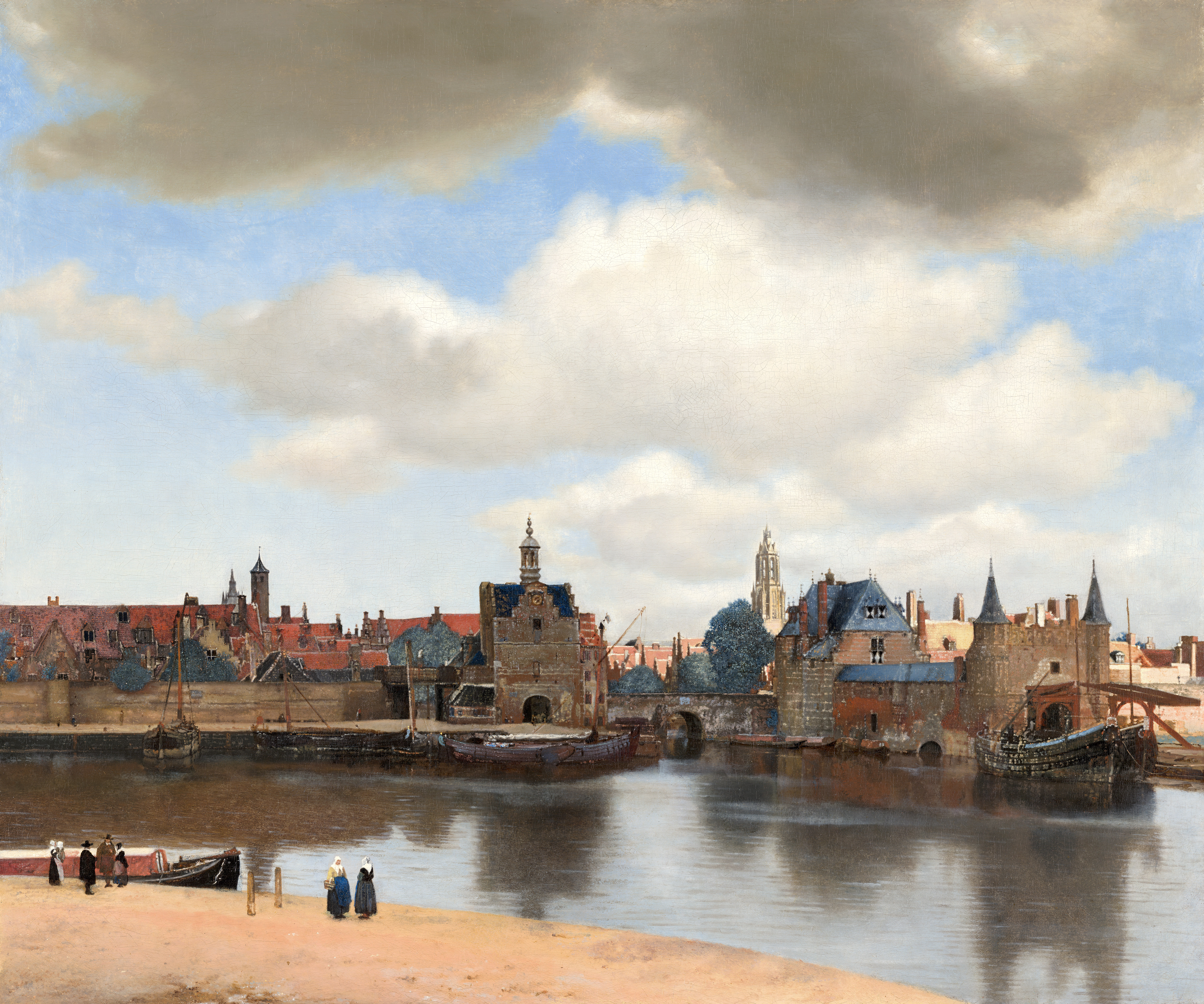
- Lot 31 (View of Delft): Described as "The Town of Delft in perspective, to be seen from the south, by J. vander Meer of Delft," achieving the highest price of the group at 200 guilders.[5:4]
Throughout the eighteenth and early nineteenth centuries, inventory clerks and auctioneers routinely confused Johannes Vermeer of Delft (Jan van der Meer van Delft) with the Haarlem landscape painter Jan van der Meer the Younger (1656–1705) and the Utrecht painter Jan van der Meer (c. 1630–c. 1696).[4:1] This homonymic overlap obscured archival provenance and diluted Vermeer's historical identity.
Misattributions and Forged Signatures
As Vermeer's paintings migrated out of the Netherlands into French, German, British, and Austrian collections during the 1700s, commercial art dealers regularly removed his authentic monogram (IVMeer) and replaced it with the signatures of Dutch masters who commanded higher market valuations:[2:2]
- Pieter de Hooch: Vermeer's monumental allegorical work The Art of Painting (c. 1666–1668) entered the collection of Austrian statesman Count Johann Rudolf Czernin in 1813 bearing a falsified signature of Pieter de Hooch. It hung in Vienna under de Hooch's name for decades until German art historian Gustav Friedrich Waagen identified Vermeer's authentic hand and hidden monogram beneath the overpaint in 1860.[1:3]
- Gabriel Metsu and Frans van Mieris: Several quiet domestic interiors were re-attributed to Leiden fijnschilders (fine-manner painters) such as Frans van Mieris or Gabriel Metsu to cater to eighteenth-century aristocratic tastes for refined finish.[4:2]
- Rembrandt van Rijn: In parts of eighteenth-century France, canvases featuring broader early impasto or strong chiaroscuro were grouped under the generic attribution of Rembrandt or the Rembrandt school.[2:3]
2. Théophile Thoré-Bürger and the 1866 Critical Revival
The Political Exile Turned Connoisseur
The figure primarily responsible for restoring Vermeer to the Western canon was Étienne-Joseph-Théophile Thoré (1807–1869), a left-wing French art critic and Republican journalist forced into political exile by Emperor Napoleon III following the revolutions of 1848–1849.[6] Travelling extensively throughout the Low Countries, Germany, and Britain under the Dutch pseudonym Willem Bürger, Thoré shifted his focus from Parisian Salon reviews to intensive archival connoisseurship of seventeenth-century Dutch painting.[6:1]
Encountering the "Sphinx of Delft"
Thoré first viewed Vermeer's View of Delft at the Mauritshuis in The Hague in 1842, an encounter that left him astonished by the painting's luminous impasto, atmospheric naturalism, and optical daylight—qualities that stood in sharp contrast to the academic history painting dominating official Parisian institutions.[2:4] Over the next two decades, utilizing photography and correspondence networks with European collectors, Thoré-Bürger tracked down dispersed works by the artist he famously christened "the Sphinx of Delft."[6:2]
- Private Acquisitions: Thoré-Bürger acquired several authentic Vermeers for his personal collection, including A Lady Standing at a Virginal, A Lady Seated at a Virginal, and Woman with a Pearl Necklace.[6:3]
- The 1866 Paris Retrospective: He coordinated the public display of eleven paintings attributed to Vermeer at the retrospective exhibition at the Palais des Champs-Élysées in Paris in 1866, presenting a unified vision of the master to the French artistic vanguard.[4:3]
The 1866 Gazette des Beaux-Arts Monograph
In late 1866, Thoré-Bürger published his seminal three-part study, "Van der Meer de Delft," in the Parisian journal Gazette des Beaux-Arts.[6:4] This monograph established three foundational pillars in Vermeer historiography:
- Biographical Reconstruction: Synthesized fragmented entries from seventeenth-century Delft civic histories and the 1696 Amsterdam auction records into a coherent narrative.[6:5]
- Aesthetic Framework: Championed Vermeer as the supreme poet of light (peintre de la lumière), arguing that his optical handling of sunlight anticipated modern French Realism and nascent Impressionist plein-air sensibilities.[4:4]
- First Catalogue Raisonné: Compiled a descriptive catalogue of more than seventy paintings attributed to Vermeer across public and private European collections.[6:6]
In his eagerness to construct a prolific oeuvre for his hero, Thoré-Bürger over-attributed nearly forty canvases to Vermeer—including domestic scenes by Jacobus Vrel, courtyard views by Pieter de Hooch, and portraits by Carel Fabritius and Nicolaes Maes—assuming Vermeer possessed a versatile corpus spanning landscapes, townscapes, and diverse genre subjects.[4:5]
3. Archival Pruning, Connoisseurship, and Modernist Canonization
Archival Corrections and Catalogue Baseline
Following Thoré-Bürger's death in 1869, a subsequent generation of archival historians and museum directors systematically dismantled erroneous attributions and unearthed primary civic documents in Delft:
- Henry Havard (1877–1888): Conducting rigorous archival investigations in the Delft municipal records (Gemeentearchief Delft), Havard discovered Vermeer's baptismal, marriage, and Guild of Saint Luke documents, correcting Thoré-Bürger's speculative biographical assumptions.[1:4]
- Cornelis Hofstede de Groot (1907): In the opening volume of his comprehensive catalogue of Dutch painters, Hofstede de Groot pared Vermeer's accepted authentic corpus down to thirty-four core paintings, establishing the baseline for modern scholarship.[2:5]
- Abraham Bredius: Serving as director of the Mauritshuis, Bredius published essential notarial records concerning Vermeer's financial dealings and secured pivotal masterpieces for public institutions, helping retain Girl with a Pearl Earring in The Hague and facilitating the acquisition of Allegory of the Catholic Faith by the Metropolitan Museum of Art.[7]
The 1881 Des Tombe Auction and Girl with a Pearl Earring
The rediscovery of Girl with a Pearl Earring (c. 1665) exemplifies the fluid state of nineteenth-century Vermeer connoisseurship.[7:1] In 1881, the neglected, unsigned painting—cataloged vaguely as a "head in Turkish costume"—appeared at the Braams auction house in The Hague.[7:2]
Recognizing Vermeer's delicate optical handling beneath layers of yellowed varnish, cultural preservationist Victor de Stuers urged his companion, collector Arnoldus Andries des Tombe, to purchase the canvas quietly. Des Tombe secured the masterpiece for two guilders plus a thirty-cent buyer's premium (roughly one US dollar at the time). Upon his death in 1902, des Tombe bequeathed the painting to the Mauritshuis, where it became one of the most celebrated icons in Western art.[7:3]
Marcel Proust and the Modernist Cult of View of Delft
By the early twentieth century, Vermeer transformed from a rediscovered Dutch master into an object of intense literary and philosophical devotion, spearheaded by French novelist Marcel Proust.[8] Having studied View of Delft in The Hague in 1902 and again at the 1921 Jeu de Paume exhibition in Paris, Proust confessed in a letter to Jean-Louis Vaudoyer that the canvas was "the most beautiful painting in the world."[8:1]
"At last he came to the Vermeer which he remembered as more striking, more different from anything else he knew, than anything in the world... a precious substance, so to speak, of a tiny patch of yellow wall."
— Marcel Proust, The Captive (La Prisonnière, 1923)[8:2]
In La Prisonnière (the fifth volume of In Search of Lost Time), Proust immortalized the death of the fictional author Bergotte, who rises from his sickbed to attend the 1921 exhibition after reading an essay concerning the "petit pan de mur jaune" (little patch of yellow wall) in View of Delft.[8:3] Collapsing fatally before the canvas, Bergotte reflects that his own literary prose should have possessed the layered, self-sufficient density of Vermeer's yellow impasto—cementing Vermeer's brushwork as the supreme avatar of modernist aesthetic epiphany.
4. Interwar Vulnerabilities to Modern Technical Art History
The Han van Meegeren Forgeries (1937–1945)
The early twentieth-century fascination with Vermeer's enigmatic early religious development created an acute scholarly vulnerability exploited by Dutch painter and forger Han van Meegeren.[4:6] Capitalizing on Abraham Bredius's published conjecture that Vermeer must have created Caravaggesque biblical compositions in the 1650s, van Meegeren forged The Supper at Emmaus (1937) utilizing hardened phenol-formaldehyde resin (Bakelite) mixed with authentic seventeenth-century pigments, baked to simulate genuine craquelure and withstand chemical alcohol tests.[4:7]
Bredius enthusiastically proclaimed the forgery as "the masterpiece of Johannes Vermeer of Delft," prompting the Museum Boijmans in Rotterdam to acquire it for 520,000 guilders.[4:8] Van Meegeren continued manufacturing fraudulent Vermeers throughout World War II, selling one to Nazi Reichsmarschall Hermann Göring. When arrested for treasonous art dealing in 1945, van Meegeren was forced to paint a new canvas in his prison cell to prove he was a forger rather than a Nazi collaborator—an episode that exposed the limitations of purely subjective connoisseurship and compelled art history toward scientific materials analysis.[4:9]
Socio-Economic Milieu and Archival Revolution (John Michael Montias)
In 1989, Yale economic historian John Michael Montias reshaped Vermeer historiography with Vermeer and His Milieu: A Web of Social History.[9] Diverging from romanticized biographical speculation, Montias systematically examined thousands of seventeenth-century Delft notarial documents, estate inventories, baptismal registers, and debt litigations:[9:1]
- The Role of Maria Thins: Montias uncovered the decisive economic influence of Vermeer's wealthy Catholic mother-in-law, Maria Thins, whose capital shielded the household from financial ruin for two decades and influenced Vermeer's conversion to Catholicism.[9:2]
- The Patronage Network: He conclusively identified Pieter van Ruijven and Maria de Knuijt as Vermeer's sustained patrons, providing an empirical explanation for the concentration of his works in Delft.[9:3]
- The Disaster Year (Rampjaar 1672): Montias illuminated the catastrophic French invasion and economic collapse that froze the Dutch art market, driving Vermeer into insurmountable debt and precipitating his sudden physical decline and death in December 1675.[9:4]
Non-Invasive Technical Imaging and the 2023 Retrospective
In the twenty-first century, advanced non-invasive imaging technologies—including Macro X-ray Fluorescence scanning (MA-XRF), Reflectance Imaging Spectroscopy (RIS), and high-resolution Infrared Reflectography (IRR)—launched international research initiatives like the Mauritshuis's The Girl in the Spotlight (2018) and the Rijksmuseum's Closer to Vermeer (2022–2023).[3:3]
These scientific investigations culminated in the landmark 2023 Rijksmuseum retrospective in Amsterdam, which brought together twenty-eight of Vermeer's surviving paintings. The technical analyses revealed that beneath the tranquil surfaces of finished compositions lay dynamic, rapid underpaintings with major compositional alterations (pentimenti)—such as a painted-out jug rack and woven fire basket beneath The Milkmaid.[3:4] These discoveries decisively overturned the nineteenth-century myth of the isolated, passive amateur, revealing instead a deliberate, highly adaptable master of optical light and dynamic studio technique.
🎴 Interactive Web Practice (Comprehension Check)
Question 1 (Historiographical Obscurity & Archival Mechanics): What structural and material factors caused Johannes Vermeer to vanish from European art historical consciousness in the eighteenth century, while peers like Rembrandt and Peter Paul Rubens retained uninterrupted international prominence?
Answer: Vermeer's eighteenth-century eclipse was driven by four interconnected structural realities of seventeenth-century Dutch art production and circulation:
- Small Oeuvre and Slow Output: Vermeer painted only two to three works per year, leaving behind an exceptionally compact corpus of roughly 45 to 50 paintings (of which only 34 to 37 survive). By contrast, Rembrandt and Rubens operated large, highly productive workshops that generated hundreds of paintings.
- Monopolized Private Patronage: Nearly half of Vermeer's total output (around twenty canvases) was acquired directly from his studio by a single Delft patron couple, Pieter van Ruijven and Maria de Knuijt. These works remained sequestered in a single private residence until the 1696 Dissius auction, preventing wider exposure across European connoisseurial networks.
- Absence of Reproductive Etchings or Prints: While Rembrandt circulated innovative etchings and Rubens employed skilled engravers to distribute prints of his compositions to international collectors, Vermeer produced no prints, leaving no visual record of his work across European capitals.
- Historiographical Exclusion: Arnold Houbraken's foundational biographical dictionary De Groote Schouburgh (1718–1721) failed to discuss Vermeer's work or style, mentioning him only in passing within a civic list. Without coverage in this standard reference text, eighteenth-century dealers routinely erased Vermeer's signatures and replaced them with those of better-known masters like Pieter de Hooch or Frans van Mieris.
Question 2 (Thoré-Bürger & The 1866 Connoisseurial Breakthrough): How did Théophile Thoré-Bürger orchestrate Vermeer's nineteenth-century rediscovery, and what theoretical and connoisseurial limitations characterized his foundational 1866 monograph?
Answer: While living in political exile under the nom de plume Willem Bürger, Théophile Thoré encountered Vermeer's View of Delft at the Mauritshuis in 1842 and initiated a systematic 24-year quest to locate Vermeer's dispersed paintings across European private and public collections. In 1866, he organized the display of eleven attributed Vermeers at the Palais des Champs-Élysées and published a landmark three-part monograph in the Gazette des Beaux-Arts. Thoré-Bürger re-established Vermeer's biography using seventeenth-century Delft records, championed him as the supreme poet of natural daylight (peintre de la lumière), and compiled the first catalogue raisonné.
However, Thoré-Bürger's scholarship was constrained by significant limitations:
- Aesthetic Bias: Thoré-Bürger viewed Vermeer through the lens of nineteenth-century French Realism and early impressionistic plein-air aesthetics, conceptualizing him as a proto-modernist naturalist rather than a Dutch Baroque painter working within the specific optical and symbolic conventions of seventeenth-century Delft.
- Connoisseurial Overreach: In his desire to construct a prolific career for the "Sphinx of Delft," Thoré-Bürger attributed more than seventy canvases to Vermeer, mistakenly including works by Pieter de Hooch, Jacobus Vrel, Carel Fabritius, and Nicolaes Maes, which required decades of subsequent archival and stylistic pruning.
Question 3 (Literary Epiphany & Modernist Aesthetics): In what ways did Marcel Proust's literary deployment of View of Delft in In Search of Lost Time transform Vermeer's cultural and philosophical status in the twentieth century?
Answer: Marcel Proust elevated Vermeer from an art-historical subject into a profound symbol of modernist aesthetic philosophy. In La Prisonnière (1923), Proust staged the death of the novelist Bergotte before Vermeer's View of Delft at the 1921 Jeu de Paume exhibition in Paris. Bergotte collapses while contemplating a tiny passage of luminous yellow impasto—the celebrated "petit pan de mur jaune" (little patch of yellow wall).
This literary dramatization had two lasting impacts:
- Aesthetic Epiphany and Pure Form: Bergotte realizes that his own literary works were overly cerebral and discursive, reflecting that he should have layered his writing with the dense, radiant, and self-contained materiality of Vermeer's yellow brushwork. This established Vermeer as the exemplar of aesthetic epiphany, where transcendent meaning inheres in the formal manipulation of pigment rather than dramatic narrative.
- Modernist Canonization: Proust's writing transformed Vermeer into a secular cult figure for twentieth-century modernists, framing his quiet domestic spaces and optical precision as the visual counterpart to the modernist search for time recovered through sensory memory.
Question 4 (The Van Meegeren Forgeries & Connoisseurial Vulnerability): How did Han van Meegeren exploit interwar art-historical scholarship to deceive Abraham Bredius, and what methodological shift did this scandal force upon Western art history?
Answer: Han van Meegeren exploited a specific theoretical blind spot in interwar scholarship. Respected art historian Abraham Bredius had published a hypothesis positing that Vermeer had an undiscovered early religious phase influenced by the Italian Caravaggisti. Van Meegeren crafted The Supper at Emmaus (1937) specifically to conform to Bredius's expectations, incorporating Caravaggesque lighting, composition, and period materials (antique canvases and seventeenth-century pigments mixed with synthetic Bakelite resin to simulate genuine craquelure and resist alcohol solubility tests). Bredius authenticated the work, and the Museum Boijmans purchased it as an undisputed masterpiece.
The postwar exposure of van Meegeren's fraud in 1945 precipitated a major methodological shift:
- Collapse of Pure Stylistic Connoisseurship: The scandal demonstrated that subjective connoisseurship ("the expert eye") was deeply susceptible to confirmation bias, theoretical prejudice, and psychological manipulation.
- Rise of Technical Art History: Authentication was systematically reoriented toward physical and chemical sciences, establishing cross-sectional pigment analysis, dendrochronology, radiography, infrared reflectography, and spectrometry as indispensable partners to stylistic criticism.
Resonant Notes
The following notes in the vault share direct thematic, aesthetic, and philosophical connections with Johannes Vermeer:
🔴 Art Theory, Light, Optics & Aesthetic Epiphany
- A Treatise on Painting (Trattato della pittura) — Parallels Vermeer's optical empiricism, mastery of chiaroscuro, subtle edge handling, and presumed use of optical lenses (camera obscura) with Leonardo da Vinci's foundational treatises on linear, aerial, and chromatic perspective.
- Aldous Huxley's Heaven and Hell (1956) — Huxley specifically analyzes Jan Vermeer as an artist capable of capturing preternatural visionary light within everyday domestic spaces, transfiguring prosaic furniture, walls, and pearls into objects of serene contemplation.
- Epiphany — Illuminates the aesthetic and psychological structure of Marcel Proust's encounter with the petit pan de mur jaune in View of Delft, where a sudden sensory perception unlocks timeless metaphysical insight.
- The Sublime & Edmund Burke-The Physiological Sublime — Provides a structural aesthetic foil; while the sublime investigates terror, vastness, and sensory disorientation, Vermeer's art represents the perfection of aesthetic containment, calm domestic order, and luminous geometric balance.
- James Joyce (1882-1941) & Virginia Woolf — Modernist contemporaries who, alongside Proust, developed narrative techniques to capture luminous moments of being and everyday epiphanies, mirroring Vermeer's elevation of quiet domestic moments over monumental historical narratives.
🟡 Authenticity, Aura, Forgery & Reception History
- The Work of Art in the Age of Mechanical Reproduction & Walter Benjamin (1892–1940) — Benjamin's concept of the unique physical "aura" and cult value explains both the intense modern pilgrimage to Vermeer's compact surviving corpus and the radical epistemological rupture caused by Han van Meegeren's forgeries, where identical appearance severed from genuine historical origin collapsed artistic value.
- Defining a Simulacrum — Jean Baudrillard's philosophy of simulation and hyperreality provides the conceptual model for van Meegeren's fraudulent Supper at Emmaus, which operated as an authentic Vermeer in museums and public consciousness before its original historical reality was revealed as non-existent.
- Giorgio de Chirico (1888-1978) — Connects to questions of artistic authorship, market demand, and serial reproduction; while de Chirico executed deliberate self-replicas to disrupt the modern art market, Vermeer's oeuvre suffered posthumous forged signatures and misattributions to satisfy eighteenth-century collector demands.
- Science vs. Pseudoscience - The Demarcation Problem — Connects to the epistemological crisis of art authentication, highlighting the demarcation between subjective connoisseurial intuition (which validated the van Meegeren forgeries) and falsifiable empirical science (MA-XRF spectrometry and chemical resin testing).
🟢 Modernist Rupture, Aesthetics & Spatial Perception
- The Dehumanization of Art — José Ortega y Gasset's 1925 analysis of how early modernism systematically rejected sentimental nineteenth-century narrative in favor of pure painterly autonomy, directly explaining the twentieth-century critical embrace of Vermeer's detached, formal optical compositions.
- Anthony Vidler-The Architectural Uncanny — Provides an architectural and psychological counterpoint; whereas Vidler explores the unhomely, estranging, and fragmented interiors of the modern city, Vermeer's domestic spaces represent the harmonious, enclosed domestic sanctuary of early modern Europe.
- Pareidolia & Gestalt Psychology-The Mechanics of the Whole — Analyzes the visual mechanics of Vermeer's pointillist highlights (pointillés), showing how discrete, globed dabs of paint are perceptually integrated by the observer's visual system into the illusion of specular reflection and radiant daylight.
- The Renaissance — Synthesizes the development of mathematical perspective, civic patronage, and bourgeois capitalism that laid the structural groundwork for the Dutch Golden Age art market and Vermeer's Delft guild environment.
References
Arthur K. Wheelock Jr. / Johannes Vermeer (1632–1675) Biography and Catalogue / nga.gov ↩︎ ↩︎ ↩︎ ↩︎ ↩︎
Walter Liedtke / Johannes Vermeer (1632–1675) in the Heilbrunn Timeline of Art History / metmuseum.org ↩︎ ↩︎ ↩︎ ↩︎ ↩︎ ↩︎
Rijksmuseum / Closer to Johannes Vermeer: Technical and Archival Research / rijksmuseum.nl ↩︎ ↩︎ ↩︎ ↩︎ ↩︎
Essential Vermeer / Vermeer's Critical Fortunes and Rediscovery / essentialvermeer.com ↩︎ ↩︎ ↩︎ ↩︎ ↩︎ ↩︎ ↩︎ ↩︎ ↩︎ ↩︎
Essential Vermeer / The Dissius Sale of 16 May 1696 in Amsterdam / essentialvermeer.com ↩︎ ↩︎ ↩︎ ↩︎ ↩︎
Frances Suzman Jowell / Thoré-Bürger's Art Collection: "A Rather Unusual Gallery of Bric-à-Brac" / simiolus.nl ↩︎ ↩︎ ↩︎ ↩︎ ↩︎ ↩︎ ↩︎
Mauritshuis / Girl with a Pearl Earring Provenance and Research / mauritshuis.nl ↩︎ ↩︎ ↩︎ ↩︎
Mauritshuis / View of Delft and Marcel Proust / mauritshuis.nl ↩︎ ↩︎ ↩︎ ↩︎
John Michael Montias / Vermeer and His Milieu: A Web of Social History / princeton.edu ↩︎ ↩︎ ↩︎ ↩︎ ↩︎