The Specular Revolution — Optics, Interiority, and the Modern Self
🗂️ Interactive Notebook: Open Study Companion (Video Summary, Flashcards, Mind Map) ↗
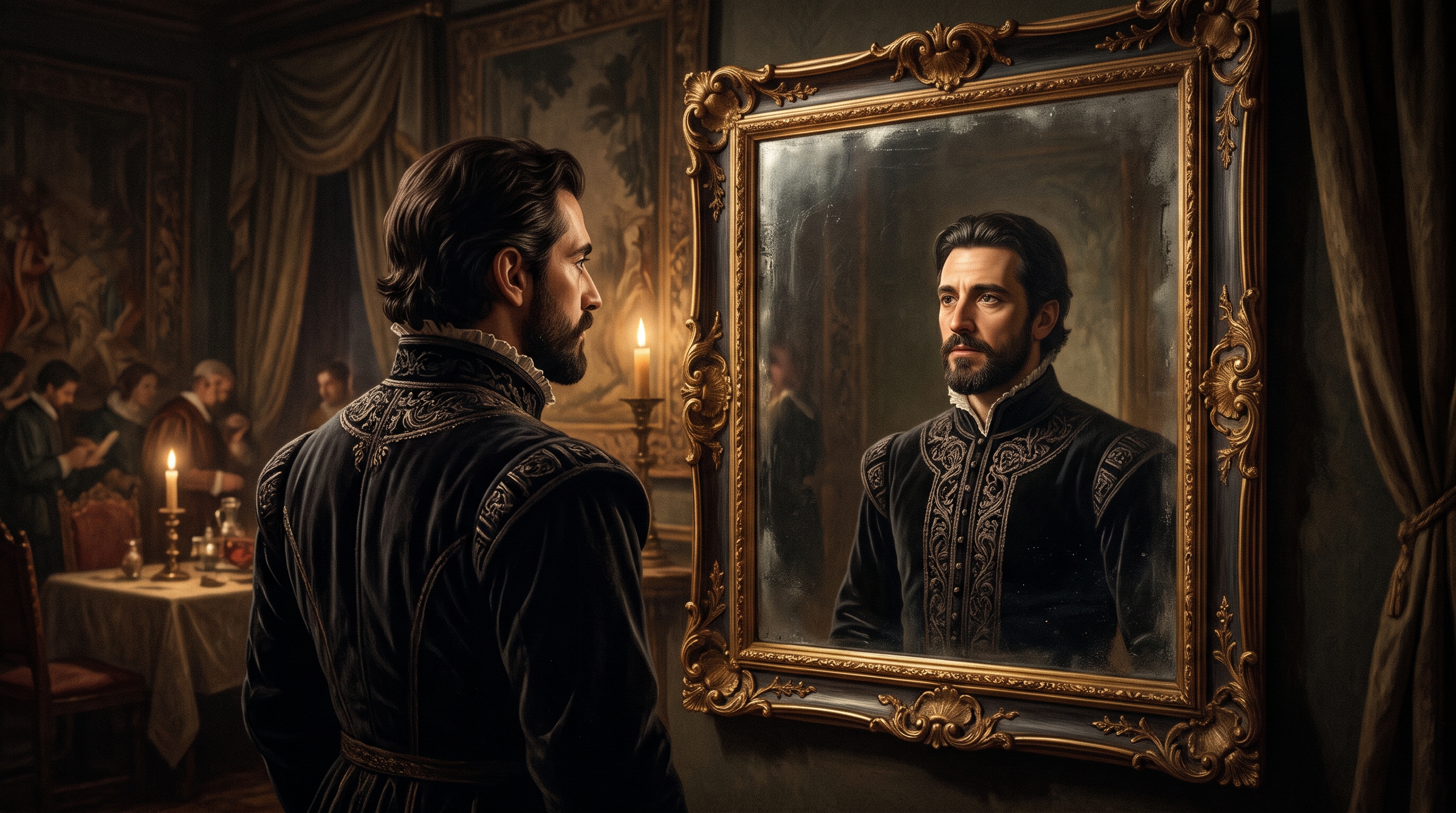
Historical & Phenomenological Thesis: The emergence of the bounded, introspective "authentic self" in Western modernity is not a timeless biological reality, but an ontological mutation engineered by the convergence of Venetian optical technology, early modern social stratigraphy, and the spatial reorganization of private life around 1500.[1] While evolutionary biology designed Homo sapiens as an outward-facing, intersubjective species that relied on the social group as its primary reflective surface, the perfection of flat cristallo tin-mercury mirrors in Murano severed the human visage from its communal background. By isolating the viewer inside a rectilinear frame with high chromatic fidelity, the Venetian mirror provided the optical architecture for the autonomous modern ego—catalyzing psychological self-portraiture, essayistic interiority, Protestant conscience, Cartesian dualism, and the contemporary regime of algorithmic hyper-reflection and self-surveillance.[1:1][2]
1. The Pre-Catoptric Episteme: Intersubjective Ontology Before 1500
Prior to the late fifteenth century, human self-consciousness operated within a predominantly "pre-catoptric" (pre-mirror) cognitive regime.[2:1] Without access to flat, plane-glass optics, pre-modern individuals experienced identity as a porous, relational field rather than an enclosed internal container.
The Physics of Ancient Reflection
- Specular Distortion: Ancient and medieval craftspeople produced mirrors from burnished bronze, copper, speculum metal, or blown lead glass coated with pitch.[2:2] Because blown glass cylinders could not be flattened without significant surface warping, these instruments had a low reflection coefficient—typically reflecting less than 20 percent of incident light—and introduced severe spherical aberration.[3] Rather than presenting a sharp, veridical double, these surfaces yielded an obscure, shimmering phantom.
- Ephemeral Glimpses: Natural reflective surfaces such as stagnant pools or calm water basins required low ambient light and downward inclination, producing dark, fleeting silhouettes rather than sustained, eye-level encounters. Self-inspection was momentary, precarious, and subordinated to external environmental conditions.
- Evolutionary Externalism: From a neurobiological and evolutionary perspective, human visual architecture evolved to scan the open horizon and decode the micro-expressions of the tribe (Theory of Mind - The Cognitive Architecture of Social Intelligence / Cognitive Schemas). Because the human retina cannot directly observe its own facial musculature, self-monitoring was naturally outsourced to the social group.[4] An individual possessed no autonomous visual reference point for their own countenance other than the empathetic or reprimanding gaze of the communal collective.
The Porous and Communal Self
In the absence of an objective optical double, medieval identity functioned through what philosopher Charles Taylor conceptualizes as the "porous self"—an identity whose psychic boundaries were open to cosmic forces, enchanted spirits, collective rituals, and communal hierarchies.[5]
- Relational Mirroring: A twelfth-century European serf or guild artisan did not look inward to discover an idiosyncratic personality; they read their social standing, moral condition, and emotional state in the faces and judgments of their kin, parish, and feudal lord.[1:2] Subjectivity was an intersubjective matrix, anticipating the sociogenetic insights of The Social Construction of Reality - A Treatise in the Sociology of Knowledge and the collective conscience theorized in Durkheimian Sociology.
- Typological Identity: Medieval biography, heraldry, and portraiture relied on office, vestments, and allegorical archetypes rather than psychological idiosyncrasy. Even Saint Augustine's fourth-century Confessions functioned not as a secular memoir of personal uniqueness, but as a liturgical testimony of universal human sinfulness addressed upward to God.[6]
- The Pre-Modern Sensorium: Just as pre-industrial communities experienced nocturnal darkness as an uncolonized, enchanted wilderness (analyzed in Nocturnalization - The Industrialization of Light), they experienced their own interiority as embedded within the trans-individual cosmic order of Christendom. The self was not an insulated castle, but an open thoroughfare.
In a mirrorless society, the boundary between internal mental life and external social reality is thoroughly permeable. It is only when the individual can visually objectify their own physical body as a discrete, self-contained figure that the "buffered self"—insulated from the collective, equipped with impermeable psychic borders, and possessing an autonomous inner core—becomes psychologically plausible.[5:1]
2. The Murano Optical Revolution: Materiality and State Monopoly
The ontological transition from communal web to bounded individual was physically manufactured in the Venetian lagoon during the late Quattrocento and early Cinquecento.[2:3]
The Metallurgy and Chemistry of Cristallo
Around 1450, Murano glassmaker Angelo Barovier developed vetro cristallo by calcining coastal plant ash (barilla rich in sodium carbonate) and purifying the molten silica with manganese dioxide to neutralize the green-brown tint of iron oxide impurities.[3:1]
In 1507, the brothers Andrea and Domenico del Gallo petitioned the Venetian Council of Ten for an exclusive commercial privilege, claiming the technical perfection of the flat tin-mercury amalgam mirror.[2:4] Their process required extraordinary material precision and chemical mastery:
- Cylinder Broad-Glass Flattening: Artisans blew massive cylinders of molten cristallo, slit them lengthwise while glowing hot, and flattened them onto polished stone tables (marmorite) before painstakingly grinding and buffing both faces to achieve absolute optical flatness.[3:2]
- Foil Amalgamation: A paper-thin sheet of beaten tin was laid completely flat on an inclined stone slab and flooded with liquid mercury, dissolving the surface of the tin to form a bright, highly reflective intermetallic compound.[2:5]
- Hermetic Lamination: The polished glass plate was slid edgewise across the mercury-saturated tin foil to expel air bubbles and surface oxides, then weighted down with lead weights for weeks until the excess mercury drained away and the amalgam adhered permanently to the rear of the glass.[3:3]
Specular Evolution: A Matrix of Optical Regimes
| Specular Paradigm & Medium | Material Composition & Optical Physics | Spatial Locus & Social Architecture | Ontological & Phenomenological Mode of the Self | Core Vault Resonance |
|---|---|---|---|---|
| Pre-Catoptric Bronze / Speculum (Ancient to Medieval) | Burnished copper alloys; <20% reflectance; severe spherical warping and surface oxidation. | Communal basins, mobile cosmetic disks; elite ecclesiastical treasuries. | The Porous Self: Identity experienced relationally; outsourced to tribal, feudal, and ecclesiastical gaze. | Durkheimian Sociology / The Social Construction of Reality - A Treatise in the Sociology of Knowledge |
| Convex Glass & Pitch (Quattrocento / Van Eyck) | Blown convex glass coated with molten lead/pitch; panoramic curvature; extreme peripheral distortion. | Hung high on chamber walls; embedded in devotional portraits; architectural survey. | The Theological Eye: The individual curved into the cosmic matrix of room, witnesses, and divine presence. | The Renaissance / A Treatise on Painting (Trattato della pittura) |
| Flat Venetian Cristallo Amalgam (1507–1835) | Soda-lime cristallo, manganese dioxide, tin-mercury amalgam; 80–90% achromatic reflectance. | Aristocratic studiolo, private dressing cabinet, state hall of mirrors (Versailles). | The Buffered Self: Excised from the background; birth of subject-object splitting and introspective ego. | Jacques Lacan / The Mind-Body Dichotomy |
| Industrial Silvered Plate Glass (Liebig Post-1835) | Chemical reduction of silver nitrate onto plate glass; non-toxic, cheap, large-scale industrial format. | Domestic wardrobes, bathroom medicine cabinets, shop vitrines, dance halls. | The Disciplined Bourgeois Ego: Chronic somatic surveillance; posture correction; public presentation of self. | Michel Foucault / The Metropolis and Mental Life |
| Algorithmic Front-Facing Screen (21st Century) | Backlit capacitive touchscreens, CMOS sensors, real-time computer vision filters, neural rendering. | Fused to human hand; 24/7 video grid; algorithmic feedback feeds. | The Synthetic / Dividual Self: Fragmented attention; algorithmic grading; gamified performative display. | Postscript on the Societies of Control / Dividual |
Optical Fidelity and the Geopolitical Monopoly
Unlike convex blown glass or oxidized bronze, the flat Murano mirror reflected nearly 80 to 90 percent of the visible spectrum without geometric distortion or chromatic shift.[3:4] For the first time in evolutionary history, a human organism could stand upright and observe a bright, life-sized, color-accurate simulacrum of its own body in real time.
Because a single full-length Venetian mirror could cost nearly three times as much as a painting by Raphael, the Venetian Republic guarded the technology as a supreme state secret.[2:6] In 1291, the Doge had forcibly relocated all glass furnaces to the island of Murano; by the 1540s, the Council of Ten decreed that any specchier (mirror-maker) who emigrated to foreign courts like France would have their family imprisoned and state assassins dispatched to execute them.[2:7] The mirror was not merely a luxury vanity item; it was a strategic monopoly of specular reproduction that concentrated immense geopolitical power.
3. Phenomenology of the Frame: How Flat Glass Rewired the Brain
The psychological shockwave of the Murano mirror stemmed not merely from its clarity, but from its spatial geometry and domestic placement.[1:3]
Severing the Figure from the Ground
When a Renaissance patrician gazed into a Venetian mirror, they did not simply see a face; they saw a solitary human figure cleanly excised from the parish, the guildhall, and the landscape, enclosed within a gilded rectangular border.[1:4]
- The Illusion of Self-Containment: By placing an architectural frame around a single biological organism, the mirror created a radical visual metaphor: that the person inside the border was an independent, self-governing microcosm.[6:1] This optical enclosure parallels the perceptual laws analyzed in Gestalt Psychology-The Mechanics of the Whole: the visual field violently segregates the unified Figure (the reflecting self) from the ambient Ground (the social environment), masking the profound ecological and communal interdependence that actually sustains human life.
- Subject-Object Splitting: The mirror forced a cognitive bifurcation. The viewer became simultaneously the observing subject (the conscious "I" looking out) and the observed object (the physical "Me" trapped in the glass).[7] This constant feedback loop trained Europeans to monitor their own countenances from the perspective of an external spectator, constructing an outward display of composure—establishing a facade of autonomous self-control that prefigured the modern psychological split between authentic interiority and social mask.
- The Architecture of Privacy: As mirrors migrated from public reception halls into private bedchambers, studioli, and dressing closets, they privatized self-examination.[2:8] Identity ceased to be an exclusively public performance validated by the village and became an intimate secret negotiated between the individual and their glass double.
Centuries before psychoanalyst Jacques Lacan formulated the Mirror Stage (le stade du miroir)—arguing that the human infant between 6 and 18 months forms a unified, albeit alienated, ego (moi) by identifying with its external speculum image (Gestalt) to defensively mask its lived bodily fragmentation (corps morcelé)—Renaissance Europe underwent a collective macro-historical Mirror Stage.[7:1]
The flat Venetian mirror presented early modern humanity with an external, static, and unified optical double. By identifying with this speculum image, Europeans constructed the Ideal Ego of the sovereign, self-contained modern individual—a psychological construct founded, in Lacanian terms, upon a primordial act of misrecognition (méconnaissance) and specular alienation.[7:2] This optical doubling also activated the deep psychological dread of the Doppelgänger, explored in Freud's The Uncanny (Das Unheimliche) and On the Psychology of the Uncanny (Zur Psychologie des Unheimlichen), where encountering one's exact mechanical replica provokes profound existential estrangement.
4. Sixteenth-Century Cultural Mutations: The Birth of Interiority
Within two generations of the Del Gallo patent of 1507, the proliferation of flat mirrors across European courts and mercantile centers triggered synchronous mutations across visual art, literature, philosophy, and religion.[1:5]
Visual Art: From Convex Cameo to Psychological Self-Portrait
The shift from convex to flat glass is directly documented in the history of European painting:
- The Convex Transition: In Jan van Eyck's Arnolfini Portrait (1434), the convex mirror on the back wall curves the entire room into a panoramic, theological eye that binds the couple, the witnesses, and the Passion of Christ into a single communal sphere.[6:2] By 1524, the young Italian Mannerist Parmigianino painted his Self-Portrait in a Convex Mirror on a specially sawed wooden hemisphere, explicitly turning the optical distortion of his own solitary face into the sole subject of the artwork.[6:3]
- The Science of Perspective and the Mirror: As Leonardo da Vinci documented in A Treatise on Painting (Trattato della pittura), the mirror was the supreme "master of painters" (maestro de' pittori). Leonardo instructed artists to use flat mirrors to verify linear perspective and test the relief of their figures, arguing that the picture plane is a flat transparent window cutting through the visual pyramid. The mirror disciplined the painter's eye to translate volumetric three-dimensional experience into an organized, mathematically measured two-dimensional plane.
- Obsessive Self-Scrutiny: Equipped with flat Venetian glass, Albrecht Dürer painted his iconic 1500 frontal self-portrait—appropriating the symmetrical Salvator Mundi (Christ as Savior) pose previously reserved exclusively for divinity—and produced dozens of intimate drawings documenting his aging body and illnesses.[1:6] A century later, Rembrandt van Rijn created over eighty self-portraits, transforming the canvas into a chronological clinical diary of his own psychological weathering.[6:4]
Literature and Philosophy: The Reflexive Essay and the Cogito
As visual artists mapped the exterior face, writers and philosophers used the mirror metaphor to excavate an unmapped interior realm:
- Montaigne and the Reflexive Essay: Retreating to his chateau tower in 1571, Michel de Montaigne invented the Essai ("trial" or "attempt"), turning his gaze entirely inward to observe the erratic, shifting contours of his own consciousness as if watching his reflection in glass.[8] Montaigne's literary practice enacted The Core Instruction - Turning the Gaze Inward, shifting literature from external heroic epic to the intimate micro-movements of subjective thought.
- Shakespearean Interiority: On the Elizabethan stage, William Shakespeare weaponized the gap between public performance and specular self-interrogation.[9] In Richard II (c. 1595), the deposed monarch demands a looking-glass, only to shatter it upon the floor when its smooth, unblemished surface fails to register the catastrophic cracks of his internal grief. By Hamlet (c. 1600), the theatrical soliloquy became the definitive dramatic architecture of a divided mind interrogating its own reflection in absolute isolation.[9:1]\n- Cartesian Dualism and the Specular Mind: By the 1630s, René Descartes formalized this optical bifurcation into modern epistemology and metaphysics.[5:2] In his Meditations on First Philosophy, Descartes systematically doubted all external sensory data, communal traditions, and bodily sensations to arrive at the foundational certainty: Cogito, ergo sum ("I think, therefore I am"). As analyzed in The Mind-Body Dichotomy and Ghost in the Machine, Descartes philosophically ratified the mirror's illusion: that an immaterial, self-transparent thinking substance (res cogitans) resides behind the eyes, observing the mechanical bodily vessel (res extensa) from an internal control room. This optical model of mind was later famously deconstructed by Gilbert Ryle's-The Concept of Mind and counterpointed by David Hume's Bundle Theory (1739), which revealed that when one looks inward, one never discovers an immutable, unified self, but only a fleeting bundle of sensory impressions.
"I am myself the matter of my book; you would be unreasonable to spend your leisure on so frivolous and vain a subject." — Essays (1580)[8:1]
The Reformation: The Theology of the Private Conscience
The outbreak of the Protestant Reformation in 1517 mapped seamlessly onto the new catoptric geography of Europe.[1:7]
- Pre-Catoptric Catholicism: Late medieval Catholicism was structured for an outward-facing, corporate populace. Grace was distributed through visible corporate sacraments, public Corpus Christi processions, relic veneration, and the external mediation of the institutional priesthood.[5:3]
- Catoptric Protestantism: Martin Luther and John Calvin relocated the theater of salvation from the public cathedral nave to the solitary bedroom.[1:8] Protestantism functioned as a theology of the mirror: it demanded relentless, solitary self-examination of one's private conscience, unmediated personal reading of vernacular scripture, and an anxious, one-on-one accounting of the soul before God.[1:9] This intense introspective anxiety catalyzed the psychological dynamic diagnosed by Max Weber (1864-1920) in The Protestant Ethic and the Spirit of Capitalism, where the isolated believer sought proof of election through tireless worldly discipline and self-surveillance.
5. Industrial Democratization and the Bourgeois Panopticon
For three centuries, the tin-mercury mirror remained an elite luxury and an occupational hazard; Murano and Saint-Gobain artisans routinely suffered from mercurialism (erethism, tremors, and severe neurological decay) caused by inhaling toxic mercury vapors during the amalgamation process.[3:5]
The Liebig Silvering Process (1835)
In 1835, German chemist Justus von Liebig revolutionized manufacturing by reducing an ammoniacal solution of silver nitrate with aldehydes, depositing a microscopic, uniform layer of pure metallic silver directly onto polished glass.[2:9]
- Mass Proliferation: Chemical silvering eliminated mercury toxicity, lowered production costs by an order of magnitude, and enabled the industrial manufacture of massive plate-glass sheets.[3:6]
- The Domestic Enclosure: By the late nineteenth century, full-length mirrors were installed inside the wardrobes, hallways, and bathrooms of working- and middle-class homes across Europe and North America.[2:10]
- The Flâneur and the Vitrine: In the public sphere, the proliferation of large-scale mirrors transformed commercial boulevards, covered arcades, and grand cafés into glittering specular labyrinths. As Walter Benjamin (1892–1940) observed in Walter Benjamin's The Arcades Project, mirrors doubled the architectural space of Parisian cafés and shopping vitrines, allowing The flâneur to observe the urban crowd without direct eye contact, embedding specular surveillance into the heart of modern leisure.[2:11]
- Sartorial and Bodily Discipline: Cheap mirrors transformed the human relationship with the physical body.[4:1] Instead of experiencing the body from the inside out (through proprioception, physical exertion, or fatigue), modern citizens began experiencing their bodies from the outside in—constantly policing posture, inspecting facial symmetry, maintaining a defensive poker face amidst the overstimulating metropolitan crowd (as analyzed in The Metropolis and Mental Life by Georg Simmel (1858-1918)), and internalizing a lifelong anxiety over blemishes, weight, and aging.[4:2]
In his landmark analysis of disciplinary power, Michel Foucault demonstrated how modern institutions (prisons, clinics, schools, and factories) train subjects to internalize the supervisory gaze. The mass-produced domestic mirror functioned as a decentralized, intimate Panopticon. By installing a permanent reflective surface in the bedroom and bathroom, the modern individual was conditioned to constantly watch, judge, and discipline themselves, converting external state and bourgeois expectations into spontaneous self-surveillance.
6. The Algorithmic Looking-Glass: 21st-Century Hyper-Reflection
If the five-hundred-year regime of the glass mirror remained bounded by physical architecture—bolted to the bathroom wall or bedroom armoire—the early twenty-first century inaugurated a mobile, computational phase of the Mirror Revolution.[10]
The Untethered Camera and Video Grid
With the commercial introduction of the front-facing smartphone camera in 2003 (popularized globally by the iPhone 4 in 2010) and the subsequent normalization of synchronous video-conferencing grids (Zoom, Teams, FaceTime), the mirror detached from domestic architecture and fused directly with the human hand.[10:1]
- Quantitative Saturation: While a Roman emperor or medieval monarch might have glimpsed a hazy specular reflection a few dozen times a year, a contemporary citizen views a high-resolution, backlit image of their own face hundreds of times per day.[4:3]
- Real-Time Self-Monitoring: During everyday video calls and digital meetings, human beings are forced to perform a cognitively exhausting unnatural act: speaking to peers while simultaneously staring at a live feed of their own countenance, splitting social attention between interpersonal empathy and narcissistic self-correction.[10:2] This continuous partial attention induces psychic fatigue and somatic burnout, navigating conversations on autopilot while obsessively adjusting angles and lighting.
Algorithmic Mediation and the Synthetic Self
Unlike the passive tin-mercury amalgam of Murano—which obeyed the neutral physical laws of geometric optics—the contemporary digital mirror is an active, commercialized computational agent.[10:3]
- Predictive Grading and Filtered Illusions: Integrated computer vision and generative AI filters smoothly alter facial symmetry, bone structure, skin luminosity, and eye proportions in real time.[4:4] This regime of digital smoke and mirrors triggers clinical phenomena such as "Snapchat dysmorphia," where individuals seek cosmetic surgical intervention to match their algorithmic simulacrum.[4:5] This exemplifies Jean Baudrillard's diagnosis in Defining a Simulacrum: the filtered digital representation precedes and determines the physical territory of the biological body.
- Quantified Validation and the Attention Economy: On algorithmic feeds, the reflection is no longer private; it is broadcast into a competitive attention market where machine-learning models grade, rank, and monetize the visage via engagement metrics (likes, shares, watch time).[10:4] As detailed in Simmel and the Attention Economy — Abstraction, Alienation, and Cognitive Capture, quantitative metrics dissolve qualitative human experience into abstract, calculable values.
- The Dividual and Liquid Modernity: In the contemporary digital sphere, the self is no longer even the unified, buffered individual of solid modernity. As Gilles Deleuze articulated in Postscript on the Societies of Control and explored in Dividual, the modern subject is fractured into "dividual" data packets, biometric markers, and behavioral clickstreams. In Zygmunt Bauman's sociological framework of Liquid Modernity, identity becomes a precarious, temporary assemblage that must be continuously performed, refreshed, and marketed through screen interfaces to avoid social obsolescence.
- The Evolutionary Trap and Narcissus Narcosis: Modern consumer platform capitalism relentlessly exhorts users to express their "authentic self" through the screen. In reality, the smartphone operates as an algorithmic Skinner box built atop a 500-year-old optical mutation.[10:5] As Marshall McLuhan (1911-1980) diagnosed in McLuhan's The Medium is the Message, technological extensions of the human sensorium induce a profound "Narcissus narcosis": humans become hypnotized by the extension of their own image, numb to the psychic amputations and cognitive alienation unfolding behind the scenes.
When the reflective surface transitions from passive glass to an algorithmic engine optimized for advertising revenue and behavioral capture, the gap between the living biological organism and the framed digital persona widens into chronic psychological alienation—manifesting in escalating rates of body dysmorphia, social atomization, and performative exhaustion.[4:6][10:6]
🎴 Interactive Web Practice (Comprehension Check)
Question 1 (The Porous Self vs. The Buffered Self): How does Charles Taylor's distinction between the "porous" and "buffered" self illuminate the psychological transition triggered by the Murano flat glass mirror?
Answer: Prior to the sixteenth-century perfection of flat glass mirrors, pre-modern human identity functioned as a porous self. Without an objective, color-accurate optical double, individuals experienced their boundaries as permeable to cosmic forces, enchanted spirits, and immediate communal hierarchies; self-evaluation was outsourced to the collective gaze of the village, guild, or church.
The flat tin-mercury mirror provided the material and spatial architecture for the buffered self. By framing a solitary biological organism within a clear, rectilinear border and reflecting it with high chromatic fidelity, the mirror visually severed the human figure from its communal background. This optical isolation trained the individual to conceptualize their consciousness as an autonomous, self-contained container with impermeable psychological boundaries, possessing an interior core that exists independently of the surrounding social environment.
Question 2 (Lacanian Psychoanalysis & Macro-Historical Specular Alienation): In what way did early modern Europe undergo a collective historical precursor to Jacques Lacan's "Mirror Stage," and how did this reshape Western philosophy?
Answer: In Jacques Lacan's psychoanalytic framework, the Mirror Stage (le stade du miroir) describes the developmental threshold between 6 and 18 months where an infant, who experiences its body as uncoordinated and fragmented (corps morcelé), jubilantly identifies with its unified external visual reflection, creating the illusory Ideal Ego. This identification is inherently alienating because the child mistakes an external, inverted, static optical image for its authentic internal reality (an act of méconnaissance or misrecognition).
On a macro-historical scale, early modern Europe underwent a collective Mirror Stage following the 1507 Del Gallo patent for flat cristallo mirrors. By gazing into flat glass, European elites identified with a unified, composed external simulacrum, constructing the modern myth of the autonomous, self-governing ego. This specular bifurcation was philosophically ratified in René Descartes' Cartesian Dualism (Cogito, ergo sum), which codified the optical illusion that an immaterial, self-transparent mind (res cogitans) sits trapped behind the eyeballs, observing the mechanical physical body (res extensa) as an external object.
Question 3 (The Digital Panopticon & Societies of Control): Contrast the nineteenth-century bourgeois mirror analyzed through Foucault with the twenty-first-century algorithmic screen analyzed through Deleuze and Bauman.
Answer: The nineteenth-century industrial mirror (democratized by Justus von Liebig's 1835 chemical silvering process) functioned as a bourgeois panopticon. Installed in domestic bedrooms, hallways, and commercial arcades, it operated as a tool of disciplinary self-policing (analyzed by Michel Foucault). Individuals internalized the bourgeois normative gaze, constantly surveying their own physical posture, attire, and expressions from the outside in to ensure social conformity.
In the twenty-first century, the front-facing camera and smartphone screen transition from disciplinary enclosure to Gilles Deleuze's societies of control. The reflection is no longer passive or architecturally fixed; it is an active, portable algorithmic agent. The self is decomposed into dividual data packets (facial metrics, gaze-tracking coordinates, engagement scores) that are graded and monetized by machine-learning models. In Zygmunt Bauman's liquid modernity, the mirror is no longer used to maintain a stable, solid bourgeois identity, but to market a continuously shifting, precarious personal brand across digital attention economies, inducing profound Narcissus narcosis and performative exhaustion.
Resonant Notes
The following notes in the vault share direct thematic, sociological, and literary connections with The Specular Revolution and the Optical Construction of the Self:
🔴 Psychoanalysis, Ego Formation & The Specular Gaze
- Jacques Lacan — Lacan's foundational theory of the Mirror Stage (le stade du miroir), the corps morcelé, and the Imaginary register reveals how the ego is born through specular alienation and misrecognition (méconnaissance) of an external optical image.
- Freud's The Uncanny (Das Unheimliche) & On the Psychology of the Uncanny (Zur Psychologie des Unheimlichen) — Explores the psychological dread of the optical double (Doppelgänger) and specular reflection, where confronting one's exact mechanical or mirrored duplicate provokes acute existential estrangement.
- Gestalt Psychology-The Mechanics of the Whole — The visual principle of figure-ground segregation directly explains how the mirror frame violently tears the unified human figure away from its communal background, creating the illusion of autonomous self-containment.
- Travis Bickle — Scorsese and Schrader's alienated protagonist enacts the terminal pathology of specular narcissism and ego fragmentation, conducting aggressive soliloquies before his bedroom mirror ("You talkin' to me?") as his symbolic defenses collapse.
- Louis Sass - Phenomenological Psychopathology and the Self — Sass's analysis of hyper-reflexivity and ipseity disturbance demonstrates how excessive, detached self-monitoring causes the lived, prereflective self to alienate into an externalized object.
🟡 Philosophy of Mind, Cartesian Dualism & Intersubjectivity
- The Mind-Body Dichotomy & Ghost in the Machine — Descartes' radical bifurcation of reality into thinking mind (res cogitans) and mechanical body (res extensa) represents the metaphysical codification of the mirror's subject-object split.
- Gilbert Ryle's-The Concept of Mind — Ryle's philosophical critique dismantles the Cartesian dogma of the "ghost in the machine," exposing the optical assumption of an internal spectator seated behind the eyes as a profound category mistake.
- David Hume's Bundle Theory (1739) — Hume's empirical introspective test provides the philosophical counterpoint to the mirror: when one gazes inward, one never detects an immutable, unified "self," but only an ever-changing bundle of fleeting perceptions.
- Constructs of the Mind-Unmasking Consciousness in East and West & The Core Instruction - Turning the Gaze Inward — Contrasts Western specular interiority with contemplative Buddhist deconstructions of the ego (Anatta), demonstrating that the bounded, introspective self is an illusion constructed by cognitive conditioning.
- The Interface Theory of Perception (ITP) — Donald Hoffman's evolutionary cognitive model demonstrates that human perception acts as a species-specific desktop interface rather than a veridical mirror of objective reality, mirroring how optics shape ontological models of mind.
- The Social Construction of Reality - A Treatise in the Sociology of Knowledge — Berger and Luckmann's dialectic of externalization, objectivation, and internalization explains how material technologies like the mirror become objective social facts that reshape subjective consciousness.
- Durkheimian Sociology & Durkheimian Sociology and Reified Gestalt — Durkheim's mechanical solidarity and collective representations illustrate the pre-catoptric social matrix that preceded the rise of the privatized, buffered individual.
🟢 Media Ecology, Disciplinary Surveillance & The Digital Panopticon
- Michel Foucault — Disciplinary power and panopticism trace the historical trajectory of the internalized gaze, where the domestic mirror and public plate-glass vitrine function as apparatuses of constant self-surveillance and somatic normalization.
- McLuhan's The Medium is the Message & Marshall McLuhan (1911-1980) — McLuhan's analysis of "Narcissus narcosis" reveals how technological extensions of the human sensorium hypnotize human consciousness, causing individuals to fall in love with mechanical reflections of themselves while ignoring systemic amputations.
- Postscript on the Societies of Control & Dividual — Gilles Deleuze's transition from disciplinary enclosures to modulatory control systems diagnoses the 21st-century shift from the fixed glass mirror to the algorithmic screen, where identity is fractured into dividual data packets.
- Zygmunt Bauman's sociological framework of Liquid Modernity — Bauman's analysis of precarious individualization and consumer identity shopping explains how the modern digital mirror has transformed the self into a temporary, marketed commodity.
- Simmel and the Attention Economy — Abstraction, Alienation, and Cognitive Capture & The Metropolis and Mental Life — Georg Simmel's diagnosis of metropolitan sensory overstimulation, the defensive "blasé attitude," and monetary abstraction illuminates the bourgeois need for a protective facade and the subsequent monetization of human attention.
- The flâneur & Walter Benjamin's The Arcades Project — Benjamin demonstrates how covered arcades, gaslit vitrines, and expansive mirrors transformed the 19th-century nocturnal city into an intoxicating consumer spectacle, turning the wandering flâneur into both observer and observed.
- Nocturnalization - The Industrialization of Light — Companion historical study analyzing how artificial lighting technologies industrialized darkness, disciplined human labor, and reorganized the domestic and urban sensorium in tandem with optical media.
- The Renaissance & A Treatise on Painting (Trattato della pittura) — Explores the emergence of linear perspective, visual pyramid optics, and Leonardo da Vinci's aesthetic theory, which positioned the mirror as the supreme master of pictorial realism and spatial geometry.
- Defining a Simulacrum — Baudrillard's hyperreality explains the contemporary regime of generative AI filters and front-facing cameras, where synthetic digital reflections precede and supersede the physical biological body.
- a-facade — Metaphoric expression capturing how the mirror's subject-object splitting conditions individuals to construct an outward display of autonomous composure and self-control.
- poker-face — Metaphoric expression illustrating the defensive emotional detachment required by the modern metropolitan subject to shield inner interiority from external observation.
- burn-out — Metaphoric expression diagnosing the somatic and psychic exhaustion inflicted by continuous partial attention and 24/7 video self-scrutiny.
- on-autopilot — Metaphoric expression depicting how individuals navigate digital conversations and social feeds while dissociatively preoccupied with their own image.
- smoke-and-mirrors — Metaphoric expression framing the digital filters and algorithmic image manipulation that produce deceptive simulacra of physical appearance.
- behind-the-scenes — Metaphoric expression illustrating the invisible computational and economic mechanisms operating beneath digital platforms to monetize attention.
References
Ian Mortimer / Millennium: From Religion to Revolution: How Civilization Has Changed Over a Thousand Years / uchicago.edu ↩︎ ↩︎ ↩︎ ↩︎ ↩︎ ↩︎ ↩︎ ↩︎ ↩︎ ↩︎
Sabine Melchior-Bonnet / The Mirror: A History / routledge.com ↩︎ ↩︎ ↩︎ ↩︎ ↩︎ ↩︎ ↩︎ ↩︎ ↩︎ ↩︎ ↩︎ ↩︎
Alan Macfarlane and Gerry Martin / Glass: A World History / uchicago.edu ↩︎ ↩︎ ↩︎ ↩︎ ↩︎ ↩︎ ↩︎
Mark Pendergrast / Mirror Mirror: A History of the Human Love Affair with Reflection / basicbooks.com ↩︎ ↩︎ ↩︎ ↩︎ ↩︎ ↩︎ ↩︎
Charles Taylor / Sources of the Self: The Making of the Modern Identity / harvard.edu ↩︎ ↩︎ ↩︎ ↩︎
Kelly Grovier / The Art of Reflection: How the Mirror Shaped Western Art / thamesandhudson.com ↩︎ ↩︎ ↩︎ ↩︎ ↩︎
Jacques Lacan / Écrits: The First Complete Edition in English / wwnorton.com ↩︎ ↩︎ ↩︎
Michel de Montaigne / The Complete Essays / stanford.edu ↩︎ ↩︎
Stephen Greenblatt / Renaissance Self-Fashioning: From More to Shakespeare / uchicago.edu ↩︎ ↩︎
Jia Tolentino / Trick Mirror: Reflections on Self-Delusion / penguinrandomhouse.com ↩︎ ↩︎ ↩︎ ↩︎ ↩︎ ↩︎ ↩︎