Nocturnalization — The Industrialization of Light in the Nineteenth Century
🗂️ Interactive Notebook: Open Study Companion (Video Summary, Flashcards, Mind Map) ↗
Historical Thesis: The industrialization of light in the nineteenth century abolished the natural boundary between day and night, converting darkness from an unmasterable cosmic sovereign into a controllable, capitalized human environment.[1][2] By severing labor from solar cycles, pacifying the nocturnal city through state surveillance lighting, and connecting the private household to centralized corporate utilities, the progression from whale oil and municipal coal gas to Edison's incandescent grid forged the infrastructural, economic, and sensory foundations of modern urban civilization.[1:1][3] Across this transformation, the ancient moral geography of darkness was systematically dismantled and replaced by the twenty-four-hour rhythms of industrial production, consumer spectacle, and individualized domestic privacy.
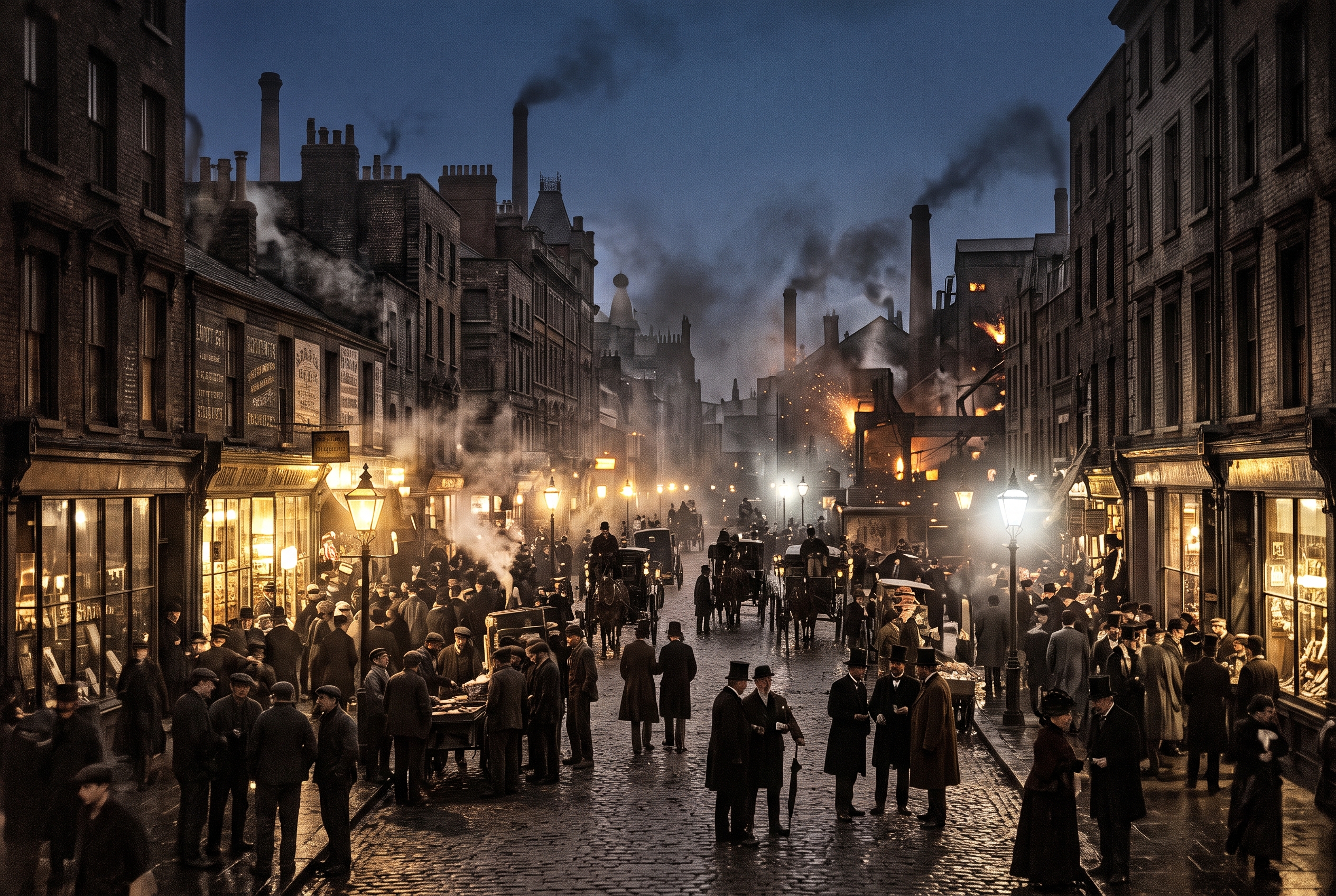
1. The Moral Geography of Pre-Industrial Darkness
Before the late eighteenth century, night in the Western imagination was an uncolonized wilderness—a domain of physical peril, spiritual vulnerability, and rigid juridical repression.[4] Without ambient illumination, darkness dissolved visual hierarchy and social boundaries, prompting both ecclesiastical and state authorities to treat nocturnal mobility as an inherent threat to order.[4:1]
- The Legal Curfew and the Night Watch: Medieval and early modern municipalities enforced strict curfews (derived from the Old French couvre-feu, signaling the evening tolling of church bells to cover and extinguish hearth fires).[2:1] After city gates were locked and heavy iron chains drawn across major thoroughfares, the public streets belonged exclusively to the night watch. Under common law and municipal statutes, anyone traveling after dusk without a visible lantern or verified lawful errand was classified as a "nightwalker"—a criminal category equating nocturnal movement with vagrancy, theft, prostitution, or treason.[2:2]
- Supernatural and Demonological Terror: Pre-industrial theology associated physical darkness with the absence of divine grace and the active dominion of demonic forces.[4:2] Nocturnal waking was culturally linked to witchcraft, spectral apparitions, and demonic sabbats.[4:3] As historian A. Roger Ekirch documented, pre-industrial communities relied on communal hearth gatherings, folkloric warding rituals, and heavily shuttered domestic architecture to insulate the psyche from the terror of an impenetrable, pitch-black night, leaving humanity physically and psychologically in the dark.[2:3] This nocturnal dread directly anticipates Edmund Burke's insight that obscurity and total darkness are the most acute physiological triggers of terror and the sublime.
- Royal Monopolies on Light as Absolutist Spectacle: When large-scale artificial illumination did appear in the seventeenth and early eighteenth centuries, it functioned strictly as an apparatus of absolutist political display.[4:4][1:2] At Versailles, Louis XIV ("The Sun King") orchestrated extravagant nocturnal court fêtes illuminated by tens of thousands of costly beeswax candles and pyrotechnic displays. This conspicuous consumption of light projected sovereign omnipotence: the monarch demonstrated supreme financial and symbolic power by unilaterally conquering the cosmic order of darkness—a theatrical precursor to the visibility regimes analyzed by Michel Foucault.[4:5][5]
2. Whale Oil and the Global Extractive Frontier (1780–1860)
The first technological rupture in pre-industrial darkness linked European bourgeois domesticity directly to an aggressive, worldwide maritime extractive frontier. In 1780, Swiss physicist Aimé Argand patented the tubular hollow wick and glass chimney lamp, producing a steady, smokeless flame with ten times the luminous intensity of a standard tallow candle.[1:3] To operate at peak efficiency, however, the Argand lamp required a radically higher grade of fuel: spermaceti and refined whale oil harvested across the Atlantic and Pacific oceans.[3:1][6]
Chronological Matrix: The Evolution of Artificial Lighting Technologies
| Era & Technology | Primary Socio-Economic Function | Spatial Organization & Infrastructure | Cultural, Class & Psychological Meaning |
|---|---|---|---|
| Tallow Candles & Rushlights (Pre-1780) | Basic subsistence visibility; localized, seasonal hearth tasks. | Centripetal: Household huddled within the immediate radius of an open fire. | Poverty, rural squalor, and olfactory stigma (acrid, foul-smelling animal tallow). |
| Whale Oil & Spermaceti (1780–1850) | Elite literacy, navigation, early textile mill night shifts. | Portable, high-output point-sources in bourgeois drawing rooms, salons, and lighthouses. | Genteel intellectual Enlightenment, domestic refinement, maritime extractive capitalism. |
| Piped Coal Gas Networks (1807–1880s) | Continuous factory labor shifts; municipal street surveillance; window shopping. | Networked, subterranean municipal grids physically tethering architecture to central gasworks. | Industrial discipline, urban pacification, volatile fears of asphyxiation and explosion. |
| Incandescent Electricity (Post-1879) | 24-hour corporate capitalism; mass commercial signage; electrified theater. | Decentralized, ubiquitous wired illumination distributed across all domestic rooms and skylines. | Cleanliness, safety, technological mastery, and the secular "Electrical Sublime." |
New Bedford and the Oceanic Factory
To sustain the reading lamps, domestic candelabra, and street fixtures of London, Paris, and Boston, American and European whaling fleets turned the open seas into an industrial slaughterhouse.[3:2][6:1] By the 1840s, New Bedford, Massachusetts—christened "The City That Lit the World"—anchored a fleet of more than 300 whaling vessels operated by a multi-ethnic, heavily exploited maritime proletariat.[6:2]
The liquid spermaceti extracted from the cranial case of a single sperm whale (Physeter macrocephalus) yielded up to five hundred gallons of crystalline waxy oil that burned with extraordinary clarity and virtually no odor or soot.[6:3] This extractive commodity accelerated two major institutional developments:
- Coastal Cartography and Commercial Empire: High-output whale oil illuminated the parabolic reflector and Fresnel-lens lighthouses built along vital shipping lanes, allowing merchant fleets to navigate treacherous coastal shallows after dark and driving round-the-clock transoceanic commerce.[3:3]
- The Bourgeois Literacy Revolution: While flickering tallow dips required labor-intensive snuffing and wick-trimming every fifteen minutes, whale oil Argand lamps burned unattended for hours with uniform intensity.[1:4] This reliable, odor-free illumination catalyzed the nineteenth-century expansion of solitary novel-reading, evening letter-writing, intellectual salon culture, and bourgeois self-cultivation (Bildung)—the critical communicative substrate of the bourgeois public sphere.[1:5][3:4]
3. Industrial Time-Discipline and the 24-Hour Factory Floor
While whale oil illuminated the bourgeois parlor, the development of coal-gas illumination in the 1790s and early 1800s by William Murdoch and Philippe Lebon targeted an entirely different theater: the industrial manufacturing plant.[1:6] As cultural historian Wolfgang Schivelbusch observed, industrial gas lighting was conceived not as a domestic amenity, but as a technological mechanism to maximize capital amortization by running expensive machinery without interruption.[1:7]
In his landmark sociological essay Time, Work-Discipline, and Industrial Capitalism, historian E.P. Thompson demonstrated that pre-industrial work was task-oriented and dictated by ecological rhythms: farmers harvested until dusk, fishermen waited upon tides, and winter imposed a mandatory seasonal contraction on labor.[7] Artificial factory illumination dismantled this organic elasticity, replacing solar cycles with abstract, mechanically synchronized clock-time (Time as Change / Time & Measurement).[7:1]
The Colonization of the Winter Night
Before the arrival of piped gas, water- and steam-driven cotton spinning mills throughout Manchester, Lancashire, and New England encountered an insurmountable seasonal bottleneck: during northern winters, daylight fell to under eight hours daily, forcing expensive factory plant to sit idle or risk catastrophic fires from open tallow torches.[1:8][3:5]
When Murdoch installed nine hundred gas burners throughout the Phillips and Lee cotton mill in Salford in 1805, industrial capital successfully emancipated itself from astronomical constraints.[1:9][3:6] Mill operators immediately instituted round-the-clock shifts, extending the working day to fourteen and sixteen hours in midwinter, maximizing output through the systematic division of labor analyzed in Adam Smith's An Inquiry into the Nature and Causes of the Wealth of Nations.[7:2][3:7]
This technological synchronization directly links to Georg Lukács's formulation of reification (Verdinglichung) in History and Class Consciousness (1923): qualitative human duration was transformed into a quantifiable, spatialized commodity to be extracted under the steady hiss of the gas jet. The living worker was subordinated as an interchangeable cog in the machine, operating in lockstep with the mechanical tempo. Time was no longer "passed" in dialogue with the sun; time was mechanically calculated, alienated, and spent in service of industrial capital.[7:3]
4. Policing the Night: Surveillance, Revolution, and the Boulevard
As coal-gas networks migrated outward from factory interiors into the public streetscape—inaugurated on London's Pall Mall in 1807 and across Parisian shopping arcades by the 1820s—artificial illumination became the preeminent physical instrument of state surveillance and municipal pacification.[1:10]
The Sociopolitical Evolution of Urban Illumination
| Historical Paradigm | Technological Mechanism | Modality of Power & Social Control | Subversive & Populist Counter-Strategies |
|---|---|---|---|
| Absolutist Darkness (Pre-1750) | Unlit streets, handheld candle lanterns, locked municipal gates. | Juridical & Carceral: Curfews (couvre-feu), night-watch patrols; nocturnal movement statutory crime. | Smuggling, criminal shadow economies, folklore, weaponizing darkness for illicit mobility. |
| State Police Lanterns (1750–1789) | Suspended candle reflector-lanterns (lanternes à réverbère). | Sovereign Inspection: Centralized surveillance under the Lieutenant General of Police; exposure of subjects to the crown. | Deep popular hatred of the streetlamp; nocturnal vandalism; targeted sabotage of police sightlines. |
| Revolutionary Contestation (1789–1848) | Destruction and repurposing of municipal lampposts. | Inversion of the Gaze: Transforming royal lampposts into improvised people's gallows ("Les aristocrates à la lanterne!"). | Lantern-Smashing: Deliberate systematic shattering of gas lamps to restore tactical darkness and construct defensive street barricades. |
| Gaslit Commercial Boulevard (1850s–1900) | Centralized coal-gas networks; high-intensity burners; plate-glass vitrines. | Seduction & Commercial Pacification: Haussmannization; street engineered for bourgeois circulation, leisure, and surveillance. | The rise of the flâneur; bohemian counter-cultures drifting through peripheral shadows. |
"À la Lanterne!" and the Tactics of Lantern-Smashing
In continental Europe, municipal street illumination was understood by the urban populace not as a civic gift, but as an invasive apparatus of police domination.[5:1] In Paris, Louis XIV had subordinated street lighting directly to the Lieutenant General of Police, suspending oil-reflector lamps (lanternes à réverbère) across the center of roadways on pulleys to strip subjects of nocturnal anonymity.[5:2]
Because the streetlamp embodied state surveillance, it became the primary target of popular insurrection.[5:3] During the outbreak of the French Revolution in 1789, Parisian sans-culottes converted the heavy wrought-iron brackets of street lanterns into makeshift gallows to hang royal officials, giving birth to the revolutionary chant, "Les aristocrates à la lanterne!" ("Aristocrats to the lamppost!").[5:4]
Throughout the revolutionary uprisings of 1830 and 1848, the mandatory opening move of insurgents before building barricades was lantern-smashing.[5:5] By systematically breaking the state's gaslamps with cobblestones, rebels extinguished the sovereign gaze, restoring tactical darkness and reasserting neighborhood sovereignty against royal troops.[5:6] This dynamic anticipates Michel Foucault's analysis of disciplinary surveillance: the streetlamp functioned as an early architectural precursor to the Panopticon, establishing an asymmetric field of visibility wherein the state could monitor the urban crowd without itself being seen—a regime of spatial enclosure that prefigured the open, ambient modulations of societies of control.
Flânerie, Plate Glass, and the Birth of Consumer Nightlife
Where municipal gaslight successfully pacified revolutionary volatility, it catalyzed an unprecedented urban phenomenon: modern commercial nightlife.[4:6][1:11] Coinciding with mid-nineteenth-century industrial advances in cast plate-glass production, gaslight turned the dark, threatening roadway into a continuous, illuminated retail vitrine.[1:12][3:8]
- The Invention of Window Shopping: Before gaslight, merchants shuttered their timber storefronts at twilight. Illuminated plate-glass windows transformed storefronts into theatrical stages that seduced urban strollers long after commercial closing hours, pioneering modern display advertising and sensory consumer desire.[1:13][3:9]
- The Boulevard, the Café, and The flâneur: The gaslit boulevards carved out by Georges-Eugène Haussmann (the urban transformation examined in Anthony Vidler-The Architectural Uncanny) allowed the middle-class flâneur to wander the nocturnal city with absolute safety.[1:14] Pavement cafés, brasseries, dance halls, and opera corridors extended their operations deep into the midnight hours, democratizing late-night leisure that had once been restricted to the nobility.[4:7][1:15] As Walter Benjamin demonstrated in The Arcades Project, following Charles Baudelaire's iconic formulation, the flâneur's leisurely stroll began as a quiet protest against industrial acceleration, only to be absorbed and domesticated by the illuminated consumer phantasmagoria of the modern department store, directly confronting the psychological overstimulation analyzed in The Metropolis and Mental Life.[1:16]
- Gendered Geographies of the Night: Artificial lighting fundamentally restructured the gendered spatial boundaries of the city. While respectable bourgeois women had been barred from the dark early modern street, brilliantly lit theater districts, shopping arcades, and restaurants gradually granted women legitimate access to the public evening sphere—even as police weaponized the same intense lighting to register, inspect, and criminalize working-class sex workers.[4:8][8]
5. The Domestic Rupture: From Communal Hearth to Fragmented Privacy
Within the domestic interior, the technological transition from open hearths and whale oil lamps to piped municipal coal gas and Thomas Edison's 1879 incandescent bulb radically restructured family sociology, psychological boundaries, and interior architecture.[1:17]
Comparative Matrix: Domestic Sociology and Illumination Regimes
| Sociological Dimension | The Pre-Industrial Communal Hearth | The Industrialized & Electrified Household |
|---|---|---|
| Energy Source & Infrastructure | Localized open fireplace, tallow dips, rushlights; produced autonomously within the home. | Centralized municipal gas piping; corporate high-voltage electrical grid (Edison Pearl Street). |
| Spatial Dynamic | Centripetal Force: Household pulled inward around a solitary, fragile point of warmth and visibility. | Centrifugal Force: Inexpensive, ubiquitous light distributed into discrete, specialized rooms. |
| Family Sociology & Culture | Collective oral culture: storytelling, shared domestic craftwork, communal recitation, singing. | Atomized, individual privacy: solitary silent reading, separate bedrooms, personal withdrawal. |
| Sensory Atmosphere | Soot, crackling wood, pungent tallow odor, heavy shadows; intimate, low-luminance refuge. | Glare, intense dry heat, toxic gas fumes, succeeded by odorless, sterile incandescent brilliance. |
| Material Culture of Defense | Open chimney hearth, iron fire dogs, heavy timber shutters to bar the external night. | Pleated silk lampshades, etched glass globes, plush velvet draperies buffering industrial glare. |
"With the connection of the private house to the public gas main, the self-sufficiency of the household was destroyed... Light was no longer produced individually within the house, like fire, but supplied by a central organization." — Disenchanted Night: The Industrialization of Light in the Nineteenth Century[1:18]
Centripetal Gathering vs. Centrifugal Fragmentation
For millennia, the scarcity of artificial light acted as an irresistible centripetal force binding the domestic unit together.[1:19] Following sunset, the entire household—parents, children, domestic servants, and workshop apprentices—was compelled to congregate around a single hearth fire or solitary oil lamp to share its narrow pool of visibility.[1:20][2:4] This spatial proximity sustained rich oral traditions: folkloric storytelling, singing, communal reading aloud, and collaborative manual crafts.[2:5][3:10]
The arrival of cheap, safe incandescent electricity exerted an opposing centrifugal force on domestic life.[3:11] By eliminating the smoke, toxic fumes, and fire hazards of open gas burners, the electric bulb enabled families to illuminate every room simultaneously. Household members dispersed into separate bedrooms, studies, and nurseries, substituting collective oral interaction with solitary reading, private contemplation, and modern psychological individualism, anticipating the modern precarious individualization theorized in Zygmunt Bauman's sociological framework of Liquid Modernity.[1:21][3:12]
Domestic Defense: The Victorian Lampshade and Softening the Glare
The entry of industrial light into the home provoked an acute aesthetic and psychological crisis.[1:22] When harsh coal-gas jets and blazing incandescent filaments were first installed in Victorian parlors, middle-class residents complained that the merciless glare destroyed domestic coziness (Gemütlichkeit), created an atmosphere resembling a public railway station, and crudely exposed bodily and interior flaws—an unhomely spatial intrusion that evokes the uncanny (unheimlich) and spatial alienation.[1:23]
To defend the psychological sanctuary of the home against industrial exposure, nineteenth-century decorative culture engineered a sophisticated material buffer of light diffusion:[1:24]
- The Pleated Fabric Lampshade: Heavily ruffled silk and lace lampshades were introduced to soften the direct beam, tinting the cold white glow with warm crimson and amber hues to simulate the nostalgic warmth of the lost pre-industrial flame.[1:25]
- Etched and Frosted Glass Globes: Gas burners and incandescent bulbs were enclosed in opaque, ground-glass globes that scattered luminance evenly, eliminating blinding hotspots.[1:26]
- Plush Velvet and Dark Wallpaper: Bourgeois drawing rooms were furnished with heavy velvet portières and dark, light-absorbent wall coverings designed to counteract excessive industrial illumination and preserve domestic intimacy.[1:27]
6. Edison's 1879 Bulb and the "Electrical Sublime"
While municipal gas networks industrialized the urban ground level, Thomas Edison's 1879 high-resistance carbon-filament incandescent bulb—anchored by his 1882 Pearl Street central generating station in Lower Manhattan—transformed artificial light into the supreme cultural icon of late-nineteenth-century progress.[3:13][8:1] Cultural historian David E. Nye describes the public reception of electric illumination as the Electrical Sublime—a collective secular mixture of awe, national pride, and technological transcendence that redirected metaphysical reverence toward human engineering.[8:2]
Comparative Visual Regimes: Pre-Industrial vs. Nocturnalized Modernity
| Cultural & Aesthetic Domain | Pre-Industrial Nocturnal Regime | Nocturnalized Modern Regime | Theoretical / Vault Resonance |
|---|---|---|---|
| Theatrical Scenography | Uniformly lit auditorium via chandeliers; spectators remain visible social actors. | Centralized gas valve dimming / instantaneous electric blackout; intense spotlights on stage. | Creation of the fourth wall; immersive spectator capture (The Work of Art in the Age of Mechanical Reproduction). |
| Painting & Chromatic Palette | Chiaroscuro (Caravaggio, Rembrandt); warm candlelight, deep natural shadows. | Sulfur yellow-green gas halos (Van Gogh); harsh upward footlights (Degas); smog nocturnes (Whistler). | Impressionist and modernist capture of sensory shock and artificial urban atmosphere (The Metropolis and Mental Life / Aesthetics). |
| Public Architecture | Monolithic stone surfaces receding into nocturnal obscurity at dusk. | Luminous facades, incandescent outlines, kinetic commercial neon billboards ("Great White Way"). | Dematerialization of physical matter into corporate spectacle; the "Electrical Sublime" (The Sublime, Awe, and Epiphany / The Sublime). |
| Celestial Relationship | Unbroken cosmic canopy; starry sky as universal mythological and religious anchor. | Artificial skyglow; urban erasure of the Milky Way and astronomical depth. | Weberian disenchantment (Entzauberung); alienation from cosmic scale and existential humility. |
The "Great White Way" and the Dematerialization of Architecture
Because Edison's incandescent bulb operated in a vacuum and generated minimal exterior heat, it could be switched on and off instantaneously, exposed to weather, and grouped into massive programmatic arrays.[8:3] By the 1890s, Broadway in Manhattan had been baptized the "Great White Way."[8:4]
Monumental electrical signs composed of tens of thousands of flashing incandescent bulbs transformed the nocturnal sky into a commercial canvas for corporate enterprise.[8:5] At the 1893 World's Columbian Exposition in Chicago and the 1901 Pan-American Exposition in Buffalo, classical architectural pavilions were outlined with hundreds of thousands of incandescent lights. At dusk, the heavy masonry of these structures appeared to dissolve into weightless, floating grids of pure luminescence, establishing an aesthetic sublime (The Sublime, Awe, and Epiphany / The Sublime) where industrial technology appeared to overcome physical gravity itself.[8:6] As Marshall McLuhan famously articulated in McLuhan's The Medium is the Message, electric light operates as pure information without a message, reshaping social patterns through its sheer infrastructural presence.
Visual Culture: Wagner's Darkened Auditorium and Impressionist Night
The ubiquity of controllable light revolutionized modern artistic perception and theatrical staging:
- The Fourth Wall and Darkened Theater: Before the mid-nineteenth century, theater auditoriums remained brightly lit during performances; the audience was as much a social spectacle as the actors on stage.[1:28] The invention of the central gas valve (the "gas table") and later electric switchboards allowed theatrical directors—most notably Richard Wagner at Bayreuth in 1876—to extinguish auditorium lights entirely while illuminating the stage with concentrated spotlights.[1:29] This sudden plunge into total collective darkness silenced social conversation, dissolved the physical presence of other patrons, and created the immersive fourth wall that laid the psychological groundwork for modern cinema and mass spectator capture (The Work of Art in the Age of Mechanical Reproduction).[1:30]
- Impressionism and Nocturnal Chromatics: Late-nineteenth-century visual artists turned away from pastoral sunlight to capture the artificial chromatic palette and sensory shock of the nocturnal city (Aesthetics / The Metropolis and Mental Life).[1:31] Edgar Degas recorded the unnatural upward shadows cast by gas footlights across the faces of ballet dancers; James Abbott McNeill Whistler painted the atmospheric, smoke-veiled Thames in his Nocturnes; and Vincent van Gogh captured the sulfurous, vibrating halo of street gaslights in Café Terrace at Night (1888) and The Night Café.[1:32]
The final consequence of cheap, ubiquitous illumination was an unprecedented existential loss: the erasure of the night sky from everyday human experience.[3:14] For thousands of generations, human culture, myth, religion, and philosophy had been anchored beneath the visible arch of the Milky Way. Within less than a century, urban skyglow extinguished the stars over major cities, severing civilization from the cosmic horizon that had historically preserved human humility before the infinite—the ultimate somatic manifestation of Max Weber's disenchantment of the world (Entzauberung der Welt).[3:15]
🎴 Interactive Web Practice (Comprehension Check)
Question 1 (Industrial Time-Discipline & Thompson's Thesis): How did William Murdoch's implementation of coal-gas illumination in cotton mills transform the concept of time, and how does this relate to Georg Lukács's theory of reification?
Answer: Prior to factory gas illumination, labor was largely task-oriented and constrained by solar seasons; winter darkness enforced a natural reduction in human production. When coal gas was piped into cotton mills in the early 1800s, industrial owners eliminated seasonal downtime, establishing twelve- to sixteen-hour workdays year-round and inaugurating continuous nocturnal shift work.
As historian E.P. Thompson documented, this shifted society from natural task-orientation to abstract, mechanical clock-time, where time became a scarce currency to be measured, disciplined, and spent. This directly embodies Georg Lukács's diagnosis of reification (Verdinglichung): qualitative, lived human duration was stripped of its organic character and transformed into a quantified, interchangeable, and spatialized economic commodity bought and sold on the market.
Question 2 (Surveillance, Resistance & The Revolutionary Street): Why did street lighting in Paris provoke violent resistance such as lantern-smashing during the revolutions of 1789, 1830, and 1848, and what does this reveal about the political function of public illumination?
Answer: In continental Europe, street illumination was established under the direct authority of the police (such as Louis XIV's Lieutenant General of Police) as a tool of surveillance and population control. The suspended reflector-lantern (*lanterne à réverbère*) was designed to strip subjects of nocturnal anonymity and expose public assembly to state observation.
Because the lamppost was recognized as a physical instrument of state power, it became a prime tactical target during insurrections. In 1789, revolutionaries inverted the state's gaze by turning lampposts into gallows for royal officials ("Les aristocrates à la lanterne!"). In 1830 and 1848, insurgents systematically smashed streetlamps with cobblestones to blind royal troops, reclaim tactical darkness, and protect defensive barricades. Public lighting was thus not a politically neutral civic convenience, but a contested frontline between Foucauldian panopticism and popular autonomy.
Question 3 (The Domestic Rupture & Sociological Vectors): Contrast the sociological impact of the pre-industrial hearth with that of the modern incandescent bulb on the internal structure of the family.
Answer: The pre-industrial hearth exerted a centripetal force on the household. Due to the acute scarcity, smoke, and expense of open fire and tallow candles, the entire family, along with servants and apprentices, was forced to gather within the immediate radius of a single communal flame. This close spatial proximity cultivated collective oral culture, including storytelling, shared manual crafts, singing, and communal reading aloud.
Conversely, the adoption of safe, cheap incandescent electricity exerted a centrifugal force. By eliminating fire hazards, offensive odors, and high costs, electricity allowed inexpensive light to be installed in every room. Family members retreated into separately illuminated private bedrooms, nurseries, and studies, dissolving collective oral rituals and replacing them with modern individualized privacy, silent solitary reading, and atomized domestic living.
Resonant Notes
The following notes in the vault share direct thematic, sociological, and literary connections with Nocturnalization and the Industrialization of Light:
🔴 Urban Modernity, Surveillance & The Street
- The flâneur — Gaslit boulevards, illuminated shop vitrines, and covered Parisian passages created the habitat of Baudelaire's and Benjamin's flâneur, whose contemplative, slow-paced aesthetic wandering was ultimately commodified by the nocturnal department store.
- Walter Benjamin's The Arcades Project & Walter Benjamin (1892–1940) — Benjamin's monumental study of nineteenth-century Paris analyzes how covered arcades, gaslit vitrines, and industrial lighting transformed the nocturnal street into a consumer phantasmagoria, domesticating the flâneur into an urban shopper.
- The Painter of Modern Life, a seminal 1863 essay by French poet and art critic Charles Baudelaire — Baudelaire's foundational aesthetic treatise defines modernity as the ephemeral, contingent, and fleeting, celebrating the spectator who immerses himself within the kinetic energy of the gaslit crowd.
- The Metropolis and Mental Life & Georg Simmel (1858-1918) — Simmel's analysis of the intensification of nervous stimulation (Steigerung des Nervenlebens), universal pocket-watch synchronization, and the defensive "blasé attitude" directly accounts for the psychological adaptation required by 24-hour illuminated metropolitan life.
- Michel Foucault — The deployment of municipal reflector-lanterns under royal police command represents the infrastructural birth of disciplinary panopticism, prefiguring modern spatial surveillance and the internalization of the state gaze.
- Anthony Vidler-The Architectural Uncanny — Explores how Haussmann's gaslit boulevards, subterranean utility networks, and dark urban arcades turned the modern metropolis into an unhomely (unheimlich) space of disorientation and psychological vertigo.
- Postscript on the Societies of Control & Dividual — Gilles Deleuze's transition from enclosed factory shifts to open, continuous digital modulations traces its historical origins to the abolition of natural day/night boundaries by centralized energy utilities.
- Travis Bickle — Scorsese and Schrader's alienated cab driver embodies the dark psychological residue of nocturnalization, drifting through the neon-lit, 24-hour insomnia of late-twentieth-century Manhattan.
🟡 Industrial Time-Discipline, Alienation & Reification
- Georg Lukács's formulation of reification (Verdinglichung) in History and Class Consciousness (1923) — Murdoch's gaslighting of textile mills exemplifies the reification of human labor, converting qualitative organic duration into quantified, interchangeable, and spatialized clock-time.
- The Enclosure of the Intangible Commons — Intellectual Property, Artificial Scarcity, and the Colonization of Knowledge — Companion historical study analyzing how Venetian patent law (1474) and the Statute of Anne (1710) enclosed the collective intellectual commons, mirroring the industrial temporal enclosure of nocturnal factory shifts.
- Max Weber (1864-1920) — Weber's concepts of formal rationalization (Zweckrationalität), the "iron cage," and the disenchantment of the world (Entzauberung der Welt) directly diagnose the replacement of celestial, organic wonder by calculable industrial utility grids.
- The Philosophy of Money (Philosophie des Geldes) — Simmel's critique of monetary abstraction mirrors the industrialization of light: both systems dismantle qualitative distinctions (day vs. night, unique tasks vs. continuous labor) in favor of uniform, calculable exchange value.
- Zygmunt Bauman's sociological framework of Liquid Modernity — The evolution from solid industrial nocturnalization (heavy gasworks, rigid 14-hour factory shifts) into light, 24/7 liquid consumption and frictionless nocturnal connectivity.
- Adam Smith's An Inquiry into the Nature and Causes of the Wealth of Nations — The division of labor and continuous capital utilization reached their infrastructural apex once artificial illumination eliminated seasonal manufacturing pauses.
- William H. Whyte's The Organization Man — Whyte's mid-century white-collar employee operates within the fully nocturnalized, air-conditioned, and artificially lit corporate skyscraper, completely detached from exterior solar rhythms.
- Jürgen Habermas's The Structural Transformation of the Public Sphere — The reliable domestic illumination of the late eighteenth and early nineteenth centuries nurtured the reading publics, literary salons, and critical discourse that formed the institutional substrate of the bourgeois public sphere.
- cog-in-the-machine — Murdoch's gaslighting of textile mills subordinated human biological rhythms to continuous factory machinery, reducing the worker to an interchangeable mechanical component.
🟢 The Technological Sublime, Media Ecology & Disenchantment
- The Sublime, Awe, and Epiphany & The Sublime — David E. Nye's concept of the "Electrical Sublime" (exhibited at the 1893 Chicago World's Fair and Broadway's Great White Way) marks the historical pivot where awe was transferred from unmasterable nature to corporate electrical engineering.
- Edmund Burke-The Physiological Sublime — Burke's identification of darkness, vastness, and obscurity as primary somatic triggers of terror and awe provides the aesthetic foil to the "Electrical Sublime," which inverted terror into the reassuring, engineered spectacle of total illumination.
- McLuhan's The Medium is the Message & Marshall McLuhan (1911-1980) — McLuhan famously identified electric light as the ultimate content-free medium: pure information that restructures human association, eliminates spatial boundaries, and constructs a new sensory environment.
- The Work of Art in the Age of Mechanical Reproduction & Walter Benjamin (1892–1940) — The dimming of auditorium gaslights and the development of electric stage lighting created the modern immersive spectator, liquidating contemplative artistic "aura" in favor of mass visual entertainment.
- Aesthetics — The nocturnalization of the nineteenth-century city generated an artificial chromatic palette (gas halos, electric footlights, deep cast shadows) that revolutionized Impressionist, Expressionist, and modernist visual art.
- Innis (1950) - Empire and Communications & Innis (1951) - The Bias of Communication — Harold Innis's space-binding media include municipal utility grids and telecommunications networks, which privilege territorial expansion and commercial velocity over deep temporal continuity.
- Don DeLillo Major Themes Analysis — DeLillo's postmodern landscapes—illuminated supermarkets glowing with corporate brand mantras, stadium spectacles under floodlights, and the dread of electronic white noise—represent the hyper-evolved contemporary stage of nocturnalization.
- in-the-dark — Metaphoric expression illustrating the pre-industrial human condition before artificial lighting networks, where darkness was an unmasterable sovereign and communities were left physically and psychologically in the dark.
References
Wolfgang Schivelbusch / Disenchanted Night: The Industrialization of Light in the Nineteenth Century / Google Books ↩︎ ↩︎ ↩︎ ↩︎ ↩︎ ↩︎ ↩︎ ↩︎ ↩︎ ↩︎ ↩︎ ↩︎ ↩︎ ↩︎ ↩︎ ↩︎ ↩︎ ↩︎ ↩︎ ↩︎ ↩︎ ↩︎ ↩︎ ↩︎ ↩︎ ↩︎ ↩︎ ↩︎ ↩︎ ↩︎ ↩︎ ↩︎ ↩︎
Brian Refford / Review of A. Roger Ekirch, At Day's Close: Night in Times Past / Cambridge Core ↩︎ ↩︎ ↩︎ ↩︎ ↩︎ ↩︎
Jane Brox / Brilliant: The Evolution of Artificial Light / janebrox.com ↩︎ ↩︎ ↩︎ ↩︎ ↩︎ ↩︎ ↩︎ ↩︎ ↩︎ ↩︎ ↩︎ ↩︎ ↩︎ ↩︎ ↩︎ ↩︎
Craig Koslofsky / Evening's Empire: A History of the Night in Early Modern Europe / Archive.org ↩︎ ↩︎ ↩︎ ↩︎ ↩︎ ↩︎ ↩︎ ↩︎ ↩︎
Wolfgang Schivelbusch / The Policing of Street Lighting / Scribd Archive ↩︎ ↩︎ ↩︎ ↩︎ ↩︎ ↩︎ ↩︎
National Park Service / Rodman Candleworks: New Bedford, The City That Lit the World / nps.gov ↩︎ ↩︎ ↩︎ ↩︎
E.P. Thompson / Time, Work-Discipline, and Industrial Capitalism / Past & Present PDF ↩︎ ↩︎ ↩︎ ↩︎
David E. Nye / American Illuminations: Urban Lighting, 1800-1920 / MIT Press ↩︎ ↩︎ ↩︎ ↩︎ ↩︎ ↩︎ ↩︎