The Metricization of Mind — Standardized Testing, State Legibility, and the Domestication of Childhood
🗂️ Interactive Notebook: Open Study Companion (Video Summary, Flashcards, Mind Map) ↗
Historical & Sociological Thesis: In the early twentieth century, industrial empires and military bureaucracies transformed human cognition from a multidimensional, ecologically embedded toolkit into a single, scalar metric.[1][2] By co-opting and reifying Alfred Binet’s 1905 diagnostic scale through Lewis Terman's Stanford-Binet and Carl Brigham’s 1926 Scholastic Aptitude Test (SAT), state and corporate institutions engineered an administrative sorting mechanism for mass armies, factories, and university gatekeeping.[3][4] This apparatus operates in plain sight, converting qualitative cognitive diversity into a calculable integer to satisfy the demands of James C. Scott's "state legibility."[2:1] In doing so, the psychometric regime institutionalized an evolutionary mismatch: domesticating human childhood through sedentary confinement, chronological batching, and algorithmic compliance, training developing minds to operate like biological optical mark readers within an industrial apparatus.[1:1][5]
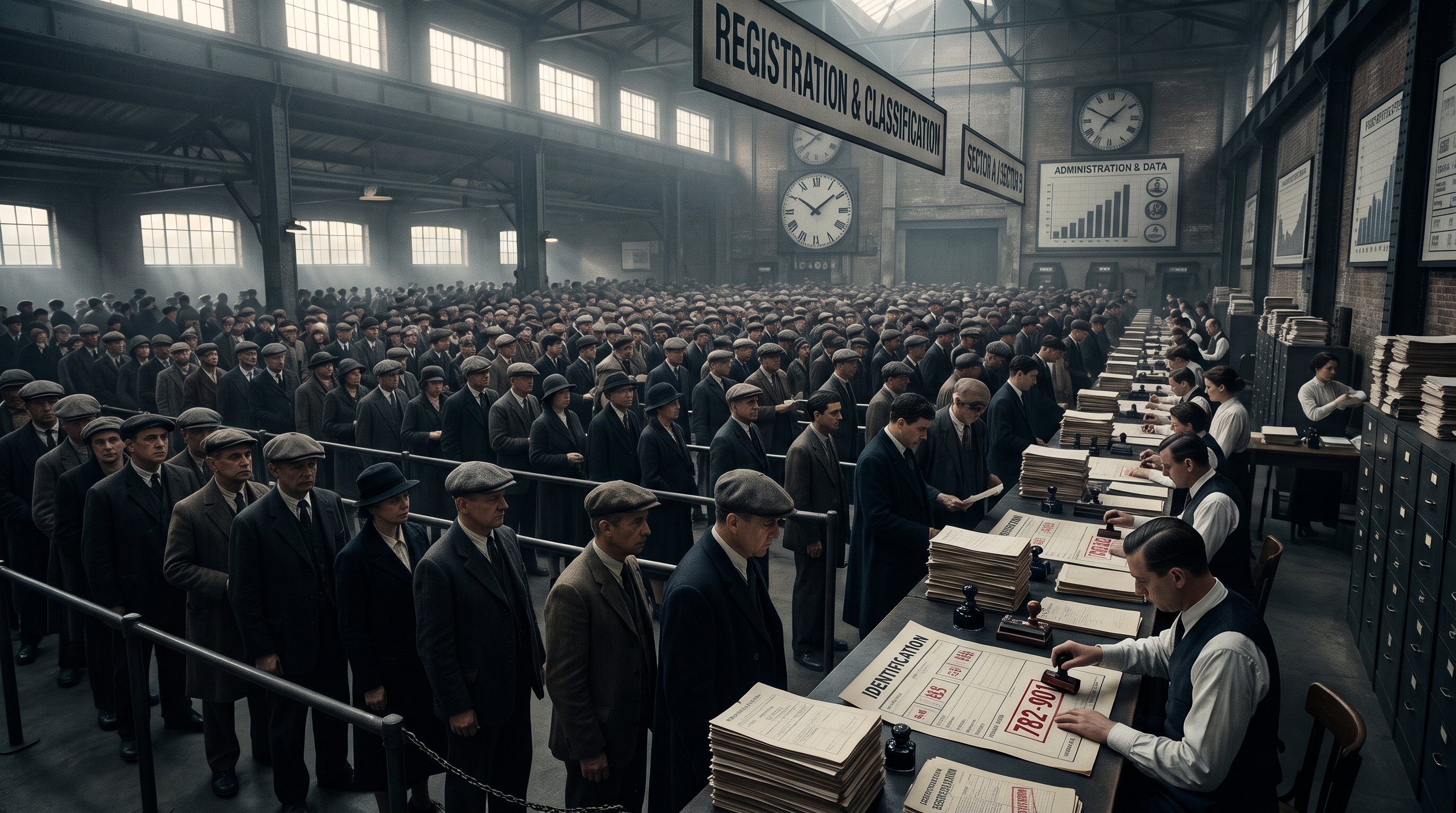
1. The Ecological Mind vs. The Bureaucratic Metric
For the vast majority of Homo sapiens evolutionary history, human cognition was pluralistic, situational, and inextricably intertwined with physical environments and living social networks.[1:2]
Within ancestral hunter-gatherer bands, survival demanded a kaleidoscope of embodied, non-linear competencies:[1:3]
- Reading micro-variations in barometric pressure, wind direction, and floral phenology.
- Decoding fragmented animal spoor across fractured geological substrates.
- Mastering biomechanical crafts such as flint-knapping, hide-tanning, and weaving watertight vessels.
- Navigating delicate kinship networks, resolving interpersonal grievances, and regulating the affective states of infants.
- Retaining expansive oral cartographies spanning hundreds of square kilometers.
As demonstrated by evolutionary psychology and Theory of Mind - The Cognitive Architecture of Social Intelligence, these adaptive capacities were situational, reciprocal, and collective. None of these cognitive faculties can be manifested in a sterile room using a Number 2 pencil under a three-hour countdown clock.
Historical Trajectory of Cognitive Legibility Regimes
| Epoch & Paradigm | Primary Operational Medium | Epistemic Substrate & Assessment Mechanism | Institutional Purpose |
|---|---|---|---|
| Ecological / Ancestral (Pre-Industrial) | Embodied, contextual action in physical space | Continuous communal observation, real-world survival performance, tangible craft apprenticeship. | Tribal resilience, ecological adaptation, egalitarian group cohesion. |
| Clinical Diagnostic (Binet 1905) | One-on-one pedagogical clinical interview | 30 qualitative diagnostic tasks of increasing complexity; flexible, individualized evaluation. | Identifying developmental delays to provide targeted remedial "mental orthopaedics." |
| Mass Military Sorting (Yerkes 1917) | Standardized paper-and-pencil bubble sheets | Timed group examinations (Army Alpha/Beta) scored via cut-out stencils; multiple-choice speed. | Rapid hierarchical sorting of 1.75 million recruits into officers vs. cannon fodder. |
| Collegiate Gatekeeping (Brigham 1926) | Mass psychometric examination (SAT) | Standardized scholastic aptitude percentiles; IBM 805 electrical mark-scoring automation. | Engineering a technocratic "meritocracy" to allocate elite educational and corporate credentials. |
| Algorithmic EdTech (21st Century) | Continuous digital surveillance & telemetry | Real-time keystroke latency, adaptive LMS tracking, predictive cognitive dashboards. | Continuous behavioral capture, automated credentialing, and cognitive optimization. |
The High-Modernist Bottleneck: The Demand for Legibility
The rise of late nineteenth- and early twentieth-century industrial nation-states, mass conscript militaries, and continental corporations generated an unprecedented administrative crisis: the bottleneck of scale.[2:2][4:1]
Pre-industrial institutions operated within localized communities where individual reputations were known firsthand through face-to-face social memory (as explored in The Consumer Credit Score - Quantifying the Soul and Dunbar's Number - The Rule of 150):[6]
- A master artisan personally selected an apprentice after months of direct observation.
- A village militia leader appointed lieutenants based on recognized bravery and social standing.
- A local academy headmaster evaluated candidates through personal correspondence and classical rhetorical dialogue.
Mass industrialization obliterated this intimate scale.[2:3] Central ministries, corporate monopolies, and military general staffs suddenly confronted millions of anonymous, mobile citizens who needed to be sorted instantaneously into specialized niches: assembly line tenders, clerical stenographers, battlefield officers, and bureaucratic administrators.[2:4][4:2]
To make heterogeneous human minds legible to distant planners, bureaucracy required an instrument that could strip away local ecological context, flatten idiosyncratic qualitative nuances, and compress the multidimensional human sensorium into a single, standardized number.[2:5]
In Seeing Like a State, political scientist James C. Scott defines "legibility" as the foundational process by which modern states simplify complex, organic, and vernacular social realities into standardized, quantifiable units that can be surveyed, aggregated, and manipulated from afar.[2:6]
Just as state foresters in eighteenth-century Prussia cleared biodiverse old-growth forests to plant uniform grids of standardized spruce trees (Normalbäume) to maximize timber yields, twentieth-century psychometricians cleared the rich, vernacular landscape of human cognition to cultivate standardized, test-responsive minds.[2:7] Standardized testing represents the ultimate application of high-modernist state legibility to the human nervous system.
2. 1905: Alfred Binet and the Diagnostic Baseline
The scientific instrument that catalyzed modern psychometrics was explicitly engineered to prevent the very reductionism it later inaugurated.[3:1]
In 1904, following the implementation of mandatory primary education laws, the French Ministry of Public Instruction commissioned psychologist Alfred Binet and physician Théodore Simon to develop an empirical method for identifying children whose cognitive development was lagging behind the standard curriculum, so they could receive specialized pedagogical assistance.[3:2]
Key Features of the Binet-Simon Scale (1905)
- Pragmatic Diagnostic Purpose: Published in 1905, the Binet-Simon scale comprised 30 discrete tasks arranged in order of ascending difficulty.[3:3] Tasks ranged from basic sensorimotor coordination (tracking a lit candle with the eyes, shaking hands) to higher-order verbal abstractions (distinguishing between abstract nouns, rhyming words, constructing sentences from three given words).[3:4] It was designed strictly as an individualized clinical triage tool, not an ontological taxonomy.[3:5]
- Rejection of Biological Determinism: Binet vehemently opposed the notion that his scale measured a fixed, immutable biological quantity called "general intelligence" (
).[3:6][7] He maintained that human intellectual capacities are plastic, malleable, and fundamentally multidimensional:[7:1]
"Some recent philosophers seem to have given their moral approval to the deplorable verdict that the intelligence of an individual is a fixed quantity, a quantity which cannot be augmented. We must protest and react against this brutal pessimism... With practice, training, and above all, method, we manage to increase our attention, our memory, our judgment, and to become literally more intelligent than before."[7:2]
- Mental Orthopaedics (Orthopédie mentale): Instead of using test scores to brand, segregate, or discard struggling children, Binet created "mental orthopaedics"—a curriculum of physical coordination drills, sensory exercises, and cognitive games designed to cultivate attention span, willpower, and intellectual stamina in struggling students.[3:7][7:3] For Binet, a low score was not a life sentence; it was an urgent invitation for compensatory pedagogical intervention.[3:8]
- Non-Linear Incommensurability: Binet explicitly warned that mental qualities are non-linear and incommensurable: "The scale, properly speaking, does not permit the measure of the intelligence, because intellectual qualities are not superposable, and therefore cannot be measured as linear surfaces are measured."[7:4] He refused to calculate a unitary scalar number or rank healthy children against one another.[3:9]
3. The American Reification: Military Sorting and Psychometric Industrialization
When Binet’s clinical diagnostic scale crossed the Atlantic, American psychologists operating within the ideological framework of social Darwinism, eugenics, and industrial Taylorism fundamentally inverted its ethical and scientific foundations.[4:3][8]
Lewis Terman and the Invention of "IQ"
In 1912, German psychologist William Stern proposed dividing a child's "mental age" (determined by test performance) by their "chronological age" to establish a mathematical ratio.[8:1]
At Stanford University, psychologist and active eugenicist Lewis Terman embraced Stern's ratio, multiplied it by 100 to eliminate decimals, and christened the resulting integer the "Intelligence Quotient" (IQ) in his landmark 1916 revision, the Stanford-Binet Intelligence Scale.[8:2]
In doing so, Terman executed a profound epistemological leap: he took an administrative ratio and reified it into a physical, hereditary essence resident in human germplasm.[4:4][8:3] Terman argued that an individual's IQ score was fixed at conception, remained essentially constant across the lifespan, and set an insurmountable biological ceiling on academic and socioeconomic achievement.[8:4]
1917: Robert Yerkes and the Mass Military Laboratory
The entry of the United States into World War I provided American psychometricians with the ultimate high-modernist laboratory.[9] APA President Robert Yerkes assembled a committee of psychologists—including Lewis Terman and Henry Goddard—to persuade the U.S. War Department that psychometric testing could streamline military mobilization.[9:1]
Yerkes engineered two mass, group-administered examinations:[9:2]
- The Army Alpha: A written, eight-part multiple-choice test evaluating verbal reasoning, arithmetic, analogies, and practical judgment, administered to literate recruits.[9:3]
- The Army Beta: A non-verbal, pictorial test utilizing pantomime instructions, mazes, and symbol-matching tasks, designed for illiterate recruits and recent non-English-speaking immigrants.[9:4]
Between 1917 and 1918, Yerkes’s team administered the Army Alpha and Beta to 1.75 million soldiers.[9:5] This operation represented the historical turning point in the technology of evaluation:[4:5][9:6]
- From Dialogue to Assembly Line: The clinical, one-on-one interview perfected by Binet was replaced by hundreds of recruits packed into drafty barracks, clutching pencils, and responding to standardized commands shouted by stopwatch-wielding proctors.[4:6][9:7]
- The Stencil and Template: Exams were graded instantly by low-skilled clerks using perforated cardboard stencils, proving to corporate executives and state bureaucrats that human minds could be sorted as cheaply, mechanically, and objectively as industrial ball bearings—operating like clockwork.[9:8]
- Legitimizing Eugenic Hierarchies: The deeply flawed Army test data—which reflected formal schooling, English fluency, and familiarity with American cultural artifacts rather than native wit—was weaponized by Yerkes, Goddard, and Carl Brigham to argue that the average mental age of American adults was a dismal 13.08 years, and that non-Nordic immigrants from Southern and Eastern Europe were genetically inferior.[4:7][10] This pseudo-scientific data directly provided the intellectual justification for the racially restrictive Immigration Act of 1924 (Johnson-Reed Act).[4:8]
4. 1926: Carl Brigham and the Birth of the SAT
The administrative apparatus perfected in the military cantonments of World War I migrated immediately into civilian educational institutions.[4:9] Among Yerkes’s chief psychometric analysts was Princeton psychology professor Carl Campbell Brigham, whose 1923 book, A Study of American Intelligence, popularized the Army test results and issued apocalyptic warnings regarding the genetic deterioration of the American intellectual pool.[10:1]
The 1926 Scholastic Aptitude Test
Recognizing the administrative power of Brigham’s work, the College Entrance Examination Board (CEEB) appointed him chairman of a committee tasked with creating a uniform, national admissions examination for American higher education.[4:10]
On June 23, 1926, Brigham’s new instrument—the Scholastic Aptitude Test (SAT)—was administered to 8,040 high school seniors.[4:11] The inaugural exam was an adaptation of the Army Alpha, consisting of 315 questions divided across nine speeded subtests: definitions, arithmetic, classification, artificial language, antonyms, number series, analogies, logical inference, and paragraph reading, all compressed into 97 minutes of stopwatch time.[4:12]
Brigham’s Forgotten Recantation
In a historical turn that mirrors Alfred Binet’s early warnings, the architect of the SAT experienced a profound intellectual crisis.[4:13]
By the late 1920s, after conducting rigorous psychometric research on language acquisition and cultural bias, Brigham realized that his earlier eugenicist assertions were scientifically bankrupt.[4:14][11] In 1930, he published a landmark retraction in Psychological Review titled Intelligence Tests of Immigrant Groups, explicitly renouncing his 1923 book:[11:1]
"This study has led to the conclusion that no available intelligence test measures pure native intelligence separate from the cultural, educational, and linguistic background of the test-taker... Comparative studies of various national and racial groups may not be made with existing tests... The writer hopes that this confession of error will help to clear away some of the confusion that has surrounded the subject."[11:2]
Before his death in 1943, Brigham turned fiercely against the very testing empire he had helped construct.[4:15] He warned that the College Board's plan to establish a centralized, monolithic national testing agency would stifle educational innovation, corrupt curricula, and convert teachers and students into anxious servants of the test.[4:16]
He resigned from the College Board, cautioning that a standardized psychometric score was a hazardous abstraction that would blind universities to the genuine, idiosyncratic qualities of human character and creative intellect.[4:17]
Conant, Chauncey, and the Machine-Graded Meritocracy
Brigham’s warnings went unheeded.[4:18] In the mid-1930s, Harvard University President James Bryant Conant sought a mechanism to dismantle the hereditary oligarchy of elite Northeastern prep school graduates dominating Harvard's undergraduate student body.[4:19]
Conant envisioned a "natural aristocracy of talent"—a technocratic elite recruited from across all geographic regions and social classes based purely on intellectual capability.[4:20] Together with his assistant dean, Henry Chauncey, Conant adopted the SAT as the objective sorting tool to identify high-aptitude scholarship candidates from public schools.[4:21]
The technocratic project achieved global hegemony through technological automation:[4:22][12]
- The IBM 805 Test Scoring Machine (1937): Developed by engineer Reynold B. Johnson, the IBM 805 utilized electrical conductivity across soft graphite pencil marks (the iconic Number 2 pencil) to grade bubble sheets automatically at a rate of 800 sheets per hour.[12:1]
- The Educational Testing Service (ETS): In 1947, Conant and Chauncey orchestrated the merger of the College Board's testing operations with those of the Carnegie Foundation and the American Council on Education to form ETS in Princeton, New Jersey.[4:23]
Equipped with IBM scoring mainframes, ETS industrialized human evaluation, cementing the standardized multiple-choice percentile as the indisputable gatekeeper to higher education, professional licenses, and corporate employment.[4:24]
5. The Domestication of Childhood and Evolutionary Mismatch
Once industrial nation-states, universities, and corporate hierarchies established psychometric percentiles as the prerequisite for socioeconomic survival, the developmental ecology of human juvenile life was radically re-engineered.[1:4][5:1]
In his evolutionary anthropology of education, Free to Learn, psychologist Peter Gray demonstrates that human childhood evolved across hundreds of thousands of years to function within an open, autonomous developmental niche.[1:5] The modern industrial schoolhouse inverted every dimension of this ancestral matrix, creating an acute evolutionary mismatch.[1:6][5:2]
Dimensions of Developmental Inversion
| Developmental Dimension | Ancestral / Evolutionary Developmental Niche | The Standardized Industrial Schoolhouse |
|---|---|---|
| Physical Mobility & Somatic State | Continuous outdoor physical movement; climbing, running, and fine-motor exploratory crafting. | Somatic Immobilization: Enforced sedentary confinement in rows under artificial lighting for 6–8 hours daily. |
| Social Architecture & Age Grouping | Mixed-age peer play groups; natural scaffolding from younger to older children. | Chronological Batching: Strict segregation by manufacture date (birth year); zero-sum ranking against peers. |
| Epistemic Modality | Self-directed play, trial-and-error curiosity, observational mimicry, and tangible feedback. | Standardized Ingestion: Passive reception of pre-packaged curricula; memorization of decontextualized symbols. |
| Cognitive Orientation | Divergent problem-solving, situational improvisation, and holistic ecological awareness. | Convergent Optical Reading: Rapid, speeded pattern recognition; optimizing for solitary, multiple-choice options. |
| Motivational Engine | Intrinsic curiosity, communal belonging, and direct survival relevance. | Extrinsic Fear & Rank: Psychometric test anxiety, letter grades, class ranks, and institutional tracking. |
The Three Pathologies of the Testing Enclosure
- Somatic Immobilization and Chemical Normalization: During the developmental window characterized by peak neuroplasticity and muscular energy, children are forced to suppress physical movement, sitting motionless at bolted desks.[1:7] Biological restlessness—an entirely adaptive mammalian impulse—is pathologized as a clinical deficit, requiring pharmacological normalization (such as widespread stimulant regimens for ADHD) to force active bodies to endure sedentary psychometric training.[1:8][5:3]
- Cognitive Narrowing to Optical Mark Reading: Divergent curiosity, kinesthetic artistry, social diplomacy, and mechanical intuition are systematically marginalized because they cannot be graded by an optical scanner.[4:25] The curriculum is hollowed out to focus on test-taking mechanics: pacing strategies, process of elimination, and convergent symbol manipulation.[4:26] Developing brains are conditioned to operate like biological optical mark readers, executing subroutines on command.[5:4]
- The Meritocracy Trap and Psychological Demoralization: When an administrative metric is conflated with intrinsic human capability, institutional sorting inflicts severe psychological trauma.[13]
British sociologist Michael Young coined the term "meritocracy" in his 1958 satirical dystopian critique, The Rise of the Meritocracy.[13:1] Young warned that a society that sorts its citizens strictly by "IQ plus effort" creates the most arrogant and cruel ruling class in human history:[13:2]
- In an aristocracy, the wealthy realize their position is the result of birth and luck, while the poor understand their subordination is due to historical circumstance rather than personal inadequacy.[13:3]
- In a meritocracy, the elite believe they deserve their privilege because they scored in the 99th percentile, while the working class is told that their low socioeconomic station is the scientifically validated consequence of their own biological and cognitive inferiority.[4:27][13:4] Standardized testing transforms political and economic inequality into an immutable, self-inflicted personal defect.[13:5]
6. Sociological and Epistemological Paradigms of Cognitive Metricization
The standardization of human cognition can only be fully understood by synthesizing classical sociological theory, media ecology, and cognitive neuroscience.[2:8][5:5][14]
Sociological & Epistemological Frameworks of Cognitive Quantification
| Sociologist / Philosopher | Core Theoretical Framework | Diagnostic Application to Psychometrics & Testing | Core Vault Resonance |
|---|---|---|---|
| James C. Scott | Seeing Like a State / High Modernism | Tests strip local, ecological cognitive context to create administrative "legibility" for distant state and industrial planners. | Seeing Like a State (1998) / The Consumer Credit Score - Quantifying the Soul |
| Michel Foucault | Disciplinary Power & The Examination | Standardized testing operates as the supreme "examination," combining surveillance, hierarchical ranking, and normalizing judgment. | Michel Foucault / Discipline and Punish (1975) |
| Max Weber (1864-1920) | Formal Rationalization (Zweckrationalität) | The bureaucratic eradication of human idiosyncrasy, intuitive judgment, and narrative wisdom in favor of cold, calculable scoring templates. | Max Weber (1864-1920) / Disenchantment (Entzauberung) |
| Georg Lukács | Reification (Verdinglichung) | Fluid, situational cognitive processes are transformed into a reified commodity: an immutable, objective number ("IQ") owned by the subject. | Georg Lukács's formulation of reification (Verdinglichung) in History and Class Consciousness (1923) |
| Georg Simmel (1858-1918) | Monetary Abstraction & Objective Culture | Just as money reduces qualitative goods to a single quantitative metric (price), psychometrics reduces diverse human minds to a single scalar percentile. | The Philosophy of Money (Philosophie des Geldes) / Simmel and the Attention Economy — Abstraction, Alienation, and Cognitive Capture |
| Gilles Deleuze | Postscript on the Societies of Control | The student is no longer an enclosed physical individual, but a numerical code: a Dividual defined by percentile distributions and test data streams. | Postscript on the Societies of Control / Dividual |
| Iain McGilchrist | Hemispheric Asymmetry & The Divided Brain | Standardized testing represents the absolute victory of the left hemisphere (decontextualized, speeded, linear symbol manipulation) over the right hemisphere (embodied, relational context). | Iain McGilchrist / The Master and His Emissary |
| Zygmunt Bauman | Liquid Modernity & Compulsory Individualization | Shifts structural failures of underfunded public education onto the isolated child, who internalizes low test scores as personal moral guilt. | Zygmunt Bauman's sociological framework of Liquid Modernity |
Foucault: The Examination as Disciplinary Power
In Discipline and Punish, Michel Foucault demonstrated that modern disciplinary power relies on the examination (l'examen).[14:1] The examination combines the techniques of an observing hierarchy and those of a normalizing judgment, establishing over individuals a visibility through which one differentiates them and judges them.[14:2]
Standardized testing functions as the purest manifestation of Foucauldian disciplinary technique:[14:3]
- The Ritual of Compulsory Visibility: The student is placed in an open, brightly lit hall, immobilized, and forced to manifest their internal mental contents onto paper.[14:4] Power operates not by being seen (like a monarch on a throne), but by making its subjects relentlessly visible and evaluable.[14:5]
- Normalizing Judgment and the Curve: By mapping millions of test scores across a Gaussian normal distribution (the bell curve), psychometrics invents the concept of the "normal" mind.[8:5][14:6] Any divergence from the statistical mean is instantly coded as a pathology, deficiency, or subnormality requiring disciplinary correction or institutional segregation.[14:7]
- The Individual as a Case Dossier: Standardized scores convert living human beings into documentary cases.[14:8] A child is cataloged, tracked across databases, and permanently fixed within an institutional transcript, transforming subjective consciousness into an extractable, manipulable archive.[14:9]
Deleuze: The Shift from School Enclosure to Dividual Control
While Foucault analyzed the nineteenth-century physical schoolhouse as a disciplinary enclosure, Gilles Deleuze diagnosed its late twentieth- and twenty-first-century mutation in Postscript on the Societies of Control.[15]
Deleuze observed that disciplinary societies moved individuals through enclosed, discontinuous sites: from the family to the school, from the school to the barracks, from the barracks to the factory floor.[15:1] In control societies, physical enclosures are superseded by open, continuous, and floating modulation:[15:2]
- The Dividual: The student is no longer a holistic, sovereign individual; they are decomposed into a cluster of trackable data points: composite score, math sub-percentile, reading fluency index, and GPA trajectory.[15:3] The university admissions committee or corporate hiring algorithm does not interact with the biological student; it evaluates the "data double" constructed by the testing apparatus.[15:4]
- Continuous Evaluation: The standardized test is no longer a terminal event marking graduation; it has evolved into a continuous condition of modern existence.[15:5] From elementary reading metrics to college admissions, from professional board certifications to corporate performance KPIs, the modern human subject navigates society on autopilot, trapped in perpetual, lifelong re-testing.[15:6]
McGilchrist: The Hemispheric Coup
In The Master and His Emissary, psychiatrist Iain McGilchrist provides the neurocognitive foundation for this civilizational mutation.[16]
The human brain relies on two radically distinct, complementary modes of attending to reality:[16:1]
- The Right Hemisphere: Processes experience in its holistic, embodied, relational, and contextual reality. It perceives depth, metaphor, living ambiguity, and the open background of existence.[16:2]
- The Left Hemisphere: Isolates fragments from context, manipulating decontextualized, static symbols with narrow, pinpoint, and utilitarian focus. It prioritizes speed, mechanical sorting, linear rules, and binary categorization.[16:3]
Standardized testing enacts what McGilchrist calls the triumph of the left hemisphere:[16:4]
- The testing regime violently penalizes right-hemisphere cognitive modes: nuance, interpretive ambiguity, holistic perspective, and creative divergent thinking are systematically weeded out.[16:5]
- The test rewards purely left-hemisphere mechanics: rapid symbol matching, mechanical rule-following, and selecting a single pre-determined answer from a closed set of four options.[16:6]
By conditioning human children across decades to prioritize the left hemisphere’s decontextualized map over the right hemisphere’s living territory, industrial society has engineered an educational apparatus that systematically atrophies the cognitive, empathetic, and imaginative capacities required to navigate systemic ecological and cultural crises.[16:7]
The modern standardized test is thus revealed not as an innocent, objective measure of human potential, but as a high-modernist disciplinary machine operating in plain sight, cutting our children from the same cloth and reducing the boundless mystery of human consciousness to a calculable, standardized, and domesticated integer.[2:9][4:28][13:6]
🎴 Interactive Web Practice (Comprehension Check)
Question 1 (High Modernism & State Legibility): How does James C. Scott's concept of "legibility" in Seeing Like a State explain why modern industrial bureaucracies replaced contextual, local evaluations with standardized psychometric testing?
Answer: In Seeing Like a State, James C. Scott defines legibility as the administrative process through which centralized states simplify complex, organic, and vernacular social realities into standardized, uniform units that can be monitored, compared, and managed from a central authority.
Prior to the twentieth century, human competence was judged through face-to-face, contextual interaction: a master observed an apprentice's tangible craft, or a community evaluated a neighbor's character over years of shared life. However, when mass industrial empires, continental corporations, and conscript militaries faced millions of mobile, anonymous citizens, this localized evaluation model created an administrative bottleneck. Bureaucracies could not conduct long-term personal interviews with millions of recruits.
To make human minds legible to central planners, the state required an instrument that could strip away local, cultural, and ecological context, flattening cognitive diversity into a single scalar number. Standardized psychometric testing (such as the Army Alpha or the SAT) allowed distant bureaucracies to rank, categorize, and sort vast human populations into factory floors, military ranks, and university halls with maximum administrative speed and low transaction costs.
Question 2 (The American Reification vs. Binet's Diagnostic): In what ways did American psychometricians (Terman, Yerkes, Brigham) invert the original purpose and philosophical tenets of Alfred Binet's 1905 diagnostic scale?
Answer: Alfred Binet developed his 1905 scale strictly as a pragmatic, individualized clinical diagnostic tool to identify Parisian schoolchildren who were struggling in standard classrooms, so they could receive remedial pedagogical assistance ("mental orthopaedics"). Binet vehemently rejected biological determinism, insisting that intelligence is not a single, fixed, immutable quantity, that intellectual qualities are non-linear and incommensurable, and that his scale should never be used to rank normal children or assign an absolute value to human intellect.
American psychologists inverted every core tenet of Binet's work:
1. Reification of IQ: Lewis Terman and William Stern transformed a clinical ratio into a single integer ("IQ") and treated it as an immutable, genetically determined biological property located in the physical brain that dictates an individual's lifelong socioeconomic ceiling.
2. From Remediation to Exclusion: Rather than using tests to provide compensatory education, American hereditarians used tests to justify segregation, denial of educational access, forced sterilization, and the restrictive racial quotas of the 1924 Immigration Act.
3. From Clinical Dialogue to Mass Mechanization: Robert Yerkes (Army Alpha/Beta) and Carl Brigham (SAT) transformed individualized clinical interviews into mass, speeded paper-and-pencil bubble exams graded via stencils and automated electrical scoring machines (IBM 805), establishing testing as an industrial gatekeeping technology.
Question 3 (Foucault, Deleuze, and Childhood Domestication): How do Michel Foucault's analysis of \"the examination\" and Gilles Deleuze's concept of \"societies of control\" illuminate the psychological and developmental impacts of standardized testing on children?
Answer: Michel Foucault's analysis of disciplinary power in Discipline and Punish identifies the examination as an apparatus of surveillance and normalizing judgment. Standardized testing operates as the supreme examination: it confines children to physical desk rows, renders their minds compulsory visible through test forms, and maps their scores across a bell curve, creating the statistical fiction of the \"normal\" mind while pathologizing deviations. This enforces somatic immobilization, requiring active, plastic mammalian bodies to suppress physical movement under threat of academic failure or pharmacological normalization.
Gilles Deleuze's Postscript on the Societies of Control extends this analysis from physical schoolhouse enclosures to continuous digital modulation. In the control society, the student is transformed into a dividual—fractured into percentile streams, GPA figures, and test data points. Modern testing ceases to be a single graduation rite and becomes an endless, lifelong condition of compliance, where citizens navigate life on autopilot, continually optimizing their performance for opaque algorithmic filters.
Furthermore, as Michael Young diagnosed in The Rise of the Meritocracy, this system creates severe psychological demoralization: because the score is coated in scientific objectivity, children who fail to achieve high percentiles internalize systemic and socioeconomic disadvantages as proof of their own inherent, biological cognitive inferiority.
Resonant Notes
The following notes in the vault share direct thematic, sociological, and cognitive connections with The Metricization of Mind, Psychometrics, and State Legibility:
🔴 High Modernism, State Legibility & Bureaucratic Control
- The Standardization of Suffering — The DSM (1952), Intersubjective Consensus, and the Looping Effects of Psychiatric Classification — Companion historical study analyzing how postwar military administration, census tracking, and health insurance reimbursement transformed fluid human suffering into standardized diagnostic checklists and alphanumeric billing codes, operating as an identical high-modernist sorting apparatus.
- The Industrialization of Inquiry — The Science Citation Index (1960), Bibliometric Surveillance, and the Commodification of Truth — Companion historical study analyzing how postwar "Big Science" and bibliometric surveillance (SCI, JIF, and the
-index) flattened qualitative inquiry into scalar citation velocity, domesticating researchers through Goodhart's Law. - The Freeze-Drying of Language — The Dictionary (1755), Prescriptive Grammar, and the Social Stratification of Speech — Companion historical study analyzing how eighteenth-century dictionaries and prescriptive grammar standardized fluid oral vernaculars into a rigid statutory code, operating as an identical high-modernist apparatus of state legibility and class gatekeeping.
- The Consumer Credit Score - Quantifying the Soul — Companion historical study analyzing how Fair, Isaac and Company standardized human moral trust and creditworthiness into an abstract, three-digit metric (FICO 300–850), operating as an identical high-modernist apparatus of state legibility and algorithmic stratification.
- The Enclosure of the Intangible Commons — Intellectual Property, Artificial Scarcity, and the Colonization of Knowledge — Companion historical inquiry examining how Renaissance and Enlightenment jurists constructed artificial scarcity around non-rivalrous ideas, turning communal knowledge into proprietary state and corporate monopolies.
- Nocturnalization - The Industrialization of Light — Companion historical inquiry into how artificial lighting grids and factory time-discipline industrialized night, conquering biological rhythms alongside the intellectual standardization of schooling.
- The Specular Revolution - Optics, Interiority, and the Modern Self — Companion historical analysis tracing how Venetian optical mirrors and early modern self-surveillance engineered the bounded, introspective ego that was subsequently cataloged by psychometrics.
- Michel Foucault — Disciplinary power, panopticism, and the examination apparatus demonstrate how nineteenth-century schools, barracks, and factories surveyed the human body and normalized behavior through documentary records.
- Max Weber (1864-1920) — Weber's concepts of formal rationalization (Zweckrationalität), the bureaucratic division of labor, and the "iron cage" explain why industrial capitalism demands the replacement of qualitative wisdom by calculable testing mechanisms.
- Durkheimian Sociology & Durkheimian Sociology and Reified Gestalt — Émile Durkheim’s analysis of mechanical versus organic solidarity highlights the pre-industrial social matrix that once anchored communal belonging before bureaucratic standardization took hold.
🟡 Reification, Cognitive Epistemology & Hemispheric Imbalance
- Georg Lukács's formulation of reification (Verdinglichung) in History and Class Consciousness (1923) — Lukács's diagnosis of reification explains how dynamic, living cognitive and creative processes were alienated from human subjects and transformed into the "phantom objectivity" of an immutable commodity metric: "IQ."
- The Philosophy of Money (Philosophie des Geldes) & Georg Simmel (1858-1918) — Simmel's critique of monetary abstraction demonstrates how quantitative money reduces qualitative human individuality into a single scalar number, serving as the structural blueprint for psychometric scorecards.
- Simmel and the Attention Economy — Abstraction, Alienation, and Cognitive Capture — Extends Simmelian abstraction to contemporary digital platform metrics, illustrating how psychometric percentiles prefigured the conversion of consciousness into engagement data.
- Iain McGilchrist — McGilchrist's divided-brain thesis explains how standardized multiple-choice testing enshrines the left hemisphere's decontextualized, speeded symbol manipulation while actively atrophying the right hemisphere's capacity for embodied, relational, and holistic insight.
- Cognitive Schemas & Cognitive Load Theory — Investigates how human cognitive architectures organize information, contrasting natural ecological schemas with the artificial, high-load constraints of speeded psychometric examinations.
- The Social Construction of Reality - A Treatise in the Sociology of Knowledge — Berger and Luckmann's analysis of institutionalization and legitimation shows how an arbitrary social construct (the 1926 SAT) solidified into an indisputable, objective natural fact of human reality.
🟢 Evolutionary Mismatch, Surveillance & Social Sorting
- The Cuckoo in the Stroller - Evolutionary Co-optation and Modern Companion Animals — Companion study examining evolutionary mismatch and the co-optation of ancestral mammalian drives under modern industrial and urban enclosures.
- Postscript on the Societies of Control & Gilles Deleuze — Deleuze's formulation of the control society, floating modulations, and the mutation of the individual into the "dividual" illuminates how standardized test scores precede and govern human life chances.
- Dividual — Explores the philosophical and political dismantling of the unified human subject into fragmented, trackable data streams and test percentiles.
- Zygmunt Bauman's sociological framework of Liquid Modernity — Bauman's analysis of compulsory individualization and precarious meritocracy illustrates how testing regimes compel children to internalize structural educational inequalities as personal genetic inadequacy.
- Dunbar's Number - The Rule of 150 — Anthropological and evolutionary limit of face-to-face social memory, explaining why the demographic explosion of the industrial city required states to engineer impersonal psychometric proxies for talent.
- Theory of Mind - The Cognitive Architecture of Social Intelligence — Documents the complex, multidimensional, and interpersonal evolutionary capacities of the human mind that are completely invisible to standardized paper-and-pencil bubble tests.
- Aldous Huxley's Brave New World (1932) — Huxley's dystopian caste hierarchy (Alphas, Betas, Gammas, Deltas, Epsilons) sorted by biological conditioning prophesied the technocratic meritocracy engineered by twentieth-century psychometricians.
- cog-in-the-machine — Applied metaphoric expression capturing how standardized testing domesticates children to function as interchangeable components within an industrial megamachine.
- like-clockwork — Applied metaphoric expression describing the speeded, mechanical precision of template-graded testing assembly lines.
- in-plain-sight — Applied metaphoric expression characterizing how the high-modernist transformation of human childhood operates invisibly within everyday public institutions.
- cut-from-the-same-cloth — Applied metaphoric expression demonstrating that standardized testing and high-modernist curricula cut diverse developing minds from the same institutional cloth.
- on-autopilot — Applied metaphoric expression depicting how students and workers navigate lifelong testing and credentialing on autopilot without questioning its human cost.
References
Peter Gray / Free to Learn: Why Unleashing the Instinct to Play Will Make Our Children Happier, More Self-Reliant, and Better Students for Life / Basic Books ↩︎ ↩︎ ↩︎ ↩︎ ↩︎ ↩︎ ↩︎ ↩︎ ↩︎
James C. Scott / Seeing Like a State: How Certain Schemes to Improve the Human Condition Have Failed / Yale University Press ↩︎ ↩︎ ↩︎ ↩︎ ↩︎ ↩︎ ↩︎ ↩︎ ↩︎ ↩︎
Alfred Binet and Théodore Simon / Méthodes nouvelles pour le diagnostic du niveau intellectuel des anormaux / L'Année Psychologique, Vol. 11 (1904), pp. 191–244 / Persée ↩︎ ↩︎ ↩︎ ↩︎ ↩︎ ↩︎ ↩︎ ↩︎ ↩︎ ↩︎
Nicholas Lemann / The Big Test: The Secret History of the American Meritocracy / Farrar, Straus and Giroux ↩︎ ↩︎ ↩︎ ↩︎ ↩︎ ↩︎ ↩︎ ↩︎ ↩︎ ↩︎ ↩︎ ↩︎ ↩︎ ↩︎ ↩︎ ↩︎ ↩︎ ↩︎ ↩︎ ↩︎ ↩︎ ↩︎ ↩︎ ↩︎ ↩︎ ↩︎ ↩︎ ↩︎ ↩︎
John Taylor Gatto / Dumbing Us Down: The Hidden Curriculum of Compulsory Schooling / New Society Publishers ↩︎ ↩︎ ↩︎ ↩︎ ↩︎ ↩︎
Bruce G. Carruthers and Wendy Nelson Espeland / Money, Meaning, and Morality / American Behavioral Scientist, Vol. 41, No. 10 (1998), pp. 1384–1408 / SAGE ↩︎
Alfred Binet / Les idées modernes sur les enfants / Ernest Flammarion, 1909 ↩︎ ↩︎ ↩︎ ↩︎ ↩︎
Stephen Jay Gould / The Mismeasure of Man / W. W. Norton & Company ↩︎ ↩︎ ↩︎ ↩︎ ↩︎ ↩︎
Daniel J. Kevles / Testing the Army's Intelligence: Psychologists and the Military in World War I / Journal of American History, Vol. 55, No. 3 (1968), pp. 565–581 / JSTOR ↩︎ ↩︎ ↩︎ ↩︎ ↩︎ ↩︎ ↩︎ ↩︎ ↩︎
Carl C. Brigham / A Study of American Intelligence / Princeton University Press, 1923 / Archive.org ↩︎ ↩︎
Carl C. Brigham / Intelligence Tests of Immigrant Groups / Psychological Review, Vol. 37, No. 2 (1930), pp. 158–165 / APA PsycNet ↩︎ ↩︎ ↩︎
IBM Archives / IBM 805 Test Scoring Machine / IBM History ↩︎ ↩︎
Michael Young / The Rise of the Meritocracy / Thames and Hudson, 1958 / Routledge ↩︎ ↩︎ ↩︎ ↩︎ ↩︎ ↩︎ ↩︎
Michel Foucault / Discipline and Punish: The Birth of the Prison (Surveiller et punir: Naissance de la prison, 1975) / Translated by Alan Sheridan / Vintage Books ↩︎ ↩︎ ↩︎ ↩︎ ↩︎ ↩︎ ↩︎ ↩︎ ↩︎ ↩︎
Gilles Deleuze / Postscript on the Societies of Control (Post-scriptum sur les sociétés de contrôle, 1990) / October, Vol. 59 (Winter 1992), pp. 3–7 / MIT Press ↩︎ ↩︎ ↩︎ ↩︎ ↩︎ ↩︎ ↩︎
Iain McGilchrist / The Master and His Emissary: The Divided Brain and the Making of the Western World / Yale University Press ↩︎ ↩︎ ↩︎ ↩︎ ↩︎ ↩︎ ↩︎ ↩︎